Operative Dentistry
Vanessa Cavalli(a)
Priscila Cristiane Suzy Liporoni(a) Marcos Augusto do Rego(a) Sandrine Bittencourt Berger(b) Marcelo Giannini(c)
(a)Department of Restorative Dentistry, School
of Dentistry, Univ de Taubaté - UNITAU, Taubaté, SP, Brazil.
(b)Department of Restorative Dentistry, School
of Dentistry, Univ Norte do Paraná - UNOPAR, Londrina, PR, Brazil.
(c)Department of Restorative Dentistry,
Piracicaba Dental School, Univ Estadual de Campinas - Unicamp, Piracicaba, SP, Brazil.
Operative Dentistry
Corresponding Author:
Vanessa Cavalli
E-mail: [email protected]
Influence of fluoride-containing
adhesives and bleaching agents on
enamel bond strength
Abstract: This study evaluated the inluence of luoride-containing carbamide peroxide (CP) bleaching agents and adhesive systems on bonded enamel interfaces that are part of the dynamic pH cycling and thermal cycling models. The buccal surfaces of 60 bovine incisors were restored with a composite resin and bonded with three- and two-step, etch-and-rinse, luoride-containing adhesives, Optibond FL (FL) and Optibond Solo Plus (SP), respectively. Restored teeth were subjected to thermal cycling to age the interface. Both SP and FL adhesive-restored teeth were bleached (n = 10) with 10% CP (CP) and 10% CP + luo-ride (CPF) or were left unbleached (control). Bleaching was performed for 14 days simultaneously with pH cycling, which comprised of 14 h of remineralization, 2 h of demineralization and 8 h of bleaching. The control groups (FL and SP) were stored in remineralizing solution during their bleaching periods and were also subjected to carious lesion forma-tion. Parallelepiped-shaped samples were obtained from the bonded in-terface for microtensile bond strength (µTBS) testing. The enamel µTBS of the FL and SP groups (control, not bleached) were higher (p < 0.05) than those of the bleached interfaces (FL > FL + CPF = FL + CP and SP > SP + CPF = SP + CP). The groups subjected to treatment with the luoride-containing bleaching agents exhibited similar µTBS compared to regular bleaching agents. Bleaching agents, regardless of whether they contained luoride, decreased enamel bond strength.
Descriptors: Bleaching Agents; Fluorides; Dental Enamel; Tooth Remineralization.
Introduction
The durability of an adhesive restoration is related to the integrity of the enamel/dentin interface. Marginal gaps in the restoration frequently lead to post-operative sensibility, marginal staining, and the development of pulp pathologies as a consequence of secondary carious lesions.1 The
development of secondary caries is similar to that of primary caries but differs according to the location and characteristics of the surface, such as roughness and marginal defects.2,3
Conventional three- and two-step etch-and-rinse adhesives can effec-tively seal the enamel interface.4 To prevent caries around the interface,
luoride has been added to some of these adhesives, thus allowing these agents to work as “luoride reservoirs” to avoid mineral loss by inhibiting Declaration of Interests: The authors
certify that they have no commercial or associative interest that represents a conflict of interest in connection with the manuscript.
Submitted: May 21, 2012
demineralization and enhancing remineralization.5
However, the ability of adhesives to release luo-ride at the interface has been evaluated under car-ies challenge conditions,6-8 so it is uncertain whether
the amount of luoride released at the restoration wall may be able to prevent or reverse the develop-ment of caries.8
In clinical situations, the adhesive interface is subjected not only to caries challenges but also to agents that compromise marginal integrity. Among these, carbamide peroxide bleaching emerges as a common esthetic procedure; however, several re-ports demonstrate its potential adverse effects on the enamel,9,10 particularly at the enamel-bonded
interface.11 The side effects of peroxides on enamel
include increased enamel porosity, pitting, erosion, demineralization of the periphery of enamel prisms and mineral loss promoted by the decrease in the inorganic content.9-12 To reverse the undesirable
ef-fects of bleaching, sodium luoride has been added to some of these agents.13,14 Fluoride-containing
bleaching agents may generate luoridated hydroxy-apatite and calcium luoride crystals on the enamel, which may accelerate the remineralization of the bleached enamel.15
To date, no study has reported the effects of lu-oride-containing bleaching agents at the interface of three- and two-step luoride-containing adhesive restorations. Therefore, this study aimed to evaluate the bond strength of the adhesive/enamel interface subjected to 10% carbamide peroxide (CP) agents with and without luoride (F-) using a dynamic pH cycling model.16 The null hypotheses tested were
that under caries challenge conditions, (1) no dif-ferences will be observed in enamel bond strengths between bleaching agents, with and without F-, and (2) no differences will be noted between the three- and two-step etch-and-rinse luoride-containing ad-hesives.
Methodology
Experimental designSixty bovine incisors were obtained after approv-al of the Ethicapprov-al Research Committee of Taubaté Dental School (protocol #0033/07), Unitau, Brazil, and randomly divided into six groups (n = 10)
ac-cording to the following factors:
1. adhesive systems: Optibond FL (FL) and Opti-bond Solo Plus (SP) (three- and two-step, etch-and-rinse adhesives, respectively, Kerr, Danbury, USA) and
2. bleaching treatment: without bleaching, bleach-ing with 10% CP (CP) or 10% CP with F-(CPF) (Opalescence, Ultradent Products, South Jordan, USA).
The factors and levels were arranged as follows: 1. (FL): Optibond FL without bleaching - control 2. (FL + CPF): Optibond FL and 10% CP bleaching
with F
-3. (FL + CP): Optibond FL and 10% CP bleaching without F
-4. (SP): Optibond SP without bleaching - control 5. (SP + CPF): Optibond SP and 10% CP bleaching
with F
-6. (SP + CP): Optibond SP and 10% CP bleaching without F
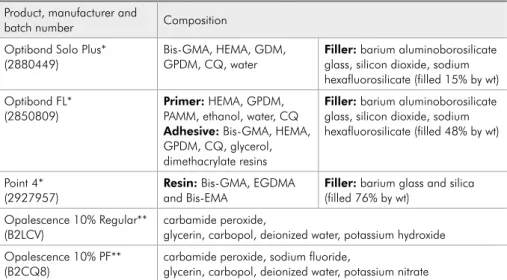
-Treatment consisted of bonding with FL or SP and bleaching treatment associated with a pH cy-cling model. After treatment, enamel bonding was evaluated by means of the µTBS, and the interface was analyzed based on the fracture failure modes. Table 1 summarizes the materials tested.
Sample preparation
The incisors were cleaned and stored in thymol solution at 5°C for 2 weeks and stored in deionized water for 24 h before beginning the experiment. The roots were removed and standard class I cavities (4 × 7 mm and 3 mm deep) were prepared on the buccal surface with diamond burs (FG 57 - KG So-rensen, Barueri, Brazil). The preparations were in-crementally restored with a hybrid composite resin (Point 4, Kerr, Danbury, USA) after bonding with one of the two test adhesive systems (FL and SP) ac-cording to the manufacturers’ directions.
Thermal cycling
Samples of all groups were subjected to 2,000 thermal cycles17 (MSCT-3 PLUS - Marcelo
Influence of fluoride-containing adhesives and bleaching agents on enamel bond strength
at 5–55°C ± 1°C to age the bonded interface. After the thermal cycles, a nail varnish was applied 2 mm away from and around the bonded interface, leaving a standardized area for initial carious lesions. The samples were stored for 24 h in remineralizing solu-tion before the caries regimen and bleaching treat-ment.
Chemical caries regimen and bleaching treatment
The cycle consisted of the application of the bleaching agent for 8 h,11 followed by luoridated
dentifrice immersion (1 g of dentifrice : 3 ml of wa-ter) for 1 min, demineralization for 2 h (0.05 M ace-tate buffer, 2.2 mM CaCl2, 2.2 mM Na3PO4, 1 ppm NaF, pH 4.5, and 6.25 mL/mm2 of enamel)16 and a
second luoridated dentifrice immersion for 1 min. Samples of all groups were then immersed overnight in remineralizing solution (1.5 mM CaCl2, 0.9 mM Na3PO4, 0.15 M KCL, pH 7.0, 3.125 mL/mm2 of
enamel)16 with the cycle continuing on the
follow-ing day. This procedure was carried out for 14 days, corresponding to an average duration of home-applied bleaching treatment. The control groups (SP and FL, not subjected to bleaching) were kept in the remineralizing solution while bleaching was performed for the other groups. The bleaching agent was applied on the enamel surface (0.05 g), and the
samples were stored at 37°C during bleaching, rem-ineralization and demrem-ineralization. After bleaching, the specimens were rinsed thoroughly with deion-ized water and kept for 24 h in water prior to me-chanical evaluation.
Microtensile bond strength (µTBS) testing
The palatal surfaces of the restored teeth were polished in a grinding machine to reduce the thick-ness of the incisors to 1 mm-thick blocks. The block was sectioned longitudinally by dividing the teeth into two hemi-sections that were serially cut (mesial to distal) in a cutting machine (1100 Isomet, Buhe-ler Ltd., Lake Bluff, USA). Cutting was performed in a direction perpendicular to the bonded interface to produce parallelepiped-shaped samples (“sticks”) with a thickness of 0.8 mm. This procedure yielded approximately three sticks per tooth, and no pre-mature debonding occurred during sample prepa-ration. The sticks were ixed to the Bencor device and subjected to a µTBS testing in a universal test-ing machine (4411, Instron Co., Canton, USA) at 0.5 mm/min crosshead speed until failure.
Failure mode
The debonded enamel sites were viewed under a stereoscopic loupe at 40× magniication to assess the failure mode. Failure was classiied as adhesive
Product, manufacturer and
batch number Composition Optibond Solo Plus*
(2880449) Bis-GMA, HEMA, GDM, GPDM, CQ, water Filler:glass, silicon dioxide, sodium barium aluminoborosilicate hexafluorosilicate (filled 15% by wt) Optibond FL*
(2850809) Primer:PAMM, ethanol, water, CQ HEMA, GPDM,
Adhesive: Bis-GMA, HEMA, GPDM, CQ, glycerol, dimethacrylate resins
Filler: barium aluminoborosilicate glass, silicon dioxide, sodium hexafluorosilicate (filled 48% by wt)
Point 4*
(2927957) Resin:and Bis-EMA Bis-GMA, EGDMA Filler:(filled 76% by wt) barium glass and silica Opalescence 10% Regular**
(B2LCV) carbamide peroxide,glycerin, carbopol, deionized water, potassium hydroxide Opalescence 10% PF**
(B2CQ8) carbamide peroxide, sodium fluoride, glycerin, carbopol, deionized water, potassium nitrate
*Kerr, Danbury, USA; **Ultradent Products, South Jordan, USA. Abbreviations: Bis-GMA = bisphenol A glycidyl dimethacrylate; HEMA = 2-hydroxyethyl methacrylate; GDM = glycerol dimethacrylate; GPDM = glycero-phosphate-dimethacrylate; CQ = camphorquinone; PAMM = phthalic acid monomethacrylate; Bis-EMA = ethoxylated bisphenol A glycol dimethacrylate; EGDMA = ethylene glycol dimethacrylate.
Cavalli V, Liporoni PCS, Rego MA, Berger SB, Giannini M
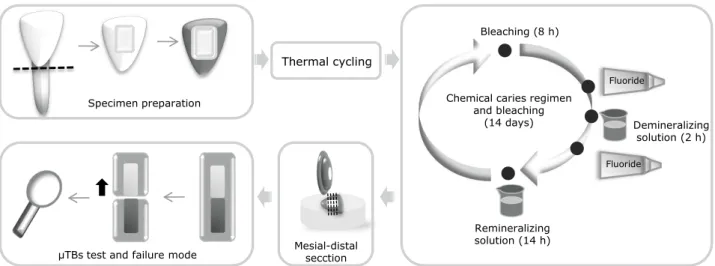
(up to 90% of enamel surface exposure), cohesive in enamel, cohesive in resin or mixed failure (also nominated adhesive and cohesive failure indicating up to 50% of the enamel surface covered with ad-hesive or resin). Figure 1 shows a schematic illustra-tion of the methodology.
Statistical analysis
Effects of the dependable variables, adhesive systems (p = 0.0016) and treatments (CP with and without F and no bleaching, p = 0.0022) and the interactions (adhesives × treatments, p = 0 = 0019) with enamel were analyzed. The normal distribu-tion of the µTBS test values was veriied by using Kolmogorov-Smirnov and Lilliefors tests (p > 0.05), and a parametric two-way ANOVA and Tukey test were performed. A value of 5% was considered signiicant (SAS 9.0 software, SAS Institute, Cary, USA).
Results
Microtensile bond strength (µTBS) testing
The results of the µTBS test (Table 2) indicated that the bond strength of the control group bonded with FL was higher than that of the enamel bond-ed with SP (p = 0.0016). However, both groups presented with higher µTBS values compared to the bleached groups (CPF and CP, p < 0.0001). No differences were observed in enamel bond strength between the groups subjected to CP 10%
(FL + CPF = F + CP and SP + CP = SP + CPF), re-gardless of the addition of F to the bleaching agents (p > 0.05).
Failure modes
A total of 45 to 50% of the failure modes in the control groups (FL and SP, respectively) were of the adhesive type. The bleached enamel interfaces ex-hibited mostly cohesive fractures in the enamel, cor-responding to 35 to 45% of the total failure pattern (Figure 2).
Discussion
Secondary caries development along the margins of an existing restoration is considered a major cause for the replacement of restorations over time.2,3
Therefore, controlling and/or preventing this condi-tion is a concern that has led to the development of adhesives with anticariogenic potential.5 However,
aside from bioilm formation, the interface of
ex-Thermal cycling
Chemical caries regimen and bleaching
(14 days) Bleaching (8 h)
Demineralizing solution (2 h)
Fluoride
Remineralizing solution (14 h)
Fluoride
Specimen preparation
Mesial-distal secction µTBs test and failure mode
Table 2 - Enamel bond strength after treatment with various adhesives and bleaching agents.
Groups FL n SP n*
Control 53.94 (12.84) Aa 27 42.23 (10.84) Ab 31 CPF 34.01 (9.27) Ba 32 31.26 (5.08) Ba 30 CP 34.32 (8.65) Ba 25 34.22 (7.38) Ba 28 Means and standard deviations (MPa) followed by different letters are different at p < 0.05, according to ANOVA and Tukey’s tests (capital let-ters - columns; lower case letlet-ters - lines). *Number of samples per group.
Influence of fluoride-containing adhesives and bleaching agents on enamel bond strength
isting restorations may be submitted to bleaching treatments, and it is unknown whether the addition of F- to these agents would affect enamel bonding. Hence, this study evaluated bond strength of exist-ing restorations exposed to bleachexist-ing agents with and without F- under caries challenge conditions.
The results suggest that bonding of the restora-tions was signiicantly inluenced by CP, as bleached groups presented lower bond strength values, re-gardless of the adhesive used or the addition of F- to the bleaching agents. Previous reports observed few or no alterations on enamel integrity after bleach-ing,18 whereas a number of studies have described
the effects of bleaching as morphological defects and the demineralization of enamel prisms.9-12 Enamel
mineral loss due to a signiicant decrease in calcium and phosphate content may occur after bleaching13
which may even increase enamel susceptibility to-wards demineralization.19
To reverse some of the adverse effects of per-oxides on enamel, the addition of F- to bleaching agents has been suggested as a form of inhibiting demineralization.14 However, the reports are
contro-versial, as some authors defend the positive outcome of F- added to CP-based agents, whereas others do not observe any prevention of enamel demineral-ization.20 In the current study, CP decreased
enam-el µTBS, regardless of the presence of F-. Enamel de-mineralization promoted by CP might have helped to lower the bond strength. Chuang et al.21 observed
that 10% CP containing high F- concentrations (0.37%) was able to maintain µTBS as effectively as unbleached enamel. The authors observed that non-luoridated and 0.11% luoridated CP agents exhibited lower µTBS immediately after bleaching, which is in accordance with our indings, but their
reported values were recovered after 7 and 14 days of storage. According to the authors, the positive outcome of F- addition to bleaching agents may as-sist subsequent restorative treatment by inhibiting enamel demineralization.21
Failure mode patterns of CP-treated interfaces demonstrated predominance (35 to 45%) of co-hesive failure in the enamel for both the bleach-ing agents used in this study. The cohesive failures conirm the hypothesis that bleaching may promote enamel structural changes, thus initializing fracture during debonding at the enamel rather than at the adhesive-bonded interface. Cavalli et al.12 observed
that bleached fractured enamel presented altered prism structure following exposure to regular (lu-oride-free) carbamide peroxides. Scanning electron microscopy showed a preference for dissolution of the boundaries between the prism and the interpris-matic substance and a porous-like appearance of the bleached prisms. The porosity created by the bleach-ing agent in the enamel may have acted as a stress raiser during µTBS testing, resulting in premature failures.12
The control groups (FL and SP), however, ex-hibited both higher bond strengths than bleached enamel and a predominance of adhesive failure (45 to 50%). Differences were observed between the three-step (FL) and two-step (SP) etch-and-rinse adhesives (µTBS FL > µTBS SP). Three- and two-step conventional etch-and-rinse adhesive systems were chosen because these agents could effectively seal the interface and promote reliable adhesion to enamel. Acid-etching selectively dissolves hydroxy-apatite crystals and creates enamel microporosities, which are iniltrated by monomers that form resin tags and promote micromechanical retention.4 The
and-rinse adhesives involve a separate etch-ing step, but the two-step combines the primer and the adhesive resin into one solution.4 In a clinical
trial studying adhesives (two self-etching and two etch-and-rinse), Perdigão et al. observed that, after 18 months, enamel marginal deiciencies were less prevalent in teeth bonded with etch-and-rinse sys-tems compared to teeth bonded with self-etching adhesives.22 The authors also note that the
three-step etch-and-rinse have better laboratory and clini-cal performance than the two-step adhesives; in the case of the former, the application of the hydrophilic monomer is performed separately before the appli-cation of the hydrophobic monomer, granting opti-mal resin iniltration and mechanical interlocking.22
Peris et al.8 evaluated the µTBS of a dentin
inter-face bonded with containing and luoride-free adhesives and subjected (or not) to pH cycling. They observed that pH cycling reduced dentin bond strength of all adhesives. The authors attribute the decreased µTBS values to the resulting demineral-ization occurring around the restorations to weak-en the bonding, regardless of the presweak-ence of luo-ride within the adhesives.8 In the current study, all
groups were subjected to pH cycling, which caused demineralization to occur around the bonded inter-face, and the bleaching treatment of the enamel in-terface, which was performed simultaneously with the pH cycling, was able to decrease bond strength to enamel, regardless of the presence of F- in the
bleaching agents. Possibly, if the amounts of F- re-leased from the bleaching agents were suficient to remineralize the enamel, then the bond strengths exhibited by groups treated with bleaching gels con-taining F- (FL + CPF and SP + CPF) would be simi-lar to the bond strengths of the non-bleached groups (FL and SP). These results should, however, be con-irmed with an in situ evaluation to corroborate the indings of this preliminary in vitro report.
Our irst null hypothesis tested was accepted as, under caries challenge, (1) no differences were ob-served in the enamel bond strength after treatment with the bleaching agents, either with or without F-. The second hypothesis was rejected because (2) dif-ferences were observed between the three- and two-step luoride-containing adhesive systems.
Conclusion
Bleaching treatment decreased the enamel bond strengths of existing adhesive restorations, regard-less of the addition of luoride to these agents. In addition, the three-step adhesive displayed higher bond strength values than the simpliied two-step etch-and-rinse adhesive.
Acknowledgments
This investigation was supported by grants 07/53878-2, 09/01228-0 and 09/01060-1 from the State of São Paulo Research Foundation, FAPESP, São Paulo, Brazil.
References
1. Dennison JB, Sarrett DC. Prediction and diagnosis of clinical outcomes affecting restoration margins. J Oral Rehabil. 2012 Apr;39(4):301-18.
2. Kidd EA. Diagnosis of secondary caries. J Dent Educ. 2001 Oct;65(10):997-1000.
3. Lima FG, Romano AR, Correa MB, Demarco FF. Influence of microleakage, surface roughness and biofilm control on sec-ondary caries formation around composite resin restorations: an in situ evaluation. J Appl Oral Sci. 2009 Jan-Feb;17(1):61-5. 4. Van Meerbeek B, De Munck J, Yoshid Y, Inoue S, Vargas M,
Vijay P, et al. Buonocore memorial lecture. Adhesion to enamel and dentin: current status and future challenges. Oper Dent. 2003 May-Jun;28(3):215-35.
5. Silva BMCG, França FMG, Flório FM, Basting RT. In situ anticariogenic effect of adhesive systems containing fluoride and MDPB. Am J Dent. 2010 Apr;23(2):75-80.
6. Hara AT, Queiroz CS, Freitas PM, Giannini M, Serra MC, Cury JA. Fluoride release and secondary caries inhi-bition by adhesive systems on root dentine. Eur J Oral Sci 2005 Jun;113(3):245-50.
7. Lobo MM, Gonçalves RB, Ambrosano GMB, Pimenta LAF. Chemical or microbiological models of secondary caries devel-opment around different dental restorative materials. J Biomed Mater Res B Appl Biomater. 2005 Aug;74(2):725-31. 8. Peris AR, Mitsui FH, Lobo MM, Bedran-Russo AK, Marchi
Influence of fluoride-containing adhesives and bleaching agents on enamel bond strength
9. Basting RT, Rodrigues AL, Serra MC. Micromorphology and surface roughness of sound and demineralized enamel and dentin bleached with a 10% carbamide peroxide bleaching agent. Am J Dent. 2007 Apr;20(2):97-102.
10. Pinto CF, Paes Leme AF, Cavalli V, Giannini M. Effect of 10% carbamide peroxide bleaching on sound and artificial enamel carious lesions. Braz Dent. J 2009;20(1):48-53.
11. Silva AP, Oliveira R, Cavalli V, Arrais CA, Giannini M, Carvalho RM. Effect of peroxide-based bleaching agents on enamel ulti-mate tensile strength. Oper Dent. 2005 May-Jun;30 (3):318-24. 12. Cavalli V, Giannini M, Carvalho RM. Effect of carbamide
peroxide bleaching agents on tensile strength of human enam-el. Dent Mater. 2004 Oct;20(8):733-39.
13. Cavalli V, Rodrigues LK, Paes-Leme AF, Soares LE, Martin AA, Berger SB, et al. Effects of the addition of fluoride and calcium to low-concentrated carbamide peroxide agents on the enamel surface and subsurface. Photomed Laser Surg. 2011 May;29(5):319-25.
14. Cavalli V, Rodrigues LK, Paes-Leme AF, Brancalion ML, Arruda MA, Berger SB, et al. Effects of bleaching agents con-taining fluoride and calcium on human enamel. Quintessence Int. 2010 Sep;41(8):e157-65.
15. Tanizawa Y. Reaction characteristics of a tooth-bleaching agent containing H2O2 and NaF: in vitro study of crystal
structure change in treated hydroxyapatite and chemical
states of incorporated fluoride. J Cosmet Sci. 2005 Mar-Apr;56(2):121-34.
16. Shinkai RS, Cury AA, Cury JA. In vitro evaluation of second-ary caries development in enamel and root dentin around luted metallic restoration. Oper Dent. 2001 Jan-Feb;26(1):52-9. 17. Gale MS, Darvell BW. Thermal cycling procedures for laboratory
testing for dental restorations. J Dent. 1999 Fev;27(2):89-99. 18. Maia E, Baratieri LN, Andrada MAC, Monteiro Jr S,
Vieira LC. The influence of two home-applied bleaching agents on enamel microhardness: an in situ study. J Dent. 2008 Jan;36(1):2-7.
19. Al-Qunaian TA. The effect of whitening agents on caries susceptibility of human enamel. Oper Dent. 2005 Mar-Apr;30(2):265-70.
20. Tschoppe P, Neumann K, Mueller J, Kielbassa AM. Ef-fect of fluoridated bleaching gels on the remineralization of predemineralized bovine enamel in vitro. J Dent. 2009 Fev;37(2):156-62.
21. Chuang SF, Chen HP, Chang CH, Liu JK. Effect of fluori-dated carbamide peroxide gels on enamel microtensile bond strength. Eur J Oral Sci. 2009 Aug;117(4):435-41.