Quantitative receptor radioautography in
the study of receptor-receptor interactions
in the nucleus tractus solitarii
1Departamento de Fisiologia, Instituto de Biociências, Universidade de São Paulo,
São Paulo, SP, Brasil
2Department of Neuroscience, Karolinska Institute, Stockholm, Sweden
D.R. Fior-Chadi1
and K. Fuxe2
Abstract
The nucleus tractus solitarii (NTS) in the dorsomedial medulla
com-prises a wide range of neuropeptides and biogenic amines. Several of
them are related to mechanisms of central blood pressure control.
Angiotensin II (Ang II), neuropeptide Y (NPY) and noradrenaline
(NA) are found in the NTS cells, as well as their receptors. Based on
this observation we have evaluated the modulatory effect of these
peptide receptors on
α
2-adrenoceptors in the NTS. Using quantitative
receptor radioautography, we observed that NPY and Ang II receptors
decreased the affinity of
α
2-adrenoceptors for their agonists in the
NTS of the rat. Cardiovascular experiments agreed with the
in vitro
data. Coinjection of a threshold dose of Ang II or of the NPY agonists
together with an ED
50dose of adrenergic agonists such as NA,
adrenaline and clonidine counteracted the depressor effect produced
by the
α
2-agonist in the NTS. The results provide evidence for the
existence of an antagonistic interaction between Ang II AT1 receptors
and NPY receptor subtypes with the
α
2-adrenoceptors in the NTS.
This receptor interaction may reduce the transduction over the
α
2-adrenoceptors which can be important in central cardiovascular
regu-lation and in the development of hypertension.
Correspondence D.R. Fior-Chadi Departamento de Fisiologia Instituto de Biociências, USP Rua do Matão, Travessa 14, 321 05508-900 São Paulo, SP
Brasil
Fax: 55 (011) 818-7416 E-mail: [email protected]
Presented at the 5th International
Symposium on Radioautography, São Paulo, SP, Brasil,
August 24-26, 1997.
Research supported by FAPESP, CNPq and the Swedish Medical Research Council (No. 04X-715).
Received September 23, 1997 Accepted November 14, 1997
Key words
•Quantitative radioautography
•Nucleus tractus solitarii
•Alpha-2-adrenoceptors
•Neuropeptide Y receptors
•Angiotensin II receptors
The nucleus tractus solitarii (NTS) in the
medulla oblongata has a crucial role in
cen-tral cardiovascular control. This nucleus
re-ceives primary afferents which derive from
visceral receptors such as cardiopulmonary,
gut, hepatic and pancreatic receptors,
chemoreceptors, and baroreceptors via the
vagus and glossopharyngeal nerves (1,2).
Several lines of evidence suggest that the
NTS, particularly its medial portion, is
abso-lutely essential to baroreceptor reflex
integ-rity (1,3). Lesions or pharmacological
block-ade of the NTS effectively eliminate the
brainstem and higher brain nuclei may exert
a modulatory role in the activity of the NTS
neurons induced by activation of peripheral
cardiovascular afferent fibers. The NTS
neu-rons activated by stimulation of
barorecep-tor and visceral afferent nerves can also
respond to electrical stimulation of the
cer-ebellum (4), the parabrachial nucleus (5),
the hypothalamus (2), the ventrolateral
me-dulla (6) and the central nucleus of the
amygdaloid complex (7). Thus, the NTS acts
as an important cardiovascular center by
integrating the cardiovascular information
from peripheral receptors and other
cardio-vascular centers.
Another outstanding feature of the NTS
is the large quantity and diversity of
neu-rotransmitters/neuromodulators and their
re-ceptors localized in this nucleus (1,8).
Non-peptidergic systems such as biogenic amines
(9,10), histamine (11) and acetylcholine are
present (12), as well as most of the known
mammalian peptidergic systems including
thyrotropin-releasing hormone (13),
corti-cotropin-releasing factor (14), vasopressin
(15), oxytocin (16), adrenocorticotropic
hor-mone (17), ß-endorphin (18), dynorphin (19),
enkephalins (20), substance P (21),
vasoac-tive intestinal polypeptide (22), bombesin
(23), galanin (24), neurotensin (25),
calcito-nin gene-related peptide (26), angiotensin II
(27), and neuropeptide Y (28).
Among these neurotransmitters, the
cat-echolamines, neuropeptide Y (NPY) and
an-giotensin II (Ang II) are of special interest
concerning central cardiovascular control
(29-31). Evidence suggests a central
inhibi-tory role of catecholamines in the regulation
of blood pressure and heart rate since
de-creases in blood pressure and heart rate were
observed following intraventricular
injec-tion of noradrenaline into the NTS (32).
NPY in the NTS possesses cardiovascular
effects similar to those observed for
cat-echolamines, leading to a prolonged decrease
in arterial pressure and heart rate (33,34).
Ang II is also well characterized as a
partici-pant in the mechanisms of blood pressure
control (29,31). Ang II injected into the brain
ventricular system leads to an increase in
blood pressure. In the NTS Ang II seems to
have a more variable effect, i.e., a depressor
action at low doses followed by a pressor
response (31). It is also suggested that Ang II
inhibits the baroreceptor reflex (35).
These neurotransmitters share another
interesting feature. NPY and Ang II coexist
in catecholaminergic cell bodies and nerve
terminals (36,37). Furthermore, an overlap
of the
α
2-adrenoceptor (38,39), NPY
recep-tor (40) and Ang II receprecep-tor (41,42)
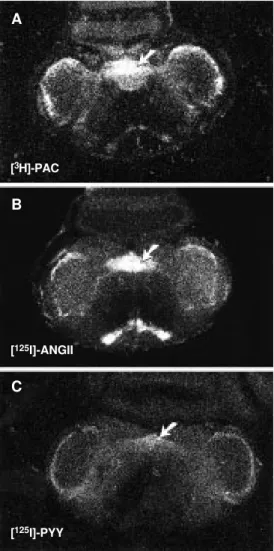
distribu-tion is observed in the NTS (Figure 1).
These morphological substrates suggest
that these neurotransmission lines may
inter-act with one another in the NTS. In support
of this view, it has been shown that NPY and
adrenaline injected intraventricularly in the
awake rat can antagonize the hypotensive
actions of one another (43). It has also been
shown that NPY reduces the affinity of [
3H]-p-aminoclonidine ([
3H]-PAC) binding sites
in membrane preparations from the rat
dor-somedial medulla (30).
These findings and the existence of
inter-action among other neurotransmission lines
in different brain areas such as between
sub-stance P and 5-HT receptors (44),
cholecys-tokinin and dopamine D2 receptors (45),
neurotensin and dopamine D2 receptors (46)
led us to evaluate carefully the possible
ex-istence of an interaction among the
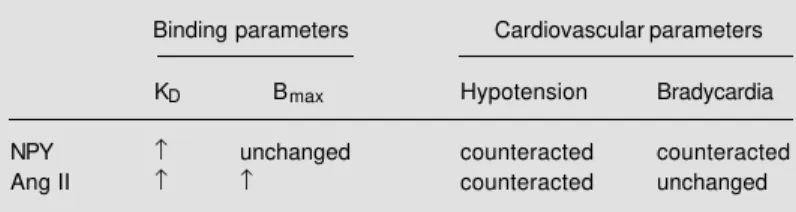
neu-Table 1 - Summary of the results obtained by the modulation of the α2
-adrenoceptors by NPY and Ang II receptors.
The binding parameters were obtained from saturation curves of [3H]-PAC in
the NTS using quantitative receptor radioautography. Cardiovascular param-eters were obtained by injection of α2-adrenoceptor agonists into the NTS and
simultaneous recording of blood pressure in anesthetized animals.
Binding parameters Cardiovascular parameters
KD Bmax Hypotension Bradycardia
NPY ↑ unchanged counteracted counteracted
rotransmission lines involved in
cardiovas-cular control in the NTS.
The experiments were designed to
evalu-ate
in vitro
the alterations in binding
param-eters of one specific receptor in the presence
of another receptor system being activated at
the same time. Furthermore,
in vivo
experi-ments were performed in order to obtain
insights about the physiological meaning of
those interactions.
Table 1 summarizes the results of the
analysis of the modulation of the
α
2-adreno-ceptors by peptide re-adreno-ceptors such as NPY
and Ang II.
The
in vitro
modulation of the
α
2-adre-noceptors was evaluated by analyzing the
binding parameters of [
3H]-PAC, an
α
2
-adrenoceptor agonist, in the presence or
ab-sence of different concentrations of NPY
(40) and of Ang II (38). We employed
quan-titative radioautography which provides a
good anatomical resolution for studying the
NTS and is also a sensitive method for
deter-mining binding parameters.
The K
D(dissociation constant) value of
[
3H]-PAC was increased in the presence of
NPY and Ang II. This means that the affinity
of the
α
2-adrenoceptor for [
3H]-PAC was
reduced in the presence of NPY and Ang II.
Noradrenaline and other
α
2-adrenocep-tor agonists such as adrenaline and clonidine
(47,48) induce a decrease in blood pressure
when injected into the NTS. The modulation
of
α
2-adrenoceptors
in vivo
was evaluated
by injecting into the NTS an ED
50dose of an
α
2-adrenoceptor agonist such as
noradrena-line in the presence or absence of a threshold
dose of NPY or Ang II. A threshold dose was
chosen as a dose that had no effect on blood
pressure or heart rate. We observed that
NPY (40) and Ang II (38) counteracted the
decrease in blood pressure triggered by the
injection of noradrenaline into the NTS.
The
in vivo
findings are in line with the
data obtained with quantitative
radioautog-raphy.
In vitro
, NPY and Ang II decreased
the affinity of the
α
2-adrenoceptor for its
agonist which could lead to a reduced
trans-duction over the activated
α
2-adrenoceptor
in the NTS.
These modulatory effects of peptides on
the
α
2-adrenoceptor seem to be specific for
areas rich in Ang II receptors and
α
2-adreno-ceptors like the NTS. No modulatory effect
by Ang II was observed on the
α
2-adreno-ceptor in the amygdala (38), an area
exhibit-ing a high density of
α
2-adrenoceptors (49)
but very low levels of Ang II receptors (50).
In support of these findings, an
antago-nistic interaction between Ang II AT1
recep-tors and
α
2-adrenoceptors in the
ventrolat-eral medulla has been described since
angio-tensin III was able to counteract the
vasode-pressor and bradycardic effects of guanabenz
(51).
Figure 1 - Autoradiograms of coronal sections of the medulla oblongata of the rat showing the binding of different ligands in the nucleus tractus solitarii (ar-row). A, Binding of [3
H]-p-aminoclonidine ([3H]-PAC). B,
Binding of [125I]-angiotensin II
([125I]-Ang II). C, Binding of [125
I]-neuropeptide Y ([125I]-PYY).
A
B
C
Furthermore, interactions between the
NPY receptor and the
α
2-adrenoceptor have
been described in other systems. Illes and
Regenold (52) showed that NPY increased
the hyperpolarizing effect of
α
2-agonists such
as noradrenaline and UK 14304 on locus
ceruleus cells but had no effect on (Met
5)-enkephalin or (D-Ala
2, D-Leu
5)-enkephalin
at opioid µ-receptors. These findings are in
agreement with ours and suggest that NPY
inhibits the action of catecholamines via a
receptor-receptor interaction. Tsuda and
col-laborators (53) also suggested an interaction
between NPY/
α
2adrenergic receptors since
NPY inhibited the stimulation-evoked [
3H]-norepinephrine release in slices of the
me-dulla oblongata.
These findings suggest the existence of
receptor-receptor interactions involving the
α
2-adrenoceptor and the NPY and Ang II
receptors. These neurotransmission systems
are involved in the mechanisms of blood
pressure control and these interactions may
have a role in the integration of extracellular
signals in the central control of blood
pres-sure. Actually, the receptor-receptor
interac-tions among these neurotransmitter systems
are altered in the NTS of spontaneously
hy-pertensive rats (54,55), highlighting the
pos-sible participation of these interactions in
the central mechanisms controlling blood
pressure.
Although the presence of
receptor-recep-tor interaction has been identified in several
systems, the exact mechanism of this
phe-nomenon has not yet been elucidated. A
probable mechanism involves the
participa-tion of the G protein. The reducparticipa-tion of
af-finity of the
α
2-adrenoceptors induced by
NPY in membranes of the medulla
oblon-gata was blocked by pretreatment with
per-tussis toxin (56). The treatment with
pertus-sis toxin was also able to counteract the
cardiovascular actions of both NPY and
clo-nidine administered to the intraventricular
system of the rat (57). The G protein seems
to be also important in the modulation of
α
2-adrenoceptors by bradykinin in the NTS (58).
References
1. Andresen MC & Kunze DL (1994). Nucleus tractus solitarius-gateway to neural circu-latory control. Annual Review of Physiolo-gy, 56: 93-116.
2. Mifflin SW, Spyer KM & Withington-Wray DJ (1988). Baroreceptor inputs to the nucleus tractus solitarius in the cat: modu-lation by the hypothalamus. Journal of Physiology, 399: 369-387.
3. Reis DJ (1984). The brain and hyperten-sion: reflections on 35 years of inquiry into the neurobiology of the circulation. Circulation, 70 (Suppl): 31-45.
4. Paton JF, Silva-Carvalho L, Goldsmith GE & Spyer KM (1990). Inhibition of barosen-sitive neurones evoked by lobule Ixb of the posterior cerebellar cortex in the de-cerebrate rabbit. Journal of Physiology, 427: 553-565.
5. Felder RB & Mifflin SW (1988). Modula-tion of carotid sinus afferent input to nucleus tractus solitarius by parabrachial nucleus stimulation. Circulation Research, 63: 35-49.
6. Paton JF, Rogers WT & Schwaber JS (1991). The ventrolateral medulla as a source of synaptic drive to rhythmically firing neurons in the cardiovascular nucleus tractus solitarius of the rat. Brain Research, 561: 217-229.
7. Cox GE, Jordan D, Moruzzi P, Schwaber JS, Spyer KM & Turner AS (1986). Amyg-daloid influences on brain-stem neurones in the rabbit. Journal of Physiology, 381: 135-148.
8. van Giersbergen PLM, Palkovits M & De Jong W (1992). Involvement of neu-rotransmitters in the nucleus tractus solitarii in cardiovascular regulation. Physi-ological Reviews, 72: 789-824.
9. Armstrong DM, Ross CA, Pickel VM, Joh TH & Reis DJ (1982). Distribution of dopa-mine-, noradrenaline-, and adrenaline-con-taining cell bodies in the rat medulla ob-longata demonstrated by the immunocy-tochemical localization of catecholamine biosynthetic enzymes. Journal of Com-parative Neurology, 212: 173-187.
10. Hökfelt T, Fuxe K, Goldstein M & Johansson O (1973). Evidence for adrena-line neurons in the rat brain. Acta Physi-ologica Scandinavica, 89: 286-288. 11. Watanabe T, Taniguchi Y, Shiosaka S,
Tanaka J, Kubota H, Terano Y, Tohyama M & Wada H (1984). Distribution of the histaminergic neuron system in the cen-tral nervous system of rats: a fluorescent immunohistochemical analysis with histi-dine decarboxylase as a marker. Brain Re-search, 295: 13-25.
12. Armstrong DM, Rotler A, Hersh LB & Pickel VM (1988). Localization of choline acetyltransferase in perikarya and den-drites within the nuclei of the solitary tract. Journal of Neuroscience Research, 20: 279-290.
14. Gray TS & Magnuson DJ (1987). Neu-ropeptide neuronal efferents from the bed nucleus of the stria terminalis and central amygdaloid nucleus to the dorsal vagal complex in the rat. Journal of Compara-tive Neurology, 262: 365-374.
15. Brinton RE, Gee KW, Wamsley LK, Davis TP & Yamamura HL (1984). Regional dis-tribution of putative vasopressin recep-tors in rat brain and pituitary by quantita-tive autoradiography. Proceedings of the National Academy of Sciences, USA, 81: 7248-7252.
16. Buijs RM (1978). Intra- and extrahypotha-lamic vasopressin and oxytocin pathways in the rat. Pathways to the limbic system, medulla oblongata and spinal cord. Cell and Tissue Research, 192: 423-435. 17. Joseph AS, Pilcher WH & Bennet CC
(1983). Immunocytochemical localization of ACTH perikarya in the nucleus tractus solitarius: evidence for a second opiocor-tin neuronal system. Neuroscience Let-ters, 38: 221-225.
18. Palkovits M, Mezey E & Eskay RL (1987). Pro-opiomelacortin-derived peptides (ACTH/β-endorphin/α-MSH) in brainstem baroreceptor areas of the rat. Brain Re-search, 436: 323-338.
19. Fodor M, Csiffary A, Kiss P & Palkovits M (1990). Dynorphin A-containing neural el-ements in the nucleus of the solitary tract of the rat. Light and electron microscopic immunohistochemistry. Brain Research, 522: 251-258.
20. Kalia M, Fuxe K, Hökfelt T, Johansson O, Lang R, Ganten D, Cuello C & Terenius L (1984). Distribution of neuropeptide im-munoreactive nerve terminals within the subnuclei of the nucleus of the tractus solitarius of the rat. Journal of Compara-tive Neurology, 222: 409-444.
21. Yamazoe M, Shiosaka S, Shibasaki T, Ling N, Tateishi K, Hashimura E, Hamaoka T, Kimmel JR, Matsuo H & Toyama M (1984). Distribution of six neuropeptides in the nucleus tractus solitarii of the rat: an immunohistochemical analysis. Neuro-science, 13: 1243-1266.
22. Palkovits M, Leranth C, Eiden LE, Rotsztejn W & Williams TH (1982). Intrin-sic vasoactive intestinal polypeptide (VIP)-containing neurons in the baroreceptor portion of the nucleus of the solitary tract in the rat. Brain Research, 244: 351-355. 23. Riche D, De Pommery J & Menetrey D
(1990). Neuropeptide and catecholamines in efferent projections of the nuclei of the solitary tract in the rat. Journal of Com-parative Neurology, 293: 399-424.
24. Melander T, Hökfelt T, Rokaeus A, Cuello AC, Oertel WH, Verhofstad A & Goldstein M (1986). Coexistence of galanin-like im-munoreactivity with catecholamines, 5-hydroxytryptamine, GABA and neuropep-tides in the rat CNS. Journal of Neurosci-ence, 6: 3640-3654.
25. Higgins GA, Hoffman GE, Wray S & Schwaber JS (1984). Distribution of neu-rotensin-immunoreactivity within barore-ceptive portions of the nucleus of the trac-tus solitarius and the dorsal vagal nucleus of the rat. Journal of Comparative Neurol-ogy, 226: 155-164.
26. Morishima Y, Takagi H, Akai F, Tohyama M, Emson PC, Hillyard CJ, Girgis SI & MacIntyre I (1985). Light and electron mi-croscopic studies of calcitonin gene-re-lated peptide-like immunoreactive neu-rons and axon terminals of the nucleus of the tractus solitarius of the rat. Brain Re-search, 344: 191-195.
27. Healy DP, Rettig R & Printz MP (1984). Evidence of an endogenous Ang II sys-tem in the rat nucleus tractus solitarius. Clinical and Experimental Hypertension, A6: 1743-1747.
28. Chronwall BM, DiMaggio DA, Massari VJ, Pickel VM, Ruggiero DA & O’Donohue TL (1985). The anatomy of the neuropeptide Y containing neurons in rat brain. Neuro-science, 15: 1159-1181.
29. Casto R & Phillips MI (1986). Angiotensin II attenuates baroreflexes at nucleus trac-tus solitarius. AmericanJournalof Physi-ology, 250: R193-R198.
30. Fuxe K, Agnati LF, Härfstrand A, Martire M, Goldstein M, Grimaldi R, Bernardi P, Zini I, Tatemoto K & Mutt V (1984). Evi-dence for a modulation by neuropeptide Y of the alpha-2 adrenergic transmission line in central adrenaline synapses. New pos-sibilities for treatment of hypertensive disorders. Clinical and Experimental Hy-pertension, A6: 1951-1956.
31. Rettig R, Healy DP & Printz MP (1986). Cardiovascular effects of microinjections of angiotensin II into the nucleus tractus solitarii. Brain Research, 364: 233-240. 32. De Jong W (1974). Noradrenaline: central
inhibitory control of blood pressure and heart rate. European Journal of Pharma-cology, 29: 179-181.
33. Carter DA, Vallejo M & Lightman NSL (1985). Cardiovascular effects of neu-ropeptide Y in the nucleus tractus solita-rius of rats: relationship with noradrena-line and vasopressin. Peptides, 6: 421-425.
34. Grundemar L, Wahlestedt C & Reis DJ (1991). Neuropeptide Y acts at an atypical receptor to evoke cardiovascular depres-sion and to inhibit glutamate responsive-ness in the brain stem. Journal of Phar-macology andExperimentalTherapeutics, 258: 633-638.
35. Michelini LC & Bonagamba LGH (1990). Angiotensin II as a modulator of barore-ceptor reflexes in the brainstem of con-scious rats. Hypertension, 15 (Suppl): I.45-I.50.
36. Coveñas R, Fuxe K, Cintra A, Aguirre JA, Goldstein M & Ganten D (1990). Evidence for the existence of angiotensin II like immunoreactivity in subpopulations of ty-rosine hydroxylase immunoreactive neu-rons in the A1 and C1 area of the ventral medulla of the male rat. Neuroscience Letters, 114: 160-166.
37. Everitt BJ, Hökfelt T, Terenius L, Tatemoto K, Mutt V & Goldstein M (1984). Differential coexistence of (NPY)-like im-munoreactivity with catecholamines in the central nervous system of the rat. Neuroscience, 11: 443-462.
38. Fior DR, Yang S-N, Hedlund PB, Narvaez JA, Agnati LF & Fuxe K (1994). Evidence for an antagonistic angiotensin II/α2
adrenoceptor interaction in the nucleus tractus solitarii of the rat. European Jour-nal of Pharmacology, 262: 271-282. 39. Young WSI & Kuhar MJ (1980).
Noradre-nergic alpha-1 and alpha-2 receptors: light microscopic autoradiographic localization. Proceedings of the National Academy of Sciences, USA, 77: 1696-1700.
40. Yang S-N, Fior DR, Hedlund PB, Agnati LF & Fuxe K (1994). Antagonistic regulation of α2-adrenoceptors by neuropeptide Y
receptor subtypes in the nucleus tractus solitarius. European Journal of Pharma-cology, 271: 201-212.
41. Fior DR, Hedlund PB & Fuxe K (1993). Autoradiographic evidence for a bradyki-nin/angiotensin II receptor-receptor inter-action in the rat brain. Neuroscience Let-ters, 163: 58-62.
42. Mendelsohn FAO, Quirion R, Saavedra JM, Aguilera GE & Catt KJ (1984). Autora-diographic localization of Ang II receptors in rat brain. Proceedings of the National Academy of Sciences, USA, 81: 1575-1579.
44. Agnati LF, Fuxe K, Benfenati F, Zini I & Hökfelt T (1983). On the functional role of coexistence of 5-HT and substance P in bulbospinal 5-HT neurons. Substance P reduces affinity and increases density of
3H-5-HT binding sites. Acta Physiologica
Scandinavica, 117: 299-301.
45. Agnati LF, Celani MF & Fuxe K (1983). Cholecystokinin peptides in vitro modu-late the characteristics of the striatal 3
H-N-propylnorapomorphine sites. Acta Physi-ologica Scandinavica, 118: 79-81. 46. Li X-M, von Euler G, Hedlund PB, Finnman
U-B & Fuxe K (1993). The C-terminal neu-rotensin (8-13) fragment potently modu-lates rat neostriatal dopamine D2 recep-tors. European Journal of Pharmacology, 234: 125-128.
47. Kubo T & Misu Y (1981). Pharmacological characterisation of the alpha-adrenocep-tors responsible for a decrease of blood pressure in the nucleus tractus solitarii of the rat. Naunyn-Schmiedeberg’s Archives of Pharmacology, 317: 120-125. 48. Zandberg P, De Jong W & De Wied D
(1979). Effects of catecholamine-receptor stimulating agents on blood pressure af-ter local application in the nucleus tractus solitarii of the medulla oblongata. Euro-pean Journalof Pharmacology, 55: 43-56.
49. Unnerstall JR, Kopajtic TA & Kuhar MJ (1984). Distribution of α2 agonist binding
sites in the rat and human central nervous system: analysis of some functional, ana-tomic correlates of the pharmacologic ef-fects of clonidine and related adrenergic agents. Brain Research Review, 7: 69-101.
50. Gehlert DR, Gackenheimer SL & Schober DA (1991). Autoradiographic localization of subtypes of angiotensin II antagonist binding in rat brain. Neuroscience, 44: 501-514.
51. Yin DC, Chan JYH & Chan SHH (1990). Interaction between angiotensin III and α2-adrenoceptors of the medulla
oblon-gata involved in cardiovascular regulation in the rat. Regulatory Peptides, 29: 59-72. 52. Illes P & Regenold JT (1990). Interaction between neuropeptide Y and noradrena-line on central catecholamine neurons. Nature, 344: 62-63.
53. Tsuda K, Tsuda S, Matsuyama Y & Goldstein M (1990). Norepinephrine re-lease and neuropeptide Y in medulla ob-longata of spontaneously hypertensive rats. Hypertension, 15: 784-790. 54. Fior DR, Yang S-N, Ganten U, Ganten D &
Fuxe K (1995). Evidence for a differential modulation of the alpha-2 adrenoceptors by angiotensin II in the nucleus tractus solitarii of the spontaneously hyperten-sive and the Wistar Kyoto normotenhyperten-sive rats. Brain Research, 679: 168-177.
55. Yang S-N, Fior DR, Hansson AC, Cintra A, Castellano M, Ganten U, Ganten D, Agnati LF & Fuxe K (1997). Increased potency of neuropeptide Y to antagonize α2
-adreno-ceptor function in the nucleus tractus solitarii of the spontaneously hyperten-sive rat. Neuroscience, 78: 803-813. 56. von Euler G, Fuxe K, Van der Ploeg I,
Fredholm BB & Agnati LF (1989). Pertus-sis toxin treatment counteracts intramem-brane interactions between neuropeptide Y receptors and α2-adrenoceptors.
Euro-pean Journal ofPharmacology, 172: 435-441.
57. Fuxe K, Härfstrand A, Agnati LF, von Euler G, Svensson T & Fredholm B (1989). On the role of NPY in central cardiovascular regulation. In: Mutt V (Editor), Neuropep-tide Y. Raven Press, New York.