Mirtazapine ve rsus fluo xe tine
in the tre atm e nt o f panic diso rde r
Setor de Psicofarmacologia, Departamento de Psiquiatria, Hospital de Clínicas de Porto Alegre, Porto Alegre, RS, Brasil L. Ribeiro, J.V. Busnello,
M. Kauer-Sant’Anna, M. Madruga, J. Q uevedo, E.A.D. Busnello and F. Kapczinski
Abstract
Mirtazapine is an antidepressant whose side effect profile differs from that of first-line agents (selective serotonin reuptake inhibitors) used in the treatment of panic disorder. The present study compared the effect of mirtazapine and fluoxetine in the treatment of panic disorder in a double-blind, randomized, flexible-dose trial conducted with outpatients. After a 1-week single-blind placebo run-in, 27 patients entered an 8-week double-blind phase in which they were randomly assigned to treatment with either mirtazapine or fluoxetine. Both groups improved significantly in all but one efficacy measure (P£0.01). ANOVA showed no significant differences between the two treatment groups in number of panic attacks, Hamilton Anxiety Scale or Sheehan Phobic Scale, whereas measures of patient global evaluation of phobic anxiety were significantly different between groups (F1,20 = 6.91, P = 0.016) favoring mirtazapine. For the 22 patients who completed the study, the mean daily dose of mirtazapine was 18.3 ± 1.3 vs 14.0 ± 1.0
mg for fluoxetine at the endpoint. Weight gain occurred more fre-quently in the mirtazapine group (50 vs 7.7%, P = 0.04) and nausea and
paresthesia occurred more often in the fluoxetine group (P = 0.01). Results suggest that mirtazapine has properties that make it attractive for the treatment of panic disorder.
Co rre spo nde nce
L. Ribeiro
Rua O távio Dutra, 174/1003
90810-230 Porto Alegre, RS Brasil
E-mail: ribeiro@ zaz.com.br
Research supported by FIPE-HCPA.
Received December 5, 2000 Accepted July 18, 2001
Ke y wo rds
·Mirtazapine ·Fluoxetine ·Panic disorder ·Treatment ·Randomized trial
Many pharmacological agents have proved to be effective in the treatment of panic disorder such as the tricyclic and tetracyclic antidepressants, monoamine oxi-dase inhibitors, selective serotonin reuptake inhibitors, and benzodiazepines (1). The side effect profile is an important issue when choosing a drug for the treatment of panic disorder, because these patients tend to am-plify somatic sensations and are unusually sensitive to these effects (2).
Mirtazapine is an antidepressant with a unique pharmacological profile. One way to
designate the pharmacological actions of mirtazapine is to consider it a noradrenergic and specific serotonergic antidepressant (3,4). The blockage of 5-HT2 and 5-HT3 receptors possibly prevents side effects associated with nonselective 5-HT activation and may also contribute to the anxiolytic and sleep-im-proving properties of mirtazapine (5,6).
informed consent was obtained from each. The study was approved by the Ethics Com-mittee of Hospital de Clínicas de Porto Alegre.
The first 30 outpatients who met entry criteria and were willing to participate in the protocol were enrolled. Assignment began on November 1998 and ended on March 1999. In order to be eligible, patients had to meet DSM-IV criteria for panic disorder, with or without agoraphobia, as assessed by a clinical interview. A qualified psychiatrist assessed all patients. The patients were sub-mitted to a medical work-up which included an electrocardiogram, complete blood cell count, aspartate aminotransferase, alanine aminotransferase, gamma-glutamyl-trans-ferase, blood urea nitrogen, creatinine, T4 and TSH. The participants were males and females 18 years of age or older, presenting a minimum of three panic attacks during the 2 weeks before enrollment. All patients scored at least 18 on the Hamilton Anxiety Scale and were free of major depressive disorder (i.e., £17 on the 17-item Hamilton Depression Rating Scale). Participants had not received previous treatment with mir-tazapine and were not being currently treated with any psychoactive drug. Women of child-bearing age who were not practicing birth control and pregnant or nursing women were excluded from the study, as also were pa-tients presenting other psychiatric or physi-cal disorders. Other reasons for exclusion were a history of seizures, organic brain syndrome, anorexia, bulimia, abuse of laxa-tive drugs and substance abuse or depend-ence within the past 6 months. Participants were also excluded if they showed hypersen-sitivity to the study drugs or had used depot antipsychotics 2 months prior to the treat-ment period, fluoxetine 5 weeks prior to the treatment period, monoamine oxidase in-hibitors, tricyclic antidepressants and other selective serotonin reuptake inhibitors 2 weeks prior to the treatment period. Patients were randomized to mirtazapine or
fluoxe-tine using a computer program, which as-signed 15 patients to each group. A person who was not participating in the study la-beled flasks containing enough medication for periods between visits. The flasks were handed to the patients on the occasion of every appointment. Code breaking did not occur until the last participant finished the study. During the first week all volunteers were submitted to a single-blind placebo run-in (week 0). During the trial, patients received 15 mg mirtazapine or 10 mg fluox-etine daily with their evening meals for the first two weeks (weeks 1 and 2). After this, doses could be raised up to 30 mg mirtaz-apine or 20 mg fluoxetine according to the investigators judgment of clinical response and/or the absence of dose-limiting side ef-fects. After this increase, the dose could be decreased at any time if significant adverse events were noticed. The use of benzodiaz-epines was not permitted during the trial. Organon Pharmaceuticals (São Paulo, SP, Brazil) kindly provided mirtazapine for the trial.
The patients were seen for evaluation at the end of weeks 0, 1, 2, 4, 6 and 8. Baseline assessment took place at the end of week 0. Two psychiatrists were responsible for ap-plying the standardized interviews. Each pa-tient maintained a self-reported diary of panic attacks (Panic Diary). Clinicians rated the Clinical Global Impression Severity Scale (CGI-S) and the Clinical Global Impression Improvement Scale (CGI-I). Patients were also assessed using the 14-item Hamilton Anxiety Rating Scale (7) and were assessed for phobic anxiety and phobic avoidance using the Sheehan Phobic Scale. The partici-pants themselves provided patient global evaluation of phobic anxiety ratings. Ad-verse events were documented regardless of their assessed severity or relationship to study drug.
any follow-up data. Outcomes were ana-lyzed by ANOVA for repeated measures. The factors analyzed were time, treatment and time-treatment interaction (General Lin-ear Models, Repeated Measures routine of the SPSS, 8th version). Other continuous
variables were compared by the Student t
-test. For non-normally distributed data, the Mann-Whitney U-test was used. Categorical data were analyzed by the chi-square test or Fisher exact test when necessary. Statistical significance was set at the 5% level.
Thirty patients entered the run-in period. Three patients did not return after the first interview and were considered noncompliant, being excluded from further analysis. Hence, a total of 27 patients, 14 treated with mir-tazapine and 13 treated with fluoxetine, were available for analysis. The groups did not differ in baseline demographic features or clinical characteristics. Mean age (years) was 36.1 ± 10.9 in the mirtazapine group and 36.4 ± 10.1 in the fluoxetine group and 86.7% of the participants in the mirtazapine group and 66.7% in the fluoxetine group were women. The median duration of illness was 36 months in both groups, with an inter-quartile range of 13-60 in the mirtazapine group and of 12-84 in the fluoxetine group.
Table 1. Frequency of adverse events occurring in 15% or more patients.
M irtazapine Fluoxetine (N = 14) (N = 13)
Drow siness 9 (64.3) 5 (38.5) Weight gain 7 (50.0) 1 (7.7)* Anxiety increase 5 (35.7) 3 (23.1) Headache 4 (28.6) 6 (46.2) Appetite increase 4 (28.6) 1 (7.7) Dizziness 3 (21.4) 3 (23.1) Dry mouth 2 (14.3) 5 (38.5) Blurred vision 2 (14.3) 2 (15.4) Nausea 2 (14.3) 9 (69.2)* Apathy 1 (7.1) 3 (23.1) Paresthesia 0 (0.0) 4 (30.8)*
Data are reported as number (percentage) for 22 patients over 8 w eeks. * P<0.05 compared to mir-tazapine (Fisher exact test).
Agoraphobia was present in 66.7 and 80.0% of the patients in the mirtazapine and fluox-etine groups, respectively.
Twenty-two of the 27 patients completed the 8 weeks of the study. Three patients on fluoxetine and two on mirtazapine dropped out due to adverse events. Drowsiness, dys-lalia, increased anxiety and tremor were the reasons for discontinuation in the mirtaz-apine group. Nausea, vomiting, epigastric pain, headaches and tremor were the reasons
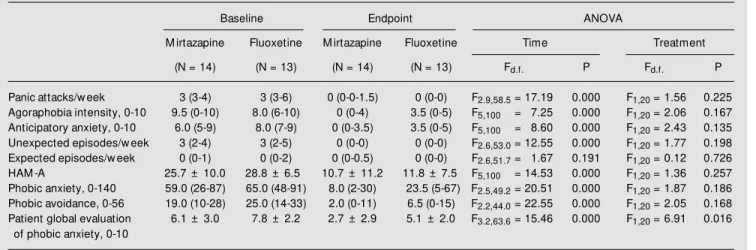
Table 2. Efficacy measures at baseline and endpoint, and ANOVA F and P values for time and treatment factors.
Baseline Endpoint ANOVA
M irtazapine Fluoxetine M irtazapine Fluoxetine Time Treatment
(N = 14) (N = 13) (N = 14) (N = 13) Fd.f. P Fd.f. P
Panic attacks/w eek 3 (3-4) 3 (3-6) 0 (0-0-1.5) 0 (0-0) F2.9,58.5= 17.19 0.000 F1,20 = 1.56 0.225 Agoraphobia intensity, 0-10 9.5 (0-10) 8.0 (6-10) 0 (0-4) 3.5 (0-5) F5,100 = 7.25 0.000 F1,20 = 2.06 0.167 Anticipatory anxiety, 0-10 6.0 (5-9) 8.0 (7-9) 0 (0-3.5) 3.5 (0-5) F5,100 = 8.60 0.000 F1,20 = 2.43 0.135 Unexpected episodes/w eek 3 (2-4) 3 (2-5) 0 (0-0) 0 (0-0) F2.6,53.0= 12.55 0.000 F1,20 = 1.77 0.198 Expected episodes/w eek 0 (0-1) 0 (0-2) 0 (0-0.5) 0 (0-0) F2.6,51.7= 1.67 0.191 F1,20 = 0.12 0.726 HAM -A 25.7 ± 10.0 28.8 ± 6.5 10.7 ± 11.2 11.8 ± 7.5 F5,100 = 14.53 0.000 F1,20 = 1.36 0.257 Phobic anxiety, 0-140 59.0 (26-87) 65.0 (48-91) 8.0 (2-30) 23.5 (5-67) F2.5,49.2= 20.51 0.000 F1,20 = 1.87 0.186 Phobic avoidance, 0-56 19.0 (10-28) 25.0 (14-33) 2.0 (0-11) 6.5 (0-15) F2.2,44.0= 22.55 0.000 F1,20 = 2.05 0.168 Patient global evaluation 6.1 ± 3.0 7.8 ± 2.2 2.7 ± 2.9 5.1 ± 2.0 F3.2,63.6= 15.46 0.000 F1,20 = 6.91 0.016
of phobic anxiety, 0-10
for discontinuation in the fluoxetine group. Some of the patients presented with more than one symptom. Discontinuation rates did not differ between groups. The types of adverse events according to medication group are shown in Table 1. At endpoint, the mean (± SD) daily dose of mirtazapine was 17.9 ± 4.3 versus 13.1 ± 3.2 mg for fluoxetine. For the 22 patients who completed the study, the mean daily dose of mirtazapine was 18.3 ± 1.3 versus 14.0 ± 1.0 mg for fluoxetine. The CGI-S Scale at endpoint was 1.9 ± 1.0 and 2.2 ± 0.9 mg for the mirtazapine and fluoxe-tine groups, respectively; this difference was not significant. The CGI-I Scale did not dem-onstrate a difference at endpoint. Both groups achieved a median of 1 point and interquar-tile ranges of 1-3 for mirtazapine and 1-2 for fluoxetine. Table 2 shows efficacy measures at baseline and endpoint.
Concerning the time factor, all but one efficacy measure showed difference from baseline to endpoint for a significance level
of P£0.01, which means that both groups
improved from baseline (Table 2).
Regarding treatment, the analysis showed no differences between treatments in all effi-cacy measures except one, i.e., patient glo-bal evaluation of phobic anxiety (P = 0.016) (Table 2).
The median number of panic attacks at endpoint was 0 in the two groups, demon-strating that both drugs came close to abol-ishing the attacks. The favorable outcomes
in the study were obtained with relatively low doses of medication. The maximum flu-oxetine dose was 20 mg daily but 20% of the patients in the fluoxetine group who com-pleted the trial did not reach this dosage. In the mirtazapine group a greater percentage (50%) did not need the full dose of 30 mg. The fact that several patients did not need the full dose to become respondents may reflect a placebo effect. This cannot be confirmed or ruled out since a placebo group was not included. The side effects of mirtazapine observed in this study were similar to those reported in studies of mirtazapine for de-pression (8). In the present study, drowsi-ness and weight gain were the side effects with the highest incidence in the mirtazapine group. In conclusion, mirtazapine may be an alternative drug for the treatment of panic disorder, producing improvements similar to those obtained with fluoxetine in many clinically relevant dimensions of panic. To our knowledge this is the first randomized trial assessing the role of mirtazapine in the treatment of panic disorder. The present data support the hypothesis that mirtazapine is an antipanic agent with an effectiveness com-parable to that of fluoxetine (9-11). How-ever, the conclusions of this study should be interpreted carefully due to its small sample size. Further studies should be performed to establish a stronger basis to support the find-ings of our work.
Re fe re nce s
1. Rosenbaum JF (1997). Treatment-resis-tant panic disorder. Journal of Clinical Psy-chiatry, 58 (Suppl 2): 61-64.
2. Katsching H & Amering M (1998). The long-term course of panic disorder and its predictors. Journal of Clinical Psychophar-macology, 18 (Suppl 2): 6S-11S. 3. Haddjeri N, Blier P & M ontigny C (1995).
Noradrenergic modulation of central sero-tonergic neurotransmission: acute and long-term actions of mirtazapine. Interna-tional Clinical Psychopharmacology, 10 (Suppl 4): 11-17.
4. Sambunaris A, Hesselink JK & Pinder R (1997). Development of new antidepres-sants. Journal of Clinical Psychiatry, 58 (Suppl 6): 40-53.
5. Boer T (1996). The pharmacologic profile of mirtazapine. Journal of Clinical Psychia-try, 57 (Suppl 4): 19-25.
6. Frazer A (1997). Pharmacology of antide-pressants. Journal of Clinical Psychophar-macology, 17 (Suppl 1): 2-18.
7. Hamilton M (1959). The assessment of anxiety states by rating. British Journal of M edical Psychology, 32: 50-55.
8. Faw cett J & Barkin RL (1998). Review of the results from clinical studies on the efficacy, safety and tolerability of mirtaza-pine for the treatment of patients w ith major depression. Journal of Affective Disorders, 51: 267-285.
10. M ichelson D, Lydiard RB, Pollack M H, Tamura RN, Hoog SL, Tepner R, Demi-track M A & Tollefson GD (1998). Outcome assessment and clinical improvement in panic disorder: evidence from a
random-ized controlled trial of fluoxetine and pla-cebo. The Fluoxet ine Panic Disorder Study Group. American Journal of Psy-chiatry, 155: 1570-1577.
11. Goeman JM , Liebow itz M R, Fyer AJ,