CARBON DIOXIDE INDUCED PANIC ATTACKS
AND SHORT TERM CLONAZEPAM TREATMENT
PRELIMINARY STUDY
ANTONIO EGIDIO NARDI*, ALEXANDRE M. VALENÇA*, WALTER ZIN**, ISABELLA NASCIMENTO*
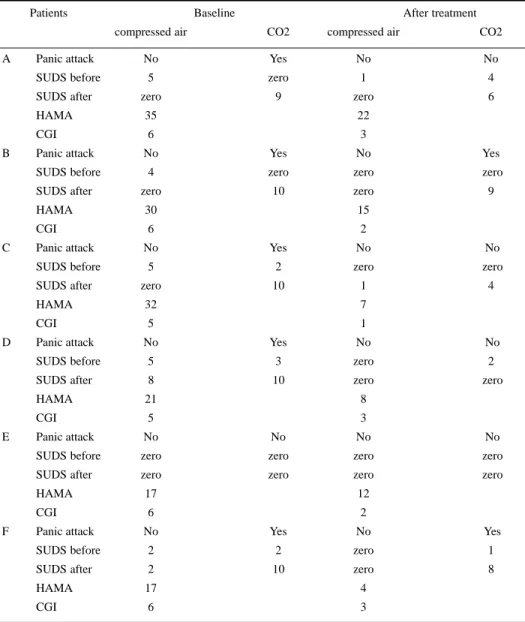
ABSTRACT - AIMS: 1. To verify the sensibility of panic patients to a mixture of 35% CO2 and 65% O2. 2. To determine if a ten days treatment with clonazepam attenuates the panic attacks induced by the inhalation of 35% carbon dioxide in panic disorder. METHOD: We randomly selected six panic disorder subjects, using the Structured Clinical Interview for DSM-IV. All subjects went double-blindly through an inhalation of 35% CO2 and compressed gas (atmospheric air) on two occasions. First, at baseline, when they were drug free. Second, after a 10 days clonazepam treatment. RESULTS: Neither at baseline nor after treatment any patient had a panic attack during compressed gas inhalation. At the first test five patients (83.3%) had a severe panic attack with high levels of subjective anxiety during carbon dioxide inhalation. After 9.6 (± 3.4) days of clonazepam treatment, only two (33.3%) patients experienced a mild panic attack. CONCLUSION: This pilot study suggests the efficacy of the short term clonazepam therapy in attenuating panic attacks and supports the usefulness of the 35% carbon dioxide challenge test as an analogue method for study the efficacy of anti-panic drugs. Further placebo-controlled studies to pharmacological treatment are warranted.
KEY WORDS: panic attacks, panic disorder, clonazepam, carbon dioxide.
Ataques de pânico induzidos por dióxido de carbono e tratamento a curto prazo com clonazepam: estudo preliminar
RESUMO - OBJETIVOS: 1. Verificar a sensibilidade de pacientes com transtorno do pânico ao teste de inalação com mistura de 35% de dióxido de carbono e 65% de oxigênio. 2. Determinar se o tratamento com clonazepam por período de dez dias bloqueia ou atenua os ataques de pânico induzidos pela inalação da mistura carbogênica, em pacientes com transtorno do pânico. METODOLOGIA: Foram selecionados randomicamente seis pacientes com transtorno do pânico (SCID-I, DSM-IV). Os pacientes foram submetidos de forma duplo-cega a testes de inalação com ar comprimido (gás atmosférico) e dióxido de carbono em dois momentos. Primeiro, no início do estudo quando não estavam usando nenhuma medicação. Segundo, após período de cerca de 10 dias de tratamento com clonazepam. RESULTADOS: Nenhum paciente apresentou ataques de pânico após a inalação de ar comprimido nos dois dias de testes. No primeiro teste, após a inalação de dióxido de carbono, cinco (83,3%) pacientes tiveram ataque de pânico intensos, com altos níveis de ansiedade subjetiva. No segundo teste, após 9,6 (± 3,4) dias de tratamento com clonazepam, apenas dois (33,3%) pacientes experimentaram ataque de pânico, de intensidade leve. CONCLUSÃO: Este estudo inicial sugere a eficácia do tratamento a curto prazo com clonazepam em bloquear ou atenuar ataques de pânico induzidos pelo dióxido de carbono e reforça a utilidade deste teste como um método análogo para o estudo da eficácia de drogas anti-pânico. São necessários outros estudos controlados, com placebo e tratamento farmacológico.
PALAVRAS-CHAVE: ataques de pânico, transtorno do pânico, clonazepam, dióxido de carbono.
The panic attack induced by carbon dioxide challenge test produces physical symptoms which are very similar to spontaneous panic attacks1-3. The two most common methods used are the prolonged
*Laboratory of Panic and Respiration, Anxiety and Depression Research Program, Institute of Psychiatry, Federal University of Rio de Janeiro, Brazil; **Laboratory of Respiration Physiology, Carlos Chagas Filho Biophysics Institute, Federal University of Rio de Janeiro, Brasil. Supported by the Brazilian Council for Scientific and Technological Development (CNPq). Aceite: 12-fevereiro-1999.
(15 minutes) inhalation of 5% CO2 and the one or two vital capacity inhalation of 35% CO2 and 65% O2. The 35% CO2 technique was found to differentiate between panic disorder patients and normals4, displaying enough specificity for panic disorder5. Carbon dioxide induced panic attacks
closely resemble the kind patients with panic disorder experience outside the laboratory6-8, and
therefore carbon dioxide panic seems a valid analog of spontaneous panic attacks. According to one model2, panic patients may have hypersensitive carbon dioxide chemoreceptors in the brain. Increasing
the inhaled CO2 concentration triggers these hypersensitive receptors, causing an inappropriatelly prolonged phase of hyperventilation, followed by a panic attack. According to other theory9,10, this
mechanism may be one of several to trigger a “false suffocation alarm”and induce a panic attack.
The effect of antipanic drus on the anxiogenic response to 35% CO2 may help to elucidate the mechanism of CO2-induced panic attacks11,12. It is important to determine if pretreatment with
antipanic drugs would alter the anxiogenic response to CO2.
The present study examines the short term (10 days) effects of clonazepam on 35% CO2 challenge test in panic disorder patients. This is the first report on the 35% CO2 model in which the carbon dioxide vulnerability of panic patients on a short term regimen with clonazepam is investigated.
METHOD
We randomly selected six panic disorder subjects with agoraphobia . The diagnosis was obtained using the Structured Clinical Interview13 for DSM-IV14. They gave a voluntary written inform consent for their
participation in this study. The protocol was approved by our local Ethical Committee.
To participate the subjects were required to be between the ages of 18 and 55, report at least three panic attacks in the last two consecutive weeks before the first challenge test day. They should be free of psychotropic drugs for one week and test negative for benzodiazepines and barbiturates in the urine. All patients underwent a physical examination and laboratory tests to ensure they were healthy enough to participate in a CO2 challenge test. All six subjets underwent inhalation of 35% CO2 on two occasions. First, at baseline when they were drug free. Second, after a ten days clonazepam therapy. The subjects were informed the test could cause sinus head pressure, dizziness, or a mild headache and that the symptoms would be quickly relieved when the test was finished. In order to practice the challenge procedure and to decrease any antecipatory anxiety, subjects were asked to exhale as fully as possible, place the mask on their face, take a fast vital capacity breath of compressed air (atmospheric air) , hold their breath for 10 seconds and exhale. Immediately after, they were asked to repeat the fast vital capacity breath and hold it again.
After 30 minutes they repeated the whole procedure using a gas composed of 35% CO2 and 65% oxygen. The patients were blind to the both compositions of the gas : first, compressed air (“placebo”) and, second, 35% CO2 mixture.
To measure the baseline anxiety level, subjects were asked before the compressed air test and the 35% CO2 challenge to complete the Subjective Units of Disturbance Scale (SUDS), a semiquantitative evaluation method ranging from 0 = no anxiety to 10 = the maximum anxiety14, and the Diagnostic Symptom Questionnaire15
adapted for DSM-IV13 in which the presence and level of disconfort of panic symptoms experienced after the
inhalations were rated on a 0-4 point scale ( 0= none , 4 = very severe). The Hamilton Scale for Anxiety (HAMA)16
and the Clinical Global Impression (CGI) were also done at first test day. On the basis of the Diagnostic Symptom Questionnaire, a CO2-induced panic attack was defined as the following: 1) four or more DSM-IV panic attack symptoms; 2) at least one DSM-IV cognitive panic symptom (i.e. fear of dying, losing control, or going crazy); 3) sensation of panic or fear, resembling real-life panic attacks; and 4) an agreement of two medical doctors.
After the first test, all the patients started treatment with 2 mg/day of clonazepam. Only one patient did not stand the fixed dose due to side effects (somnolence) and it was reduced to 1mg/day. The mean treatment period was 9.6 (±3.4) days. The respiratory tests and scales were repeated after the period of treatment. The second tests were taken about twelve hours after the last dose of clonazepam.
RESULTS
Table 1. Tests results for each patient before and after treatment.
Patients Baseline After treatment
compressed air CO2 compressed air CO2
A Panic attack No Yes No No
SUDS before 5 zero 1 4
SUDS after zero 9 zero 6
HAMA 35 22
CGI 6 3
B Panic attack No Yes No Yes
SUDS before 4 zero zero zero
SUDS after zero 10 zero 9
HAMA 30 15
CGI 6 2
C Panic attack No Yes No No
SUDS before 5 2 zero zero
SUDS after zero 10 1 4
HAMA 32 7
CGI 5 1
D Panic attack No Yes No No
SUDS before 5 3 zero 2
SUDS after 8 10 zero zero
HAMA 21 8
CGI 5 3
E Panic attack No No No No
SUDS before zero zero zero zero
SUDS after zero zero zero zero
HAMA 17 12
CGI 6 2
F Panic attack No Yes No Yes
SUDS before 2 2 zero 1
SUDS after 2 10 zero 8
HAMA 17 4
CGI 6 3
SUDS, Subjective Units of Disturbance Scale; HAMA, Hamilton Scale for Anxiety; CGI, Clinical Global Impression.
than before the 35% CO2 challenge. It might be that the high antecipatory anxiety was due to the unknown test. After the asymptomatic reaction to compressed air it decreased (Table 1). So it had no effect on 35% CO2 challenge test.
The patients were better of the anxiety symptoms and of the frequency and intensity of spontaneous panic attacks after the period of treatment (decrease in HAMA and Clinical Global Impression (Table 1).
DISCUSSION
The results of the current study indicate that short term administration of clonazepam reduces anxiety and panic attacks evoked by inhalation of 35% CO2. This finding is consistent with the observation that acute3 and long term9 alprazolam treatment and 5-week treatment with
clonazepam10,11 are effective in reducing CO2 induced panic attacks. Perhaps the most essential
part in every CO2 study is the criteria used to define laboratory panic attacks and the CO2 concentrations. Only studies with the acute response to alprazolam3 and the 5-week treatment
with clonazepam10 used the 35% CO2 concentration.
The definition of a panic attack utilized in this study was essential for the concordance in every case. Perhaps in a larger sample the difficulty in agreement between the raters can be decreased by a clinical method with panic attack and increased anxiety criteria.
Alprazolam7 and clonazepam8 are efficacious drugs for the treatment of panic disorder and mostly
studied in association with CO2 provoked panic attacks. The chronic administration (11 weeks) of alprazolam (mean dose 3.1 mg) to eight panic disorder patients has been reported to attenuate the anxiety induced by 5% CO2 inhalation9. A single dose of alprazolam (1 mg) as a pretreatment reduced
anxiety and panic provoked by the inhalation of 35% CO2 in patients with panic disorder3.
A significant reduction in 35% CO2 vulnerability was observed in ten panic disorder patients after a 5-week treatment with clonazepam10 - mean dose 2.1 mg/day. There is also a case report11 of a
30-year-old woman with panic disorder and phobic avoidance who responded partially to treatment with alprazolam but recovered fully while receiving clonazepam. After 5 weeks of alprazolam she had still spontaneous panic attacks but not after a 8-weeks treatment with clonazepam. At this moment she also underwent a 5% CO2 challange test and had no panic attack. Studies with benzodiazepines in provoked panic attacks may be useful as in manyanxiety units panic disorder patients use benzodiazepines on an as-needed basis in phobic panic-provoking situations that would be expected to otherwise evoke anxiety.
Some theories have been developed over the years to account for the diverse manifestations of panic disorder17,18. To place them in perspective, it is important to examine them in the light of clinical
observations and available laboratory data5,16. 35% CO2 challenge test is an interesting neurobiologic
probe into the pathophysiology of panic anxiety and an ideal controlled setting for the observation and experimental manipulation of different components of panic in a controlled setting. It is possible that CO2 is merely one way to trigger a conditioned hypersensitive response in patients with panic disorders.
CONCLUSION
Basic and clinical research on the mechanism of the anxiogenic effect of CO2 may help elucidate the neurobiologic vulnerability of panic disorder patients and may lead to the development of more specific and effective treatments. Further studies on this topic are warranted as there are some limitations in our study: the sample was very small and it was not a placebo-controlled trial. However, the present pilot study suggests that the panicogenic effect of 35% CO2 is significantly attenuated after 10 days treatment period with clonazepam.
REFERENCES
1. Sanderson WC, Wetzler S . Five percent carbon dioxide challenge: valid analogue and maker of panic disorder? Biol Psychiatry 1990;27:689-701.
2. Papp LA, Klein DF, Gorman JM. Carbon dioxide hypersensitivity, hyperventilation, and panic disorder. Am J Psychiatry 1993;150:1149-1157.
4. Griez EJL, Lousberg H, van den Hout MA. CO2 vulnerability in panic disorder. Psychiatry Res 1987;20:87-95. 5. Griez EJL, de Loof C, Pols H, Zandbergen J, Lousberg H. Specific sensitivity of patients with panic attacks to carbon
dioxide inhalation. Psychiatry Res 1990;31:193-199.
6. Papp LA, Klein DF, Martinez J, et al.. Diagnostic and substance specificity of carbon-dioxide-induced panic. Am J Psychiatry 1993;150:250-257.
7. Chouinard G, Annable L, Fontaine R, Solyom L. Alprazolam in the treatment of generalized anxiety and panic disorders: a double-blind placebo-controlled study. Psychopharmacology 1982;77:229-233.
8. Fontaine R, Chouinard G. Antipanic effects of clonazepam (Letter). Am J Psychiatry 1984;141:149.
9. Klein DF . False suffocation alarms, spontaneous panics and related conditions: on integrative hypotesis. Arch Gen Psychiatry 1993;50:306-317.
10. Woods SW, Charney DS, Loke J, Goodman WK, Redmond E Jr, Heninger GR. Carbon dioxide sensitivity in panic anxiety. Arch Gen Psychiatry 1986;43:900-909.
11. Pols H, Zandbergen J, de Loof C, Griez E. Attenuation of carbon dioxide-induced panic after clonazepam treatment. Acta Psychiatr Scand 1991;84:585-586.
12. Beckett A, Fishman SM, Rosenbaum JF. Clonazepam blockade of spontaneous and CO2 inhalation-provoked panic in a patient with panic disorder. J Clin Psychiatry 1986;47:475 - 476.
13. First MB, Spitzer RL, Gibbon M, Williams JBW. Structured clinical interview diagnostic (SCID) for DSM-IV axis I Disorders - Clinician Version (SCID-CV). Washington: American Psychiatric Press, 1997.
14. American Psychiatric Association. Diagnostic and statistical manual for mental disorders. 4Ed. DSM-IV. Washington: American Psychiatric Press, Washington,1994.
15. Bech P, Kastrup M, Rafaelsen OJ . Mini-compendium of rating scales for states of anxiety, depression, mania, schizophrenia with corresponding DSM III syndromes. Acta Psychiatr Scand 1986;73(Suppl 326): 1-37.
16. Hamilton M. The assessment of anxiety states by rating. Br J Med Psychol 1959;32:50-55.
17. Sanderson WC, Rapee RM, Barlow DH. The influence of an illusion of control on panic attacks induce via inhalation of 5.5% carbon dioxide-enriched air. Arch Gen Psychiatry 1989;46:157-162.