ABSTRACT: Ceratitis capitata is one of the most important pests of fruits for exportation, and Sterile Insect Technique (SIT) has been the most efficient and environmental friendly technique used to control fruit fly populations around the world. A key goal in achieving a successful SIT program is a mass rearing system producing high quality insects at low cost. Providing adults with an artificial diet containing hydrolysed protein has been the major obstacle for bio-production facilities in Brazil, because it is expensive and has to be imported. Two other commercial prod-ucts, autolysed yeast (AY) and yeast extract (YE), of domestic origin and low cost, were tested as substitutes of the imported hydrolyzed protein. To compare their efficiency we observed the female fecundity, adult survival and egg viability of flies raised on diets containing one of each of the different protein products. Flies reared on the domestic yeast products had equivalent or superior performance to the flies reared on imported protein. Both AY and YE can be a possible substitute for imported hydrolyzed protein for C. capitata mass-rearing, as they are cheaper and are readily available in the national market.
Keywords: Ceratitis capitata, protein, artificial diet, rearing facility
Introduction
The Mediterranean fruit fly, Ceratitis capitata (Wie-demann) (Diptera: Tephritidae), is one of the most seri-ous agricultural pests in the world. One of the princi-pal techniques for controlling populations of C. capitata is the Sterile Insect Technique (SIT) (Hendrichs et al., 2002). The SIT allows government agencies to control the population levels of many pests, and has found large scale use in many parts of the world (Hendrichs et al., 2002). This technique uses males from specific labora-tory lines that are often generated in large scale in bio-production facilities and subsequently sterilized using irradiation. Then, they are released en masse as an at-tempt to force females in the environment to mate with sterile males only and thus eradicate wild populations or significantly reduce the number of offspring they can produce (Hendrichs et al., 1995).
Brazil currently occupies third place in the world’s commercial production level of fruits, although their export to several countries has been impeded due to quarantine restrictions (Santos, 2003). The Brazilian northeastern re-gion has shown a true vocation for natural fruit production, mainly fruits adapted to tropical conditions, and the sub-median São Francisco Valley region [Juazeiro (Bahia State) / Petrolina (Pernambuco)] is currently the largest irrigated fruit producing region in this region (Santos, 2003).
Due to the economic importance for this region, a bio-production facility was recently established to sup-ply mass-produced sterile males to combat C. capitata infestations and uses large quantities of artificial food for raising both larva and adults. Artificial diets must supply the insects with all of the nutrients they will need for increase fecundity, longevity and for sexual success (mating success and production of viable eggs), and must include a protein source, an energy source (normally carbohydrates), B complex vitamins, and mineral salts (Dadd, 1985). Kaur and Srivastava (1991) have demon-strated that diets without B complex vitamins, folic acid, or biotin will reduce fecundity and eclosion rates in fruit flies. The larval diet for mass-rearing of C. capitata is well-defined and fulfills the technical and cost necessities of the bio-production facility. The adult diet, however, uses an enzymatically hydrolyzed protein product that is imported at great cost (Manrakhan and Lux, 2006).
In the bio-production facility, 88.86 g of hydro-lyzed protein are required to produce one million C. capitata pupae, at a cost of approximately US$ 14.00, only for this ingredient. Usually, the protein used for adult diets in fruit fly facilities around the world is de-rived from yeast which is treated to produce a source of hydrolyzed protein as well as lipids, B complex vitamins (especially thiamine, riboflavin, niacin and pantothenic acid) and salt (Schulz and Oslage, 1976; Chang, 2009). Received February 24, 2011
Accepted June 19, 2012
1UFBA/IBIO – Depto. de Biologia Geral, Av. Ademar de Barros, s/n, Campus Ondina – 40170-115 – Salvador, BA – Brasil. 2UNEB – Depto. de Ciências da Vida, R. Silveira Martins, 2555 – 41150-000 – Salvador, BA – Brasil.
3MOSCAMED – Biofábrica Moscamed Brasil,
Quadra D-13, Lote 15, Distrito Industrial do São Francisco – 48900-000 – Juazeiro, BA – Brasil.
4UFRB/Centro de Ciências da Saúde, Av. Carlos Amaral, 1015 – 44570-000 – Santo Antônio de Jesus, BA – Brasil. 5USP/CENA – Lab. de Irradiação de Alimentos e Radioentomologia, Av. Centenário, 303, C.P. 96 – 13416-000 – Piracicaba, SP – Brasil. 6Embrapa Semiárido, BR 428, Km 152, Zona Rural, C.P. 23 – 56302-970 – Petrolina, PE – Brasil. 7Embrapa Mandioca e Fruticultura, R. Embrapa, s/n – 44380-000 – Cruz das Almas, BA – Brasil. *Corresponding author <[email protected]>
Edited by: Richard V. Glatz
Mass-rearing of Mediterranean fruit fly using low-cost yeast products produced in Brazil
Alberto Moreira da Silva Neto1, Tatiana Rodrigues de Oliveira Santos1, Vanessa Simões Dias1, Iara Sordi Joachim-Bravo1*, Leandro
de Jesus Benevides2, Clicia Maria de Jesus Benevides2, Mariangela Vieira Lopes Silva2, Deise Cristina Campos dos Santos3, Jair
These yeast-based diets are used in large-scale commer-cial production of larval and adult fruit-flies throughout the world (Aluja et al., 2001; Rohlfs and Hoffmeister, 2005). However, in a large scale production (200 million pupae per week), the quantity needed to attend whole Vale do São Francisco-Brazil, it is the most expensive item used in the facility, pushing us to search for new options of hydrolyzed protein source, which could be found in local markets, with high nutritional quality, and lower cost for both fruit fly facility and fruit pro-ducers (consumers of the SIT flies).
This study tested the viability of using a low-cost extract and commercially available yeast products pro-duced in Brazil as a substitute for the imported material currently used in the adult diet of C. capitata.
Materials and Methods
The C. capitata flies used in this study were of strain Vienna 8 tsl (temperature sensitive lethal), a ge-netic sexing strain, from a population maintained by bio-production facility in Juazeiro, Bahia (BA) state, Brazil (09°34’ S; 40°21’ W), since 2005. The biological parameters used to evaluate the protein sources were: fecundity (evaluated in both small and large-scale ex-periments), adult survival and egg viability. The two diets tested used protein sources derived from either a yeast extract designated here as YE, or an autolyzed yeast designated here as AY; both are produced in Brazil and are used as food supplements in human diets. The control diet used an imported hydrolyzed protein source, designated here as IHP. Refined sugar was added to all of the diets in the proportion of 3:1 (sugar: protein). Recently emerged flies were divided into three groups receiving one of the three diets on a daily basis throughout the experiment (in addition to water ad libitum). Small-scale tests of fecundity and survival were undertaken under laboratory condi-tions using a 12 h photophase. The large-scale tests of fecundity and egg viability were performed using 24 h of light. All tests were performed at 25 ± 3 °C and 65 ± 5 % relative humidity.
Small-scale fecundity tests
In these experiments, five recently emerged vir-gin females were placed in a plastic cage (10 × 5 cm), covered with voile screen at the top, containing one of the three diets. During the period of the tests the flies received the respective diet and water ad libitum. The females’ fecundity (estimated by the numbers of eggs laid by these flies) was verified daily for 10 days after initiating ovipositioning. Daily, females oviposited on the screen and the eggs were collected using a scalpel. All collected eggs were deposited on a Petri dish with wax and were counted. Some eggs oviposited inside the cage were reg-istered too. Twenty replicates were performed for each diet tested with flies from different groups of our Vi-enna 8 tsl flies.
Large-scale fecundity tests
Large-scale fecundity experiments were under-taken using the same cages (71 cm × 80 cm × 7.7 cm) employed in the mass production lines of the bio-pro-duction facility in Juazeiro-BA. Each cage contained 150 mL of female pupae (white) and 150 mL of male pupae (brown), totaling 300 mL of pupae. Each mL of pupae contained an average 60 pupae, totaling an average of approximately 18,000 pupae per cage with an adult emergence estimate of 70 %, according bio-production facility information. Each cage - lined with voile fabric - was supplied with a tray containing filtered water for collecting the eggs.
The eggs deposited on voile fabric were removed from the cages two times in the morning (09h00 and 12h00) and two times in the afternoon (14h00 and 17h00). The positions of the cages were changed each day to avoid any possible effects of subtle variations in the light inten-sity or temperature in the culture room. The eggs were always collected in the same sequence from the same cages (independent of their shifting positions) to eliminate the possibility that the females in the last cage handled would have more time to lay eggs. All of the trays were carefully washed after the morning collections to avoid leaving residual eggs. The eggs were collected early in the morning and transferred successively to smaller flasks (af-ter five minutes of settling followed by decantation of the excess water) until the residual volume was transferred to a graduated cylinder (with an open bottom covered by cheese cloth to filter the water and retain the eggs) and measured in milliliters. The eggs were collected on a daily basis for 10 days after the first observed ovipositioning. Three replicates (cages) were made for each diet tested. Inside each cage, a different batch from the same popula-tion of Vienna 8 tsl flies was used to ensure sampling of flies with more genetic diversity.
Tests of egg viability
During each experimental test of fecundity under large-scale egg production conditions, sub-samples of eggs were removed for viability tests. Small quantities of eggs from each of the cages were placed into ten Petri dishes containing a piece of wet sponge cloth (to avoid desicca-tion) covered by a piece of dark cloth (to contrast with the eggs and facilitate counting them). Any dry or obvi-ously damaged eggs were removed from the sub-samples at the beginning of the tests, and the remaining eggs were counted. The number of eggs considered to be unable to hatch was determined by adding those not hatched at 96 h to those removed as dry or damaged eggs. This value was then used to determine the relative percentages of total eggs that were hatched and not hatched.
Survival tests
on a daily basis for 20 days, noting the numbers of dead or living flies. The observation period was limited to 20 days as this represents the maximum time the flies are held in their cages during rearing at the bio-production facility. Thirty replicates were performed for each diet and for each sex.
Analyses of diet composition
The analyses of the compositions of the diets (proteins, lipids, ash, humidity, and carbohydrates) were performed according to the following methodol-ogy: (i) Proteins: it was based on determination of total nitrogen (Kjeldahl) which evolves steps of digestion, distillation and titration of nitrogen. The conversion factor for the N protein was 6.25; (ii) Lipids: continuous extraction with petroleum ether type in the Soxhlet ap-paratus, followed by removal of solvent emissions and lipids quantified gravimetrically; (iii) Ash: samples ob-tained by calcination in muffle at 550 °C; (iv) Humidity: direct heating of the sample at 105 °C and calculated by gravimetry; and (v) Carbohydrates: The percentage of carbohydrate was determined by difference.
Statistical analyses
All data were examined for normality using the Kolmogorov and Smirnov test, and for variance of ho-mogeneity using Bartlett’s method. The data that were not normally distributed were transformed to be com-pared by parametric tests. The data of small-scale fe-cundity tests were analyzed by one-way ANOVA with Tukey-Kramer post-test to compare their averages. The data of large-scale fecundity and egg viability tests were analyzed by two-way ANOVA (concerning pos-sible interactions between female age and diet during the experiment) with Bonferroni multiple comparisons analyses post-test. The male and female survival on dif-ferent diets survival was analyzed by using the Kaplan-Meyer survival test method. The statistical tests were performed using GraphPad Prism version 5.04 software program for Windows (GraphPad Software, San Diego, California, USA). An alpha value of 5 % was used in all statistical tests.
Results and Discussion
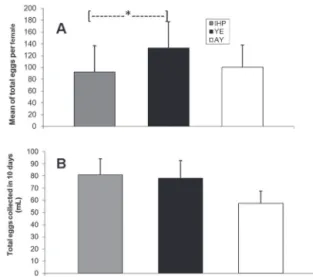
In small-scale fecundity tests, the mean of eggs laid per female during ten days of the experiment was greater for females fed with YE compared with those fed with IHP diet (one-way ANOVA, F = 5.015, df = 2, p = 0.00099 – Figure 1A). Regarding AY diet, there was no difference compared with the other di-ets. In large-scale tests, the total production of eggs was similar among the three diets (Figure 1B, one-way ANOVA, F = 2.937, df = 2, p = 0.1290).
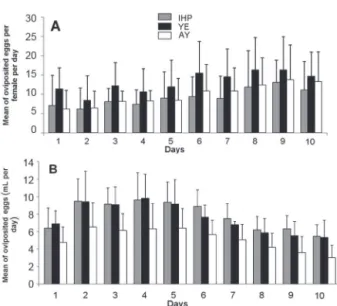
In small-scale tests, the egg production (eggs per female per day) was greater for YE group comparing with the two other diet groups, independent of flies’ age (two-way ANOVA with Bonferroni multiple
com-parisons post test, F = 6.811, df = 17.82, p < 0.05 – Figure 2A). In large-scale tests, the egg production (mL eggs per day) did not differ between the three tested diets and there was no interaction between the factors age and diet (two-way ANOVA with Bonfer-roni multiple comparisons post test, F = 0.1132, df = 18, p > 0.05 – Figure 2B). The great variance (SD) in egg production observed in small and large scale tests is likely due to natural individual variation of flies, because in each replicate we used a different group of flies. Also, in large scale tests there were differ-ent numbers of flies in each treatmdiffer-ent and replicate (because of the method used) and so this could have contributed to the amount of variation found in large scale data. However, there was a consistent result con-cerning the similar efficiency of diets with regard to this parameter.
The equivalence of egg production among the diets, and the superiority of YE in small scale tests, represented excellent results in that SIT requires mass rearing with high fecundity rates and the production of millions of insects every week (Chang, 2009). Adult female fecundity in C. capitata is related to protein intake in larval stage (Cocareli et al., 1988) but prin-cipally determined by protein ingestion in the adult phase, especially after the pre-oviposition period (the fifth day of adult life) (Cangussu and Zucoloto, 1995). Not only the quantity, but also the quality of the pro-tein sources will affect reproductive rates in C. capi-tata (Chang, 2004).
The compositional analysis of the three diets indi-cated that they were all very similar in terms of the ma-jority of their components, and that the protein contents (above 50 %) of the diets tests were all adequate (with the YE diet having a greater protein content than the control diet) (Table 1). The data from the compositional analyses corroborated the results of the fecundity rates in the small-scale tests that demonstrated greater fecun-dity on the YE diet.
The eclosion percentages of the eggs were simi-lar (means around 60-70 %) for the three diets tested and there was no interaction between the factors age and diet (two-way ANOVA with Bonferroni multiple comparisons post test, F = 0.1099, df = 18, p > 0.05 – Figure 3). The equivalence between the three diets in relation to egg viability was an important result be-cause the quality, not just the quantity, of the eggs is fundamental to the success of the SIT technique (Chang, 2009).
Regarding fly survival, after 20 days on each diet, the survival curve for females (Figure 4A) and males (Figure 4B) analyzed by Kaplan-Meyer method did not show differences in mortality patterns between the flies from different diets. Females - Log-rank (Mantel-cox) test: X2 = 5.615, d.f = 2; p = 0.0603. Males - Log-Figure 2 – Daily fecundity in small and large-scale tests. (A) Daily
fecundity in small-scale tests (mean ± SD; n = 20). There is difference between IHP vs. YE and YE vs. AY (two-way ANOVA with Bonferroni post test, F = 6.811, d.f = 17.82, p < 0.05). (B) Daily fecundity (mL per day) in large-scale tests (mean ± SD; n = 3). There is no difference in egg production (mL per day) among the three diets: IHP = 7.82 ± 1.61 (mean ± SD of mean daily production- mL of eggs in 10 days); YE = 7.54 ± 1.70 (mean ± SD of mean daily production- mL of eggs in 10 days); AY = 5.16 ± 1.25 (mean ± SD of the mean daily production- mL of eggs in 10 days) (two-way ANOVA with Bonferroni post test, F = 0.1132, d.f = 18, p > 0.05). IHP: imported hydrolyzed protein, and YE: yeast extract and AY: autolyzed yeast.
Table 1 – Comparison of approximate composition of proteins, lipids, ash, moisture and carbohydrate between the three diets (mean ± SD; n = 3). IHP: imported hydrolyzed protein, AY: autolyzed yeast and YE: yeast extract.
Diet Protein Lipid Ash Moisture Carbohydrate % ---IHP 58.1 ± 1.3 7.6 ± 1.8 10.0 ± 0.2 7.3 ± 0.2 16.86 AY 51.5 ± 0.9 6.9 ± 0.4 6.5 ± 0.5 6.46 ± 0.2 28.47 YE 63.0 ± 0.4 8.5 ± 0.2 15.1 ± 0.2 4.6 ± 0.2 8.79
Figure 3 – Comparison of egg viability for diets containing each protein source. Egg eclosion percentage of each diet group in each day is shown (mean ± SD; n = 3). There is no difference among the three diets (two-way ANOVA with Bonferroni multiple comparisons post test, F = 0.1099, d.f = 18, p > 0.05). IHP: imported hydrolyzed protein, AY: autolyzed yeast and YE: yeast extract.
rank (Mantel-cox) test: X2 = 1.727, d.f = 2; p = 0.4217. On the twentieth day (the end of experiment) around 80-90 % of males and 45-80 % of females of all diets were still alive. The means (± SD) of survival percentage show a greater variation for females’ survival fed on IHP diets (73.9 ± 20.68) compared with other diets (YE = 89.00 ± 13.64; AY = 90.25 ± 8.10). These data could explain the no significant result in Long-rank (Mantel-cox) test (p = 0.0603) for females’ survival comparison. Among males there was a more uniform pattern of sur-vival results as shown also by means (± SD): IHP = 91.15 ± 7.12; YE = 95.4 ± 3.50; AY = 96.55 ± 4.23).
Some lines of C. capitata supplied with low con-centration protein diets in their adult phase demon-strate longevity reductions (Cangussu and Zucoloto, 1997; Niyazi et al., 2004). Kaspi and Yuval (2000) noted that after 24 h of fasting, C. capitata adults that had been fed on high protein diets demonstrated much higher mortality rates than adults that had been raised on low protein diets. In another study, Muller et al. (1997) reported that the mortality rates of C. capitata decreased when the adults were fed on protein diets. Others authors do not show any strict link between the amount of protein ingestion in their adult phase and longevity (Shelly and Kennelly, 2002; Shelly and McIn-nis, 2003). Despite the fact that longevity can be an important parameter in evaluating the quality of any diet (Chang et al., 2001), the most important consid-erations for large scale commercial producers are that the females produce large numbers of viable eggs near the peak phase of ovipositioning and that the males are active and able perform copulation so that there will be no drop in fertility.
Survivorship beyond 20 days will not result in any significant benefits to breeding these fruit flies, as it has been established that senescence has strong negative effects on the fertility and survival rates of most insects, including C. capitata (Carey et al., 1998; Burger et al., 2007). The Brazilian commercial yeast products tested here demonstrated very good results in terms of male and female longevity when compared to insects raised on imported hydrolyzed protein, thus eliminating any concerns about this pa-rameter.
In terms of economic viability, the IHP feed cur-rently costs approximately 122.00 US$ kg–1, while the
two domestic products YE and AY have much lower costs: approximately 3.00 US$ kg–1, and 2.00 US$ kg–1,
respectively - which represents a huge savings in terms of the costs of commercial mass production of C. capi-tata.
Acknowledgements
To Biofábrica Moscamed Brasil (BMB) for their logistic support and to the Fundação de Amparo à Pes-quisa do Estado da Bahia (FAPESB) for their financial support (Edital Semi-Árido, number 8020/2007).
References
Aluja, M.; Jacome, I.; Macıas-Ordonez, R. 2001. Effect of adult nutrition on male sexual performance in four tropical fruit fly species of the genus Anastrepha (Diptera: Tephritidae). Journal of Insect Behavior 14: 759–775.
Burger, J.M.S.; Hwangbo, D.S.; Corby-Harris, V.; Promislow, D.E.L. 2007. The functional costs and benefits of dietary restriction in Drosophila. Aging Cell 6: 63–71.
Cangussu, J.A.; Zucoloto, F.S. 1995. Self-selection and perception threshold in adult females of Ceratitis capitata. Journal of Insect Physiology 41: 223–227.
Cangussu, J.A.; Zucoloto, F.S. 1997. Effect of protein sources on fecundity, food acceptance, and sexual choice by Ceratitis capitata (Diptera, Tephritidae). Revista Brasileira de Biologia 57: 611–618.
Carey, J.R.; Liedo, P.; Muller, H.G.; Wang, J.L.; Vaupel, J.W. 1998. Dual modes of aging in Mediterranean fruit fly females. Science 281: 996–998.
Chang, C.L. 2004. Effect of amino acids on larvae and adults of Ceratitis capitata (Diptera: Tephritidae). Annals of the Entomological Society of America 97: 529–535.
Chang, C.L. 2009. Evaluation of yeasts products in larval and adult diets for the oriental fruit fly, Bactrocera dorsalis, and adult diets for the medfly, Ceratitis capitata, and the melon fly, Bactrocera curcubitae. Journal of Insect Science 9: 1–9. Chang, C.L.; Albrecht, C.; El-Shall, S.S.A.; Kurashima, R. 2001.
Adult reproductive capacity of Ceratitis capitata (Diptera, Tephritidae) on a chemically defined diet. Annals of the Entomological Society of America 94: 702–706.
Cocareli, N.M.; Ferro, M.I.T.; Zucoloto, F.S. 1988. Nutritive value of beer yeast for Ceratitis capitata. Revista Brasileira de Zoologia 5: 253–259.
Dadd, R.H. 1985. Nutrition: organisms. p. 313–389. In: Kerkut, G.A.; Gilbert L.I., eds. Comprehensive insect physiology, biochemistry and pharmacology. Pergamon Press, London, UK.
Hendrichs, J.; Franz, G.; Rendon, P. 1995. Increased effectiveness and applicability of the sterile insect technique through male-only releases for control of Mediterranean fruit flies during fruiting seasons. Journal of Applied Entomology 119: 371–377.
Hendrichs, J.; Robinson, A.S.; Cayol, J.P.; Enkerlin, W. 2002. Medfly area-wide sterile insect technique programmes for prevention, suppression or eradication: the importance of mating behavior studies. Florida Entomologist 85: 1–13. Kaspi, R.; Yuval, B. 2000. Post-teneral protein feeding improves
sexual competitiveness but reduces longevity of mass-reared sterile male Mediterranean fruit flies (Diptera: Tephritidae). Annals of the Entomological Society of America 93: 949–955. Kaur, S.; Srivastava, B.G. 1991. Effect of B-vitamins on various
parameters of reproductive potential of Dacus cucurbitae (Coquillett). Indian Journal of Entomology 53: 543–547. Manrakhan, A.; Lux, S.A. 2006. Contribution of natural food
Muller, H.G.; Wang, J.L.; Capra, W.B.; Liedo, P.; Carey, J.R. 1997. Early mortality surge in protein deprived females causes reversal of sex differential of life expectancy in Mediterranean fruit flies. Proceedings of the National Academy of Sciences of the United States of America 94: 2762–2765.
Niyazi, N.C.; Lauzon, R.; Shelly, T.E. 2004. Effect of probiotic adult diets on fitness components of sterile male Mediterranean fruit flies (Diptera: Tephritidae) under laboratory and field cage conditions. Journal of Economic Entomology 97: 1570–1580.
Rohlfs, M.; Hoffmeister, T.S. 2005. Maternal effects increase survival probability in Drosophila subobscura larvae. Entomologia Experimentalis et Applicata 117: 51–58.
Santos, R.K.P. 2003. Will we achieve $1 billion with export of fruits by 2010? Hortifruti Brasil 10: 8–11 (in Portuguese).
Schulz, H.E.; Oslage, H.J. 1976. Composition and nutritive value of single-cell protein (SCP). Animal Feed Science and Technology 1: 9–24.
Shelly, T.E; Kennelly, S. 2002. Influence of male diet on male mating success and longevity and female remating in the Mediterranean fruit fly (Diptera: Tephritidae) under laboratory conditions. Florida Entomologist 85: 572–579. Shelly, T.E; Mcinnis, D.O. 2003. Influence of adult diet on the