Temporal and spatial variation of limnological
variables and biomass of different macrophyte species
in a Neotropical reservoir (São Paulo – Brazil)
Variação temporal e especial de variáveis limnológicas e da biomassa de diferentes
espécies de macrófitas em um reservatório Neotropical (São Paulo – Brasil)
Flávia Bottino1, Maria do Carmo Calijuri1 and Kevin Joseph Murphy2
1Departamento de Hidráulica e Saneamento – SHS, Escola de Engenharia de São Carlos – EESC, Universidade de São Paulo – USP, Av. Trabalhador São-Carlense, 400, CEP 13566-590, São Carlos, SP, Brazil
e-mail: [email protected]; [email protected]
2Institute of Biodiversity, Animal Health and Comparative Medicine, Graham Kerr Building, University of Glasgow, G12 8QQ, Glasgow, Scotland
e-mail: [email protected]
Abstract:Aim: This study reports an investigation of limnological characteristics and aquatic macrophyte occurrence in a neotropical reservoir in order to assess the spatio-temporal variation of water and sediment variables and their influence on plant distribution. Methods: Macrophytes, water and sediment samples were collected from a Brazilian reservoir in different seasons from four main arms of the reservoir. In total sixteen water-sediment variables were analyzed including N:P ratio and Trophic State Index. The plants were collected using a quadrat sampling procedure and the dry weight per sample was measured. MANOVA was performed to evaluate spatial and temporal variation of environmental variables as well as seasonal biomass differences. To assess the relationship among environmental variables and macrophytes an ordination analysis (using Canonical Correspondence Analysis: CCA) was carried out. Results: The spatial and temporal variation of limnological variables generated a heterogeneous system which supports the presence of different species of macrophyte. pH, dissolved oxygen and sediment composition were important predictors of Polygonum lapathifolium occurrence while nutrients were associated with Eichhornia crassipes and Pistia stratiotes. Inorganic substances were related to biomass variation of Eichhornia azurea and Myriophyllum aquaticum. Conclusions: The spatial variation of the environmental variables has caused heterogeneity in the reservoir and it may support the occurrence of different species of macrophyte. Limnological variables highlighted in CCA are important to predict the species occurrence and their control in the study area.
Keywords: environmental variables, Eichhornia sp., Polygonum lapathifolium,
Myriophyllum aquaticum, neotropical reservoir.
Resumo: Objetivos: Esse estudo relata uma investigação das características limnológicas e da ocorrência de macrófitas aquáticas em um reservatório Neotropical com o intuito de verificar a variação espaço-temporal das variáveis da água e do sedimento e sua influência sobre a distribuição das plantas. Métodos: Amostras de macrófitas, água e sedimento foram coletadas em quatro braços de um reservatório brasileiro nas diferentes estações do ano. No total, dezesseis variáveis foram analisadas, incluindo relação N:P e Índice de Estado Trófico. As plantas foram coletadas com um amostrador quadrado e o peso seco foi obtido. Um teste MANOVA foi realizado para verificar a variação espaço temporal das variáveis limnológicas, bem como da biomassa de macrófitas aquáticas. Para avaliar a relação entre as variáveis ambientais e a biomassa das plantas, uma análise de ordenação foi empregada (Análise de Correspondência Canônica: CCA). Resultados: A variação espacial das variáveis limnológicas gerou um sistema heterogêneo que favorece a ocorrência de diferentes espécies de macrófitas. Variáveis como pH, oxigênio dissolvido e composição do sedimento foram importantes para predizer a ocorrência de Polygonum lapathifolium, enquanto nutrientes estiveram associados com Eichhornia crassipes e
Pistia stratiotes. Substâncias inorgânicas relacionaram-se com a variação da biomassa de Eichhornia azurea e Myriophyllum aquaticum. Conclusões: A variação espacial das variáveis ambientais causou uma heterogeneidade no ecossistema, permitindo a ocorrência de diferentes espécies de macrófitas. As variáveis limnológicas indicadas na CCA são importantes para predizer a ocorrência de macrófitas e controlar seu crescimento exacerbado no reservatório estudado.
Palavras-chave: variáveis ambientais Eichhornia sp., Polygonum lapathifolium,
State are eutrophic, and as a result an increase of the macrophyte biomass of mainly free-floating species has been reported (Cavenaghi et al., 2005; Martins et al., 2008). Although the benefits of macrophytes for aquatic systems are recognized (Kouki et al., 2009; Hassan et al., 2010; Vymazal, 2011), when growing in high abundance these plants interfere with the utilization of water resources (Pieterse and Murphy, 1993), blocking water flow, depleting oxygen in the water, and causing problems for hydropower generation and navigation. Due to these issues (both benefits and nuisance) the study of aquatic macrophyte communities and the factors which drive their distribution are important for water resource management of reservoir systems. This study aimed to assess the seasonal variation of water and sediment variables and their influence on macrophyte distribution in a Neotropical reservoir.
2. Material and Methods
2.1. Study area
Itupararanga Reservoir (23° 36’ 42” S; 47° 23’ 48” W), within the Sorocaba River Basin in São Paulo State, Brazil (Figure 1), is 26 km in length and has an area of approximately 936 km2. The
annual rainfall in the watershed is around 1400 mm, with dry winters and wet summers. The minimum
1. Introduction
Prediction of the occurrence and abundance of macrophytes species is a major issue in ecological studies of these plants, so establishing what factors determine their growth and distribution is essential. Macrophyte distribution is related to several environmental and anthropogenic factors (eg. climate, hydrology, geomorphology, nutrient availability, biological interactions, and human activities) (Lacoul and Freedman, 2006; Feldmann and Nõges, 2007; Hrivnák et al., 2009).
In neotropical regions abundant aquatic macrophyte biomass is a usual feature of reservoirs due to slow or near-static water velocity, sediment stability, water level control, shoreline development, high temperatures and often high nutrient availability (Bini et al., 2005). Most Brazilian reservoirs are shallow, with a dendritic morphology, which supports the development of coastal areas (Thomaz and Bini, 1998). The presence of these shallow areas, coupled with the generally favorable growing conditions of the tropics, as well as human activities (i.e. domestic and industrial effluent input, fertilizer use, dam construction) which promote macrophyte growth, all tend to favour abundant macrophyte production in neotropical reservoirs.
According to Dos Santos and Calijuri (2001) many lentic aquatic ecosystems in Sao Paulo
(APHA, 2005). Total Organic Carbon (TOC) and Inorganic Carbon (IC) were analyzed using TOC Analyzer (Shimadzu – SSM 5000 – Combustion Method) Trophic Status was obtained according to Lamparelli (2004). Sediment organic matter (OMS) was analyzed according to Wetzel and Likens (2000), while total phosphorus (TPS) was analyzed following Andersen (1976), and total nitrogen (TNS) following APHA (2005). Granulometric analyses were performed in accordance with Nogueira (2005).
For macrophyte live-biomass analyses, the main plant species (i.e. most abundant species) in the littoral zone were collected within quadrat samples (area 0.25 m2) (Westlake, 1965). The quadrat was
randomly-located (at sites with healthy and mature plants; in triplicate) and aerial and submerged parts of the macrophytes were sampled (including roots in the emerged species) using sickle and hook. The collected biomass was washed with tap water to remove coarse material and dried (60 °C) to constant weight. The plants were weighed to obtain values of mean biomass (calculated per 1 m2). The main species in ITU
1 were Eichhornia
crassipes (Mart) Solms and Pistia stratiotes L., while in ITU2 and ITU3 Polygonum lapathifolium L. was predominant and in ITU4 Eichhornia azurea (Sw.) Kunth and Myriophyllum aquaticum (Vell.) Verdc.
Temporal and spatial variations of water variables as well as time variation of the biomass were tested using MANOVA (significance level p<0.05) (Statistica® Software Version 10.0). The macrophyte environment dataset was analyzed using CCA ordination (CANOCO 4.5) to determine the relative importance of individual environmental factors as predictors of macrophyte distribution in Itupararanga Reservoir.
3. Results
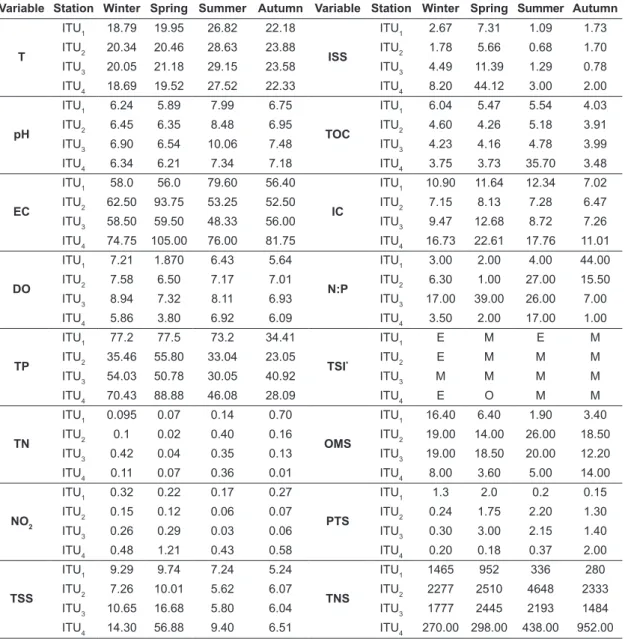
Table 2 shows mean environmental data recorded for the four sampling stations and seasons. MANOVA results suggested a significant difference among sampling stations (spatial variation; p < 0.05) and maximum air temperatures in the area are
between 15.0 °C and 24.0 °C and the mean wind speeds range from 1.5 m s–1 to 3.0 m s–1 (INMET,
2009, 2010). The main uses of the reservoir are public water supply and power generation for an aluminium company. Despite the existence of a permanent preservation area around the reservoir, agriculture (mainly strawberries, onions, potatoes, lettuce and tomato crops) is the predominant land use in the watershed, occupying 42% of the reservoir area (Garcia et al., 1999).
The sampling stations were located in four main arms of Itupararanga Reservoir (Figure 1) which are influenced by rivers running through different parts of Ibiuna city. These arms were coded as ITU1 (23° 37’ 28.3” S; 47° 13’ 52.24” W) located near the headwater of the reservoir, and surrounded by small riparian forest, road and building in its sides; ITU2 (23° 39’ 24.65” S; 47° 18’ 36.5” W) which has agriculture (lettuce crop) as the main land use in the sub-catchment and Campo Verde Stream is the main tributary of this arm; ITU3 (23° 37’ 42.53” S; 47° 17’ 04.62” W) which is influenced by Ressaca Stream and has buildings and roads on its shore lines; and ITU4 (23° 40’ 10.72” S; 47° 21’ 21.02” W) which is surrounded by buildings and fishing area, whilst its tributary (Paruru Stream) receives effluent input from a sewage treatment plant. 2.2. Sampling regime
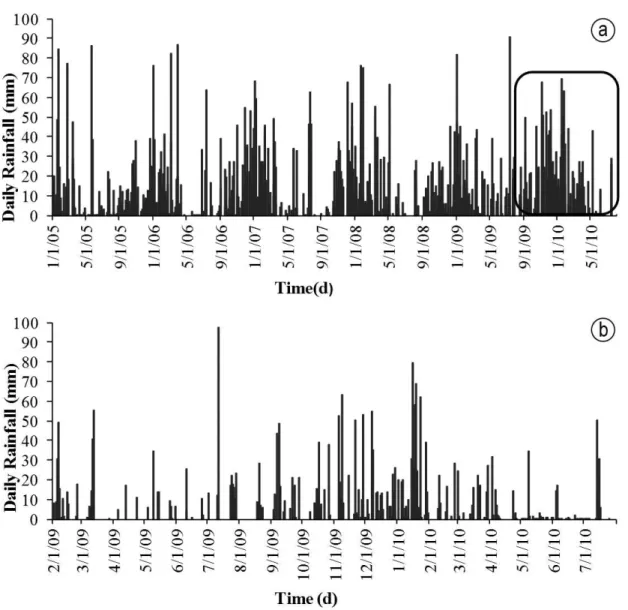
Sampling was carried out in the winter, spring, summer and autumn periods, respectively in August and October 2009 and February and April 2010. Table 1 and Figure 2 show the main differences among the seasons and the hydrological pattern in Itupararanga Reservoir, respectively. In situ measurements for water temperature (T), pH, electrical conductivity (EC) and dissolved oxygen (DO) were obtained with a multiparameter probe (Yellow Spring Instruments YSI 556®). Total suspended solids (TSS), organic suspended solids (SSO), inorganic suspended solids (SSI) total phosphorus (TP), nitrite (NO2) and nitrate (NO3) were analyzed using standard methods
Table 1. Data of Itupararanga Reservoir in different seasons (Winter-August/2009; Spring-October/2009; Summer-February/2010; Autumn-April/2010).
Season Water Level* (mAMSL**) Monthly Rainfall (mm)* Previous Rainfall (mm)*** Upstream Flow* (m3.s–1)
Downstream Flow*(m3.s–1)
Winter 823.74 57.00 0.0 13.41 17.43
Spring 823.06 135.00 76.00 16.83 19.70
Summer 825.15 110.00 22.00 26.43 32.70
Autumn 825.01 79.00 18.00 22.50 27.00
predominance of SSI (maximum value: 77.1% in ITU4) while the SSO ranged from 51% to 87.1% in other seasons. In general the TP and NO2 concentrations were higher in spring except for TN. ITU4 showed the highest nutrient concentration. The N:P ratio was generally higher in autumn and the lowest values ranged between winter and spring and the Trophic Status Index (TSI) was on average mesotrophic for the four arms.
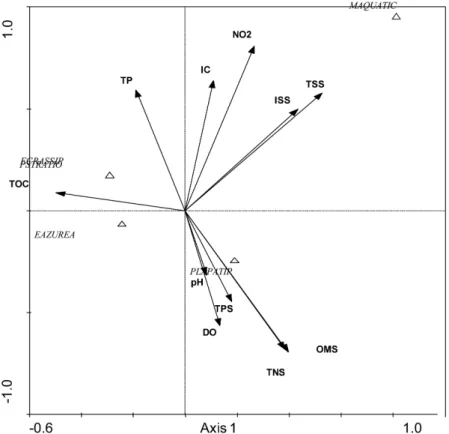
The CCA results (Figure 4) showed that ISS has significant relation with pH, TSS, NO2, IC and TP,
whilst NO2 is related with TSS, IC and TP; TP with IC, and TSS with IC and TP (p < 0.05).
The sediment analyses indicated significant spatial and temporal variation of PTS (p = 0.01) with higher values in the spring (maximum concentration: 3.0 µg.g–1 in ITU
3). The highest
as well as among periods (temporal variation; p < 0.01). In general the main differences among the arms (spatial variation) were recorded for pH, DO, SSI, TP, T, OMS and TPS; the variables responsible for seasonal differences (temporal variation) were pH, T, NO3, TOC, OMS, TPS, TNS (Table 3).
In relation to the thermal structure ITU3 was stratified in the summer and micro-stratifications occurred in the other periods (Figure 3). The highest water temperature (27-29 °C) and pH (7.67-9.8) occurred in the summer. DO concentrations were generally high in all sampling stations mainly in the winter (6 mg.L–1 to 8 mg.L–1). Electrical
conductivity ranged from 54 µS.cm–1 to 81 µS.cm–1
and the highest values were recorded mainly in spring, as well as the SST concentrations (9.7-57 mg.L-1). Moreover in the same period there was a
percentages of OMS were recorded in both ITU2 and ITU3 while TN showed high concentration in ITU2 (Table 2). From the CCA we found significant correlation (p < 0.05) between OMS and DO; OMS and TP; OMS and TPS; OMS and TNS as well as between TNS and NO2 and TNS
and TPS. Figure 5 shows the results of sediment granulometric analyses. Silt was the predominant fraction in all sampling stations and seasons (90% to 60.8%), while gravel occurred mainly after rainfall but in small proportion. The variation in Table 2. Mean data of environmental variables in four arms of Itupararanga Reservoir. EC: Electrical Conductivity (µS.cm–1); DO: Dissolved Oxygen (mg.L–1); TP: Total Phosphorus (mg.L–1); TN; Total nitrogen (mg.L–1); NO
2: Nitrite (µg.L–1); TSS: Total Dissolved Solids (mg.L–1); ISS: Inorganic Solids (mg.L–1); TOC: Total Organic Carbon (mg.L–1); IC: Inorganic Carbon (mg.L–1); TN:TP: Total Nitrogen and Total Phosphorus molecular ratio; TSI: Trophic Status Index; MOS: Organic Matter in Sediment (%); TPS: Total Phosphorus in Sediment (µg.g–1); TNS: Total Nitrogen in Sediment (µg.g–1).
Variable Station Winter Spring Summer Autumn Variable Station Winter Spring Summer Autumn
T
ITU1 18.79 19.95 26.82 22.18
ISS
ITU1 2.67 7.31 1.09 1.73
ITU2 20.34 20.46 28.63 23.88 ITU2 1.78 5.66 0.68 1.70
ITU3 20.05 21.18 29.15 23.58 ITU3 4.49 11.39 1.29 0.78
ITU4 18.69 19.52 27.52 22.33 ITU4 8.20 44.12 3.00 2.00
pH
ITU1 6.24 5.89 7.99 6.75
TOC
ITU1 6.04 5.47 5.54 4.03
ITU2 6.45 6.35 8.48 6.95 ITU2 4.60 4.26 5.18 3.91
ITU3 6.90 6.54 10.06 7.48 ITU3 4.23 4.16 4.78 3.99
ITU4 6.34 6.21 7.34 7.18 ITU4 3.75 3.73 35.70 3.48
EC
ITU1 58.0 56.0 79.60 56.40
IC
ITU1 10.90 11.64 12.34 7.02
ITU2 62.50 93.75 53.25 52.50 ITU2 7.15 8.13 7.28 6.47
ITU3 58.50 59.50 48.33 56.00 ITU3 9.47 12.68 8.72 7.26
ITU4 74.75 105.00 76.00 81.75 ITU4 16.73 22.61 17.76 11.01
DO
ITU1 7.21 1.870 6.43 5.64
N:P
ITU1 3.00 2.00 4.00 44.00
ITU2 7.58 6.50 7.17 7.01 ITU2 6.30 1.00 27.00 15.50
ITU3 8.94 7.32 8.11 6.93 ITU3 17.00 39.00 26.00 7.00
ITU4 5.86 3.80 6.92 6.09 ITU4 3.50 2.00 17.00 1.00
TP
ITU1 77.2 77.5 73.2 34.41
TSI*
ITU1 E M E M
ITU2 35.46 55.80 33.04 23.05 ITU2 E M M M
ITU3 54.03 50.78 30.05 40.92 ITU3 M M M M
ITU4 70.43 88.88 46.08 28.09 ITU4 E O M M
TN
ITU1 0.095 0.07 0.14 0.70
OMS
ITU1 16.40 6.40 1.90 3.40
ITU2 0.1 0.02 0.40 0.16 ITU2 19.00 14.00 26.00 18.50
ITU3 0.42 0.04 0.35 0.13 ITU3 19.00 18.50 20.00 12.20
ITU4 0.11 0.07 0.36 0.01 ITU4 8.00 3.60 5.00 14.00
NO2
ITU1 0.32 0.22 0.17 0.27
PTS
ITU1 1.3 2.0 0.2 0.15
ITU2 0.15 0.12 0.06 0.07 ITU2 0.24 1.75 2.20 1.30
ITU3 0.26 0.29 0.03 0.06 ITU3 0.30 3.00 2.15 1.40
ITU4 0.48 1.21 0.43 0.58 ITU4 0.20 0.18 0.37 2.00
TSS
ITU1 9.29 9.74 7.24 5.24
TNS
ITU1 1465 952 336 280
ITU2 7.26 10.01 5.62 6.07 ITU2 2277 2510 4648 2333
ITU3 10.65 16.68 5.80 6.04 ITU3 1777 2445 2193 1484
ITU4 14.30 56.88 9.40 6.51 ITU4 270.00 298.00 438.00 952.00
Table 3. Main variables responsible for spatio-temporal variation in Itupararanga Reservoir. Results from MANOVA (significance level p < 0.05).
Variable Spatial variation
Variable Temporal variation
OMS p=0.007 OMS p=0.01
TPS p=0.01 TPS p=0.01
DO p=0.017 pH p=0.012
T p=0.019 T p=0.028
ISS p=0.039 NO3 p=0.03
TP p=0.046 TNS p=0.03
Figure 3. Vertical variation of water temperature (°C) in four arms of Itupararanga Reservoir in different seasons (Winter-August/2009; Spring-October/2009; Summer-February/2010; Autumn-April/2010).
substrate fractions did not show seasonal significant differences.
Macrophyte biomass varied seasonally as showed by MANOVA (Table 4). The highest biomass of Polygonum lapathifolium was recorded in ITU2 in
the winter and in the autumn (966 gDW.m2 and
917 gDW.m2 respectively) while Eichhornia crassipes
and Pistia stratiotes showed high biomass values in ITU1 in the spring and summer, respectively. In ITU4 the stands of Eichhornia azurea and
Myriophyllum aquaticum were senescent in both summer and autumn.
The CCA analysis (total variance: 90%) suggests that ITU1 sampling station was influenced by TP and TOC in all periods while DO, pH, OMS, TPS and TNS were related with ITU2 and ITU3. TOC was associated with ITU4 in winter and with NO2, TSS and ISS in the spring. So the species distribution was correlated with these variables (Figure 4) which explained almost 63% of data variability on the first axis of the CCA (eigenvalue: 0.89). The most important variables for Factor 1 were TP, DO, pH, MOS, TPS, NTS, P. lapathipholium, E. crassipes and P. stratiotes.
4. Discussion
Water temperature followed the normal seasonal pattern and DO concentrations were highest in the
summer due probably to phytoplankton activity. CE, TSS, ISS, IC and TP are likely to be related to the rainfall in spring (76 mm) while high pH values may be associated with high photosynthesis rates in summer, which is usual in tropical reservoirs. Both TOC and IC showed lowest concentrations when the pH values were relatively neutral. Probably the tributaries and runoff provide a constant TN load to the reservoir since this variable did not show temporal variation in either water or sediment. Our TSI results are in agreement with Pedrazzi et al. (2013) although the differences between methods used. Previous research concluded the seasons and rainfall pattern are important to predict the heterogeneity of Itupararanga Reservoir (Pedrazzi et al., 2013).
Granulometric analysis showed the prevalence of silt in sediment and in rainy periods (mainly in the spring) there was increased gravel occurrence which may be from tributary drainage, due to high flows (see Table 1). Sediment variables (mainly OMS and TPS) were the main responsible for spatio-temporal heterogeneity in Itupararanga Reservoir suggesting the influence of different land covers in the arms (see item 2.1).
spatial variation of limnological variables for aquatic macrophytes through the CCA analysis. The results of the Canonical Correspondence highlighted the relationship of variables responsible for spatial heterogeneity and macrophyte species.
E. crassipes and P. stratiotes were influenced by TP and TOC in Itupararanga Reservoir. It is known these species are associated with high nutrient concentration (Henry-Silva et al., 2008) and are abundant in eutrophic ecosystems: ITU1 was the sampling station with eutrophic conditions for most of the study period. Although not clear in CCA analysis, the maximum P. stratiotes biomass coincided with the highest TN concentration and this species growth is influenced by nitrogen concentration (Henry-Silva et al., 2008).
The senescence of P. stratiotes in the spring may be related to the competition process with E. here, which suggested a substantial amount of
spatial and seasonal variation of water and sediment variables, and macrophyte occurrence. So we may point out the macrophyte cover is related mainly to the spatial habitat heterogeneity of Itupararanga Reservoir. We suppose the influence of different land covers and streams (tributaries) running through different areas were responsible to generate the limnological differences among sampling stations (Table 3). In this regard different macrophyte species grew on the arms studied.
Indeed some researches have reported the influence of water variables on macrophyte growth and distribution, for instance TP concentration and E. crassipes and P. stratiotes presence (Bini et al., 1999; Lacoul and Freedman, 2006); sediment variables and Poligonaceae occurrence (Takamura et al., 2003). It is possible to assess the importance of
Figure 4. CCA ordination plot on Axis 1 (horizontal) and Axis 2 (vertical) of 5 macropyte species and 11 environ-mental samples. Species codes: EAZUREA: Eichhornia azurea; ECRASSIP: Eichhornia crassipes; PSTRATIO: Pistia stratiotes; MAQUATIC: Myriophyllum aquaticum; PLAPATIP: Polygonum lapathifolium. Environmental codes: TOC: Total Organic Carbon (mg.L–1); TP: Total Phosphorus (mg.L–1); IC: Inorganic Carbon (mg.L–1); NO
Table 4. Aquatic macrophyte biomass (gDW.m–2) in different arms and seasons in Itupararanga Reservoir.
Species Winter Spring Summer Autumn p MANOVA
ITU1
Eichhornia crassipes 409.07 721.30 508.53 882.30 p < 0.05
Pistia stratiotes 219.30 * 591.6 551.07 p < 0.05
ITU2
Polygonum lapathifolium 966.30 391.07 512.30 917.10 p < 0.05
ITU3
Polygonum lapathifolium 506.30 487.60 407.30 541.50 p < 0.05
ITU4
Eichhornia azurea 617.30 * * *
-Myriophyllum aquaticum * 317.07 * *
-*The macrophyte stand was senescent.
pollution, for example compounds draining from agricultural areas (Lacoul and Freedman, 2006). Similarly Pozo et al. (2011) have concluded that emergent and floating macrophytes composition is best explained by land use variables within the catchment. Due to the proximity of stream mouths to the sites with macrophyte biomass we propose too that the fluvial activity has an important role on biomass development. This fact is relevant when comparing the occurrence of the same macrophyte species in the whole river basin (Tietê River Basin: e.g. Cavenaghi et al., 2005; Martins et al., 2008).
In summary, variables like pH, DO, TOC, IC, NO2, ISS, TSS, TPS, TNS and OMS were more important to predict the macrophyte occurrence and may be used as a tool for water management. The variables highlighted here may be useful to control macrophyte excessive growth since the nutrients increasing is a problem in Brazilians reservoirs mainly in Tietê River Basin. In this regard we suggest that P. lapathifolium generates different redox conditions influencing phosphorus release from the sediment. E. crassipes may be considered as indicating high trophic status while E. azurea and M. aquaticum are indicative of inorganic compounds in the water. Moreover P. lapathifolium and E. crassipes presence may be also associated with different land uses. The heterogeneity of the ecosystem due to spatial variation of environmental variables may be more important than seasonal variation to predict the occurrence of different macrophyte species. The composition of the species did not range with the temporal variation of the environmental variables. However water and sediment variables were important to predict biomass development and although land use data were not available we supposed they have an important role in macrophyte distribution.
This study has demonstrated in general way the factors driving the macrophytes distribution in Itupararanga Reservoir. Our results may support future researches in similar environments and to contribute to the water resources management.
Acknowledgments
We express our sincere thanks to FAPESP (Fundação de Amparo à Pesquisa do Estado de São Paulo) for the financial support granted to MC Calijuri (2008/55636-9). We are grateful to CNPq (Conselho Nacional de Desenvolvimento Científico e Tecnológico) for the doctoral scholarship awarded to F Bottino (141074/2009-4).
crassipes during this period (P. stratiotes is known to be a fairly weak competitor with other tropical free-floating macrophytes: e.g. Agami and Reddy, 1990). P. stratiotes was senescent when the E. crassipes biomass increased 56% approximately. E. crassipes specimens normally have advantages due to their intensive growth, more efficient use of solar radiation and higher capacity of absorbing nutrients when they are abundant (Agami and Reddy, 1990; Henry-Silva et al., 2008).
The CCA species-environmental analyses showed a positive relationship between P. lapathifolium (in both ITU2 and ITU3) and pH and DO. Higher pH
values were recorded in sampling stations with P. lapathifolium presence. In addition TP was inversely correlated with that species while the results suggest that the sediment is an important factor for P. lapathifolium development and probably drives the distribution of this plant. According to Takamura et al. (2003) Polygonaceae are important to restrain the P loadings from the sediment due to high DO concentration in the stands with these plants, even in the bottom as in Itupararanga Reservoir (from 6.5 to 8.94). Both ITU2 and ITU3 have shown mesotrophic condition in almost all seasons and had relatively high TPS concentration when the biomass of P. lapathifolium was high.
In ITU4 M. aquaticum was correlated with solids and NO2 while E. azurea and TOC were associated with the presence of this plant. Interestingly E. azurea was absent when the pH and SST concentrations were high, as also noted by Bini et al. (1999) in another Brazilian reservoir (Itaipu). On the other hand M. aquaticum occurrence coincided with the highest concentrations of solids and with the SSI predominance period. Both inorganic compounds and probably electrical conductivity appear to be predictors of Myriophyllum presence (see also Lacoul and Freedman, 2006).
shallow reservoir Lake Qattieneh/Syria. Limnologica, vol. 40, p. 54-60. http://dx.doi.org/10.1016/j. limno.2009.01.002
HENRY-SILVA, GG., CAMARGO, AFM. and PEZZATO, MM. 2008. Growth of free-floating aquatic macrophytes in different concentrations of nutrients. Hydrobiologia, vol. 610, no. 1 p. 153-160. http://dx.doi.org/10.1007/s10750-008-9430-0 HRIVNÁK, R., OŤAHE’OVÁ, H. and GÖMÖRY, D.
2009. Seasonal dynamics of macrophyte abundance in two regulated streams. Central European Journal of Biology, vol. 4, no. 2, p. 241-249. http://dx.doi. org/10.2478/s11535-009-0004-6
Instituto Nacional de Meteorologia - INMET. Dados climáticos sobre temperatura do ar, precipitação e ventos.
INMET, 2009. Available: <http://www.inmet.gov. br>. Access in: Dec 2009.
Instituto Nacional de Meteorologia - INMET. Dados climáticos sobre temperatura do ar, precipitação e ventos.
INMET, 2010. Available from: <http://www.inmet. gov.br>. Access in: July 2010.
JEFFRIES, M. 2008. The spatial and temporal heterogeneity of macrophyte communities in thirty small, temporary ponds over a period of ten years.
Ecography, vol. 31, no. 6, p. 765-775. http://dx.doi. org/10.1111/j.0906-7590.2008.05487.x
KOUKI, S., M’HIRI, F., SAIDI, N., BELAÏD, S. and HASSEN, A., 2009. Performances of a constructed wetland treating domestic wastewaters during a macrophytes life cycle. Desalination, vol. 246, p. 452-467. http://dx.doi.org/10.1016/j.desal.2008.03.067 LACOUL, P. and FREEDMAN, B. 2006. Environmental influences on aquatic plants in freshwater ecosystems.
Environmental Reviews, vol. 136, p. 89-136. http:// dx.doi.org/10.1139/a06-001
LAMPARELLI, MC. 2004. Graus de trofia em corpos d´água do estado de São Paulo: avaliação dos métodos de monitoramento. Universidade de São Paulo. 238 p. [Tese de Doutorado].
MARTINS, D., COSTA, NV., TERRA, MA. and MARCHI, SR. 2008. Caracterização da comunidade de plantas aquáticas de dezoito reservatórios pertencentes a cinco bacias hidrográficas do estado de São Paulo. Planta Daninha, vol. 26, no.1 p.17-32. http://dx.doi.org/10.1590/S0100-83582008000100003
NOGUEIRA, JB. 2005. Análise Granulométrica. In NOGUEIRA, JB. Mecânica dos solos – Ensaios de laboratório. EESC/USP/Departamento de Geotecnia. p. 93-107.
PEDRAZZI, FJM., CONCEIÇÃO, FT., SARDINHA, DS., MOSCHINI-CARLOS, V. and PÔMPEO, MLM. 2013. Spatial and temporal quality of water in Itupararanga Reservoir, Alto Sorocaba Basin (SP), Brazil. Journal of Water Resource and Protection,
References
AGAMI, M. and REDDY, KR. 1990. Competition for space between Eichhornia crassipes (Mart.) Solms and
Pistia stratiotes L. cultured in nutrient-enriched water.
Aquatic Botany, vol. 38, p. 195-208. http://dx.doi. org/10.1016/0304-3770(90)90005-6
American Public Health Association - APHA. 2005.
Standard Methods for the examination of water and wastewater. 21th ed. Washington.
ANDERSEN, JM. 1976. An ignition method for determination of total phosphorus in lake sediments.
Water Resources, vol. 10, p. 329-31.
B I N I , L M . , T H O M A Z , S M . , M U R P H Y, KJ. and CAMARGO, AFM. 1999. Aquatic macrophyte distribution in relation to water and sediment conditions in Itaipu Reservoir, Brazil.
Hydrobiologia, vol. 415, p. 147-154. http://dx.doi. org/10.1023/A:1003856629837
BINI, LM; OLIVEIRA, LG., SOUZA, DC., CARVALHO, P. and PINTO, MP. 2005. Patterns of the aquatic macrophyte cover in Cachoeira Dourada Reservoir (GO-MG). Brazilian Journal of Biology, vol. 65, no. 1, p. 19-24. PMid:16025899. http:// dx.doi.org/10.1590/S1519-69842005000100004 CAVENAGHI, AL., VELINI, ED., GALO, MLBT.,
CARVALHO, FT, NEGRISOLI, E., TRINDADE, MLB. and SIMIONATO, JLA. 2005. Caracterização da qualidade da água e sedimento relacionados com a ocorrência de plantas aquáticas em cinco reservatórios da bacia do rio Tietê. Planta daninha, vol. 21, p. 43-52.
CHERUVELIL, KS. and SORANNO, PA. 2008. Relationships between lake macrophyte cover and lake and landscape features. Aquatic Botany,
vol. 88 p. 219-227. http://dx.doi.org/10.1016/j. aquabot.2007.10.005
DOS SANTOS, ACA. and CALIJURI, MC. 2001. Temporal variations in phytoplankton primary production in a tropical reservoir (Barra Bonita, SP – Brazil). Hydrobiologia, vol. 445 p.11-26. http:// dx.doi.org/10.1023/A:1017554829992
FELDMANN, T. and NÕGES, P. 2007. Factors controlling macrophyte distribution in large shallow Lake Võrtsjärv. Aquatic Botany, vol. 87, no. 1, p. 15-21. http://dx.doi.org/10.1016/j. aquabot.2007.01.004
GARCIA, JPM, FREITAS, NP and SILVA FILHO, NL. 1999. Caracterização geo-ambiental da Represa de Itupararanga. Available from: <http://IPE.ibrc.unesp. br/cbhsmt/projeto.html>. Access in: Dec 2009. GRIME, JP. 1979. Plant strategies and vegetation processes.
Chichester: John Wiley and Sons. 222 p.
Ecological Research, vol. 18 p. 381-395. http://dx.doi. org/10.1046/j.1440-1703.2003.00563.x
THOMAZ, SM. and BINI, LM. 1998. Ecologia e manejo de macrófitas aquáticas em reservatórios. Acta Limnologica Brasiliensia, vol. 10, no. 1, p. 103-116. VYMAZAL, J. 2011. Long-term performance of
constructed wetlands with horizontal sub-surface flow: Ten case studies from the Czech Republic.
Ecological Engineering, vol. 37, p. 54-63. http:// dx.doi.org/10.1016/j.ecoleng.2009.11.028
WESTLAKE, DF. 1965. Some basic investigation of the productivity of aquatic macrophytes. Memorie dell?Istituto Italiano di Idrobiologia, vol. 18, p. 229-248.
WETZEL, RG. and LINKENS, GE. 2000. Limnological analysis. New York: Springer-Verlag. 429 p.
Received: 25 September 2012 Accepted: 11 November 2013 vol. 5, p. 64-71. http://dx.doi.org/10.4236/
jwarp.2013.51008
PIETERSE, AH. and MURPHY, KJ. 1993. Aquatic weeds: the ecology and management of nuisance aquatic vegetation. Oxford: Oxford University Press. 593 p. POZO, R., FERNÁNDEZ-AL ÁEZ, C. and
FERNÁNDEZ-ALÁEZ, M. 2011. The relative importance of natural and anthropogenic effects on community composition of aquatic macrophytes in Mediterranean ponds. Marine and Freshwater Research, vol. 62, no. 2, p. 101-109.