Note
ESSENTIAL OIL COMPOSITION OF FRUIT COLOUR
VARIETIES OF Eugenia brasiliensis Lam.
Paulo Roberto H. Moreno1*; Marcos Enoque Leite Lima1; Marcos Sobral2; Maria Cláudia Marx Young3; Inês Cordeiro3; Miriam Anders Apel1,4; Renata Pereira Limberger4; Amélia Teresinha Henriques4
1
USP - Instituto de Química, C.P. 26077 - 05585-900 - São Paulo, SP - Brasil. 2
UFMG - Depto. de Botânica, C.P. 486 - 31270-901- Belo Horizonte, MG - Brasil. 3
SMA/SP - Instituto de Botânica, C.P. 3005 - 01061-970 - São Paulo, SP - Brasil. 4
UFRGS - Programa de Pós-Graduação em Ciências Farmacêuticas, Av. Ipiranga, 2752 - 90610-000 - Porto Alegre, RS - Brasil.
*Corresponding author <[email protected]>
ABSTRACT: Eugenia brasiliensis Lam. is a variable species concerning fruit colour, with three recognized varieties. However, the definition of varieties is not easy for Myrtaceae species and not widely accepted. Two fruit colour varieties (purple and yellow) of E. brasiliensis had their essential oil composition analysed in order to give support to the existence of varieties for this species. Although, the major components in the leaf oil are the same monoterpenes for both varieties, α-pinene, β-pinene and 1,8-cineol, the purple fruit variety accumulates more oxygenated sesquiterpenes (33.9%) than the one with yellow fruits (3.8%). The major differences occurred in purple fruits that present as major components caryophyllene oxide (22.2%) and α-cadinol (10.4%), not found in the leaf oil, and the yellow fruit oil presented a similar composition as observed for the leaves. These fruit colour varieties of E. brasilensis can be considered as two distinct chemotypes, since the sesquiterpene pathway is more operant in the purple variety than in the yellow one, in which monoterpenes are mainly accumulated.
Key words: Myrtaceae, chemotypes, terpenes, pinenes, caryophyllene oxide
COMPOSIÇÃO DOS ÓLEOS ESSENCIAIS DE VARIEDADES
DE COLORAÇÃO DE FRUTOS DE
Eugenia brasiliensis
Lam.
RESUMO: A espécie Eugenia brasiliensis Lam. apresenta a coloração dos frutos variável, sendo reconhecidas três variedades. Entretanto, a definição de variedades não é fácil para espécies de Myrtaceae e também não é amplamente aceita. Duas variedades de Eugenia brasiliensis, baseado na cor dos frutos (roxos e amarelos), tiveram a composição de seus óleos essenciais analisadas com a finalidade de obter indícios de variedade botânica para esta espécie. Embora, os componentes principais nos óleos das folhas fossem os mesmos monoterpenos para ambas as variedades, α-pineno, β-pineno e 1,8-cineol, a variedade com frutos roxos acumulou maior quantidade de sesquiterpenos oxigenados (33,9%) do que aquela com frutos amarelos (3,8%). As diferenças principais ocorreram nos frutos roxos que apresentaram como componente principal o óxido de cariofileno (22,2%) e o α-cadinol (10,4%), não detectados no óleo das folhas, e o óleo dos frutos amarelos apresentou uma composição similar àquela observada para as folhas. Estas variedades de coloração dos frutos de E. brasilensis podem ser considerados como dois quimiotipos distintos, uma vez que na variedade com frutos roxos a rota biossintética para sesquiterpenos encontra-se mais operante do que naquela com frutos amarelos, onde são acumulados principalmente os monoterpenos.
Palavras-chave: Myrtaceae, quimiotipos,terpenos, pinenos, óxido de cariofileno
INTRODUCTION
Eugenia brasiliensis Lam. is a variable species
concerning fruit characters which is found in coastal Brazilian forests, commonly known as “Grumixama” or Brazilian-cherry. Three varieties were recognized by
as having yellowish rather than white fruits, should be recognized as a variety, and it is even called by plant breeders as “grumixama-branca” (white “grumixama”). Nevertheless, varieties are not easily definable entities in the Myrtaceae family and are not widely accepted; much of the variation that can be considered in only one species by an author may deserve not only vari-etal but also specific recognition by others. For in-stance, the delimitation of Blepharocalyx salicifolius
(Kunth) O. Berg, as considered by Landrum (1986), encompasses not only the three varieties of this spe-cies recognized by Legrand & Klein (1978) but also what they consider as two additional distinct species,
B. suaveolens (Cambess.) Burret and B. picrocarpus
O. Berg.
The essential oil composition of E. brasiliensis
has previously been investigated in specimens collected in southern and south eastern Brazil. In the southern specimens, the main components were α- and β -pinene (10.3% and 10.4%, respectively), spathulenol (7.7%) and τ-cadinol (7.1%) (Vérin, 1996; Apel et al.,
2004) and in a specimen collected in São Paulo the major constituents were α- and β-selinene (14.8 and 17.3%) (Fischer et al., 2005). In these previous in-vestigations, there was no indication of the fruit colour. In order to correlate the varietal concept to chemical composition, the essential oil composition of the two fruit colour varieties from both, leaves and fruits, were analysed.
MATERIAL AND METHODS
The leaves of both purple and yellow fruit
Eugenia brasiliensis Lam., were collected from six
specimens for each variety cultivated in Martinho Prado, Moji-Guaçu, SP, between 22°10’43’’ and 22°18’19’’S; 47°8’5’’ and 47°11’34’’W, in October 2000 during the morning. The identification was per-formed by Marcos Sobral and voucher specimens (Fischer 13 and 14, respectively) were deposited at the Herbarium of the Universidade Federal do Rio Grande do Sul (ICN).
The essential oils were obtained from a pool of leaves and fruits of the six specimens for each va-riety by hydro-distillation during 5h using a Clevenger-type apparatus. The oil from the purple fruit specimens presented a yield of 0.17 % for leaves and 0.002% for fruits while the yellow fruit specimens yielded 0.34% for leaves and 0.15% for fruits.
For component identification, the essential oils were submitted to Gas Chromatography (GC) and Mass Spectrometry (GC/MS) analysis. GC analysis was performed in a Shimadzu GC-17A chromatograph equipped with Shimadzu GC 10 software, using a fused
silica capillary column (30 m × 0.25 mm × 0.25 µm, coated with DB-5), and a flame ionization detector. In-jector and detector temperatures were set at 220ºC and 250ºC, respectively; the oven temperature was pro-grammed from 60º-300ºC at 3ºC min-1 and helium was
employed as carrier gas (1 mL min-1). The
percent-age compositions were obtained from electronic inte-gration measurements using flame ionization detection without taking into account relative response factors.
GC/MS analysis was performed using a Shimadzu GC-quadrupole MS system (QP 5000), EI operating at 70 eV; GC carried out in the same condi-tions as described above. The compound identification was performed by comparing retention indices (Kóvats Index (KI), determined relatively to the retention times of a series of n-alkanes) and mass spectra with those
of authentic samples and with literature data (Adams, 1995; Jennings & Shibamoto, 1980).
RESULTS AND DISCUSSION
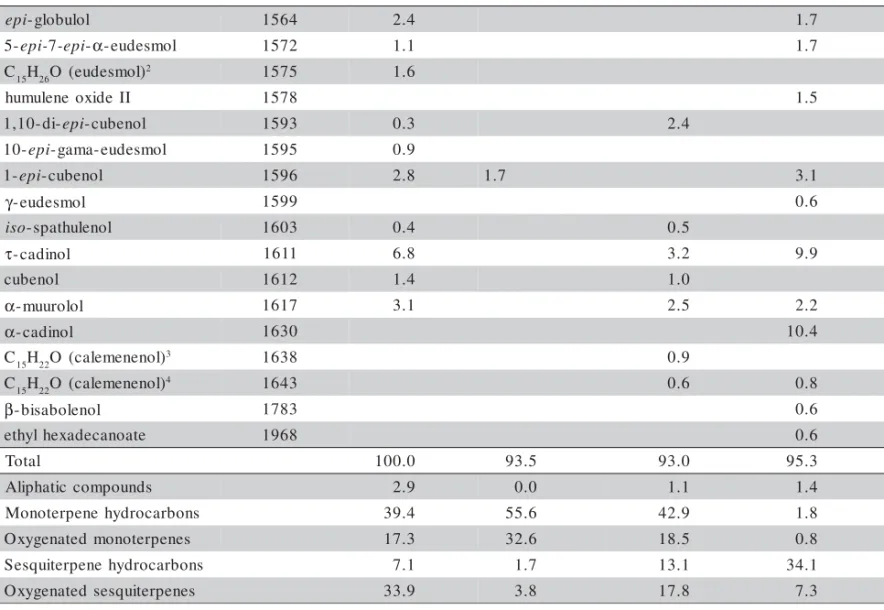
The chromatographic analysis of the oils from both specimens identified (Table 1) fifty-nine pounds representing 93.0 - 100% of the total oil com-ponents. Clear differences in the pattern of terpenes were observed for both fruit colour varieties. Although the major components in the leaf oil are the same for both varieties (α-pinene, β-pinene and 1,8-cineol), in the leaf oil from the purple fruit variety a higher amount of oxygenated sesquiterpenes (33.9%) was observed as compared to the yellow fruit variety, in which the majority of the identified compounds were monoter-pene hydrocarbons (55.6%) and oxygenated monot-erpenes (32.6%) and only 3.8% of oxygenated ses-quiterpenes. In the fruit oils, this difference can be seen more clearly. The purple fruit oil contained almost exclusively sesquiterpenes (57.3% oxygenated and 34.1% hydrocarbons) while the yellow fruit oil was composed in the majority by monoterpenes (42.9% hydrocarbons and 18.5% oxygenated). The essential oil composition of the oil from fruits and leaves of the yellow fruit variety were very similar while in the purple fruit variety the fruit oil composition was quite different from that observed in the leaves. In this va-riety, the major fruit oil components were caryophyllene oxide (22.2%) and α-cadinol (10.4%), these compounds were not observed in the leaves oil. In this oil, the major component was the sequiterpene globulol (6.7%), not found in fruit oil, and very low amount of monoterpenes were detected.
Table 1 - Volatile oil composition of leaves and fruits from two fruit colour varieties of Eugenia brasiliensis. Continue... d n u o p m o
C IK*
t r a P t n a l P s e v a e
L Fruits
y t e i r a V e l p r u
P YellowVariety YellowVariety Purple Variety
e t a t e c a l y h t
e 790 2.7 0.9 0.2
e n e l c y c i r
t 905 0.2 0.2
α-pinene 914 18.8 33.5 15.4 0.6
α-fenchene 925 0.2
β-pinene 953 11.0 14.4 9.3 0.2
e n e c r y
m 966 0.6 5.0 10.7
p-cymene 1002 0.4 0.7
e n e n o m i
l 1006 8.6 2.7 4.4 0.7
l o e n i c -8 ,
1 1009 9.6 28.2 7.5 0.3
(Z)- β -ocimene 1022 0.3
(E)- β -ocimene 1033 0.2
e n e l o n i p r e
t 1061 0.8
l o o l a n i
l 1072 1.5
e n e l i r e
p 1073 0.9 0.3
o x
e -fenchol 1086 0.4
(E)-sabinol 1111 0.4
l o -4 -n e n i p r e
t 1147 0.8
α-terpineol 1161 5.4 4.4 10.2 0.5
e t a t e c a -2 l y h t e l y n e h
p 1224 0.6
α-copaene 1344 0.4 1.1 1.6
β -elemene 1360 2.0
β -caryophyllene 1389 2.1 1.7 5.4 9.2
α-humulene 1422 0.7 1.4 2.1
(E)- β -farnesene 1425 0.2
o l l
a -aromadendrene 1429 0.4
γ-muurolene 1445 1.8
D e n e r c a m r e
g 1450 0.5
r
a -curcumene 1452 0.3
β-selinene 1456 0.9
e n e r o l f i d i r i
v 1466 1.0 0.5 1.7
α-muurolene 1471 0.4 1.4
β-bisabolene 1479 0.6 9.6
γ-cadinene 1483 0.5
δ-cadinene 1494 1.8 4.3
(Z)-calamenene 1496 2.4
(E)-nerolidol 1538 0.3 1.6
l o d e
l 1539 0.9
e n e l l y h p o y r a c -y x o r d i
h 1543 1.0
l o n e l u h t a p
s 1548 5.2 4.4
I
N1 1552 5.4
e d i x o e n e l l y h p o y r a
c 1555 0.9 22.2
l o l u b o l
difference in the chemical composition of the essen-tial oils for both fruit colour varieties of E. brasiliensis, mainly in the fruits. These results
indi-cate that these fruit colour varieties have a distinct biochemical regulation or even a different genomic of their secondary metabolism, since in the purple fruit variety the sesquiterpene pathway is more operant than in the yellow one, in which mainly monoterpe-nes are accumulated. Additionally, the phenolic path-way seems to be different in these two varieties, in the purple variety this biochemical pathway leads to the accumulation of anthocyanidins, noticed by the dark purple colour of the fruits, whether in the yel-low one these metabolites are apparently not present. These observations together with the essential oil analysis may indicate that these two fruit colour va-rieties are indeed two chemotypes of this species. A more detailed taxonomic study, such as DNA analy-sis, is required to define whether we are dealing with two taxonomic varieties or two distinct species. Table 1 - Continuation.
i p
e -globulol 1564 2.4 1.7
-5 epi-7-epi-α-eudesmol 1572 1.1 1.7
C15H26O (eudesmol)2 1575 1.6
I I e d i x o e n e l u m u
h 1578 1.5
-i d -0 1 ,
1 epi-cubenol 1593 0.3 2.4
-0
1 epi-gama-eudesmol 1595 0.9
-1 epi-cubenol 1596 2.8 1.7 3.1
γ-eudesmol 1599 0.6
o s
i -spathulenol 1603 0.4 0.5
τ-cadinol 1611 6.8 3.2 9.9
l o n e b u
c 1612 1.4 1.0
α-muurolol 1617 3.1 2.5 2.2
α-cadinol 1630 10.4
C15H22O (calemenenol)3 1638 0.9
C15H22O (calemenenol)4 1643 0.6 0.8
β-bisabolenol 1783 0.6
e t a o n a c e d a x e h l y h t
e 1968 0.6
l a t o
T 100.0 93.5 93.0 95.3
s d n u o p m o c c i t a h p il
A 2.9 0.0 1.1 1.4
s n o b r a c o r d y h e n e p r e t o n o
M 39.4 55.6 42.9 1.8
s e n e p r e t o n o m d e t a n e g y x
O 17.3 32.6 18.5 0.8
s n o b r a c o r d y h e n e p r e ti u q s e
S 7.1 1.7 13.1 34.1
s e n e p r e ti u q s e s d e t a n e g y x
O 33.9 3.8 17.8 7.3
*IK = Kóvats Retention Index
1NI (non-identified) – m/z (rel. int., 70 eV): 41(100), 53(21), 67(14), 91(38), 105(28), 117(17), 131(30), 145(19), 159 (3). 2Correct isomer not determined – m/z (rel. int., 70 eV): 41(52), 59(100), 81(31), 93(29), 107(38), 149(33), 161(19), 204(9). 3Correct isomer not determined – m/z (rel. int., 70 eV): 41(100), 43(62), 55(37), 91(27), 105(17), 131(15), 187(7), 202(3). 4Correct isomer not determined – m/z (rel. int., 70 eV): 41(100), 43(61), 55(37), 91(26), 105(18), 131(16), 187(8), 202(1).
ACKNOWLEDGEMENTS
To the BIOTA/FAPESP Program for the finan-cial support and to CNPq for the grants awarded.
REFERENCES
ADAMS R.P. Identification of essential oil components by gas chromatography/ion trap mass spectrometry. Carol Stream: Allured Pub., 1995. 469p.
APEL, M.A.; SOBRAL, M.; MENUT, C.; BESSIERE, J.-M.; SCHAPOVAL, E.E.S.; HENRIQUES, A.T. Essential oils from
Eugenia species. Part VII: Sections Phyllocalyx and Stenocalyx.
Journal of Essential Oil Research, v.16, p.135-138, 2004. CAMBESSÈDES, J. Myrtaceae. In: SAINT-HILAIRE, A. (Org.)
Flora Brasiliae Meridionalis. Paris: A. Belin, 1832-1833. v.2, p.277-384.
FISCHER, D.C.H.; LIMBERGER, R.P.; HENRIQUES, A.T.; MORENO, P.R.H. Essential oils from leaves of two Eugenia brasiliensis specimens from Southeastern Brazil. Journal of Essential Oil Research, v.17, p.499-500, 2005.
LANDRUM, L.R. Campomanesia, Pimenta, Blepharocalyx,
Legrandia, Acca, Myrrhinium and Luma. Flora Neotropica,
v.45, p.1-178, 1986.
LEGRAND, C.D.; KLEIN, R.M. Mirtáceas - Myrciaria, Pseudocaryophyllus, Blepharocalyx, Espécies suplementares,
espécies cultivadas, generalidades. In: REITZ, R. (Org.) Flora Ilustrada Catarinense. Itajaí: Herbário Barbosa Rodrigues, 1978. p.731-876.
Received September 13, 2006 Accepted April 20, 2007
MATTOS, J.R. Myrtaceae do Rio Grande do Sul. Roessléria, v.6, p.3-394, 1984.