So lubilizatio n o f Na,K-ATPase fro m
rabbit kidne y o ute r m e dulla using
o nly C
12
E
8
Departamento de Q uímica, Faculdade de Filosofia,
Ciências e Letras de Ribeirão Preto, Universidade de São Paulo, Ribeirão Preto, SP, Brasil
H.L. Santos, R.P. Lamas and P. Ciancaglini
Abstract
SDS, C12E8, CHAPS or CHAPSO or a combination of two of these detergents is generally used for the solubilization of Na,K-ATPase and other ATPases. Our method using only C12E8 has the advantage of considerable reduction of the time for enzyme purification, with rapid solubilization and purification in a single chromatographic step. Na,K-ATPase-rich membrane fragments of rabbit kidney outer medulla were obtained without adding SDS. Optimum conditions for solubili-zation were obtained at 4ºC after rapid mixing of 1 mg of membrane Na,K-ATPase with 1 mg of C12E8/ml, yielding 98% recovery of the activity. The solubilized enzyme was purified by gel filtration on a Sepharose 6B column at 4ºC. Non-denaturing PAGE revealed a single protein band with phosphomonohydrolase activity. The molecular mass of the purified enzyme estimated by gel filtration chromatogra-phy was 320 kDa. The optimum apparent pH obtained for the purified enzyme was 7.5 for both PNPP and ATP. The dependence of ATPase activity on ATP concentration showed high (K0.5 = 4.0 µM) and low (K0.5 = 1.4 mM) affinity sites for ATP, with negative cooperativity. Ouabain (5 mM), oligomycin (1 µg/ml) and sodium vanadate (3 µM) inhibited the ATPase activity of C12E8-solubilized and purified ATPase by 99, 81 and 98.5%, respectively. We have shown that Na,K-ATPase solubilized only with C12E8 can be purified and retains its activity. The activity is consistent with the form of (aß)2 association.
Co rre spo nde nce
P. Ciancaglini
Departamento de Q uímica FFCLRP, USP
Av. Bandeirantes, 3900 14040-901 Ribeirão Preto, SP Brasil
Fax: + 55-16-633-8151 E-mail: pietro@ ffclrp.usp.br
Research supported by FAPESP and CNPq. H.L. Santos is the recipient of a student fellowship from FAPESP, and P. Ciancaglini is a
CNPq research fellow.
Received April 20, 2001 Accepted January 2, 2002
Ke y wo rds ·Na,K-ATPase
·Rabbit kidney medulla ·Membrane solubilization
·C12E8
·(aß)2 Dimer
Intro ductio n
Detergents have been successfully used for the solubilization of membrane proteins. Several excellent reviews can be found on detergents, their physical properties and their use in the solubilization of membrane pro-teins (1-4). Due to three important factors, non-ionic detergents are frequently used for the solubilization of protein membranes: i)
their efficiency in breaking the lipid-lipid and lipid-protein interactions, ii) their ineffi-ciency in weakening protein-protein interac-tions, and iii) their property of being less denaturing than the ionic detergents (3-6).
and/or Na,K-ATPase solubilization, although it partially denatures the enzyme molecule, is sodium dodecyl sulfate (SDS). Other de-tergents that have also been used to inacti-vate the enzyme in a concentration-depend-ent way are cholate, deoxycholate and 3-((3-cholamidopropyl)dimethylamino)-1-propane sulfonate (CHAPS) (7). For example, so-dium cholate (1-2%, w/v) solubilizes 50% of renal Na,K-ATPase with retention of only half of the original specific activity (7). On the other hand, 0.2% (w/v) deoxycholate combined with 0.1% (w/v) saponin and high concentrations of NaCl (~360 mM) and cho-lesterol was efficient in Na,K-ATPase solu-bilization without losses of specific activity (7,8). However, CHAPS when used at a 1:2 (w/w) ratio of detergent:enzyme at a final concentration of 9 mM (0.55%, w/v) solubi-lized about 25% of the enzyme without loss of specific activity (7).
Another class of detergents used in Na,K-ATPase solubilization are octylglucosides and polyoxyethylenes (Triton, Lubrol, Brij, dodecyloctaethyleneglycol (C12E8) and
Tween). Octylglucoside was not efficient for Na,K-ATPase solubilization because it needed a long incubation time with the pro-tein, with the consequent inactivation of the enzyme. In contrast, polyoxyethylenes are good agents for Na,K-ATPase solubilization (7). Triton X-100, when used at a concentra-tion of 0.25% (w/v), solubilizes 92% of Na,K-ATPase from kidney outer medulla, but par-tially inactivates the reconstituted enzyme (9).
A detergent that has been used with great success in Na,K-ATPase solubilization is C12E8 (4,5,7,10,11). Different results showed
that Na,K-ATPase previously treated with SDS can be solubilized with C12E8 in an
active form where most of the kinetic and conformational properties of the enzyme are preserved after solubilization (4,7,11).
Na,K-ATPase is an integral membrane protein found in all superior eukaryotic cells which are responsible for the active
trans-port of sodium and potassium ions through the plasma membrane coupled with ATP hydrolysis (8,12-14). This enzyme is a heterodimer of three subunits: a subunit, with a molecular mass of about 110 kDa; ß subunit, highly glycosylated, with a molecu-lar mass of about 50 kDa, and g subunit, with a molecular mass of about 15 kDa (8,14,15). The a subunit is responsible for the enzy-matic activity. It contains the binding and phosphorylation ATP domain, as well as essential amino acids for the binding of so-dium, potassium and some inhibitors (8,16, 17). The ß subunit has a structural function and is important for membrane enzyme in-sertion (8,14,18,19). The g peptide has hy-drophobic characteristics associated with the Na,K-ATPase molecule; however, it is not required for the enzyme catalytic activity or for ion transport. Its association with the a
and ß subunits seems to involve a modulator function for Na,K-ATPase obtained from several tissues (14). In the plasma mem-branes, the a and ß subunits build functional oligomers of the (aß)2 type or oligomers
with superior structure (aß)n (20-24).
Na,K-ATPase is specifically inhibited by cardiac glycosides such as ouabain, that bind to the extracellular domains. Its binding and inhi-bition depend on the combination of magne-sium, sodium and potassium ions (8,25,26). Another potent inhibitor of the enzyme is orthovanadate (25,27).
The present study describes the solubili-zation using only C12E8, and a single step
purification of Na,K-ATPase from the outer medulla of rabbit kidney. Our data suggest that this method is efficient, and the kinetic and structural characteristics of the solubi-lized enzyme are preserved.
Mate rial and Me tho ds
ethanesulfonic acid (MES), N-(2-hydroxy-ethyl) piperazine-N-ethanesulfonic acid (HEPES), 2-amino-2-methyl-propan-1-ol (AMPOL), a-naphthyl phosphate, fast blue RR, oligomycin, ouabain, adenosine 5-tri-phosphate Tris salt (ATP), sodium ortho-vanadate, p-nitrophenyl phosphate (di)Tris salt (PNPP), BSA, CHAPS, and 3-((3-chol- amidopropyl)dimethylamino)-2-hydroxy-1-propane sulfonate (CHAPSO) were from Sigma (St. Louis, MO, USA). Ethylenedia-minetetraacetic acid (EDTA), potassium chloride, sodium chloride and magnesium chloride were from Merck (São Paulo, SP, Brazil). C12E8 was from Calbiochem (San
Diego, CA, USA). Analytical grade reagents were used without further purification.
Iso latio n o f Na,K-ATPase fro m the o ute r
me dulla o f rabbit kidne y
Isolation of membrane enzyme. Mem-brane-bound Na,K-ATPase was obtained from the dark red outer medulla of the kid-ney of adult New Zealand white rabbits as described by Jorgensen (28), with some modifications, as follows. The kidney was removed immediately after sacrifice and stored in ice-cold 20 mM imidazole buffer, pH 6.8, containing 250 mM sucrose, 6 mM EDTA and 6 mM Tris. The kidney was cut into transversal sections and the light gray inner medulla was removed and discarded. The tissue from the dark red outer medulla was obtained by incisions along the inner side of the boundary with the cortex. The extracted tissue was homogenized in 20 mM imidazole buffer, pH 6.8, containing 250 mM sucrose, 6 mM EDTA and 6 mM Tris (7 ml buffer to 1 g of moist weight) in a high-speed shearing homogenizer for 30 s. The homogenate was centrifuged at 10,000 g for 35 min at 4ºC and the supernatant was ultracentrifuged at 180,000 g for 1 h at 4ºC. The pellet corresponding to membrane-bound Na,K-ATPase was resuspended in 20 mM imidazole buffer, pH 6.8,
contain-ing 250 mM sucrose, 6 mM EDTA and 6 mM Tris, and stored in 1-10 ml aliquots at -20ºC.
Solubilization of Na,K-ATPase membrane fragments with C12E8. To determine opti-mum conditions to solubilize membrane-bound enzyme, an assay was carried out by varying the protein/C12E8 ratio and the time
and temperature of incubation with the de-tergent. Optimum conditions were obtained at 4ºC after rapid mixing of 1 mg of Na,K-ATPase membrane fragments with 1 mg of C12E8/ml. The non-solubilized residues were
removed by centrifugation at 4ºC for 1 h at 100,000 g in a Hitachi centrifuge. The super-natant was assayed for protein concentration and ATPase and PNPPase activities.
Purification of solubilized Na,K-ATPase. The C12E8-solubilized enzyme was
concen-trated through a YM-10 Amicon filter and purified by gel filtration at 4ºC on a Sepha-rose 6B column (1.4 x 119 cm) equilibrated and eluted with 5 mM Tris-HCl buffer, pH 7.0, containing 1 mM EDTA, 150 mM KCl and 0.005 mg/ml C12E8 at a flow rate of 21
ml/h. The fractions showing ATPase activity were pooled, concentrated through a YM-10 Amicon filter, and dialyzed for 2 h at 4ºC against 5 mM Tris-HCl buffer, pH 7.5, con-taining 15 mM KCl, 6 mM EDTA and 0.005 mg/ml C12E8, and stored in 1-ml aliquots at
-20ºC.
Enzym e assay
PNPPase activity was assayed discon-tinuously at 37ºC with a Genesys 2 spectro-photometer by monitoring the liberation of p-nitrophenolate ion (e 1 M, pH 13 = 17,600 M-1
cm-1
) at 410 nm, in 50 mM HEPES buffer, pH 7.5, containing 10 mM PNPP, 15 mM KCl and 10 mM MgCl2 in a final
described by Santos and Ciancaglini (5), adjusting the assay medium to a final volume of 1.0 ml. The reaction was initiated by the addition of the enzyme, stopped with 0.5 ml of cold 30% TCA at appropriate intervals and centrifuged at 4,000 g immediately prior to phosphate determination. Standard condi-tions were 50 mM HEPES buffer, pH 7.5, containing 3 mM ATP, 10 mM KCl, 5 mM MgCl2 and 50 mM NaCl.
For both enzyme activities the determi-nation was carried out in triplicate and the initial velocities were constant for at least 30 min, provided that less than 5% of substrate was hydrolyzed. Controls without enzyme were included in each experiment to quan-tify the non-enzymatic hydrolysis of the sub-strate. One enzyme unit (U) is defined as the amount of enzyme hydrolyzing 1.0 nmol of substrate per minute at 37ºC.
Pro te in analysis
Protein concentrations were estimated as described by Santos and Ciancaglini (5) in the presence of 2% (w/w) SDS, with BSA used as standard.
Sucro se de nsity gradie nt ce ntrifugatio n o f
m e m brane -bo und Na,K-ATPase
Membrane-bound Na,K-ATPase (1 mg) was layered onto a continuous sucrose gradi-ent (10-50%, w/v) in imidazole buffer and centrifuged for 2 h at 180,000 g using a Hitachi PV50TA vertical rotor at 4ºC. Frac-tions of 0.5 ml were collected and assayed for protein concentration (29), refractive in-dex (% sucrose), and ATPase and PNPPase activities.
Po lyacrylam ide ge l e le ctro pho re sis
Polyacrylamide gel electrophoresis (PAGE) was carried out on 5% gel according to Davis (30) using silver nitrate for protein staining (31). Phosphohydrolytic activity on
the gel was detected in 50 mM HEPES buf-fer, pH 7.5, containing 10 mM PNPP, 15 mM KCl, 10 mM MgCl2, 0.12% a-naphthyl
phosphate, and 0.12% fast blue RR at 37ºC.
Mo le cular m ass de te rm inatio n
The molecular mass of the solubilized and purified Na,K-ATPase was estimated by filtration on a Sepharose 6B column (0.8 x 133 cm) equilibrated and eluted with 5 mM Tris-HCl buffer, pH 7.0, containing 1 mM EDTA, 150 mM KCl and 0.005 mg/ml C12E8.
BSA (66 kDa), alcohol dehydrogenase (150 kDa), ß-amylase (200 kDa), apoferritin mono-mer (110 kDa), apoferritin dimono-mer (221 kDa) and apoferritin tetramer (443 kDa) were used as molecular markers.
The molecular mass of the a and ß units of kidney Na,K-ATPase was estimated by SDS-PAGE on 10% gels according to Laemmli (32), using silver nitrate for protein staining (31). Myosin (205 kDa), ß-galac-tosidase (116 kDa), phosphorylase B (97.4 kDa), BSA (66 kDa), egg albumin (45 kDa) and carbonic anhydrase (29 kDa) were used as molecular markers.
pH se nsitivity o f catalysis
The effect of pH on ATPase and PNPPase activities was measured in 50 mM buffer over the pH range of 5.0 to 9.5. MES buffer was used in the 5.0 to 6.0 range, Bis-Tris in the 6.0 to 6.5 range, imidazole in the 6.5 to 7.5 range, Tris in the 7.0 to 9.0 range, and AMPOL in the 8.5 to 9.5 range. The pH of the reaction mixture was measured both be-fore and after the assay and did not vary by more than 0.05 units. ATPase and PNPPase activities were assayed as described above.
Estim atio n o f kine tic param e te rs
Maximum velocity (V), initial velocity (v), apparent dissociation constant (K0.5)
sub-strate hydrolysis, were determined with a microcomputer program as described by Leone et al. (33). Data are reported as the mean of triplicate determinations in which P<0.05 was considered to be statistically significant.
Re sults
Membrane fractions rich in Na,K-AT-Pase were obtained by homogenization of the dark red outer medulla of the kidney without the addition of SDS. Figure 1 shows the results of the centrifugation of the mem-brane enzyme in a 10 to 50% continuous sucrose gradient. A single protein peak, pre-senting PNPPase and ATPase activities, was obtained between 35.5 and 41% sucrose.
In order to obtain efficient solubilization of Na,K-ATPase using only C12E8, the
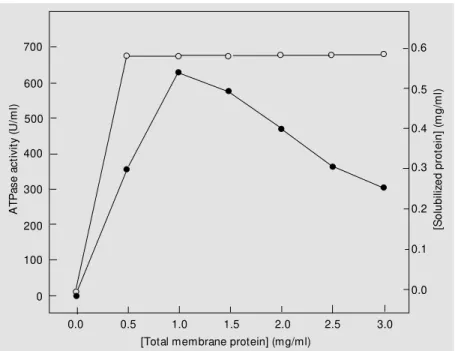
ef-fects of detergentconcentration, protein con-centration and incubation time were studied. Figure 2 illustrates the variation in protein concentration for a fixed C12E8
concentra-tion. The amount of solubilized enzyme in-creased proportionally, reaching a maximum at a 1 mg protein/1 mg detergent ratio. At protein detergent ratios >1.0 ATPase activ-ity in the supernatant decreased, suggesting that the detergent was not sufficient to solu-bilize a larger amount of enzyme.
Variation of C12E8 concentration for a
fixed protein concentration in the solubiliza-tion of membrane Na,K-ATPase (Figure 3) showed that the amount of solubilized en-zyme was maximum (about 98%) when C12E8
was used at a ratio of 1 mg protein/1 mg detergent. Above this maximum value, the ATPase activity of the solubilized enzyme decreased, but the amount of solubilized protein for C12E8 concentrations above 1
mg/ml remained constant (Figure 3). This decrease in ATPase activity can be inter-preted as inactivation by excess detergent. Under these conditions, the ATPase activity of solubilized enzyme was similar to that detected for the membrane fraction, with
Figure 1. Sucrose density gradient centrifugation of membrane-bound Na,K-ATPase from rabbit kidney outer medulla. A sample of 1.0 mg protein in 20 mM imidazole buffer, pH 6.8, containing 250 mM sucrose, 6 mM Tris and 6 mM EDTA w as layered on a continuous sucrose density gradient
(10-50% , w /v) in 20 mM imidazole buffer, pH 6.8, and centrifuged at 180,000 g for 2 h using a Hitachi
(M odel 55P-72) centrifuge w ith a vertical rotor (PV50TA), at 4ºC. Fractions of 0.5 ml w ere collected
and assayed for protein concentration (A595 nm; filled circles); refractive index (% sucrose; triangles);
PNPPase activity (squares) and ATPase activity (open circles). ATPase, adenosine 5’-triphosphatase; PNPPase, p-nitrophenyl phosphatase.
Figure 2. Solubilization of membrane-bound Na,K-ATPase w ith 1 mg/ml C12E8. Aliquots containing
different concentrations of membrane-bound Na,K-ATPase in 20 mM imidazole buffer, pH 6.8,
containing 250 mM sucrose, 6 mM Tris and 6 mM EDTA w ere mixed at 4ºC w ith 1 mg/ml C12E8
and centrifuged for 1.5 h at 100,000 g using a Hitachi (M odel 55P-72) centrifuge. The supernatant
w as assayed for ATPase activity (filled circles) and solubilized protein (open circles). ATPase, adenosine 5' -triphosphatase.
A T P a s e a c ti v it y ( U /m l) 700 500 600 400 300 200 100 0 0.6 [S o lu b ili ze d p ro te in ] (m g /m l) 0.5 0.4 0.3 0.2 0.1 0.0
0.0 0.5 1.0 1.5 2.0 2.5 3.0
[Total membrane protein] (mg/ml)
A T P a s e a c ti v it y ( U /m l) 60 P N P P a s e a c ti v it y ( U /m l) 2.0 1.5 1.0 0.5 0.0 50 40 30 20 10 0
0 5 10 15 20 25
cess was more efficient at 4ºC (data not shown).
C12E8-solubilized Na,K-ATPase (1 mg
of protein/1 mg of detergent) was purified through a Sepharose 6B column (1.4 x 119 cm). The chromatogram obtained presented at least four protein peaks (Figure 4), and at least two peaks presented as much ATPase as PNPPase activity. Fractions 100-138 ob-tained in peak 11 were pooled, concentrated, analyzed and found to correspond to solubi-lized and purified Na,K-ATPase. Moreover, this pool presented a specific activity of 930 U/mg, with a recovery of about 21.4% of the total activity present in the outer medulla extract. The protein recovery corresponding to this peak represented about 27.5% of the total protein applied to the column, 17.4% of a membrane fragment and only 1.8% of the total protein present in the outer medulla extract. The purification factor for these pu-rification steps of Na,K-ATPase was about 11.8 (see Table 1).
Non-denaturing PAGE showed that the solubilized extract presented a relatively large number of protein bands. In contrast, the purified sample presented only one discrete
A b s o rb a n c e ( 2 8 0 n m ) ( .. .. ..) 0.4 0.2 0.3 0.1 0.0 A b s o rb a n c e ( 4 1 0 n m ) (- - - - -) 0.20 0.10 0.15 0.05 0.00 A b s o rb a n c e ( 3 5 5 n m ) ( )
0 50 100 150 200 250 300
Fraction
Figure 4. Chromatography of Na,K-ATPase solubilized w ith C12E8 on a Sepharose 6B column. A sample of Na,K-ATPase solubilized w ith C12E8 (1:1, w /w ) contain-ing 154 U/mg w as applied to a Sepharose 6B column (1.4 x 119 cm) equilibrated and eluted w ith 5 mM Tris-HCl buffer, pH 7.0, containing 1.0 mM EDTA, 150 mM KCl and 0.005 mg/ml C12E8, at a flow rate of 21 ml/h. Fractions of 3.5 ml w ere collected and aliquots w ere assayed f or prot ein concent rat ion (dot t ed line) (A280 nm); PNPPase activity (broken line) and ATPase activity (solid line). The fractions indicated (peak II) w ere pooled and correspond to solubilized and purified Na,K-ATPase. Inset: Non-denaturing polyacrylamide gel elec-trophoresis of Na,K-ATPase in different purification steps: gel 1 - C12E8-solubilized extract stained w ith silver nitrate; gel 2 - purified enzyme (peak II) stained w ith silver nitrate, and gel 3 - phosphohydrolytic activity of purif ied enzym e developed w it h 0.12% (w /v) 1-naphthyl phosphate and 0.12% (w /v) fast blue RR, in the normal kinetic assay medium.
values of about 600-700 U/mg. Solubiliza-tion of Na,K-ATPase using C12E8 at the 1:1
ratio (w/w) was instantaneous and this
pro-1 2 3
A T P a s e a c ti v it y ( U /m l) 700 500 600 400 300 200 100 0 0.7 [S o lu b ili ze d p ro te in ] (m g /m l) 0.6 0.5 0.4 0.3 0.2 0.0 0.1
0 0.5 1.0 1.5 2.0
[C12E8] (mg/ml)
band with relatively diffuse phosphomono-hydrolase activity (Figure 4, inset). These results indicate that the solubilized sample was relatively homogeneous and purified after chromatography through a Sepharose 6B column.
The molecular mass of C12E8-solubilized
and purified Na,K-ATPase determined by chromatography was about 320 kDa (Figure 5). Note that the molecular mass was not corrected for the amounts of phospholipids and detergent that remained bound to the purified enzyme.
In order to determine the integrity of C12E8-solubilized and purified Na,K-ATPase,
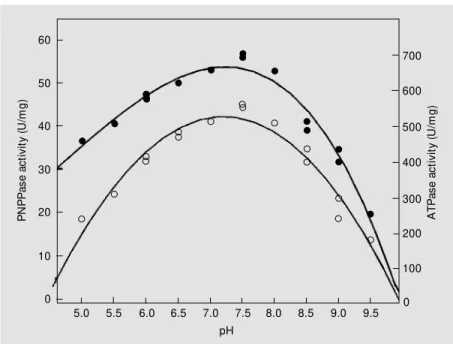
some kinetic studies were performed. Figure 6 shows the pH effect of ATP and PNPP hydrolysis by purified Na,K-ATPase. The same optimum pH of about 7.5 was found for both substrates. Table 2 shows the effects of some inhibitors on the ATPase and PNPPase activities of purified Na,K-ATPase. It should be stressed that 5 mM ouabain or 3 µM vanadate totally inhibited both assayed activities. Oligomycin (10 µg/ml) and so-dium azide (0.1 mM) inhibited activity by about 70 and 15%, respectively. Note that 10 µM ouabain inhibited Na,K-ATPase activity by 50% (results not shown).
The results reported for pH optimum (Fig-ure 6) and inhibition studies (Table 2) attest to the purity of the enzyme using these solu-bilization and purification steps.
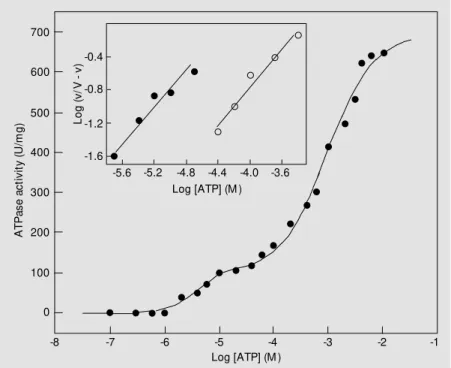
The dependence on ATP concentration of the rate of hydrolysis by purified Na,K-ATPase at pH 7.5 is shown in Figure 7. Relatively complex results suggested that at least two classes of hydrolyzing sites were involved in these experimental conditions. The high-affinity sites appearing in the range of 1 µM to 0.1 mM ATP correspond to about 15% of total activity (K0.5 = 4 µM and V =
120.9 U/mg) while the low-affinity sites ob-served above 0.1 mM ATP represent 85% of total activity (K0.5 = 1.4 mM and V = 703.9
U/mg). Cooperative effects were found for both hydrolysis sites (0.8 and 0.9,
respec-Table 1. Extraction, C12E8 solubilization and purification steps of an Na,K-ATPase from rabbit kidney outer medulla.
Step Volume Protein U/ml U/mg Yield Purification
(ml) (mg/ml) (% )
Outer medulla extract 63 11.30 890.4 78.8 100 1
M embrane fragment 53 1.40 702.9 689.2 66.4 7.5
Supernatant of solubilized 64 0.893 409.1 458.1 46.7 5.8
membrane
Pellet of solubilized 74.2 0.501 154.1 307.4 20.3 3.9
membrane
Concentrate of solubilized 35 1.34 382.9 285.8 23.9 3.6
extract
* Peak II 85 0.152 141.4 930.3 21.4 11.8
All assays w ere carried out in 50 mM HEPES buffer, pH 7.5, containing 3 mM ATP, 10 mM KCl, 5 mM M gCl2 and 50 mM NaCl, at 37ºC, as described in M ethods.
* Peak of a Sepharose 6B column.
Figure 5. M olecular mass determination of C12E8-solubilized Na,K-ATPase. M olecular mass w as determined using a Sepharose 6B column (0.8 x 133 cm) equilibrated and eluted w ith 5 mM Tris-HCl buffer, pH 7.0, containing 1 mM EDTA, 150 mM KCl and 0.005 mg/ml C12E8 as described in M aterial and M ethods. BSA (lozenge); alcohol dehydrogenase (open circle); ß-amylase (filled circle); apoferritin tetramer (triangle); apoferritin dimer (open square); apofer-ritin monomer (asterisk), and solubilized and purified Na,K-ATPase (filled square).
tively) and inhibition of ATPase activity was observed for ATP concentrations above 3 mM (results not shown).
The dependence on PNPP concentration
M
o
le
c
u
la
r
w
e
ig
h
t
(x
1
0
0
0
)
100
*
10
1.3 1.4 1.5 1.6 1.7 1.8 1.9 2.0
of the rate of hydrolysis by purified Na, K-ATPase at pH 7.5 in the presence of 10 mM MgCl2 and 15 mM KCl showed
a single saturation curve with cooperative effects (n = 1.3), K0.5 = 0.74 mM and
V = 42.1 U/mg (results not shown).
D iscussio n
Obtaining Na,K-ATPase from a highly specialized tissue with enhanced capacity for Na+
and K+
transport such as the outer medulla of the kidney has the advantage of obtaining enzyme activity in relatively large amounts (7,8,28).
Generally, Na,K-ATPase-rich mem-branes were obtained by mechanical tissue disruption followed by differential centrifu-gation steps. However, other methods, such as cloning techniques using the enzyme ex-pressed in different systems, have also been described and used for enzyme production and characterization (14,34).
Kidney outer medulla membrane extrac-tion and homogenizaextrac-tion followed by a su-crose gradient resulted in a single protein peak (Figure 1). The fact of not finding any other soluble protein component along the whole gradient suggests that the membrane obtained in the preparation of Na,K-ATPase was homogeneous. However, it should be emphasized that membranes contain many proteins and solubilization and purification methods are necessary for isolation of the pure Na,K-ATPase enzyme (8,19,25,35). The presence of other enzymes in the membrane fraction was easily proven by specific in-hibitors such as ouabain. In fact, 5 mM ouabain inhibited only 11.5% of the ATPase activity of the membrane fraction (data not shown).
Therefore, Na,K-ATPase could be sepa-rated from the other proteins present in the membrane that can directly or indirectly in-terfere with the kinetic properties of the enzyme. The development of a rational ap-proach to the solubilization of membrane proteins always requires a review of the literature to determine the detergent type and the conditions that are generally used for the solubilization of the protein of interest (1,3-8,10).
P
N
P
P
a
s
e
a
c
ti
v
it
y
(
U
/m
g
)
40
A
T
P
a
s
e
a
c
ti
v
it
y
(
U
/m
g
)
500 700
600
400
300
200
100
0 60
50
30
20
10
0
5.0 5.5 6.0 6.5 7.0 7.5 8.0 8.5 9.0 9.5
pH
Figure 6. pH sensitivity of the hydrolysis of p-nitrophenyl phosphate (PNPP) and adenosine 5’-triphosphate (ATP) by Na,K-ATPase solubilized w ith C12E8 (1:1, w /w ) and purified on a Sepharose 6B column. PNPPase (filled circles) and ATPase activities (open circles) are show n. Assays w ere buffered w ith 50 mM buffer containing 5 mM M gCl2, 10 mM KCl and 50 mM NaCl and the substrate, i.e., 10 mM PNPP or 3 mM ATP (for details, see M aterial and M ethods). The reaction w as started by the addition of 3.5 µg protein.
Table 2. Effect of several inhibitors on adenosine 5’-triphosphatase (ATPase) and p-nitrophenyl phosphatase (PNPPase) activities of purified Na,K-ATPase from rabbit kidney outer medulla.
Inhibitors Concentration Inhibition (% )
ATPase PNPPase
Ouabain 5 mM 99.1 99.9
Oligomycin 1 µg/ml 81.1 63.7
Sodium azide 100 µM 14.5 16.1
Vanadate 3 µM 98.5 93.2
The treatment of Na,K-ATPase mem-brane fractions with different concentrations of SDS resulted in a time-dependent inacti-vation of the enzyme activity (5). This inac-tivation is also determined by the SDS/pro-tein ratio. Moreover, apparently many SDS molecules are involved in the inactivation of a single Na,K-ATPase molecule. The use of SDS is only recommended for the selective removal of some contaminant proteins of the membrane without significantly affecting the Na,K-ATPase molecule, which remains in the membrane fraction after this treatment (28).
The incubation of the Na,K-ATPase-rich membrane fraction with SDS is also recom-mended in the presence of ATP because this substrate protects the enzyme structure against inactivation. Another important fac-tor is that the purification procedure using SDS should be combined with density gradi-ent cgradi-entrifugation steps. This slow purifica-tion procedure resulted in a significant loss and irreversible inactivation of ATPase ac-tivity, even when controlling the detergent/ protein relationship, temperature, pH, incu-bation time and buffer ionic forces (7,28).
Our method using only C12E8 is based on
the methodology described by Santos and Ciancaglini (5) and others who used it com-bined with other detergents (7,10). The ad-vantage of this method is the considerable reduction in the time needed to obtain the purified enzyme, which is solubilized in-stantaneously and purified in a single chro-matographic step and has a smaller denatur-ing effect on the solubilized enzyme.
The amount of solubilized enzyme activ-ity was maximum, about 98%, when C12E8
was used at a ratio of 1 mg enzyme/1 mg detergent (Figures 2 and 3). Under these conditions, the specific ATPase activity of the solubilized Na,K-ATPase was in the range of 600-700 U/mg, which is similar to the activity of the membrane enzyme, as re-ported by Cornelius (7) for the enzyme ob-tained from rabbit kidney. However,
activi-ties 20-30-fold higher have been reported both for membrane-bound and solubilized enzyme (8,10,28). In our study the initial activity for the membrane-bound enzyme was lower than reported by others but a purification factor of about 6-10-fold, which is typical for enzyme isolated from mem-brane of specialized tissue, suggests a selec-tive extraction of Na,K-ATPase.
It should be noted that quite different values of specific ATPase activity can be obtained in different conditions for tissue source, solubilization and purification, as well as methods for the determination of enzymatic activity (4,5,7,10,36).
The enzyme obtained from the kidney external medulla showed a purification fac-tor of about 11 (Figure 4 and Table 1). In a single chromatographic step, rabbit kidney (aß)2 protomer of Na,K-ATPase was
puri-fied and separated from non-solubilized
pro-A
T
P
a
s
e
a
c
ti
v
it
y
(
U
/m
g
)
700
600
500
400
300
200
100
0
-0.4
-0.8
-1.2
-1.6
L
o
g
(
v
/V
v
)
-5.6 -5.2 -4.8 -4.4 -4.0 -3.6 Log [ATP] (M )
-8 -7 -6 -5 -4 -3 -2 -1
Log [ATP] (M )
teins that were excluded in the column void, and other proteins that were also solubilized by the detergent, and from different other forms of association between the a and ß subunits and even the individual subunits (10,28). The purification factor, the specific activity and the stability of the enzyme solu-bilized and purified by gel filtration obtained by several authors with Na,K-ATPases from different sources show different values. This fact can be attributed to several causes, in-cluding i) variation in the methodology for the extraction and preparation of the mem-brane fraction; ii) differences in the determi-nation of activity such as different substrate concentrations, buffer, and metal ion used at different concentrations, and iii) differences in the duration and in the temperature of the solubilization and purification steps (7,10, 28).
In the present study the molecular mass found for rabbit kidney Na,K-ATPase solu-bilized with C12E8 and purified on a
Sepha-rose 6B column was about 320 kDa (Figure 5), suggesting an association of the (aß)2
type, considering the molecular mass of the
a and ß subunits to be about 100 and 57 kDa, respectively. Note that, under our experi-mental conditions, amounts of phospholipids and detergent that remained bound to the purified enzyme were not taken into ac-count. Moreover, when the purification step used 10-fold more detergent, a significant decrease in the activity of the fractions cor-responding to the oligomer (aß)2 was
ob-served (results not shown). Another impor-tant factor which may be responsible for the loss of catalytic activity of the enzyme can be attributed to the oligomer delipidation that might occur in the presence of high detergent concentrations (7,10).
Although most of the structural studies indicate a 1:1 stoichiometry of the a and ß subunits, the exact quaternary structure of Na,K-ATPase, as well as its functional asso-ciation with the membrane, are not under-stood. There are controversies about whether
the enzyme exists as a protomer (aß) (21-23,37) or as a diprotomer (aß)2 involving a
balance between protomer-diprotomer, or even in the form of oligomers (aß)n (24,38).
Rabbit kidney Na,K-ATPase, when solu-bilized with C12E8, and purified by
fraction-ated centrifugation, showed that the solubi-lized form of the enzyme consists predomi-nantly (80-85%) of associations of the (aß) type, with molecular mass between 140 and 170 kDa (7,20-22,28). However, when other isolation methods are used, such as gel filtra-tion, a relatively stable association of sub-unit (aß)2 types and/or superior oligomers
with molecular mass of 257-380 kDa was observed. It is important to note that these associations are necessary for the enzyme to have a catalytic activity and are related to the incubation time with the detergent and to detergent concentration (10,20-22,24).
The apparent optimum pH for ATP and PNPP hydrolysis by Na,K-ATPase (Figure 6) was 7.5 for the same substrate, and was similar to that reported by other investiga-tors with enzymes obtained from several tissues (28). The effect of some Na,K-ATPase inhibitors showed that the solubilized en-zyme is completely inhibited by 5 mM oua-bain or 3 µM vanadate (see Table 2), as described by several authors (8,13,19,25). However, oligomycin does not completely inhibit the activity of Na,K-ATPase (80%), and it is known that the effect of this inhibi-tor depends on the enzyme orientation and the presence of sodium ions (8,13,25).
Finally, the inhibition of only about 15% of Na,K-ATPase by sodium azide confirmed the absence of FoF1-ATPase (25). It is im-portant to emphasize that the effect of these inhibitors depends on the presence of diva-lent metal ions (sodium, potassium and/or magnesium) and the substrate used in the reaction medium, as well as on the tissue origin of Na,K-ATPase (8,25).
Kinetic results for C12E8-solubilized and
these experimental conditions, one in the micromolar range (high-affinity site) and the other in the millimolar range (low-affinity site), presenting negative cooperativity.
Results using microsomal fractions of several vertebrate tissues showed that the stimulation of Na,K-ATPase activity by ATP occurs through two-phase curves, one with K0.5 from 0.1 to 1 µM and the other with K0.5
from 0.01 to 0.4 mM, which suggests the existence of two sites of substrate hydrolysis (21,39). Dual effects were also found on ATP hydrolysis by C12E8-solubilized and
purified Na,K-ATPase with K0.5 values of
about 0.1 and 4 µM for the high-affinity site and of about 0.1 and 0.5 mM for the low-affinity site, both with negative cooperativi-ty, suggesting that the enzyme environment or oligomer formation is very important for substrate hydrolysis (21-23,40). It should be emphasized that the contribution of the high-affinity site to the ATPase specific activity of the enzyme generally corresponds to val-ues about 1 to 10% of the total activity, which hinders its kinetic characterization
(21-23,39). It is very difficult to determine whether these arose from the presence of more than one ATP site per (aß) protomer or from a single site whose function and af-finity change during the catalytic cycle (21-24,40), and the functional relationship tween the two hydrolysis sites and their be-havior during the reaction cycle remains to be explored.
The kinetic data shown for rabbit kidney Na,K-ATPase solubilized with C12E8 and
purified suggest that the enzyme molecule is preserved and presents some important char-acteristics reported by some investigators, i.e., stability, (aß)2 protomer association,
biphasic behavior during ATP hydrolysis, and ouabain and vanadate inhibition, which makes the method suitable for obtaining the enzyme for studies in reconstitution systems.
Ackno wle dgm e nts
We thank Dr. Richard John Ward and Mrs. Priscila C. Ciancaglini for revising the manuscript.
Re fe re nce s
1. Helenius A, M cCaslin DR, Fries E & Tanford C (1979). Properties of detergent.
M ethods in Enzymology, 56: 734-749. 2. Tanford C (1980). The Hydrophobic
Ef-fect: Formation of M icelles and Biological M embranes. 2nd edn. Wiley-Interscience, New York, NY, USA.
3. Koepsell H (1986). M ethodological as-pects of purification and reconstitution of transport proteins from mammalian plas-ma membranes. Review s of Physiology, Biochemistry and Pharmacology, 104: 65-137.
4. Silvius JR (1992). Solubilization and func-tional reconstitution of biom em brane components. Annual Review of Biophys-ics and Biomolecular Structure, 21: 323-348.
5. Santos HL & Ciancaglini P (2000). A prac-tical approach to the choice of a suitable detergent and optimal conditions to solu-bilize a membrane protein. Biochemical Education, 28: 178-182.
6. Le M aire M , Champeil P & M oller JV (2000). Interaction of membrane proteins and lipids w ith solubilizing detergents.
Biochimica et Biophysica Acta, 1508: 86-111.
7. Cornelius F (1991). Functional reconstitu-tion of the sodium pump. Kinetics of ex-change reactions performed by reconsti-tuted Na,K-ATPase. Biochimica et Biophy-sica Acta,1071: 19-66.
8. Skou JC & Esmann M (1992). The (Na+, K+)-ATPase. Journal of Bioenergetics and
Biomembranes, 24: 249-261.
9. Jackson RL, Verkleij AJ, Van Zoelen EJJ, Lane LK, Schw artz A & Van Deenen LLM (1980). Asymmetric incorporation of Na,K-ATPase into phospholipid vesicles. Ar-chives of Biochemistry and Biophysics, 200: 269-278.
10. Brotherus JR, Jacobsen L & Jorgensen PL (1983). Soluble and enzym atically stable Na,K-ATPase from mammalian kid-ney consisting predominantly of protomer
aß-units. Preparation, assay and reconsti-tution of active Na,K transport. Biochimi-ca et BiophysiBiochimi-ca Acta, 731: 290-303. 11. Esmann M & Skou JC (1985). Occlusion
of Na+ by the Na,K-ATPase in the pres-ence of oligomycin. Biochemical and Bio-physical Research Communications, 127: 857-863.
12. Jorgensen PL (1992). Functional domains of Na,K-ATPase; conformational transi-tions in the a-subunit and ion occlusion.
Acta Physiologica Scandinavica, 146: 89-94.
13. Skou JC (1998). The identification of the sodium-potassium pump (Nobel Lecture).
Angew andte Chemie International Edi-tion, 37: 2320-2328.
14. Pressley TA (1996). Structure and func-tion of the Na,K pump: ten years of mo-lecular biology. M ineral and Electrolyte M etabolism, 22: 264-271.
Structure-funtion relationships based on ATP bind-ing and cation occlusion at equilibrium in Na,K-ATPase. Acta Physiologica Scandi-navica,163: 79-87.
16. Jorgensen PL, Rasmussen JH, Nielsen JM & Pedersen PA (1997). Transport-linked conformational changes in Na,K-ATPase. Structure-function relationships of ligand binding and E1-E2 conforma-tional transitions. Annals of the New York Academy of Sciences, 834: 161-174. 17. Lingrel JB, Croyle LM , Woo AL & Arguello
JM (1998). Ligand binding sites of Na,K-ATPase. Acta Physiologica Scandinavica, 163: 69-77.
18. O’Brien WJ, Lingrel JB & Wallick ET (1994). Ouabain binding kinetics of the rat alpha tw o and alpha three isoforms of the sodium -pot assium adenosine t riphos-phate. Archives of Biochemistry and Bio-physics, 310: 32-39.
19. Emery AM , Billingsley PF, Ready PD & Djam goz M BA (1998). Insect Na,K-ATPase. Journal of Insect Physiology, 44: 197-209.
20. Brotherus JR, M oller JV & Jorgensen PL (1981). Soluble and active renal Na,K-ATPase w ith maximum protein molecular mass 170,000 ± 9,000 daltons; formation of larger units by secondary aggregation.
Biochemical and Biophysical Research Communications, 100: 146-154. 21. Ward DG & Cavieres JD (1993).
Solubi-lized aß Na,K-ATPase remains protomeric
during turnover yet show s apparent nega-tive cooperativity tow ard ATP. Proceed-ings of the National Academy of Sciences, USA, 96: 5332-5336.
22. Ward DG & Cavieres JD (1996). Binding of 2' (3' )-O-(2,4,6-trinitrophenyl)ADP to soluble alpha beta protomers of Na,K-ATPase modified w ith fluorescein isothio-cyanate. Evidence for tw o distinct sites.
Journal of Biological Chem istry, 271:
12317-12321.
23. Ward DG & Cavieres JD (1998). Photoin-activation of fluorescein isothiocyanate-modified Na,K-ATPase by 2' (3' )-O-(2,4,6-t rini)-O-(2,4,6-t rophenyl)8-azidoadenosine 5' -di-phosphate. Journal of Biological Chemis-try, 273: 14277-14284.
24. Linnertz H, Urbanova P, Obsil T, Herman P, Amler E & Schoner W (1998). M olecu-lar distance measurements reveal an (al-pha beta)(2) dimeric structure of Na,K-ATPase - high affinity ATP binding site and K+-activated phosphatase reside on different alpha-subunits. Journal of Bio-logical Chemistry, 273: 28813-28821. 25. M acGregor SE & Walker JM (1993).
In-hibitors of the Na,K-ATPase. Comparative Biochemistry and Physiology, 105C: 1-9. 26. Kasturi R, Yuan J, M cLean LR, M argolies
M N & Ball WJ (1998). Identification of a model cardiac glycosid receptor: compari-sons w ith Na,K-ATPase. Biochemistry, 37: 6658-6666.
27. Fedosova NU, Cornelius F & Klodos I (1998). E2P phosphof orm s of Na,K-ATPase. I. Comparison of phosphointer-mediates formed from ATP and Pi by their reactivity tow ard hydroxylamine and vana-date. Biochemistry,37: 13634-13642. 28. Jorgensen PL (1988). Purification of
Na,K-ATPase. Enzyme sources, preparative problems and preparation from mamma-lian kidney. M ethods in Enzymology, 156: 29-42.
29. Read SM & Northcote DH (1981). M inimi-zation of variation in the response to dif-ferent proteins of the Coomassie blue G dye-binding assay for protein. Analytical Biochemistry,116: 53-64.
30. Davis BJ (1964). Disc electrophoresis II -M ethod and application to human serum proteins. Annals of the New York Acade-my of Sciences, 121: 404-427.
31. Blum H, Beir H & Gross HJ (1987).
Im-proved silver staining of plant proteins, RNA and DNA in polyacrylamide gels.
Electrophoresis, 8: 93-99.
32. Laemmli UK (1970). Cleavage of struc-tural proteins during the assembly of the head of bacteriophage T4. Nature, 227: 680-685.
33. Leone FA, Degreve L & Baranauskas JA (1992). Sigraf-A versatile computer-pro-gram for fitting enzyme kinetic data. Bio-chemical Education, 20: 94-96.
34. Pedersen PA, Rasmussen JH & Jorgen-sen PL (1996). Consequences of muta-tions to the phosphorylation site of the alpha-subunit of Na,K-ATPase for ATP binding and E1-E2 conformational equilib-rium. Biochemistry, 35: 16085-16093. 35. Yingst DR, Yang SY & Schiebinger R
(1998). Purification of active Na,K-ATPase using a new ouabain-affinity colum n.
American Journal of Physiology, 275C: 1167-1177.
36. Rigaud JL, Pitard B & Levy D (1995). Re-constitution of membrane proteins into liposomes: application to energy-trans-ducing membrane proteins. Biochimica et Biophysica Acta, 1231: 223-246. 37. Jorgensen PL & Andersen JP (1986).
Structural basis for E1-E2 conformational transitions in Na,K-pump proteins. Jour-nal of M embrane Biology, 103: 95-120. 38. Tsuda T, Kaya S, Yokoyama T & Taniguchi
K (1997). Are pyridoxal and fluorescein probes in lysine residues of a-chain in Na+,K+-ATPase sensing ATP binding?
An-nals of the New York Academy of Sci-ences, 834: 186-192.
39. Robinson JD (1976). Substrate sites for the Na,K dependent ATPase. Biochimica et Biophysica Acta, 429: 1006-1019. 40. Thoenges D, Linnetz H & Schoner W