Original article (short paper)
Functional independence and mobility in kidney
transplanted patients: cross-sectional study
Tuíra O. Maia Lívia G. Rocha Shirley D. Bezerra Patrícia E.M. Marinho
Universidade Federal de Pernambuco, UFPE, Recife, PE, Brazil
Abstract - Aim — To assess functional independence, balance and mobility of kidney transplant recipients, to verify transplant time, donor type, regular exercise practice, musculoskeletal complaints, as well as association among these variables. Methods: Observational study with 86 kidney transplant individuals, subjected to evaluation of the Functional Independence Measure (FIM) and Timed Up and Go test (TUG). Results: The mean age of the study population was 43.98 years old, 50% of these individuals were between 5-10 years of transplantation and 50% between 10-15 years.
Changes in mobility and balance (TUG) were found in 9.3% of transplant patients, while 2.3% had deicits in functional independence (FIM). The association between TUG and the FIM (χ2= 19.964, p< 0.001) was found in 25% of the 9.3%
of individuals who showed changes in TUG. It was found that only 20.9% of kidney transplant between 5-10 years
and 14.0% between 11 and 15 years performed regular physical exercises (χ2= 0.727, p= 0.394) and 67.4% presented
prevalent complaints on lower limbs musculoskeletal. Conclusion: Although the level of dependence and impairments
in mobility and balance found in renal transplants are low, deicits in mobility and balance may lead to changes in the
ability to perform their functional activities independently.
Keywords: chronic kidney disease, kidney transplantation, functionality, physical therapy.
Introduction
Chronic Kidney Disease (CKD) is considered an important public health problem with high prevalence, morbimortality rate and cost of treatment1, 2, 3.
Once installed the CKD requires substitutive kidney treatment at
the disease’s inal stage3, 4, 5.Among the therapeutic modalities to
be established for these patients, the kidney transplant represents
the most durable treatment with beneits in the survival, quality of life and in the cost-efectiveness, when compared to dialysis, forming the gold treatment for the disease's inal stage6,7,8.
While the kidney transplantation is considered the gold
treatment, other transplanted patients can continue to sufer
consequences of a uremic disease. Uremic myopathy can occur by reducing protein intake and muscle atrophy generated by
CKD, leading to loss of muscle ibers, decrease in bone mass and peripheral circulatory deicits4. Thus, the transplanted patient
can present balance and mobility changes, for impairment of
muscle iber and bone complications, and consequently, reduced
work capacity and quality of life, leading to restrictions and limitations, resulting in the inability to develop daily activi-ties, requiring the help of others, characterizing this patient as a dependent9, 10, 11.
Patient independence can also be hampered by fragility fol-lowing transplant surgery. Fragility represents a measure of the physiological reserve that is related as a risk factor for adverse
efects of renal transplantation, such as delayed graft function, early
hospital readmission and mortality. The decline in physiological reserve promotes an increased vulnerability to stressors resulting from a deregulation of multiple physiological systems, and this
may directly afect the functionality of these individuals12, 13, 14, 15.
Few studies show the relationship of functionality with transplantation time, however, the study by Costa, Nogueira16
demonstrated that renal transplants with shorter transplantation
time had lower functional capacity, which may directly afect
the independence of these individuals16. Thus, the functional
independence is conceptualized as the ability to do something with their own means, through satisfactory motor and cognitive conditions to the development of activities17, 18, 19. Considering that the functionality of kidney transplant patients may be altered due to the permanence of uremic symptoms, even after years of transplantation, and considering the need for further studies to evaluate the impact of CKD after renal transplantation on functionality, mobility and balance these patients, studies with such evaluation perspectives prove necessary.
Thus, the objective of this study was to evaluate the func-tional independence, balance and mobility of kidney transplant recipients, to verify transplant time, donor type, regular exercise practice, musculoskeletal complaints, as well as association among these variables.
Methods
Observational study conducted at the Nephrology ambulatory of Hospital das Clínicas, Universidade Federal de Pernambuco from January to July 2015. After approval by the Ethics Committee
on Institutional Research (CAAE 38714914.7.0000.5208) all
volunteers signed the consent form to participate in this study, according to Resolution 466/2012 of CONEP.
totaling 180 transplanted. Of these, 96 patients met the inclusion criteria. The adopted inclusion criteria were: age between 18 and 60 years old, transplanted from 2000 to 2010 and treated at the Hospital das Clínicas. Patients who had a history of hospitaliza-tion during the three months preceding the day of collechospitaliza-tion and the ones who were not being monitored by the service for a period of six months were excluded from the study.
All patients were approached at the hospital nephrology
clinic for the interview, then the data were conirmed in the
medical records.
It was applied a questionnaire, covering socio-demographic data (gender, income, and education), age, time of kidney transplant, type of donor (living or deceased), presumed etiol-ogy of kidney disease, presence and number of comorbidities and medication used. Through a direct interview, without the use of validated questionnaires, musculoskeletal complaints and information about regular practice of physical exercise were reported. The recommendations of the Physical Activity Guidelines Advisory Committee classify regular exercise, a
minimum of 75 vigorous-intensity or 150 moderate-intensity
minutes per week19.
Functional Independence (Functional Independence Measure – FIM)
For the functional independence assessment it was applied the Functional Independence Measure (FIM) validated in Brazil by Oller, Ribeiro, Travagim, Batista, Marques, Kusumota 18
with good cultural equivalency and reproducibility.
The FIM checks the individual's performance in carrying out 18 tasks related to subscales of self-care, sphincter control, transfers, locomotion, communication and social cognition. Each item was rated on a scale of degrees of dependence on
7 levels, the value 0 corresponding to the total dependence and the value 7 corresponding to normal in carrying out tasks
independently 19. The total score ranges from 18 to 126, the
lower the result, the greater the dependence of the individual to perform their functional activities19,20. To analysis purposes
in this study, the result of the FIM was dichotomized into "yes" (preserved functionality) and 'no' (functional dependence) 20.
In this study, a total score of 108 was considered as
cut-of point for the classiication cut-of renal transplants evaluated.
Thus, scores lower than 108 represent that the individuals evaluated are dependent, whereas the same or higher values suggest that these individuals are functionally independent20.
Mobility and Balance (Timed Up and Go - TUG)
To evaluate the mobility and static and dynamic balance, it was used the Timed Up and Go test (TUG) developed by Podsiadlo and Richardson21. For the realization of the test,
it was used a chair with armrests and seat height of 46 cm, a timer and bookmarks for notes of the results. Participants were instructed to walk as fast as possible, safely, and thus, the test started from the issue of the verbal command "go" by the researcher, followed by the time tracking. Participants came
from the starting position, with their back against the back of the chair and feet parallel to the ground, then stood up from the chair, walked a distance of 3 meters and returned to the chair into the shortest time possible. The test was performed in duplicate with an interval of two minutes among repeti-tions, and then was adopted the best time of attempts21. Test
results less than or equal to 20 seconds are considered people with no balance changes in basic tasks, those that exceed that time to complete the test are considered dependent in many of their activities of daily living and mobility22. For analysis
purposes, the TUG was classiied as without (score ≤ 20
seconds) and with balance changes (score > 21 seconds) 21.
All tests were performed by the same examiner. In our study, patients were familiarized with the test before recording the time of collection and the best time of three trials was used.
Statistical Analysis
A descriptive analysis was performed to characterize the sample and the variables were expressed through mean and
standard deviation, conidence interval and frequency distri
-bution. In order to verify associations between the variables, including FIM and TUG, the Pearson chi-square test was
performed, considering p< 0.05 as the signiicance level. The contingency coeicient was used to verify the degree of
association between TUG and FIM. For analysis purposes,
individuals were classiied into 5-10 years and 11-15 years
since receiving their kidney transplant. The statistical analysis was performed in SPSS 20.0 software.
Results
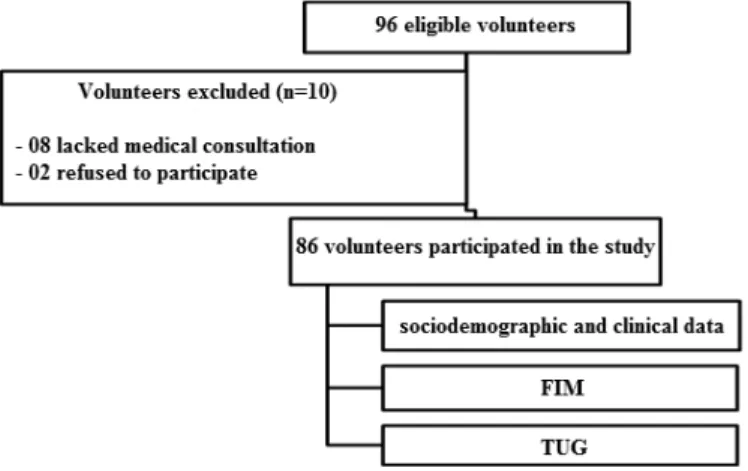
From the 96 eligible transplant patients, 8 individuals failed to attend the clinic at the scheduled time for consultation and 2 refused to participate in the study, totaling 86 kidney transplanted (Figure 1). The time of renal transplantation among study subjects was 10.60 ± 2.92 years (9.98 - 11.23). The Table 1 presents general characteristics of the sample.
Table 1. General characteristics of kidney transplant patients from the Nephrology Service, Hospital das Clínicas UFPE, Recife, Brazil.
Variables Mean ± SD/ n(%)
n= 86 CI 95%
Age (years) 43.98 ± 0.93 42.12 - 45.83
Time of kidney transplantation
5 to 10 years 11 to 15 years
43 (50.0%) 43 (50.0%)
Type of transplantation
Living donor Deceased donor
32 (37.2%) 54 (62.8%)
Etiology
SAH Others
45 (52.3%) 41 (47.7%)
Medications
Anti-SAH Others
41 (47.7%) 12 (14.0%)
Comorbidities
Yes No
33 (38.4%) 53 (61.6%)
Practice of Exercise
Yes No
15 (17.4%) 71 (82.6%)
Complaints
Yes No
58 (67.4%) 28 (32.6%) Types of complaints
Pain in the LLs Low back pain Other complaints
44 (51,2%) 14 (16.3%) 12 (14.0%)
TUG (s) 10.48 ± 0,49 9.49 - 11.46
FIM 123.23 ± 0.62 122 - 124.47
CI: conidence interval; TUG: timed up and go; SAH: systemic arterial hypertension; FIM: functional independence measure; LLs: lower limbs; s: seconds.
Regarding mobility and balance of these patients (TUG), 9.3% underwent the test with time above 20 seconds. Of these,
7% (3) were in the group between 5-10 years and 11.6% (5)
were in the group above 11 years, as can be seen in Table 2 (χ2
= 0.551, p = 0.458). All patients with altered TUG received
deceased donor graft (χ2 = 5.227, p = 0.022) (Table 2).
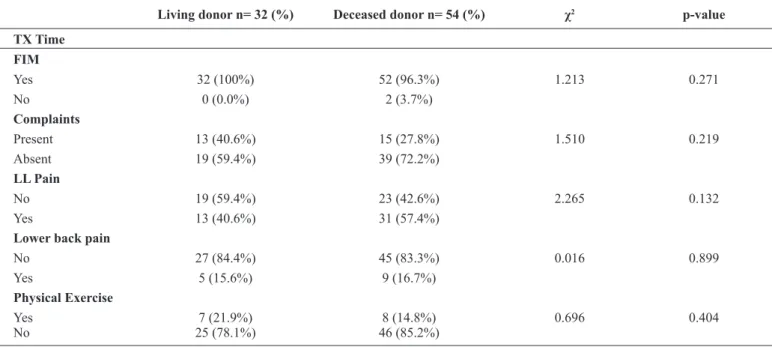
Table 2. Characteristics of individuals related to the type of kidney transplant (living donor and deceased donor).
Living donor n= 32 (%) Deceased donor n= 54 (%) χ2 p-value
TX Time
5 to10 years 14 (43.8%) 29 (53.7%) 0.796 0.372
11 to 15 years 18 (56.3%) 25 (46.3%)
Etiology
SAH 16 (50.0%) 29 (53.7%) 0.110 0.740
Others 16 (50.0%) 25 (46.3%)
Comorbidities
No 21 (65.5%) 32 (59.3%) 0.344 0.557
Yes 11 (34.4%) 22 (40.7%)
SAH
No 27 (84.4%) 40 (74.1%) 1.239 0.266
Yes 5 (15.6%) 14 (25.9%)
TUG
Yes 32 (100%) 46 (85.2%) 5.227 0.022
No 0 (0.0%) 8 (14.8%)
Living donor n= 32 (%) Deceased donor n= 54 (%) χ2 p-value
TX Time FIM
Yes 32 (100%) 52 (96.3%) 1.213 0.271
No 0 (0.0%) 2 (3.7%)
Complaints
Present 13 (40.6%) 15 (27.8%) 1.510 0.219
Absent 19 (59.4%) 39 (72.2%)
LL Pain
No 19 (59.4%) 23 (42.6%) 2.265 0.132
Yes 13 (40.6%) 31 (57.4%)
Lower back pain
No 27 (84.4%) 45 (83.3%) 0.016 0.899
Yes 5 (15.6%) 9 (16.7%)
Physical Exercise
Yes No
7 (21.9%)
25 (78.1%) 46 (85.2%) 8 (14.8%)
0.696 0.404
TX: Transplant; SAH: systemic arterial hypertension; TUG: timed up and go; FIM: functional independence measure; LL: lower limbs; χ 2: Chi-Square test.
Signiicant level, p < 0.05. ...continuação
Table 3. Characteristics of individuals in the study related to the time of kidney transplantation.
5 to 10 years of TX n= 43 (%) 11 to 15 years of TX n= 43 (%) χ2 p-value
TUG
Yes 40 (93.0%) 38 (88.4%) 0.551 0.458
No 3 (7.0%) 5 (11.6%)
FIM
Yes 43 (100%) 41 (95.3%) 2.048 0.152
No 0 (0.0%) 2 (4.7%)
Complaints
Present 16 (37.2%) 12 (27.9%) 0.847 0.357
Absent 27 (62.8%) 31 (72.1%)
Pain in the LLs
Yes 20 (46.5%) 24 (55.8%)
No 23 (53.5%) 19 (44.2%) 0.745 0.388
Low back pain
Yes 8 (18.6%) 6 (14.0%)
No 35 (81.4%) 37 (86.0%) 0.341 0.559
Medications
Yes 4 (9.3%) 8 (18.6%)
No 39 (90.7%) 35 (81.4%) 1.550 0.213
Physical Exercise
Yes No
9 (20.9%)
34 (79.1%) 37 (86.0%)6 (14.0%) 0.727 0.394
As for functionality (FIM), it was observed that 2.3% of individuals had the need of some type of assistance to perform their functional activities and these were in the group over 11 years of transplantation (χ2 = 2.048, p = 0.152) (Table 2) and
received the graft from a deceased donor (χ2 = 1.213, p = 0.271),
as can be seen in Table 2.
Regarding to the practice of regular exercise, only 15
indi-viduals (17.4%) reported performing, being 20.9% (9) of the
group between 5-10 years and 14.0% (6) of the group between 11 to 15 years of transplantation respectively (χ2 = 0.727, p
= 0.394). When this association was carried out taking into consideration the type of donor, it was found that 21.9% (7) of
patients with graft from a living donor and 14.8% (8) patients with graft from a deceased donor practiced physical exercise
(χ2 = 0.696, p = 0.404) (Tables 2 and 3).
From the 67.4% of transplanted who reported having muscu
-loskeletal complaints, 51.2% had pain in the lower limbs, 16.3% had low back pain and 14.0% had other complaints (paresthesia, edema in the lower limbs and pain in the upper limbs). The pains in lower limbs were the most common among them, where 46.5% (20) of the patients between 5-10 years and 55.8% (24) of the patients between 11 and 15 years of the transplantation
(χ2 = 0.745, p = 0.388) (Table 2). When considering the donor
type, this association remained similar to the previous one, as can be observed in table 3 (χ2 = 0.341, p = 0.599).
When we veriied the association between the TUG and the
FIM among individuals of the study, it was observed that 25% of the 9.3% patients who showed impaired TUG also showed an impaired FIM (χ2 = 19.964, p <0.001) and the degree of as
-sociation between these two variables was 0.434 (p = 0.000), according to the analysis of the contingency coeicient.
Discussion
With the primary objective of assessing the functional inde-pendence, balance and mobility of renal transplant recipients as well as the association between these variables, this study found the association between functional independence (FIM) and mobility (TUG) between the recipients of Kidney transplant in the study, showing that patients with mobility and changes in balance may also demonstrate functional dependence, although the level of dependence.
In our study, the TUG test was able to detect changes in mo-bility and balance at 9.3% of kidney transplant patients, similar to the study by Greenwood, Lindup, Taylor, Koufaki, Rush, Macdougall23. These authors subjected patients with chronic
kidney disease (pre-dialysis, dialysis, and transplantation) to a 12-week rehabilitation program and observed that, for the kidney transplant, the TUG showed a reduction of 25% of their time at the end of the program23.
In our study, we observed that patients with an altered TUG received the graft from deceased donor and the majority was in the group above 11 years of kidney transplantation.
The functionality of most of transplanted from our study
was preserved, relecting functional independence, similar to the indings in patients undergoing hemodialysis in the study
of Oller, Ribeiro, Travagim, Batista, Marques, Kusumota18.
Although the functionality was not compromised, the changes in the muscular system are common to occur in the population due to decreased protein-calorie intake, muscle atrophy due to disuse and impaired muscle protein balance, the same occurring in patients with CKD undergoing hemodialysis. Unlike patients on hemodialysis, renal transplant patients require immunosup-pressive therapy constantly. This therapy may also be respon-sible for the decrease of protein synthesis and the increase of protein catabolism, further compromising the muscular system of these patients 4, 24.
In addition, renal transplant recipients have a high risk of bone loss due to factors found in the general population, as well as additional time, such as time on hemodialysis and transplantation, recipients of deceased donors and persistence of secondary hyperparathyroidism In addition, renal transplant recipients have a high risk of bone loss due to factors found in the general population, as well as additional time, such as time on hemodialysis and transplantation, recipients of deceased donors and persistence of secondary hyperparathyroidism, increasing the risk of fractures and the incidence of cardiovascular diseases10.
With respect to functionality, patients considered dependent in our study were in the group over 11 years of transplanta-tion and received deceased donor graft, unlike that found in the study by Costa, Nogueira16, where the transplant patients
were assessed in a shorter transplant and whose functionality was assessed by the functional capacity domain of the SF-36 questionnaire. What possibly should have occurred in the study mentioned above is that the transplant elapsed time has not
been suicient to eliminate the deleterious efects of uremia on
the musculoskeletal functions and thus, the functionality was presented as compromised4.
Although most of the study participants present preservation of mobility and functionality for the most part, we noted the presence of pain complaints, especially in the lower limbs. Pain in lower limbs are more frequent, and can be explained by the
signiicant physical inactivity found among these patients, but
also by the late uremic consequences on the muscular, metabolic, circulatory and skeletal systems, which cause symptoms such as
early fatigue, peripheral circulatory deicit, changes sensitivity,
muscle dysfunction and peripheral neuropathy3, 4, 10, 11, 16.
Physical inactivity was high among our transplanted pa-tients, similar to those found in the study by Costa, Nogueira16,
which reported a frequency of 66.7%. According to the study by
Romano, Lorenzon, Montanaro11 the low frequency of physical
activity is aggravated by depression as well as by a decrease in quality of life that does not only compromise hemodialysis patients, but also renal transplants. In these patients the tendency to sedentary lifestyle can also be attributed to patients' fear of losing the graft, lack of professional knowledge to indicate ex-ercise, excessive family protection with these patients and lack of structural support to perform the exercises. Although we did not investigate the reasons for physical inactivity in our study, the reasons explained by Romano, Lorenzon, Montanaro11 can
be applied to our patients, considering that they have the same type of transplant in common11.
whom were made the interviews uses it. The immunosuppressive therapy maximizes transplant survival and minimizes rejection
however corticosteroids have signiicant impact on cardiovas
-cular risk, leading to increased and severity of hypertension and to diabetes mellitus26, 27. Although exercise is considered important in combating these risk factors, and considering the necessity to use of such therapy for maintenance of the graft, we observed that physical inactivity predominated among our patients and this may be responsible for the high frequency
of pain complaints found among them relecting that only the
recovery of the isolated kidney function from incorporating other health maintenance measures is needed16.
In our study, was observed that about half of patients using antihypertensive and hypoglycemic agents and the presence of
comorbidities in these patients may relect increased risk for
these same patients. Other frequent occurrences in transplanted patients concern the increase in atherosclerotic plaques and other vascular changes associated with physical inactivity of
this population may relect badly on functional capacity and
early mortality of these patients11, 28.
As far for the limitations found, we recognize the need to assess kidney transplant in the early years after the transplant, which cannot be performed in this study due to the character-istics of the service, with a prevalence of more than 5 years of transplanted patients. We also recognize the importance of evaluating the reasons why these patients are inactive for the most part (fear, lack of access, lack of medical advice, excess of family protection).
Finally, we highlight the clinical relevance of our study in order to draw attention to the high number of transplanted who do not practice physical exercise. Although mobility and balance as well as the functionality were relatively preserved, these patients present complaints of pain in the lower limbs and lumbar spine, thus suggesting the importance of physical therapy monitoring over time. At present, these patients present preserva-tion of funcpreserva-tional independence, mobility and balance however, it is unknown to what extent these parameters will be maintai
Conclusion
The present study showed that although the level of depen-dence and impairments in mobility and balance found in renal
transplants are low, deicits in mobility and balance may lead
to changes in the ability to perform their functional activities independently. These individuals are mostly inactive and have musculoskeletal complaints mainly in the lower limbs. Additional studies need to be performed in order to monitor these individu-als, especially as the periodic assessment and development of a treatment protocol involving regular physical exercise.
References
1. Bastos MG, Bregman R, Kirsztajn GM. Chronic kidney disease: frequent and severe, but also preventable and treatable. Rev Assoc Med Bras. 2010; 56: 248-53.
2. Hou W, Jocheng LV, Perkovic V, Yang L, Zhao N, Jardine MJ, et al. Efect of statin therapy on cardiovascular and kidney outcomes in patients with chronic kidney disease. Eur Heart J. 2013; 34:1807-181.
3. Machado EL, Gomes IC, Acurcio FA, Cesar CC, Almeida MCM, Cherchiglia ML. Factors associated with waiting time and access to kidney transplants in Belo Horizonte, Minas Gerais State, Brazil. Cad Saúde Pública. 2012;28: 2315-2326.
4. Cury JL, Brunetto AF, Aydos RD. Negative efects of chronic kidney failure on lung function and functional capacity. Braz J Phys Ther. 2010; 14:91-8.
5. Kanashiro H, Torricelli FCM, Falci JR, Piovisan AC, Antonopoulos IM, N WC. Current outcome of prioritized patients for kidney transplantation. Int Braz J Urol. 2012; 38:389-94.
6. Albuquerque JG, Lira ALBC, Lira MVO. Predisposing factors of nursing diagnoses in patients submitted to kidney transplantation. Rev Bras Enferm. 2010; 63:98-103.
7. Ojo AO, Morales JM, Gonzalez-Molina M, Steick LFL, Merion RM, Ojo T, et al. Comparison of the long-term outcomes of kid-ney transplantation: USAversus Spain. Nephrol Dial Transplant. 2013; 28:213–220.
8. Mcadams-Demarco MA, Law A, Salter ML, Chow E, Grams M, Walston JM, et al. Frailty and early hospital readmission after kidney transplantation. Am J Transplant. 2013;13: 2091–2095. 9. Mendonça AEO, Torres GV, Salvetti MG, Alchiere JC, Costa
IKF. Changes in quality of life after kidney transplantation and related factors. Acta Paul Enferm. 2014; 27: 287-92.
10. Gueiros AP, Neves CL, Sampaio EA, Custódio MR. Guidelines for bone and mineral disorders after kidney transplantation. J Bras Nefrol. 2011; 33:189-247.
11. Romano G, Lorenzon E, Montanaro D. Efects of exercise in kidney transplant recipients. World J Transplant. 2012; 2:46–50. 12. Mcadams-Demarco MA, Law A, Tan J, Delp C, King EA, Orandi
B, et al. Frailty, mycophenolate reduction, and graft loss in kidney transplant recipients. Transplantation. 2015; 99: 805-10. 13. Mcadams-Demarco MA, Isaacs K, Darko L, Salter ML, Gupta
N, King EA, et al. Changes in frailty after kidney transplantation. Journal of the American Geriatrics Society. 2015; 63: 2152-2157. 14. Mcadams-Demarco MA, Ying H, Olorundare I, King EA, Haugen
C, Buta B, et al. Individual Frailty Components and Mortality in Kidney Transplant Recipients. Transplantation, 2017.
15. Mcadams-Demarco MA, King EA, Luo X, Haugen C, DiBrito S, Shafer A , et al. Frailty, length of stay, and mortality in kidney transplant recipients: A national registry and prospective cohort study. Annals of Surgery; in press.
16. Costa JM, Nogueira LT. Factors associated with health-related quality of life of kidney transplant recipients in the municipality of Teresina, Piauí state, Brazil, 2010. Epidemiol Serv Saúde. 2014;23:121-129.
17. Benvegnu AB, Gomes LA, Souza CT, Cuadros TBB, Pavão LW, Avila SN. Functional independence measure evaluation in indi-viduals with stroke disability Rev Ciencia Saúde. 2008;1:71-77. 18. Oller GASAO, Ribeiro RCHM, Travagim DSA, Batista MA,
19. Riberto M, Miyazaki MH, Sakamoto H, Battistela LR. Reproducibility of the Brazilian version of the functional inde-pendence measure. Acta Fisiátrica. 2001; 8: 45-52.
20. Monteiro RBC, Laurentino GEC, Melo PG, Cabral DL, Correa JCF, Salmela-Tedixeira LF. Fear of falling and the relationship with the measure of functional independence and quality of life in post-cerebral vascular accident (Stroke) victims. Ciência Saúde Coletiva. 2013; 18:2017-2027.
21. Figueiredo KMOB, Lima KC, Guerra RO. Instruments for the assessment of physical balance in the elderly. Rev Bras Cineantropom Desempenho Hum. 2007;9:408-413.
22. Bohannon RW. Reference values for the timed up and go test: a descriptive meta-analysis. J Geriatr Phys Ther. 2006; 29:64-8. 23. Greenwood SA, Lindup H, Taylor K, Koufaki P, Rush R,
Macdougall IC, et al. Evaluation of a pragmatic exercise reha-bilitation programme in chronic kidney disease. Nephrol Dial Transplant. 2012; 27:126-34.
24. Johansen KL, Shubert T, Doyle J, Soher B, Sakkas GK, Kent-Braun JA. Muscle atrophy in patients receiving hemodialysis: efects on muscle strength, muscle quality, and physical function. Kidney Int. 2003; 63:291-7.
25. Bellizzia V, Cupisti A, Capitanini A, Calella P, D’Alessandrp C. Physical activity and kidney transplantation. Kidney Blood Press Res 2014;39:212-219.
26. Oliveira MIG, Santos AM, Salgado FN. Survival analysis and associated factors to mortality of kidney transplant recipients in a University Hospital in Maranhão. J Bras Nefrol. 2012;34:216-225. 27. Guerra JAA, Acúrcio FA, Andrade EG, Cherchiglia ML, Cesar CC, Queiroz OV, et al. Cyclosporine versus tacrolimus in kidney transplants in Brazil: a cost comparison. Cad Saúde Pública. 2010; 26:163-174.
28. Marcen R. Cardiovascular risk factors in kidney transplantation-current controversies. Nephrol Dial Transplant. 2006;21[Suppl 3]: 3]: iii3–iii8
Corresponding author
Patrícia Érika de Melo Marinho
Avenida Jornalista Aníbal Fernandes, s/n, Cidade Universitária. CEP: 50740-560,
Recife (PE), Brasil
Email: [email protected]/ [email protected]
Manuscript received on May 9, 2017 Manuscript accepted on July 12, 2017