1
A Work Project presented as part of the requirements for the Award of a Masters in Management from Nova School of Business and Economics – Double Degree program with
Maastricht University.
FIRMS SURVIVAL AND INTERNATIONAL TRADE: THE IMPACT OF EXPORTS AND IMPORTS
Joana Tremoceiro Nova nr: 1133 MU nr: 6063947
A project carried out under the supervision of:
Prof. José Mata
Prof. Martin Wetzels
2
ABSTRACT
This study examines the relationship between firm’s engagement in international trade – namely exports and imports - on firm’s survival. Moreover, it studies the impact of the duration of exports and duration of imports on firm’s survival. It uses a panel data of 674 firms of the information technologies & software (ITS) industry in India between the year 2002 and 2009. Results show that exports are not linked to firm’s survival, whereas imports
3
T
ABLE OFC
ONTENTSAbstract ...2
1. Introduction ...4
2. Literature Review and Hypothesis ...8
2.1 India’s ITS Industry ...8
2.2 International Trade and Firm’s Survival ... 11
Exports ... 11
Imports ... 16
3. Methods ...20
3.1 Sample and Procedures ... 20
3.2 Measures... 22
The Hazard Rate ... 22
Independent Variables ... 22
Control Variables ... 23
3.3 Analysis ... 25
4. Results ...27
5. Discussion ...33
5.1Theoretical Implication ... 36
5.2 Managerial Implication ... 38
5.3 Limitations and Future Research ... 39
6. Conclusion ...41
References ...43
4
1. INTRODUCTION
Research on the dynamics of international trade has been shifting its focus from an economic level towards a business level of analysis of firms and their products and services offerings (Bernard et al, 2007). An increasing stream of research emerges discussing the relationship between firms’ engagement in international trade and their performance (Wagner 2012b), namely measured by productivity, profitability, survival, innovation and wages. Firms that engage in international trade are able to step beyond their domestic market and enhance their growth and likelihood of survival (Lee et al. 2012). Moreover, these firms may also capitalize on market imperfections and other opportunities in different geographical regions as well as take advantage of economies of scale (Álvarez & Vergara 2013). In a growingly globalized world, firms can no longer rely on their domestic market, no matter how small or focused on domestic trade they are. Exporting may help diversifying sales risk by conducting business in different markets with different life cycles. Moreover, it can help firms to gain new knowledge and expertise that may enable them to improve their performance (Clerides et al 1998) .As regards to imports, imported intermediate inputs or capital goods might be cheaper or even more technical advanced than the inputs of domestic suppliers (Wagner 2012). Firms may hence be able to gain competitive advantages by decreasing their costs of production and increasing productivity. Additionally, imports may also enable firms to specialize and transfer knowledge with other organizations.
self-5
selection, and (2) learning-by exporting. Whereas in the first mechanism it is argued that only the most productive firms engage in exporting (thus selecting themselves to export); in the learning-by-exporting mechanism, firm’s increase their productivity by entering new markets. In what regards imports, only more recently, research is conducted to study its potential impact on firm’s productivity, in which it is mostly found a positive link between these two components (e.g. Bernard et al, 2007, Andersson et al 2008, Castellani et al 2010).
Nevertheless, stakeholders in firms are concerned with other dimension of performance besides productivity. From employees to shareholders, they ultimately care about the long-term development of the firm as that may be crucial for their own long-long-term welfare. Consequently, these research studies the impact of international trade on a long-term measure of performance: firm’s survival. It links these variables by suggesting productivity as one of
the mediators of this relationship.
While the relation between international trade and firm’s productivity has been repeatedly studied, little research has focused on the impact on firm’s survival. Moreover, research about the impact of imports has also received little attention, even for its impact on firm’s productivity. In addition, the results from previous studies are mixed. While some studies find a positive relation between exports and firm’s survival (Lee et al 2012), others do not find a relationship between these two variables (Wagner 2012) or even find a negative relationship (Giobannetti et al 2011, Namini et al 2013) explained by the fierce competition firm’s face by
6
To address the mixed findings and research gaps mentioned above – namely (1) the lack of research about the link between firm’s engagement in international trade and firm’s survival,
and (2) the little research acknowledging the potential impact of imports in firm’s performance -, this research examines the relation between firm’s engagement in exports and imports, and firm’s survival. This study uses an Indian longitudinal database of information technologies & software (ITS) firms between 2002 and 2009. To provide a more solid approach to the problem, the following questions are investigated:
What is the impact of exports and imports on firm’s productivity?
What is the relation between firm’s productivity and survival?
By what other means can firm's engagement in international trade affect firm’s survival?
How is the relationship between exports (imports) and firm’s survival influenced by firm’s
duration of engagement in exporting (importing)?
Ultimately, this research aims to analyse two focal points. Firstly, it intends to examine the relation between exports and imports, and firm’s survival. Secondly it intends to study the direct impact of the duration of exports (imports) engagement in firm’s survival, as well as the influence of the duration of this engagement as a moderator of the relationship between firm’s exports (imports) and firm’s survival. This aims to test if there is a learning-by-exporting mechanism in place that enables firms to increase their likelihood of survival with time..
7
impacts firm’s survival by measuring the effect of firm’s duration of exports (imports) in firm’s hazard rate. Finally, to the best of my knowledge, this study offers the first evidences of the relation between firm’s engagement in international trade and firm’s survival in the service sector.
8
2. LITERATURE REVIEW AND HYPOTHESIS
2.1 India’s ITS Industry
India has emerged as one of the fastest growing economies in the last decades, mostly reflecting its strong performance in the service sector (Dzhumashev et al 2011). The service sector exports accounts for 30% of total Indian exports, with the ITS industry representing the largest and one of the fastest growing services exporting sectors of the Indian economy (Hyvonen & Wang, 2012). The ITS industry includes three broad areas: information technology, business process outsourcing and engineering design & product development. Over the past 15 years, this industry has grown at an average annual rate of almost 30% with exports accounting for around two-thirds of industry’s revenues (NASSCOM 2012).
Historical Background and Engagement in International Trade
India’s ITS industry, begins with multinational firms, such as IBM and ICL, as vendors of both software and hardware in India, followed by local firms as Tata Consultancy Services established in 1968 (Sahoo & Patnaik 2009, Majumbar et al 2012). In the 1970s, the Indian government attempts to promote software exports, allowing those who develop software for exports to import computer hardware (Athreye 2005, Sahoo & Patnaik 2009). However, software exports remain poor as the delays in obtaining imports permission and the procedures governing foreign exchange prevent early software firms from moving rapidly and constrain potential entrants to the industry (Athreye 2005).
9
domestic manufactures of computers and foreign firms to push sales of their computers in India. In turn, both types of firms depend on Indian software developers for their particular computer system (Athreye 2005, Sahoo & Patnaik 2009, Majumbar et al 2012). In addition, domestic demand also came from the public sector, banks and other mainframe users. Domestic demand for ITS firms thus sustains a large share of Indian firms’ sales. Moreover,
taking into consideration the variety of projects to which they were exposed to, Indian firms accumulate important programming skills (Athreye 2005) that are revealed crucial for their exporting competitiveness in the future.
Although the potential of software export is recognized as early as in 1968, it is only in the 1980s that the government openly encourages software exports and export-oriented foreign investment (Sahoo & Patnaik 2009). During this time, the Indian government begins to gradually lift the restrictions on domestic firms and foreign investment (Barnes 2013). By 1986, the industry is liberalized, allowing existence of 100 per cent foreign subsidiaries and growth of software to be independent from the domestic hardware (Patibandla et al 2000).
Soon after the liberalization of the ITS industry, the government realized its role in the performance and growth of the software industry. In 1988, it creates Software Technology Parks (STP’s) that provide the lacking infrastructures and support required by small firms.
10
The support from the Indian government and liberalization of the ITS industry foster the growth of this industry and turn it to the foreign market. New foreign firms start entering such as Texas Instruments which set up a 100 per cent export-oriented unit in India (Athreye 2005, Sahoo & Patnaik 2009). Besides the importance of the Indian government as a main driver of this industry, the international competitiveness of India’s ITS firms and subsidiaries is founded on three main pillars: (1) the extended working days due to the time difference between India and other countries - in the case of US, the difference is 12 hours hence allowing for 24 hours of operations -, (2) the native English speaking employees, and (3) the cost advantage in the form of low salaries. These are still nowadays the main drivers of India’s ITS industry with special consideration taken for the low cost labour force.
Fluctuations in Indian rupees exchange rate and entrance of other low cost competitors such as China, can hence greatly impact India’s ITS firms performance.
11 2.2 International Trade and Firm’s Survival
Exports
Exporting can be considered as a source of risk diversification through spread of sales between markets subjected to different business cycle conditions or different phases of the product life cycle (Wagner 2012a). Consequently, when a demand shock hits the home market, or even when the domestic market is saturated, foreign demand may compensate for a drop in domestic demand and vice-versa. Moreover, exposure to an internationally competitive market may force firms to improve their performance in order to be able to compete and survive in foreign countries. In this study, I argue that firm’s exports increase firm’s probability of survival. I base this argument on previous findings about the impact of exports on measures of performance, especially productivity. I argue that the mechanisms behind the positive effect of exports on productivity will ultimately positively affect firm’s
survival.
Although little research has been conducted to study the impact of firm’s engagement in international trade on firm’s survival, one of the most prominent topics in the literature aims to study the link between exports and firm’s productivity. If in fact exporting increases firm’s productivity, it could be argued that exports may also increase chances of survival by means of an increase in productivity.
12
Hwang 1994, Delgado et al. 2002, Kimura & Kiyota 2006, Loecker 2007). Delgado et al. (2002) clearly indicates that exporting firms have higher levels of productivity than non-exporting ones. Kimura and Kiyota (2006) use a longitudinal data of Japanese firms and found that the most productive firms engage in exports and foreign direct investment (FDI), medium productive firms engage in either exports or FDI and the least productive ones focus only on the domestic market.
Two main, but not self-excluded, mechanisms are behind the positive link between exports and productivity, differing in the suggested direction of causality of the relationship. The first mechanism is “self-selection”, i.e. only the most productive firms engage in export activities and enter into international competition. Two main arguments support it. Firstly, it is argued that firms participating in international markets are faced with more intense competition thus leaving fewer opportunities for less efficient firms to enter the foreign market (e.g. Aw & Hwang 1995). Secondly, exporters have higher entry sunk costs than domestic firms (e.g. Melitz, 2003, Das et al., 2007), based on the assumption that a non-exporter has to incur a cost to enter the exporting market (Delgado et al., 2002). Therefore, even when considering the case in which competition in the domestic market is similar to the one in the foreign market, a pre-selection is made when firms’ consider the costs incurred to enter a foreign market. Only firms with the right resources – both financial and intangible resources to allow for market research and exporting agreements - decide to enter.
13
that these are the firms that have more chances of survival as they are better prepared to compete in price as well as to retain higher margins. Furthermore, exports can increase firm’s probability of survival independently of productivity. As previously mentioned, exports are a source of risk diversification of sales. Additionally, the fact that exporting increases firm’s market size implies that exports increases firm’s growth potential
These arguments are the base of my hypothesis that firm’s exports increase firm’s survival. In previous research, Lee et al (2012) find a positive relationship between firm’s exports and firm’s survival, even when controlling for firms’ characteristics that may be related with both exports and survival - such as size, age and productivity. However, some studies do not find a significant relationship between these two variables (Wagner 2013) and others even find a negative relationship (Giovannetti et al 2011, Namini et al 2013). Giovannetti et al (2011), find that being an exporter reduces probability of survival explained by the fact that exposure to strong competition in international markets increases firms’ risk of failure. Wagner (2012b) finds that, after including imports and two-way trading into the equation, exporting alone does not affect firms’ survival. Finally, Namini and his colleagues (2013) study the impact of sector-wide exports on plant survival. These authors show that a higher export volume at the sector level negatively affects the survival probability of exporters, but does not affect that of non-exporters.
non-14
exporters in the initial phase of exports, over time, exporters benefit more from productivity gains than non-exporters and the hazard rate is then higher for non-exporters.
Based on these aspects, I posit that:
Hypothesis 1: Firm’s level of exports has a positive relation with firm’s survival.
According to Esteves-Pérez and his colleagues (2013) there is persistence in the exporting status i.e. being an exporter in one period raises the probability of being an exporter on the next period. These authors find that the risk of failure of a firm-country trade relationship falls with the duration of that relationship – although median duration is only two years, if a firm manages to export for more than two years, the risk of exiting that exporting market sharply falls. These could be explained by the following. After entering in a foreign market, firms gain new knowledge and expertise that enable them, not only to increase their productivity by learning from the best practices, but also to gain new market information - in terms of, for example, what are potential new market opportunities – that will ultimately increase their likelihood of survival.
15
mostly explained by more productive firms choosing to become exporters (Clerides et al 1998, Kim et al. 2009, Delgado et al 2002) hence solely supporting the self-selection mechanism.
As far as I am concern, there is no previous research studying the possible existence of a learning-by-exporting mechanism in the relationship between firm’s exports and firm’s survival. However, it can be argued that it exists and thus the longer the time that a firm has been exporting, the more likely it is that it survives. In fact, the longer the duration of exports, the broader it is firm’s vision about its current and potentially future competitors and
customers. Moreover, the longer the duration, the better the relationships developed with customers and organizations in the foreign countries and, therefore, the more and faster firms can gain knowledge and information about the industry, and the better and faster they can adapt and satisfy market demand. Ultimately, these arguments increase firm’s knowledge about its current and future market thus enabling a better and faster adaptation to current and future trends in the industry.
For these reasons, I argue that the duration of exports have a direct positive relation with firm’s survival. In addition, I argue that the anticipated positive relationship between firm’s exports and firm’s survival is stronger for firms that export for a longer period of time.
Hypothesis 2: Firm’s duration of export relationship has a positive relation with
firm’s survival.
Hypothesis 3: Firm’s duration of export relationship positively moderates the
16 Imports
The relationship between imports and firms’ performance has not received the same level of
attention as exports, which can be partly explained by the limitations in data sets on census of domestic production or manufacturing. Bernard et al. (2007) use a database on importing firms in the United States and find that they share a wide variety of the same positive attributes with firm’s exports. Although indirect imports - by purchasing inputs that have been imported by domestic whole-sellers - cannot be observed, the authors state that importing firms “are both bigger and more productive, pay higher wages, and are more skill-and capital-intensive than non-exporters and non-importers” (p125).
In the present study, I argue that firm’s imports increase firm’s probability of survival. Firms that import have access to inputs of better quality or at lower costs that enable them not only to increase their performance, but also to increase their likeliness to satisfy market demand at the best standards. Moreover, firms may be able to concentrate on their core business, specializing and thus focusing resources on their core strengths. In addition, imports increase firm’s learning transfer by getting in contact with a wider variety of organizations and people.
Therefore, importing firms have better access to market information – concerning competitors, best practices, new market opportunities, etc –, becoming more likely to adapt better and faster to market trends fluctuations. Furthermore, analogously to exports in the previous section, I argue that the mechanisms behind the positive effect of imports on productivity eventually affect firm’s survival. Therefore, if in fact importing increases firm’s productivity, it could be argued that imports increase chances of survival by means of an increase in productivity.
17
and Wagner, 2008; Altomonte and Bekes, 2009; Castellani et al., 2010). Similarly to exports, the relationship between imports and firms’ productivity are grouped into two mechanisms with opposite directions of causality and, once again, not mutually exclusive: (1) self-selection and (2) learning-by-importing.
In what concerns the self-selection mechanism, the main reason for its existence is the fixed entry sunk costs in which firms incur before an importing agreement is settled. This induces only the most productive firms to import (Kraay et al. 2002; Andersson et al. 2008; Kasahara &Lapham, 2008; Muûs & Pisu, 2009; Voger & Wagner, 2009; Castellani et al., 2010). Preceding the importing agreement, firms need to learn and acquire custom procedures as well as incur in “a search process for potential foreign suppliers, inspection of goods, negotiation, contract formulation, etc” (Wagner, 2012, p245). Nonetheless, it is worth taking into consideration that it is not certain that all these costs apply to importers as it is a bit odd to assume that sellers (exporters) bear fixed costs to find their buyers (importers) and vice versa (Castellani et al 2010). However, importers still need to incur in costs that do not have to be sustained by exporters, such as the integration of imported inputs into the production process.
18
Taking the previous arguments into consideration, it is expected that:
Hypothesis 4: Firm’s imports have a positive relation with firm’s survival
In the present study, I also argue that firm’s probability of exit decreases with firm’s imports duration. As time passes, firm’s benefits from importing are augmented as firms learn from
their past experience and adapt their business and operations. Moreover, as time passes, firm’s ability to specialize increases as it takes time to realign resources to focus on the core business. Furthermore, the longer the duration of an importing relation, the broader it is the business network that the firm has. Consequently, firms with longer imports duration may have better access to market knowledge. In addition, this market knowledge may also translate into the selection of suppliers. Firms with better knowledge of foreign suppliers’ offerings may not only select the best supplier, but also gain some power for negotiation.
19
a source of international technology transfer in which productivity gains are a result of improvements in the existing firm. Finally, positive effects of imports on productivity can also be due to access to capital goods and intermediate goods of wider variety and better quality that better suit firm’s and market needs (Kraay et al., 2002; Halpern et al., 2005; Amiti & Konings, 2007).
Based on these arguments, I argue that the duration of exports, not only directly influences firm’s survival, but also serves as a moderator in the relationship between imports and firm’s survival.
Hypothesis 5: Firm’s duration of export relationship has a positive relation with
firm’s survival.
Hypothesis 6: Firm’s duration of imports engagement positively moderates the
20
3. METHODS
3.1 Sample and Procedures
The initial sample comprises an unbalanced panel of 819 software firms for the period of 2001 to 2013. This panel is retrieved from Prowess database of the Center for Monitoring Indian Economy (CMIE). Prowess is the largest database of financial performance of Indian firms containing data since 1989-1990 and using annual reports of individual firms as its primary source. For the purpose of this study of analyzing the exit rate of firms that export and import, this source is acutely suitable given the longitudinal dimension of the data and the fact that it attempts to cover a whole industry.
After consideration, the final panel is restricted to an eight year period from 2002 to 2009. The year 2001 is not included due to the existence of variables that measure growth and, therefore growth values for the year 2001 would not be available. The years 2012 and 2013 are considered to provide especially incomplete data. It is found that Prowess database is continuously being updated and that the latest years contain less information than the years from two or three years before. This could bias the data results and, for this reason, these years are excluded from the panel. Moreover, the years 2010 and 2011 cannot be used for the final regression given that it is established that a firm is considered as having exited the industry in a specific year only after two years of missing data for the next two years. Consequently, since the years 2012 and 2013 are excluded, the exit rates for the years 2010 and 2011 could not be directly used for the regression models.
21
the survey, i.e. 2002, the values are inputted. In the first case, the values are inputted using an average between the values of the year before and after. In the second case, the values of 2002 are equivalent to the ones in the year 2003. Secondly, some firms in the initial panel have missing value for the incorporation years. This data is inputted by making use of firms’ websites and Bloomberg’s database.
Special attention was also given to the “trustworthiness” of the data for each company. For this reason, some firms are excluded from the final panel due to its erratic values of total sales, sales of exports and profit margins. More specifically, firms with (1) cases of extremely high variation of sales or profit-margins (above 300%) between consecutive years, and (2) cases in which sales of exports systematically exceed total sales, are excluded. After these procedures, a total of 697 firms remain.
22 3.2 Measures
The Hazard Rate
The hazard rate is defined as the probability that a firm exits during a specific period given that it survived until the beginning of that particular period. The dependent variable of this study is hence firm’s exit. A firm is identified as an exit in year if it appears in the Prowess panel in year , but it stops appearing in and . This means that if a firm receives the value for the exit indicator in year , it is no longer present in any of the periods , etc as there is no gaps in the final panel. Firms that are still present in period and/or receive the value zero. The year is established according to India's government financial year, running from the 1st of April to the 31st of March. Exit hence implies that, if a firm is considered active in year t, it is active until the 31st of March of that year, but not later than that.
It is worth taking into consideration that firms that exit the market and firms that are merged both stop appearing in the dataset. Nonetheless, special care was taken and these firms are kept in the final panel, but are not considered to exit when they merge.
Independent Variables
Exports. Exports is measured as the proportion of firm’s sales from exports in terms of firm’s
total sales. The variable is thus computed by the division of sales from exports by total sales.
Imports. Imports is relative to importing expenses on capital goods and, in the same way as Exports, it is computed in relative terms by the division of firm’s imports spending divided by
23
Exports duration and Imports duration. The duration of exports and imports measures the
number of past years (including the current year) in which the firm engaged in exports and imports, respectively. If a firm does not export (import) in between exporting (importing) years, the count does not stop. The reasoning behind this formulation is that know-how and firm’s business network in the foreign countries are not completely lost during that time.
Control Variables
Firm Level
Segment. Segment is a dummy variable that takes the value if the firm belongs to the
Computer Software segment and if it belongs to the IT Enabled Services segment.
Age. Measured by the difference between the current year of analysis and firm’s incorporation
year. According to previous research on firms’ survival, it has been fairly established that a firm’s age shape firm’s survival function (Audretsh 1995, Mata & Portugal 1994, Ilmakunnas & Nurmi 2010, Mata & Freitas 2012, Baik et al 2013).
Size. In accordance to past literature (Audretsh 1995, Honjo 2000, Ilmakunnas & Murmi
2010, Mata & Freitas 2012, Baik et al 2013) Size is expected to show a negative relationship
with firm’s survival and is computed as the logarithm of sales in millions of Indian rupees adjusted for inflation.
Marketing. To control for firm’s intangible characteristics - such as its brand recognition - Marketing expenses are included. . This variables is computed by the sum of the expenses on
24
Profit margin. Finally, Profit margin is also used in order to control for differences in firms’
financial conditions that may impact survival. This variable calculated by the division of firm’s profit before depreciation, interest, tax and amortization (PBDITA) by firm’s total sales.
Industry Level
Domestic demand growth. Domestic demand is calculated by the sum of two components: (1)
domestic sales, i.e. the difference between total sales and sales from exports of all firms in the ITS industry, and (2) India’s imports of ITS services. Domestic demand growth measures the
annual growth of domestic demand and is thus calculated by the difference between domestic demand in the current year and domestic demand in the previous year, divided by domestic demand of the year before.
Foreign demand growth. Foreign demand is calculated by the sum of exports of all countries
in the World minus India’s imports. Foreign demand growth measures the annual growth of
foreign demand and is calculated by the difference between foreign demand in the current year and foreign demand in the previous year, divided by foreign demand in the previous year.
Exchange Rate. The variable expresses the value of US dollars in Indian rupees. This is
measured by an annual average of the daily closing values of the exchange rate from April 1st to March 31st of the following year. This variable is included as a control given that variations in Indian rupees exchange rate may influence Indian firm’s ability to export and import. In the case that Exchange Rate decreases, exporting products become more expensive for foreigners
25 3.3 Analysis
To investigate the influence of firm’s exports and imports on firm’s survival, this study conducts a survival analysis using a hazard model. The selection of this statistical method, in contrast with other more conventional ones such as OLS and binary dependent regression models, was mostly based on the existence of right censored in the panel i.e. the existence of firms that do not exit at the time of the survey - it is only known that these firms survive longer than the last year of observation. Moreover, besides being capable of accommodating this type of incomplete data, hazard models can also handle time-varying covariates thus standing as the most suitable model for this study.
Although survival occurs in continuous time, survival times in the survey are only observed in intervals of one year. That is, exact survival times are not known, only that they fall within some interval of time. For this reason, survival times are grouped into discrete intervals (interval censoring) of equal length of one year and may be summarized using a set of positive integers with observations on survival being discrete rather than continuous. The discrete hazard rate is thus defined as:
where labels each individual firm and T is firm’s life duration since the first observation defined as with being some latent exit time and some latent censoring time. The discrete hazard function is defined as the probability that the firm exits at time given that it survived until .
26
rate is estimated using a discrete-time proportional hazard duration model corresponding to an underlying continuous time proportional hazard model. This model assumes that the discrete hazard rate follows a complementary log-log distribution and allows for unobserved firm heterogeneity. This model is the most commonly used discrete-time model for dealing with intrinsically continuous but group data (Jenkins, 2005), and it can be formally represented as follows:
where , is the set of explanatory variables, is the baseline hazard rate and is the error term - that incorporates individual random effects – and is assumed to be normally distributed with mean and variance , .
27
4. RESULTS
The final panel includes 697 firms in a total of 3660 observations for a period of 8 years, from 2002 to 2009. There are, on average, 5.3 observations per firm - with a minimum of 1 and a maximum of 8 observations. From the total number of observations, 57% of the observations have exports, 27% report imports and 25% report engaging in both imports and exports. This implies that 93% of importing firms also export and that, conversely 45% of exporting firms also import. During the period of analysis, 259 firms exited the industry.
Table 1 includes the means of firm-level characteristics for each subgroup of (non-) exporters and (non-) importers. Table 1 also shows the results of two t-tests with equal variance to test if there is a statistical difference between (1) exporters and non-exporters and (2) importers and non-importers. Both t-tests (1) and (2) show statistically significance for differences in age and size, with exporters and importers being older and larger, on average, than their counterparts. It is also worth to notice that non-exporters seem to have higher expenses in marketing than exporters. Finally, although there seems to be no difference in firms’ segments between exporters and non-exporters; in the imports case, IT Enabled Services segment seems to have higher tendency to import than the Computer Software segment.
Table 1: Mean values by subgroup
Exporters Non-exporters p-value Importers Non Importers p-value
Segment 0.83 0.84 0.45 0.77 0.86 0.00
Age 12.2 11.6 0.03 12.4 11.8 0.03
Size (millions of Indian ruppes) 2075 141 0.00 4595 354 0.00
Marketing 5% 10% 0.00 6% 8% 0.14
Profit margin 23% 38% 0.11 25% 40% 0.29
N 2075 1585 999 2661
28
Table 2 includes means, standard deviations and correlations between the study variables. In what concerns the variables between which the level of correlation is above 0.2, special care was taken to assess the potential existence of multicollinearity in the final model, namely by monitoring the impact that the elimination of a particular variable has on the coefficient of another variable to which correlation with the eliminated variable is found. Moreover, moderating terms are also included to test the potential significance of some interesting interaction between correlated variables.
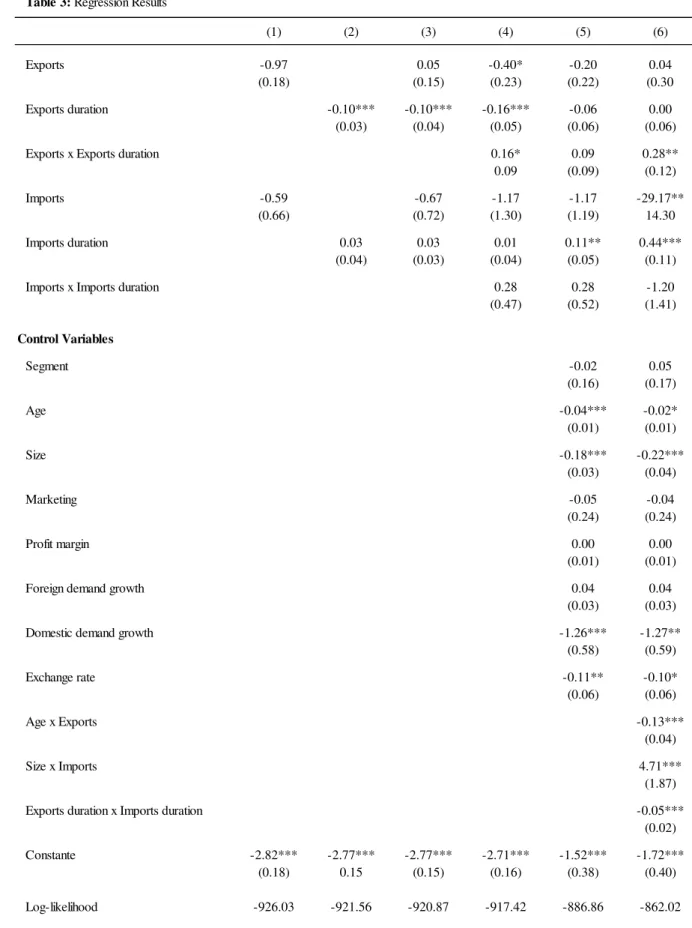
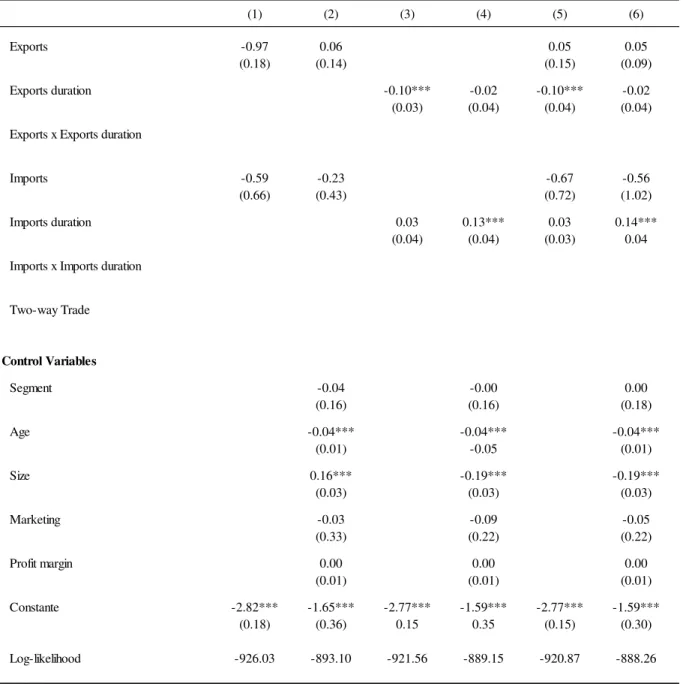
The estimation results of six regression models designed to test the hypothesis are presented in table 3. In the first four models, the independent variables are examined without controlling for firm- and industry-level characteristics. In the fifth model, all independent variables and control variables are put together, and in the sixth model, some moderating terms of interest are incorporated. In Appendix, Table 4 displays the models that add all firm-level control variables to each of the models (1), (2) and (3) of Table 3. This aims to have a better individual look about the impact of firm-level characteristics on study variables.
In the first model, only Exports and Imports are included and none of these variables is found
significant. In the second model, only the durations of exports and imports are integrated, with Exports duration being found significant at a 1 per cent level of significance (
. In the third model, all independent variables are joined together. The results for this model are consistent with the first two models in which only Exports duration is significant.
In the ford model in table 3, all independent variables are included along with the moderating terms between Exports and Exports duration, and Imports and Imports duration. Adding these
interactive terms does not largely impact the results for the importing side. However, on the exporting side, Exports( ) are revealed to have a positive impact on firm’s survival.
29 Table 2: Descriptive statistics and correlation matrix
Mean Std. Error 1. 2. 3. 4. 5. 6. 7. 8. 9. 10. 11. 12
1. Exports 0.40 0.64 1.00
2. Exports Duration 2.20 2.55 0.50 1.00
3. Imports 0.09 4.21 0.00 -0.01 1.00
4. Imports Duration 1.02 2.02 0.37 0.60 0.01 1.00
5. Segment 0.83 0.37 0.00 0.05 0.01 -0.02 1.00
6. Age 11.94 8.06 0.10 0.29 -0.01 0.19 0.10 1.00
7. Size 4.17 2.65 0.12 0.21 0.00 0.27 0.03 0.19 1.00
8. Marketing 0.08 0.36 0.01 -0.01 0.03 0.00 -0.01 0.00 -0.01 1.00
9. Profit margin 0.36 0.35 -0.01 -0.01 0.00 -0.01 0.01 0.00 0.00 0.16 1.00
10. Foreign Demand Growth 4.47 4.47 -0.01 -0.06 0.01 -0.04 0.00 -0.07 -0.02 -0.01 -0.01 1.00
11. Domestic Demand Growth 0.19 0.19 0.04 0.09 -0.01 0.05 0.00 0.08 0.01 0.02 0.02 0.19 1.00
30
moderating term between Exports and Exports duration has on firm’s survival ( ).
In the fifth model, firm- and industry-level characteristics are added. In this model, it is possible to verify that in the exports side, all the variables that seem to impact firm’s survival
on the forth model lose their significance. Moreover, Imports duration is now relevant for
firm’s survival ( ). In what concerns the control variables, Segment Marketing and
Profit margin do not seem to affect firm’s survival, while Age ( ) and Size (
) appear to have a positive impact. At the industry-level, Domestic demand growth ( ) and Exchange rate ( ) are found significant with Foreign demand growth appearing not to have an effect on firm’s survival.
Finally, the last model in Table 3 represents the model in the fifth column but now including three additional moderating terms of interest. The integration of these terms reveals that
Imports ( ) alone have an impact on firm’s survival, as well as the interactive term
between Exports and Exportsduration ( . In what concerns the moderating terms
included in this final model, these are the interactive terms between (1) Age and Exports, (2) Size and Imports and (3) Exports duration and Imports duration, with p-values of ,
and , respectively. In either of these two final models, Segment, Marketing, Profit margin and Foreign demand growth are not found to have an impact on firm’s survival.
Different models were regressed using different definitions of Exports and Imports. Namely,
instead of measuring these variables in terms of sales, Exports and Imports were also
31 Table 3: Regression Results
(1) (2) (3) (4) (5) (6)
Exports -0.97 0.05 -0.40* -0.20 0.04
(0.18) (0.15) (0.23) (0.22) (0.30
Exports duration -0.10*** -0.10*** -0.16*** -0.06 0.00
(0.03) (0.04) (0.05) (0.06) (0.06)
Exports x Exports duration 0.16* 0.09 0.28**
0.09 (0.09) (0.12)
Imports -0.59 -0.67 -1.17 -1.17 -29.17**
(0.66) (0.72) (1.30) (1.19) 14.30
Imports duration 0.03 0.03 0.01 0.11** 0.44***
(0.04) (0.03) (0.04) (0.05) (0.11)
Imports x Imports duration 0.28 0.28 -1.20
(0.47) (0.52) (1.41)
Control Variables
Segment -0.02 0.05
(0.16) (0.17)
Age -0.04*** -0.02*
(0.01) (0.01)
Size -0.18*** -0.22***
(0.03) (0.04)
Marketing -0.05 -0.04
(0.24) (0.24)
Profit margin 0.00 0.00
(0.01) (0.01)
Foreign demand growth 0.04 0.04
(0.03) (0.03)
Domestic demand growth -1.26*** -1.27**
(0.58) (0.59)
Exchange rate -0.11** -0.10*
(0.06) (0.06)
Age x Exports -0.13***
(0.04)
Size x Imports 4.71***
(1.87)
Exports duration x Imports duration -0.05***
(0.02)
Constante -2.82*** -2.77*** -2.77*** -2.71*** -1.52*** -1.72***
(0.18) 0.15 (0.15) (0.16) (0.38) (0.40)
Log-likelihood -926.03 -921.56 -920.87 -917.42 -886.86 -862.02
32
square term of these variables. However, none of these terms showed statistical significance. Finally, a vast number of other models containing potential moderating terms of interest were regressed as it was the case of the interaction between Exports and Imports. This aimed to
33
5. DISCUSSION
This research is the first evidence of the role of exports and imports on firm’s survival in the service sector. Results indicate a strong positive link between firm’s imports and firm’s
survival (H4), while exporting does not seem to play a role for exiting the market. Moreover, firm’s exports duration seems to positively moderate the impact of firm’s exports on firm’s
survival (H3), as well as the duration of imports appears to impact firm’s survival (H5).
Exports
The results do not lend support to hypothesis 1 that firm’s exports are positively related with firm’s survival. Although Exports are negative and significant in the forth model of Table 3,
after the introduction of firm-level characteristics that are positively associated with exports and survival, this variable is no longer significant. These results indicate that firm’s exports
per se are not found to impact firm’s survival. Exporting firms have specific characteristics -
namely the fact that they are larger and older (as seen in Table 1 and as concluded from Table 3) – that enable them to have higher chances of survival. Consequently, when controlled for size and age, these results indicate that exports alone are not related with firm’s probability of exit.
When analysing the impact of firm’s exports duration on firm’s survival, this variable alone does not affect firm’s probability of exit. Nonetheless, it has a negative moderating effect on the relationship between firm’s exports and firm’s survival. This means that, although exports
do not directly impact firm’s survival, when subjected to higher duration of exports, exports increases firm’s probability of exit. Even though this result is at odds with what was previously expected, a possible justification is formulated. Exports duration may be
34
case, a fluctuation in demand for India’s ITS services may affect firm’s survival. Given that this survey covers a period of economic crisis in which countries are more closed to international trade, dependency from exports can actually be related with an increase in firm’s probability of exit. For that reason, the moderating term between exports and exports duration is explained as positively impacting firm’s probability of exit.
Finally, it should be mentioned that exports have a positive effect on the relationship between firm’s age and firm’s survival. However, this effect should be examined in conjunction with the effect of exports on the relationship between firm’s duration of exports and survival. Finally, firm’s Exports duration is found to positively moderate the relationship between Imports duration and firm’s survival. Taking this into consideration, a positive variation in
exports yields a negative impact on firm’s survival.
Imports
In the present study, imports alone are found to have a strong positive link to firm’s survival. Nonetheless, statistical significance is only found after the moderating term between size and imports is added in Model 6. The fact that imports become significant after the moderating term is included indicates that the impact of imports on firm’s survival is not linear and is dependent on firm’s size.
When the moderating term between size and imports is included, it is revealed that size negatively moderates the relationship between firm’s imports and survival. However, it is worth to notice that, for an average firm (to which, as seen in Table 2, the variable Size is
35
quality, be able to specialize and gain knowledge and expertise; all benefits from engaging into imports. According to the present research, these and other factors explain the positive relation found between firm’s imports and firm’s survival.
Firm’s imports duration is also found significant and positively impacting firm’s probability of exit. This is not in line with what was expected. In fact, even when considering the moderating impact of this variable on the relationship between firm’s exports duration and firm’s survival, the overall effect of firm’s duration of imports is positive.
As a final remark, the results do not provide evidences that two-way traders face differences in their probability of exit. This indicates that a firm that imports does not benefit further - in terms of its likelihood of survival - by starting to export.
Control Variables
In what concerns the control variables, age is found to have a positive impact on firm’s survival. This means that as firms get older, their probability of exit decreases. This finding is in line with previous research that finds that firm’s age is impacts firm’s probability of survival. As firms age, the uncertainty of firms to be able to cope with the market they are entering gradually becomes resolved (Mata & Portugal 2002). Moreover, older firms are ahead in the learning curve in the industry and are more engaged in efficient routines and culture.
36
survival. In fact, firm’s size seems to be more relevant for technological advanced industries such as the ITS industry than for traditional industries (Giovannetti et al 2011).
At the industry level, foreign demand growth is not found to have an effect on firm’s survival. This could be explain by the fact that variations in the overall growth of the World demand reflect a much higher scale than the one to which Indian firms are affected by. However, domestic demand growth is found to be positively related with firm’s survival. Therefore, as domestic demand growth increases, firm’s survival also increases. This can be explained by the fact that domestic demand for ITS services is mostly served by domestic firms. Therefore, an increase in domestic demand growth means a direct increase in demand for domestic firms’ services hence increasing domestic sales and ultimately impacting firm’s survival.
Finally, higher exchange rates of Indian rupees in terms of dollars are found to positively impact firm’s survival. Most Indian software firms in this panel are exporters (57%) and, for those, exports represent, on average, 70% of their total sales. Consequently, Indian firms may be considered to largely rely on exports. Consequently, a variation in Indian rupees exchange rate in terms of dollars may represent and impact on foreign demand for Indian’s services and products as these become relatively cheaper or more expensive if the exchange rate increases or decreases, respectively. Moreover, importing firms may also be affected by fluctuations in the exchange rate as the importing services or products become more expensive or cheaper if the exchange rate increases or decreases, respectively.
5.1Theoretical Implication
37
the manufacturing sector. Therefore, these results shed some new light for the potential impact of international trade on firm’s performance in a different setting.
Secondly, previous research is focused on the relation of firm’s exports and firm’s performance, neglecting the relation with imports and the effect of two-way trade. This study examines the relation between international trade and firm’s survival by examining its multiple components separately - namely exports and imports, and also considering two-way trade. Secondly, this research studies the link between the engagement in international trade and firm’s survival. Firm’s survival as a measure of performance has been poorly studied in comparison with other measures. Mostly, previous research has focused on firm’s productivity as a measure of firm’s performance. However, by studying firm’s survival, this research enables the study of the potential impact of exports and imports on a longer-term measure of performance. The empirical findings indicate that exports are not linked to firm’s survival. Although previous research finds a positive relation between firm’s exports and firm’s productivity, it seems that, in what concerns its long-term impact, firm’s survival is not affected. On the other hand, imports show a very strong and positive relation with firm’s survival indicating that the higher the imports of a firms, the lower is its probability of exiting.
38
influence as moderator between the relationship between exports and firm’s survival, duration of imports exert a direct impact on firm’s survival. A possible explanation for these relationships is that, the longer a firm engages in exports, the longer it is its dependence on that engagement.
5.2 Managerial Implication
Findings from the current study also have implications for firms that wish to engage in international trade or are already engaged. Firm’s exports have been regarded in both theoretical and empirical studies as having a positive impact on firm’s productivity. Not disregarding these arguments, in this study, exports are not found to have an impact on a longer-term measure of performance - firm’s survival. As a result, managers should take into consideration that, although starting exporting or maintaining their exporting status may increase their firms’ productivity; it may not be a key factor to survive in the market. If firm’s survival is the ultimate goal, managers should conduct a careful research to assess the impact that exports may have (or already have) on their firms’ survival.
Moreover, results indicate that managers should take special care to their level of imports. Firm’s imports seem to have a positive impact on firm’s likelihood of survival. For this reason, managers should consider how imports can impact firm’s survival and how can
managers maximize the potentially positive impact of these imports. This includes taking advantage of potential specialization opportunities, learning transfer and access to cheaper and of higher quality inputs. In addition, this study indicates that managers should also examine the duration of exports and imports as it seems that longer durations of exports (or imports) increases firm’s probability of exit.
39
of Indian firms, this research shows that managers should be aware of fluctuations in the exchange rate as well as how these fluctuations can impact their sales and costs.
5.3 Limitations and Future Research
Several limitations of this study are acknowledged. First of all, firm’s exports and imports are
solely measured in terms of sales derived from exports. Future research could segment exports into categories. For instances, in the case of software exports, exports could be divide into onsite projects, offshore projects and a mixed of the two. Imports could also be segmented into types, such as imports of capital goods and imports of services. While the first category may lead to cheaper materials or materials of higher quality, the second category may be a way for sharing and spreading of different knowledge throughout the firm as a direct contact of human capital is in place.
Secondly, exports could also be controlled for the destination of the trade, since relations with different countries may yield different levels of exports success in terms of firm’s survival. Exports destinations could thus be controlled for countries or groups of countries that may be thought to have a different impact on firm’s performance - as could be the case of developed countries versus developing countries. For instances, the US market is considered to be far more competitive than less-developed destinations. For this reason, firms may be more willing to enter the latter. However, efficiency gains derived from the pressure of firm’s to
compete in a foreign market are higher in the US market. In this case, firm’s could thus have more chances of survival.
40
and firm’s survival as this is a relationship that has received little attention in previous studies and is found highly significant in the present study. The relationship between firm’s imports and firm’s survival could be analysed using mediators such as input quality, input variety,
specialization and learning transfer.
Furthermore, future research could further examine the relation between firm’s exports and imports and firm’s survival. As it seems from the results of the present study, the duration of these engagements have a negative impact on firm’s survival. This could be explained by the fact that the longer the duration, the longer it may be firm’s dependence on these engagements. Future research could verify these results and apply them to different industries. Moreover, it could examine what may be the reasons behind a negative relation.
41
6. CONCLUSION
Recent research studying the relation between firm’s engagement in international trade and firm’s performance has largely emphasized the relation between exports and firm’s performance and neglected imports. Moreover, previous research is focused on the relation between international trade and firm’s productivity, neglecting other measures of performance in particular long-term measures that are of great interest for firm’s stakeholders.
This study analyses the relationship between firm’s engagement into international trade – considering exports and imports – and firm’s survival in the service sector. It uses a panel of firms operating in the ITS industry in India between 2002 and 2009 that contains information on firm’s level of exports and imports, as well as age, sales, marketing expenses and profit margins. This data is complemented by data at the industry-level, namely foreign and domestic demand and exchange rate. The introduction of these variables allows verifying if export and imports are individually linked to firm’s survival even when controlling for both firm- and industry- level characteristics. Additionally, it provides relevant information about the relation of these characteristics with firm’s survival.
Taking firm- and industry-level characteristics into account, it was not found a link between exports and firm’s survival. However, exporting firm’s are usually larger and older, and these characteristics are positively related with firm’s survival. Imports, on the other hand, have a positive relation with firm’s survival which can be explained by such aspects such as the fact
42
43
REFERENCES
Acharya, R. C., & Keller, W. (2009). Technology transfer through imports. The Canadian Journal of Economics1, 42(4), 1411–1448.
Altomonte, C., & Békés, G. (2009). Trade Complexity and Productivity. Institute of Economics, Hungarian Academy of Sciences. mimeo, July
Álvarez, R., & Vergara, S. (2013). Trade exposure, survival and growth of small and medium-size firms. International Review of Economics & Finance, 25, 185–201.
doi:10.1016/j.iref.2012.07.010
Amiti, M., & Konings, J. (2007). Trade Intermediate and Productivity: Liberalization, Inputs, from Indonesia Evidence. The American Economic Review, 97(5), 1611–1638.
Andersson, M., Lööf, H., & Johansson, S. (2008). Productivity and International Trade: Firm Level Evidence from a Small Open Economy. Review of World Economics, 144(4), 774–801.
doi:10.1007/s10290-008-0169-5
Athreye, S. S. (2005). The Indian software industry and its evolving service capability.
Industrial and Corporate Change, 14(3), 393–418. doi:10.1093/icc/dth056
Audretsch, D. B. (1995). Innovation, growth and survival. International Journal of Industrial Organization, 13, 441–457.
Aw, B.-Y., & Hwang, a. R. (1995). Productivity and the export market: A firm-level analysis.
Journal of Development Economics, 47(2), 313–332.
44
Baik, B., Kang, J.-K., Kim, J.-M., & Lee, J. (2013). The liability of foreignness in international equity investments: Evidence from the US stock market. Journal of International Business Studies, 44(4), 391–411. doi:10.1057/jibs.2013.13
Barber, J., & Alegre, J. (2007). Analysing the link between export intensity, innovation and firm size in a science-based industry. International Business Review, 16(3), 275–293.
doi:10.1016/j.ibusrev.2007.02.005
Barnes, T. (2013). The IT Industry and Economic Development in India: A Critical Study.
Journal of South Asian Development, 8(1), 61–83. doi:10.1177/0973174113477000
Bernard, A. B., Jensen, J. B., Redding, S. J., & Schott, P. K. (2007). Firms in International Trade. The Journal of Economic Perspectives, 21(3), 105–130.
Blalock, G., & Veloso, F. M. (2007). Imports, Productivity Growth, and Supply Chain Learning. World Development, 35(7), 1134–1151.
doi:10.1016/j.worlddev.2006.10.009
Castellani, D., Serti, F., & Tomasi, C. (2010). Firms in International Trade: Importers’ and Exporters’ Heterogeneity in Italian Manufacturing Industry. World Economy, 33(3),
424–457. doi:10.1111/j.1467-9701.2010.01262.x
Cleredis, S. K., Saul, L., & Tybout, J. R. (1998). Is Learning by Exporting Important ? Micro -Dynamic Evidence from Colombia , Mexico , and Morocco. The Quarterly Journal of Economics, 113(3), 903–947.
45
Das, S., Roberts, M. J., & Tybout, J. R. (2007). Market entry costs, producer heterogeneity, and export dynamics. Econometrica, 75(3), 837–873.
Delgado, M. A., Fariñas, J. C., & Ruano, S. (2002). Firm productivity and export markets : a non-parametric approach. Journal of International Economics, 57, 397–422.
Dzhumashev, R., Mishra, V., & Smyth, R. (2011). Exporting , R & D Investment and Firm Survival, mimeo.
Esteve-Pérez, S., Requena-Silvente, F., & Pallardó-Lopez, V. J. (2013). The Duration of Firm-Destination Export Relationships: Evidence From Spain, 1997-2006. Economic Inquiry, 51(1), 159–180. doi:10.1111/j.1465-7295.2012.00460.x
Gibson, M. J., & Graciano, T. A. (2011). Costs of Starting to Trade and Costs of Continuing to Trade, Washington State University, mimeo, January.
Giovannetti, G., Ricchiuti, G., & Velucchi, M. (2011). Size, innovation and
internationalization: a survival analysis of Italian firms. Applied Economics, 43(12),
1511–1520. doi:10.1080/00036840802600566
Halpern, L., Koren, M., & Szeidl, Á. (2005). Imports and productivity. Institute of Economics, Hungarian Academy of Sciences. mimeo, September.
Honjo, Y. (2000). Business failure of new firms: an empirical analysis using a multiplicative hazards model. International Journal of Industrial Organization, 18(4), 557–574.
doi:10.1016/S0167-7187(98)00035-6
Ilmakunnas, P., & Nurmi, S. (2010). Dynamics of Export Market Entry and Exit.
Scandinavian Journal of Economics, 112(1), 101–126.
46
Jenkins, S.P. 2005. “Survival Analysis.” Lecture Notes, Essex University
Kasahara, H., & Lapham, B. (2013). Productivity and the decision to import and export: Theory and evidence. Journal of International Economics, 89(2), 297–316.
doi:10.1016/j.jinteco.2012.08.005
Kasahara, H., & Rodrigue, J. (2008). Does the use of imported intermediates increase
productivity? Plant-level evidence. Journal of Development Economics, 87(1), 106–118.
doi:10.1016/j.jdeveco.2007.12.008
Kim, S.-I., Gopinath, M., & Kim, H. (2009). High productivity before or after exports? An empirical analysis of Korean manufacturing firms. Journal of Asian Economics, 20(4),
410–418. doi:10.1016/j.asieco.2009.02.012
Kimura, F., & Kiyota, K. (2006). Exports, FDI, and Productivity: Dynamic Evidence from Japanese Firms. Review of World Economics, 142(4), 695–719.
doi:10.1007/s10290-006-0089-1
Kraay, A., Soloaga, I., & Tybout, J. (2002). Product Quality , Productive Efficiency , and International Technology Diffusion: Evidence from Plant-Level Panel Data, World Bank.
Lee, H., Kelley, D., Lee, J., & Lee, S. (2012). SME Survival : The Impact of
Internationalization, Technology, Resources and Aliances. Journal of Small Business Management, 50(1), 1–19.
Loecker, J. (2007). Do exports generate higher productivity? Evidence from Slovenia. Journal of International Economics, 73(1), 69–98. doi:10.1016/j.jinteco.2007.03.003
47
Majumdar, S. K., Vora, D., & Nag, A. K. (2012). Legal form of the firm and overseas market choice in India’s software and IT industry. Springer Science+Business Media.
doi:10.1007/s10490-010-9223-7
Hyvonen, Markus, Wang, Hao (2012). India’s Services Exports. Reserve Bank of Australia.
December Quarter 2012.
Mata, J., & Portugal, P. (1994). Life Duration of New Firms. The Journal of Industrial Economics, 42(3), 227–245.
Mata, J., & Freitas, E. (2012). Foreignness and exit over the life cycle of firms. Journal of International Business Studies, 43(7), 615–630. doi:10.1057/jibs.2012.21
Melitz, M. J. (2003). The Impact of Trade on Intra-Industry Reallocations and Aggregate Industry Productivity. Econometrica, 71(6), 1695–1725.
Mûus, M., & Pisu, M. (2009). Imports and Exports at the Level of the Firm: Evidence from Belgium. doi:10.1111/j.1467-9701.2009.001172.x
NASSCOM. (2012). Annual Report 2012-2013.
Namini, J. E., Facchini, G., & López, R. a. (2013). Export growth and firm survival.
Economics Letters, 120(3), 481–486. doi:10.1016/j.econlet.2013.05.025
Patibandla, M., Kapur, D., & Peterson, B. (2000). Import Substitution with Free Trade: Case of India’s Software Industry. Economics & Political Weekly, 35(15), 1263–1270.
Sahoo, P. K., & Patnaik, R. (2009). Emergence and Growth of the Indian Software Industry :
48
Salomon, R. M., & Shaver, J. M. (2005). Learning by Exporting : New Insights from
Examining Firm Innovation. Journal of Economics & Management Strategy, 14(2), 431–
460.
Van Biesebroeck, J. (2005). Exporting raises productivity in sub-Saharan African manufacturing firms. Journal of International Economics, 67(2), 373–391.
doi:10.1016/j.jinteco.2004.12.002
Vogel, A., & Wagner, J. (2009). Higher productivity in importing German manufacturing firms: self-selection, learning from importing, or both? Review of World Economics, 145(4), 641–665. doi:10.1007/s10290-009-0031-4
Wagner, J. (2012a). International trade and firm performance: a survey of empirical studies since 2006. Review of World Economics, 148(2), 235–267.
doi:10.1007/s10290-011-0116-8
Wagner, J. (2012b). Exports, imports and firm survival: first evidence for manufacturing enterprises in Germany. Review of World Economics, 149(1), 113–130.
49
APPENDIX
Table 4: Regression Results
(1) (2) (3) (4) (5) (6)
Exports -0.97 0.06 0.05 0.05
(0.18) (0.14) (0.15) (0.09)
Exports duration -0.10*** -0.02 -0.10*** -0.02
(0.03) (0.04) (0.04) (0.04)
Exports x Exports duration
Imports -0.59 -0.23 -0.67 -0.56
(0.66) (0.43) (0.72) (1.02)
Imports duration 0.03 0.13*** 0.03 0.14***
(0.04) (0.04) (0.03) 0.04
Imports x Imports duration
Two-way Trade
Control Variables
Segment -0.04 -0.00 0.00
(0.16) (0.16) (0.18)
Age -0.04*** -0.04*** -0.04***
(0.01) -0.05 (0.01)
Size 0.16*** -0.19*** -0.19***
(0.03) (0.03) (0.03)
Marketing -0.03 -0.09 -0.05
(0.33) (0.22) (0.22)
Profit margin 0.00 0.00 0.00
(0.01) (0.01) (0.01)
Constante -2.82*** -1.65*** -2.77*** -1.59*** -2.77*** -1.59***
(0.18) (0.36) 0.15 0.35 (0.15) (0.30)
Log-likelihood -926.03 -893.10 -921.56 -889.15 -920.87 -888.26
50 Table 5: Summary of hypothesis testing
Hyp. Path Direction Result
H1 Exports → Survival + Not supported
H2 Exports Duration → Survival + Not supported
H3 Exports * Exports duration → Survival + Supported
H4 Imports → Survival + Supported
H5 Imports Duration → Survival + Supported