Burden of Chemotherapy-Induced Neuropathy in School ged children
M. D, Artan Shkoza
University of Medicine, Tirana, Albania
Msc., Mirlinda Likmeta
University of Medicine, Tirana, Albania
M. D, PhD, Ledjan Malaj
University of Medicine, Tirana, Albania
Abstract
Chemotherapy-induced peripheral neuropathy (CIPN) is the most common neurological complication in cancer treatment and probably the most common toxic neuropathy in our environment. The aim of the study was to assess the incidence and discomfort caused by neuropathic symptoms in children treated for hematologic cancers. The study included all children admitted to the pediatric oncology service at the University Hospital Center “Mother Teresa”, Tirana, by the year 2011 – 2013 divided in three diagnosis groups: acute lymphoblastic leukemia, Hodgkin and non-Hodgkin’s lymphoma, or other solid tumors. In a prospective cohort setting, data were collected by standard questionnaire for symptoms and signs of neurological damage, according to The Pediatric Modified Total Neuropathy Scale (Ped -mTNS), as well as clinical evaluation of pin sensibility, vibration sensibility, muscle strength and deep tendon reflexes (DTR). The results obtained from Ped-mTNS, showed the high incidence of sensory and motor symptoms as well as functional deficits in balance and manual dexterity in children treated with anticancer drugs. Ped-mTNS scores, as the first measure designed to assess CIPN in school-aged children, are significantly higher for children undergoing neurotoxic chemotherapy. Even though the neuropathy in these children was relatively mild, it was associated with functional deficits in balance and manual dexterity, suggesting clinical importance. An important limiting factor of this study is the exclusion of children younger than 5 years old, whom discomfort is evident but not properly evaluated.
Keywords: Peripheral neuropathy, chemotherapy, toxicity in children.
Introduction
97
derivatives and taxanes (Quasthoff & Hartung, 2002, 9).
The first early sensory symptoms are paresthesias and numbness, which occur usually between the first and third cycles of therapy. Motor weakness usually develops later, because sensory neurons and axons that transmit pain perception are unmyelinated and lightly myelinated fibers and are more susceptible than motor fibers to toxic damage.
Sensory symptoms may persist or even develop weeks to months after discontinuation of the chemotherapy. This feature, known as “coasting,” was first detected with the vinca alkaloid vincristine. Sensory loss refers to pin, touch, or both. It is due to the distal degeneration of sensory axons (Krarup-Hansen, Helweg-Larsen, et al., 2007, 1076). The neuronal injury begins at the most distal portion of an axon where the lack of nutritional cytoplasmic support is more pronounced (Asbury, 1987, 58).
Neuropathic pain is prominent and important for many patients, and its severity may be dose-limiting, particularly in the treatment of multiple myeloma with bortezomib (Cavaletti & Nobile-Orazio, 2007, 1308). Additionally, patients with pre-existing neuropathies of any kind (eg, diabetic, paraneoplastic, alcoholic, or hereditary) show an increased propensity to develop neuropathy when treated with neurotoxic agents used in cancer treatment (Chaudhry et al., 2003, 337 & Graf et al., 1996, 1356). CIPN is less frequent and severe with second-generation vinca alkaloids such as vinorelbine and vinflunine (Swain & Arezzo, 2008, 455).
At present, early detection and management of CIPN are the best approaches available to prevent its progression towards a severe and disabling neuropathy.
Materials and methods
The study included all children admitted to the pediatric oncology service at the University Hospital Center “Mother Teresa”, Tirana, by the year 2011 - 2013 with a diagnosis of acute lymphoblastic leukemia, Hodgkin and non-Hodgkin’s lymphoma, or other solid tumors.In a prospective cohort setting, data were gathered by standard questionnaire (Table 1) for symptoms and signs of neurological damage modified for children (Pedm-TNS), as well as clinical evaluation of light touch sensation, pin sensibility, vibration sensibility, muscle strength and deep tendon reflexes, prior and two to six month after chemotherapy treatment (Gilchrist, Tanner, Hooke, 2009, 7).
99
Each category is rated from 0 to 4, with 0 indicating no symptom or deficit on clinical exam to 4 indicating worse symptoms or proximal spread of neurologic symptoms. The scale has 28 possible points (autonomic tests not included) and a higher score indicates worse neuropathy.
Results
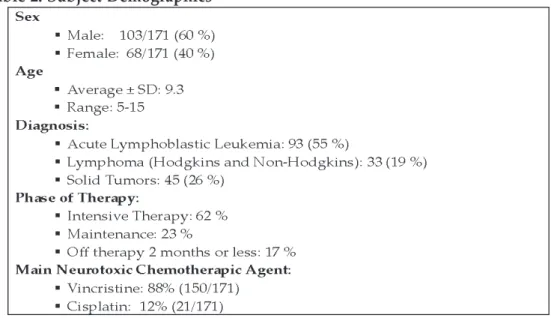
The total number of patient admitted to the pediatric oncology service was 285. 114 of them were less than 5 years old and, did not meet inclusion criteria. Subject demographics are given in Table 2.
Table 2. Subject Demographics
Descriptive statistics of scoring on the ped-mTNS are given in Table 3.
The detailed results obtained from standardized Ped-m TNS, showed the following: 60 % of children reported sensory symptoms, of whom 30 % (50/166) reported numbness, 30 % (50/166) tingling, 25 % (41/166) reported pain, and 20 % (33/166) reported numbness and tingling simultaneously.
52 % (86/166) of children reported motor symptoms, with all of these subjects reporting some difficulty with walking or ascending stairs.
28 % (46/166) showed impairments in pin sensibility, with a mean item score of 0.3 ± 0.5 and a range of 0-1, indicating that subjects had decreased pin sensibility only in their toes or fingers when impacted.
Four of children who could not participate in the study were found to have depressed nerve conduction studies.
Discussion
Chemotherapy- induced peripheral neuropathy (CIPN) is the most common neurological complication in cancer treatment (Kannarkat et al., 2007, 719). From the first reported case of sensory neuropathy secondary to cisplatin over 30 years ago (Kedar et al., 1978, 819 ), the problem of neurotoxicity in relation to these treatments has always been part of the oncology scene. Similar to the findings of Wampler et al. (Wampler et al., 2006, 9), even though the neuropathy in these children was relatively mild, it was associated with functional deficits in balance and manual dexterity, suggesting clinical importance.
The importance of CIPN lies in two factors: it impairs pateint’s quality of life (Cavaletti at al., 1994, 1287 and Mileshkin at al., 2002 ) and it is a dose limiting factor (Wolf et al., 2008, 1507 and Mileshkin et al., 2006, 4507).
There are several strengths and limitations in this study. Strengths include the study design presenting real-life clinical practice. In the present study, the occurrence of neurotoxicity is in line with the previous literature confirming the reliability of the study (Lavoie Smith E, at. al, 2010). The strongest limitation of the present study is that we selected only patients treated with neurotoxic agents like vinca alkaloids, platinum and taxanes. Also, because of large variation in doses and duration of treatment, no comparisons between different chemotherapy regimens or analysis or dose response were feasible.
101
serious concern is about children younger than five years old, who cannot understand physician questions and report their symptoms.
References
Ries, LAG., Smith, MA., Gurney, JG., et al., (1999). Cancer incidence and survival among children and adolescents: United States SEER Program 1975–1995, National Cancer Institute, SEER Program. NIH Pub. No. 99–4649. Bethesda, MD.
Markman, M. (2006). Chemotherapy-induced peripheral neuropathy: underreported and underappreciated. Curr Pain Headache Rep 10:275–278.
Quasthoff, S., Hartung, HP. (2002). Chemotherapy-induced peripheral neuropathy. J Neurol 249:9– 17.
Krarup-Hansen, A., Helweg-Larsen, S., et al. (2007). Neuronal involvement in cisplatin neuropathy: prospective clinical and neurophysiological studies. Brain, 130:1076–1088.
Asbury, AK. (1987). Sensory neuronopathy. Sem Neurol, 7: 58–66.
Cavaletti G, Nobile-Orazio E (2007). Bortezomib-induced peripheral neurotoxicity: still far from a painless gain. Haematologica; 92 (10):1308–10.
Chaudhry, V., Chaudhry, M., Crawford, TO., et al., (2003). Toxic neuropathy in patients with pre-existing neuropathy. Neurology, 60:337–340.
Graf, WD., Chance, PF., Lensch, MW., et al., (1996). Severe vincristine neuropathy in Charcot-Marie-Tooth disease type 1A. Cancer, 77:1356–1362.
Swain, SM., Arezzo, JC. (2008). Neuropathy associated with microtubule inhibitors: diagnosis, incidence, and management. Clin Adv Hematol Oncol; 6 (6):455–67.
Gilchrist, LS., Tanner, L., Hooke, MC. (2009). Measuring chemotherapy induced peripheral neuropathy in children: development of the PedmTNS and pilot study results. Rehabil Oncol 27:7– 15.
Kannarkat, G., Lasher, EE., Schiff, D. (2007). Neurologic complications of chemotherapy agents. Curr Opin Neurol.; 20:719-25.
Kedar, A., Cohen, ME., Freeman, AI. (1978). Peripheral neuropathy as a complication of cis-dichlorodiammineplatinum (II) treatment: a case report. Cancer Treat Rep.; 62:819-21.
Wampler, MA., Miaskowski, C., Hamel, K. et al., (2006). The modified total neuropathy score: a clinically feasible and valid measure of taxane-induced peripheral neuropathy in women with breast cancer. J Support Oncol 4:9–16.
Cavaletti, G., Bogliun., G, Marzorati, L., et al. (1994). Long-term peripheral neurotoxicity of cisplatin in patients with successfully treated epithelial ovarian cancer. Anticancer Res 14:1287– 1292.
Mileshkin, L., Antil, Y., Rischin, D. (2002). Management of complications of chemotherapy. In: Gershenson DM, McGuire MP, Gore M et al., (eds) Gynaecologic cancer: controversies in management. Elsevier Science, Philadelphia, PA.
Wolf, S., Barton, D., Kottschade, L. et al., (2008). Chemotherapy-induced neuropathy: prevention and treatment strategies. Eur J Cancer 44:1507–1515.
Mileshkin, L., Stark, R., Day, B., et al., (2006). Development of neuropathy in patients with myeloma treated with thalidomide: patterns of occurrence and the role of electrophysiologic monitoring. J Clin Oncol 24:4507–4514.