PERFORMANCE EVALUATION OF KOGI STATE AGRICULTURAL DEVELOPMENT PROGRAMME SINCE THE WITHDRAWAL OF
WORLD BANK’S ASSISTANCE TO NIGERIA
Joseph Unuetara Agbamu*
Department of Agricultural Economics and Extension, Delta State University, Asaba Campus, Asaba, Nigeria
Abstract: This study evaluated the performance of Kogi State Agricultural
Development Programme (KADP) during World Bank’s assistance period (1991 to 1995) and after World Bank’s assistance period (2009 to 2013). Data were collected through the use of questionnaire and interviews of 120 farmers and 60 staff members of KADP and through various secondary sources of information. It was found that during World Bank’s assistance, KADP received N2.25 billion, while it received N928.9 million after cessation of the assistance. From 1991 to 1995, KADP received 72.6% of its funding from the World Bank and International Fund for Agricultural Development. From 2009 to 2013, KADP received 83.1% of its funding from international organizations. KADP had a high degree of dependency on temporary international assistance. Analysis of 19 performance indicators showed that a significant difference exists in KADP’s performance between before and after World Bank’s assistance, with better performance during the period of World Bank’s assistance, 1991‒1995. This study discussed the effects of World Bank’s withdrawal and the measures taken by KADP to strengthen itself.
Key words: performance, agricultural development, World Bank, Kogi State.
Introduction
Kogi State is in the middle belt of Nigeria. It is situated between latitudes 6°33’N and 8°44’N and longitudes 3°22’E and 7°49’E and has its capital in Lokoja. Kogi State has a total land area of 28,313.53 sq. km and a population of 3,278,487. It has about 172,000 farm families, 70% of this population lives in the rural areas and they are engaged in crop production and animal rearing (Kogi State Government, 2010). Kogi State is made up of 21 Local Government Areas. Its low land areas are extensively plain, alluvial and swampy. The State is a good producer
of yam, cocoyam, cassava, melon, maize, sorghum, rice, cowpea, benniseed and oil palm. Cattle, sheep, goats and poultry birds are reared in Kogi State.
In order to replace the less flexible and rather less efficient agricultural extension services of the Ministry of Agriculture in each state of Nigeria, an Integrated Agricultural Development Project supported by the World Bank was started in 1975. Today, all states in Nigeria and the Federal Capital Territory have Agricultural Development Programmes (ADPs). With the involvement of World Bank assistance through loans from the International Bank for Reconstruction and Development (IBRD), the ADPs came to have a revitalized agricultural extension system and a less bureaucratic management unit from 1975 to 1995 (Agbamu and Okagbare, 2005). The ADPs have evolved to be permanent institutions for agricultural services and rural infrastructural development (World Bank, 2001; Adeokun, 2005).
Kogi State Agricultural Development Programme (KADP) came into existence under Edict No. 12 of 1991. KADP consists of six sub-programmes, namely: (1) Agricultural Services; (2) Rural Institution Development that handles group formation, credit matters and agribusiness; (3) Administration and Training; (4) Programme Monitoring and Evaluation; (5) Engineering Services; and (6) Finance. The World Bank’s assistance to KADP ceased on the 30th
June, 1995, having assisted it for four years. Although the major assistance from the World Bank expired in 1995, the World Bank and International Fund for Agricultural Development (IFAD) continued special assistance to KADP in irrigation project as well as in root and tuber crop expansion project.
It has become imperative to evaluate the performance of KADP in the Post-World Bank era by examining performance indicators during Post-World Bank’s assistance period (1991–1995) and after World Bank’s assistance period (2009– 2013). Is there any significant difference in KADP’s performance between before and after the expiration of World Bank’s assistance? Arising from the withdrawal of World Bank funding for KADP and the inadequacy of funds available to it, what are the effects on the mode of operation of Kogi State Agricultural Development Programme’s activities that support small holder farmers and on-farm adaptive trials? What measures did KADP adopt to strengthen itself as a development institution following the expiration of World Bank’s assistance?
Agricultural Development Programme (KADP) to strengthen itself as a development institution following the expiration of World Bank’s assistance.
Material and Methods
There are four agricultural zones in Kogi State: zones A, B, C, D. By simple random sampling, one Local Government Area (LGA) was selected from each of the four agricultural zones. The four LGAs so selected are Kabba Bunu, Dekina, Koton Karfe and Idah. Two towns or villages were randomly selected from each of the four local government areas, giving rise to 8 towns/villages. The towns/villages are Bunu village and Kabba town from Kabba Bunu LGA, Anyigba town and Ehime village from Dekina LGA, Koton Karfe town and Kpareke village from Koton Karfe LGA, Idah town and Ofu village from Idah LGA.
Farmers in each town/village were stratified into contact and non-contact farmers. From each of the eight (8) towns or villages, fifteen (15) farmers were randomly selected (8 contact farmers and 7 non-contact farmers). This gave rise to a total of 120 farmers. On selection of staff, fifteen (15) staff members of Kogi State Agricultural Development Programme (KADP) were randomly selected from each of the four zonal offices, making a total of 60 respondents.
Data were collected through the use of questionnaire and personal interviews. Information was sought on proportion of farmers served by agricultural extension workers. Farmers and staff of KADP were asked to rate the performance of KADP before and after the expiration of World Bank’s assistance. The respondents responded to a list of fourteen (14) activities that served as assessment criteria. For each criteria, a respondent was required to rate KADP as excellent with 5 points, very good with 4 points, good with 3 points, fair with 2 points, poor with 1 point, or very poor with 0 point. Secondary data on nineteen (19) performance indicators were obtained from annual reports of KADP to show the level of performance before expiration and after expiration of World Bank’s assistance. Secondary data were also collected on budgetary allocations and disbursements for 1991–1995 and 2009–2013 in order to ascertain the funding status of KADP during the two periods under study.
where: T = Absolute sum of the negative ranks. Once T-value is identified, its sign (+ or -) is ignored; T is then treated as an absolute value.
N = Number of performance indicators.
In this Wilcoxon test, Z-calculated value is compared with Z-table value in order to reject or accept the null hypothesis that no significant difference exists in performance of Kogi State Agricultural Development Programme between before and after the expiration of World Bank’s assistance.
Results and Discussion
Table 1 shows the funding status of Kogi State Agricultural Development Programme in terms of the budgeted amount by the various funding agencies and the actual amount received during the periods under study.
Table 1. Funding situation of Kogi State agricultural development programme.
Year
Source of funds (N)
IBRD IFAD Total IBRD & IFAD
Federal government
State government
Total budget
Actual receipt
1991 417,556,874 29,825,491 447,382,365 110,378,718 79,914,929 637,676,012 454,054,011
1992 417,556,874 29,825,491 447,382,365 110,378,718 79,914,929 637,676,012 454,054,011
1993 417,556,006 29,825,358 447,380,364 64,076,726 79,914,929 591,372,019 431,778,635
1994 417,556,006 29,825,358 447,380,364 47,690,310 79,914,929 574,985,603 425,465,133
1995 417,556,006 29,825,358 447,380,364 110,378,718 79,914,929 637,674,011 485,928,881
2009 26,538,337 371,536,714 398,075,051 17,003,400 85,385,110 500,463,561 204,019,681
2010 26,538,337 371,536,714 398,075,051 46,301,410 60,560,000 504,936,461 201,990,318
2011 26,534,870 371,488,178 398,023,048 16,386,410 65,560,000 479,969,458 190,580,044
2012 19,805,071 277,270,990 297,076,061 10,560,510 28,796,400 336,432,971 172,253,178
2013 19,849,709 277,895,921 297,745,638 11,680,610 18,060,000 327,486,248 160,100,589
IBRD = International Bank for Reconstruction and Development. IFAD = International Fund for Agricultural Development. Source: KADP (1995; 2003). Note: 1$ = N165.
This study finds that the World Bank, Federal Government of Nigeria and Kogi State Government funded KADP through the contribution of 67.8%, 14.4% and 13% of the budgeted funds respectively, while the International Fund for Agricultural Development (IFAD) contributed 4.8% of the budgeted funds from 1991 to 1995. During this period of World Bank’s assistance, N3.08 billion was budgeted for KADP but it received N2.25 billion representing 73.1% of the budgeted funds.
During this period in which the World Bank only funded irrigation, root and tuber crop project, KADP actually received 50.2% of the budgeted funds which is N928.9 million.
The study finds that from 1991 to 1995, the fund available for KADP to run its activities, was larger compared to the period between 2009 and 2013. From 1991 to 1995, 72.6% of the budgeted funds by KADP came from international organizations, and from 2009 to 2013, 83.1% of the budgeted funds by KADP also came from international organizations (76.7% from IFAD, and 6.4% from the World Bank).
Poor financing of agricultural extension programmes has been a long-standing problem facing the service in developing countries as echoed by Agbamu (2005) and Dayie and Bemile (2013). The current funding situation of KADP is precarious because of limited and unreliable provision of operating resources by Kogi State Government. Due to the unreliable flow of funds from 2009 to 2013, the gap between budgeted funds and actual allocations, and the high degree of dependency on temporary international assistance which is usually unsustainable, agricultural extension performance could dwindle. Ammani et al. (2010) reported that the bulk of the State ADPs in Nigeria have very weak funding status and they require a stable source of funding.
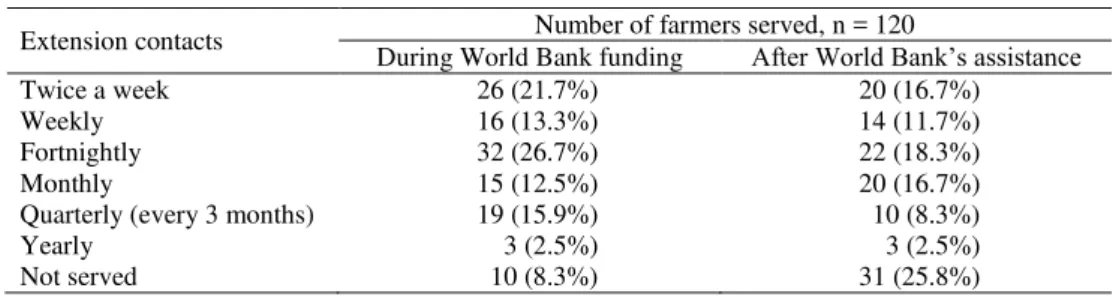
The results of the schedule of training and visit to farmers by agricultural extension workers during and after World Bank’s assistance are shown in Table 2. The results indicate that 26.7% of farmers were provided with agricultural extension service fortnightly (every two weeks) during World Bank’s assistance period but this fell to 18.3% after cessation of World Bank’s assistance. The results also show that the proportion of farmers not served by agricultural extension agents during World Bank’s assistance era was 8.3%; this grew to 25.8% after the withdrawal of World Bank’s assistance.
Table 2. Schedule of training and visits to farmers.
Extension contacts Number of farmers served, n = 120
During World Bank funding After World Bank’s assistance
Twice a week 26 (21.7%) 20 (16.7%)
Weekly 16 (13.3%) 14 (11.7%)
Fortnightly 32 (26.7%) 22 (18.3%)
Monthly 15 (12.5%) 20 (16.7%)
Quarterly (every 3 months) 19 (15.9%) 10 (8.3%)
Yearly 3 (2.5%) 3 (2.5%)
Not served 10 (8.3%) 31 (25.8%)
funding brought about by the cessation of World Bank’s component of funding. According to Haruna and Abdullahi (2013), the number of village extension agents in Kogi State ADP has been diminishing over the last five years because the ADP could not recruit new extension agents despite the dire need.
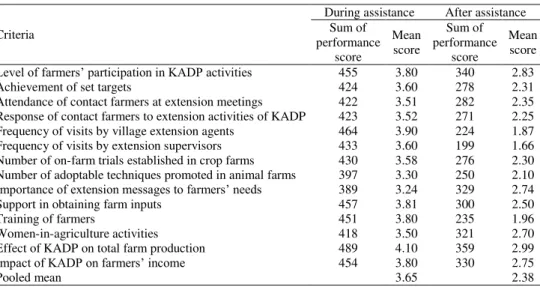
The results of farmers’ rating of KADP’s performance during the two periods under study are presented in Table 3. The results show that Kogi State Agricultural Development Programme performed poorly on all the criteria of assessment after expiration of World Bank’s assistance. Whereas the pooled mean of the performance score during World Bank’s financial assistance is 3.65, that of the ‘after assistance’ period is 2.38. The various sub-programmes of KADP require a lot of finance. When World Bank’s funding ceased, Kogi State Government’s funding of KADP stood at 11.4% of the budgeted funds. This poor level of funding by the State Government coupled with the fact that international funds were for only special projects between 2009 and 2013 led to poor financing of agricultural extension activities of KADP.
Table 3. Farmers’ rating of the performance of Kogi State Agricultural Development Programme (KADP) during and after the expiration of World Bank’s assistance, n = 120.
Criteria
During assistance After assistance
Sum of performance
score
Mean score
Sum of performance
score
Mean score
Level of farmers’ participation in KADP activities 455 3.80 340 2.83
Achievement of set targets 424 3.60 278 2.31
Attendance of contact farmers at extension meetings 422 3.51 282 2.35
Response of contact farmers to extension activities of KADP 423 3.52 271 2.25
Frequency of visits by village extension agents 464 3.90 224 1.87
Frequency of visits by extension supervisors 433 3.60 199 1.66
Number of on-farm trials established in crop farms 430 3.58 276 2.30
Number of adoptable techniques promoted in animal farms 397 3.30 250 2.10
Importance of extension messages to farmers’ needs 389 3.24 329 2.74
Support in obtaining farm inputs 457 3.81 300 2.50
Training of farmers 451 3.80 235 1.96
Women-in-agriculture activities 418 3.50 321 2.70
Effect of KADP on total farm production 489 4.10 359 2.99
Impact of KADP on farmers’ income 454 3.80 330 2.75
Pooled mean 3.65 2.38
most critical constraint to agricultural development in Nigeria and other African countries is finance.
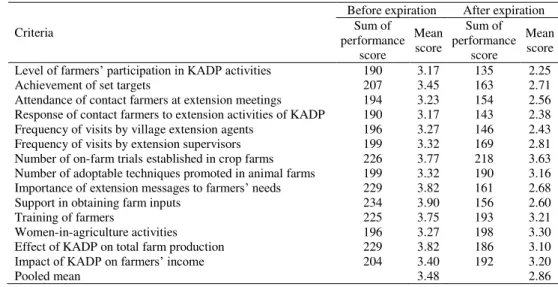
The results in Table 4 reveal that with the exception of women-in-agriculture activities, the staff respondents rated the performance of KADP as better on all the itemized criteria during the funding assistance of the World Bank. While the mean performance score for women-in-agriculture activities is 3.27 before expiration of World Bank’s assistance, it is 3.30 after the expiration. This shows only a marginal increase in performance. Staff respondents argued that the management of KADP channelled more resources to women-in-agriculture sub-programme after the expiration of World Bank’s assistance. Akerele and Aihonsou (2011) and Asadu et al. (2013) noted that increased participation of women in agricultural development has become crucial in Nigeria.
On the whole, the pooled mean for performance before expiration of World Bank’s assistance is 3.48 according to staff view, while that of ‘after expiration’ is 2.86 as shown in Table 4. This final verdict of KADP staff is similar to that of farmers in Kogi State, that is, both concluded that KADP’s performance was better during the period of World Bank’s assistance.
Table 4. Staff rating of the performance of Kogi State Agricultural Development Programme (KADP) before and after the expiration of World Bank’s assistance, n = 60.
Criteria
Before expiration After expiration
Sum of performance
score
Mean score
Sum of performance
score
Mean score
Level of farmers’ participation in KADP activities 190 3.17 135 2.25
Achievement of set targets 207 3.45 163 2.71
Attendance of contact farmers at extension meetings 194 3.23 154 2.56
Response of contact farmers to extension activities of KADP 190 3.17 143 2.38
Frequency of visits by village extension agents 196 3.27 146 2.43
Frequency of visits by extension supervisors 199 3.32 169 2.81
Number of on-farm trials established in crop farms 226 3.77 218 3.63
Number of adoptable techniques promoted in animal farms 199 3.32 190 3.16
Importance of extension messages to farmers’ needs 229 3.82 161 2.68
Support in obtaining farm inputs 234 3.90 156 2.60
Training of farmers 225 3.75 193 3.21
Women-in-agriculture activities 196 3.27 198 3.30
Effect of KADP on total farm production 229 3.82 186 3.10
Impact of KADP on farmers’ income 204 3.40 192 3.20
Pooled mean 3.48 2.86
done by Adebayo et al. (1999) and Agbamu and Okagbare (2005) on the performance of Ogun State Agricultural Development Programme.
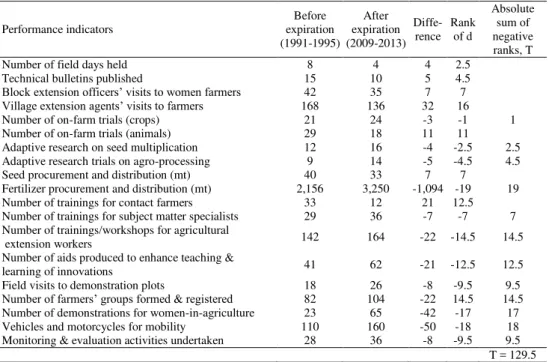
Table 5. Analysis of performance for Kogi State Agricultural Development Programme (KADP) before and after the expiration of World Bank’s assistance.
Performance indicators
Before expiration (1991-1995)
After expiration (2009-2013)
Diffe-rence
Rank of d
Absolute sum of negative ranks, T
Number of field days held 8 4 4 2.5
Technical bulletins published 15 10 5 4.5
Block extension officers’ visits to women farmers 42 35 7 7
Village extension agents’ visits to farmers 168 136 32 16
Number of on-farm trials (crops) 21 24 -3 -1 1
Number of on-farm trials (animals) 29 18 11 11
Adaptive research on seed multiplication 12 16 -4 -2.5 2.5
Adaptive research trials on agro-processing 9 14 -5 -4.5 4.5
Seed procurement and distribution (mt) 40 33 7 7
Fertilizer procurement and distribution (mt) 2,156 3,250 -1,094 -19 19
Number of trainings for contact farmers 33 12 21 12.5
Number of trainings for subject matter specialists 29 36 -7 -7 7
Number of trainings/workshops for agricultural
extension workers 142 164 -22 -14.5 14.5
Number of aids produced to enhance teaching &
learning of innovations 41 62 -21 -12.5 12.5
Field visits to demonstration plots 18 26 -8 -9.5 9.5
Number of farmers’ groups formed & registered 82 104 -22 14.5 14.5
Number of demonstrations for women-in-agriculture 23 65 -42 -17 17
Vehicles and motorcycles for mobility 110 160 -50 -18 18
Monitoring & evaluation activities undertaken 28 36 -8 -9.5 9.5
T = 129.5 Using Wilcoxon test, Zcal. = 1.39, Ztab. @ 0.10 = 1.28.
(5) KADP could no longer grant loans for inputs to farmers’ groups due to financial constraints.
The measures taken by Kogi State Agricultural Development Programme to cope with the cessation of assistance by the World Bank and strengthen its activities are: (1) The stoppage of some activities of KADP such as rural road construction, drilling of water boreholes in rural communities, and reducing of seed procurement and distribution to farmers; (2) It engaged in further reduction of staff strength in a bid to live within the scope of its resources; (3) It changed its fortnightly training of extension officers and monthly technology review meetings that fostered research-extension linkage to monthly training of extension officers and quarterly technology review meetings respectively; (4) KADP limited collaboration with national agricultural research institutes and universities to only those that are closer to KADP; (5) Reduction in the number of workshops or seminars organized for its contact farmers; (6) It secured approval to benefit from the National Agricultural Technology Support Fund to continue with on-farm adaptive research activities.
Conclusion
During the period of World Bank’s assistance (1991–1995), Kogi State Agricultural Development Programme received N2.25 billion, but after the cessation of the assistance (2009–2013), it received N928.9 million. From 1991 to 1995, 72.6% of the funds available to KADP came from World Bank and IFAD. From 2009 to 2013, 83.1% of the funds for KADP came from IFAD and the World Bank. This study concludes that there is a high dependency on international organizations in the form of loans and donors to finance agricultural development in Kogi State of Nigeria.
This study noted that the performance of KADP on agricultural extension contact declined during 2009 to 2013 period when World Bank’s assistance ceased. Farmers and staff of KADP who were respondents in this study alluded to a decline in the performance of KADP after World Bank’s assistance when KADP was assessed on fourteen (14) criteria. Analysis of nineteen (19) performance indicators showed that a significant difference exists in the performance of KADP between before and after the expiration of World Bank’s assistance, with better performance during World Bank’s assistance. The results of this study have provided empirical evidence of the failure of an agricultural development programme that depended largely on international loans and donors rather than on sustained domestic financing mechanism.
agricultural and rural development in Kogi State. The Kogi State Government and Local Government Councils should develop the political will to budget more funds for the activities of KADP. In the light of the funding problem facing KADP, large-scale commercial farmers can be made to pay for agricultural extension services of KADP, while low and medium income farmers should only be offered free public agricultural extension services.
References
Adebayo, K., Idowu, I.A., Omotayo, A.M., Olunuga, B.A., Apantaku, S.O. (1999): An appraisal of the prospects and constraints to the sustainable funding of Ogun State agricultural development programme. Journal of Agricultural Extension 3:28-38.
Adeokun, O.A. (2005): Research and extension support for sustainable development of Nigerian child: A general overview. Journal of Sustainable Development 2(1):18-26.
Agbamu, J.U. (2005): Problems and prospects of agricultural extension in developing countries. In: Adedoyin, S. F. (Ed.), Agricultural extension in Nigeria. Agricultural Extension Society of Nigeria Publication, Ilorin, pp. 159-169.
Agbamu, J.U., Okagbare, G.O. (2005): Institutional strengthening of Ogun State agricultural development programme upon expiration of World Bank assistance. Proceedings of the 39th Annual Conference of Agricultural Society of Nigeria held at University of Benin, Benin City, 9th to 13th October, pp. 322-325.
Akerele, E.O., Aihonsu, J.O.Y. (2011): Determinants of women’s participation in entrepreneurship development in Yewa North local government area of Ogun State, Nigeria. Nigerian Journal of Agricultural Economics 2(1):68-78.
Ammani, A.A., Auta, S.J., Aliyu, J.A. (2010): Challenges to sustainability: Applying the problem tree analysis methodology to the ADP system in Nigeria. Journal of Agricultural Extension 14(2):35-45.
Asadu, A.N., Egbujor, C.L., Chah, J.M., Ifejika, P.I. (2013): Gender roles in urban crop production in Imo State, Nigeria. Journal of Agricultural Extension 17(2):1-7.
Dayie, M., Bemile, E.N. (2013): Technical advisory services in Ghana. Journal of Extension Systems 29(1):41-50.
Haruna, S.K., Abdullahi, Y.M.G. (2013): Training of public extension agents in Nigeria and the
implications for government’s agricultural transformation agenda. Journal of Agricultural
Extension 17(2):109-117.
Idachaba, F.S. (2006): Good intentions are not enough: Collected essays on government and agriculture, Vol. 3. University Press Plc, Ibadan, Nigeria.
KADP (1995): Annual reports for 1991-1995. Kogi State Agricultural Development Programme,
Lokoja, Nigeria.
KADP (2013): Annual reports for 2009-2013. Kogi State Agricultural Development Programme,
Lokoja, Nigeria.
Kante, A., Edwards, M.C., Blackwell, C. (2013): The Sasakawa African fund for extension educaton initiative in Mali. Journal of Extension Systems 29(1):77-87.
Kogi State Government (2010): Kogi State handbook. Kogi State Government Press, Lokoja,
Nigeria, pp. 1-7.
World Bank (2001): Agricultural development programmes in Nigeria. Independent evaluation group, The World Bank, Washington, DC, USA.
EVALUACIJA UĈINKA PROGRAMA POLJOPRIVREDNOG RAZVOJA DRŽAVE KOGI NAKON USKRAĆIVANJA POMOĆI
SVETSKE BANKE NIGERIJI
Joseph Unuetara Agbamu*
Odsek za agroekonomiju i savetodavstvo, Univerzitet Delta State, Kampus Asaba, Asaba, Nigerija
R e z i m e
Ovo istraživanje procenjuje uĉinak Programa poljoprivrednog razvoja države Kogi (KADP) tokom perioda pomoći Svetske banke (od 1991. godine do 1995. godine) i perioda posle prestanka pomoći Svetske banke (od 2009. godine do 2013. godine). Podaci su prikupljeni putem upitnika i intervjua 120 poljoprivrednika i 60 ĉlanova osoblja programa KADP i putem razliĉitih sekundarnih izvora informacija. Otkriveno je da je tokom perioda pomoći Svetske banke, KADP primio 2,25 milijarde naira, dok je primio 928,9 miliona naira po prestanku pomoći. Od 1991. do 1995. godine 72,6% finansiranja programa KADP je bilo od strane Svetske banke i MeĊunarodnog fonda za poljoprivredni razvoj. Od 2009. godine do 2013. godine, 83,1% finansiranja programa KADP je bilo od strane meĊunarodnih organizacija. KADP je pokazao visok stepen zavisnosti od privremene meĊunarodne pomoći. Analiza 19 pokazatelja uĉinka je ukazala da postoji znaĉajna razlika u uĉinku KADP izmeĊu perioda pre i posle pomoći Svetske banke, sa boljim uĉinkom tokom trajanja pomoći Svetske banke. Ovo istraživanje razmatra uticaje uskraćivanja pomoći Svetske banke i mere koje je KADP preduzeo kako bi se ojaĉao.
Ključne reči:uĉinak, poljoprivredni razvoj, Svetska banka, država Kogi.
Primljeno: 21. maja 2014. Odobreno: 11. jula 2014.