J. Braz. Chem. Soc., Vol. 18, No. 8, 1560-1565, 2007. Printed in Brazil - ©2007 Sociedade Brasileira de Química 0103 - 5053 $6.00+0.00
ArticleArticleArticleArticleArticle
*e-mail: [email protected]
Chemical Constituents of the Underground Stem Bark of
Duguetia furfuracea
(Annonaceae)
Denise B. da Silva,a Elaine C. O. Tulli,a Walmir S. Garcez,b Evandro A. Nascimentoc and João M. de Siqueira*,a
a
Departamento de Farmácia and bDepartamento de Química, Universidade Federal do Mato Grosso do Sul, CP 579, 79070-900 Campo Grande-MS, Brazil
c
Instituto de Química, Universidade Federal de Uberlândia, Av. João Naves de Ávila, 121, Campus Santa Mônica, CP 593, 38400-089 Uberlândia-MG, Brazil
No presente trabalho foi realizado um estudo fitoquímico com os diferentes extratos obtidos a partir de órgãos subterrâneos de Duguetia furfuracea (Annonaceae), o qual incluiu o teste de toxicidade para Artemia salina. O extrato alcaloídico, obtido das cascas do caule subterrâneo, conduziu ao isolamento de (-)-duguetina β-N-óxido, de (-)-duguetina, dicentrinona, (-)-N -metiltetraidropalmatina e (+)-N-metilglaucina. Do extrato etanólico do cerne do caule subterrâneo obteve-se alantoína por precipitação. O óleo volátil e o extrato apolar também foram extraídos das cascas do caule subterrâneo. As substâncias 2,4,5-trimetoxiestireno, α-gurjuneno, aromadendreno, biciclogermacreno, (E)-metil-isoeugenol e α-asarona foram isoladas a partir do óleo volátil, e as substâncias policarpol, óxido de β-cariofileno, 2,4,5-trimetóxi-estireno,
α-asarona e asaraldeído foram obtidas do extrato em éter de petróleo. Este estudo descreve pela primeira vez o alcalóide β-N-óxido de (-)-duguetina, e a ocorrência das substâncias (-)-N -metiltetraidropalmatina e (+)-N-metilglaucina na família Annonaceae. Todos os extratos se mostraram tóxicos nos testes com Artemia salina.
In the present investigation the underground parts of Duguetia furfuracea (Annonaceae) were used to conduct a phytochemical study that included the brine shrimp (Artemia salina) lethality bioassay. The substances (-)-duguetine β-N-oxide, (-)-duguetine, dicentrinone, (-)-N -methyltetrahydropalmatine, and (+)-N-methylglaucine were isolated from the alkaloid extract of the bark of the underground stem, and the ureide allantoin was also isolated by precipitation from the ethanol extract of the wood of the underground stem. A fresh volatile oil and a nonpolar extract were also obtained from the underground stem bark. The substances 2,4,5-trimethoxystyrene, α-gurjunene, aromadendrene, bicyclogermacrene, (E)-methylisoeugenol, and
α-asarone were isolated from the fresh volatile oil and polycarpol, β-caryophyllene oxide, 2,4,5-trimethoxystyrene, α-asarone, and asaraldehyde were obtained from the petroleum ether extract. The present study describes for the first time the alkaloid (-)-duguetine β-N-oxide and the occurrence of (-)-N-methyltetrahydropalmatine and (+)-N-methylglaucine in the family Annonaceae. All extracts were active in the brine shrimp lethality bioassay.
Keywords: alkaloids, Annonaceae, aporphines, duguetine β-N-oxide,Duguetia furfuracea,
sesquiterpenoids
Introduction
Nearly 80 species are known in the genus Duguetia, which is one of the 128 genera included in the family Annonaceae.1
This paper reports the results of our continued phytochemical investigations of the family Annonaceae. We analyzed various extracts obtained from the
underground stem bark of Duguetia furfuracea (A. St.-Hil.) Benth. & Hook f., which is a shrub distributed throughout the Brazilian state of Mato Grosso do Sul. Two species of the genus Duguetia have been found and worked up to date, and little data on their use in folk medicine can be found in the literature.
D. furfuracea is known as “araticum-seco”.2 In folk
medicine, the seed powder is mixed with water for use in the treatment of pediculosis,3 while an infusion of the
1561 da Silva et al.
Vol. 18, No. 8, 2007
medicine derived from this plant is claimed to be useful in the treatment of renal colic.4 On the other hand, this
species is a major invader of pastures and therefore is harmful to the regional economy, which is based predominantly on agribusiness. Thus, the chemical knowledge of the species could contribute to control its weedy behaviour.
The chemical constituents of the aerial parts (leaves and twigs) of D. furfuracea are described in three previous papers.5-7 The first paper describes the isolation of
sesquiterpenoids;5 the other two papers report the isolation
of a flavonoid and various alkaloids from an isoquinoline-derived skeleton,6 and the trypanocidal activity of some of
these compounds. One of these papers7 describes two
aporphine alkaloids containing N-nitroso functionality. The present investigation, which adds to the knowledge of this species, led to the isolation of alkaloids, sesquiterpenoids and other constituents from different extracts obtained from the underground stem bark of D. furfuracea.
An alkaloid extract was obtained from the dried and finely ground stem bark, from which (-)-duguetine β-N-oxide (1), (-)-duguetine (2), dicentrinone (3), (-)-N -methyltetra-hydropalmatine (4), and (+)-N-methylglaucine (5) were isolated. Also, the ureide allantoin (6) was isolated from the ethanol extract of the underground stem (Figure 1).
The substances 2,4,5-trimethoxystyrene (7),
α-gurjunene (8), aromadendrene (9), bicyclogermacrene (10), (E)-methylisoeugenol (11), and α-asarone (12) were
isolated from the fresh volatile oil. The substances polycarpol (13), β-caryophyllene oxide (14), asaraldehyde (15), 7 and 12 were obtained from the petroleum ether extract (Figure 1).
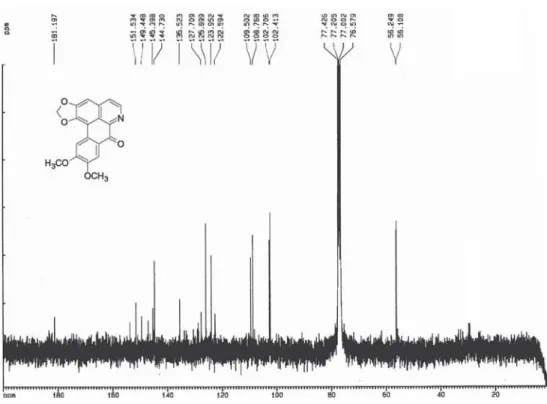
The 1H and 13C NMR data of 1, including 2D NMR
data (NOESY, HMQC and HMBC) and (+) HR-ESIMS characterized this compound as an aporphine alkaloid. To the best of our knowledge, this compound has not been previously reported in the literature. For the first time, substances 6 and 12 are described in the genus Duguetia and substances 4 and 5, in the family Annonaceae.
Results and Discussion
The alkaloid extract was fractionated by column chromatography (CC), yielding a novel alkaloid identified as (-)-duguetine β-N-oxide (1), and four other known alkaloids (2, 3, 4, 5).
Compound 1 was obtained as a brown amorphous solid and exhibited [α]D20 –33.3 (MeOH, c 0.001). Its
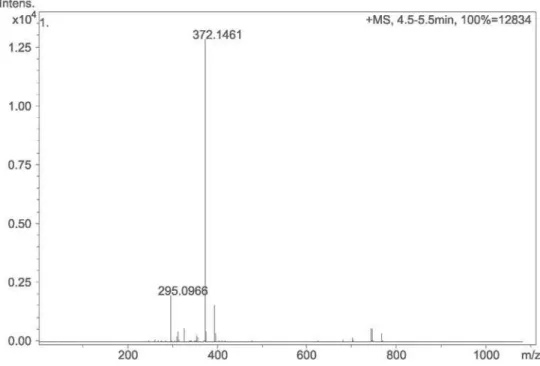
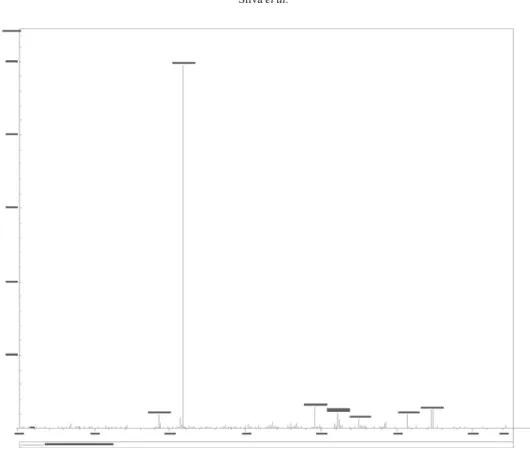
molecular formula (C20H21NO6) was determined using HR-ESIMS (m/z 372.1413, [M+H]+). Its FTIR spectrum
revealed the presence of a hydroxyl group (3418 cm-1)
and an aliphatic system (2959-2846 cm-1). The 1H NMR
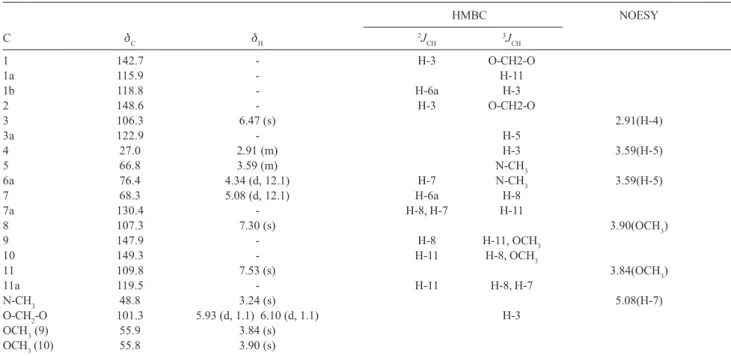
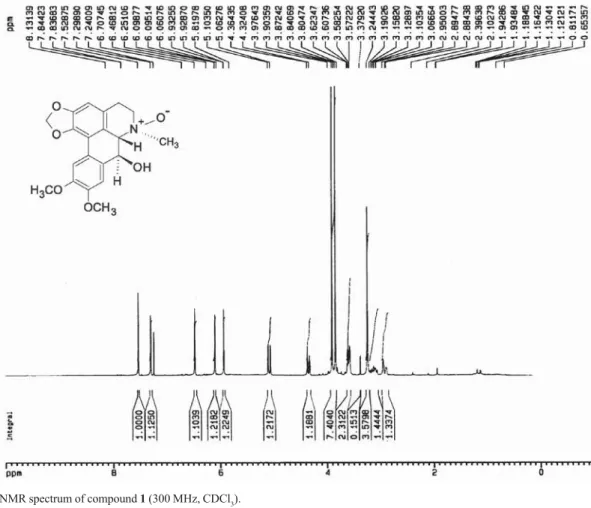
data showed three hydrogen signals in the aromatic region at δ 7.53 (s), 7.30 (s), and 6.47 (s) and an N-linked methyl group at δ 3.24 (s).
The presence of 1,2-methylenedioxy and 9,10-dimethoxy groups was indicated in the NMR spectrum
Table 1. NMR spectroscopic data of compound 1
HMBC NOESY
C δC δH
2J CH
3J CH
1 142.7 - H-3 O-CH2-O
1a 115.9 - H-11
1b 118.8 - H-6a H-3
2 148.6 - H-3 O-CH2-O
3 106.3 6.47 (s) 2.91(H-4)
3a 122.9 - H-5
4 27.0 2.91 (m) H-3 3.59(H-5)
5 66.8 3.59 (m) N-CH3
6a 76.4 4.34 (d, 12.1) H-7 N-CH3 3.59(H-5)
7 68.3 5.08 (d, 12.1) H-6a H-8
7a 130.4 - H-8, H-7 H-11
8 107.3 7.30 (s) 3.90(OCH3)
9 147.9 - H-8 H-11, OCH3
10 149.3 - H-11 H-8, OCH3
11 109.8 7.53 (s) 3.84(OCH3)
11a 119.5 - H-11 H-8, H-7
N-CH3 48.8 3.24 (s) 5.08(H-7)
O-CH2-O 101.3 5.93 (d, 1.1) 6.10 (d, 1.1) H-3
OCH3 (9) 55.9 3.84 (s)
OCH3 (10) 55.8 3.90 (s)
1H and 13C NMR spectra were acquired in CDCl
3 at 300 and 75 MHz respectively. TMS was used as internal standard, chemical shifts are shown in the δ scale
1562 Chemical Constituents of the Underground Stem Bark of Duguetia furfuracea (Annonaceae) J. Braz. Chem. Soc.
by two singlet signals at δ 3.84 (s) and 3.90 (s), and the typical pair of doublets of methylenedioxy protons was observed at δ 6.10 and 5.93 (d, 1.1 Hz). Also, were observed aliphatic protons signals at δ 3.59 (m) and 2.91 (m). These 1H NMR data (Table 1) are in
agreement with an aporphine alkaloid having 1,2-methylenedioxy and 7-hydroxy groups with trans configuration at 6a,7, exhibiting a large coupling constant for the two doublets at δ 5.08 (d, 12.1 Hz) and 4.34 (d, 12.1 Hz).
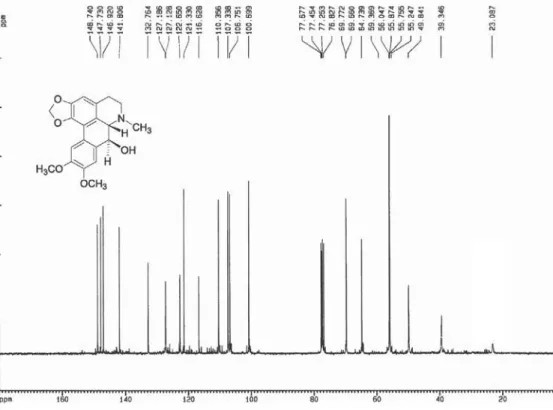
The 13C NMR data were also in agreement with the
observations (Table 1), but the chemical shift of carbon atoms in the neighborhood of the N-heterocycle suggests the presence of an N-O group, as the N-heterocycle region
showed a more pronounced deshielding effect than in duguetine (2) (Figure 2).
This effect is in accordance with the molecular formula established by HR-MS, indicating the presence of an additional oxygen atom.8 By comparing the 13C NMR data
of 1 with those of 2, using N-O models available in the literature, namely oliveroline β-N-oxide(6a,7α-H, β-N -oxide)9 and dasymaschaline α-N-oxide (6a,7α-H, α-N
-oxide),8 and confirming with NOESY the stereochemistry
of the N-oxide moiety of 1, it was possible to propose that
1 is a (-)-duguetine β-N-oxide (Table 1).
Allantoin (6) was isolated from the ethanol extract by precipitation with acetone and its spectral data were agree with those in the literature.10 This metabolite
1563 da Silva et al.
Vol. 18, No. 8, 2007
belongs to the ureide class and plays an important role in the transport and assimilation in some nitrogen-fixing species.11 Allantoin, which is also used in cosmetics,12
exhibits anti-inflammatory activity among other properties. This compound has already been obtained in large amounts from the underground parts of other pasture-invading species.10
The fresh volatile oil was fractionated by CC on silica gel, yielding several fractions. The fractions, composed of a mixture of two compounds, were subjected to an additional preparative thin layer chromatography (TLC) followed by preparative argentation TLC separation, and six compounds (7-12) were isolated and identified by comparison of their spectral data with literature values (see Experimental section). In order to contribute to the chemical knowledge of nonpolar compounds from the fresh stem bark, the fresh volatile oil was subjected to GC/MS
analysis. The compounds identified by this method are listed in Table 2.
In a further chemical investigation of the fresh stem bark, the petroleum ether extract yielded, by the usual phytochemical work up, 7, 12, 13, 14 and 15 (Figure 1).
Volatile and nonpolar compounds have been described in Annonaceae.13 Essential oils, for instance, are
responsible for the fragrance of several species and their chemical composition generally includes well-known monoterpenes, sesquiterpenes, or aromatic compounds.14
A noteworthy feature is the fact that the isolation of aromatic compounds such as propenylbenzenes (or vinylbenzenes) has been described predominantly in the underground parts.14,15 Phenylpropanoid-derived
com-pounds are widespread among vascular plants and play an important role in chemical defense.16
With regard to polycarpol (13), it has been described as a chemical marker of the family Annonaceae, however it has recently been found in another plant family.17
The fresh volatile oil and the petroleum ether and alkaloid extracts were active in the brine shrimp lethality bioassay, with LD50 values of 2.6, 6.1, and 36.9 µg mL-1,
respectively.
The toxicity exhibited by the extracts and fresh volatile oil might be explained by the presence of active substances previously tested in the brine shrimp lethality bioassay, namely 2,4,5-trimethoxystyrene (7) (LD50 = 8 µg mL-1),18
found in both the fresh volatile oil and petroleum ether extract, polycarpol (13) (LD50 = 254 µg mL-1),19 in the
petroleum ether extract, and several oxoaporphine alkaloids.20
Experimental
General experimental procedures
Optical rotations were measured on a Perkin-Elmer 341 polarimeter in MeOH. The FTIR spectra of either KBr pellets or CHCl3 films were obtained on a Perkin Elmer 783 spectrophotometer. The MS system (HR-ESIMS) used
Table 2. Chemical constitution of the fresh volatile oil of the underground stem bark of Duguetia furfuracea
Compounds Rt %
α-gurjunene* 31.1 2.1
trans-caryophyllene 31.4 3.2
aromadendrene* 31.9 2.2
α-humulene 33.4 0.8
7,9(11)-drimadiene 34.1 1.5
γ-gurjunene 34.3 0.9
bicyclogermacrene* 35.3 8.6
γ-cadinene 36.3 2.8
2,4,5-trimethoxystyrene*,** 37.7 29.2
palustrol 38.0 1.1
spathulenol 38.8 4.7
caryophyllene oxide** 39.0 2.2
viridiflorol 39.4 1.4
epi-globulol 39.9 6.4
1-epi-cubenol 40.7 0.7
epi-α-cadinol 41.2 2.7
valerianol 41.7 1.0
α-asarone*,** 42.4 23.8
asaraldehyde** 43.8 1.6
Not identified 47.3 3.1
Some of the compounds in Table 2 were also identified by conventional phytochemical work up of the fresh volatile oil (*) or petroleum ether ex-tract (**) or both.
Figure 2. Comparison between 13C (75 MHz, CDCl
1564 Chemical Constituents of the Underground Stem Bark of Duguetia furfuracea (Annonaceae) J. Braz. Chem. Soc.
was a quadrupole time-of-flight instrument (UltrOTOF-Q, Bruker Daltonics, Billerica, MA), equipped with an ESI source; the analyses were performed with the mass spectrometer in the positive ion mode. The GC/MS data were obtained on a CG17A/QP5000 Shimadzu GC/MS instrument equipped with a DB-5 capillary column using He as the carrier gas. The 1H and 13C 1D and 2D NMR
spectra were recorded at 300 MHz (1H) and 75 MHz (13C)
on a Bruker DPX-300 spectrometer.
Plant material
The underground parts (stem bark and wood) of Duguetia furfuracea (A. St.-Hil.) Benth. & Hook f. were collected in March 2004, on the UFMS campus in Campo Grande, MS, Brazil, and identified by Prof. R. Mello-Silva. A voucher specimen (No. 023) was deposited in the CGMS Herbarium (UFMS, Campo Grande, MS).
Extraction and isolation of compounds
Ammonium hydroxide was added to 1300 g of air-dried and finely ground bark of the underground stem until pH 9.0 was reached and then subjected to exhaustive extraction with CHCl3. The resulting chloroform layer was concentrated under reduced pressure and a brown residue (68 g) was obtained.
The residue was solubilized in CHCl3 and extracted with 5% HCl; the resulting acid fraction was adjusted to pH 9.0 (NH4OH) and again exhaustively extracted with CHCl3.
A brown precipitate was obtained (9.2 g). This extract (7.2 g) was fractionated by CC on alumina (70-230 mesh) and eluted with CHCl3:MeOH:H2O gradient system to yield thirteen fractions (I-XIII).
Fractions IV, X and XI from this column provided 2
(812.1 mg), 4 (69.3 mg) and 5 (11.2 mg). Fraction V (800 mg) was fractionated by CC on silica gel (70-230 mesh) in CHCl3:MeOH:H2O. Fractions 60-75 yielded 3 (4.6 mg). Fraction VII (378.9 mg) yielded 1 after CC on silica gel (70-230 mesh) eluted with CHCl3:EtOAc:MeOH:H2O gradient system.
From the ethanol extract of the underground stem, the ureide allantoin (6) was isolated by precipitation with acetone. The alkaloids 2, 3, 4 and 5,as well as the compounds
6-12 were identified by 1H and 13C NMR spectroscopy and
compared with literature values.10,18-31
(-)-Duguetine β-N-oxide, (1)
Brown amorphous solid; Rf 0.51 (CHCl3:MeOH, 85.15); [α]D20: –33.3o (MeOH; c 0.001,); FTIR (KBr) ν
max/
cm-1: 3418, 2959, 2929, 2846, 1607, 1515, 1463, 1393,
1340, 1244, 1226, 1217, 1118, 1046, 993, 945, 870; (+) HR-ESIMS m/z: 372.1413 [M+H]+ (Calc. for C
20H22NO6
requires 372.1436). 1H NMR (300 MHz, CDCl
3, δ) and 13C NMR (75 MHz, CDCl
3, δ): see Table 1.
(-)-N-Methyltetrahydropalmatine, (4)
Brown amorphous solid; [α]D20: –104.1o (MeOH; c
0.0012). FTIR, 1H and 13C NMR data are in agreement
with those reported in the literature.30
(+)-N-Methylglaucine, (5)
Brown amorphous solid; [α]D20: +34.9o (MeOH; c
0.0012). FTIR, 1H and 13C NMR data are in agreement
with those reported in the literature.31 A 4-hour
hydrodistillation of 300 g of fresh bark of underground stem, using a Clevenger-type apparatus, yielded 1.2% fresh volatile oil.
The oil was fractionated by CC on silica gel (70-230 mesh), and eluted with petroleum ether:CHCl3:MeOH gradient system to yield thirteen combined fractions (I-XIII). Compound 7 (117.1 mg)was identified as the major component of fraction XII, and compound 12 (160.2 mg), of fraction XIII. Fractions II and XI from this column provided 8 (19.5 mg) and 11 (10.1 mg), respectively. Fractions III and VI were purified by preparative/ argentation TLC yielding 9 (9.1 mg) and 10 (17.2 mg), respectively.
A separate amount of air-dried and finely ground bark of the underground stem (155 g) was subjected to exhaustive petroleum ether extraction in a Soxhlet apparatus; the resulting extract was concentrated in vacuo to dryness (13 g). The precipitate from this extract was purified by recrystallization from hexane and CHCl3 providing 13 (176.4 mg). The resulting extract (5 g) was then fractionated by CC on silica gel (70-230 mesh) using hexane:CHCl3:MeOH as elution gradient. The fractions showing similar spots on TLC were combined into twelve fractions (I-XII). Fractions I and IX provided 14 (11.8 mg) and 15 (12.3 mg), respectively. Fraction X (235.2 mg) yielded a mixture of 7 and 12.
Brine shrimp lethality test
The brine shrimp (A. salina Leach) toxicity tests were conducted using second instar larvae according to the method of McLaughlin. Stock solutions of samples were prepared by dissolving 15 mg of the test material in 5 mL of sea water containing 1% (v/v) DMSO. The assays were carried out in triplicate on samples at a concentration of 500, 50, 5.0 and 0.5 µg mL-1. Positive (Quinidine Sulfate)
1565 da Silva et al.
Vol. 18, No. 8, 2007
controls were included in each bioassay in order to verify the susceptibility of the brine shrimps. LD50 values were determined from 24 h counts, by Probit Analysis.32
Acknowledgments
The authors acknowledge the financial support provided by FUNDECT - Fundação de Apoio ao Desenvolvimento do Ensino, Ciência e Tecnologia do Estado de Mato Grosso do Sul, Brazil. They are also thankful to CNPq for the fellowship granted. Thanks are also due to Dr. Norberto Peporine Lopes (Faculdade de Ciências Farmacêuticas de Ribeirão Preto/USP, SP, Brazil) for mass spectrometry analysis.
References
1. Muhammad, I.; Dunbar, D. C.; Takamatsu, S.; Walker, L. A.; Clark, A. M.; J. Nat. Prod. 2001, 64, 559.
2. Lorenzi, H.; Plantas Daninhas do Brasil: Terrestres, Aquáticas, Parasitas e Tóxicas; Plantarum: Nova Odesa, Brazil, 2000, p. 62.
3. Silberbauer-Gottsberger, I.; Abstract of VII Simpósio de Plantas Medicinais do Brasil, Belo Horizonte, Brazil,1981/2. 4. Rodrigues, V. E. G.; Carvalho, D. A.; Cienc. Agrotec. 2001, 25,
102; Da Silva Coelho, L.; PatentBR 200202030-A,2004. 5. Carollo, C. A.; Hellman, A. R.; Siqueira, J. M.; Biochem. Syst.
Ecol. 2005, 33, 647.
6. Carollo, C. A.; Hellmann-Carollo, A. R.; Siqueira, J. M. de; Albuquerque, S.; J. Chil. Chem. Soc. 2006, 51, 837.
7. Carollo, C. A.; Siqueira, J. M.; Garcez, W. S.; Diniz, R.; Fernandes, N. G.; J. Nat. Prod. 2006, 69, 1222.
8. Asaruddin, M. R.; Kiuchi, F.; Honda, G.; Nat. Med. 2001, 55, 149.
9. Guinaudeau, H.; Leboeuf, M.; Cavé, A.; J. Nat. Prod. 1994, 57,
1033.
10. Ferreira, D. T.; Alvares, P. S.; Houghton, P. J.; Braz-Filho, R. B.;
Quim. Nova2000, 23, 42; Grassi, R. F.; Resende, U. M.; Silva, W.; Macedo, M. L. R.; Butera, A. P.; Tulli, E. O.; Saffran, F. P.; Siqueira, J. M. de; Quim. Nova 2005, 28, 199.
11. Hopkins, W. G.; Introduction to Plant Physiology, Willey: London, 1995, ch. 6.
12. Martindale, W.; The Extra Pharmacopoeia, 30th ed., James, E.
F.; Reynolds, eds.; The Pharmaceutical Press: London, 1993; Joanne, M. M.; Cosmetic Ingredient Handbook, 1st ed.,
Washington: Cosmetic, Toiletry and Fragrance Association, 1988. Reference Stacks TP 983.C953 1988, p. 108.
13. Leboeuf, M.; Cavé, A.; Bhaumik, P. K.; Mukherjee, B.; Mukherjee, R.; Phytochemistry1982, 21, 2783.
14. Fournier, G.; Leboeuf, M.; Cavé, A.; J. Essent. Oil Res. 1999,
11, 131.
15. Maia, J. G. S.; Andrade, E. H. A.; Carreira, L. M. M.; Oliveira, J.; J. Essent. Oil Res. 2006, 18, 60.
16. Lane, A. L.; Kubanek, J.; Phytochemistry 2006, 67, 1224. 17. Jayasuriya, H.; Herath, K. B.; Ondeyka, J. G.; Guan, Z.; Bpris,
R. P.; Tiwari, S.; Jong, W.; Chavez, F.; Moss, J.; Stevenson, D. W.; Beck, H. T.; Slattery, M.; Zamora, N.; Schulman, M.; Ali, A.; Sharma, N.; Macnaul, K.; Hayes, N.; Menke, J. G.; Singh, S. B.; J. Nat. Prod. 2005, 68, 1247.
18. Wang, Z-W.; Ma, W-W.; McLaughlin, J. L.; Gupta, M. P.; J. Nat. Prod. 1988, 51, 382.
19. Jung, J. H.; Pummangura, S.; Chaichantipyuth, C.; Patarapanich, C.; McLaughlin, J. L.; Phytochemistry 1990, 29, 1667. 20. Siqueira, J. M. de; Ziminiani, M. G.; Resende, U. M.; Boaventura,
M. A. D.; Quim. Nova 2001, 24, 185; Wu, Y-C.; Chang, G-Y.; Duh, C-Y.; Wang, S-K.; Phytochemistry 1993, 33, 497. 21. Nagashima, F.; Murakami, Y.; Aasakawa, Y.; Phytochemistry
1999, 51, 1101.
22. Krishnappa, S.; Dev, S.; Phytochemistry 1973, 12, 823; Atta-Ur-Rahman; Ahmad, V. U.; 13C NMR of Natural Products
(Monoterpenes and Sesquiterpenes), vol. 1, Plenum Press: New York, 1992, p. 467.
23. Miyazawa, M.; Uemura, T.; Kameoka, H.; Phytochemistry 1995,
40, 793.
24. Ferreira, M. J. P.; Costantin, M. B.; Sartorelli, P.; Rodrigues, G. V.; Limberger, R.; Henriques, A. T.; Kato, M. J.; Emerenciano, V. P.; Anal. Chim. Acta2001, 447, 125.
25. Joshi, B. P.; Sharma, A.; Sinha, A. K.; Tetrahedron 2005, 61, 3075. 26. González, M. C.; Sentandreu, M. A.; Rao, K. S.; Zafra-Polo, M.
C.; Cortes, D.; Phytochemistry1996, 43, 1361.
27. Silverstein, R. M.; Webster, F. X.; Identificação Espectrométrica de Compostos Orgânicos, 6th ed., LTC: Rio de Janeiro, Brazil, 2000.
28. Navarro, V. R.; Sette, I. M. F.; Da-Cunha, E. V. L.; Silva, M. S.; Barbosa-Filho, J. M.; Maia, J. G. S.; Rev. Bras. Plant. Med. 2001, 3, 23.
29. Zhou, B.; Johson, R. K.; Mattern, M. R.; Xiangyang, W.; Hecht, S. M.; Beck, H. T.; Ortiz, A.; Kingston, D. G. I.; J. Nat. Prod. 2000, 63, 217.
30. Calderwood, J. M.; Finkelstein, N.; Fish, F.; Parfitt, R. T.;
Phytochemistry 1971, 10, 682.
31. Marsaioli, A. J.; Rúveda, E. A.; Reis, F. A. M.; Kuck, A. M.; Magalhães, A. F.; Phytochemistry1979, 18, 165.
32. Meyer, B. N.; Ferrigni, J. E.; Putnam, J. E.; Jacobsen, L. B.; Nichols, D. E.; McLaughlin, J. L.; Planta Med. 1982, 45, 31; Finney, D. J.; Probit Analysis, 3rd ed., Cambridge University
Press: Cambridge, 1971.
J. Braz. Chem. Soc., Vol. 18, No. 8, S1-S15, 2007. Printed in Brazil - ©2007 Sociedade Brasileira de Química 0103 - 5053 $6.00+0.00
Supplementary InformationSupplementary InformationSupplementary InformationSupplementary InformationSupplementary Information
*e-mail: [email protected]
Chemical Constituents of the Underground Stem Bark of
Duguetia furfuracea
(Annonaceae)
Denise B. da Silva,a Elaine C. O. Tulli,a Walmir S. Garcez,b Evandro A. Nascimentoc and João M. de Siqueira*,a
a
Departamento de Farmácia and bDepartamento de Química, Universidade Federal do Mato Grosso do Sul, CP 579, 79070-900 Campo Grande-MS, Brazil
c
Instituto de Química, Universidade Federal de Uberlândia, Av. João Naves de Ávila, 121, Campus Santa Mônica, CP 593, 38400-089 Uberlândia-MG, Brazil
S2 Chemical Constituents of the Underground Stem Bark of Duguetia furfuracea (Annonaceae) J. Braz. Chem. Soc.
Figure S2. 1H NMR spectrum of compound 1(300 MHz, CDCl 3).
S3 Silvaet al.
Vol. 18, No. 8, 2007
Figure S4. HR-ESIMS spectrum of compound 1(positive mode).
S4 Chemical Constituents of the Underground Stem Bark of Duguetia furfuracea (Annonaceae) J. Braz. Chem. Soc.
Figure S6. 1H NMR spectrum of compound 2(300 MHz, CDCl 3).
S5 Silvaet al.
Vol. 18, No. 8, 2007
Figure S8. 1H NMR spectrum of compound 3(300 MHz, CDCl 3).
S6 Chemical Constituents of the Underground Stem Bark of Duguetia furfuracea (Annonaceae) J. Braz. Chem. Soc.
Figure S10. 1H NMR spectrum of compound 4(300 MHz, CDCl 3).
S7 Silvaet al.
Vol. 18, No. 8, 2007
Figure S12. HR-ESIMS/MS spectrum of compound 4(positive mode).
S8 Chemical Constituents of the Underground Stem Bark of Duguetia furfuracea (Annonaceae) J. Braz. Chem. Soc.
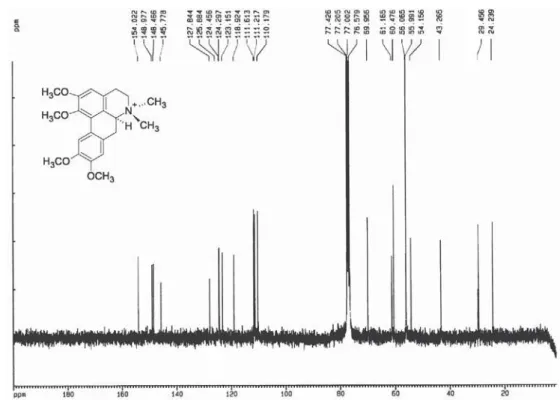
Figure S14. 13C NMR spectrum of compound 5(75 MHz, CDCl 3).
S9 Silvaet al.
Vol. 18, No. 8, 2007
Figure S16. 13C NMR spectrum of compound 6(75 MHz, DMSO-d 6).
S10 Chemical Constituents of the Underground Stem Bark of Duguetia furfuracea (Annonaceae) J. Braz. Chem. Soc.
Figure S18. 13C NMR spectrum of compound 7(75 MHz, CDCl 3).
S11 Silvaet al.
Vol. 18, No. 8, 2007
Figure S20. 13C NMR spectrum of compound 9(75 MHz, CDCl 3).
S12 Chemical Constituents of the Underground Stem Bark of Duguetia furfuracea (Annonaceae) J. Braz. Chem. Soc.
Figure S22. 13C NMR spectrum of compound 10(75 MHz, CDCl 3).
S13 Silvaet al.
Vol. 18, No. 8, 2007
Figure S24. 1H NMR spectrum of compound 13(300 MHz, CDCl 3).
S14 Chemical Constituents of the Underground Stem Bark of Duguetia furfuracea (Annonaceae) J. Braz. Chem. Soc.
Figure S26. 1H NMR spectrum of compound 14(300 MHz, CDCl 3).
S15 Silvaet al.
Vol. 18, No. 8, 2007
Figure S28. 1H NMR spectrum of compound 15(300 MHz, CDCl 3).