1Institute of Geosciences, Universidade Federal do Pará, Belém (PA), Brazil. E-mails: [email protected], [email protected], [email protected] 2Federal Institute of Maranhão, Campus Pinheiro, Pinheiro (MA), Brazil. E-mail: [email protected]
*Corresponding author.
Manuscript ID: 30297. Received in: 05/01/2015. Approved in: 11/27/2015. ABSTRACT: his study irst aimed to evaluate the efect of hu-man activities on the distribution of lead within the estuarine sys-tem of Belém, Pará. his was achieved by studying the concentra-tion and isotopic signature of Pb in bottom sediments from the western margin of Guajará Bay and from Carnapijó River, an area removed from the inluence of the city of Belém. Secondly, the contribution of suspended matter in the transportation of anthro-pogenic Pb in Guajará Bay was evaluated. hird, the content and background isotopic signature of Pb in the hydrographic system of Belém was determined. Isotopic signatures of sediments from the western margin of Guajará Bay conirm an anthropogenic contribu-tion of Pb throughout the entire bay. he Pb accumulacontribu-tion process has become more eicient over the last 10 years, and this can be attributed to the rapid population growth of Belém city. Sediments in Carnapijó River are not afected by human activities, and the average concentration values (Pb = 19.6 ± 3.7 mg kg-1) and isotopic signatures (206Pb/207Pb = 1.196 ± 0.004) conirm the background Pb values previously proposed for the river system in the Belém region. he isotopic signatures of suspended matter on the eastern (206Pb/207Pb = 1.188) and western (206Pb/207Pb = 1.174) margins of Guajará Bay show that suspended matter is an eicient Pb trans-portation mechanism of domestic and industrial wastewater from Belém to the western margin of the Bay due to tidal efects at the conluence with Guamá River.
KEYWORDS: Lead isotopes; Bottom sediments; Belém estuarine system.
RESUMO: Este trabalho teve como objetivos: (1) avaliar a ex-tensão da ação antrópica sobre a distribuição do chumbo no siste-ma estuarino da região de Belém, Pará, por meio do estudo da concentração e assinatura isotópica de Pb em sedimentos de fundo da margem oeste da baía do Guajará e do rio Carnapijó, localiza-do em uma área mais afastada da inluência da cidade de Belém; (2) avaliar a contribuição do material em suspensão como meio de trans-porte de Pb antropogênico na baía do Guajará; e (3) conferir os teores e assinatura isotópica de background de Pb no sistema hidrográico de Belém. As assinaturas isotópicas dos sedimentos da margem oeste da baía do Guajará conirmam uma contribuição antropogênica para o Pb na escala de toda a baía. O processo de acumulação de Pb se tornou mais ei-ciente nos últimos 10 anos e deve estar ligado ao crescimento populacional acelerado da cidade de Belém. Os sedimentos do rio Carnapijó ainda não foram afetados pela ação antrópica e os valores médios de concentração (Pb = 19,6 ± 3,7 mg kg-1) e assinatura isotópica (206Pb/207Pb = 1,196 ± 0,004) conirmam os valores de background de Pb anteriormente propostos para o sistema hidrográico da região de Belém. As assinaturas isotópicas do material em suspensão nas margens oriental (206Pb/207Pb = 1,188) e ocidental (206Pb/207Pb = 1,174) da baía do Guajará mostram que o material em suspensão é um mecanismo eiciente de transporte do chumbo proveniente dos eluentes domésticos e industriais da cidade de Belém para a margem oeste da baía; em razão dos efeitos de maré na conluência com o rio Guamá.
PALAVRAS-CHAVE: Isótopos de Pb, Sedimentos de fundo, Sistema estuarino de Belém.
Distribution and isotopic composition
of lead in bottom sediments from the
hydrographic system of Belém,
Pará (western margin of Guajará
Bay and Carnapijó River)
Distribuição e composição isotópica do chumbo em
sedimentos de fundo do sistema hidrográico de Belém,
Pará (margem oeste da Baía do Guajará e Rio Carnapijó)
Elma Costa Oliveira1*, Jean Michel Lafon1,
José Augusto Martins Corrêa1, Jully Hellen dos Santos Carvalho1,2
INTRODUCTION
he geochemistry of sediments from rivers, estuaries, and coasts provides important information about sediment origin and environmental changes due to both natural and anthropogenic inluences. herefore, chemical composition of river sediments can generally depict a high degree of spa-tial variation in relation to provenance, river transport, and depositional environment (Roig et al. 2005). In addition to geochemical studies of trace elements, the application of radiogenic isotopes is widely employed in hydrological, geological and atmospheric studies, due to their capability to characterize natural and anthropogenic sources (Banner 2004). Lead, in particular, has acquired great importance in environmental studies as it has been demonstrated that, unlike other heavy metals, the isotopic signatures of Pb from anthropogenic and geogenic sources are distinct and can, therefore, be used as tracers of contamination sources for this element (Komarék et al. 2008, Kylander et al. 2010, Bird 2011).
In recent years, urban growth has occurred in a disorga-nized manner in the metropolitan area of Belém, and this is directly relected in the quality of water and sediments in Guamá River and Guajará Bay, which constitute the main hydrological elements from the Belém’s estuary system. Guajará Bay is sufering from environmental degradation, and this is gradually increasing due to the accelerated pop-ulation and industrial growth of the city of Belém, and the related dumping of domestic and industrial wastewater with-out prior treatment, that causes damage to organisms and sediments (IDESP 1990). In contrast, the Guajará estuary has intense hydrodynamics and therefore a large capacity for pollutant dilution.
Guajará Bay is formed at the conluence of Acará and Guamá Rivers, west of the city of Belém, and extends almost to the island of Mosqueiro. At this point it meets the Bay of Marajó, which with Pará River forms the southern-most estuary system at the mouth of Amazon River. Numerous channels and islands, the largest island of which is the Onças Island, make up the left margin of Guajará Bay and sepa-rate the bay from the Pará River. he interaction between the river currents, tides, and waves results in an environ-ment with high-energy hydrodynamic conditions. In this respect, the water dynamics and extreme seasonal variations are important factors inluencing the concentration of sus-pended matter and the complexity of the sedimentation processes (Gregório & Mendes 2009).
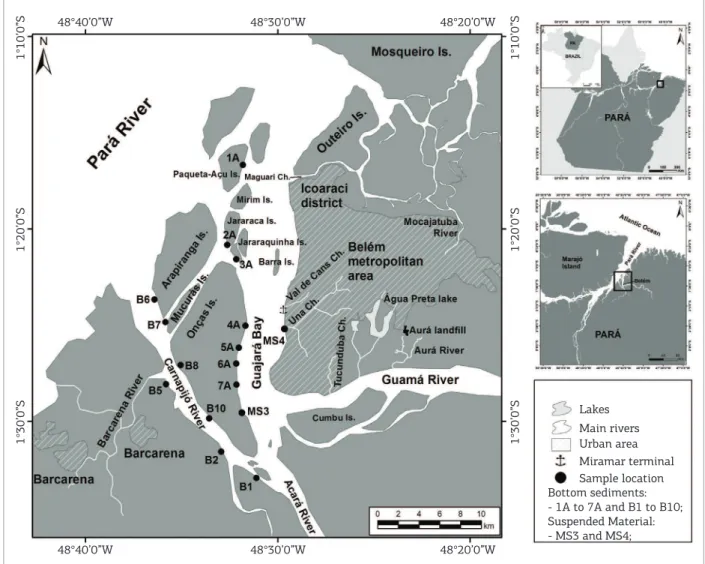
he study area is located on the western margin of Guajará Bay between 01° 10’- 01° 33’ S and 48°38’- 48°15’W, and includes the islands of Onças, Jararaca, Jararaquinha, Mirim, Paquetá Açu, and Carnapijó River, which is located west of
the islands (Fig. 1). he regional climate is hot and humid, with average annual humidity about 87%. Rain occurs frequently in the afternoon and evening, especially from January to April. he area is characterized by geological units of the Neogene and Quaternary periods, which include Miocene sediments of Barreiras formation and post-Barrei-ras Quaternary and recent sediments. he Barreipost-Barrei-ras deposits consist of continental siliciclastic sediments including clay-stones, sandclay-stones, and conglomerates with poorly consol-idated ferruginous sandstones (Rossetti 2001). he eastern margin consists of topographically lower area, and the low clay content in sediments shows that Guajará Bay pres-ents a higher-energy hydrodynamic regime (Gregório & Mendes 2009).
Several studies involving Pb concentration and isotopes have been previously conducted in the metropolitan area of Belém. Bollhöfer and Rosman (2000) found an isotope ratio 206Pb/207Pb of 1.15 in aerosols in the Icoaraci district, an industrial district located in the northern sector of Belém. his result was considered an indication of anthropogenic contributions. In addition, Moura et al. (2004) determined 206Pb/207Pb ratios of bottom sediments and soil in three
dif-ferent areas (Fig. 1). heir results showed that in the Maguari Channel, located in the Icoaraci district, the bottom sedi-ments had values between 1.162 and 1.199. In Água Preta Lake, one of the most important potable water supply of Belém, 206Pb/207Pb ratios of 1.166 to 1.176 and between 1.192 and 1.194 were obtained, respectively, in bottom sediments near the urban area and from a non-urbanized area. In between, intermediate 206Pb/207Pb values of 1.187 to 1.188 were determined. In the Aurá landill area, which is the main waste disposal site of Belém and surrounding areas, the bottom sediments and soil were found to have a low 206Pb/207Pb ratio of 1.145 to 1.174. Moura et al. (2004) suggested that high isotopic ratios close to 1.20 relect the isotopic Pb signature of the natural environment, and that lower isotope ratios indicate anthropogenic contributions related to industrial and urban settlement activity.
Oliveira et al. (2013) found Pb concentrations of 3 and 5 mg kg-1, and 206Pb/207Pb values from 1.183 to 1.189 in
oligochaete and polychaete organisms in sediments from the
eastern margin of Guajará Bay, along the Belém waterfront. Bottom sediments sampled at the mouth of the Una Channel in the Bay (also from the eastern margin of the Bay) had a 206Pb/207Pb ratio of 1.167, revealing the contribution from
into Guamá River (southern sector of the city of Belém), bot-tom sediments showed a 206Pb/207Pb ratio of 1.193 (Fig. 1).
Furthermore, Santos et al. (2012) obtained 206Pb/207Pb ratios in bottom sediments of Guamá River between 1.193 and 1.20 and 1.194 and 1.197, on the left and right margins, respectively. hey considered that these geogenic values are not inluenced by anthropogenic components. he authors additionally proposed a Pb background value of 18 mg kg-1 and a 206Pb/207Pb ratio of 1.196 as a natural reference in the hydrographic system of Belém. Locally, on the right mar-gin of this river, 206Pb/207Pb ratios between 1.186 and 1.192 were observed and pointed to a speciic anthropogenic con-tribution of Pb from a channel draining the Aurá landill. On the western margin of Guajará Bay, Pb levels are higher than 28 mg kg-1, and 206Pb/207 ratios between 1.173 and 1.188 indicate an even higher contribution of anthropogenic sources. he only sample analyzed from the Belém water-front, on the eastern margin of the Bay, provided the lowest 206Pb/207 ratio value of 1.172, and contained 37 mg kg-1 of
Pb. It is noteworthy that this sample came from the mouth of the Val de Cans Channel (Fig. 1), which also discharges untreated urban wastewater in the bay.
he purpose of this study was to evaluate the efect of human activities on the Pb trace metal distribution in the estuarine system of the Belém region, by studying the con-centration and isotopic signature of Pb in bottom sediments in two areas: the western margin of Guajará Bay and the Carnapijó River, an area far removed from the inluence of Belém metropolitan area. In addition, the study aimed to assess the contribution of suspended matter as means of transporting anthropogenic-related Pb in Guajará Bay, and to ascertain whether the contents and isotopic com-position of Pb previously proposed as geogenic Pb (Santos
et al. 2012) can be considered as a background for the whole
river system of Belém.
MATERIALS AND METHODS
A total number of 13 bottom sediment samples were collected using a Russian Peat Borer-type core drill (Souza
et al. 2008), and 1 sample (sample B5) was collected using
a Petersen dredge. hese 2 types of samples corresponded respectively to 10 and 5 cm of the surface layer of bottom sediments. Seven points were sampled on the western mar-gin of Guajará Bay (samples 1A-7A), 6 in Carnapijó River (samples B2-B10) and 1 sample (sample B1) at the con-luence of Acará River, Carnapijó River and Guajará Bay. hese samples were initially stored in a Ziploc bag, before being dried at 50°C and then disaggregated in an agate mortar. A thin fraction (silt + clay) was separated from the
samples by classical wet sieving method using a stainless steel sieve of 63 μm (250 mesh).
Two samples of suspended matter were collected in a 100 L container from Guajará Bay, one from the margin of the Belém waterfront (sample MS4) and the other from the western side of the Bay (sample MS3), and allowed to stand for a few days. he water was then iltered using 45 μm cellulose ilter paper to determine the presence of suspended matter. he material deposited on the bottom of the container (approximately 0.3 and 0.5 g for MS3 and MS4, respectively) was transferred to a Telon container and dried in a plate heater at 40°C. Only the isotopic composi-tion of Pb was determined from these samples.
To calculate the percentage of organic matter in the sediments, organic carbon (OC) was determined by oxi-dizing 300 mg of the sample with 1N potassium dichro-mate (K2Cr2O7) in an acid media (H2SO4 + H3PO4) at 100°C and, subsequently, performing titration with ferrous ammonium sulfate, using the method proposed by Loring & Rantala (1992).
he total concentrations of Pb, Al and Fe in the ine fraction of bottom sediments were then determined in a commercial laboratory. he standard procedure used was to fully dissolve 0.25 g of a sample using a combination of concentrated acids HF-HNO3-HClO4-HCl, for subsequent analysis by ICP-MS mass spectrometry. he concentration of exchangeable Pb in the ine fraction of bottom sediments was also determined in the same laboratory, using a standard procedure in which 0.5 g of a sample was leached with a combination of acid at a ratio of 1:3 HNO3 – HCl (Aqua Regia), and subsequently analyzed with ICP-MS mass spec-trometry. During chemical analysis, the analytical quality control procedure used within the laboratory included the analysis of samples in duplicate and against STD OREAS 24P and STD OREAS 45PA reference materials (in-house standard). Details on the procedures are available online on the laboratory’s website (www.acmelab.com).
he isotopic compositions were then determined in the Isotope Geology Laboratory (Pará-Iso) at the Geosciences Institute of the Universidade Federal do Pará, according to the experimental procedure described by Lafon et al. (1993) and Santos et al. (2012). One gram of each sediment sam-ple was leached with 3 mL of HNO3 5N and stirred during 24 hours, and then leached using HBr 8N. Chromatographic separation of Pb was performed in Telon micro columns illed with BioRad Dowex AG1-X8 resin, using a 200 – 400 mesh, in HBr 0.5N medium. he same procedure was used for the samples of suspended matter.
spectrometry with Inductively Coupled Plasma (ICP-MS). For the TIMS analysis, puriied Pb was concentrated with H3PO4 and deposited with silica gel on a rhenium ilament. Isotopic analyses were performed in a static mode using a Finnigan MAT 262 model mass spectrometer equipped with multicollectors. 206Pb/207Pb ratios were corrected by a discrimination factor of 0.12 ± 0.03% per atomic mass unit, determined from repeated analysis of the reference material NBS 982 (equal atoms). For ICP-MS analysis, the puriied Pb was dissolved in 2 mL of HNO3 3% + Tl (thallium) 50 ppb. Isotopic analysis was then performed using a hermo-Finnigan Neptune model mass spectrom-eter with multicollectors. In this mass spectromspectrom-eter, the 205Tl/203Tl ratio was used to correct the isotopic ratios of
Pb, from mass fractionation efects according to the expo-nential law (Platzner et al. 2001). Accuracy control of the analyses was performed with repeated analysis of NBS 981 reference material (common lead), and the multi-element Tune-up Reference Solution for Neptune furnished by
hermo Fisher Scientiic. he total blanks used to estimate the level of contamination introduced during analytical procedures were always less than 0.1% of the Pb amount of the samples and were therefore negligible.
RESULTS
Detailed information relating to the particle size charac-terization with Shepard (1954) and Pejrup (1988) diagrams and the mineralogical composition of the clay fraction can be found in Oliveira et al. (in press).
he bottom sediments samples are composed mainly of sand and silty-sand, indicating high hydrodynamics depo-sitional conditions. he mineralogical composition of the clay fraction of the bottom sediments showed a predomi-nance of kaolinite, smectite, and illite clayminerals, similar to the composition described in previous studies (Santos
et al. 2012).
48°40’0”W
1°10’0”S
1°20’0”S
1°30’0”S
1°10’0”S
1°20’0”S
1°30’0”S
48°30’0”W 48°20’0”W
48°40’0”W 48°30’0”W 48°20’0”W
Lakes
Bottom sediments: - 1A to 7A and B1 to B10; Suspended Material: - MS3 and MS4;
Sample location Miramar terminal Urban area Main rivers
Pb, Al, Fe and organic
matter content in the sediments
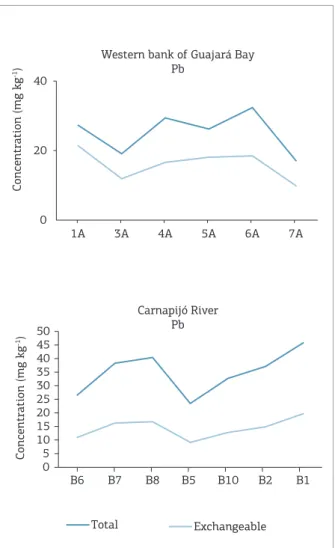
he total concentration of Pb in samples from the western margin of Guajará Bay ranged from 17.1 to 32.4 mg kg-1, with higher concentrations in the samples taken from the Paquetá Açu island (1A) and Onças island (4A and 6A) (Tab. 1). Concentrations in the sediments of Carnapijó River were slightly more homogeneous, ranging from 14.3 to 23.6 mg kg-1, which overlap the range of the samples obtained from the Bay, but with lower values. he sample from the con-luence of Acará River (B1) had a Pb content of 26 mg kg-1, a value that was within the range of samples from the west-ern margin of the Bay (Fig. 2).
he Pb contents determined in the exchangeable fraction of samples from the western margin of Guajará Bay varied from 9.9 to 21.4 mg kg-1, while samples from Carnapijó River also varied from 9.2 to 16.3 mg kg-1 (Tab. 1). Again, the sample at the conluence of Acará River (B1) had a Pb content of 19.7 mg kg-1, a value within the range from sam-ples from the western margin of the bay (Fig. 2). Overall, proportionality between the total and exchangeable Pb concentrations was observed (1.3< Pbtotal/Pbexchangeable < 1.8).
he samples from the western margin of Guajará Bay had a high organic matter (OM) content, with values of 1.8% for the sample on the Onças island (5A) and 5.2% for the sample on Jararaquinha island (2A). he samples from Carnapijó River and those taken at the conluence of Acará River showed lower levels, from 0.8–1.3 and 1.5%, respec-tively. here were no signiicant diferences in the Al and Fe contents between the two sectors studied, with respective mean values of 4.9 and 3.1% for samples from the western Table 1. Total concentrations and exchangeable Pb
(mg kg-1), total abundances (weight %) of Al, Fe, and organic matter, determined in the ine fraction of bottom sediments from the western margin of Guajará Bay and Carnapijó River.
tot.: total concentrations; ex.: exchangeable; OM: organic matter.
Sample Pbtot. Pbex. Al Fe OM
Western bank of Guajará Bay 1A (Paquetá Açu
Island) 27.3 21.4 5.0 3.6 3.0 2A (Jararaca Island) 25.6 n.d. 4.4 3.2 5.2 3A (Jararaquinha
Island) 19.1 11.9 3.6 2.1 2.3 4A (Onças Island) 29.4 16.6 7.0 3.4 5.0 5A (Onças Island) 26.2 18.1 4.8 3.5 1.8 6A (Onças Island) 32.4 18.5 6.8 4.0 5.1 7A (Onças Island ) 17.1 9.9 2.9 1.7 4.5 Mean 25.3 16.1 4.9 3.1 3.9 Standard deviation 5.4 4.3 1.5 0.8 1.4 Carnapijó River
B6 (Arapiranga Island) 15.6 11.0 3.8 2.8 0.9 B7 (Mucurás Island) 22.0 16.3 4.9 3.5 1.3 B8 (Onças Island ) 23.6 16.8 6.2 4.2 1.0
B5 (Conluence of
river Barcarena) 14.3 9.2 3.0 2.3 0.8 B10 (Onças Island) 19.9 12.8 4.4 3.1 0.9 B2 (Western bank) 22.2 14.9 3.6 3.4 1.2 Mean 19.3 13.5 4.3 3.2 1.0 Standard deviation 3.7 3.0 1.1 0.6 0.2
B1 (Conluence of
river Acará) 26.1 19.7 7.1 6.0 1.5
0 20 40
1A 3A 4A 5A 6A 7A
Co
n
ce
n
tr
a
tio
n
(
m
g
k
g
-1)
Western bank of Guajará Bay Pb
Exchangeable Total
0 5 10 15 20 25 30 35 40 45 50
B6 B7 B8 B5 B10 B2 B1
Co
n
ce
n
tr
a
tio
n
(
m
g
k
g
-1)
Carnapijó River Pb
Figure 2. Diagram of the distribution of the total and exchangeable Pb content in bottom sediments. (A) Western margin of Guajará Bay, and (B) Carnapijó
margin of Guajará Bay, and 4.3 and 3.2% for sediments from Carnapijó River. he sample from the conluence of Acará River showed the highest values of all samples, at 7.1 and 6.0%, respectively.
he correlation coeicients between the Pb content and the Al, Fe and OM contents were determined using the Estatistica
®
program. On the western margin of Guajará Bay, Pb showed an excellent correlation with Al and Fe; however, no correlation was observed with OM (Tab. 2). he Carnapijó River samples, showed a very strong correlation with Al andFe and a good correlation with OM (Tab. 3). When the B1 sample was excluded from the calculation, the correlation with Fe became even greater (Tab. 3).
Pb isotopic data of bottom
sediments and suspended matter
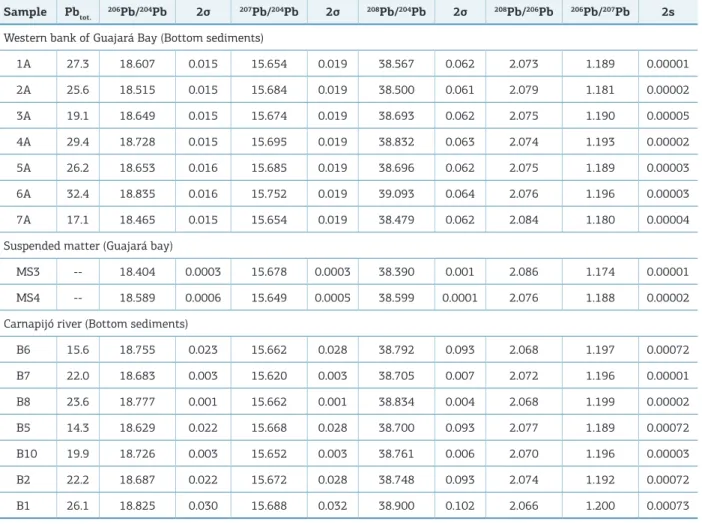
Analyses of the Pb isotopic compositions from the sam-ples of bottom sediments and two samsam-ples of suspended matter are displayed in Table 4.
Table 4. Pb isotopic ratios determined by leaching of the ine fraction of sediments from the western margin of Guajará Bay and Carnapijó River, and in suspended matter from Guajará Bay.
Sample Pbtot. 206Pb/204Pb 2σ 207Pb/204Pb 2σ 208Pb/204Pb 2σ 208Pb/206Pb 206Pb/207Pb 2s
Western bank of Guajará Bay (Bottom sediments)
1A 27.3 18.607 0.015 15.654 0.019 38.567 0.062 2.073 1.189 0.00001 2A 25.6 18.515 0.015 15.684 0.019 38.500 0.061 2.079 1.181 0.00002 3A 19.1 18.649 0.015 15.674 0.019 38.693 0.062 2.075 1.190 0.00005 4A 29.4 18.728 0.015 15.695 0.019 38.832 0.063 2.074 1.193 0.00002 5A 26.2 18.653 0.016 15.685 0.019 38.696 0.062 2.075 1.189 0.00003 6A 32.4 18.835 0.016 15.752 0.019 39.093 0.064 2.076 1.196 0.00003 7A 17.1 18.465 0.015 15.654 0.019 38.479 0.062 2.084 1.180 0.00004 Suspended matter (Guajará bay)
MS3 -- 18.404 0.0003 15.678 0.0003 38.390 0.001 2.086 1.174 0.00001 MS4 -- 18.589 0.0006 15.649 0.0005 38.599 0.0001 2.076 1.188 0.00002 Carnapijó river (Bottom sediments)
B6 15.6 18.755 0.023 15.662 0.028 38.792 0.093 2.068 1.197 0.00072 B7 22.0 18.683 0.003 15.620 0.003 38.705 0.007 2.072 1.196 0.00001 B8 23.6 18.777 0.001 15.662 0.001 38.834 0.004 2.068 1.199 0.00002 B5 14.3 18.629 0.022 15.668 0.028 38.700 0.093 2.077 1.189 0.00072 B10 19.9 18.726 0.003 15.652 0.003 38.761 0.006 2.070 1.196 0.00003 B2 22.2 18.687 0.022 15.672 0.028 38.748 0.093 2.074 1.192 0.00072 B1 26.1 18.825 0.030 15.688 0.032 38.900 0.102 2.066 1.200 0.00073
Table 2. Correlation matrix between the total Pb and Al, Fe, and organic matter (OM) in sediments from the western margin of Guajará Bay. Values in bold type emphasize strong correlation (correlation coeicient > 0.80).
Pb Al Fe OM
Pb 1.00
Al 0.93 1.00
Fe 0.97 0.83 1.00
OM 0.31 0.38 0.14 1.00
OM: organic matter.
Table 3. Correlation matrix between the total Pb and Al, Fe, and OM in sediments from Carnapijó River. The values in parentheses show the correlation coeicient excluding the B1 sample obtained from the conluence of Carnapijó River and Guajará Bay. Values in bold type emphasize strong correlation (correlation coeicient > 0.80).
Pb Al Fe OM
Pb 1.00
Al 0.84 (0.75) 1.00
Fe 0.88 (0.94) 0.93 (0.90) 1.00
OM 0.82 (0.72) 0.66 (0.31) 0.82 (0.57) 1.00
he 206Pb/207Pb isotopic ratios of bottom sediments from the western margin of Guajará Bay varied from 1.180 to 1.196, and the highest values were found in two samples taken from the Onças island (4A and 6A), with ratios of 1.193 and 1.196 and high Pb concentrations. However, the values of 206Pb/207Pb ratios observed in samples from the Paquetá Açu (1A), Jararaca (2A), Jararaquinha (3A) and Onças (5A and 7A) islands were signiicantly lower, with low concentrations of Pb. In Carnapijó River, 206Pb/207Pb ratios of 1.189 to 1.200 were obtained, with low concentrations of Pb. In addition, sample B5 had the lowest Pb isotope ratio. he suspended matter samples from margin of the Onças island (MS3) and from the mouth of the Una Canal (MS4) had 206Pb/207Pb ratios of 1.174 and 1.188, respectively.
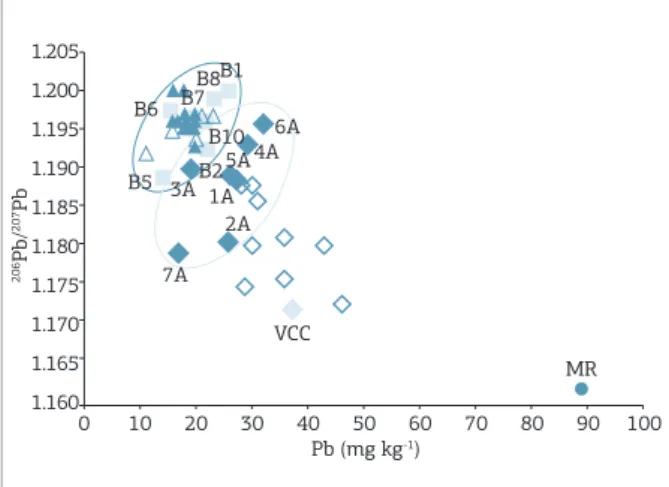
In the diagram showing 206Pb/207Pb ratios versus the total concentrations of Pb (Fig. 3), including the data by Santos et al. (2012), and a sample from Mocajatuba River, which represents sediments with the lowest isotope ratio and highest Pb content in the Belém river system (206Pb/207Pb = 1.162; [Pb] = 89 mg kg-1; Moura et al. 2004), the Carnapijó River bottom sediments deine a relatively homogeneous area. In addition, they have high isotopic ratios that over-lap with the ield of samples from Guamá River obtained by Santos et al. (2012). he bottom sediments from the west-ern margin of Guajará Bay are more dispersed and deine a wider ield, with lower 206Pb/207Pb ratios and higher or equal Pb contents than those of the previous ield samples and partially overlap that deined by the bottom sediment samples of Santos et al. (2012). However, unlike the samples analyzed by Santos et al. (2012), the points do not show a decreasing trend in the isotope ratios, with an increase in the Pb content (Fig. 3).
DISCUSSION
Relationship between
Pb and levels of Al, Fe, and OM
he correlation matrices showed that there was a sig-niicant correlation between Pb and Al and Fe elements on the western margin of Guajará Bay and Carnapijó River, which would suggest that Pb is associated with aluminos-ilicate minerals (clays) and oxides-Fe hydroxides as already demonstrated in previous studies (Saraiva 2007, Nascimento 2007). he absence of a strong correlation between Pb and OM can be explained by the fact that the eiciency of OM in adsorbing chemical compounds essentially depends on its complexing properties (Lima et al. 2004). In this respect, it is possible that the existing OM in most of the sediments from the western margin of Guajará Bay and Carnapijó River lacks suicient complexing properties to ix Pb, and may therefore consist purely of organic plant matter.
Evaluation of anthropogenic Pb
contribution
he isotopic data obtained in this study shown signii-cant variations in the isotopic compositions of the Guajará Bay samples. Some samples had low values, which indi-cated an anthropogenic contribution. hese data coincide slightly with the isotopic composition determined by Santos
et al. (2012), although a similar trending correlation in the
increase of the Pb content was not found. Overall, the iso-topic signatures suggest an anthropogenic Pb contribution, but the values are not accompanied by a signiicant increase in Pb contents.
In Carnapijó River, the isotopic composition values of Pb are higher, and within the value levels found in Guamá River, particularly on the left margin. he average 206Pb/207Pb ratio is 1.196 ± 0.004 for Carnapijó River, similar to the value observed in the left margin of the Guamá (1.196 ± 0.002, Santos et al. 2012), but diferent from the average value for the western margin of Guajará Bay (1.188 ± 0.006), despite the averages being close and within the error. here was no evidence of an anthropogenic inluence in this sector of the Belém hydrographic system, which is located faraway from the urban center. he B5 sample, which was taken from the conluence of Barcarena River, has a slightly lower value. his may be related to its proximity to the mouth of Barcarena River, which drains the urban and industrial hub of the city of Barcarena. he B1 sample from the conlu-ence of Acará River was obtained at the furthest point of all samples from the city of Belém, and has a higher 206Pb/207Pb ratio value of 1.20, which is compatible with having a purely geogenic origin of Pb.
Pb (mg kg-1)
MR VCC
7A 2A 1A
5A 4A 6A B1 B8 B7 B6
B2 B10
B5 3A
0 1.205
1.200
1.195
1.190
1.185
1.180
1.175
1.170
1.165
1.160
20
10 30 40 50 60 70 80 90 100
206
Pb/
207
Pb
Figure 3. Diagram showing Pb (mg kg-1) versus
206Pb/207Pb of bottom sediments.
Criteria and limitations for the use
of the concentration and isotopic
signature of Pb in identifying Pb
contamination
Sampling modes
he results obtained on our samples from the western margin of Guajará Bay difer from previous results for the same part of the Bay. Even when there were a partial over-lapping of the 206Pb/207Pb isotope range, the isotopic com-position 206Pb/207Pb of the samples by Santos et al. (2012) showed lower values (1.172 < 206Pb/207Pb < 1.188), which were not evident in our results (1.180 < 206Pb/207Pb < 1.196) (Fig. 3). Furthermore, there was no evidence of a clear rela-tionship between the increased Pb content and the decreased isotope ratio, unlike the evidence provided by Santos et al. (2012). It is considered that this diference in behavior may result from the sampling mode. Santos et al. (2012) used a Petersen dredge, in which a surface layer of 5 cm of the bot-tom sediments is collected. Our study established the iso-topic signatures using the top layer of 10 cm from a core of bottom sediments, which therefore corresponded to a dif-ferent time period of deposition. Based on an approximate rate of sediment deposition of 0.7 cm year-1 for Guajará Bay (Dias et al. 2010; Santos et al. 2012, Oliveira et al. in press), the 10 cm analysis of the core corresponds to a period of 16 to 18 years of sedimentation, while the sampling by Santos
et al. (2012) corresponds to a period of only 8 to 9 years.
his diference may justify the less anthropogenic signature found in this study, as the population growth of the city of Belém has accelerated over the past 10 years (Carvalho 2012). he lowest isotope ratio in the sediments from Carnapijó River was found in sample B5, which was the only sample collected in this area using a Petersen dredge. herefore, this could also relect the diferences in the sampling time rather than any anthropogenic inluence from the Barcarena city.
Total and partial concentration of Pb (exchangeable)
he anthropogenic Pb component is preferably located in the exchangeable fraction of bottom sediments removed by acid leaching, while geogenic Pb is located in the struc-ture of minerals (mainly silicate minerals), and is obtained by total dissolution of the sample (Bur et al. 2009). In studies involving Pb and its isotopic signature, correlations have been established using both the total concentration (Ferrand et al. 1999, Bindler et al. 2001, Moraes et al. 2004, Miller et al. 2007, Gioia et al. 2006, Dong et al. 2010) and the exchange-able Pb fraction (Bird et al. 2010; Gioia et al. 2006). For the hydrographic system of Belém, results have been presented using either the total Pb (Santos et al. 2012) or exchangeable Pb concentrations (Moura et al. 2004). In the Pb content
Pb/Al 3.0
1.205
1.200
1.195
1.190
1.185
1.180
1.175
3.5 4.0
4A 3A
1A, 5A
2A 7A 6A
B10
B5 B7 B6 B8 B1
B2
4.5 5.0 5.5 6.5
206
Pb/
207
Pb
6.0
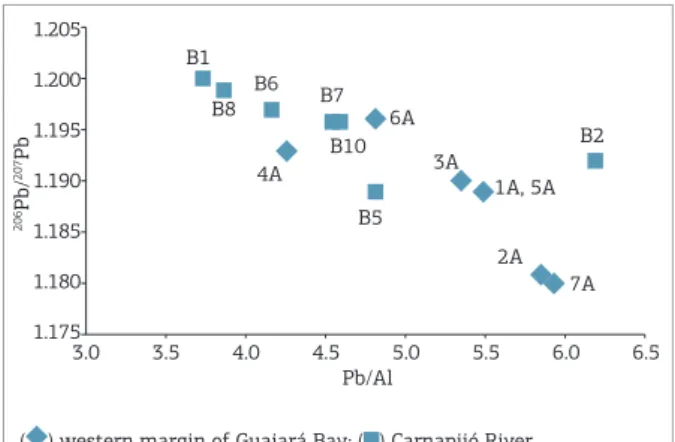
Figure 4. 206Pb/207Pb versus Pb
total(mg kg
-1)/Al (weight %) diagram of bottom sediments;
vs. isotopic signature diagrams, exchangeable Pb should be normally used because the isotopic signatures are obtained by acid leaching, which preferentially remove the anthro-pogenic lead component. However, there is a relationship between exchangeable (leachate) and total Pb concentra-tions, considering that the geogenic Pb value content must remain constant and the total concentration varies only due to the increase in the anthropogenic contribution. Ettler et al. (2004) suggested using the Pb/Al ratio instead of Pb contents to identify the presence of anthropogenic Pb. It is evident that in the 206Pb/207Pb versus Pb/Al diagram, there is a clear tendency of the 206Pb/207Pb ratio to decrease as the Pb/Al ratio increases, with respectively lower and higher values for the Guajará Bay samples than the samples from Carnapijó River (Fig. 4). he sample taken from the Acará River con-luence, despite having a Pb content similar to that of the more concentrated samples from Guajará Bay, has the low-est Pb/Al ratio and the highlow-est 206Pb/207Pb ratio (1.20). his suggests that the Pb/Al ratio is an appropriate parameter to be considered with the isotopic signature of Pb, for use in indicating an anthropogenic contribution. he B2 sample has a distinct behavior, and it stands out because it has the highest Pb/Al ratio and a high isotopic signature (206Pb/207Pb = 1.192). However, the fact that this sample has a much higher percentage of sand (>95%) than all other samples (Oliveira et al. in press) may have caused the increase in the Pb/Al ratio in relation to the low Al content, and not because of the high Pb content.
Variation in the background for Pb content and isotopic signature
he background value for the Pb concentration of bottom sediments is diicult to determine, especially in estuarine systems with fairly complex hydrodynamics. his under-mines the ability to obtain a reliable determination of
anthropogenic contributions, as contamination levels (Geoaccumulation Index, Enrichment Factor etc.) depend on the choice of a reference value for natural Pb (such as the average continental crust value or the natural local value). A background value about 18 mg kg-1 for total Pb was pro-posed by Santos et al. (2012) for the Belém hydrographic system with a corresponding 206Pb/207Pb isotopic signature of 1.196. It is considered that the average total Pb content of 19.3 ± 3.7 mg kg-1 (20.5 ± 4.3 mg kg-1, when including the B1 sample from the conluence with Acará River) and the average 206Pb/207Pb ratio of 1.196 ± 0.004 obtained for Carnapijó River also relect the geogenic background.
Sources and transport
of anthropogenic Pb
Previous studies have determined that the accumulation of anthropogenic Pb, which is found in natural environ-ments such as lakes, peat bogs, and oceanic waters, is linked to industrial atmospheric sources rather than to the dump-ing of domestic sewage and industrial waste (Komarék et al. 2008, Bollhöfer & Rosman 2000). However, the transport and accumulation of anthropogenic Pb in estuarine envi-ronments occurs mainly by sorption to suspended matter (Helland et al. 2002, Callender 2011).
Bollhöfer and Rosman (2000) determined an isotope 206Pb/207Pb ratio of 1.15 in particulate matter (aerosols)
found in the industrial district of Icoaraci, in the northern sector of Belém. It has also been considered that the anthro-pogenic Pb contribution in relation to atmospheric transport could explain the isotopic signatures of bottom sediments on the western margin of Guajará Bay. However, Santos et al., (2012) dismissed such a hypothesis, and suggested suspended matter to be the main vehicle for Pb transport to the western margin of the Bay.
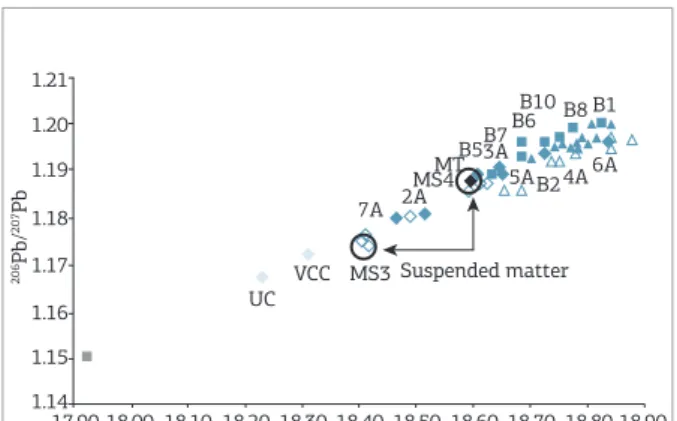
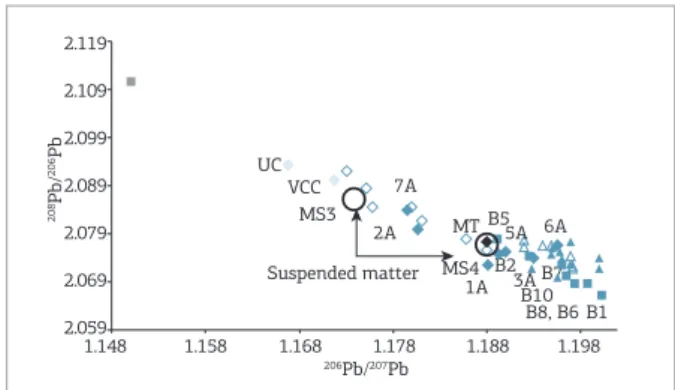
In 206Pb/207Pb versus206Pb/204Pb and 208Pb/206Pb versus
206Pb/207Pb diagrams (Figs. 5 and 6, respectively), the
isoto-pic signatures of the two samples of suspended matter from the Belém waterfront were inserted, in addition to those of bottom sediments from Carnapijó River and western mar-gin Guajará Bay (this study). Also inserted were those from bottom sediments obtained from the left and right margins of Guamá River (Santos et al. 2012), three samples from the Belém waterfront (Santos et al. 2012; Oliveira et al. 2013) and the values from aerosols in Icoaraci district (Bollhöfer & Rosman 2000). All samples show a linear arrangement, which is compatible with binary mixing between a geogenic pole, as marked by samples from Carnapijó and Guamá Rivers (206Pb/207Pb
average = 1.196), and an anthropogenic pole, marked by the isotopic signature from aerosols obtained in the industrial district. he two suspended matter sam-ples showed distinct isotopic compositions of geogenic Pb,
particularly in the case of the sample taken from the west-ern margin of the Bay (206Pb/207Pb = 1.174). his sample was obtained close to that of the bottom sediment sam-ple, which had a more anthropogenic isotopic signature of 206Pb/207Pb = 1.170 (Santos et al. 2012).
he Pb isotopic signatures point to the southern sector where the Bay is narrower as the area from the western margin of the Bay most afected by the anthropogenic contribution. he main drivers of the deposition and dispersion of sediments in Guajará Bay are the topography, river inlow, and tidal cur-rents (Gregório & Mendes 2009). hese authors also identiied that the hydrodynamic regime of Guajará Bay is controlled by a looding stream at the eastern margin of the Bay, and an ebb on the western margin. he suspended matter is thus trans-ported during the lood and ebb tide from the Belém water-front on the eastern margin to the western margin, and the water discharge from Guamá River promotes the transport in that direction (Fig. 7). his hydrodynamic behavior would thus be responsible for increasing the anthropic inluence along the entire length of the Bay, not only on the Belém waterfront, in relation to transport by suspended particulate matter.
he fact that the samples from the Belém waterfront (Una and Val de Cans channels; Santos et al. 2012; Oliveira
et al. 2013) and aerosols (Bolhöfer & Rosman 2000) plot on
the same linear trend in both Pb isotopic diagrams (Figs. 5 and 6) indicates that the isotopic signature of the contam-inant end-member of industrial aerosols and urban waste-waters is probably similar. In addition, Petroleum byprod-ucts like gasoline or used motor oil may also be involved as
17.90 1.21
1.20
1.19
1.17
1.16
1.15
1.14
18.00 18.10 18.20 18.30 18.40 18.90
206
Pb/
207
Pb
206Pb/204Pb
18.60 Suspended matter MS3
VCC UC
7A 2A MS4MT
B5B7
B6B10 B8 B1
6A 4A B2 5A 3A
18.70 18.80 18.50
1.18
Figure 5. 206Pb/207Pb versus 206Pb/204Pb diagram of
their Pb isotopic signatures (Lima et al. 2010) also it the linear trend (not shown in the diagrams).
The isotopic composition of suspended matter is within the range of bottom sediment samples from the Bay and from the mouth of the Una and Val de Cans channels, which is compatible with anthropogenic Pb dispersal in the hydrographic system mainly by particu-lates-associated transport. However, the behavior of the isotopic signatures in the 206Pb/204Pb versus206Pb/207Pb
and 208Pb/206Pb versus206Pb/207Pb diagrams indicates that
aerosols cannot be discarded as a possible contributor to the anthropic influence in the bottom sediments of the Guajará bay.
1.148 2.119
2.109
2.099
2.089
2.079
2.069
2.059
1.158 1.168 1.198
208
Pb/
206
Pb
206Pb/207Pb
Suspended matter MS3 VCC UC
7A
2A
MS4 MT B5
B7 B10
B8, B6 B1 6A
1A B2
5A
3A
1.188 1.178
Figure 6. 206Pb/207Pb versus 208Pb/206Pb diagram of
bottom sediments, suspended matter, and aerosols (same symbols as those used in Fig. 5).
Figure 7. Simpliied map of the Belém hydrographic system. 206Pb/207Pb values of the bottom sediments and
suspended matter are reported, including those of bottom sediments from the Belém waterfront (Val de Cans
Channel – Santos et al. (2012); Miramar terminal and Una Channel – Oliveira et al. (2013)). Tidal and luvial
currents according to Gregório and Mendes (2009) are also displayed. 48°40’0”W
1°10’0”S
1°20’0”S
1°30’0”S
1°10’0”S
1°20’0”S
1°30’0”S
48°30’0”W 48°20’0”W
48°40’0”W 48°30’0”W 48°20’0”W
Bottom sediments: - 1A to 7A and B1 to B10; Suspended Material: - MS3 and MS4;
Sample location
CONCLUSIONS
he isotopic signatures of sediments from the west-ern margin of Guajará Bay conirm an anthropogenic contribution in relation to the presence of Pb, as shown by Santos et al. (2012). However, this contribution is incipient, and as yet no associated environmental dam-age has occurred.
hroughout the Bay, the accumulation of lead with an anthropogenic origin is related to recent processes that have become more eicient in the last 10 years, as shown by the isotopic signature diferences between the Guajará Bay sediments analyzed in this study and those analyzed by Santos et al. (2012). It is considered that such changes may be connected to the rapid population growth within the city of Belém.
In Carnapijó River, isotopic signatures show that this area has not yet been afected by human activity. he mean Pb concentration (20.5 ± 4.5 mg kg-1) and isotopic signa-ture (206Pb/207Pb = 1.196 ± 0.004) conirm the background values previously proposed by Moura et al. (2004) and Santos et al. (2012).
he isotopic signatures of suspended matter from the eastern Belém waterfront (206Pb/207Pb = 1.188) and western margin (the island region: 206Pb/207Pb = 1.174) of Guajará Bay show that domestic sewage from Belém is a major anthro-pogenic source of Pb in the Guajará Bay bottom sediments,
and that this suspended matter is an eicient transport mech-anism of metals to the western margin of the bay. In this respect, there is greater accumulation in the southern part, which is the narrowest section of the Bay, due to the efect of the tides at the conluence with Guamá River. However, the isotopic signatures of Pb indicate that aerosols cannot be ruled out as possibly contributing to the anthropogenic inluence of lead accumulation in Guajará Bay.
Finally, the isotopic results demonstrate the potential of using the isotopic signature of Pb as a prospective tool for the indication of human activity and the future contamination of bottom sedi-ments, even in a complex hydrodynamic environment within an area that is currently only minimally impacted by human occupation.
ACKNOWLEDGMENTS
We acknowledge the Conselho Nacional de Desenvolvimento Científico e Tecnológico (CNPq) for the research scholarship granted to ECO, JML and JHC and the CNPq Universal projects (Grant 472146/2008-4 and grant 485539/2012-8) for inancial support. In addi-tion, the authors are grateful to the technical staf of the geochronological laboratory of Universidade Federal do Pará (UFPA) for the acquisition of the isotopic data. he authors are thankful to BJG reviewers for their commen-taries and constructive suggestions.
Acme Analytical Laboratories Ltd. 2009 [Internet]. Available at: http://www.acmelab.com. [cited at Apr. 2009].
Banner J.L. 2004. Radiogenic isotopes: systematics and applications
to earth surface processes and chemical stratigraphy. Earth Science
Reviews, 65:141-194.
Bird G. 2011. Provenancing anthropogenic Pb within the luvial
environment: Developments and challenges in the use of Pb
isotopes. Environment International, 37:802-819.
Bird G., Brewer P.A., Macklin M.G., Nikolova M., Kotsev T., Mollov M., Swain C. 2010. Quantifying sediment - associated metal dispersal using Pb isotopes: Application of binary and multivariate mixing models at
the catchment - scale. Environmental Pollution, 158:2158-2169.
Bollhöfer A., Rosman K.J.R. 2000. Isotopic source signatures
for atmospheric lead: The Southern Hemisphere. Geochimica et
Cosmochimica Acta, 64(19):3251-3262.
Bindler R., Renberg I., Anderson N.J., Appleby P.G., Emteryd O., Boyle J. 2001. Pb isotope ratios of lake sediments in West Greenland: inferences
on pollution sources. Atmospheric Environment, 35:4675-4685.
Bur T., Probst J.L., N’guessan M., Probst A. 2009. Distribution and origin of lead in stream sediments from small agricultural catchments draining Miocene molassic deposits (SW France). Applied Geochemistry, 24:1324-1338.
REFERENCES
Carvalho J.H.S. 2012. Distribuição e registro histórico de metais pesados e assinatura isotópicas de Pb em testemunhos de sedimentos de fundo da baía do Guajará, Belém-PA. MS Dissertation, Instituto de Geociências, Universidade Federal do Pará, 89p.
Callender, E. 2011. Heavy metals in the environment –
historical trends In: Holland H.D., Turekian K.K. (eds) Radioactive
Geochronometry. New York, Academic Press, Elsevier, 463p.
Dias F.F., Taddei M.H.T., Nascimento S.M., Lafon J.M. 2010. 210Pb
geochronology of sediments from the Guamá River and Guajará
Bay in the Amazon region, Belem, Brazil. Atoms for Peace: an
International Journal (AFP), 3:26-32.
Dong Z., Bao Z., Wu G. 2010. Lead Concentration Distribution and Source Tracing of Urban/Suburban Aquatic Sediments in Two
Typical Famous Tourist Cities: Haikou and Sanya, China. Bull
Environment Contamination Toxicological, 85:509-514
Ettler V., Mihaljevic M., Sebek O., Molek M., Grygar T., Zeman J. 2004. Geochemical and Pb isotopic evidence for sources and dispersal of metal contamination in stream sediments from the mining and smelting district of Príbam, Czech Republic. Environment Pollution, 142:409-417.
Ferrand J.L., Hamelin B., Monaco A. 1999. Isotopic tracing of anthropogenic Pb inventories and sedimentary fluxes in
the Gulf of Lions (NW Mediterranean sea).Continental Shelf
Gregório A.M.S., Mendes A.S. 2009. Characterization of sedimentary
deposits at the conluence of two tributaries of the Pará River estuary
(Guajara Bay, Amazon). Continental Shelf Research, 29:609-618.
Gioia S.M.C.L., Pimentel M.M., Tessler M., Dantas E.L., Campos J.E.G., Guimarães E.M., Maruoka M.T.S., Nascimento E.L.C. 2006. Sources of
anthropogenic lead in sediments from an artiicial lake in
Brasília-central Brazil. Science of the Total Environment, 356:125-142.
Helland A., Aberg G., Skei J. 2002. Source dependent behavior of lead and organic matter inthe Glomma estuary, SE Norway: evidence
from isotope ratios. Marine Chemistry, 78:149-169.
IDESP. 1990. Um estudo Ambiental do estuário Guajarino. Relatório de Pesquisa, 17, 154p.
Komarék M., Ettler V., Chrastný V., Mihaljevic M. 2008. Lead isotopes
in environmental sciences: A review. Environment International,
34:562-577.
Kylander M.E., Klaminder J., Bindler R., Weiss D.J. 2010. Natural lead
isotope variations in the atmosphere. Earth and Planetary Science
Letters, 1-2:44 -53.
Lafon J.M., Rodrigues E.M.S. Scheller, T. 1993. Geocronologia Pb-Pb em feldspato e rocha total: procedimento experimental e exemplos de aplicação. In: IV Congresso Brasileiro de Geoquímica, Brasília, Boletim resumos expandidos, Brasília/DF, p.242-244.
Lima E.A.R., Siqueira G.W., Lima W.N., Mendes A.S. 2004. Aplicação
da técnica de infravermelho na identiicação e caracterização
da matéria orgânica nos sedimentos de fundo da plataforma
continental do Amazonas. Geochimica Brasiliensis, 18(1):46-53.
Lima C.S., Moura C.A.V., Siqueira N.V.M., Galarza M.A. 2010. Determination of the isotope composition of lead and strontium in crude oil and derivatives and prospective environmental applications. In: VII South American Sym posium on Isotope Geology,
7, 2010, Brasília, Extended Abstract, CD-ROM.
Loring D.M., Rantala R.T.T. 1992. Manual for the geochemical analyses of marine sediments and suspended particulate matter. Earth Science Review, 32:235-283.
Moraes R.P., Figueiredo B.R., Lafon J.M. 2004. Pb - Isotopic tracing of metal – pollution sources in the Ribeira Valley, Southeastern Brazil. Terrae, 1(1):26-33.
Moura C.A.V., Gaudette H.E., Carvalho M.C., Morales G.P. 2004. The use of lead isotope composition as a tool to investigate the anthropogenic impacts on the environment in the metropolitan region of Belém (PA). Terrae, 1(1):16-25.
Miller J.R., Lechier P.J., Mckin G., Germanoski D., Villarroel L.F. 2007. Evaluation of particle dispersal from milling operations using lead
isotopic ingerprinting techniques, Rio Pilcomayo Basin, Bolivia.
Science of the Total Environment, 384: 355-373.
Nascimento S.M. 2007. Caracterização da assinatura isotópica de Pb atual e da concentração de metais pesados em sedimentos de fundo da foz do rio Guamá e da baía do Guajará (Belém-Pará). MS Dissertation, Instituto de Geociências, Universidade Federal do Pará, 103p.
Oliveira E.C., Lafon J.M., Corrêa J.A.M., Carvalho J.H.S., Dias F.F., Taddei M.H.T. Avaliação da distribuição dos metais traços em sedimentos de
fundo do sistema hidrográico da região de Belém (margem oeste da
baía do Guajará e rio Carnapijó). Geochimica Brasiliensis (in press).
Oliveira S.P., Moura C.A.V., Rosa Filho J.S. 2013. Avaliação de Oligochaeta
(Tubiicinae) e Polychaeta (Namalycastis abiuma) como bioindicadores
da composição isotópica de chumbo: exemplo do estuário guajarino, Belém (PA), Brasil. Pesquisas em Geociências, 40(2): 141-146.
Platzner I., Ehelichs S., Halicz L. 2001. Isotope-ratio measurements of lead in NIST reference materials by multiple-collector inductively coupled plasma mass spectrometry. Journal of Analytical Chemistry, 370: 624-628.
Pejrup, M. 1988. The triangular diagram used for classiication of
estuarine sediments: a new approach. In: Boer, P.L., Van Gelder,
A., Nio, S.D. (eds.). Tide-inluenced Sedimentary Environments and
Facies. D. Reidel, Dordrecht, p289-300.
Pinheiro, R.V.L. 1987. Estudo hidrodinâmico e sedimentológico do estuário Guajará- Belém (PA). MS Dissertation, Centro de Geociências, Universidade Federal do Pará, 179p.
Roig H.L., Rego A.P.M., Dantas E.L., Meneses P.R., Walde D.H.G., Gioia S.M.L.C. 2005. Assinatura isotópica Sm-Nd de sedimento em suspensão: implicações na caracterização da proveniência dos
sedimentos do rio Paraíba do Sul, São Paulo. Revista Brasileira de
Geociências, 35(4):503-514.
Rosseti D.F. 2001. Late Cenozoic sedimentary evolution in northeastern Pará, Brazil, within the context of sea level changes. Journal of South American Earth Sciences, 14:77-89.
Santos S.N., Lafon J.M., Corrêa J.A.M., Babinski M., Dias F.F., Taddei M.H.T. 2012. Distribuição e assinatura de Pb em sedimentos de fundo da foz do rio Guamá e da baía do Guajará (Belém-Pará). Química Nova, 35(2):249-256.
Saraiva A.L.L. 2007. Estudo sedimentológico e geoquímico em sedimentos de fundo da baía do Guajará - Belém (PA).MS Dissertation, Instituto de Geociências, Universidade Federal do Pará, 122p.
Shepard F.P. 1954. Nomenclature based on sand-silt-clay ratios. Journal of Sedimentary Petrology, 24:151-158.
Souza S.R., Oliveira A.O., Hartmann C. 2008. Utilização do
testemunhador Russian Pet Borer no Saco do Martins e Arraial,
Estuário da Laguna dos Patos: RS, Brasil. Gravel, 6(1):1-13.