0103 - 5053 $6.00+0.00
S
ho
rt
R
e
p
o
rt
* e-mail: [email protected]
Characterization of Spin-Coated Polymer Films
D. F. S. Petri
Instituto de Química, Universidade de São Paulo, CP 26077, 05513-970 São Paulo - SP, Brazil
Neste trabalho a morfologia de filmes obtidos por revestimento rotacional foi explicada como sendo resultante de forças competitivas entre polímero, solvente e substrato. Lâminas de silício (superfícies polares) suportaram os filmes. Tolueno e tetrahidrofurano (THF) foram os solventes escolhidos para dissolver poliestireno (PS), poli(cloreto de vinila) (PVC) e poli(butiral vinílico) (PVB). Análises de microscopia de força atômica mostraram que filmes de PS obtidos a partir de soluções preparadas em tolueno são homogêneos e lisos, enquanto filmes de PS e PVC obtidos a partir de soluções preparadas em THF são muito rugosos e segregados. Entretanto, filmes de PVB preparados a partir de soluções em THF são contínuos e homogêneos. Quando as interações entre substrato e solvente são mais favoráveis que as interações entre substrato e polímero, o filme se torna rugoso e segrega. Contrariamente, quando as interações entre substrato e polímero são mais favoráveis que as interações entre substrato e solvente, ou quando as interações são muito fracas, os filmes obtidos são homogêneos e lisos. Os filmes homogêneos e lisos também foram caracterizados por elipsometria e medidas de ângulo de contato.
In this work the morphology of spin-coated polymer films is explained based on the competitive interactions between polymer, solvent and substrate. The films were formed on silicon wafers, a polar surface. Toluene and tetrahydrofuran (THF) were chosen for the dissolution of polystyrene (PS), poly(vinyl chloride) (PVC) and poly(vinyl butyral) (PVB). PS spin-coated films from solutions prepared in toluene were homogeneous and flat, while PS and PVC films obtained from solutions prepared in THF were very rough and presented segregation on the surface, as revealed by the atomic force microscopy. However, PVB films prepared from THF are continuous and homogeneous. When the interaction energy between substrate and solvent overcomes that between substrate and polymer, the films become rough and segregate. On the contrary, when the interaction energy between substrate and polymer is stronger than that between substrate and solvent, or when both interaction energies are weak, the films obtained are homogeneous and flat. These homogeneous and flat films were also characterized by ellipsometry and contact angle measurements.
Keywords: spin-coating, polymer films, atomic force microscopy, ellipsometry, wettability
Introduction
Thin polymeric films are often used in the microelectronic industry, the development of sensors, packing industry and in the academic field. Homogeneous films with thickness varying from 2 to 5000 nm are commonly prepared by spin-coating. In this technique, polymer solution is dropped on the substrate surface, which rotates at a given angular velocity during a given period of time. The film thickness is controlled by the concentration of the polymer in solution, polymer
molecular weight, 1 spinning velocity and solvent
evaporation rate. 2 The films are stable at temperatures lower
than their glass temperature (Tg) or melt temperature (Tm). However, when the polymer films are annealed at temperatures higher than their Tg or Tm, the films may become unstable and dewetting takes place.3-5 Depending
on the substrate and the medium surrounding the layer, the wetting phase can form a continuous film, a single droplet or a pattern of discontinuous droplets. 6 If the
interactions between substrate and polymer are van der Waals type, the values of the Hammaker constant A for polymer/polymer and polymer/substrate indicate the film stability. If Apolymer/polymer is higher than Apolymer/substrate,
dewetting will be favored.3-5
the resulting surface morphology of spin-coated films. We choose silicon wafers as substrate, the commercial polymers polystyrene, poly(vinyl chloride) and poly(vinyl butyral) dissolved in common solvents like toluene and tetrahydrofuran, due to their large industrial application. Moreover, the determination of the optical constants and wettability of the films was carried out. Such informations
are important for the development of adhesives7 and
waveguides.8
Materials
Silicon (100) wafers purchased from Crystec (Berlin, Germany) with a native SiO2 layer approximately 2 nm thick were used as substrates. Polystyrene, PS, (Mw ~
200.000 g mol-1) was kindly supplied by BASF
(Ludwigshafen, Germany). Poly(vinyl chloride), PVC, (Mw ~ 80.000 g mol-1) and poly(vinyl butyral), PVB, (M
w ~
40.000 g mol-1) were kindly supplied by Trikem (São Paulo,
Brazil) and Monsanto (São Paulo, Brazil), respectively. Analytical grade toluene and THF were used to prepare the solutions at the polymer concentration of 10 mg mL-1.
The polymers were dissolved only in good solvents, where no phase separation takes place.
The chemical structure of substrate, solvents and polymers are schematically represented in Figure 1.
Methods
Spin-coating.The polymer films were prepared by spin-coating on Si wafers with a Headway PWM32-PS-R790 spinner (Garland, USA). The wafers with dimensions of 1.5 cm x 1.5 cm were previously rinsed in a standard manner9 and dried under a stream of N
2. All coatings were
performed with the spinning velocity of 3000 rpm and the spinning time of 30 seconds.
Ellipsometry. The mean thickness and index of
refraction (n) of the films were determined by means of ellipsometry10 in a DRE-X02 Ellipsometer (Ratzeburg,
Germany), equipped with a He-Ne laser (632.8 nm). The samplescharacteristics are shown in Table 1.
Contact angle. Measurements were performed in a
home-built apparatus11 equipped with a Casio QV-10
digital camera, which is connected to a computer. Sessile water drops of 4 µL and 2 µL were used for the advancing (θA) and the receding contact angle (θR), respectively. At least five samples of the same composition were analyzed at different spots.
Atomic Force Microscopy (AFM). Measurements were
carried out with an instrument from Park Scientific (Sunnyvale, CA, USA) equipped with a homebuilt head with a laser deflection detection system in the contact mode in air at room temperature. V-shaped silicon nitride cantilevers with sharpened pyramidal tips and force constants between 0.03 and 0.1 N/m were applied. All AFM images represent unfiltered original data and are displayed in a linear gray scale. At least three samples of the same composition were analyzed at different areas of the surface.
Results and Discussion
The spin-coating process can be visualized in 3 steps. In the first step, the substrate is covered by the polymer solution in the steady state. Here 2 cases will be considered. If the interactions between polymer and substrate are stronger than those between substrate and solvent, the
Table 1. Characteristic of polymers used for spin-coating. Films of PS and PVC prepared from THF were too rough for the ellipsometric measurements as well as for the contact angle measurements. All measurements were performed at (23 ± 1) oC
Sample Solvent Thickness (nm) n632.8 θ
A (
o) θ
R (
o) ∆θ (o)
SiO2 - 1.70 ± 0.05 1.462 5 ± 1 -
-PS Toluene 50 ± 2 1.585 ± 0.005 90 ± 2 88 ± 2 2
PVB THF 99 ± 5 1.51 ± 0.02 60 ± 1 34 ± 3 2 6
chains will preferentially wet the substrate. On the contrary, if the interactions between solvent molecules and substrate are stronger than those between substrate and polymer chains, the chains will be driven away from the substrate. This kind of competition controls the adsorption of polymers from solution onto inorganic surfaces,12-14 as first
described by Silberberg: 15
χpo
s = [fps – fos + ½ (fpp – foo)] / kT (1)
where χpo
s is the adsorption energy involved in the
adsorption of a polymer segment from solution onto a substrate; fps, fos, fpp, foo represent the interaction energies polymer/substrate, solvent/substrate, polymer/polymer and solvent/solvent, respectively; k is the Boltzmann constant and T is the temperature. When fps is larger than fos the polymer adsorption takes place.
In the first spinning moments the solvent begins to evaporate, increasing the solution concentration. As a consequence, the solution viscosity increases and the chains mobility decreases. If the interactions between substrate and polymer are repulsive, the chains tend to aggregate to minimize the contact with the surface. On the contrary, if the interactions between substrate and polymer are attractive, the polymer chains tend to wet the substrate. After complete solvent evaporation the film adopts the structure corresponding to the lowest free energy of the system. It is important to remember that the resulting structure in this case might not be the equilibrium one.
Thin films of polystyrene (PS) were spin-coated onto silicon wafers from solutions prepared in toluene or in THF. The films were analyzed by means of AFM. Figure 2 and Figure 3, show the surface structure of PS films from solutions prepared in toluene and THF, respectively. In the former, the PS film is continuous and smooth with a root mean square (r.m.s.) roughness of 1.9 Å, while in the latter, the film is discontinuous with r.m.s. of 55 ± 5 nm. Ellipsometry and contact angle measurements easily characterized the PS film prepared from toluene. The hysteresis in the contact angle (∆θ) is very low (Table 1), confirming the very smooth surface observed by AFM. On the contrary, PS films obtained from THF were too rough for ellipsometry, as revealed by the very low intensity of reflected light. The interaction energy between polymer and substrate, fps, is weak in both cases. PS is very hydrophobic, while SiO2 is a very hydrophilic surface (Table 1). For instance, PS films are easily detached from silicon wafers or glass slides, when immersed in a water bath, because water wets SiO2 much better than PS and the interaction between PS and SiO2 is weak.16 Toluene and
THF are good solvents for PS17 with different polarities.
The interaction between toluene and SiO2 is very
unfavorable. The acid-base interactions between them are very weak.18,19 Therefore, there is no competition between
polymer and solvent for the substrate. However, THF is an organic base, which shows stronger acid-base interactions with SiO2 than toluene, turning the interaction energy solvent/substrate, fos, strong.18 In this case, the polymer
chains dry in the form of aggregates to minimize surface energy. Bolger19 observed that a Brφnsted-type acid-base
interaction plays a very important role in the adhesion of polymer coatings form organic solvent to metal oxides. The free energy of such acid-base reaction was calculated for SiO2/toluene and SiO2/THF as + 35 RT and + 4.2 RT, respectively, evidencing the preferential interaction
between SiO2 and THF. Similar results were found by
Fowkes12 for the adsorption of poly(methyl methacrylate)
(PMMA) from organic solvents onto inorganic surfaces. He showed that the adsorption of PMMA, a basic polymer
Figure 2. AFM topographic image of PS spin-coated film from toluene.
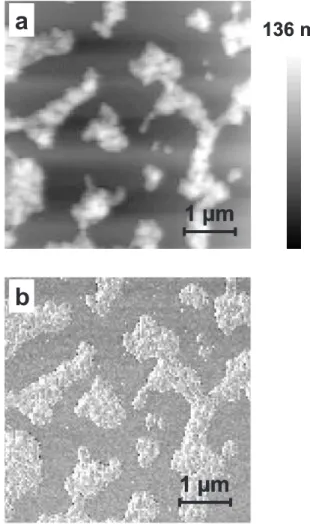
contact angle measurements because of the high roughness (r.m.s. = 32 ± 5 nm).
Films of poly(vinyl butyral) (PVB) were spin-coated from THF, a good solvent. Although the solvent used is the same as that used in the PVC films, the surface morphology is completely different, as shown in Figure 5. The film covering the surface is rough (r.m.s = 24 ± 2 nm), but the substrate is not exposed. The film is formed by spherical islands with a mean diameter of 300 ± 30 nm. Ellipsometry and contact angle measurements were performed. The thickness and index of refraction were obtained independently. Although the value of the index of refraction agrees well with the literature20
value, its accuracy is lower than the usual because of the roughness, as indicated by the high value of hysteresis in the contact angle. PVB films are more hydrophilic than the PS films. PVB has been largely used for safety laminations. It is pressed between glass layers under heat and pressure. The excellent properties of transparency and good adhesion to glass make this polymer appropriate for the automobile windshield fabrication.20 The chemical structure of PVB
monomers (Figure 1) provides sites able to form H bonding with the SiO2 surface, turning the interaction energy between polymer and substrate, fps, strong. In this case, there is competition between polymer and solvent for the substrate. Since PVB covers the substrate completely, we can consider qualitatively that PVB wets the substrate even better than THF (fps > fos), driving the polymer chains towards the surface. When THF evaporates the PVB chains are already oriented to the substrate and form a continuous film.
Conclusions
The morphology of spin-coated polymeric films is determined by the interaction energy polymer/substrate
Figure 5. AFM topographic image of PVB spin-coated film from THF.
Figure 4. AFM image of PVC film spin-coated from THF. (a) to-pography and (b) lateral force measurement.
onto acidic silica is maximum in the presence of a neutral solvent (carbon tetrachloride, for instance) and it decreases when the solvent competes with either the polymer or the substrate, as in the case of THF or chloroform. Fowkes also proposed that the adhesion of polymers onto inorganic surfaces is mainly driven by acid-base interactions.
and solvent/substrate. When the solvent wets the substrate preferentially, the polymer chains are driven away from the substrate and dry in the form of aggregates. Homogeneous films are obtained when there is no preferential interaction or when the polymer interacts more strongly with the substrate than the solvent.
Acknowledgements
DFSP acknowledges Prof. Dr. Th. Schimmel (University of Karlsruhe, Germany) for AFM facilities and FAPESP and CNPq for financial support.
References
1. Schubert, D. W.; Polym. Bull.1997, 38, 177. 2. Meyerhofer, D.; J. Appl. Phys.1978, 49, 3993. 3. Reiter, G.; Langmuir1993, 9, 1344.
4. Brochard-Wyart, F. C. R.; Acad. Sci. Paris 1992, 314(II), 19. 5. Müller-Buschbaum, P.; Vanhoorne, P.; Scheumann, V.; Stamm,
M.; Europhys. Lett. 1997, 40, 655.
6. Lipowsky, R.; Lenz, P.; Swain, S.; Colloid Surf. A: Physico-chemical and Engineering Aspects2000, 161, 3.
7. Garbassi, F.; Morra, M.; Occhiello, E.; Polymer Surfaces: From Physics to Technology, John Wiley & Sons: England, 1998. 8. Suematsu, Y. ed.; Optical Devices & Fibers, OHMSHA Lta.
and North Holland Publishing Co.: Amsterdam,1986, Vol. 17, Chapter 2, p. 56.
9. Petri, D.F.S.; Wenz, G.; Schunk, P.; Schimmel, T.; Langmuir 1999, 15,4520.
10. Azzam, R.M.A.; Bashara, N.M.; Ellipsometry and Polarized Light, North Holland: Amsterdam, 1987.
11. Adamson, A.; Physical Chemistry of Surfaces, John Wiley & Sons: New York, 1982.
12. Fowkes, F.M.; J. Adhesion Sci. Technol. 1987, 1, 7. 13. Cohen Stuart, M.A.; Fleer, G.J.; Lyklema, J.; Norde, W.;
Scheutjens, J.M.H.M.; Adv. Colloid Interface Sci. 1991, 34, 477.
14. Siqueira, D.F.; Stamm, M.; Colloid Polymer Sci. 1996, 274, 588.
15. Silbeberg, A.; J. Chem Phys 1968, 48, 2835.
16. Freitas Siqueira, D.; Schubert, D. W.; Erb, V.; Stamm, M.; Amato, J.P.; Colloid Polymer Sci. 1995,273, 1041. 17. Brandrup, J.; Immergut, E.H. eds.; Polymer Handbook, 2nd.
Edition, John Wiley & Sons: New York, 1966.
18. Chaudhury, M. K.; Materials Sci. Engineering1996,R16, 97. 19. Bolger, J.C. In Adhesion Aspects of Polymeric Coatings; Mittal,
K.L., ed.; Plenum Press: New York, 1983, p. 3.
20. Grayson, M. ed.; Encyclopedia of Chemical Technology , 3rd. ed., John Wiley & Sons: New York, 1983, vol. 23, p. 798.
Received: January 8, 2002 Published on the web: August 28, 2002