ORIGINAL ARTICLES
Admission for tuberculosis to a university hospital*
SANDRA APARECIDA RIBEIRO1, THAÍS NEMOTO MATSUI2
Patients with active tuberculosis (Tb) may be admitted to a hospital for different conditions, and not have Tb as their main diagnosis. In this study, 141 inpatient Tb cases are analyzed, which were notified to the São Paulo Hospital Central Control of Infectious Diseases from August, 1999, through April, 2001, with identification of causes, risk factors, and hospitalization time. Sixty-three percent of
the patients were males, and 37% were females, with a mean age of 38.1 years. Twenty-eight percent of them were smokers, 23% were alcoholics, and 17% were drug addicts. Previous tuberculosis was reported by 23% of the patients. Forty-two of them were HIV-positive. Fifty-four point six percent had pulmonary Tb, 67.5% of which were sputum-positive. Twenty-two percent of
the patients presented side effects to the Tb treatment during hospitalization, the most frequent of which were drug-induced hepatitis (65.7%), and gastric intolerance (25.7%). Eight point five percent
of the patients required intensive care for an average of 11 days, and 54% stayed in a ward with respiratory isolation. Death occurred in 17.7% of cases, in 52% of them as a consequence of Tb. On
the average, the patients stayed at the hospital for 29 days, and in isolation (when necessary) for 18 days. Drug addicted and smoking patients had longer hospitalization times. This was not the case of
HIV-positive or sputum-positive patients. (J Pneumol2003;29(1): 9-14)
Key words – Tuberculosis. Hospital admission. Hospitalization time. Risk factors.
Abbreviations used in this paper: AARB – Alcohol-acid-resistant bacillus HSP – Hospital São Paulo
AIDS – Acquired Immunodeficiency Syndrome Tb – Tuberculosis
* Research work done at the Department of Preventive Medicine of “Universidade Federal de São Paulo”, São Paulo, Brazil.
1. Associate Professor of the Discipline of Preventive Clinical Medicine. 2. Undergraduate Medical Student.
Mailing address: Sandra Aparecida Ribeiro, Universidade Federal de São Paulo, Departamento de Medicina Preventiva, Rua Botucatu, 740 – 04023-900 – São Paulo, SP, Brazil. Phone: 55 11 5571-5000; Fax: 55 11 5549-5159; e-mail: [email protected]
Received for publication on 04/16/02. Approved, after revision, on 11/19/02.
I
NTRODUCTIONTuberculosis is a major health problem in Brazil. It is estimated that only 75% of all cases are detected, and that 76% of them are cured. The low cure percentage is due mainly to the high dropout rate from treatment, especially in the big cities, which can lead, on the long run, to an increase in the number of tuberculosis cases and of patients with resistance to treatment 1 (1).
The detection of new cases depends fundamentally on the qualification and continued education of the health teams, since most of the cases do not require sophisticated tests, a chest X-ray and sputum test being sufficient for a first evaluation (2)
.
Along with this fact, the treatment costs of tuberculosis grow, consuming resources which might be better applied in the basic health network.
O
BJECTIVEThe objective of the present study was to assess the main causes for hospitalization at Hospital São Paulo (a university hospital) related to tuberculosis: whether for diagnosis or during treatment (for reasons related to the disease or not), identifying the main variables which lead to a longer hospitalization time.
C
ASUISTIC AND METHODSIn this study, we made a prospective analysis of the data regarding the charts of 141 inpatients of Hospital São Paulo (HSP), from August 1st
, 1999, to April 30th
, 2001, notified for Tb to the São Paulo Hospital Central Control of Infectious Diseases. Using a standard chart, we recorded the patient identification, place of origin, lasting of symptoms, reason for admission, previous Tb records, HIV serum testing, location of Tb and way of diagnosing, side effects presented to the antituberculosis therapy during hospitalization, need to be transferred to the ICU or the respiratory isolation ward, hospitalization time.
Hospital São Paulo has a ward with biosafety items for tuberculosis, consisting of rooms with permanently closed doors and windows, in addition to a negative-pressure ventilation system that allows a minimum of six to twelve air volume exchanges per hour. Before reaching the outside of the ward, the air coming from the isolation units passes through a highly efficient filter system, capable of retaining particles as small as those containing micobacteria in suspension. In addition to that, respiratory protection devices (type N95) are used by the health care professionals wherever there may be patients with confirmed or suspected pulmonary Tb bacillus, and in all places where medical procedures with a high potential of generating air spray by coughing are carried out, besides other places where management and engineering measures are insufficient to prevent the inhaling of infecting particles.
The patients were released from respiratory isolation after three consecutive negative bacilloscopic tests at 24-hours’ intervals, performed two weeks after treatment started. It should be stressed that the criterion for hospital discharge had no relation whatsoever with bacilloscopic positivity.
The collected data were entered and analyzed by a statistical computer program (STATA®). Chi-square and Fisher’s tests (whenever at least one of the expected frequencies was < 5) were used. Values with p < 0.05 were considered significant.
The present protocol was approved by the Unifesp Medical Ethics Committee.
R
ESULTSSixty-three point one percent of the patients were males, and 36.9% were females, the mean age being 38.1 years. Patients from São Paulo amounted to 61%, and those coming from other States had been living in this city for over 17 years. Forty-two percent were unemployed.
The mean duration of symptoms upon admission was 2.9 months. The reasons for admission are listed in Table 1. Twenty-eight percent of all patients were smokers, 31% were alcoholics, and 17% were drug addicts. The most frequently reported drugs were: marijuana, cocaine, and crack. Previous Tb was reported by 32 patients (23%), 37.5% of which had been discharged, 34.4% had abandoned Tb treatment, 15.6% were under treatment upon admission, and 12.5% were admitted due to multi-resistant Tb (MRTB).
TABLE 1
Main reasons for hospital admission
Reasons Frequency
Diagnosis 19.4%
Cachexia 18.2%
AIDS 15.9%
Acute respiratory failure 0 6.5% Neurological symptoms 0 5.9%
Hemoptysis 0 5.3%
Drug intolerance 0 3.5% Multi-resistant Tb 0 1.8%
Other 16.7%
Serum testing for HIV was positive in 42% of the studied patients. HIV-positive patients
presented a higher occurrence of extrapulmonary Tb. No statistically significant relationship was
observed between positive HIV status and lower body weight of the patients.
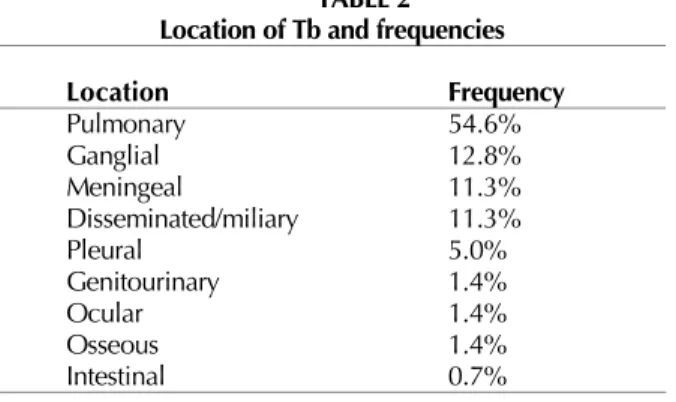
A total of 77 patients (54.6%) presented pulmonary Tb, with positive sputum in 67.5% of
them. The other forms of Tb and their frequencies are shown in Table 2.
Side effects to the Tb treatment during hospitalization were presented by 22% of the patients,
the most frequent of them being drug-induced hepatitis (65.7%), and gastric intolerance (25.7%
of cases). No statistically significant relationship was observed between body weight (< 45kg)
and the occurrence of side effects to the therapy.
Admission to the ICU was necessary in 8.5% of the cases, and the patients stayed there for
11 days; 54% (76/141) of them stayed in the respiratory isolation ward. Twenty-five patients
(17.7%) died, 13/25 (52%) having Tb as the main cause.
A comparison between the main reasons for hospitalization and its duration showed a longer
hospitalization period in patients admitted for cachexia, and a higher lethality among those with
acute respiratory failure and cachexia (Table 3).
TABLE 2 Location of Tb and frequencies
Location Frequency
Pulmonary 54.6%
Ganglial 12.8%
Meningeal 11.3%
Disseminated/miliary 11.3%
Pleural 0 5.0%
Genitourinary 0 1.4%
Ocular 0 1.4%
Osseous 0 1.4%
Intestinal 0 0.7%
TABLE 3
Relationship between main reasons for hospital admission and hospitalization time (days) and death
Reasons Mean hospitalization time Death
Acute respiratory failure 19.3 days 27.3%0
Hemoptysis 12.1 days –
Cachexia 32.2 days 25.8%0
Diagnosis 26.9 days 15.2%0
Multiresistant Tb 29.3 days -
Previous AIDS 26.7 days 11.50%
found in patients with a positive sputum test (p < 0.05), as compared to those with negative sputum (Table 4 and Figure 1).
TABLE 4
Mean number of hospitalization days by risk variables
Hospitalization
Common Ward p Isolation p ICU p
(days) (days) (days)
Smoker Yes 31.6 0.024 23.0 0.055 4.0 0.810
No 29.6 17.6 9.0
Ex- 27.0 15.5 13.2
Alcoholic Yes 26.8 0.032 16.9 0.237 9.5 0.075
No 30.4 18.9 10.9
Drug addict Yes 34.7 < 0.001 20.8 < 0.001 10.0 0.075
No 28.2 17.5 10.8
HIV status Positive 33.2 0.563 21.3 0.933 8.6 0.486
Negative 29.0 16.8 10.5
NT* 23.6 15.0 12.8
Sputum test Positive 26.1 0.257 18.6 0.074 22.0 0.015
Negative 32.0 18.3 11.0
NT* 30.7 16.5 8.0
Side effect Yes 33.9 < 0.001 18.1 0.034 14.7 0.075
No 28.1 18.2 9.3
* NT: not tested.
0 5 10 15 20 25 30 35
HIV+ HIV-BAAR
+
BAA
R-DROGA S+
DROGA
S-TABAGISM O+
TABAGISM O
EF.COLAT .+
EF.COLA T
N.S.
N.S.
p<0,05 p<0,05
p<0,05 Dias de internação
FIGURE 1– HOSPITALIZATION TIME FOR TUBERCULOSIS (DAYS) BY RISK VARIABLES
D
ISCUSSIONTuberculosis is estimated to cause 7% of all deaths, and 26% of all preventable deaths in the
world, most of them occurring in young persons.
Brazil comes in the first place regarding the number of Tb cases in Latin America. The
recurrence of Tb in certain places is coincident with a deterioration of the access to health care
services in high-risk populations
(3,4).
Nine out of the ten countries with the highest
per capita
incidence of Tb are in Africa, where
the rate of co-infection by HIV is also high. On a worldwide scale, it is reported that 8% of Tb
cases are HIV-positive
(5). In the United States, the proportion of tuberculosis in HIV-positive
patients is about 30 to 40%.
Brazil is considered as a medium-risk country for both HIV and Mycobacterium tuberculosis infections (6). Among all notified AIDS cases in persons aged 13 years or older, tuberculosis represented 26.9% of the opportunistic infections, having been the second most frequent notified opportunistic infection in 1996, after oral candidiasis. Since 1997, Brazil has experienced a decrease in the number of notified Tb cases in HIV-infected patients. In the State of São Paulo, according to data of the Tuberculosis Section of the Center for Epidemiological Vigilance (Divisão de Tuberculose do Centro de Vigilância Epidemiológica), this association that formerly represented 20.4% of the notified tuberculosis cases dropped to 17.5% of all cases. At the STD/AIDS Reference and Treatment Center (Centro de Referência e Treinamento em DST/AIDS), headquarters of the São Paulo State Program, a 54% decrease of notified Tb cases in HIV-positive patients was observed: from 332 cases in 1996 down to 151 cases in 1997. This fact, along with the decrease in the number of other AIDS-related opportunistic infections and with the decrease of mortality due to AIDS, reinforces the importance of high-strength anti-retroviral therapy within the AIDS drug arsenal, introduced in Brazil in late 1996.
The fact that 42% of the patients admitted for tuberculosis showed to be HIV-positive was due to the fact that our hospital is also a reference for AIDS cases, which, as they present severer infectious complications, have a greater need for hospitalization, in addition to cases which were admitted for tuberculosis, and had the presence of an HIV co-infection identified afterwards.
Overall, the percentage of identified HIV-positive cases among patients admitted for tuberculosis varies from one hospital to another, tending to be higher than the one found in tuberculosis outpatients, and increasing with the complexity of the hospital, taking also into account whether the hospital is a reference for AIDS, as in our case.
According to data of the São Paulo State Center for Epidemiological Vigilance, 60% of the tuberculosis cases are diagnosed in general hospitals (7). In the present work, 22.7% of the patients had a previous Tb history, and most of
them had no Tb diagnosis upon admission, which is similar to the data of CVE-ESP and of other studies. Melo et al. reported that, in Londrina/PR, 67.4% of the tuberculosis diagnoses are made in hospitals (8).
In 1998, only 40% of deaths by tuberculosis in the municipality of São Paulo had had a previous notification, which suggests that many cases are diagnosed very late, and the patients die without even starting treatment (7)
. The duration of symptoms before hospital admission was 2.9 months on the average, a period similar to the one observed in the basic health care network until a diagnosis is made (approximately three months) (9)
. This is probably due to the worse general conditions presented by patients with a severer illness, justifying hospitalization. Thus, malnourished, alcoholics, HIV-positive patients, individuals under stress and in poor socioeconomic situation (regarding home, food, etc.) are more susceptible to presenting severer forms of Tb, including bronchogenic or lympho-hematogenic dissemination, leading them to go to a general hospital as a first step, and to be admitted there. Therefore, a good tuberculosis control program should improve the access of patients at high risk for Tb to the health care services, in order to prevent the spreading of the disease among them and the persons they are in contact with, and active search for new Tb cases should be present in any health care program, for early diagnosis of the disease (7)
.
As for the place of hospitalization, the respiratory isolation wards (76/141 patients or 53.9%) proved adequate, i.e., all sputum-positive patients (56 patients) could be isolated. Another finding showed that the mean hospitalization time in an isolation ward (18.2 days) was sufficient to ensure that the patient no longer presented any risk of transmission (about 15 days after the beginning of treatment) (10,11). To most of the patients in this study,
no sensitivity test for Mycobacterium tuberculosis was available, due to operational problems of the laboratory during that period.
The hospitalization time found was approximately 50% longer than reported in the literature, but no statistically significant increase of the hospitalization time was shown for HIV-positive or sputum-positive patients, as reported in American and Italian studies (12,13)
in an ICU in sputum-positive patients. Another observation concerns the fact that in patients admitted for cachexia the hospitalization time was also longer, similarly to the data presented by Nogueira (14)
.
The published studies regarding hospital costs usually come from industrialized countries, and the amounts paid by the Brazilian Public Health Care System (SUS) for Tb hospitalizations cannot be compared to the studies published in other countries. Nevertheless, the surveys of this study can be used for a year-to-year comparison, so as to evaluate the reflex of the improvement of the basic health care services on the diagnosis and treatment of tuberculosis.
It was not the purpose of this study to measure the indirect costs connected with the disease, such as the loss of social productivity and the individual financial loss that this disease can cause.
A point that called our attention was the great number of unemployed patients (41.8%), compatible with the current Brazilian reality, demonstrating the already known association between the disease and the economic structure: the country’s large socioeconomic differences make the population more susceptible to diseases like Tb. Another impressive result was the high hospital death rate found (17.7%) – higher than the one reported in the literature (14)
and probably related to the patients’ severer condition upon hospital admission, and to associated diseases.
In Brazil, Tb control aims at equipping and training the personnel of basic health care units to enable them to make an early diagnosis of the disease and to treat most of the cases, preventing its spreading among the persons in contact with the patients, and reducing patient morbidity and mortality.
The use of supervised treatment may be an option for patients at higher risk of dropping out, for it reduces the hospitalization rates or makes it possible to shorten its duration and, consequently, its cost, with a lower probability of relapse or even of acquired resistance (in the case of patients with multi-resistant Tb).
We believe that studies like this one should be carried out at several locations, in order to get to know the epidemiological reality and to follow it up over time, improving and speeding up the diagnosis of tuberculosis, thus reducing its morbidity and mortality, both in the hospitals and in the basic health care network.
R
EFERENCES1. I Consenso Brasileiro de Tb, 1997. J Pneumol 1997;23:279-342.
2. Brasil. Ministério da Saúde. Manual de normas para o controle da Tb. Brasília; 1995.
3. Ruffino Neto AE, Hijjar MA. Destaques da avaliação do programa nacional de controle da Tb – 1996. Bol Pneumol Sanit 1997;5:59-62.
4. Ruffino Neto A, et al. Reforma do setor saúde e controle da tuberculose no Brasil. Informe Epidemiol SUS 1999;8:35-51. 5. Dye C, Dolin P, Pathania V, Raviglione MC. Consensus statement. Global burden of tuberculosis: estimated incidence,
prevalence, and mortality by country. JAMA 1999;282:677-86.
6. Brasil. Ministério da Saúde. Fundação Nacional de Saúde. Controle da tuberculose: uma proposta de integração ensino-serviço. 5a ed. Rio de Janeiro: FUNASA/CRPHF/SBPT; 2002.
7. Centro de Vigilância Epidemiológica. Disponível em: http://www.cve. saúde.sp.gov.br.
8. Melo VO, et al. Avaliação do programa de controle de tuberculose em Londrina/PR no ano de 1996. Informe Epidemiol SUS 1999;8:53-62.
9. Asch S, Leake B, Anderson R, Gelberg L. Why do symptomatic patients delay obtaining care for tuberculosis? Am J Respir Crit Care Med 1998;157(4 Pt 1):1244-8.
10. Universidade Federal de São Paulo. Manual de padronização: diagnóstico, tratamento e prevenção de tuberculose pulmonar bacilífera. São Paulo: Unifesp; 1998.
11. Kritski AL, Conde MB, Souza GRM. Tuberculose – do ambulatório à enfermaria. São Paulo: Atheneu; 1999.
12. Migliori GB, Ambrosetti M, Besozzi G, Farris B, Nutini S, Saini L, et al. Cost-comparison of different management policies for tuberculosis patients in Italy. Bull World Health Organ 1999;77:467-76.
13. Weis SE, Foresman B, Matty KJ, Brown A, Blais FX, Burgess G, et al. Treatment costs of directly observed therapy and traditional therapy for Mycobacterium tuberculosis: a comparative analysis. Int J Tuberc Lung Dis 1999;3:976-84.