Consistent Histories and Contrary Inferences
G. Nistic`o
Istituto Nazionale Fisica Nucleare, Italy
Dipartimento di Matematica, Universit`a della Calabria, via P. Bucci 30b, 87036, Rende (Italy)
Received on 26 January, 2005
To perform a more transparent analysis of the problems raised by contrary inferences within Consistent History approach to Quantum Theory, we extend the formalism of the conceptual basis. According to our analysis, the conceptual difficulties arising from contrary inferences are ruled out.
1
Introduction
Consistent History Approach to quantum theory, introduced in explicit form by Griffiths [1], provides an extension of the interpretation of the formalism of quantum mechanics. While standard quantum theory is based on the concept of event, represented by a projection operatorEof the Hilbert spaceH
describing the system, CHA is based on the concept of his-tory, which is a finite ordered sequenceh= (E1, E2, ..., En) of events. Suitable families of histories can be selected by means of a criterion ofconsistency. According to CHA, only the histories of a consistent family have physical meaning. The occurrences of histories are the empirical facts the the-ory is concerned with.
One of the aims of CHA is to solve some conceptual diffi-culties of standard quantum mechanics. Griffiths and Omn`es [2] argue that the famous quantum measurement problem [3] is solved by the extended interpretation provided by CHA.
However, the new theory raised some criticisms. One of the most debated problems is linked to the so calledcontrary inferences, illustrated in section 3 below. The debate pro-voked by this problem did not reach a shared conclusion. We think that a better clarity can be obtained if some natural con-cepts of CHA are better formalized, so that to allow a more transparent analysis of the debated questions.
We do this by extending the formalism of the concep-tual basis of CHA with the introduction of the notion of sup-port. Starting from it, new tools can be developed allowing a deeper analysis of some questions. Also the problem of con-trary inferences can be submitted to such an analysis. Our result is that contrary inferences do not entail conceptual dif-ficulties.
The plan of the paper is the following. In section 2 the ba-sic concepts of CHA are outlined. The problem of contrary inferences is described is section 3. The notion of support of a family of histories is introduced in section 4, where the for-malism stemming from this notion is developed. In section 4.2 some general implications of the extended formalism are derived. A deeper undestanding of CHA notion of compati-ble familiesis obtained in section 4.3.
Finally, the problem of contrary inferences is analyzed in section 5 on the basis of the extended formalism, showing
that the related difficulties are ruled out.
2
Basic concepts of CHA
LetHbe the Hilbert space which describes the physical sys-tem according to standard quantum theory. Throughout this paper we assume thatHhas a finite dimensionN; moreover, the Heisenberg picture is adopted. Fixed a finite sequence of timest1,t2, ...,tn, let us consider for each timetka decom-position of the identityEk ={E
(1)
k , E
(2)
k , ..., E
(ik)
k }which is a finite set of projection operators of Hilbert spaceH, with Ek(i)⊥E
(j)
k ifi6=jand Pik
i=1E (i)
k =1. AfamilyCof his-tories, generated byE1,E2, ...,En, is the set of all sequences
h= (E1, E2, ..., En)such thatEk=Psome
iE
(i)
k . Projec-tion operatorEkin a historyhrepresents an event susceptible of occurring at timetk. When every eventEkconstituting a historyhis just an event ofEk, i.e. ifEk ∈ Ek for allk=
1,2, ..., n, thenhis calledelementaryhistory. Hence the set
Eof all elementary histories ofCis the cartesian productE=
E1×E2× · · · ×En. For every historyh= (E1, E2, ..., En), byhwe denote the following subset of elementary histories:
h={ˆh= ( ˆE1,Eˆ2, ...,Eˆn)∈ E |Eˆk ≤Ek}. Two histories
h1 = (E1, E2, ..., En), h2 = (F1, F2, ..., Fn)∈ Care
sum-mableif they differ in only one place, sayk, henceEj =Fj for all j 6= k, and Ek ⊥ Fk; in such a case theirsum is
h1+h2 = (E1, E2, ..., Ek +Fk, ..., En) ∈ C. The histo-riesh1andh2are said to bealternativeif there isksuch that Ek ⊥Fk.
Leth = (E1, E2, ..., En)be acommutativehistory, i.e. such that all Ek commute with each other. According to quantum theory, the statement “h occurs” means that all eventsE1, E2, ..., En occur. Therefore,his identified with the single event E1 ·E2· · ·En = E1 ∧ E2 ∧ · · · ∧En. Though the mathematical notions of CHA are given within the usual quantum theoretical formalism, standard quantum theory is unable to consider and describe the occurrence of a history when it isnotcommutative. However, in the case that C isweakly decohering, i.e. ifRe(T r(Ch1C
∗
h2)) = 0 for allh1, h2 ∈ E,h1 6=h2, the functionalpC : C →[0,1],
ex-tends the probability predicted by standard quantum theory for commutative histories [4]. The basic principle of CHA establishes that when familyCsatisfies the mathematical cri-terion of being weakly decohering then it isconsistent, i.e.
(I) the set of all elementary histories of C is a “sample space of mutually exclusive elementary events, one and only one of which occurs” [8].
The occurrence of historyhmeans that an elementary history
ˆ
h ∈ hoccurs. Here the physical meaning of the notion of occurrence of a history, involved in (I), is the following
(O) A given history h = (E1, E2, ..., En) occurs if all events E1, E2, ..., En objectively occur at respective timest1,t2, ...,tn. The occurrence of a history is an ob-jective physical fact, independent of the performance of a measurement which reveals this occurrence.
Accordingly, if C is consistent, any occurrence (or non-occurrence) of an elementary history inC must be referred to an individual, concrete sample of the physical system.
Remark 1. The probability of occurrence of a history h, pC(h) = N1T r(ChC
∗
h), is clearly independent of the con-sistent family it belongs to. However, the symbolCis kept in the formula for future convenience, as explained in remark 2 below.
3
Contrary inferences
To make predictions about occurrences of histories, the ini-tial data, i.e. the known information about the physical sys-tem, are expressed as sentences involving histories of a con-sistent familyC, and assumed astrue, i.e. objectively real-ized sentences. Conclusions can be derived by means of log-ical reasonings in which histories ofCare regarded asevents of a classical sample spaceand by interpreting the number pC(h) = N1T r(ChCh∗) as the probability of occurrence of historyh. These conclusions are the theoretical predictions to be regarded as objectively realized sentences.
However, the histories needed to express the same ini-tial data belong, in general, also to another consistent family
C′. Therefore, another set of conclusions can be obtained by
using C′ instead of C. A conclusion of this new set could
contradict some conclusion derived fromC. To avoid these conflicts, CHA introduces the following rule.
Single Family Rule. All valid physical inferences are those obtained by using asingleconsistent familyC. In general, different conclusions drawn by using distinct consistent fam-ilies do not hold together.
The possibility of contrary inferences is the main criti-cism opposed to CHA. They are a particularly effective ex-ample of the conflicts described above. Let us briefly de-scribe them. Suppose thatC1andC2are twodifferentweakly decohering families such that h1 = (E0, E1, E2) ∈ C1 andh2 = (E0, F1, E2) ∈ C2, with E1 ⊥ F1, and h0 =
(E0,1, E2)∈ C1∩ C2. A. Kent [5] was able to find examples in which the conditional probabilitiespC1(h1|h0) =
pC1(h1)
pC1(h0)
andpC2(h2|h0) =
pC2(h2)
pC2(h0)are both 1. Therefore, according to CHA we may state that ifh0occurs,thenalsoE1occurs within the familyC1, butthenalsoF1occurs within the fam-ilyC2; on the other hand,E1⊥F1means that the occurrence ofE1excludes the occurrence ofF1: then we have two infer-ences which are contrary to each other. Contrary inferinfer-ences do not entail logical incoherence for CHA because they take place indifferentconsistent families, and thus the contradic-tion arises only by violating the single family rule.
The presence of contrary inferences in CHA is at the root of a rather lively debate. According to Kent, their occurrence makes it “hard to take it [CHA] seriously as a fundamen-tal theory in its present form” [5]. And about single family rule, which formally prevents contrary inferences from yield-ing theoretical contradiction [6], “anyformalism [...] can be made free from contradiction by such a restriction” [7]. The replies of Griffiths are essentially based on the following ar-guments.
1. The derivation of the contradiction violates the sin-gle family rule. In particular, the problem arises be-cause Kent assigns to ‘contrary’ historiesh1andh2the classical-logic meaning of wordcontrary, i.e. that the occurrence ofh1always implies the non-occurrence of h2. But this cannot be done becauseh1andh2cannot be compared without violating single family rule 3.
2. “The conceptual difficulty goes away if one supposes that the two incompatible frameworks are being used to describe two distinct physical systems that are de-scribed by the same initial data” [9].
The critics of CHA were not satisfied by these arguments. To synthetically explain the reason for such a disagreement, let us consider the example of contrary inferences above out-lined and two physicists, Alice and Bob. Suppose that the known data about a single physical systemsare thatE0and E2 occur, i.e. h0 occurs. In order to establish whether E1 occurs or not, Alice uses familyC1and, in accordance with CHA, she finds thatE1occurs. Bob, for the same individ-ual systems, choosesC2, and he concludes thatF1 occurs. The fact thatE1occurs orF1occurs seems to depend on the physicist. But, according to CHA itself, the occurrence of a history, once established by means of the theory, is to be con-sidered anobjectivefact. As a consequence, bothE1andF1 should occur. But everybody rejects this conclusion because E1⊥F1.
4
Extended formalism
the results of this analysis, the conceptual difficulties linked to contrary inferences are ruled out.
4.1
The notion of support
Given a family C and a concrete specimen sof the physi-cal system, there are two mutually exclusive possibilities: for this particularseither
i) one elementary historyhofCoccurs and all other ele-mentary histories do not occur,
or
ii) no one of the elementary histories ofCoccurs.
In case (i) we say that the histories ofCmake sensefor thiss; in case (ii) we say that the histories ofCdo not make sense.
For instance, if the physical system is a silver atom en-tering a Stern and Gerlach apparatus, we may consider two families of histories.
FamilyC(a), which is the family generated by the following elementary histories
h(1a)= “the atom emerges from the apparatus with spin up”
h(2a)= “the atom emerges from the apparatus with spin down”.
FamilyC(b), which is the family generated by the following elementary histories
h(1b)= “the atom is democratic”
h(2b)= “the atom is republican”.
For this particulars familyC(a)makes sense. On the con-trary, familyC(b)does not.
BysupportofCwe mean the setb(C)of all concrete spec-imens of the physical system for whichCmakes sense. The introduction of setb(C)allows us to formally express the con-sistency of a family by means of a simple definition which reflects the meaning of consistency expressed by (I) and (O).
Definition 1.A familyCis consistent if and only ifb(C)6=∅. As an evident insight,the (sufficient) condition which makes the conclusions of logical reasonings based on a family C
valid for a specimensof the physical system is
s∈b(C). (1)
Remark 2. As a consequence, also the numberpC(h) =
1
NT r(ChC
∗
h)can be interpreted as probability of occurrence ofhonly ifs∈b(C). For this reason it makes sense to keep symbolCin this formula.
Now we deduce a natural implication for the supports of two familiesC1andC2 such thatC1 ⊆ C2. We consider the case in whichb(C2) 6=∅. For everys ∈b(C2), there is only one elementary history h2(s)of C2 which occurs, and all other elementary histories ofC2do not occur. FromC1⊆ C2it fol-lows that all elementary histories ofC1form a set, denoted by
E1, of albeit non-elementary histories ofC2. Only one history h1∈ E1occurs, because there is a uniqueh1∈ E1such that h2(s)∈h1. Analogously we find that all otherh∈ E1do not occur. Therefore, it is possible to state that only one elemen-tary history ofC1occurs and all otherh∈ E1 do not occur for this individual systems; thus, by definition 1,s∈b(C1). We state the result of this argument as the following axiom.
Axiom 1.LetC1,C2be two families of histories. Then
C1⊆ C2 implies b(C2)⊆b(C1).
Now we proceed to state another axiom. Ifh∈ C, byb1(h;C) (resp.,b0(h;C)) we denote the subset ofb(C)whose elements are the specimens for whichhoccurs (resp., does not occur). It is obvious to assume that
b0(h;C) =b(C)\b1(h;C)andb(C) =∪h∈E b1(h;C). (2)
According to (O), the occurrence ofh= (E1, E2, ..., En)is equivalent to the occurrences of all events E1, E2, ...En at the respective timest1,t2, ...,tn, and then it is independent of the family whichhbelongs to. Therefore, we can state the following axiom.
Axiom 2. If h ∈ C ∩ C′, then b
1(h;C)∩ b0(h;C′) = b1(h;C′)∩b0(h;C) =∅.
Axiom 2 establishes that a historyhcannot occur as history ofCand do not occur as history ofC′, for the same specimen
s.
4.2
General implications
LetX be any set of histories. The family generated byX is C(X) = ∩{C|X⊆C}C. By axiom 1 we have that h ∈ C
impliesb(C)⊆b(C({h})) =∪h∈C (C). Therefore,b(h)≡
b(C({h}))is the set of all specimens of the physical system for which single historyhoccurs or does not occur (hmakes sense). Byb1(h)(resp.,b0(h))we denote the subset of those systems for whichhoccurs (resp., does not occur). Of course
b0(h) =b(h)\b1(h), b1(h) =b(h)\b0(h). (3)
According to the present approach, the fact that a given his-toryh0occurs (or does not occur) for a physical systems0 means that a familyC0exists such that
h0∈ C0 and s0∈b(C0). (4)
FamilyC0 =C({h0})fullfils these requirements. All histo-ries ofC0make sense fors0. However, the eventuality that for a given systemshistoryh ∈ Coccurs but s /∈ b(C)is logically possible. Therefore, the fact that a familyCis con-sistent, andh∈ Cdoes not imply that the inferences obtained by means of reasonings based onChold for an arbitrary phys-ical systemsfor whichhoccurs.
s∈b(C({h0})), are true statements. Thus, all sentences ob-tained by logical deductions based onC({h0})hold fors.
Family C({h0}) admits several refinements, i.e. vari-ous families C may exist such that C({h0}) ⊆ C. Deduc-tions based on a refinement C in general do not hold for s ∈ c(C({h0})); indeed, as already argued, C({h0}) ⊆ C implies, by Axiom 1, b(C) ⊆ b(C({h0})), and therefore s ∈ b(C)does not necessarily follow. SinceC({h0}) ⊆ C, all inferences obtained by reasoning with C({h0}) can be obtained withC; this implies that the two set of sentences cannot contradict with each other; but inferences involving histories in C \ C({h0}) in general do not make sense if s∈b(C({h0}))\b(C).
Here is a profound difference between the “coarsest” fam-ilyC(X)compatible with the available initial data relative to a physical systemsand any refinementC ofC(X): con-clusions drawn by usingC(X)are true, i.e. objective facts, whereas the truth of conclusions obtained from a refinement is not ensured by the truth of the data (X) alone. As a conse-quence, in the present approach Griffiths’ prescription: “Use the smallest, or coarsest framework which contains both the initial data and theadditional properties of interest in order to analyse the problem.” [9] is not always valid.
4.3
Compatibility of families
Now we come to analyze the notion ofcompatibility of fam-ilies.
Definition 2. Two consistent familiesC1andC2are compat-ible if a third consistent familyCexists such thatC1∪C2⊆ C. According to standard CHA, the conclusions drawn in dif-ferent families hold together in the case that these families are compatible. By axiom 1, compatibility impliesb(C) ⊆
b(C1)∩b(C2); therefore, the conclusions drawn fromC1and
C2 certainly hold together for the systemss ∈ b(C). How-ever, ifs ∈b(C1)∩b(C2), then the predictions drawn inC1 andC2hold together for this systems, no matter whetherC1 andC2are compatible or not. It is true that single family rule of CHA guarantees from conflicting inferences, but it makes the theory unable to describe this possibility.
Moreover, ifs∈b(C1)ands /∈b(C2), then a conclusion drawn fromC2does not necessarily hold for thiss.
5
Analysis of contrary inferences
Contrary inferences were discovered by Kent within the framework of standard CHA. To can discuss them on the ba-sis of our extended formalism, we make coincide the concept of consistency of definition 1 with that of standard CHA. This identification is formally realized by means of the following axiom.
AxiomCHA.A familyC is consistent, in the sense of defi-nition 1, if and only if it is weakly decohering. In this case pC(h) = N1T r(ChC
∗
h) is the probability of occurrence of
historyh.
We begin our analysis of contrary inferences by formally
showing, within our approach, that two mutually orthogonal projections represent events which cannot occur simultane-ously.
LetEandFbe two mutually orthogonal projections. The family generated byEandF, i.e.C({E, F}), has 3 elemen-tary (one-event) histories:E={E, F, G=1−(E+F)}; it is the smallest family containingEandF. Then, following the argument of section 4.2, whenever bothEandFmake sense, all histories inC({E, F})must make sense too. Therefore, the following proposition holds.
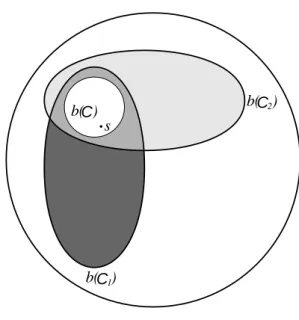
Proposition 1. If E ⊥ F, thens ∈ b(E)∩b(F)implies s∈b(C({E, F}))and, therefore,b1(E)∩b1(F) =∅.
If familiesC1andC2in Kent’s example of contrary infer-ences were compatible families, then we would have a con-tradiction.
b( )
b( )
b( )
s
C
C
C
2
1
Figure 1. Compatible families.
Indeed, in this case a consistent familyC would exist such thatC1∪ C2⊆ C. By axiom 1 we get
b(C)⊆b(C1)∩b(C2). (5)
b( )
b( )
b (h )
b (h )
C
C
2
1
0 0
1 0
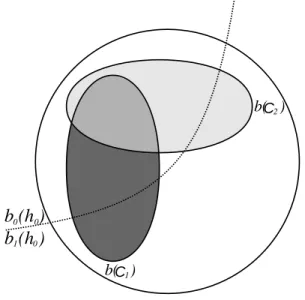
Figure 2. Non compatible families.
However,C1 andC2 in contrary inferences example are not compatible families, therefore previous argument does not apply. We can show that the occurrence of historyh0 =
(E0,1, E2)does not give rise to conceptual difficulties. The foregoing argument shows that the condition to be satisfied to avoid the contradiction is
b1(h0)∩b(C1)∩b(C2) =∅. (6)
IfC1andC2are not compatible, (6) is logically consistent with the occurrence ofh0. Indeed, from
h0∈ C1∩ C2, (7)
by axiom 1 we are simply led to
b(C1)∪b(C2)⊆b(h0).
This relation is consistent with (6), contrary to what happen ifC1 andC2were compatible. Indeed, whenh0 occurs, i.e. if s ∈ b1(h0) ⊆ b(h0), we have 3 mutually exclusive and exhaustive possibilities:
p) s ∈ b(C1). In this casepC1(h1 | h0) = 1must hold (see remark 2) and this entails that E1 occurs. The consistency with (6) merely requires thats /∈b(C2)so thatpC2(h2|h0) = 1(‘h0occurs impliesF1occurs’), does not hold for thiss. Regards to the occurrence of F1there are two possibilities:
p1)s ∈ b(F1)\b(C2). This possibility is consistent be-causeF1 ∈ C2 impliesb(C2) ⊆ b(F1). In this case axiom 2 and proposition 1 imply thatF1does not oc-cur, i.e.s∈b0(F1);
p2)s /∈ b(F1), thereforeF1does not make sense, i.e. it neither occurs nor does not occur.
q) s ∈ b(C2). In this case pC2(h2 | h0) = 1holds, and thenF1occurs. We have forE1the same conclusions of item (p) above forF1.
r) s /∈b(C1)∪b(C2). In this case no conclusion aboutE1 orF1can be obtained with the available data.
Which of these alternatives (p), (q) and (r) is actually realized with our initial data (s∈b1(h0)) is a question which cannot be predicted without further data. However, no contradiction is implied.
References
[1] R.B. Griffiths, J. Stat. Phys.36, 219 (1984).
[2] R.B. Griffiths and R. Omn`es, Physics Today (August 1999) 26.
[3] Quantum theory of measurement, J.A. Wheeler and W.H. Zurek (eds.) (Princeton University Press, Princeton, 1983).
[4] G. Nistic`o, Found. Phys.29, 221 (1999).
[5] A. Kent, Phys. Rev. Letters78, 2874 (1997).
[6] R.B. Griffiths and J.B. Hartle, Phys. Rev. Lett. 81, 1981 (1998).
[7] A. Kent, Phys. Rev. Lett.81, 1982 (1998).
[8] R.B. Griffiths, Phys. Rev. A57, 1604 (1998).