INTRODUCTION
Glaucoma is an optic neuropathy characterized by progressive
structural and functional damage. Intraocular pressure (IOP) is the
most important known risk factor for disease development and
progression and until now the only modiiable one
(1,2). That said,
ef-fective IOP reduction is the primary goal when it comes to glaucoma
treatment
(3).
When it comes to treatment options for IOP reduction, we have
three main categories: topical medication, laser surgery, and
inci-sional surgery. Topical hypotensive medications are often used as a
irst-line treatment option, while incisional surgery is generally used
when topical and laser treatments were not efective in achieving the
target IOP. Although usually safe and efective, side efects from eye
drops may occur, which can be local (e.g., conjunctival injection of
prostaglandin analogues)
(4)or systemic (e.g., cardiorespiratory efects
of beta-blockers)
(5). Furthermore, persistence and adherence studies
on glaucoma show multiple barriers to an adequate treatment
regimen with topical medication
(6). Forgetfulness, medication cost,
diiculty to instill eye drops, and patient’s misbelief that glaucoma is
a blinding disease are frequently reported
(6). As a result, self-reported
treatment adherence rates are poor (ranging from 30 to 80%)
(7,8), and
many patients interrupt their newly prescribed medications in the
irst year of treatment
(9,10). Therefore, an initial therapeutic alternative
that minimizes ocular side efects and compliance issues could be
very useful in clinical practice.
In this context, laser trabeculoplasty rises as an interesting
the-rapeutic option for open-angle glaucoma (OAG) cases, not relying
on patient compliance. Argon laser trabeculoplasty (ALT) was irst
described in 1979 (Table 1)
(11). The laser uses a blue-green (488 and
514 nm) continuous wave argon laser with a 50 μm spot diameter and
makes a disruption of the trabecular meshwork
(12,13). In 1995, selective
laser trabeculoplasty (SLT) was described. This melanin-target tissue
sparing procedure uses a green (532 nm), Q-switched,
frequency-dou bled Nd:YAG laser
(13). It is important to emphasize that ordinary
YAG laser devices, commonly used for iridotomy or capsulotomy,
cannot be used to perform SLT.
Laser trabeculoplasty was initially described as an adjunctive
treatment in eyes under topical hypotensive medications, often
performed as a last alternative prior to incisional surgery in cases of
uncontrolled disease
(14). With the advent of SLT, there was a shift in
the focus of most clinical studies related to laser trabeculoplasty
(12,15).
Looking carefully at the most recent publications, one can note that
SLT has been evaluated as a irst-line treatment option for
IOP-lo-wering in OAG patients without topical medication and less severe
damage, with quite encouraging results
(16,17).
Selective laser trabeculoplasty as an initial treatment option for open-angle glaucoma
Trabeculoplastia seletiva como opção terapêutica inicial para o tratamento do glaucoma de ângulo aberto
A
nAL
úciAF
reitAs1, M
icheLeU
shidA2, i
zAbeLAA
LMeidA2, d
iegot. d
iAs2, s
yriLd
orAirAj3, F
ábion
ishiMUrAK
AnAdAni1, t
iAgos
AntosP
rAtA2,4,5Submitted for publication: June 14, 2016 Accepted for publication: November 17, 2016
1 Department of Ophthalmology, Hospital Universitário de Ciências Médicas, Belo Horizonte, MG, Brazil. 2 Glaucoma Unit, Hospital Medicina dos Olhos, Osasco, SP, Brazil.
3 Glaucoma Unit, Department of Ophthalmology, Mayo Clinic, Jacksonville, FL, USA. 4 Glaucoma Service, Department of Ophthalmology and Visual Science, Escola Paulista de Medicina
(EPM), Universidade Federal de São Paulo (UNIFESP), São Paulo, SP, Brazil.
5 Glaucoma Service, Department of Ophthalmology, Hospital Oftalmológico de Sorocaba, Sorocaba, SP, Brazil.
Funding: No specific financial support was available for this study.
Disclosure of potential conflicts of interest: None of the authors have any potential conflict of interest to disclose.
Corresponding address: Tiago S. Prata. Rua Dr. Jose Rodrigues Alves Sobrinho, 125 - São Paulo, SP - 05466-040 - Brazil - E-mail: [email protected]
ABSTRACT
Although eye drops are frequently used as an initial treatment option for open angle glaucoma (OAG), side effects, and poor adherence, among others, may compromise treatment efficacy. In this scenario, laser trabeculoplasty is an in-teresting therapeutic option for open angle glaucoma cases. Commonly used for many years as a last alternative prior to glaucoma incisional surgery, laser trabeculoplasty has been changing its indication after the advent of selective laser trabeculoplasty (SLT ). In the current review, we critically evaluated the published data regarding the use of laser trabeculoplasty as a first treatment option for open angle glaucoma patients. Studies using SLT as a first-line treat-ment have encouraging findings. One-year efficacy results are comparable to those obtained with prostaglandin analogues, with a good safety profile. Although the laser´s effect is known to be transitory, recent data suggest it can be successfully repeated in cases with good response to the first SLT treatment.
Keywords: Glaucoma, openangle/surgery; Trabeculectomy/methods; Lasers; In -traocular pressure
RESUMO
Embora a terapia tópica seja frequentemente usada como primeira opção para o tratamento inicial do glaucoma de ângulo aberto (GAA), efeitos colaterais, baixa adesão, entre outros fatores podem comprometer a eficácia do tratamento. Nesse cenário, a trabeculoplastia a laser surge como uma opção terapêutica interessante. Comumente usada como última alternativa antes da cirurgia antiglaucomatosa incisional por muitos anos, a trabeculoplastia a laser tem sido indicada cada vez mais cedo com o advento da trabeculoplastia seletiva a laser (SLT ). Nessa revisão, nós avaliamos criticamente as publicações sobre trabeculoplastia a laser como primeira opção para glaucoma de ângulo aberto. Os estudos de SLT como primeira opção terapêutica têm apresentado dados animadores. Os resultados de um ano de acompanhamento mostram eficácia semelhante àquela obtida com análogos de prostaglandinas. Embora o efeito do laser seja transitório, estudos recentes sugerem que o procedimento pode ser repetido com sucesso nos casos que tiveram boa res posta ao primeiro tratamento com SLT.
In the current review, we critically evaluated the published data
regarding the use of laser trabeculoplasty as a irst treatment option
for OAG patients. We conducted a PubMed search on March 19, 2016
using the following keywords: “laser trabeculoplasty”, “open-angle
glaucoma”, and “treatment”. All types of studies were considered for
a irst analysis. Only case-reports were excluded. Meeting abstracts
were considered if presenting relevant and new data. Studies were
then selected based on clinical relevance and contribution to the
main focus of this review article. As most studies comparing ALT
with SLT results were conducted in glaucoma patients under clinical
treatment, we could not restrict our search criteria to studies using
laser as irst treatment option only. Therefore, we also included data
from studies in patients already being treated by medication.
TOPICS
L
ASERTRABECULOPLASTYASINITIALTREATMENTFOROPENANGLEGLAUCOMA
The idea of using laser trabeculoplasty as the irst treatment
option for glaucoma is not recent nor restrict to SLT. The Glaucoma
Laser Trial (GLT) was a multicenter study that evaluated the eicacy
and safety of ALT as the primary therapy for glaucoma. In that study,
patients with OAG were randomly assigned for initial treatment with
ALT in one eye
versus
topical medication in the fellow eye. The main
results showed that initial treatment with ALT was associated with
a greater IOP reduction (mean diference of 1.2 mmHg) and better
visual ield outcomes (mean diference of 0.6 dB) than topical
treat-ment with timolol maleate. Additionally, ALT was at least as efective
as timolol regarding stability of optic disc status over seven years
(14).
It is important to note that when GLT was carried out, neither
prosta-glandin analogs (PGA) nor SLT were available, thus limiting a straight
comparison with more recent studies data
(18).
There are scant data in the literature comparing ALT
vs
SLT as the
initial treatment options for OAG cases. In a relatively recent study
by Gandoli et al.
(19), the authors reported that low power 360° SLT
(repeated every year) was more efective than conventional ALT in
achieving adequate IOP control in cases of ocular hypertension. On
the other hand, most studies comparing ALT
vs
SLT for OAG (but
not as a irst treatment option) found similar success rates between
the two laser modalities
(20-22). However, when it comes to safety, the
development of peripheral anterior synechiae seems to be a more
frequent complication following ALT (incidence ranging between
12% and 43% in previous studies) than SLT (rarely reported)
(23,24).
This procedure-related complication is inluenced by technique and
laser burns position (higher risk when laser is applied too
posterior-ly). Moreover, we believe that the ease of application (outcomes of
physicians in training are comparable to those of glaucoma
specia-lists)
(25)and the possibility of repeating the procedure with relatively
good success rates (in cases with good response to the irst SLT
treat-ment)
(20,26)are two important advantages of SLT over ALT treatment.
These factors have certainly contributed to the shift towards SLT use
in the past decade and might explain the reason why ALT has not
taken its place as a irst line therapy.
S
ELECTIVELASERTRABECULOPLASTYASINITIALTREATMENTFOROPENANGLEGLAUCOMA
Eicacy (IOP reduction)
In most studies, SLT has been investigated as a second-line
treat-ment option for OAG, being performed only after inappropriate
response or intolerance to topical medication as an attempt to delay
incisional surgery
(27). As a result, there are few studies evaluating SLT
as irst treatment option. It is important to note that because the
SLT efect is transitory, most of these studies are short-term (one to
three years of follow-up). As PGAs are the irst line clinical treatment
to OAG, most studies compared SLT with PGA results in terms of IOP
reduction. Looking carefully at safety and eicacy outcomes of these
studies, we believe there is growing evidence that SLT can be used
as a primary treatment for IOP-control in OAG cases
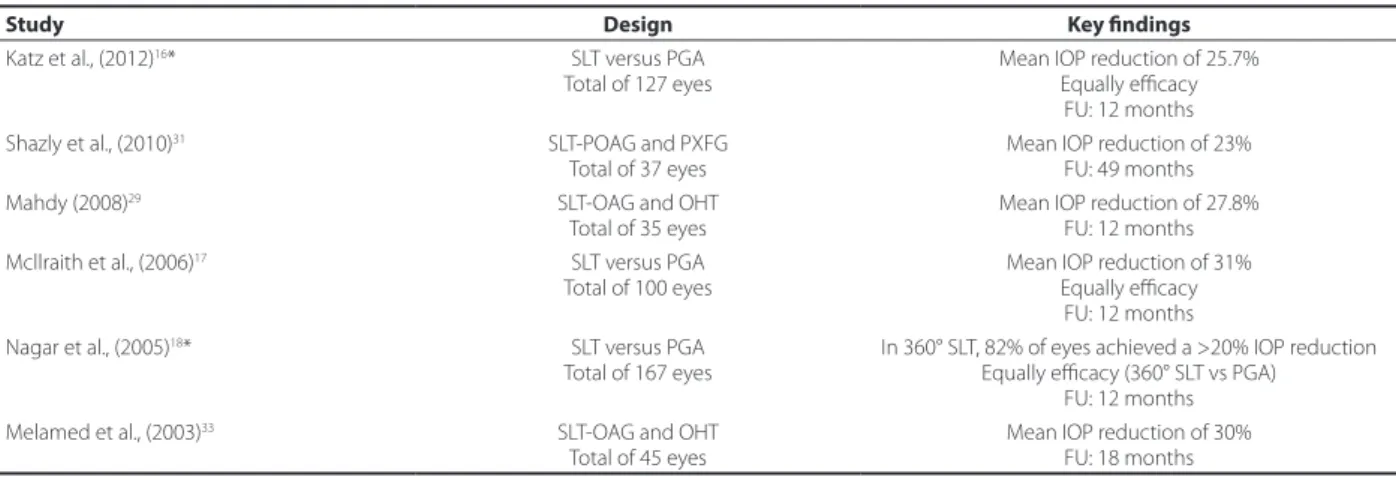
(17,28-33). Table 2
provides a summary of the main results of these studies.
Table 2. Studies of selective laser trabeculoplasty as the irst treatment option for open-angle glaucoma and ocular hypertension
Study Design Key indings
Katz et al., (2012)16* SLT versus PGA
Total of 127 eyes
Mean IOP reduction of 25.7% Equally eicacy
FU: 12 months Shazly et al., (2010)31 SLT-POAG and PXFG
Total of 37 eyes
Mean IOP reduction of 23% FU: 49 months Mahdy (2008)29 SLT-OAG and OHT
Total of 35 eyes
Mean IOP reduction of 27.8% FU: 12 months Mcllraith et al., (2006)17 SLT versus PGA
Total of 100 eyes
Mean IOP reduction of 31% Equally eicacy
FU: 12 months Nagar et al., (2005)18* SLT versus PGA
Total of 167 eyes
In 360° SLT, 82% of eyes achieved a >20% IOP reduction Equally eicacy (360° SLT vs PGA)
FU: 12 months Melamed et al., (2003)33 SLT-OAG and OHT
Total of 45 eyes
Mean IOP reduction of 30% FU: 18 months
*= randomized studies.
OAG= open-angle glaucoma; OHT= ocular hypertension; PGA= prostaglandin analogs; POAG= primary open-angle glaucoma; PXFG= pseudoexfoliative glaucoma; SLT= selective laser trabeculoplasty; FU= follow up.
Table 1. Comparison of the diferent features of argon laser trabeculoplasty (ALT) and selective laser trabeculoplasty (SLT)
ALT SLT
Described in 1979 1995
Laser type Argon laser Q-switched, frequency-doubled Nd:YAG laser Laser wavelength 488 and 514 nm (blue-green) 532 nm (green)
At this point, we believe it is important to briely discuss the main
aspects of each study. When evaluating patients with OAG or ocular
hypertension (OHT) treated with SLT, Melamed et al.
(33)observed a
≥19.6% IOP reduction in 89% of the patients, while Mahdy
(29)found
an IOP-reduction ≥25% in 77.1% of the cases. Overall, in an attempt to
summarize IOP data from the available studies, we found that average
absolute IOP-reduction following SLT as irst treatment ranges from
3 to 8 mmHg (percentage IOP reduction: 20% to 38%)
(17,18,29,31,33,34).
Other studies compared SLT
versus
PGA as a primary therapy, with
similar eicacy between the two treatment modalities
(16-18). When the
extension of the laser was considered, PGA showed better results
than 90° and 180° SLT, but not 360°
(18). The eicacy of SLT was also
evaluated in OAG eyes previously treated with glaucoma medication
(monotherapy)
(34). After a 30-day medication washout, SLT reduced
IOP signiicantly, and IOP remained stable without medical therapy
for 12 months
(34). In addition, another study also evaluated SLT results
after topical medication washout, and SLT 360° was efective [mean
IOP reduction of 2.9 mmHg (40%) at 3 months and 2.1 mmHg (29.2%)
at 6 months after the laser)
(35). Besides that, another study that
inclu-ded eyes with pseudoexfoliative glaucoma (XFG) and primary
open-an gle glaucoma (POAG) revealed that SLT was efective as a primary
treatment in both groups
(31).
Safety, duration, and repeatability
In general, SLT is considered a safe procedure
(36). Serious
compli-cations are rare, but conjunctival redness and injection
(33,37), transient
IOP-increase
(33,38,39), and mild anterior chamber reaction
(37,38,40)are
issues that the ophthalmologist and the patient should be aware of.
Special attention must be given to sustained IOP increase
(41),
particu-larly in higher risk patients, such as individuals with highly pigmented
trabecular meshwork, multiple topical medications, and previous ALT
treatment
(42). Although loss of corneal endothelial cells has been
re-ported, it does not seem to be permanent, as recovery was observed
after one month of the procedure
(43). Additionally, anterior chamber
volume and central corneal thickness decrease after SLT, retuning
back to pre-SLT values after three months of the laser procedure
(44).
It is well established that the IOP-lowering efect of SLT decreases
over time
(38). Although it is usually attributed to the transitory
efec-tiveness of the procedure
(21,38),
the progressive trabecular meshwork
dysfunction presented by glaucomatous patients along the years
should also be considered
(45). In this context, the possibility of
re-peating the laser procedure in eyes that lost IOP control over time
became an important point to be investigated. Looking close at the
more recent literature, one can note several studies showing that SLT
can be repeated with similar eicacy when compared to the irst SLT
treatment. In these studies, POAG patients presented a signiicant
IOP reduction at 1
(46), 4
(47), 6
(46), 12
(19,48), 15
(46), and 24 months after
re-peating SLT
(26,49). Corroborating these indings, Gandoli and Ungaro
demonstrated that repeated low power SLT as initial treatment
pos-tponed the initiation of medical therapy by a mean time of 6.2 years
in patients with OHT
(19).
Success predictors of selective laser trabeculoplasty
As mentioned above, SLT does not work for everyone, as
appro-ximately one quarter of the patients do not achieve a signiicant
IOP reduction
(50). Therefore, the knowledge of success predictors is
important for a proper indication and to estimate treatment
out-comes. Some success predictors are well established. For instance,
better results are usually observed in patients with POAG
(33,37,51-56),
pseudoexfoliative glaucoma
(31,40,57,58), and higher baseline IOP
(40,41,46,47).
A few isolated studies observed better results in eyes with thinner
corneas
(59), with earlier disease stage
(60), and with higher refractive
errors
(52). Conversely, the use of PGA before laser was associated with
a decreased IOP-lowering response
(61), and SLT treatment had limited
results in eyes with OAG receiving maximal-tolerable medical
thera-py
(50,62). Other factors remain controversial, such as iridocorneal angle
pigmentation
(63,64)and advanced age
(57,61). While some studies found
a positive correlation between these factors and success rates, others
did not. Regarding laser parameters itself, although good results
have been recently reported with low power SLT (0.4 mJ per shot;
repeated annually)
(19), most studies have suggested better outcomes
with higher power settings (energy per shot), more extensive laser
treatment (360 degree), and greater number of shots
(18,25,65,66).
There is also a strong correlation between SLT outcomes when
we consider both eyes from the same patient
(67). Shazly and Latina,
evaluating eyes with OAG and OHT, found that in patients with SLT
failure in the irst treated eye, success odds in the fellow eye were
less than 35%
(67). Considering those with good response in the irst
treated eye, success rates of the fellow eye varied between 80% and
100% in two diferent studies
(68). In this context, it seems reasonable
to perform SLT in one eye at a time. Not only because success odds
of the second eye are remote in cases of failure of the irst treated eye
(and therefore the second eye should not be indicated in such cases),
but also because the IOP values of the fellow untreated eye can be
used to adjust SLT outcomes of the irst treated eye (mitigating the
inluence of inter-visits IOP luctuation and reducing the inluence of
regression to the mean).
COMMENT
During the course of OAG, patients will often need one or more
medications to maintain IOP control and prevent progression of
the disease. Ocular and systemic side efects of topical medications,
forgetfulness, diiculties in handling the bottle and instill eye drops
properly, and consequently poor compliance with the proposed
medical regimen are important issues for clinicians when starting a
therapy that will last a lifetime
(6,8). Moreover, growing concern exists
with drug-related chronic ocular surface inlammation, which may
have a negative impact on success of a future iltration surgery
(69).
With this in mind, we believe it is reasonable to consider alternative
treatments, such as laser therapy, as irst-line treatment options
(17,28,29).
SLT has a good safety proile, does not rely on patient compliance,
and has shown to be at least as efective as topical medications in
lowering IOP as an initial treatment (for at least one year)
(70-72)and
can be repeated when IOP control is lost over time
(19,46-48), possibly
allowing patients to remain free of topical medication for years
(73,74).
In a chronic disease such as OAG, time is always a key parameter. We
believe that SLT can be a way to buy it. Additionally, if this strategy
does not work, topical medications can be promptly started.
Never-theless, it should be emphasized that studies are needed to evaluate
whether SLT treatment would afect the eicacy of topical
hypo-tensive medications. All these things considered, SLT seems to be a
reasonable, but still underused, form of initial treatment for patients
with OAG and OHT.
REFERENCES
1. Weinreb RN, Khaw PT. Primary open-angle glaucoma. Lancet. 2004;363(9422):1711-20. Comment in: Lancet. 2004;364(9442):1311-2.
2. Comparison of glaucomatous progression between untreated patients with normal-tension glaucoma and patients with therapeutically reduced intraocular pressures. Collaborative Normal-Tension Glaucoma Study Group. Am J Ophthalmol. 1998;126(4):487-97. Erratum in: Am J Ophthalmol. 1999;127(1):120.
3. Heijl A, Leske MC, Bengtsson B, Hyman L, Bengtsson B, Hussein M. Early Manifest Glaucoma Trial Group. Reduction of intraocular pressure and glaucoma progression: results from the Early Manifest Glaucoma Trial. Arch Ophthalmol. 2002;120(10):1268-79. Comment in: Arch Opthalmol. 2002;120(10):1371-2; JAMA. 2002;288(20):2607-8; Optom Vis Sci. 2002;79(12):741-2.
4. Alm A, Grierson I, Shields MB. Side efects associated with prostaglandin analog therapy. Surv Ophthalmol. 2008;53 Suppl1(6):S93-S105.
5. Lama PJ. Systemic adverse efects of beta-adrenergic blockers: an evidence-based assessment. Am J Ophthalmol. 2002;134(5):749-60.
7. Olthof CM, Schouten JS, van de Borne BW, Webers CA. Noncompliance with ocu-lar hypotensive treatment in patients with glaucoma or ocuocu-lar hypertension an evidence-based review. Ophthalmology. 2005;112(6):953-61.
8. Schwartz GF, Quigley HA. Adherence and persistence with glaucoma therapy. Surv Ophthalmol. 2008;53 Suppl1:S57-S68.doi:10.1016/j.survophthal.2008.08.002. 9. Dasgupta S, Oates V, Bookhart BK, Vaziri B, Schwartz GF, Mozafari E. Population-based
persistency rates for topical glaucoma medications measured with pharmacy claims data. Am J Manag Care. 2002;8(10 Suppl):S255-S261.
10. Fiscella RG. Persistency with glaucoma medication. Am J Ophthalmol. 2004;138(6): 1093-4-author reply1094. Comment in: Am J Ophthalmol. 2004;137(1 Suppl):S1-2. 11. Wise JB, Witter SL. Argon laser therapy for open-angle glaucoma. A pilot study. Arch
Ophthalmol. 1979;97(2):319-22.
12. Kramer TR, Noecker RJ. Comparison of the morphologic changes after selective laser trabeculoplasty and argon laser trabeculoplasty in human eye bank eyes. Ophthal-mology. 2001;108(4):773-9.
13. Kagan DB, Gorinkel NS, Hutnik CM. Mechanisms of selective laser trabeculoplasty: a review. Clin Experiment Ophthalmol. 2014;42(7):675-81. doi:10.1111/ceo.12281. 14. The Glaucoma Laser Trial (GLT) and glaucoma laser trial follow-up study: 7. Results.
Glaucoma Laser Trial Research Group. Am J Ophthalmol. 1995;120(6):718-31. 15. Ekici F, Waisbourd M, Katz LJ. Current and future of laser therapy in the management
of glaucoma. Open Ophthalmol J. 2016;10:56-67. doi:10.2174/1874364101610010056. 16. Katz LJ, Steinmann WC, Kabir A, Molineaux J, Wizov SS, Marcellino G. SLT/Med Study
Group. Selective laser trabeculoplasty versus medical therapy as initial treatment of glaucoma: a prospective, randomized trial. J Glaucoma. 2012;21(7):460-8. doi: 10.1097/IJG.0b013e318218287f.
17. McIlraith I, Strasfeld M, Colev G, Hutnik CML. Selective laser trabeculoplasty as initial and adjunctive treatment for open-angle glaucoma. J Glaucoma. 2006;15(2):124-30. 18. Nagar M, Ogunyomade A, O’Brart DP, Howes F, Marshall J. A randomised, prospective study comparing selective laser trabeculoplasty with latanoprost for the control of intraocular pressure in ocular hypertension and open angle glaucoma. Br J Ophthal-mol. 2005;89(11):1413-7. doi: 10.1136/bjo.2004.052795.
19. Gandoli SA, Ungaro N. Low power selective laser trabecuoplasty (SLT) repeated yearly as primary treatment in ocular hypertension: long term comparison with conventional SLT and ALT. Invest Ophthalmol Vis Sci. 2014;55(13):818.
20. Wang W, He M, Zhou M, Zhang X. Selective laser trabeculoplasty versus argon laser trabeculoplasty in patients with open-angle glaucoma: a systematic review and meta-analysis. PLoS One. 2013;8(12):e84270. doi:10.1371/journal.pone.0084270. 21. Juzych MS, Chopra V, Banitt MR, Hughes BA, Kim C, Goulas MT, et al. Comparison of
long-term outcomes of selective laser trabeculoplasty versus argon laser trabeculo-plasty in open-angle glaucoma. Ophthalmology. 2004;111(10):1853-9.
22. Wang H, Cheng JW, Wei RL, Cai JP, Li Y, Ma XY. Meta-analysis of selective laser trabecu-loplasty with argon laser trabecutrabecu-loplasty in the treatment of open-angle glaucoma. Can J Ophthalmol. 2013;48(3):186-92. doi:10.1016/j.jcjo.2013.01.001.
23. Rouhiainen HJ, Teräsvirta ME, Tuovinen EJ. Peripheral anterior synechiae formation after trabeculoplasty. Arch Ophthalmol. 1988;106(2):189-91.
24. Traverso CE, Greenidge KC, Spaeth GL. Formation of peripheral anterior synechiae following argon laser trabeculoplasty. A prospective study to determine relationship to position of laser burns. Arch Ophthalmol. 1984;102(6):861-3.
25. Greninger DA, Lowry EA, Porco TC, Naseri A, Stamper RL, Han Y. Resident-performed selective laser trabeculoplasty in patients with open-angle glaucoma. JAMA Ophthal-mol. 2014;132(4):403-8. doi:10.1001/jamaophthalOphthal-mol.2013.7651.
26. Polat J, Grantham L, Mitchell K, Realini T. Repeatability of selective laser trabeculo-plasty. Br J Ophthalmol. February 2016;100(10):1437-41.
27. Gracner T. Intraocular pressure reduction after selective laser trabeculoplasty in primary open angle glaucoma. Coll Antropol. 2001;25 Suppl:111-5.
28. Waisbourd M, Katz LJ. Selective laser trabeculoplasty as a irst-line therapy: a review. Can J Ophthalmol. 2014;49(6):519-22. doi:10.1016/j.jcjo.2014.10.003.
29. Mahdy MA. Eicacy and safety of selective laser trabeculoplasty as a primary proce-dure for controlling intraocular pressure in primary open angle glaucoma and ocular hypertensive patients. Sultan Qaboos Univ Med J. 2008;8(1):53-8.
30. Latina MA, Tumbocon JA. Selective laser trabeculoplasty: a new treatment option for open angle glaucoma. Curr Opin Ophthalmol. 2002;13(2):94-6.
31. Shazly TA, Smith J, Latina MA. Long-term safety and eicacy of selective laser tra-beculoplasty as primary therapy for the treatment of pseudoexfoliation glaucoma compared with primary open-angle glaucoma. Clin Ophthalmol. 2010;5:5-10. 32. Peng W, Zhong X, Yu M. [Meta-analysis of randomized controlled trials comparing
selective laser trabeculoplasty with prostaglandin analogue in the primary treat-ment of open-angle glaucoma or ocular hypertention]. Zhonghua Yan Ke Za Zhi. 2014;50(5):343-8. Chinese.
33. Melamed S, Ben Simon GJ, Levkovitch-Verbin H. Selective laser trabeculoplasty as primary treatment for open-angle glaucoma: a prospective, nonrandomized pilot study. Arch Ophthalmol. 2003;121(7):957-60. doi:10.1001/archopht.121.7.957. 34. Realini T. Selective laser trabeculoplasty for the management of open-angle
glauco-ma in St. Lucia. JAMA Ophthalmol. 2013;131(3):321-7. doi:10.1001/jaglauco-maophthalmol. 2013.1706.
35. Kóthy P, Tóth M, Holló G. Inluence of selective laser trabeculoplasty on 24-hour diur-nal intraocular pressure luctuation in primary open-angle glaucoma: a pilot study. Ophthalmic Surg Lasers Imaging. 2010;41(3):342-7. doi:10.3928/15428877-20100430-08.
36. Ayala M, Landau Högbeck I, Chen E. Inlammation assessment after selective laser trabeculoplasty (SLT ) treatment. Acta Ophthalmol. 2011;89(4):e306-e309. doi:10.1111/j.1755-3768.2010.02029.x.
37. Thatsnarong D, Ngamchittiampai C, Phoksunthorn T. One year results of selective laser trabeculoplasty in the treatment of primary open angle glaucoma. J Med Assoc Thai. 2010;93(2):211-4.
38. Cvenkel B. One-year follow-up of selective laser trabeculoplasty in open-angle glau-coma. Ophthalmologica. 2004;218(1):20-5. doi:10.1159/000074562.
39. Song J. Complications of selective laser trabeculoplasty: a review. Clin Ophthalmol. 2016;10:137-43. doi:10.2147/OPTH.S84996.
40. Kara N, Altan C, Yuksel K, Tetikoglu M. Comparison of the eicacy and safety of selective laser trabeculoplasty in cases with primary open-angle glaucoma and pseudoexfoliative glaucoma. Kaohsiung J Med Sci. 2013;29(9):500-4. doi:10.1016/j. kjms.2013.01.005.
41. Almeida ED, Pinto LM, Fernandes RA, Prata TS. Pattern of intraocular pressure reduc-tion following laser trabeculoplasty in open-angle glaucoma patients: comparison between selective and nonselective treatment. Clin Ophthalmol. 2011;5:933-6. doi:10.2147/OPTH.S21759.
42. Harasymowycz PJ, Papamatheakis DG, Latina M, De Leon M, Lesk MR, Damji KF. Se-lective laser trabeculoplasty (SLT) complicated by intraocular pressure elevation in eyes with heavily pigmented trabecular meshworks. Am J Ophthalmol. 2005;139(6): 1110-3. doi:10.1016/j.ajo.2004.11.038.
43. Lee JW, Chan JC, Chang RT, Singh K, Liu CC, Gangwani R, et al. Corneal changes after a single session of selective laser trabeculoplasty for open-angle glaucoma. Eye (Lond). 2014;28(1):47-52. doi:10.1038/eye.2013.231.
44. Guven Yilmaz S, Palamar M, Yusifov E, Ates H, Egrilmez S, Yagci A. Efects of primary selective laser trabeculoplasty on anterior segment parameters. Int J Ophthalmol. 2015; 8(5):954-9. doi:10.3980/j.issn.2222-3959.2015.05.18.
45. Tektas O-Y, Lütjen-Drecoll E. Structural changes of the trabecular meshwork in diferent kinds of glaucoma. Exp Eye Res. 2009;88(4):769-75. doi:10.1016/j.exer.2008.11.025. 46. Durr GM, Harasymowycz P. The efect of repeat 360-degree selective laser
trabeculo-plasty on intraocular pressure control in open-angle glaucoma. J Fr Ophtalmol. March 2016;39(3):261-4. doi:10.1016/j.jfo.2015.10.008.
47. Avery N, Ang GS, Nicholas S, Wells A. Repeatability of primary selective laser trabeculoplasty in patients with primary open-angle glaucoma. Int Ophthalmol. 2013;33(5):501-6. doi:10.1007/s10792-013-9729-3.
48. Hong BK, Winer JC, Martone JF, Wand M, Altman B, Shields B. Repeat selective laser trabeculoplasty. J Glaucoma. 2009;18(3):180-3. doi:10.1097/IJG.0b013e31817eee0b. 49. Khouri AS, Lari HB, Berezina TL, Maltzman B, Fechtner RD. Long term eicacy of
repeat selective laser trabeculoplasty. J Ophthalmic Vis Res. 2014;9(4):444-8. doi: 10.4103/2008-322X.150814.
50. Barretto GC, Biteli LG, Moreno PA, Prata TS. Selective Laser Trabeculoplasty: Predictors of Short-Term Surgical Outcomes in Open-Angle Glaucoma Patients. Invest Ophthal-mol Vis Sci. 2011;52(14):2624.
51. Kontić M, Ristić D, Vukosavljević M. Hypotensive efect of selective laser trabeculo-plasty in patients with medically uncontrolled primary open-angle glaucoma. Srp Arh Celok Lek. 2014;142(9-10):524-8.
52. Lee JW, Liu CC, Chan JC, Wong RL, Wong IY, Lai JS. Predictors of success in selective laser trabeculoplasty for primary open angle glaucoma in Chinese. Clin Ophthalmol. 2014;8:1787-91. doi:10.2147/OPTH.S69166.
53. Abdelrahman AM, Eltanamly RM. Selective laser trabeculoplasty in Egyptian patients with primary open-angle glaucoma. Middle East Afr J Ophthalmol. 2012;19(3):299-303. doi:10.4103/0974-9233.97930.
54. Weinand FS, Althen F. Long-term clinical results of selective laser trabeculoplasty in the treatment of primary open angle glaucoma. Eur J Ophthalmol. 2006;16(1):100-4. 55. Francis BA, Ianchulev T, Schoield JK, Minckler DS. Selective laser trabeculoplasty
as a replacement for medical therapy in open-angle glaucoma. Am J Ophthalmol. 2005;140(3):524-5. doi:10.1016/j.ajo.2005.02.047.
56. Chiselita D, Cantemir A, Pantalon AD. Selective laser trabeculoplasty--short term eicacy and safety proile in open angle glaucoma or ocular hypertension treatment. Rom J Ophthalmol. 2015;59(3):148-53.
57. Ayala M, Chen E. Comparison of selective laser trabeculoplasty (SLT) in primary open angle glaucoma and pseudoexfoliation glaucoma. Clin Ophthalmol. 2011;5:1469-73. doi:10.2147/OPTH.S25636.
58. Koucheki B, Hashemi H. Selective laser trabeculoplasty in the treatment of open-an-gle glaucoma. J Glaucoma. 2012;21(1):65-70. doi:10.1097/IJG.0b013e3182027596. 59. Shazly TA, Latina MA, Dagianis JJ, Chitturi S. Efect of central corneal thickness on
the long-term outcome of selective laser trabeculoplasty as primary treatment for ocular hypertension and primary open-angle glaucoma. Cornea. 2012;31(8):883-6. doi:10.1097/ICO.0b013e318243f684.
60. Schlote T, Kynigopoulos M. Selective laser trabeculoplasty (SLT): 1-year results in early and advanced open angle glaucoma. Int Ophthalmol. 2016;36(1):55-61. doi:10.1007/ s10792-015-0079-1.
maximal-tolerable medical therapy. J Glaucoma. 2016;25(10):78509. doi:10.1097/ IJG.0000000000000411.
63. Wasyluk JT, Piekarniak-Woźniak A, Grabska-Liberek I. The hypotensive efect of selective laser trabeculoplasty depending on iridocorneal angle pigmentation in primary open angle glaucoma patients. Arch Med Sci. 2014;10(2):306-8. doi:10.5114/ aoms.2014.42583.
64. Tardif A, Bonnin N, Borel A, Viennet A, Pereira B, Chiambaretta F. [Selective laser tra-beculoplasty: results after a irst and a second session, overall comparison and results for three indications]. J Fr Ophtalmol. 2014;37(5):353-7. doi:10.1016/j.jfo.2013.08.008. French. 65. Lee JW, Wong MO, Liu CC, Lai JS. Optimal selective laser trabeculoplasty energy for maximal intraocular pressure reduction in open-angle glaucoma. J Glaucoma. 2015; 24(5):e128-e131. doi:10.1097/IJG.0000000000000215.
66. Shibata M, Sugiyama T, Ishida O, Ueki M, Kojima S, Okuda T, et al. Clinical results of selective laser trabeculoplasty in open-angle glaucoma in Japanese eyes: compari-son of 180 degree with 360 degree SLT. J Glaucoma. 2012;21(1):17-21. doi:10.1097/ IJG.0b013e3181fc8020.
67. Shazly TA, Latina MA. Intraocular pressure response to selective laser trabeculoplasty in the irst treated eye vs the fellow eye. Arch Ophthalmol. 2011;129(6):699-702. doi:10.1001/archophthalmol.2011.108.
68. Lee JW, Wong MO, Wong RL, Lai JS. Correlation of intraocular pressure between
both eyes after bilateral selective laser trabeculoplasty in open-angle glaucoma. J Glaucoma. 2016;25(3):e248-e252. doi:10.1097/IJG.0000000000000274.
69. Baudouin C. Ocular surface and external iltration surgery: mutual relationships. Dev Ophthalmol. 2012;50:64-78. doi:10.1159/000334791.
70. Wong MO, Lee JW, Choy BN, Chan JC, Lai JS. Systematic review and meta-analysis on the eicacy of selective laser trabeculoplasty in open-angle glaucoma. Surv Ophthalmol. 2015;60(1):36-50. doi:10.1016/j.survophthal.2014.06.006.
71. Li X, Wang W, Zhang X. Meta-analysis of selective laser trabeculoplasty versus topi-cal medication in the treatment of open-angle glaucoma. BMC Ophthalmol. 2015; 15(1):107. doi:10.1186/s12886-015-0091-2.
72. McAlinden C. Selective laser trabeculoplasty (SLT) vs other treatment modalities for glaucoma: systematic review. Eye (Lond). 2014;28(3):249-58. doi:10.1038/eye. 2013.267.
73. Nagar M, Luhishi E, Shah N. Intraocular pressure control and luctuation: the efect of treatment with selective laser trabeculoplasty. Br J Ophthalmol. 2009;93(4):497-501. doi:10.1136/bjo.2008.148510.
74. Prasad N, Murthy S, Dagianis JJ, Latina MA. A comparison of the intervisit intraocular pressure luctuation after 180 and 360 degrees of selective laser trabeculoplasty (SLT) as a primary therapy in primary open angle glaucoma and ocular hypertension. J Glaucoma. 2009;18(2):157-60. doi:10.1097/IJG.0b013e3181752c97.