EVALUATION
OF CANDIDATE
INTERNATIONAL
REFERENCE
METHODS
FOR THE RUBELLA
HEMAGGLUTINATION
INHIBITION
TEST:
REPORT
OF A
COLLABORATIVE
STUDYI*
2
M. Suggs,3 P. Bri%,4 L. Huoang,5 and 0. Sobeslavsky6
Various rubella hemaglutination-inhibition (HI) test procedures are used around the world to detect rubella antibodies in human sera. This article de- scribes the work of a WI-IO-sponsored international research projkct designed to select one such procedure as an international reference method.
Introduction
Rubella virus infection in children or adults results in a self-limited, benign disease char- acterized by mild upper respiratory symp- toms, an erythematous rash, and suboccipital lymphadenopathy. Complications of arthral- gia and arthritis which may follow disappear- ance of the rash are most common in young women. Severe complications occur rarely. Infection of the fetus during the first trimester of pregnancy and, to a lesser degree, in the second and third tri.mesters may result in con- genital rubella, a frequent cause of malforma- tions and disabilities (I, 2).
Of the various serologic methods for detect- ing or measuring rubella antibodies, the hem- agglutination-inhibition (HI) test has had the widest use and has been evaluated the most
frequently. When the test is performed prop- erly, the indicated presence of antibodies cor- relates well with resistance to developing rubella. The test can be used to determine which individuals need vaccination and which pregnant women are at risk of giving birth to an infant with congenital rubella. However, the test does not distinguish between IgM and IgC antibody, and in order to determine whether a positive test reflects a recent infec- tion, a test for IgM antibody is necessary.
The basic principles of all the modifications of the HI test are as originally described (3). In addition, attempts have been made to stan- dardize the HI procedure. In the United States, the Centers for Disease Control (CDC) and National Committee for Clinical Laboratory Standards (NCCLS) have pub- lished standardized HI procedures (4, 5).
‘From WHO Document LAq/82.1 with the same title, World Health Organization, Geneva, 1982. Also appear- ing in Spanish in the Boletin de la Oficina Sanitaria Panameri- cana
21n addition to the authors, the following investigators participated in the work reported here: M. Badillet, Na- tional Center for Blood Transfusion (Paris, France); C.M.P. Bradstreet, WHO Virus Collaborating Center (London, England); W. K. Chang, Queen Mary Hospi-
tal (Hong Kong); N. E. Cremer, Viral and Rickettsial Disease Laboratory, California Department of Health (Berkeley, California, U.S.A.); I. D. Gust, Fairfield Hospital (Fairfield, Victoria, Australia); K. Herrmann, Centers for Disease Control (Atlanta, Georgia, U.S.A.); Lam Sai Kit, University of Malaya (Kuala Lumpur,
Malaysia); Reisaku Kono, National Institute of Health (Tokyo, Japan); and J. Strauss, Center of Epidemiology and Microbiology (Prague, Czechoslovakia).
3Director, Biological Products Program, Center for In- fectious Diseases, U.S. Centers for Disease Control, Atlanta, Georgia, United States.
4Chief Medical Off%er, Viral Diseases Unit, World Health Organization, Geneva, Switzerland. Present ad- dress: The Pasteur Institute, Paris, France.
5Acting Chief Medical Officer, Health Laboratory Technology Unit, World Health Organization, Geneva, Switzerland.
GMedical Officer, Virus Diseases, World Health Orga- nization. Present address: Institute of Sera and Vaccines, Prague, Czechoslovakia.
282 PAHO BULLETIN l vol. 17, no. 3. 1983
However, the need for an international rubel- la HI reference method was recognized by the World Health Organization and WHO advi- sory groups in 1976. A collaborative study was therefore designed in which nine participants tested a preselected panel7 of coded human serum specimens with the HI techniques nor- mally employed in their laboratories. Pro- tocols for the nine techniques used were sub- mitted by the participants and are on file at the WHO Virus Diseases Unit and Health Laboratory Technology Unit.8 Basic dif- ferences between these nine techniques are shown in Table 1.
Objectives
The purpose of the study described here was to select a rubella HI test that could be designated as a WHO reference method. It
7A set of sera with varying degrees of reactivity or dif- ferent titers.
8Copies of these protocols are available upon request. A detailed description of the technique ultimately selected as the WHO reference method is contained in WHO mimeographed document LAB/82.1, which may be ob- tained from the World Health Organization, 1211 Ge- neva 27, Switzerland.
was decided that the method selected should have the best score for the following measure- ments used in the study: (1) overall precision (overall reproducibility), (2) same-day preci- sion (same-day reproducibility), (3) specifki- ty, and (4) sensitivity. For purposes of the study these terms and the term “reactivity” were defined as follows:
1) The overall precision of the method is propor- tional to one standard deviation (S.D.) from the mean that includes all variations in the results ex- cept variations due to the specimen component.
2) The same-day precirion of the method is propor- tional to one standard deviation (S.D.) that in- cludes all variations in the results except variations due to the specimen component and factors that changed from one testing day to another.
3) The overall reproducibility of the method is indi- cated by the proportion of distinct specimens yield- ing a pair of titers, obtained on two different days,
that differ by no more than a factor of two. This re- producibility reflects both the between-day and same-day components of variation.
4) The same-day reproducibili& of the method is in- dicated by the proportion of distinct specimens yielding a pair of titers, obtained in the same daily titration run, that differ by no more than a factor of two. This reproducibility reflects only the same-day
component of variation.
5) The specifz’cip of the method is shown by the
Table 1. The nine rubella HI techniques tested, showing the serum treatments, serum vcdumes, cell types, and starting dilutions employed.
Participant’s
code Serum treatment Cell type Starting dilution
A
B C D E
F G
Y
Kaolin (treatment x); heparin-MnC12 (treatment y) Heparin-MnCl2 Heparin-MnCl2 Kaolin
Kaolin (treatment x); heparin-MnC12 (treatment y) Kaolin Kaolin
0.1
0.2 ml 0.2 ml
Kaolin 0.2 ml
Kaolin 0.025 ml
0.2 ml
0.1 ml 0.2 ml 0.2 ml
Pigeon
Chick Chick Chick (freshly
hatched) Pigeon
Goose Chick
(day old-unfed) Chick
Chick (day old)
1:4
1:8 1:8 1:4 1:lO
Suggs et al. . RUBELLA HI TEST EVALUATION 283
proportion of negative specimens correctly read as negative by the method (correct negative rate).
6) The sensitivity of the method is shown by the proportion of positive specimens correctly read as positive by the method (correct positive rate).
7) The reuctiui@ of the method is indicated by the dilution factor of the antigen. That is, a method re- quiring an antigen dilution of 1:8 (i.e., a dilution factor of eight) is less reactive than a method requir- ing an antigen dilution of 1:32 (i.e., a dilution fac- tor of 32).
Study Planning and Design
Phase One
Each of the nine participants used the rubella HI microtitration procedure normally employed in his or her laboratory to test 80 to 100 (40 to 50 duplicate) randomly coded human serum specimens. The testing was to be done on three different days, at least one week apart, with different sets of randomly coded serum samples being supplied by the U.S. Centers for Disease Control for each day of testing. In addition, each participant re- ceived three control sera-one negatively- reacting serum ( < 8), one low-titered positive- reacting serum (16-32), and one high-titered positive-reacting serum ( ~128). All the par- ticipants were asked to include these sera along with their normal control sera in each run.
A portion of the same lot of CDC antigen was provided to each participant. The 40 to 50 pairs of blind-coded human serum specimens included the following: (1) eight to 10 different pairs of sera yielding negative ( < 8) results at the CDC when tested for’rubella by HI and radioimmunoassay (RIA), and (2) 30 to 40 different positive sera, including eight to 10 low-titered sera (HI 8-16) and two to four high-titered sera ( 2 256), with the remaining sera having HI titers ranging from 32 to 128.
The negative and low-titered sera were tested by both the CDC standardized HI tech- nique and the RIA technique of Dr. Olli Meurman at the Department of Virology, University of Turku, Turku, Finland.
Phase Two
The two procedures that ranked first and second for reproducibility, specificity, and sensitivity in phase one (those of laboratories
B and J) were used by all the participants in phase two. The specimens were the same as those used in phase one, but in addition six new randomly coded sets (three for each test procedure) were prepared and used in phase two. The initial testing was done on three separate days, each at least one week apart, using the laboratory J procedure (serum ad- sorption with kaolin). After this work was completed, the testing was repeated in the same manner using the laboratory B pro- cedure (serum adsorption with heparin-man- ganous chloride).
Except for the fact that items 5 and 9 below
were provided to only one participant because of procurement problems, the following mate- rials were provided to all the participants by the sources indicated:
1) Rubella antigen; CDC.
2) Rubella reference control sera; CDC. The set of reference reagents included one negative ( <8), one low-titered (16-32), and one high-titered ( > 128) human serum.
3) Kaolin, lot 771130; Fisher Scientific Com- pany.
4) Sodium heparin, 5000 USP heparin units per ml, lot 787FX; Upjohn Company.
5) Gelatin, lot J 1 DIOK; Baltimore Biological Laboratories.
6) Bovine albumin powder, fraction V, control number S 12506, stock number 2293-01; Reheis Chemical Company.
7) HEPES,g lot 0697, ICN.
8) MnC12.4H20, lot 775323; Fisher Scientific Company.
9) Cyanmethemoglobin, Hycel Reagents No. 116, lot 6349A 1, standard No. 117, lot 6819A 1.
Phase Three
In phase three the nine participants per- formed the procedure B (heparin-manganous
284 PAHO BULLETIN l vol. 17, no. 3, 1983
chloride serum treatment) HI test that was used in phase two on three sets of 49 duplicate coded serum specimens at least one week apart. After completing this procedure, the participants followed the same testing schedule with the procedure J (kaolin serum treatment) HI technique that was used in phase two. During this phase the only mate- rials provided to the participants were the six sets of coded serum specimens and the three CDC reference control sera.
Serum Panels
The blind-coded human serum specimens used to make each serum panel were obtained from single donors and were not pooled. The donors were adult males and females between the ages of 19 and 55. Sodium azide (0.1 per cent) was added to each serum as a preserva- tive, and the sera were stored at 4%.
Sterility testing was done on the first and last vials dispensed by placing 0.5 ml of the serum on two blood agar plates and into one tube of thioglycollate broth. One plate was in- cubated at 23”C, and the second plate and the broth culture were incubated at 37’C, all for 72 hours. All of the results were negative. In addition, all of the specimens were tested by the RIA technique for HB,Ag in the CDC Hepatitis Laboratory at Phoenix, Arizona. The only specimen found to be positive was withdrawn from the study. Preliminary testing of all the serum specimens used in the three phases of the study was performed in two CDC laboratories that used the CDC Standardized HI Method in which heparin- MnC12 is used to treat the serum (4).
The serum specimens used only in phases two and three of the study were also tested in two CDC laboratories by applying procedures J and B.
After the expected titer values were estab- lished, all of the negative ( <8) and low posi- tive (16-32) specimens were further tested with the RIA method by Dr. Meurman. All the specimens were dispensed at 0.5 ml per 2
ml sterile glass bottle, stoppered with white rubber stoppers, and capped with aluminum tear-away caps.
The random coding of the sera and decod- ing of the results were done by the Statistical Office of the CDC. The bottles were stored at 4% after the coded labels were affixed to the sets of vials during each phase of the study.
The same serum panel, but coded different- ly, was used in phases one and two. A second panel was used in phase three.
Results
Phase One
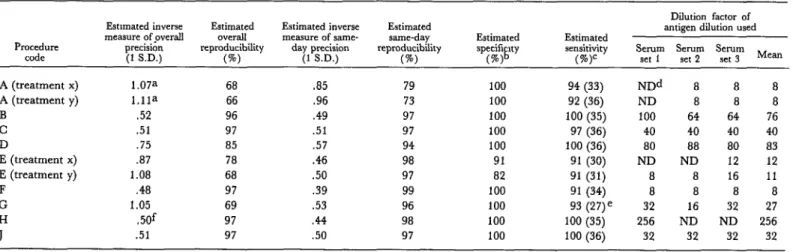
Table 2 shows a summary of the results ob- tained in phase one. The procedures were then ranked according to their overall preci- sion (Table 3) and same-day precision (Table 4), and the F-test was used to decide if ob- served differences between the various preci- sion and reproducibility values for the proce- dures were significant at the 5 per cent level. As indicated in the tables, procedures F, H, C , J, and B had similar overall precision (and thus overall reproducibility) values. The same was true of procedures D and E (treatment x), and also of procedures G, A, and E (treatment y). However, G, A, and E (treatment y) had significantly less overall precision than pro- cedures F, H, C, J, and B.
Procedures F, H, E, B, J, C, and G had similar same-day precision (and thus same- day reproducibility) values, and the same was true of procedures H, E, B, J, C, G, and D. However, procedure D had significantly less same-day precision than procedure F.
Table 2. A summary of phase one results from the WHO rubella HI study.
Procedure code
Dilution factor of Estunated inverse Estimated Estimated inverse Estimated
measure ofpverall overall measure of same- same-day Estimated Estimated antigen dilution used
precision reproducibility day precision . .
(1 SD.) (%I (1 S.D.) reproducibility @) speciii ny (d
Serum Serum Serum Mean set 1 set 2 set 3 A (treatment x)
A (treatment y) B
C D
E (treatment x) E (treatment y) F
G
1.07a 68 -85 79
l.ila 66 .96 73
.52 96 .49 97
.51 97 .51 97
.75 85 .57 94
.a7 78 .46 98
1.08 68 .50 97
.48 97 .39 99
1.05 69 .53 96
.50f 97 .44 98
.51 97 .50 97
100 100 100 100 100 91 a2 100 100 100 100
94 (33) NDd 8 a a
92 (36) ND 8 El 8
100 (35) 100 64 64 76
97 (36) 40 40 40 40
100 (36) 80 88 80 83
91 (30) ND ND 12 12
91 (31) 8 8 16 11
91 (34) 8 8 a 8
93 (27)e 32 16 32 27
100 (35) 256 ND ND 256
100 (36) 32 32 32 32
aSet one was not tested. Thus, the day-to-day variation in this precision is from only two days of testing rather than from the three days called for by the pro- tocol.
bRadioimmunoassay testing by an independent laboratory showed that there were 11 negative specimens. cThe number of positive specimens is shown in parentheses.
dND = Not Done.
eDespite provision of over 27 sera initially yielding positive results, laboratory G reported only 27 positive sera.
286 PAHO BULLETIN l vol. 17, no. 3, 1983
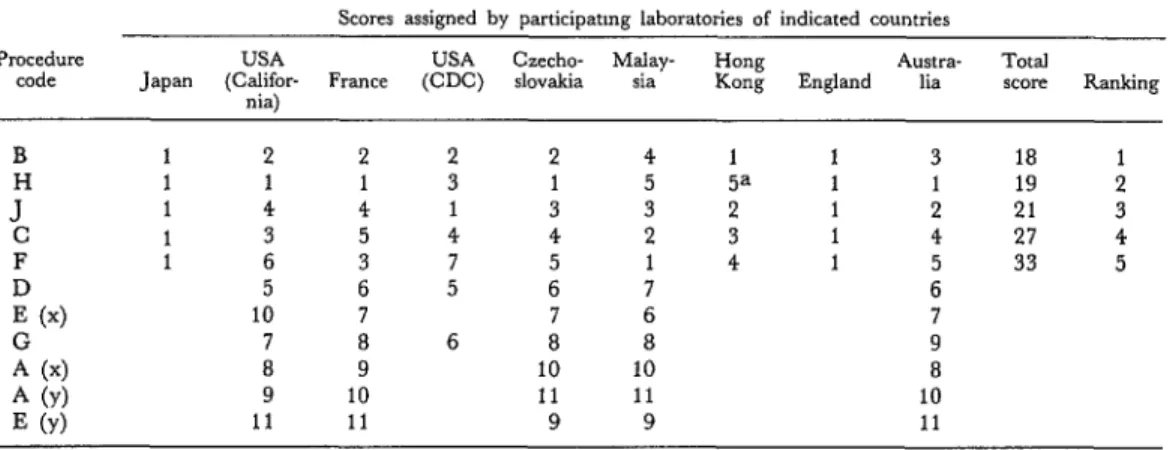
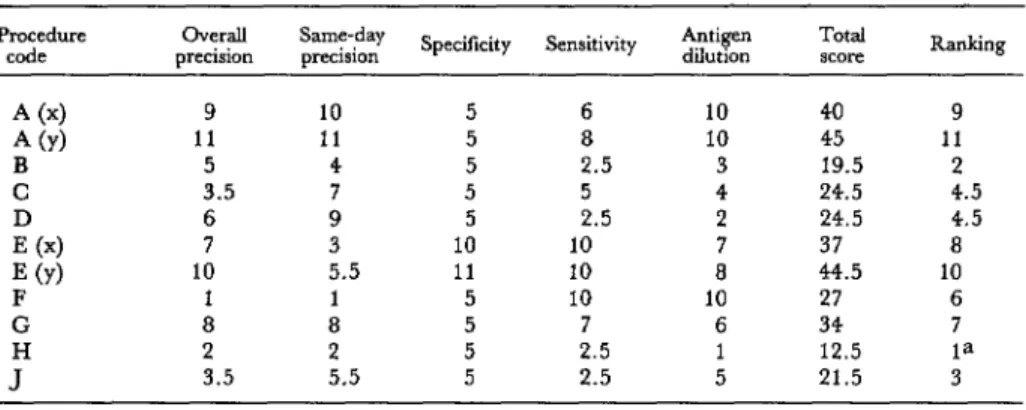
added, the procedure with the lowest numeri- analyses, as shown in Table 6, the same four cal total was taken to be the best, and so on, procedures occupied the top four positions. up to the highest numerical total. Two of the four techniques used kaolin serum
As Table 5 shows, the top four rubella HI treatment, and the other two used heparin- procedures selected by the participants in this MnC12. On the basis of these initial findings, manner were B, H, J, and C. When the pro- the participants selected procedures B and J to cedures were ranked according to statistical be used in phases two and three.
Table 3. The test procedures ranked by order of Table 4. The test procedures ranked by order of same- overall precision and overall reproducibility. The day precision and same-day reproducibility. The letters “NS” in the right-hand column indicate that letters “NS” in the right-hand column indicate the differences between the bracketed results were not that the differences between the bracketed results
statistically significant. were not statistically significant.
Procedure code
Estimated inverse Estimated overall measure of overall reproducibility
precision (1 S.D.) (%) Procedure code
Estimated inverse Estimated same-day measure of same-day reproducibility
precision (1 S.D ) (%) F
H C
J,
D .75 85
E (treatment x) .a7 78 I NS
G
A (treatment x) E (treatment y) A (treatment y)
1.05 69
1.07 68
1.08 68 NS
1.11 66
.48 97
.50 97
.51 97 NS
.51 97
.52 96
F H
E (treatment x) B
E (treatment y) Jc
G D
A (treatment x) .a5 79
A (treatment y) .96 73 I NS
.39 99
.44 98
.46 98
.49 97
.50 97
.50 97
.51 97
.53 96
.57 94
NS
Table 5. Scores assigned to the various test procedures by participants on the basis of data presented in Tables 2, 3, and 4 and the resulting ranks of the five top-ranked procedures.
Scores assigned by panicipatmg laboratories of indicated countries Procedure
code Japan (Califor- USA France (CDC) USA &echo- slovakia Malay- sia nia)
Austra- Total Hong
Kong England lia score Ranking
B
! F &4 z (4 A (Y) E (Y)
1 2 2 2 2 4 1 1 3 18 1
1 1 1 3 1 5 5a 1 1 19 2
1 4 4 1 3 3 2 1 2 21 3
1 3 5 4 4 2 3 1 4 27 4
1 6 3 7 5 1 4 1 5 33 5
5 6 5 6 7 6
10 7 7 6 7
7 8 6 8 8 9
8 9 10 10 8
9 10 11 11 10
11 11 9 9 11
Suggs et al. . RUBELLA HI TEST EVALUATION 287
Table 6. Numerical scores and rankings assigned to the various test procedures on the basis of statistical analyses of tbe data presented in Tables 2, 3, and 4.
Procedure overall
code precision
A (4 9
A (Y) 11
B 5
C 3.5
h4 6 7
E (Y) 10
F 1
G 8
J” 2 3.5
Same-day
precision Specificity Sensitivity Antigen dilution
10 5 6 10 40 9
11 5 8 10 45 11
4 5 2.5 3 19.5 2
7 5 5 4 24.5 4.5
9 5 2.5 2 24.5 4.5
3 10 10 7 37 8
5.5 11 10 8 44.5 10
1 5 10 10 27 6
a 5 7 6 34 7
2 5 2.5 1 12.5 ia
5.5 5 2.5 5 21.5 3
Total
score Ranking
aprotocol for phase one not followed.
Phase Two
As previously noted, during phase two each of the nine laboratories tested six blind-coded sets of the same sera, three by procedure B (heparin-MnClg) and three by procedure J (kaolin). The six serum sets had different ran- dom codes. All testing with procedure B was completed before testing with procedure J was begun. The purpose was to select the better method with respect to precision (reproducibil- ity), specificity, sensitivity, and antigen dilu- tion.
Table 7 shows the precision and reproduci- bility results each laboratory obtained with the two procedures. These results, as assessed by the Wilcoxon Matched-Pairs Signed-Ranks Test, showed that the two procedures did not differ significantly (p>O.O5) with regard to their overall or same-day precision and repro- ducibility values.
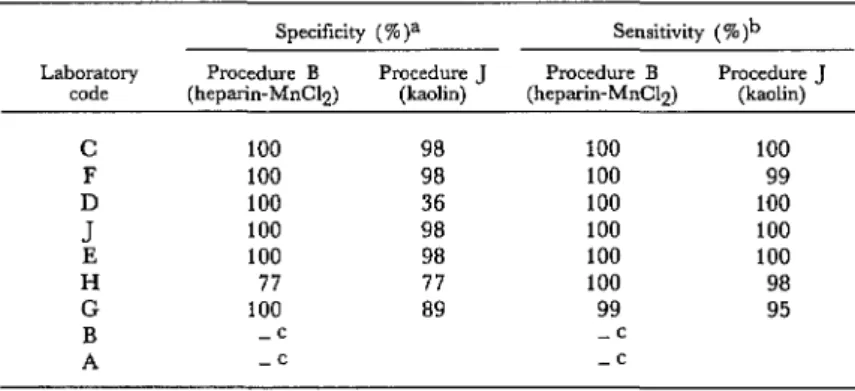
Table 8 shows the sensitivity and specificity results each laboratory obtained with the two procedures. These results, likewise assessed by the Wilcoxon Matched-Pairs Signed- Ranks Test, indicated that procedure B (hepa-
Table 7. Precision and reproducibility results obtained by the nine participating laboratories using HI test procedures B and J (phase two).
Overall precision and repmducibility Same-day precision and reproduability
Procedure B Procedure J Procedure B Procedure J
(heparin-M&12) (kaolin) (heparm-MnClp) (kaolin)
Laboratory
code Estimated precision reproducibility Estimated Estimated precision reproducibility Estimated Estimated precision reproducibility Estimated Estimated precxion reproducibility Estimated
(1 S.D.) @) (1 SD.) @) (1 S.D.) VJ) (1 SD.) (S)
C .44
F .46
i .62 .52 .56
H .63
G .65
B .69
A .69
98 98 96 94 91 91 90 88 88
.37 100
.48 97
.58 93
.49 97
.39 99
.98 72
.66 89
.72 86
.43 99
.39 99
.46 98
.52 96
.56 94
.59 93
.60 92
.61 92
.59 93
.35 100
.45 98
.54 95
.41 99
.38 100
.98 72
.64 90
PAHO BULLETIN l vol. 17, no. 3, 1983
Table 8. Specificity and sensitivity results obtained by the nine participating laboratories using HI test procedures B and J (phase two).
Specificity (%)a Sensitivity (S )b Laboratory
code (heparin-M&12) Procedure B
Procedure J Procedure B Procedure J (kaolin) (heparin-MnCI2) (kaolin)
C 100
F 100
D 100
J 100
E 100
H 77
G 100
B -c
A -c
98 100 100
98 100 99
36 100 100
98 100 100
98 100 100
77 100 98
89 99 95
-C -c
aBased on the existence of 11 negative specimens, as verified by an independent lab- oratory.
bBased on the existence of 37 positive specimens.
Would not be estimated because “ 16” appeared in data (reciprocal of serum dilu- tion too low to be of value in the statistical analysis).
Table 9. Dilution factors of the antigen used by the nine participating laboratories during phase two
testing of procedures B and J. Laboratory
code (heparin-M&l?) Procedure B Procedure J (kaolin)
C 40 64
F 32 32
s 64, 64, 128 64 128 256 64 16
H 64 64
G 32 32
B 256 256
A 128
rin-MnClp) was significantly more specific than procedure B using kaolin (PC 0.05). No significant difference in the two procedures’ sensitivity was detected.
Table 9 shows the dilution factors of the an- tigen dilutions used by each laboratory. No significant difference was observed between the two procedures’ overall reactivities as measured in terms of these dilution factors.
Phase Three
The selection of a reference rubella HI pro- cedure should not depend upon all laborato-
ries having the same reagents. The purpose of phase three of the study was to determine which procedure, B or J, produced the most consistent results among and within laborato- ries when each laboratory provided its own reagents.
The study design used a collection of 12 negative and 37 positive serum specimens. Each of the nine participating laboratories tested six blinded-coded sets of the same sera-three by procedure B (one set per day for three spaced days) and three by procedure J (one set per day for three spaced days). The
six sets of sera had different random codes, and all of the testing with procedure B was completed and reported before testing was begun with procedure J.
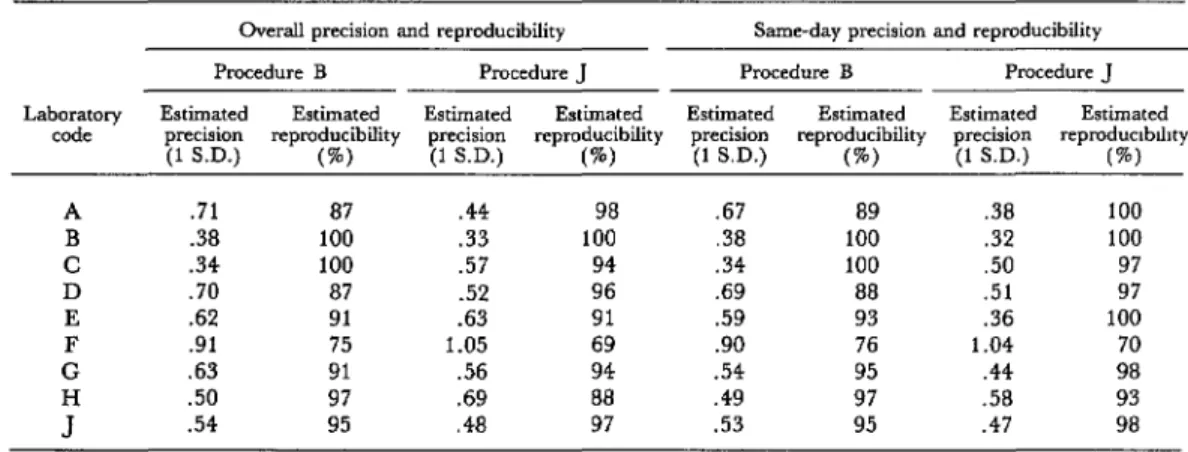
The precision and reproducibility results for the nine laboratories obtained with each procedure are shown in Table 10. The Wil- coxon Matched-Pairs Signed-Ranks Test in- dicated there was no significant difference be- tween the results regarding either overall or same-day precision and reproducibility.
Suggs et al. l RUBELLA HI TEST EVALUATION 289
Table 10. Precision and reproducibility results obtained using procedures B and J (phase three). Overall precision and reproducibility Same-day precision and reproducibility
Procedure B Procedure J Procedure B Procedure J
Laboratory Estimated Estimated Estimated Estimated Estimated Estimated Estimated Estimated code precision
(1 S.D.) reproducibility @) precision (1 S.D.) reproducibility (%I precision (1 SD.) reproducibility (%) precision (1 S.D.) repmduclblllty @I
A .71 87 .44 98 .67 89 .38 100
B .38 100 .33 100 .38 100 .32 100
C .34 100 .57 94 .34 100 .50 97
D .70 87 .52 96 .69 88 .51 97
E .62 91 .63 91 .59 93 .36 100
F .91 75 1.05 69 .90 76 1.04 70
G .63 91 .56 94 .54 95 .44 98
.50 97 .69 88 .49 97 .58 93
.54 95 .48 97 .53 95 .47 98
Table 11. Specificity and sensitivity results obtained using procedures B and J (phase three).
Laboratory code
Specifnty ( %)a Sensitivity ( W) ‘b Procedure B Procedure .I Procedure B Procedure 1
98.6 98.6 99.5 100.0
100.0 100.0 100.0 100.0
100.0 98.6 100.0 100.0
90.3 100.0 100.0 100.0
98.6 100.0 99.5 100.0
41.8 45.8 99.5 100.0
98.6 100.0 96.3 100.0
-c 98.6 c 100.0
98.6 98.6 100.0 99.5
aBased on the existence of 12 negative specimens, as verified by an independent laboratory.
abased on the existence of 37 positive specimens.
CCould not be estimated because “ < 16” appeared in data (reciprocal of serum dilution too low to be of value in the statistical analysis).
Table 12. Dilution factors of the antigen dilutions used Table 12 shows the dilution factors of the
during phase three testing of procedures B and J. antigen dilutions used by each laboratory. Dilution factors of antqen These factors differed in only four of the nine
dilutions used with:
Laboratory laboratories; however, these differences all
code Procedure B Procedure J showed the kaolin procedure (procedure J) to
A 64 64 be more reactive than the heparin-MnC12 pro-
B 32 32 cedure (procedure B).
C 64 64
D 16 16
E 16, 25, 32 32, 16, 32 Conclusions
F G H J
32 64, 32, 45
a 64, 64, 128 Four measures of test performance were
80 80 used in
32, 32, 64 64 this study to identify a recommended
290 PAHO BULLETIN . vol. 17, no. 3, 1983
ty, specificity, reactivity, and reproducibility. The test sensitivity observed in phases two and three is shown in Tables 8 and 11. For procedure l3 (the heparin-MnC12 procedure) these sensitivity values were quite high. That is, among the 15 sets of results the lowest sen- sitivity percentage registered was 96.3 per cent, and 10 of the 15 sets of results indicated
100 per cent sensitivity. This shows that pro- cedure B yielded very few false negative read- ings. Likewise, the lowest degree of sensitivity attained with procedure J (using kaolin) was 95.0 per cent, and 12 of the 16 sets of results attained 100 per cent sensitivity, leading to the same conclusion.
Tables 8 and 11 also show the observed spe- cificity of the two procedures. Twelve of the 15 sets of results shown indicated a very high specificity for procedure B (in excess of 98 per cent). However, the two lowest procedure B specificity scores were 77 and 42 per cent, which shows that certain laboratories had a problem with false positive readings. The same was true of procedure H. That is, eight of the 16 sets of results shown indicated a spe- cificity of 98 per cent or more, but the lowest specificity scores were 77, 46, and 36 per cent, which again indicated a problem with false positive readings.
Tables 7 and 10 indicate the overall repro- ducibility of the phase two and three results. Regarding procedure B, even though seven of the 18 sets of results indicated 95 per cent re- producibility or better, five others indicated less than 90 per cent reproducibility. This shows that the results obtained with procedure B varied substantially in certain laboratories. Likewise, eight of the 17 sets of procedure J results indicated 95 per cent reproducibility or better; but five indicated less than 90 per cent reproducibility, again revealing substantial variation within certain laboratories. It should be noted, however, that two of the laboratories reporting low procedure J reproducibility were different from those reporting low repro- ducibility with procedure B.
Overall, the observed differences between the two procedures were not significant; but since it was necessary to designate only one reference procedure, a letter was sent from WHO asking the participants in this study to select one of these two procedures to be recom- mended as the WHO rubella reference HI procedure. Five of the nine participants chose procedure B (heparin-MnClz), which has therefore been designated as the recommend- ed procedure.
SUMMARY
Various rubella hemagglutination-inhibition (HI) test procedures are used around the world to detect rubella antibodies in human sera-in order to determine which individuals need vaccination and which pregnant women are at risk of giving birth to an infant with congenital rubella. In view of the need to have ,a single international rubella HI reference method, the World Health Organization sponsored a collaborative study involving the testing of various procedures by nine laboratories in eight countries.
The initial tests singled out four procedures as being superior in terms of their sensitivity, specifici- ty, reactivity, and reproducibility, and the chief participants at the nine laboratories selected two of these for further testing. This subsequent testing in-
dicated that both methods were very sensitive, yielding few false negative results; that both showed a high degree of specificity (few false positive results), though some of the participating labora- tories did have problems with false positive read- ings; and that high levels of precision and reproduc- ibility were attained in some laboratories but not in others.
Overall, the observed differences between the two procedures were not significant. The nine study participants were therefore asked to select which of the two methods they preferred, and they accordingly selected the one employing heparin- manganous chloride to treat the sera. A detailed de- scription of this reference method is available from
Suggs et al. . RUBELLA HI TEST EVALUATION 291
REFERENCES
(1) Lennette, E. H., E. A. Spaulding, and J. P. Truant (eds.). Manual of Clinical Microbiology (second ed.). American Society for Microbiology, Wash- ington, D.C., 1974.
(2) Gregg, N. M. Congenital cataract following German measles in the mother. Trans Ophthalmol Sot Aust 3:35-46, 1931.
(3) Stewart, G. L., et al. Rubella-virus hemag- glutination inhibition test. N Engl J Med 176:554- 557, 1967.
(4) Palmer, D. F., J. J. Cavallaro, and K. L. Herrmann. A Procedural Guide to the Pe$ormance of
Rubella Hemagglutination-Inhibition Tests. Immunol- ogy series No. 2. Center for Disease Control, 1977.
(5) United States, National Committee for Clin- ical Laboratory Standards (NCCLS). Approved Stan- dard: ASM-5 Standard for Rubella Hemag$utination (HAI) Reagent Specifications and for a Rubella HAZ Rejerence Method.
JAMAICA LAUNCHES PUBLIC EDUCATION PROGRAM ON IMMUNIZATION
The Ministry of Health of Jamaica has launched an extensive public education program designed to focus attention on a national plan for im- munizing children up to 12 years old. Due to be completed by the end of 1983, the plan represents further development of the ministry’s existing Ex- panded Program of Immunization (EPI); its goal is to achieve a satisfactory
immunization status for 80 per cent of the children in this age group against tetanus, polio, diphtheria, whooping cough, and measles.
The education program, which was preceded by a recently concluded survey of knowledge, attitudes, and practices in relation to immunization, is being funded by UNICEF and PAHO with grants of Jf50,OOO and J$ 40,000, respectively. On the local scene, a well-known musician has al- lowed his hit song “Treat the Youth Right” to be used as a jingle in the im- munization program, and the Graduate Theatre Company of the Jamaica
School of Drama has used its talents to highlight the importance of immu- nization.