The health sector in social representations of HIV/Aids and quality
of life of seropositive people
O setor saúde nas representações sociais do HIV/Aids e qualidade de vida de pessoas soropositivas
El sector salud en las representaciones sociales del vih/sida y la calidad de vida de personas
seropositivas
Tadeu Lessa da Costa1
Denize Crisina de Oliveira2 Gláucia Alexandre Formozo1
1. Universidade Federal do Rio de Janeiro. Macaé - RJ, Brazil.
2. Universidade do Estado do Rio de Janeiro. Rio de Janeiro - RJ, Brazil.
Corresponding author: Tadeu Lessa da Costa.
E-mail: [email protected] Submited on 05/19/2014. Accepted on 08/03/2015.
DOI: 10.5935/1414-8145.20150063
A
bstrActObjectives: To identify and analyze the content of the health sector in the social representations of people living with HIV/Aids on
the disease and quality of life. Methods: Descriptive and qualitative study, based on social representations theory. The subjects
were 35 seropositive followed in specialized center. Semi-structured interviews were used, with computerized lexical analysis.
Results: The representational content on health sector encompassed a description and presentation of attitudes about two
dimensions, functional and structural. Also the specialized HIV/Aids was identiied with its structure and emphasis on the human resources. Conclusion: The health sector was symbolically present and with inluence on quality of life of people living with HIV,
considering, especially, the contact and relationship with the professionals, which can support programmatic actions in this ield.
Keywords: Acquired Immunodeiciency Syndrome; Quality of Life; Delivery of Health Care; Health Impact Assessment; Nursing.
r
esumoObjetivos: Identiicar e analisar os conteúdos relacionados ao setor saúde no contexto das representações sociais das pessoas
que vivem com HIV/Aids acerca do HIV/Aids e da qualidade de vida. Métodos: Estudo descritivo e qualitativo, pautado na teoria
de representações sociais. Os sujeitos foram 35 pessoas soropositivas acompanhadas em centro especializado. Utilizaram-se entrevistas semiestruturadas, submetidas à análise lexical informatizada. Resultados: Os conteúdos representacionais dos
participantes sobre o setor saúde envolveram uma descrição e apresentação de atitudes diante o mesmo, a partir de duas dimensões, funcional e estrutural. Comportaram, também, o serviço especializado em HIV/Aids, tendo em vista sua estrutura, com destaque para a atuação de seus recursos humanos. Conclusão: O setor saúde mostrou-se, simbolicamente, presente e
com inluência na qualidade de vida das pessoas soropositivas, considerando, especialmente, o relacionamento estabelecido com seus proissionais, o que pode subsidiar ações programáticas na área.
Palavras-chave: Síndrome da Imunodeiciência Adquirida; Qualidade de Vida; Assistência à Saúde; Avaliação do impacto na saúde;
Enfermagem.
r
esumenObjetivos: Identiicar y analizar los contenidos relacionados con el sector salud en el contexto de las representaciones sociales de
personas portadoras del VIH/Sida acerca de la enfermedad y calidad de vida. Métodos: Estudio descriptivo, cualitativo, basado en
la Teoría de las Representaciones Sociales. Los sujetos fueron 35 seropositivos de un centro especializado. Se utilizó la entrevista semiestructurada, con análisis léxico informatizado. Resultados: Los contenidos representacionales de los participantes sobre
el sector salud requirieron una descripción y actitudes acerca de las dimensiones funcional y estructural. También comportó la zona especializada, teniendo en vista su estructura con énfasis en el papel de los recursos humanos. Conclusión: El sector
salud estaba simbólicamente presente, con inluencia en la calidad de vida de los seropositivos, especialmente por su contacto y relación con los profesionales, siendo esto útil para las acciones programáticas a este respecto.
Palabras clave: Síndrome de Inmunodeiciencia Adquirida; Calidad de Vida; Prestación de Atención de Salud; Evaluación del impacto
INTRODUCTION
After more than three decades, the Human Immunodei
-ciency Virus (HIV) infection and the disease that causes the Ac
-quired Immune Deiciency Syndrome (AIDS), continue as major challenges to the health sector. Among the questions brought to the fore by the disease in the present days is the quality of life (QOL) of people living with it. This QOL is a complex concept and has diferent dimensions involved in evaluation.
Before the conceptual complexity of QOL, the World Health Organization (WHO) deines QOL as:
the individual's perception of their position in life in the context of the culture and value systems in which they live and in relation to their goals, expectations, standards and concerns. It is a broad ranging concept afected in a complex way by the person's physical health, psycho-logical state, level of independence, social relationships, personal beliefs and their relationship to salient features of their environment"1.
Thus, the health sector represents a signiicant compound of potential devices for the promotion of QoL of people living with HIV/AIDS (PLWHA). This, because the health services in the seek to promote the attention to PLWHA must permit clinical and psychosocial assessment to identify coping strategies, accep
-tance and diiculties of living with a diagnosis of seropositivity2. In Brazil, a network of reference as part of the programmatic response to HIV/AIDS within the Uniied Health System (UHS) has been made, and the outpatient units named Service of the Specialized Care (SSC). With the progressive difusion of AIDS to areas in the country side, such services have been expanded, according to the latest data published by the Ministry of Health, from 33 individuals in 1996 to 737 in 20103.
Because they are linked to the UHS, the SSC should fol
-low their approach based on universality and on health needs, therefore investing in drug assistance for antiretroviral therapy (ART) and in adhering to it, even though they are not restricted to medicalization and the biological focus4. The PLWHA lays their expectations of treatment in these places and the currently chronic characteristic of the disease generates the dependence on them, in which they express physical and psychological needs, also taking into account the process of stigmatization that HIV-positive subjects experience5.
Thus, it is assumed that a Brazilian eicient, durable, innova
-tive and sustainable response to AIDS, should seek health care practices in all of their dimensions and rely on a public health system well structured3. In this sense, recommendations for the care of PLWHA in Brazil indicate that the activities of health ser
-vices should be organized in order to facilitate the access of the users not only to treatment, but the service itself, ofering diverse
care alternatives and establishing a diferent low to those with greater diiculties2. In synergy with these concerns, challenges to the health sector are set in the country: the ampliication of the access and quality of health services and social support; and the improvement of the QoL of PLWHA3.
In this regard, we emphasize the importance of the dimen
-sion of subjectivity in the assessment of QoL, as mentioned above, that should be given by incorporating the perception of subjects concerning their position in life, their culture, accord
-ing to their culture, system of values and personal and social expectations1-6. In addition to that, in the case of PLWHA, there is the speciicity of expression on issues such as ways of living together with the stigmatization, diagnosis and coping with the disease, the acceptance process as well as representations and experiences as for the treatment in the health sector2,5,6, the latter being, in particular, the focus of the current study.
Thus, it is presented as a matter of the study: which contents related to the health sector would be present in the context of social representations (SR) of PLWHA on HIV/AIDS and QoL? And the object of study: the setting of the contents related to the health sector within the context of SR of PLWHA about AIDS and QoL. This, because the SR are "a way of knowledge that is socially developed and shared with a practical purpose, and that contributes to the construction of a common reality for a social group"7. In this sense, it has an interface with the concept of QoL proposed by WHO and enables the understanding of the aspects related to the institutionalized and specialized ield of health care as the one designed for PLWHA.
In this perspective, the objectives are to identify and analyze the contents related to the health sector within the context of SR of PLWHA about HIV/AIDS and QoL. The work has shown to be relevant because the subjects’ SR about their QoL in living with HIV/AIDS hold qualitative components of attention in the health sector, bringing implications for the organization of services, pro
-grams and health policies in this area. Thus, the indings presented in the study may help improve attention to the health of this group, considering the impact on their well-being and adherence to treat
-ment, which, in turn, contributes also to optimize the expenses in the sector and boost the efect of collective prevention.
METHOD
This is a descriptive study of qualitative approach, based on the theory of social representations, especially in its procedural approach7. It was attended by 35 PLWHA, accompanied by a SSC HIV/AIDS in a mid-sized city in the northern state of Rio de Janeiro.
The sample of the participants was not probabilistic, by con
unavailability to respond to the study; and impairment of cognitive functions that make it impossible to understand the survey ques
-tions or that are unable to discern on participation in the same. There was a previous contact with the SSC for the approaching to the context and authorization for the research. And, participants were asked to integrate research at the time in the waiting room for consultations with health professionals.
The data collection site was a SSC of a city in the northern state of Rio de Janeiro and the research took place between May and October 2011, during the everyday service in the week, randomly. Data collection occurred initially, with the application of a questionnaire with socioeconomic and clinical data. Later, semi-structured interviews based on a pre-script were developed. The conduction of the interviews comprised the dimension of the SR about the QoL and HIV/AIDS. The average of the duration was 43 minutes (± 12.6). The data were stored in digital apparatus and then rewritten. The collection procedure was efected in a private room before or after the consultations with the health professionals, according to the availability of each PLWHA who agreed to participate.
The analysis of the sociodemographic and clinical data were by SPSS v.17 software, with described statistics. For the inter
-views, we have used the technique of analysis of the lexical type, with the help of ALCESTE software (Lexical Analysis by Context of a Text Segments Setting) version 4.7. The lexical analysis al
-lows the classiication of the statements by their lexical distance, measured in terms of association by value chi-square (χ2). Thus, the closer the statements the more they hold similar lexical roots (or reduced forms)8.
The operational procedures for the development of Alceste analysis consisted initially in the corpus preparation, correspond
-ing to all of the transcribed interviews, accord-ing to the software's speciic rules, in which terms with common meaning were stan
-dardized and8 arranged in a dictionary.
After this procedure we carried the efective lexical statisti
-cal analysis itself, which, for this study, was the standard type by ALCESTE software. This procedure promotes the division of the corpus in Elementary Context Unit (ECU). Then, the program performs progressive binary divisions of the corpus with the ECU, the textual statistics, generating explanatory classes of phenomenon focused in the study8. Such division occurs through the Descending Hierarchical Classiication (DHC), whose product is a dendrogram8.
The identiication and description of the contents in classes are given based on the reduced forms related, in the ECU and by analyzing the Ascending Hierarchical Classiication (CAH), generated by the software for each class. The CAH allows the visualization of binary divisions between the lexical roots within each class. In this study, then, it has been done a cut of one of the six classes that make up the set of SR of PLWHA about QoL and HIV/AIDS.
This procedure was approved by the Ethics Committee of the State University of Rio de Janeiro and the Consent Informed was obtained before de interview. The anonymity of the survey participants was guaranteed by the application of numeric codes to replace their names, as can be seen in excerpts of his testi
-mony, as the following.
RESULTS
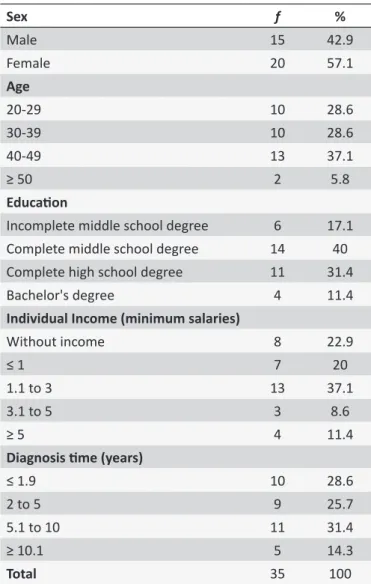
The characterization of the participants of the research can be seen in Table 1.
As for the analysis by the Alceste software, it was identiied in the corpus 123,585 occurrences of words, in 35 interviews after the standardization under the rules for it. From this amount, 7,089 were distinct and 1735 reduced forms. The program carried out the cleavage of the corpus in 3037 ECU, of which 2211 (72.8%) were inserted into the classes into which have been divided, as shown in the dendrogram below (Figure 1).
Table 1.
Distribuion of PLWHA according to sociodemo
-graphic and clinical variables. North zone of Rio de Janeiro
State, Brazil, 2011
Sex
f
%
Male
15
42.9
Female
20
57.1
Age
20-29
10
28.6
30-39
10
28.6
40-49
13
37.1
≥ 50
2
5.8
Educaion
Incomplete middle school degree
6
17.1
Complete middle school degree
14
40
Complete high school degree
11
31.4
Bachelor's degree
4
11.4
Individual Income (minimum salaries)
Without income
8
22.9
≤ 1
7
20
1.1 to 3
13
37.1
3.1 to 5
3
8.6
≥ 5
4
11.4
Diagnosis ime (years)
≤ 1.9
10
28.6
2 to 5
9
25.7
5.1 to 10
11
31.4
≥ 10.1
5
14.3
Figure 1. Dendrogram with SR about QoL and HIV/AIDS among PLWHA. North zone of Rio de Janeiro State, Brazil, in 2011.
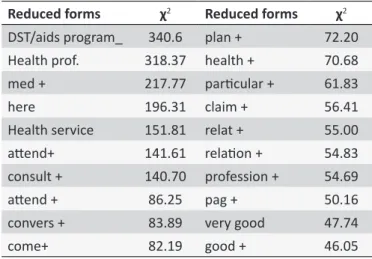
Table 2. Reduced forms more associated with the class.
North zone of Rio de Janeiro State, Brazil, in 2011
Reduced forms
χ
2Reduced forms
χ
2DST/aids program_
340.6
plan +
72.20
Health prof.
318.37
health +
70.68
med +
217.77
paricular +
61.83
here
196.31
claim +
56.41
Health service
151.81
relat +
55.00
atend+
141.61 relaion +
54.83
consult +
140.70
profession +
54.69
atend +
86.25
pag +
50.16
convers +
83.89
very good
47.74
come+
82.19
good +
46.05
Considering the context of the present indings in the den
-drogram, the class 1 involves issues of social context of PLWHA, especially with regard to interactive processes and attitudinal in the family, friends and work, from the veiling and unveiling of seropositivity. Class 6 covers the evaluation of (non) social acceptance in the perspective of PLWHA as well as the dimen
-sion of love, emotional and sexual lives. It also brings extensive existential aspects of PLWHA and the implications of the work for the QoL.
Class 2, it can be noted the body and organic changes on HIV/AIDS and ART, the inluences between psychosocial as
-pects and the body with aggravation, the expectations related to ART, and QoL before the body and organic implications and drug treatment. In Class 4, it was identiied the role of routine in using the ART, the diiculties of adherence to it and its implica
-tions for social life and eating habits of PLWHA. In Class 5, in turn, it was noted the contents about HIV transmission modes and their most afected groups, the arrangements for prevention and the origin of the disease.
The class 3 dendrogram thus is more speciically the object of this study, it has 361 ECU, ie 16.3% of those classiied by the Alceste. The reduced forms with greater statistical association with the class can be seen in Table 2.
From the reduced forms, as well as the scrutiny of the ECU that compose the class, it was revealed that its whole ap
-proaches representational aspects of QoL in living with HIV/AIDS and interfaces with the health sector from three sub-themes: the insertion of PLWHA and their care in the health services in general; SSC structural elements; and the relationship with healthcare professionals.
Thus, it was noted at the participants’ SR an association about the public health system in general, not focusing on the experience with HIV/AIDS by ofering care activities for people in lower economic level. This would take place due to the inancial limitations to keep a private health plan, pointed as important to facilitate the use of certain technologies.
I have my medical care, everything is private but some people don’t have this. They depend on the public health service to receive treatment (E19).
I am not rich, I am poor, I don’t live in good conditions, but my mother always preached that if we get a better job, we should get a health insurance plan due to the service problems of the UHS. (E11)
In this sense, as a possible conductive for the previous point of view, it came forth in the analyzed SR, the delay in the results of certain laboratory tests, which could increase vulnerability to other hazards. And also the need for consultations more often or more types of health professionals due to the serologic condi
-tion to the HIV.
Another issue of interest is the perceived vulnerability to stigmatization in the community because of HIV/AIDS, which creates a concern about the conidentiality of the fact of having to disease. Thus, the presence of PLWHA itself in the health service, particularly if public, facing the demands for that disease could take the serologic status to the acknowledgement of the family and social networks due to the eventual risk of possible contact with individuals in these circles, also, in this space.
As I am known and so is my family, I also have this limita-tion here. That's why I've always been served by the health plan (E34).
It was noted the development of representational content about the Brazilian health system through comparisons between the healthcare reality of the study participants and the other ex
-perienced or known locations trough daily communication. This is due to the health care ofered to the PLWHA and as for the free distributions of the ART by the Brazilian government. This policy of universal distribution of drug treatment to HIV/AIDS leads us even to the relection on the situation in other countries where such access is perceived as absent. It brings us, in this way, a more positive look over the health system. This from the access to hard technologies to the needs generated by the HIV/AIDS.
Once it is public, because before everything was private and the poor didn't have the right to take the antiretroviral. In the US, people who take antiretroviral are only those who have money (E10).
I know places where the health service is terrible and lack antiretroviral. Mine is ok for me, because I do not need to buy antiretroviral, the government pays the exams that are very expensive (E35).
It also emerged coexisting issues with HIV/AIDS linked to the overall care process of the disease carriers in the State. These issues refer to the most basic material conditions, such as the guarantee of nutrition, the reduction of the inancial impact in the family’s income and the consideration of transportation costs to the health service.
If I didn't thirteen reais to come to my appointment today, I would not have come. The care is free at the SSC, but I need money to come, have lunch and buy the drugs that the doctor prescribes (E8).
Quality of life for the person with HIV/AIDS means to be safe. It means having a controlled life according to your needs. You need, mainly, proper feeding. There are many
people who live in the suburbs or from lower social classes. They don't have assistance from the government, that is, when they discovers they have HIV/AIDS, the INSS keeps the individuals away for two or three months and then releases the person (E18).
As for the contents related, more speciically to the SSC in the SR, it could be noticed some elements corresponding to a more positive attitude, which were greatly expressed, and oth
-ers concerning a more negative attitude. It was identiied, once again, the establishment of parallels with other locations or health services according their relationship soon or through the relation
-ships with other subjects.
Among the representational elements with a more posi
-tive character stood out in structural and logistical terms: the availability of blood tests considered expensive; the gratuity of the items from specialized service; and the distribution of ARTs without the occurrence of interruption. These components have been valued as for the safety it presents to the PLWHA during the therapeutic process, reducing the negative impact of this disease and improvement in QoL.
Here at the SSC, where I come to see the doctor, for now, it is good, because every month I have my doctor to see me and I get the antiretroviral (E14).
At the SSC things work right, I can do my exam on an speciic date, I can go back and show it the physician and he can guide me in what I need. This inluences in my QoL because a blood test may signal that I need some medica-tion and I wonder if I did not have this informamedica-tion (E32).
Still, in relation to the positive attitudinal contents to the SSC, it can be found the structuring of human resources. This context it is valued: the presence of medical professionals in the consultations; the existence of a multidisciplinary team with other doctors besides infectologists, dentists, psychologists, social workers, nurses and other professionals; the availability of the care; the lack of discriminatory actions; and the type of interper
-sonal relationship established, this last being more speciically discussed as follows.
The SSC is very good. I quite liked it. People, such as the psychologist, the gynecologist, the infectologists, the employees here, I liked them all (E3).
Nevertheless, some participants presented elements denoting some negative attitude while at the care, such as the delay in the results of test, which could be, however, by
-passed by strategies adopted by some professionals. These may be blood tests or any other, such as the preventive test for uterus cancer. Some users recognize the importance and the influence of the health sector in their QOL, yet at the same pace, the need to be provided with all the prescribe drugs for the treatment.
The doctors say that they could prescribe the test the next month, but they do so sooner once it takes two months to be ready (E8).
The health service inluences a lot in my quality of life. I think it could be easier. There shouldn’t be only some medications but all of them (E33).
With regard to the relationship built with the health profes
-sionals from the SSC, the representational content also was compared to other realities.
They are very nice. I’ve already seen at places where they quite neglect you (E1, χ2: 24).
The interpersonal relationship proile with health profession
-als in the SSC has proved to be signiicant in the SR content of the class in question, emerging as one of the most associated aspects for a satisfactory service. Nevertheless the importance given by other professionals, there was greater emphasis as for the received by the doctors.
Thus, the PLWHA expressed that a fruitful relationship with professionals and health workers can inluence positively in their QoL. Being well assisted by those professionals involve: demonstration of concern about the health through attention and afection; active listening and dialogue, which would lead to an increase in self-esteem; complicity; answering questions and guidance about health and treatment, reducing anxiety and fear; ludic space; and it also be remembered by their names and their medical histories by the health care professional, even before consulting the health records of the unit.
My relationship with the health professionals who care for me is good due to the attention and dedication, respect and concern that I have been treated with (E27).
I have always been lucky physicians. Except the irst one, who sort of said I was going to die the next day. The others were all wonderful. Every question I have they answer, in details, about all I need to know (E4).
However, besides these emotional-expressive aspects, the relationship with the healthcare providers also encompasses the technical-instrumental dimension, through the perception of having experienced a good clinical examination, proper under
-standing and meeting of the complaints brought, the request of exams and prescription of drugs or other relevant interventions for improvement.
They provide very good care, with a lot of attention, they ask everything and prescribe tests to check if the viral load is satisfactory (E7).
My doctor is excellent, he prescribes several tests that at irst aren’t necessary, but to have a better control over my health they always prescribe stool, urine, blood, vaccines in order to keep everything under control (E6).
In the face of such representational content about the rela
-tionship with the healthcare workers, some began to question even the determinants of the care they believed to receive. This occurred, also, in relation to previous experiences. So it was observed in the context of the representation an evaluation of the chances of empathy to interfere with the relational process of these professionals with the service users. It was perceived that it would inluence the health team attitude at the SSC to
-wards a greater awareness as for the sufering, and above all the prejudice that PLWHA experience due to the stigma of the disease. They have considered also the possible inluences of any speciic training for this activity.
The health professionals see that most patients are very mistreated by the prejudice out there and believe to have a good relationship (E34).
It is also interesting to note that some respondents, when mentioning about the role of the health sector in their QoL with the HIV/AIDS, they link the proile of the service provided to the adherence process to the treatment, ranging from the use of medication to the frequency at unity. Thus by contributing to a more positive evaluation of the QoL for people with aggrava
-tions, they can also optimize adherence to needed therapeutic approaches and vice versa.
He is a very caring person and talks extensively with the person and then prescribes the antiretroviral. This inlu -ences in my QoL because when the appointment day comes I'm excited to know that I will be treated well (E21).
It was identiied in this class, also, that the QoL was directly ruled on the good relationship with the professional who investi
-gates and advises about the care in diets as part of the monitoring of the health service. Thus, representational contents pointed to nutrition guidelines and during the medical consultation.
My relationship with the health professionals interfere in the QoL because they are always telling me things that are good for my health, such as the nutritionist who says what I can eat or not (S16).
The doctors treat me very well, they spend hours talking to me, they want to know my diet, everything (E21).
Another pertinent issue in this class concerns the relationship dynamics of the PLWHA with the health care professionals in the public or private system not included in the specialized services. At this point, some participants reported feeling the need or duty to disclose their diagnosis to the professionals who assist them.
I have to talk with the other doctors I have HIV/AIDS. It’s an obligation. It is a patient’s duty (E26).
For some participants this constitutes protection against possible attitudes of prejudice, allowing the negotiation of the establishment or not of the relationship at irst. This is the case of a respondent who reported having experienced embarrass
-ment in while at care outside the SSC, preferring to seek, then, the corresponding professional in the last site.
I prefer that the professionals who assist me know that I have HIV/AIDS than arriving at a place and going through the embarrassment I went through. My dentist knows I have HIV/AIDS. He work at the SSC. I do everything at the SSC, and I feel welcomed (E16).
In this sense, another conlict was evident in the representa
-tional content identiied on the question of conidentiality of the HIV status, where one interviewee reported having her condition disclosed to others, which led her for formal courts and change of service location.
At the time I went to the hospital, I complained about the doctors and went to court against a doctor, so soon I moved to another city and my cesarean was booked there (E17).
It stands out in the participants’ SR, also, the evaluation of biosecurity measures adopted by the health professionals. There was some recognition of the need for individual protection equip
-ment (PPE), in this case, exempliied by gloves, which, however, essential to the expression of the professional that would not be afraid to perform the necessary procedure.
I think the health service helps in my QoL because they relate to us very well. If you're coming to a blood test, of course you have to use glove for anything but you can relate very well and make the fearless procedure (E12).
DISCUSSION
Considering the representational contents about the health sector in its general component (non specialized) identiied in this study, there was a distinct result in comparison to a study that had been previously carried out among the UHS users in region: the metropolitan area of Rio de Janeiro. In this last one, there was a negative social representation of the system, which seemed more related to its practical aspects, in which it tends to consider the services as unable to meet the demands. However, it joined, also in the construction of these representations the involvement with the media, by the frequent airing of negative images regarding it, which tend to be quickly passed and seized9.
Despite the operational diiculties of the UHS and the as
-sociation, by the participants, of the public health care services to the socioeconomic status of those most disadvantaged, there was also, representational elements referring such system as a provider of the access to exams and more expensive drugs. In this respect, there is convergence with the other study which found that even the users of private health plans use public health services, and that occurs especially in some speciic programs and at medium and high complexity10.
As for the general conditions pointed by the participants we can ind transportation, food and availability of prescribed drugs, with potential interference in the access and outcome of the treat
-ment. It is thought that they are possibly conditioned by the pre
Regarding the representational contents related, more speciically to the SSC, the general rules for its structure and operational organization are arranged by the National STD/AIDS and Viral Hepatitis, given the need to seek improved access and quality in the attention to the diferent locations in the country13. This, including the complexity that involves comprising dynamic assistance to the PLWHA in diferent geographic areas13, such as urban areas or, as in the case of this research, in smaller cities that are far from the capital. And it has been possible to note that in the given representational aspects indicated by the PLWHA the importance of proper setting of the features of this kind of service.
Health care would then be an important component in the results achieved by programmatic actions to chronic diseases such as AIDS, and is able to inluence in controlling the disease and QoL of the PLWHA13. And, just as in the present work, the recognition conferred by the PLWHA about the inluence of the health sector in their QoL was observed in a previous study where such group started depositing their expectations about the treatment on the health services. And in this context, they sought meeting the needs of physical, tests, drugs and also psychosocial orders5.
Considering the representational content about the relation
-ship of the PLWHA with the health care professionals, a positive characterization was observed in this process, set in relational and technical facets. It’s possible to say that this setting is aligned to contemporary conceptions of health care, for such it must involve aspects of technical and instrumental nature. However, without being limited to the same, it needs the involvement of emotional-expressive elements. And the absence of this dual composition would generate the self-removal of the being under care or may be conigured as mistreat14.
A positive symbolic appropriation of the specialized health service aimed at the PLWHA was also found in a research in Santa Catarina, where users highlighted the importance of ac
-ceptance and support on their psychological needs beyond those of clinical nature. Thus, it was pointed to the crucial need for a multidisciplinary and well qualiied staf to meet the demands of this group5.
Diferently from the indings of this study, a previous study on the inluence of relationship between doctor-PLWHA for the therapy adherence and QoL noted that there was a lack of communication in this binomial, which cooperated to a number of problems such as poor adherence to treatment15. And in this sense, by investigating the SR of adherence to the ART by PLWHA other authors concluded that the support provided by fruitful interactions with the healthcare professionals are critical for coping with aspects that trigger treatment dropout, such as adverse drug efects, fear of the stigma attached to the disease and failure to present the disease's symptoms16.
Thus, it is thought that the relationship between health professionals and the PLWHA can ind in the SR of the irst components of contribution or diiculty for positive coping with the disease. And the elimination of these symbolic barriers could impact positively in the treatment and the QoL of PLWHA.
The representational content of the class in question had more normative nature on the health system in general, even though, it revealed to be more functional, when it comes to the SSC. This set
-ting can be related to an efect of closeness to the object17, which is this case, is the most frequent contact with this last one.
And, considering the selective construction and schematiza
-tion7 of the contents, involved in the process of objectiication of SR, it was observed thus the importance given to the health sector for the QoL of PLWHA, especially in the specialized ser
-vices. And within such, they seemed to be fundamental in the structuring of such content the igure of the health professionals as facilitators in the routine imposed by the disease compared with the one in specialized care. Considering the anchoring process7, such development proved to be supported in previous symbolic reference points, such as the health system in general, previous contact with health professionals from this ield and the services ofered in other locations (in the country or abroad) to PLWHA, enabling the establishment of a positive practical sense as for the attention received in health.
CONCLUSION
This study aimed at analyzing the symbolic contents related to the health sector in the context of the SR of PLWHA about HIV/AIDS and the QoL. There was, then, the identiication of this sector as an important element in the QoL coniguration according to the perspectives of such group, bearing in mind its potential impact on the diferent constitutive dimensions of health, conceived in an integrated manner.
Thus, the representational content of the health sector for the PLWHA embraced, initially, the public health system in general, considering its features, mainly structural and functional, and meeting elements already seen in the media. It was observed also in this analytical framework, positive emphasis on the Brazilian national policy of sustainable free distribution of ART and the inluence of the socioeconomic aspects of therapy on HIV/AIDS and the QoL.
In a second moment, there was the characterization of the SSC, as essential and attitudinally positive, once considering the functional and structural elements, such as availability of human and material resources such as examinations and uninterrupted distribution of ART. In this space, the representational content of the relationship established with the health professionals stood out, being largely considered as fruitful and with great power of implications for the therapeutic follow-up related to this aggrava
It is thought, inally, that the study consisted of considerable contribution to the ield of analysis on QoL of PLWHA, given its chronicity and the qualitative analysis of public policies in the area within the health sector, to the context from which it is believed that these indings may be useful. This, especially, as for the invest
-ments on the better qualiication of the interactions between the customer in question and the healthcare professionals, given their inluence on the therapeutic monitoring and the QL of PLWHA. In addition, it was possible the approach as for the relationship between the health constructs, especially in its programmatic dimension, and the QoL.
It is considered as a limitation to the study, the fact that the PLWHA participants were recruited from the SSC on HIV/AIDS, which therefore can not bring qualitative representation of car
-riers with aggravation and with possible diiculty in the access or adherence to the follow-up in the services. However, it was not observed, at least in regards to the irst aspect mentioned, a representational content expressed by the participants as for the barriers encountered when entering the specialized care studied.
REFERENCES
1. Vahedi S. World Health Organization Quality-of-Life Scale (WHOQOL-BREF): analyses of their item response theory properties based on the graded responses model. Iran J Psychiatry [on line]. 2010;[cited 2015 jun 03];5(4):140-53. Available from: http://www.ncbi.nlm.nih.gov/pmc/ articles/PMC3395923/
2. Ministério da Saúde (BR). Secretaria de Vigilância em Saúde. Departamento de DST, Aids e Hepatites Virais. Protocolo clínico e diretrizes terapêuticas para manejo da infecção pelo HIV em adultos [Internet]. Brasília (DF): Ministério da Saúde; 2013;[acesso em 11 mar 2014]. Disponível: http://www.aids.gov.br/sites/default/iles/anexos/ publicacao/2013/55308/01_protocolo_hiv_pdf_29576.pdf
3. Ministério da Saúde (BR). Secretaria de Vigilância em Saúde. Departamento de DST, Aids e Hepatites Virais. Acesso universal no Brasil: cenário atual, conquistas, desaios e perspectivas - 2010 [Internet]. Brasília (DF): Ministério da Saúde; 2010. Disponível: http:// www.aids.gov.br/sites/default/iles/publicacao/2011/acesso_universal_ brasil_port_pdf_68184.pdf
4. Oliveira IBN. Acesso universal? Obstáculo ao acesso, continuidade de uso e gênero em um serviço especializado em HIV/Aids em Salvador, Bahia, Brasil. Cad. Saude Pubica [on line]. 2009;[citado 2014 Mar 06];25(supp):259-68. Disponível: http://www.scielosp.org/pdf/csp/ v25s2/08.pdf
5. Meirelles BHS, Silva DMG, Vieira FMA, Souza SS, Coelho IZ, Batista R. Percepções da QV de pessoas com HIV/Aids. Rev Rene [on line]. 2010;[citado 2013 set 27];11(3):68-76. Disponível: http://www. revistarene.ufc.br/revista/index.php/revista/article/view/397/pdf.
6. Zimpel R, Fleck MPA. Quality of life in HIV-positive Brazilians: application and validation of the WHOQOL-HIV, Brazilian version. Aids Care [on line]. 2007;[citado 2010 abr 10];19:923-30. Available from: http://www. ncbi.nlm.nih.gov/pubmed/17712697.
7. Jodelet D. Representações Sociais: um domínio em expansão. In: Jodelet D, organizador. As representações sociais. Rio de Janeiro: EdUERJ; 2001. p.17-44.
8. Oliveira DC, Gomes AMT, Marques SC. Análise estatística de dados textuais na pesquisa das representações sociais: alguns princípios e uma aplicação no campo da saúde. In: Menin MSS, Shimizu AM, organizadores. Experiência e representação social:questões teóricas e metodológicas. São Paulo: Casa do Psicólogo; 2005. p.157-200. 9. Santos CCE, Oliveira DC, Gomes AMT, Pontes APM, Campos LA.
Memórias e representações acerca do SUS para técnicos e auxiliares de enfermagem. Rev. Eletr. Enf. [Internet]. 2010;[citado 2013 dez 07];12(4):630-9. Disponível: http://dx.doi.org/10.5216/ree.v12i4.8580. 10. Nogueira RP. O desenvolvimento federativo do SUS e as novas
modalidades institucionais de gerência das unidades assistenciais. In: Santos NR, Amarante PDC, organizadores. Gestão pública e relação público privado na saúde. Rio de Janeiro: CEBES; 2010. p.24-47. 11. Reis RK, Santos CB, Dantas RAS, Gir E. Qualidade de vida, aspectos
sociodemográicos e de sexualidade de pessoas vivendo com HIV/Aids. Texto Contexto Enferm [on line]. 2011;[citado 2013 jun 03];20(3):365-75. Disponível: http://www.scielo.br/pdf/tce/v20n3/19.pdf
12. Joint United Nations Programme on HIV/Aids (UNAIDS). World Health Organization - WHO. We can enhance social protection for people affected by HIV [Internet].2010;[citado 2012 jan 18]. Disponível: http://www.unaids.org/en/media/unaids/contentassets/documents/ unaidspublication/2010/20101031_JC1967_Social-Protection_en.pdf 13. Melchior R, Nemes MIB, Basso CR, Castanheira ERL, Alves MTSB,
Buchalla CM, et al. Avaliação da estrutura organizacional da assistência ambulatorial em HIV/Aids no Brasil. Rev. Saúde Pública [periódico na internet]. 2006;[citado 2011 set 29];40(1):143-51. Disponível: http:// bvsms.saude.gov.br/bvs/publicacoes/premio2006/Regina_Melchior_ TP_MH.pdf
14. Formozo GA, Oliveira DC, Costa TL, Gomes AMT. As relações interpessoais no cuidado em saúde: uma aproximação ao problema. Rev. Enferm. UERJ [on line]. 2012; [citado 2013 out 21];20(1):124-7. Disponível: http://www.facenf.uerj.br/v20n1/v20n1a21.pdf
15. Herrera C, Campero L, Caballero M, Kendall T et al. Relación entre médicos y pacientes com VIH: influencia en apego terapêutico y calidad de vida. Rev. Saúde Pública [on line]. 2008;[citado 2012 maio 24];42(2):249-55. Disponível: http://www.scielo.br/pdf/rsp/v42n2/6277. pdf
16. Paschoal EP, Espírito Santo CC, Gomes AMT, Santos EI, Oliveira DC, Pontes APM. Adherence to antiretroviral therapy and its representations for people living with HIV/AIDS. Esc. Anna Nery [on line]. 2014 Jan./ Mar.;[cited 2014 jun 12];18(1):32-40. Available from: http://www.scielo. br/pdf/ean/v18n1/1414-8145-ean-18-01-0032.pdf