Fisioter. Mov., Curitiba, v. , n. , p. - , Apr./June Licenciado sob uma Licença Creative Commons http://dx.doi.org. . / - . . .AO
[T]
Effectiveness of a physical activity program on indicators
of health status of users of the Family Health Strategy
[)]
Efetividade de um programa de atividade física nos indicadores do
estado de saúde de usuários da Estratégia de Saúde da Família
[A]
Janaina Vasconcelos Rocha[a], Saulo Vasconcelos Rocha[b], Wisla Keile Medeiros Rodrigues[b],
Paulo Fonseca Valença Neto[b], Lélia Renata Carneiro Vasconcelos[b]*
[a] União Metropolitana de Educação e Cultura Unime , )bicuí, BA, Brazil [b] Universidade Estadual do Sudoeste da Bahia, Jequié, BA, Brazil
[R]
Abstract
Introduction: The guided interventions in drug therapies contribute to the effectiveness of health promotion in the Family (ealth Strategy F(S . Objective: To evaluate the effectiveness of an action grounded in physi-cal activity in heath state of users in the Unified (ealth System [Sistema Único de Saúde – SUS] of the Family (ealth Strategy of the Municipality of )guaí BA . Methodology: )ntervention study with an epidemiological approach, studies in the community, sample of registered users on F(U aged years old. Data collection was performed using an instrument that contained sociodemographic information, and evaluation of blood
* JVR: grad., specialist in Public (ealth Management with emphasis in Family (ealth, e-mail: [email protected] SVR: MSc, e-mail: [email protected]
pressure and glucose levels, weight and height for later calculation of Body Mass )ndex BM) . The physical activity program was conducted during the period of months, with a frequency of days/weeks. The activi-ties were carried out in a city of F(U of )guaí BA . The data from this study were tabulated and analyzed using SPSS . . Results: After the intervention, there was a statistically significant reduction in levels in the blood pressure and glucose levels, and reduction in body mass index, indicating the importance of this intervention as a form of non-pharmacological treatment for hypertension and diabetes. Conclusion: We observed the effectiveness of the intervention was possible to reduce risk factors, but it is necessary that the projects have sustainability, to continue with its development.
[P]
Keywords: Physical activity. (ealth promotion. )ntervention studies. SUS.
[B]
Resumo
Introdução: As intervenções pautadas em terapias não medicamentosas contribuem para a efetivação da promoção da saúde na Estratégia de Saúde da Família (ESF). Objetivo: Analisar a efetividade de uma ação pautada em práticas de atividades físicas no âmbito do Sistema Único de Saúde (SUS) no estado de saúde de usuários da ESF do município de Iguaí (BA). Metodologia: Estudo de intervenção com uma abordagem
epidemiológica, na modalidade estudos comunitários, amostra composta por 30 usuários cadastrados na Unidade de Saúde da Família (USF) com idade ≥ 60 anos. A coleta de dados foi realizada por meio de um instrumento que continha informações sociodemograficas, além de avaliação dos índices pressóricos e glicê-micos, peso e estatura para posterior cálculo do Índice de Massa Corporal (IMC). O programa de atividade física foi conduzido durante o período de 10 meses, com frequência de 5 dias/semana. As atividades eram realizadas no espaço do de uma USF no município de Iguaí (BA). Os dados do presente estudo foram tabu-lados e analisados por meio do Programa SPSS 15.0. Resultados: Após a intervenção observou-se uma re-dução em níveis estatisticamente significante nos índices pressóricos e glicêmicos, além de redução no IMC, evidenciando a importância dessa intervenção como modalidade de tratamento não medicamentoso para hipertensão e diabetes. Conclusão: Observou-se a efetividade da intervenção e foi possível reduzir indica-dores de risco, porém é necessário que os projetos tenham sustentabilidade, para que prossigam com o seu desenvolvimento. [K]
Palavras-chave: Atividade física. Promoção da saúde. Estudos de intervenção. SUS.
risk of obesity , helping to prevent or reduce osteo-porosis, promoting wellness, reducing stress, anxiety and depression.
Despite the regular physical activity advantages, the prevalence of physical inactivity is very high in Brazil. A study conducted in the southeast and north-east of Brazil, showed that only % of Brazilian adults practice minutes of leisure physical activity at least once a week and a smaller quantity of people, . % reported physical activity for minutes five times a week .
Since the last decade, the Ministry of (ealth MS gave priority to the health promotion structure, pre-vention and surveillance of non-communicable dis-eases and disorders DANT as a function of the possi-bilities for prevention and control of these diseases .
Introduction
The World (ealth Organization W(O high-lights that the main causes of mortality in the country are cardiovascular disease, followed by cancer, exter-nal causes and homicides. )n the city of )guaí BA , in , deaths from cardiovascular disease were recorded , following a national trend, since this in-cidence is associated with the frequency of risk factors such as (ypertension, Diabetes Mellitus and life habits as smoking, physical inactivity, obesity and stress.
367 (ealth promotion policy suggests that actions are
implemented in public health care facilities and in the community; counseling/disclosure actions; in-tersectoral actions and mobilization of partners and monitoring and evaluation actions. The strategies and health promotion, prevention and DANT control are currently one of the biggest challenges for the healthcare area.
Although the international and national litera-ture related to physical activity epidemiology have grown in recent years, studies based on small and medium-sized cities are still scarce in Brazil, espe-cially when it comes to work involving intervention in the community.
Baretta et al. identified that . % of adults in Joaçaba SC were physically inactive and (allal et al. estimated in . % in Pelotas. )n the north-east, Pitanga and Lessa in the city of Salvador
BA found that . % of adults were sedentary , similar findings found km far from the capital, in the city of Feira de Santana BA found prevalence of physical inactivity among adults of . % .
)n this sense, the purpose of this study is to ana-lyze the effectiveness of an action guided by physical activity practices within the Unified (ealth System [Sistema Único de Saúde – SUS] in health status indi-cators of Family (ealth Strategy F(S users in )guaí city, Bahia.
Methodology
Study type
The study is characterized as intervention and will have an epidemiological approach in community studies .
Study scenario
The city of )guaí is located km from Salvador, borders with Poções, Boa Nova, Dário Meira, Nova Canaã e )bicuí. )ts territory has km . )ts popula-tion, estimated in , has , inhabitants. )t is located in Vitória da Conquista micro-region, in the valley of Gongogi, river basin of Contas, between the regions of the Atlantic Forest, on the slopes of Planalto da Conquista.
Family (ealth Strategy coverage in )guaí is . % of the population. Currently the city has six Family (ealth teams and one Family (ealth Center.
The study setting was the Family (ealth Unit USF assisting , users, of them are years old.
Study population
There were users over years old with hy-pertension and/or diabetes registered at USF . The individuals with the following conditions were excluded from the study: age less than years old and those with normal BM) and minimum frequency of % in the sessions. After this step, the sample consisted of users.
Data collection technics and instruments
The instrument had sociodemographic informa-tion, level of physical activity )nternational Physical Activity Questionnaire , and evaluation of blood pres-sure and glycemic index of weight and height for sub-sequent calculation of Body Mass )ndex BM) .
Blood pressure was measured with a B)C™ sphyg-momanometer and stethoscope, according to the rec-ommendations of the Ministry of (ealth .
Arterial hypertension is defined as systolic blood pressure more or equal to mm(g and a diastolic blood pressure more or equal to mm(g, in individu-als who are not using antihypertensive medication . Blood glucose monitoring was performed by a nursing technician, with digital glucometer Accu-Chek Advantage )) , lancets, graded from to in increasing degree of penetration depth depth: = less, = average, = greater . The measurements were performed on the distal phalanx of the rd finger
of the right hand, in fasting, after collecting the blood on the glucometer; the puncture site was obstructed with cotton promoting hemostasis and checking the value calculated by the glucometer .
According to the Ministry of (ealth , the blood glucose levels measured in fasting are normal up to
mm(g.
Mass )ndex BM) was calculated by dividing weight by height squared kg/m . Waist circumference in cm was obtained at the navel.
The evaluation of the physical activity level was performed using the )nternational Physical Activity Questionnaire )PAQ , prepared by researchers from several countries with support from the World (ealth Organization , as part of a multicenter study in-volving countries, to know the classification of the population about physical activity . Each par-ticipating country has adapted and validated their questionnaire, taking into account the characteristics of the population. )n Brazil, this questionnaire was validated by the Laboratory of Physical Fitness Center of São Caetano do Sul .
Data collection was through personal interview in outpatient consultation applying the questionnaire that assessed the frequency in days, and the duration in minutes of the activities performed more than ten continuous minutes during a normal week.
The physical activity program was conducted dur-ing months, with a frequency of days/week. The activities were carried out in Dr. Jailton Matos USF. The physical activity program consisted of daily walk-ing, with low intensity based on Borg scale during the first minutes. This scale proposed by Gunnar Borg ranges from to and in exercise intensity verification, Matsudo and Matsudo recommend levels between - . Then there were aerobic ac-tivities times a week, involving dancing, resistance exercising performed working different muscles as quadriceps, gluteus, biceps femurs, with kg in the form of circuit, with - series reps and exercises of the lower limbs involving chest, biceps, triceps and trapezius, with load ½ kg. The flexibility exercises were developed at the beginning and end of the ses-sion every day during minutes.
Recreational activities were developed in holidays such as St. John, with forro music, Senior’s Day with group dynamics, Christmas going to a resort and conducting secret friend game, Carnival with mask dancing and Easter. )n addition, birthdays were cel-ebrated bimonthly.
Ethic issues
Data collection was performed after approval and consent of the participants, participants were interviewed individually through the research form
and evaluated, and then the physical activity program began in compliance with Resolution / which deals with research on human beings. The research protocols were approved by the Ethics Committee of the State University of Southwest Bahia / .
Data analysis and tables
The data from this study were tabulated and ana-lyzed using two computer tools through the statistical package SPSS . . )n the data analysis, procedures of descriptive statistics were used average, standard de-viation and inferential with variance analysis measures
ANOVA followed by Scheffe Post (oc with p . .
Results and discussion
Buss points out that during the debate on health promotion and quality of life, healthy public policies must be strengthen, characterized as con-crete operational mechanisms for the implementa-tion of health promoimplementa-tion strategy and quality of life. )n this sense, the result of a health promotion interven-tion and quality of life is presented, based on body practices to users of the Family (ealth Strategy.
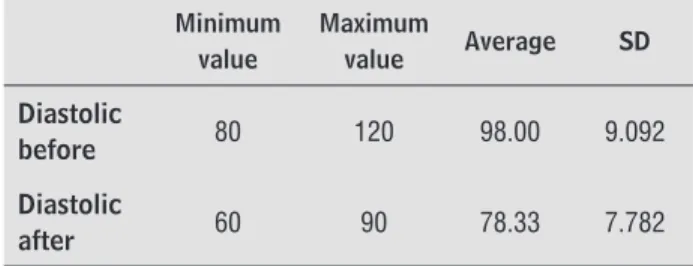
There were participants with an average of years old SD = . , with a predominance of fe-male participants . % . As observed on the data obtained, when the project started, the participants had an average systolic blood pressure of . mm(g Table and the diastolic pressure of mm(g Table . After participating in developed body practices, the elderly had an average systolic pressure of mm(g and diastolic blood pressure of . mm(g, but the association was statistically significant only for systolic pressure p . .
Lima et al. (18) when evaluated the effectiveness of aerobic exercise to control blood pressure in hyper-tensive postmenopausal women found similar results.
369
pressure in hypertensive individuals and decreasing – mm(g and – mm(g for systolic and diastolic, respectively, in normotensive .
Study of hypertensive patients in stages ) and )), undergoing a light training for eight weeks in gyms, found that there was a significant reduction in blood pressure in all of them, and the elderly showed lower reduction in blood pressure that young indi-viduals . This fact can be explained by structural and functional changes in the heart and vessels, and changes in the autonomic nervous system that ac-company aging , , physical activity being even more important in this population.
The results of the study by Silva et al. high-lighted the value of physical activity in achieving a better quality of life. This contribution occurs, since it minimizes the degeneration caused by aging and stimulates the essential body functions.
Regular physical activity practice retains higher levels of functional capacity and especially in the cardiovascular function , , , reducing anxi-ety, stress, contributing to the improvement of sleep
disorder, invigorating the energy and providing well-being and quality of life for its practitioners, work-ing in the prevention and treatment of psychological morbidity , .
Regarding the glycemic index among the studied elderly, there was a significant reduction in the av-erage of blood glucose in the pre-intervention and post-intervention, from . mgdL to . mgdL, respectively Table .
Diabetes mellitus is one of the public health prob-lem diseases by the high prevalence in the world and higher among the elderly, by the morbidity and for being one of the main cardiovascular and cerebro-vascular risk factors .
The beneficial effect of exercising for health is re-lated to the ability to fight diabetes by increasing the sensitivity of cells to insulin and by stimulating the metabolism of carbohydrates .
Study by Silva and Lima found chronic blood glucose reduction by a regular exercise program, and states that individuals with type diabetes mellitus DM have their blood glucose decreased by acute effect of physical exercise, shown in glucose hair, which was collected before and after workout. Thus, he demonstrates the importance of physical activity also in the control of metabolic diseases.
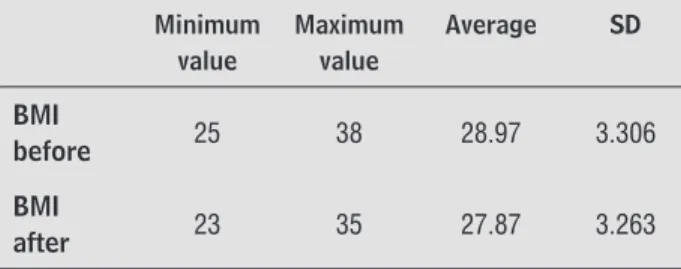
The anthropometric evaluation of BM) showed that elderly have a high prevalence of overweight/ obesity before the intervention program. After the program, there was a significant reduction in BM) of the participants, as shown in Table . The study by Silva and Lima demonstrated that the effect of physical exercise program in BM) was significant, leading to a slight decrease of . kg/m in average BM) in the group.
Overweight and obesity are important public health problems, because besides being related to Table 1 - Systolic blood pressure scores of ESF users
before and after an intervention program in SUS, Iguaí, 2010 (n = 30)
Mi nimum value
Maximum value
Average SD
Systolic
before 130 230 167.33 23.228
Systolic
after 90 150 120.00 14.606
Note: F = 4.48; p = 0.003.
Table 2 - Diastolic blood pressure scores of ESF users before and after an intervention program in the SUS, Iguaí, 2010 (n = 30)
Minimum value
Maximum
value Average SD
Diastolic
before 80 120 98.00 9.092
Diastolic
after 60 90 78.33 7.782
Note: F = 0.492; p = 0.742.
Table 3 - Glycemic index of ESF users before and after an intervention program in SUS, Iguaí, 2010 (n = 30)
Minimum value
Maximum value
Average SD
Glycemic
before 83 309 133.87 46.199
Glycemic
after 69 167 100.47 23.906
a number of chronic diseases, its gradual increase occurs continuously from childhood to adulthood, and in recent years a major challenge for researchers and health professionals . The physical exercise has proven an important factor in the prevention and control of overweight and obesity .
Table 4 - Body Mass Index (BMI) of ESF users before and after an intervention program in SUS, Iguaí, 2010 (n = 30)
Minimum value
Maximum value
Average SD
BMI
before 25 38 28.97 3.306
BMI
after 23 35 27.87 3.263
Note: F = 7.66 p < 0.001.
Physical activity facilitates the performance of activities of daily living functional capacity , re-duces the frequency of chronic venous diseases responsible for the significant decline in labor pro-ductivity, generating retirement or disability, and restricting the activities of daily living and leisure also influencing the treatment and prevention of diseases, providing an improvement of general well-being .
The proposed intervention covers aspects of modern health promotion, in healthy lifestyle and a suitable spectrum of health care , not taking into account only the individual but the collective.
)ncreased access to the population to physical activity programs within the primary care becomes an important strategy. The Brazilian health system through the Unified (ealth System SUS provides citizens with universal access to health services and – % of the population, approximately, have access to health care, mainly through the (ealth Strategy family. This broad access is fertile ground for implementation of physical activity and other non-medicinal practices health care programs.
The Ministry of (ealth has advanced, offering financial options for specific programs such as Corporal Practices Project of coping with diseases and non-communicable diseases, which was the
object of this study and programs with the pos-sibility of continuity such as health clubs.
)t is observed that the promotion of physical activity has become a government priority in the country. Since the health promotion policy in , cities have been encouraged to develop physical ac-tivity interventions .
Funding was an important aspect for the success of this intervention, the resources by the Ministry of (ealth helped hiring physical education teachers and the purchase of materials for the execution of project´s activities. The possibility of expanding the family health team, with professional incorporation with specific training for the development of physi-cal activity programs favors the implementation, as identified by Florindo et al. that the minimum professional team of family health in Brazil has a very superficial knowledge about physical activity.
A negative aspect was the insufficient participa-tion in the intervenparticipa-tion; only users were includ-ed, the requirement of funding notice of the choice program of direct actions for users with chronic diseases for the city studied the diseases were diabetes and hypertension , the schedules of ac-tivities were limiting factors of the expansion of the project's to a larger number of users. )t is speculated that the popular mobilization observed during the intervention and the empowerment of participating users with in the understanding of the importance of physical activity is an aspect that can contribute to the expansion and continuation of the program by the municipal government.
Another limitation of this study may be related to not having been constituted a control group for comparison with the group that participated in the proposed program.
(owever, despite the limitations, the study dem-onstrated the importance of developing physical activity intervention programs in the populations assisted by the Family (ealth Strategy, emphasiz-ing its contribution as non-medication treatment modality for hypertension and diabetes.
Final considerations
371 the project Strategic actions of physical activity as
non-medication therapy modality in prevention and control of patients with hypertension and diabetes in the city of )guaí-Bahia , indicates that such integration may be useful for decreasing the morbidity resulting from DANTs in the population.
Although it is recommended that physical activ-ity is important for health, prescription of physical activity by health professionals of these units is still insufficient to promote changes in the attitude of people in relation to physical activity. )t can be also concluded that the USFs are not meeting the needs of users in relation to physical activity as a health promotion tool.
The progress of prevention work is being viewed. )t was possible to change the habit of a group of sed-entary people, but it is necessary that the projects have sustainability to continue with its development, since other results will be observed in long-term, such as the reduction of hospitalizations for chronic com-plications of hypertension and diabetes and it is also necessary to spread to all the Family (ealth Units, involving the community.
References
. Brasil. Ministério da Saúde. Secretaria de Atenção à Saúde. Departamento de Atenção Básica. (iperten-são arterial sistêmica para o Sistema Único de Saúde. Brasília: Ministério da Saúde; .
. Brasil. Ministério da Saúde. DATASUS. [cited July ]. Available from: http://www .datasus. gov.br/DATASUS/index.php
. Brasil. Ministério da Saúde. Secretaria de Atenção à Saúde. Departamento de Atenção Básica. Diabetes Mellitus. Brasília: Ministério da Saúde; . . Monteiro CA, Conde WL, Matsudo SM, Matsudo VR,
Bonseñor )S, Lotufo PAA. Descriptive epidemiology of leisure-time physical activity in Brazil, – . Rev Panam Salud Publica. ; : - . . Malta DC, Cezário AC, de Moura L, de Morais Neto OL,
da Silva Junior JB. A construção da vigilância e preven-ção das doenças crônicas e agravos não transmissíveis no contexto do Sistema Único de Saúde. Epidemiol
Serv Saúde. ; : - .
. Baretta E, Baretta M, Peres KG. Nível de atividade físi-ca e fatores associados em adultos no Município de Joaçaba, Santa Catarina, Brasil. Cad Saúde Publica.
; : - .
. (allal PC, Victora CG, Wells JCK, Lima RC. Physical inac-tivity: prevalence and associated variables in Brazilian adults. Med Sci Sports Exerc. ; : - . . Pitanga FJG, Lessa ). Prevalência e fatores associa-dos ao sedentarismo no lazer em adultos. Cad Saúde
Pública. ; : - .
. Rocha, SV, de Almeida MMG, de Araújo TM, Virtuoso Junior JS. Fatores associados à atividade física no lazer entre residentes de áreas urbanas de um município do nordeste do Brasil. Rev Bras Cineantropom
Des-empenho (um. ; : - .
. Medronho RA, Medronho RA, Bloch KV, Luiz RR, Werneck GL. Epidemiologia. . ed. São Paulo:
Atheneu; .
. )nstituto Brasileiro de Geografia e Estatística. Censo demográfico. Brasília: )BGE; .
. Ferraz DP, Maia FFR, Araújo LR. Glicemia capilar em ponta do dedo versus lóbulo de orelha: estudo com-parativo dos valores resultantes e preferências dos pacientes. Arq Bras Endocrinol Metab. ; :
- .
. World (ealth Organization. The world report : life in the st century — a vision for all. Geneva:
W(O; .
. Craig CL, Marshall AL, Sjöström M, Bauman AE, Booth ML, Ainsworth BE, et al. )nternational Physical Activ-ity Questionnaire: -country reliabilActiv-ity and validActiv-ity. Med Sci Sports Exerc. ; : - .
. Pardini R, Matsudo SM, Araújo T, Matsudo V, Andrade E, Braggion G, et al. Validação do questionário interna-cional de nível de atividade física )PAQ – versão : estudo piloto em adultos jovens brasileiros. Rev Bras Ciên e Mov. ; : - .
. Matsudo SMM, Matsudo VKR. Prescrição de exercícios e benefícios da atividade física na terceira idade. Rev Bras Ciên e Mov. ; : - .
. Lima MMO, Britto RR, Baião EA, Alves GS, Abreu
CDG, Parreira VF. Exercício aeróbico no controle da hipertensão arterial na pós-menopausa. Fisioter Mov.
. Barroso WKS, Jardim PCBV, Vitorino PV, Bittencourt A, Miquetichuc F. )nfluência da atividade física pro-gramada na pressão arterial de idosos hipertensos sob tratamento não-farmacológico. Rev Assoc Med
Bras. ; : - .
. Kenney MJ, Seals DR. Postexercise hypotension. Key features, mechanisms and clinical significance.
(y-pertension. ; : - .
. )shikawa (O, Ayukawa T, Nakayama M, (igashi S, Ka-miyama S, Nishihara S, et al. Two pathways for import-ing GDP-fucose into the endoplasmic reticulum lumen function redundantly in the O-fucosylation of Notch in Drosophila. J Biol Chem. ; : - . . Cheitlin MD. Cardiovascular physiology-changes with
aging. Am J Geriatr Cardiol. ; : - . . O’Rourke MF, (ashimoto J. Mechanical factors in
ar-terial aging: a clinical perspective. J Am Coll Cardiol.
; : - .
. da Silva EB, Krug MR, Giordani MC. Nível de atividade física e qualidade de vida dos usuários assistidos pela Estratégia de Saúde da Família do Município de Cruz Alta/RS. Revista Digital Buenos Aires . [cited , July ]; . Available from: http://www. efdeportes.com/efd /atividade-fisica-pela-estrate-gia-de-saude-da-familia.htm
. Nahas MV. Atividade física, saúde e qualidade de vida: conceitos e sugestões para um estilo de vida ativo.
. ed. Londrina: Midiograf; .
. Matsudo SM, Matsudo VKR, de Barros Neto TL.)mpacto do envelhecimento nas variáveis antropométricas, neuromotoras e metabólicas da aptidão física. Rev Bras Ciên Mov. ; : - .
. Pickles B, Ann C, Janet CCS, Vander VA. Fisioterapia na terceira idade. . ed. São Paulo: Santos; . . Reijneveld S, Westhof W, (opman-Rock M. Promotion
of health and physical activity improves the mental health of elderly immigrants: results of a group ran-domized controlled trial among Turkish immigrants in the Netherlands aged and over. J Epidemiol
Com-munity (ealth. ; : - .
. Gerber M, Puhse U. Dont crack under pressure! — Do leisure time physical activity and self-esteem mod-erate the relationship between scholl-based stress and psychosomatic complaints? J Psychosom Res.
; : - .
. Sartorelli DS, Franco LJ. Tendências do diabetes mel-litus no Brasil: o papel da transição nutricional. Cad Saúde Pública. ; Suppl : - .
. Milhomem FC(. Atividade física para preven-ção e controle da hipertensão arterial em adultos.
; / : - .
. da Silva CA, de Lima WC.Efeito benéfico do exercí-cio físico no controle metabólico do diabetes melli-tus tipo à curto prazo. Arq Bras Endocrinol Metab.
; : - .
. Amer NM, Marcon SS, Santana RG. Índice de mas-sa corporal e hipertensão arterial em indivíduos adultos no Centro-Oeste do Brasil. Arq Bras Cardiol.
; : - .
. World (ealth Organization. World health day . Sedentary lifestyle: a global public health problem. [cited , Nov ]. Available from: http:// www.who.int/world-health-day/.
. Júlio CP, Luciana BM. Existe associação entre doenças venosas e nível de atividade física em jovens? Fisioter
Mov. ; : - .
. Buss PM. Promoção da saúde e qualidade de vida. Ciênc Saúde Coletiva. ; : - .
. Florindo AA, Mielke G), Gomes GA, Ramos LR, Brac-co MM, Parra DC, et al. Physical activity Brac-counseling in primary health care in Brazil: a national study on prevalence and associated factors. BMC Public (ealth.
; : .
Received: / / Recebido: / /