J Pediatr (Rio J). 2013;89(1):75−82
0021-7557/$ - see front matter © 2013 Sociedade Brasileira de Pediatria. Published by Elsevier Editora Ltda. All rights reserved. http://dx.doi.org/10.1016/j.jped.2013.02.012
www.jped.com.br
☆Please, cite this article as: Melo AM, Kassar SB, Lira PI, Coutinho SB, Eickmann SH, Lima MC. Characteristics and factors associated with health care in children younger than 1 year with very low birth weight. J Pediatr (Rio J). 2013;89:75-82.
* Corresponding author.
E-mail: [email protected] (A.M.C. Melo).
ORIGINAL ARTICLE
Characteristics and factors associated with health care in children
younger than 1 year with very low birth weight
☆Ana M.C. Melo
a,*, Samir B. Kassar
b, Pedro I.C. Lira
c, Sônia B. Coutinho
d,
Sophie H. Eickmann
e, and Marilia C. Lima
fa MSc, Child and Adolescent Health. Neonatologist, Neonatal Intensive Care Unit, Hospital Universitário Professor
Alberto Antunes, Universidade Federal de Alagoas (UFAL), Maceió, AL, Brazil
b PhD, Child and Adolescent Health. Adjunct Professor, Department of Pediatrics, Universidade Estadual Ciências
da Saúde de Alagoas (UNCISAL), Maceió, AL, Brazil
c PhD. Full Professor, Department of Nutrition, Universidade Federal de Pernambuco (UFPE), Recife, PE, Brazil
d PhD, Nutrition. Associate Professor, Department of Maternal and Child Health, UFPE, Recife, PE, Brazil
e PhD, Nutrition. Adjunct Professor, Department of Maternal and Child Health, UFPE, Recife, PE, Brazil
f PhD. Adjunct Professor, Department of Maternal and Child Health, UFPE, Recife, PE, Brazil
Received 24 March 2012; accepted 25 July 2012
KEYWORDS
Very low birth weight newborn;
Health care; Child care;
Socioeconomic factors
Abstract
Objectives:To identify the characteristics of health care in infants with very low birth
weight during the first year of life and the factors associated with this care.
Methods: This was a descriptive study with an analytical component conducted in the
city of Maceió, Northeastern Brazil, with a sample of 53 children with a median age of five months at the time of the interview, and their mothers. The mothers were interviewed at home regarding socioeconomic and demographic data and health care provided for the child. Health care was assessed through an index using 16 variables related to the recommended actions for this type of care.
Results: Multivariate linear regression analysis showed that maternal education and family
income were the variables that best explained the health care index variation (18.9%), followed by parity (6.6%), and breastfeeding at the time of the interview (6.9%).
Conclusions:Considering that families with lower socioeconomic status, women with a
higher number of children, and women who did not breastfeed were factors associated with poor health care of children born with very low birth weight, these variables should be included in measures of public health planning.
Introduction
The increase in the survival rate of premature infants, especially among infants with very low birth weight (VLBW), has been observed in developed and developing countries.1,2 The vulnerability of these infants, and the risk
of death and incidence of sequelae resulting from birth circumstances call attention to the need for follow-up and evaluation of the long-term prognosis.3-7
Knowledge of clinical circumstances and provision of care include support for difficulties in growth, development, and nutrition;8 retinopathy9,10 and hearing problems;11 assistance
for respiratory problems;12 and special immunization
recommendations.13
The care of children with VLBW is a current focus of interest and concern, as their survival reflects the structure of care for pregnant women and newborns in different regions of the world. A differentiated service to this group of children is recommended by the Department of Health Care of the Brazilian Ministry of Health, which recommends the following: prioritizing assistance in a responsive, timely, and articulated way until complete recovery has been achieved; communication between levels of care through reports and the child’s medical records; guidance to the mother and family from the prenatal period onwards. In this sense, the Brazilian experience with the policy of humanization for premature newborns is also based on the reception of the baby and the mother even after hospital discharge, with a follow-up program that includes regular consultations and active search or home visits if necessary; ophthalmologic and auditory function revaluation should also be included, as well as verifications of the vaccination schedule for premature infants.14
The neonatal intensive care units of the public healthcare
sector were implemented in Alagoas in 1996; since then, no
study has been performed on the health care provided to children with VLBW after discharge. Studies performed with standardized tools in Brazil for such monitoring were not found, with isolated evaluations of respiratory, ophthalmologic, growth, and development disorders.12,15-17
Therefore, this study aimed to identify the characteristics of health care for children with VLBW during the first year of life, by checking the guidelines provided to mothers in the neonatal unit, the minimum resources provided at the unit to enable outpatient follow-up, the frequency of assistance after hospital discharge, and the factors associated with this assistance.
Methods
Study site
The study was carried out in Maceió, capital of the state of Alagoas, Brazil, which has a population of approximately
924,000 inhabitants distributed in 511 km2. The city has 12
hospitals, two public and ten private, seven of which have an agreement to provide care through the National Unified Health System (Sistema Único de Saúde - SUS). Hospital beds for intensive and intermediate neonatal care do not meet the demand of the population; currently, only the neonatal units in the two university hospitals are available to provide care for newborns from SUS, and three other units provide care to patients with health insurance and private care patients.18 In 2010, the percentage of children
with low birth weight in Maceió was 8.4%, of which 6.6% were preterm, and 1.2% VLBW.19
The specialized follow-up of at-risk infants after hospital discharge in public health care is only offered by the Departments of Pediatrics of the Universidade Federal PALAVRAS-CHAVE
Recém-nascido de muito baixo peso; Assistência à saúde; Cuidado da criança; Fatores
socioeconômicos
Características e fatores associados à assistência à saúde de crianças menores de um ano com muito baixo peso ao nascer
Resumo
Objetivos:Identificar as características da assistência à saúde de lactentes com muito
baixo peso ao nascer no primeiro ano de vida e os fatores associados a esta atenção.
Métodos: Estudo descritivo com componente analítico foi realizado na cidade de Maceió,
Nordeste do Brasil, com uma amostra de 53 crianças com idade mediana de cinco meses na época da entrevista, e suas respectivas mães. As mães foram entrevistadas no domi-cílio, quanto às condições socioeconômicas, demográficas e de assistência à saúde da criança. A atenção à saúde foi avaliada com a elaboração de um índice utilizando 16 variáveis relacionadas às ações preconizadas para esta assistência.
Resultados: A análise de regressão linear multivariada mostrou que a escolaridade
mater-na e a renda familiar foram as variáveis que, juntas, melhor explicaram a variação do
Índice de Atenção à Saúde (18,9%), seguidas da paridade (6,6%) e da prática do aleita
-mento materno na época da entrevista (6,9%).
Conclusões: Considerando que as famílias com piores condições socioeconômicas e as
Healthcare of very low birth weight infants 77
and of the Universidade Estadual de Alagoas. Primary care is offered in 56 basic health units (BHUs), of which 17 function as general health units, 32 as family health units, and 7 as mixed units, distributed in 7 health districts. The
Family Health Strategy consists of 79 teams, and covers 26% of the population of Maceió. The city also has a central
medical unit in the downtown area, not linked to any specific district, where there is a public early stimulation service.
Study design and sampling
This is an observational, descriptive study with an analytical component, conducted with mothers and children born and living in Maceió with VLBW (< 1,500 g) and who survived until the time of the interview. During the period of data collection, the Municipal Health Secretariat of Maceió received 73 certificates of live births resulting from single gestations weighing less than 1,500 g, living in Maceió,
and who did not die in the neonatal period. A total of 18 children were lost (24.6%): 15 addresses were not found,
three mothers no longer resided in the capital; additionally 2 children had died after hospital discharge, before the time of the interview. Therefore, the study sample consisted of 53 children and their mothers.
These children belonged to the control group of a case-control study that aimed to identify factors related to health care for pregnant women and newborns that contribute to neonatal mortality in Maceió. The birth of twins was used as an exclusion criterion for this study due to the high neonatal mortality rate in this group.
Data collection
A pilot study was carried out with 10 mothers in order to assess the quality of the interview questions and the interviewer training. Data collection was then started with a team of four interviewers, employees of the Municipal Health Secretariat and members of Maceió Program of Infant Mortality Reduction, which occurred from March,
2007 to July, 2008.
The ratio of births and neonatal deaths was obtained weekly from the surveillance coordination of children’s deaths from the Municipal Health Secretariat of Maceió by a research assistant, when the addresses of children born weighing < 1,500 g were collected. A home visit was then conducted, and mothers were interviewed using forms with closed, pre-coded questions to obtain data on socioeconomic, demographic, maternal and reproductive health factors, biological characteristics of the child at birth, and health care provided. The mean age of the children at the time of the maternal interview was 5 months (SD = 2.5) with a median of 5 months (Quartiles: 25 = 4, and 75 = 6).
During data collection, a biweekly meeting was conducted at the Municipal Health Secretariat of Maceió with the team of interviewers to review the questionnaires and correct inconsistencies. Occasional visits to the hospitals were necessary in order to obtain supplementary data from the medical charts, especially on gestational age. According to the hospital routine, children are weighed
shortly after birth, using the Capurro or Ballard methods to assess gestational age, and Lubchenco fetal growth curves are used to assess the adequacy of birth weight in relation to gestational age. Information was also obtained from the mother’s chart, from the child’s medical records, from the medical report at the discharge, and at time of interview.
Maternal socioeconomic, demographic and
reproductive health data
Age, schooling, per capita family income, availability of health insurance, cohabitation with the child’s father, number of people residing in the house, maternal occupation, prenatal care, parity, and breastfeeding at the time of the interview were assessed.
Newborn’s biological and health factors
Birth weight, gender, gestational age, weight classification according to gestational age, length of hospitalization, incidence of rehospitalization, and child’s age at the time of the interview were assessed.
Health care index of children with very low birth
weight
The index used to assess the health care of children with VLBW was prepared with the variables related to the recommended measures in health care, subdivided into three areas:
Maternal instruction at neonatal unit: participation
in family support groups, instructions on recognizing signs of risk that call for immediate care, breastfeeding encouragement, individualized care and handling (hygiene, position in the crib to sleep, colic and regurgitation).
Follow-up resources: discharge report, with clear
handwriting and understandable to the interviewer; consultations scheduled in the outpatient clinic for follow-up after hospital discharge.
Health care practices after discharge: weight control
until the eighth day after discharge (information in child’s medical record), newborn screening test and screening for hearing impairment, updated vaccination schedule, use of special immunobiological agents, iron and vitamin supplementation, consultation with pediatrician and ophthalmologist.
The variables related to health care consisted of 16 items and were coded with zero (0) in the absence of assistance and with one (1) when present. The total sum of positive codes resulted in an index that ranged from 0 to 16. The assessment of internal consistency reliability of the items that comprised this index, verified through the Cronbach alpha coefficient, was 0.72.
Data processing and analysis
Data quality regarding the completion of the questionnaires
was performed regularly with partial repetition of 5% of the
The health care index (HCI) of children with VLBW was analyzed as a continuous variable. The association between the explanatory variables with the HCI was verified by
analysis of variance. A value of p ≤ 0.05 was considered
statistically significant.
Multivariate linear regression analysis was performed using the hierarchical model of entry of the explanatory variables that showed a p-value < 0.20 in the bivariate analyses. In model 1, the socioeconomic variables (family income, maternal education, and availability of health plan) were introduced; in model 2, the number of prenatal consultations, parity, and breastfeeding practices; and in model 3, the child’s age and length of stay in the neonatal unit. Analyses were performed using the Statistical Package for the Social Sciences (SPSS), release 13.0, employing the “Enter method” to enter variables in the models.
Ethical considerations
This project was approved by the Ethics Committee of the
Universidade Federal de Alagoas, Case No. 000439/2008-49.
The mothers were interviewed after receiving explanation of the research objectives and signing an informed consent.
Results
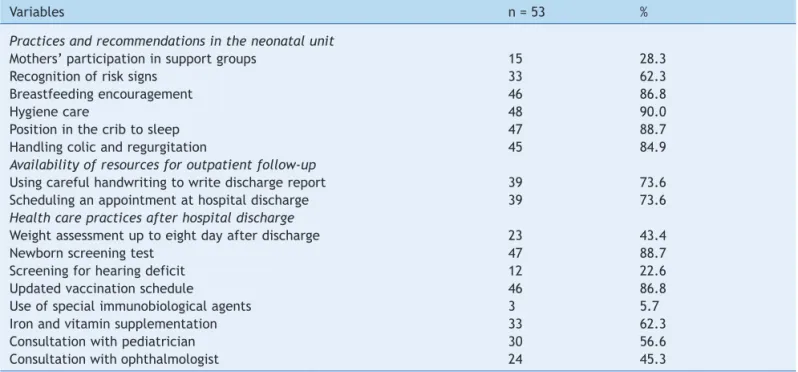
Table 1 shows the frequency at which some actions recommended in the care of children with VLBW were performed during their stay in the neonatal unit and after discharge. This table shows the low percentage of participation of mothers in support groups for families
of preterm newborn (28%) and of the use of special immunobiological agents (6%). The HCI of children with
VLBW, derived from these data, showed a mean of 10.0
points (SD = 2.9).
Table 2 shows that children whose mothers had lower schooling and per capita income had significantly lower mean HCI. The same was observed among mothers with four or fewer prenatal visits, those with two or more children, and those who did not breastfeed at the time of the interview.
Table 3 shows that children who remained hospitalized in neonatal units for more than 30 days showed a significantly lower mean HCI when compared to those who had a shorter hospitalization.
The multivariate linear regression analysis showed that maternal schooling and family income were the variables
that together best explained HCI variation (18.9%), followed by parity (6.6%), and breastfeeding (6.9%) (Table 4).
Discussion
This research was conducted in the capital of Alagoas, a state with large disparities in the distribution of wealth and a low human development index. Among the health indicators, infant mortality among the residents of Maceió
in the year 2010 was 16.1/1,000 live births, and 66.4%
of these deaths occurred in the neonatal period. The
percentage of children with VLBW who died was 11%; however, there was underreporting of birth weight in 22.4%
of the infant death certificates.20
The combination of indicators related to practices and guidelines offered to mothers in the neonatal unit, the availability of resources to facilitate follow-up, and the implementation of care practices after hospital discharge in an index of health care of children with VLBW, allowed
Table 1 Frequencies of recommended actions performed for the care of children with very low birth weight.
Variables n = 53 %
Practices and recommendations in the neonatal unit
Mothers’ participation in support groups 15 28.3
Recognition of risk signs 33 62.3
Breastfeeding encouragement 46 86.8
Hygiene care 48 90.0
Position in the crib to sleep 47 88.7
Handling colic and regurgitation 45 84.9
Availability of resources for outpatient follow-up
Using careful handwriting to write discharge report 39 73.6
Scheduling an appointment at hospital discharge 39 73.6
Health care practices after hospital discharge
Weight assessment up to eight day after discharge 23 43.4
Newborn screening test 47 88.7
Screening for hearing deficit 12 22.6
Updated vaccination schedule 46 86.8
Use of special immunobiological agents 3 5.7
Iron and vitamin supplementation 33 62.3
Consultation with pediatrician 30 56.6
Healthcare of very low birth weight infants 79
for the assessment of the associated markers. Although the factors of this index had a satisfactory internal validation, it needs to be validated for its accuracy to identify the quality of health care offered to children with VLBW.
Among the socioeconomic conditions analyzed as possible determinants of children’s health care, low maternal education and family income were identified as markers for a lower mean HCI. The literature shows that socioeconomic factors determine the use of health services, and the differences observed in the quality of care between groups of countries demonstrate the importance of policies and local health systems. In countries with varying levels of development, where access is universal, the population of lower socioeconomic status has greater access to services when compared to countries where access is not favorable.21 In Brazil, the SUS has universal accessibility as
one of its principles; however, in this study, it did not act as an effect modifier, thus contributing to the inequity among
VLBW children from different socioeconomic groups that used the complementary system of health insurance.
The mothers with inadequate prenatal care also presented a lower mean HCI in the bivariate analysis; it appears that the accessibility barriers start from the health care offered to pregnant women. It is important to emphasize that mothers who had worse prenatal care had a worse socioeconomic and educational status; therefore, they are more vulnerable to lower mean HCI. However, probably due to sample size, this variable lost statistical significance in
the multivariate analysis (p = 0.09).
A similar result was observed regarding the number of children, showing that families with two or more children also had a lower mean HCI. It is probable the longer periods of time devoted to domestic activities in larger families may have limited maternal stay in the neonatal unit and their search for health services after discharge. According to the literature, the family size and structure are associated with the use of health services, but the direction of the effect
Table 2 Mean health care index in children with very low birth weight, according to the maternal demographic and
socioeconomic characteristics.
Variables Total Health care index
n % Mean SD p
Maternal degree of schooling (years)
0-4 12 22.6 8.2 3.5 0.01
≥ 5 41 77.4 10.6 2.5
Per capita family income (MW)
< 0.25 20 37.7 8.8 3.2 0.02
≥ 0.25 33 62.3 10.8 2.5
Health care insurance availability
No 44 83.0 9.6 2.9 0.03
Yes 9 17.0 11.9 1.8
Lives with baby’s father
No 16 30.2 9.3 3.0 0.25
Yes 37 69.8 10.3 2.8
Number of people at home
≥ 5 11 20.8 9.3 3.2 0.34
< 5 42 79.2 10.2 2.8
Maternal age (years)
≥ 20 39 73.6 9.7 3.0 0.21
< 20 14 26.4 10.9 2.4
Maternal occupation
Homemaker 31 58.5 9.6 2.5 0.23
Works outside the home 22 41.5 10.6 3.3
Prenatal consultations
≤ 4 31 58.5 9.2 3.3 0.02
> 4 22 41.5 11.1 1.8
Parity
≥ 2 22 41.5 8.8 3.2 0.01
1 31 58.5 10.9 2.3
Breastfeeding at the time of interview
No 31 58.5 9.3 3.1 0.02
Yes 22 41.5 11.1 2.2
depends on the country studied.22 In this study, the health
system failed to promote equity, although that is one of the principles of SUS.
Table 3 Mean health care index according to the characteristics of children born with very low birth weight.
Variables Total Health care index
n % Mean SD p
Birth weight (g)
≥ 1,250 35 66.0 9.9 2.9 0.64
< 1,250 18 34.0 10.3 2.9
Gender
Female 31 58.5 9.9 3.1 0.66
Male 22 41.5 10.2 2.6
Gestational age (weeks)
≥ 35 6 11.3 8.8 4.3 0.29
< 35 47 88.7 10.2 2.7
Weight/gestational age classification
AGA 41 77.4 9.9 2.7 0.59
SGA 12 22.6 10.4 3.6
Duration of NICU stay (days)
≥ 30 27 50.9 9.1 3.3 0.02
< 30 26 49.1 10.9 2.1
Rehospitalizations
Yes 6 11.3 8.7 5.2 0.23
No 47 88.7 10.2 2.5
Age (months)
1-5 35 66.0 9.6 3.1 0.12
6-12 18 34.0 10.9 2.3
AGA, adequate for gestational age; NICU, neonatal intensive care unit; SD, standard deviation; SGA, small for gestational age.
Table 4 Multivariate linear regression analysis of factors associated with the health care index of children born with very low
birth weight.
Variables ba not adjusted p b adjusted 95% CI p R2 b %
Model 1
Maternal degree of schoolingc
0-4 years −2.4 0.01 −2.0 (−3.8; −0.2) 0.03 12.2 (12.2)
Per capita family incomec
< 0.25 MW −2.0 0.02 −1.6 (−3.1; −0.1) 0.05 6.7 (18.9)
Model 2
Prenatal consultationsc
≤ 4 −1.9 0.02 −1.3 (−2.8; 0.2) 0.09 3.7 (22.6)
Parityc
≥ 2 −2.1 0.01 −1.4 (−2.8; −0.1) 0.05 6.6 (29.2)
Breastfeedingc
No −1.8 0.02 −1.6 (−3.0; −0.2) 0.03 6.9 (36.1)
Model 3 Agec
1-5 months −1.3 0.12 −1.0 (−2.5; 0.5) 0.18 2.5 (38.6)
95% CI, 95% confidence interval.
a Non-standardized coefficient of regression. b Coefficient of determination.
c Reference categories for the categorical variables:
maternal degree of schooling: ≥ 5 years; per capita family income: ≥ 0.25 minimum wage (MW); prenatal consultations: > 4; parity: 1; breastfeeding: Yes; Age: 6 – 12 months
Model 1 adjusted by health insurance availability.
Model 3 adjusted by duration of neonatal intensive care unit stay.
Most mothers reported receiving encouragement to
breastfeed; however, 59% of them did not breastfeed their
Healthcare of very low birth weight infants 81
with a lower mean HCI, which demonstrated the limited effectiveness of this action in the studied population. Maternal motivation and support received for breastfeeding are essential to extend the duration of breastfeeding, an essential strategy to reduce child morbimortality.23,24 The
factors that drive maternal care for the newborn derive from maternal concern, responsibility, and maturity. This requires, in addition to the social-cognitive process, the involvement of health professionals to favor the safe participation of the mother as early as in the neonatal unit.25 The strengthening of the emotional bonds between
mothers and children, secondary to breastfeeding, may also produce a feeling of protection, stimulating a greater care for the child’s health.
Some of the study limitations were the difficulty to standardize the dates of the interviews due to the unavailability of live birth certificates in the first weeks after birth, and the incomplete recording and lack of reference points in most addresses, which may have contributed to a maternal recall bias among those who were interviewed later. In order to attenuate these biases, interviewers obtained information from prenatal care reports, the child’s medical records, and discharge reports during the interviews. It should also be considered that, since some health actions depended on the age of the child, those who were interviewed later had a greater chance of presenting better HCI scores. However, this was not observed when analyzing the association between age of the child at the time of the interview with health care actions.
The recognition of the importance of socioeconomic factors influencing the inadequate health care to children with VLBW in Maceió can help professionals and health managers to understand their social reality and to identify health actions that should be incorporated into this service, aiming at better health promotion in this group of children.
In conclusion, the need for a special attention to the health care of children with VLBW in Maceió should be stressed, since this group has a high risk for biological and psychosocial disorders. Health services need to be engaged in order to adequately promote this attention, providing resources that will enable them to attain satisfactory development. In the humanized care recommended by the Brazilian Ministry of Health, the early follow-up of these infants in the hospitals where they were born is included as a step in the kangaroo care method.14,26 However, the
neonatal units also need to carry out joint, routine work with the primary health care,27 providing data that can
facilitate monitoring after discharge.
Conlicts of interest
The authors have no conflicts of interest to declare.
Acknowledgements
Conselho Nacional de Desenvolvimento Científico e Tecnológico (CNPq) for funding this research, and for the productivity grants given to Pedro Lira and Marilia Lima.
References
1. Hahn WH, Chang JY, Chang YS, Shim KS, Bae CW. Recent trends in neonatal mortality in very low birth weight Korean infants: in comparison with Japan and the USA. J Korean Med Sci. 2011;26:467-73.
2. Castro EC, Leite AJ. Hospital mortality rates of infants with birth weight less than or equal to 1,500 g in the Northeast of Brazil. J Pediatr (Rio J). 2007;83:27-32.
3. Rugolo LM. Crescimento e desenvolvimento a longo prazo do prematuro extremo. J Pediatr (Rio J). 2005;81:S101-10. 4. Gäddlin PO, Finnström O, Hellgren K, Leijon I. Hospital
readmissions and morbidity in a ifteen-year follow-up of very low birthweight children in Southeast Sweden. Acta Paediatr. 2007;96:499-505.
5. Farooqi A, Hägglöf B, Sedin G, Serenius F. Impact at age 11 years of major neonatal morbidities in children born extremely preterm. Pediatrics. 2011;127:e1247-57.
6. Kelly MM. Primary care issues for the healthy premature infant. J Pediatr Health Care. 2006;20:293-9.
7. de Kleine MJ, den Ouden AL, Kollée LA, Nijhuis-van der Sanden MW, Sondaar M, van Kessel-Feddema BJ, et al. Development and evaluation of a follow up assessment of preterm infants at 5 years of age. Arch Dis Child. 2003;88:870-5.
8. Wang CJ, McGlynn EA, Brook RH, Leonard CH, Piecuch RE, Hsueh SI, et al. Quality-of-care indicators for the neurodeve-lopmental follow-up of very low birth weight children: results of an expert panel process. Pediatrics. 2006;117:2080-92. 9. van Sorge AJ, Termote JU, de Vries MJ, Boonstra FN, Stellingwerf
C, Schalij-Delfos NE. The incidence of visual impairment due to retinopathy of prematurity (ROP) and concomitant disabilities in the Netherlands: a 30 year overview. Br J Ophthalmol. 2011; 95:937-41.
10. Başmak H, Niyaz L, Sahin A, Erol N, Gürsoy HH. Retinopathy of prematurity: screening guidelines need to be reevaluated for developing countries. Eur J Ophthalmol. 2010;20:752-5. 11. Tiensoli LO, Goulart LM, Resende LM, Colosimo EA. Hearing
screening in a public hospital in Belo Horizonte, Minas Gerais State, Brazil: hearing impairment and risk factors in neonates and infants. Cad Saúde Pública. 2007;23:1431-41.
12. de Mello RR, Dutra MV, Lopes JM. Morbidade respiratória no primeiro ano de vida de prematuros egressos de uma unidade pública de tratamento intensivo neonatal. J Pediatr (Rio J). 2004;80:503-10.
13. Calderón CG, Moore VR, Pittaluga PE, Potin SM. Adherence to immunizations in newborns less than 1500 gr at birth and/or younger than 32 weeks, in two Chilean centers. Rev Chilena Infectol. 2011;28:166-73.
14. Brasil. Ministério da Saúde. Atenção humanizada ao recém-nascido de baixo peso. Método mãe-canguru. Área de Saúde da Criança. 2ª ed. Brasília: Ministério da Saúde; 2011. p. 203. (Série A. Normas e Manuais Técnicos).
15. Oliveira M, Almeida P, Cardoso M. Growth of premature children with very low weight coming from the neonatal unit: descriptive study. Online Braz J Nurs. 2009;8 [accessed 30 May 2012]. Available from: http://www.objnursing.uff.br/index.php/ nursing/article/view/j.1676-4285.2009.2256/472
16. Mello RR, Silva KS, Rodrigues MC, Chalfun G, Ferreira RC, Delamônica JV. Predictive factors for neuromotor abnormalities at the corrected age of 12 months in very low birth weight premature infants. Arq Neuropsiquiatr. 2009; 67:235-41.
17. Lorena SH, Brito JM. Retrospective study of preterm newborn infants at the ambulatory of specialities Jardim Peri-Peri. Arq Bras Oftalmol. 2009;72:360-4.
19. Brasil. Ministério da Saúde. Vigilância em Saúde. Sistema de Informações sobre Nascidos Vivos-SINASC [accessed 30 May 2012]. Available from: http://www.datasus.gov.br
20. Brasil. Ministério da Saúde. Vigilância em Saúde. Sistema de Informações sobre Mortalidade-SIM [accessed 30 May 2012]. Available from: http://www.datasus.gov.br
21. Mendoza-Sassi R, Béria JU, Barros AJ. Outpatient health service utilization and associated factors: a population-based study. Rev Saúde Pública. 2003;37:372-8.
22. Tsou KI, Hsu CH, Fang LJ, Tsou KS, Jeng SF. Factors affecting the non-compliance for follow-up in very low birth weight children. Acta Paediatr Taiwan. 2006;47:284-92.
23. Buarque V, Lima M de C, Scott RP, Vasconcelos MG. The inluence of support groups on the family of risk newborns and on neonatal unit workers. J Pediatr (Rio J). 2006;82:295-301.
24. Forcada-Guex M, Pierrehumbert B, Borghini A, Moessinger A, Muller-Nix C. Early dyadic patterns of mother-infant interactions and outcomes of prematurity at 18 months. Pediatrics. 2006;118:e107-14.
25. Zachariassen G, Faerk J, Grytter C, Esberg B, Juvonen P, Halken S. Factors associated with successful establishment of breastfeeding in very preterm infants. Acta Paediatr. 2010;99: 1000-4.
26. Gontijo TL, Meireles AL, Malta DC, Proietti FA, Xavier CC. Evaluation of implementation of humanized care to low weight newborns – the Kangaroo Method. J Pediatr (Rio J). 2010;86:33-9.