Rev Bras M ed Esporte _ Vol. 11, Nº 6 – Nov/Dez, 2005
315e
1. Vale do Paraíba University – IP&D – Laboratory of Physiology andPhar-macodynamics – São José dos Campos – São Paulo, Brazil. 2. Taubaté University – Institute of Biosciences – Taubaté – Brazil. 3. Taubaté University – Department of Physical Education – Taubaté –
Bra-zil.
Received in 14/2/05. Final version received in 2/8/05. Approved in 5/9/05.
Correspondence to: Ricardo Pombo Sales, Rua Irmã M aria Rita de M oura, 230, Independência – 12031-140 – Taubaté, SP. Phone: (12) 3681-4430. E-mail: [email protected]
Effects of the acute arginine aspartate supplement
on the muscular fatigue in trained volunteers
Ricardo Pombo Sales1, Carlos Eduardo César M iné1, Andréia Dellú Franco1, Érika Lima Rodrigues1, Naira Correia Cusma Pelógia2, Renato de Souza e Silva3, José Carlos Cogo1, Rodrigo A.B. Lopes-M artins1, Rodrigo Lazo Osorio1 and Wellington Ribeiro1
O
RIGINALA
RTICLEKeyw ords: Lactate. Aminoacid. Exhaustion.
ENGLISH VERSION
ABSTRACT
The physical activity influences specific mechanisms responsi-ble by a reduction in the pow er production, and consequently on the fatigue. It has been proposed premises to improve the physi-cal performance, and w e observed that some studies have been focused on the reduction of the metabolites that decrease the fa-tigue on intense physical exercising, using aminoacids know n for their properties to induce to metabolic changes, and among these, it is the arginine. The present study had the purpose to study the effects of the acute arginine aspartate supplement in trained healthy individuals submitted to an exhaustion protocol on ergonomic bi-cycle. Tw elve 22.6 ± 3.5 years old trained individuals w ere used in the research. After taking a single dose of arginine aspartate or a placebo solution, they performed three 90 minute test on an ergo-nomic bicycle to w hich load increments w ere added up to reach-ing the exhaustion. The blood samples w ere obtained through bio-chemical analysis, such as: creatinine, urea, glycosis, and lactate. It w as found no statistical differences upon the comparison of the M aximal Heart Rate, M aximal Time and Load, and also comparing to the previous and later results on the urea, creatinine and glyco-sis tests. The lactate concentrations (mmol/l) presented statistical differences compared to the pre-test values (Control: 2.2 ± 0.14; Arginine: 2.43 ± 0.23; Placebo: 2.26 ± 0.11) to the post-test values (Control 10.35 ± 0.57; Arginine: 12.07 ± 0.88; Placebo: 12.2 ± 0.96), p < 0.001. The main results found in this study indicate that the acute administration of the arginine aspartate did not show effec-tive to increase the fatigue tolerance in the individuals evaluated and treated in the incremental test protocol up to the exhaustion. Thus, it can be concluded that the dosage used w as not able to increase the muscular fatigue tolerance.
INTRODUCTION
It is know n that during high intensity exercising, the major w ays for the ATP supply are the phosphate creatine breakdow n, and the degradation of the muscular glycogen to the lactic acid. Thus, the reduction in the phosphate creatine and glycogen contribute to the decrease in the anaerobic production of the energy and in the ex-ercise performance(1-3). It is clear that the skeletal-muscular perfor-mance decreases during an intense physical activity, and such phe-nomenon is know n as fatigue(4,5). There is a consensus among several researchers that the term fatigue is the decrease in the
muscular ability in keeping the pow er generation and the relax-ation velocity, induction to changes in the contractile feature and in the electrical properties that generate malfunctions in the human neuromuscular system(5-13). The fatigue is a quite researched sub-ject, but the precise mechanisms that lead to the changes it caus-es are still to be clarified(14).
It is clear that the fatigue is follow ed by several physiological and metabolic changes. Among them, there are indicative factors such as hematological and immunological parameters, glycemia, lipid level, enzymatic activity, blood urea, uric acid, and other fac-tors(15). The nature of the physical activity performed has influence on specific mechanisms responsible by the reduction in the ability to produce pow er, and consequently the fatigue(16,17).
Tw o major mechanisms w ere described to explain the fatigue in the skeletal muscle solely: (i) decline in the contractile pow er gen-eration of the muscle through a metabolic effect in the contractile proteins, and (ii) decrease in the Ca2+ releasing from the sarcoplas-mic reticulum(18). Also, it is asserted that the point of fatigue during prolonged exercising coincides w ith low er reserves of the muscu-lar glycogen(19,20).
One practice used in the Exercise Physiology Laboratory is to determine the blood lactate concentration ([La]b)(21,22). High lactate concentrations can favor the appearance of the fatigue, as they increase the H+ ions concentration generated by the dissociation of the lactic acid in lactate and H+, and decrease the pH. The de-creased pH can be associated to a reduction in the pow er pro-duced by the inhibition of the glycolysis through the phosphofruc-tokinase inhibition, and consequently, the interruption of the energetic supply(2,7,13). The issue related to the lactate accumula-tion into the muscle and blood in submaximal w orkloads is attrib-uted to an unbalance betw een the supply and utilization of the O2 in the muscular w ork(21,23).
Another factor considered is the sarcoplasmic reticulum that actuates as a storage spot to the Ca2+, and it still controls the cyto-plasmatic concentrations of the Ca2+ that regulates the muscular contractions. If the function of the sarcoplasmic reticulum is de-creased, it can be started a critical role: the appearance of the fa-tigue. Especially, the decreasing utilization of the Ca2+ can be re-sponsible by the difficulty in the relaxation, as w ell as by a pow er reduction during the fatigue(14,24-26).
By its turn, the lactate significantly inhibits the Ca2+ channels activation. So, the contraction-excitatory coupling process, and the Ca2+ releasing inhibition in the sarcoplasmic reticulum can be the only responsible factor by the decreasing performance, but such disturbance in the Ca2+ transition contributes to the muscular fa-tigue(18,27).
316e
Rev Bras M ed Esporte _ Vol. 11, Nº 6 – Nov/Dez, 2005 Thus, the concern on the improvement in the physicalperfor-mance using several resources has been proposed in the last few years(30,31). This w ay, w e observed that studies are more focused in the reduction of the metabolite accumulations that decrease and/ or induce the fatigue during physical exercising using aminoacid supplements know n for their property to induce to beneficial met-abolic changes(31-35). Among these aminoacids, the L-arginine, w hich is essential to the child’s grow th and a substrate for different and important enzymes, such as the arginase, the NO synthase (NOS), decarboxylase arginine, etc. The arginase is a classical catabolizing enzyme of the arginine in the Urea Cycle, and the decarboxylase arginine catalyzes the change of the L-arginine to the agmatine, an endogenous agonist of the α2-adrenoceptors that can have a role in the antihypertensive effect of the L-arginine. In healthy humans and in some animals, the L-arginine has been elucidated by being able to induce hypotension caused by the stimulation of the nitric oxide (NO) through the L-arginine-NO w ay(13,36-42). The arginine’s biochemistry is complex, and it involves several metabolic w ays and organic systems. Arginine has an important role in the urea, protein, high energy compounds (creatine and phosphate creat-ine), polyamine, and nitric oxide synthesis(42-48).
The vasodilation of the muscle-skeletal arteriole as a response to the exercising increases the nutrient and oxygen supply to the muscles that are requested during the movement. Studies con-ducted w ith mouse and the action of the L-arginine supplement as determinant of the ability to perform a specific physical activity have show ed an improvement in the ability to perform the activity due to the systemic increase in the production of the nitric oxide derived from the endothelium(49). Some studies have already point-ed out that the arginine supplements helppoint-ed to rpoint-educe the physio-logical fatigue through the reduction of the ammonia a few time after the oral ingestion(50).
The present study had the purpose to study the effects of the acute arginine aspartate supplement in trained healthy individuals submitted to an exhaustion protocol on an ergometric bicycle.
M ETHODOLOGY
The sequence of the arginine aspartate administration for each volunteer w as based on a randomized schedule previously approved by the Committee of Ethics in Human Researches under the num-ber A020/2003/CEP.
To perform this study it w as used tablets containing 1,5 g of arginine aspartate, commercially know n as TARGIFOR® produces
by the company Aventispharma, batch number 300971, and expi-ration date 02/2006. Volunteers received orally 4,5 g (3 tablets) of arginine aspartate in a sole dose diluted in mineral w ater (250 ml) containing a non-energetic dye. The placebo group received only dyed mineral w ater (250 ml).
It w as used tw elve healthy male individuals w ith ages from 22.6 ± 3.5 years.
Volunteers w ere submitted to a fatigue-inducing protocol orga-nized as follow s: all volunteers w ere evaluated, in order to obtain the controlling values. Later, they passed through the below de-scribed tw o experimental phases (FI and FII):
FI: 4,5 g administration of the arginine aspartate to volunteers I, II, IV, VII, IX, and XII.
FII: 4,5 g administration of the arginine aspartate to volunteers III, V, VI, VIII, X, and XI.
The fatigue-inducing protocol w as performed 90 minutes after the administration of the arginine aspartate or the placebo solu-tion, w hen volunteers w ere oriented to be positioned in one ergo-nomic bicycle (LifeFitness).
Pedaling at a 60 rpm frequency and after a tw o minute period at 38 w att it increased approximately 25 w atts every tw o minutes except in the sixth minute (50 Watts) up to reaching the fatigue using a frequency meter to record the heart rate.
Each volunteer performed four times the same fatigue-induc-ing protocol (adaptation, control, arginine, and placebo) alw ays using the same criteria(adapted 13).
Biochemical Analysis: blood collection: 5 ml before and 5 ml after the protocol, in order to perform the biochemical analysis such as: creatinine, urea, glycemia, and lactate. All biochemical analysis w ere made using Laborlab® diagnostic kits (Guarulhos/São Paulo,
Brazil) through the non-kinetic methodology at 37oC in a Shimadzu UV-1650 PC spectrophotometer. The plasmatic lactate w as ana-lyzed before and after the fatigue-inducing protocol using an Ac-cusport® equipment, and stripes for the BM -Lactate analysis (Roche
Diagnostics, M anheim, Germany).
Statistical Analysis: It w as used the variance analysis (ANOVA) follow ed by the Tukey test for independent sampling. The signifi-cance level low er than 5% (p < 0.05) w as adopted.
RESULTS
The data below presented are the M ean ± Standard Error of the M ean (SEM ). The M aximal Heart Rate (HRmax) w as recorded in beatings/minute (bpm) immediately after performing the fatigue-inducing protocol, and compared to the three groups, and it w as found no statistically significant difference: Control (185 ± 4) vs. Arginine (184 ± 3), and Placebo (185 ± 4).
The M aximal Time (Tmax) obtained in the fatigue-inducing proto-col for different groups did not present statistical significance w here it w as verified the Control (17.86 ± 0.78) vs. Arginine (18.87 ± 0.71), and Placebo (18.31 ± 0.72).
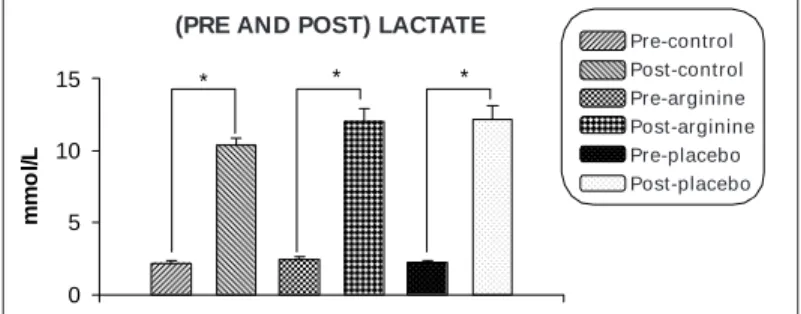
No statistical difference could be observed in response to the M aximal Load (Loadmax) obtained in Watts (W) after performing the fatigue-inducing protocol, w ith the follow ing results: Control (266.08 ± 9.20) vs. Arginine (285.36 ± 8.23), and Placebo (276.67 ± 7.94). The Lactate concentration (mmol/L) in trained volunteers w as previously determined just after the conclusion of the fatigue-in-ducing protocol. Graphic 1 show s the plasmatic concentration of the pre-protocol Lactate, w here it can be observed no difference betw een the experimental groups: Control (2.2 ± 0.14) vs. Pre-Arginine (2.43 ± 0.23), and Pre-Placebo (2.26 ± 0.11). The post-protocol plasmatic concentration, Post-Control (10.35 ± 0.57) vs. Post-Arginine (12.07 ± 0.88), and Post-Placebo (12.2 ± 0.96) did not present any statistical difference. Upon the comparison of the post-protocol concentration ([La]b) before and after the fatigue-in-ducing protocol in the different phases, it w as observed statistical differences. The Pre-Control (2.2 ± 0.14) vs. Post-Control (10.35 ± 0.57); Pre-Arginine (2.43 ± 0.23) vs. Post-Arginine (12.07 ± 0.88); Pre-Placebo (2.26 ± 0.11) vs. Post-Placebo (12.2 ± 0.96), p < 0.001.
LACTATO (PRÉ vs PÓS)
0 5 10 15
mmo
l/
L
Controle pré
Arginina pré
Placebo pré Controle pós
Arginina pós
Placebo pós
* * *
Graphic 1 – M ean Plasmatic Concentration of the Lactate obtained in 12
trained volunteers before and after performing the fatigue-inducing proto-col in the different experimental groups. Data represent the mean ± S.E.M ., n = 12. * P < 0.001.
Pre-control Post-control Pre-arginine Post-arginine Pre-placebo Post-placebo (PRE AND POST) LACTATE
Rev Bras M ed Esporte _ Vol. 11, Nº 6 – Nov/Dez, 2005
317e
(44.44 ± 2.59), and Post-Placebo (43.08 ± 2.94). Creatinine:Pre-Control (1.68 ± 0.29), Pre-Arginine (2.19 ± 0.31), and Pre-Placebo (2.49 ± 0.40); Post-Control (2.38 ± 0.33) Post-Arginine (2.55 ± 0.30), and Post-Placebo (2.82 ± 0.29), and Glycosis: Pre-control (74.48 ± 4.19), Pre-Arginine (78.70 ± 3.91), and Pre-Placebo (73.60 ± 4.31); Control (85.53 ± 5.04), Arginine (79.28 ± 3.95), and Post-Placebo (70.83 ± 4.63).
DISCUSSION
It have been performed a great number of researches w ith the purpose to identify more effective ergogenic substances to im-prove the athletic performance, alw ays focusing the demanded energy in all sports range, and in the control of the dietetic con-sumption(31). The oral L-arginine supplement has show n both pos-itive and negative results. The discrepancies betw een the clinic observations that in some cases, the L-arginine can increase the nitric oxide formation, added to the expectation that this could be the basis for the L-arginine’s kinetics to the NO reaction is called “ the arginine paradox” . Theories related to the arginine paradox have focused the possibility that high doses of the L-arginine w ould provide the required effects(42), since if there w ill be an increase in the blood flow ing, this w ould allow a higher lactate and ion releas-ing of the muscle, thus promotreleas-ing a higher removal in the circula-tion due to the blood distribucircula-tion(51).
The M aximal Heart Rate (HRmax) obtained in the tests during the phases clarifies the high intensity developed by volunteers, ob-serving that the arginine aspartate supplement did not change the heart rate (bpm) of individuals along the test after the administra-tion.
Another characteristic w here it w as obtained no changes w as the M aximal Time (Tmax) of the performance in different phases of the fatigue-inducing protocol, show ing that the final performance w as not changed by the administration of the 4,5 g of the arginine aspartate.
Upon the evaluation of the M aximal Load produced on the ergo-nomic bicycle w hen it w as performed the fatigue-inducing proto-col in the different phases of the administration, it w as kept w ith-out any change, and t his is cert ainly in conf orm it y t hat t he supplement used does not exert any effect on the obtainment of heavier w orkloads w hen using such fatigue-inducing protocol.
The measurement of the blood lactate concentration is a stan-dard procedure to set the physical exercise intensity. The absolute value of the lactate concentration is used in certain groups of indi-viduals, in order to make an objective estimate of the exercise or as a maximal exhaustion criterion(52). In this study, these concepts w ere used to determine the exercise intensity, and w hen the val-ues found in the post-protocol w ere checked, it w as determined that volunteers attained their maximal exhaustion, that w as con-sidered the point of fatigue. The lactate accumulation during the execution of a high intensity exercise protocol means that the ltate production exceeds the amount it is removed. The lacltate ac-cumulation is an indicative of the glycogen depletion, and this gives sense to the finding of the high lactate concentrations at point of fatigue, in conformity w ith the reports made by other authors (18-20,51).
Thus, w e observed the significant amount of the ([La]b) w hen comparing the pre- and the post-protocol. So, it can be asserted that the rising in the plasmatic concentration of the lactate existed in face of the high intensity of the exercises proposed, and there is no differentiation due to the presence of the arginine aspartate supplement.
It is know n that the surplus of the aminoacids is metabolized w ithin the cycle of the urea, and it is excreted into the urine. The supplement surplus can lead to renal damage. So, analyzing the urea and creatinine concentrations, it is observed the effects on the renal function(35). In a study accomplished in 1994, it w as
veri-fied that the acute oral administration of 20 g arginine induced an increased ureagenesis and cellular ATP concentration(50). But as to the urea concentrations, our results did not change after the acute oral administration of 4,5 g of arginine aspartate, reassuring that the oral dose suggested in studies w as not sufficient to induce the increase in the ureagenegis(13).
The creatinine alone has been used to determine the renal abil-ity and/or overload after an ingestion of aminoacids. By its turn, the arginine induces the endogen synthesis of the creatine, gener-ating an additional source of the creatinine to be excreted. Regard-ing to this, the arginine together w ith the glycine and S-adenosyl-methionine are the precursor aminoacids of the creatine, w hat in our study could be an additional energy to improve the performance, and this did not happen. The increase in the creatine synthesis demands a complex process that includes the captation of the argi-nine by the synthesizer organs of the creatine, to form phosphate creatine and to the dephosphorylation of the creatine, and conse-quently, the circulation(53).
Results related to the glycosis did not change along the test in the different phases, and this can explain the absence of an in-crease in the arginine-mediated flow ing to the formation of the NO, as several authors have already show n the fundamental role of the formation w ay to the NO in the skeletal-muscle system as to the glycosis transport(47). Thus, w e point out the inefficiency of the supplement used in our research.
Despite the study has suggested that the oral administration of 4 to 5 g of arginine could bring benefits such as reduction in the lactate and ammonia concentrations and maybe an improvement in the performance, our results suggest that studies w ith other dosages and other administration schedule w ould be further per-formed maybe trying to attain an increase in the tolerance to the fatigue(13).
Finally, this study had the purpose to study the effect of the acute supplement of the arginine aspartate in trained healthy indi-viduals submitted to an exhaustion protocol in an ergometric bicy-cle. But in face of the results attained, it can be concluded that the acute supplement of the arginine aspartate in the 4,5 g dosage it w as impossible to increase the physical performance, characteriz-ing the fact it did not help in the tolerance to the muscular fatigue.
All the authors declared there is not any potential conflict of inter-ests regarding this article.
REFERENCES
1. Lucia A, Hoyos J, Pardo J, Chicharro JL. Effects of endurance training on the breathing pattern of professional cyclists. Jpn J Physiol 2001;51:133-41.
2. Hargreaves M , M ckenna M J, Jenkins DG, Warmington SA, Li JL, Snow RJ, et al. M uscle metabolites and performance during high-intensity, intermittent exer-cise. J Appl Physiol 1998;84:1687-91.
3. Bangsbo J, Krustrup P, Alonso JG, Saltin B. ATP production and efficiency of human skeletal muscle during intense exercise: effect of previous exercise. Am J Physiol Endocrinol M etab 2001;280:956-64.
4. Dahlstedt AJ, Westerblad H. Inhibition of creatine kinase reduces the rate of fatigue-induced decrease in tetanic [Ca2+], in mouse skeletal muscle. J Physiol 2001;533:639-49.
5. Hicks AL, Kent-Braun J, Ditor DS. Sex differences in human skeletal muscle fatigue. Exerc Sports Sci Rev 2001;29:109-12.
6. Kirkendal DT. M echanisms of peripheral fatigue. M ed Sci Sports Exerc 1990;22: 444-9.
7. M arquezi M L, Lancha Junior AH. Possível efeito da suplementação de aminoá-cidos de cadeia ramificada, aspartato e asparagina sobre o limiar anaeróbio. Rev Paul Educ Fis 1997;11:90-101.
8. Green HJ. Cation pumps in skeletal muscle: potential role in muscle fatigue. Acta Physiol Scand 1998;162:201-13.
318e
Rev Bras M ed Esporte _ Vol. 11, Nº 6 – Nov/Dez, 2005 10. Danion F, Latash M L, Li ZM , Zatsiorsky VM . The effect of fatigue on multifingerco-ordination in force tasks in humans. J Physiol 2000;523:523-32.
11. Gandevia SC. Spinal and supraspinal factors in human muscle fatigue. Physiol Rev 2001;81:1725-89.
12. Santos RS. Estudo do efeito da administração oral de l-arginina na resistência muscular em voluntários sadios por meio de dinamometria isocinética 2001; f.62. Dissertação (M estrado em Engenharia Biomédica) – Instituto de Pesquisa e De-senvolvimento, Universidade do Vale do Paraíba.
13. Schaefer A, Piquard F, Geny B, Doutreleau S, Lampert E, M ettaure B, et al. L-Arginine reduce exercise-induced increase in plasma lactate and ammonia. Int J Sports M ed 2002;23:403-7.
14. Lees SJ, Franks PD, Spangenburg EE, Williams JH. Glycogen and glycogen phos-phorylase associated w ith sarcoplasmatic reticulum: effects of fatiguing activity. J Appl Physiol 2001;91:1638-44.
15. Tsopanakis C, Tsopanakis A. Stress hormonal factors, fatigue, and antioxidant responses to prolonged speed driving. Pharmacol Biochem Behav 1998;60:747-51.
16. Rassier DE, M acintosh BR. Coexistence of potentiation an fatigue in skeletal muscle. Braz J M ed Biol Res 2000;33:499-508.
17. Bilodeau M , Henderson TK, Nolta BE, Pursley PJ, Sandfort GL. Effect of aging on fatigue characteristics of elbow flexor muscle during sustained submaximal con-traction. J Appl Physiol 2001;91:2654-64.
18. Favero TG, Zable AC, Colter D, Abramson JJ. Lactate inhibits Ca2+-activated Ca2+ -channel activity from skeletal muscle sarcoplasmic reticulum. J Appl Physiol 1997;82:447-52.
19. Febbraio M A, Dancey J. Skeletal muscle energy metabolism during prolonged, fatiguing exercise. J Appl Physiol 1999;87:2341-7.
20. Baldw in J, Snow RJ, Gibala M J, Garnham A, How arth K, Febbraio M A. Glycogen availability does not af fect the TCA cycle or TAN pools during prolonged, fatigu-ing exercise. J Appl Physiol 2003;94:2181-7.
21. Grassi B, Quaresima V, M arconi C, Ferrari M , Cerretelli P. Blood lactate accumu-lation and muscle deoxygenation during incremental exercise. J Appl Physiol 1999;87:348-55.
22. Brooks GA, Dubouchaud H, Brow n M , Sicurello JP, Butz CE. Role of mitochondri-al lactate dehydrogenase and lactate oxidation in the intracellular lactate shuttle. Proc Natl Acad Sci USA 1999;96:1129-34.
23. Von Grumbckow L, Elsner P, Hellsten Y, Quistorff B, Juel C. Kinetics of lactate and pyruvate transport in cultured rat myotubes. Biochim Biophys Acta 1999;1417: 267-75.
24. Ferrington DA, Reijneveld JC, Bar PR, Bigelow DJ. Activation of the sarcoplasmic reticulum Ca2+-ATPase induced by exercise. Biochim Biophys Acta 1996;1279: 203-13.
25. Favero TG. Sarcoplasmic reticulum Ca2+ release and muscle fatigue. J Appl Phys-iol 1999;87:471-83.
26. Kabbara AA, Allen DG. The role of calcium stores in fatigue of isolated single muscle fibres from the cane toad. J Physiol 1999;519:169-76.
27. Chin ER, Allen DG. The contribution of pH-dependent mechanisms to fatigue at different intensities in mammalian single muscle fibres. J Physiol 2000;512:523-32.
28. M odin A, Björne H, Herulf M , Aluin K, Weitzbeg E, Lundberg JON. Nitrite-derived nitric oxide: a possible mediator of ‘acidic-metabolic’ vasodilation. Acta Physiol Scand 2001;171:9-16.
29. Jacob TL, Segal SS. Attenuation of vasodilatation w ith skeletal muscle fatigue in hamster retractor. . . . J Physiol 2000;524:929-41..
30. Barros Neto TL. A controvérsia dos agentes ergogênicos: estamos subestiman-do os efeitos naturais da atividade física? Arq Bras Ensubestiman-docrinol M etab 2001;45: 121-2.
31. Ohtani M , M aruyama K, Sugita M , Kobayashi K. Amino acid supplementation affects hematological and biochemical parameters in elite rugby players. Biosci Biotechnol Biochem 2001;65:1970-6.
32. Lemon PWR. Protein and exercise: update 1987. M ed Sci Sports Exerc 1987; 19:179-90.
33. Rossi L, Tirapegui J. Aspectos atuais sobre exercício físico, fadiga e nutrição. Rev Paul Educ Fís 1999;13:67-82.
34. Stevens BR, Godfrey M D, Kaminski TW, Brainth RW. High-intensity dynamic human muscle performance enhanced by metabolic intervention. M ed Sci Sports Exerc 2000;32:2102-8.
35. Law rence M E, Kirby DF. Nutrition and sports supplements. J Clin Gastroenterol 2002;35:299-306.
36. Tricarico D, Casini G, Conte Camerino D. Effects of high energy phosphates and L-arginine on the electrical parameters of ischemic-reperfused rat skeletal mus-cle fibers. Eur J Pharmacol 1995;287:17-25.
37. M arin J, Rodriguez-M artinez A. Role of vascular nitric oxide in physiological and pathological conditions. Pharmacol Ther 1997;75:111-34.
38. New sholme E, Hardy G. Supplementation of diets w ith nutritional pharmaceuti-cals. Nutrition 1997;13:837-9.
39. Harrison DG. Cellular and molecular mechanisms of endothelial cell dysfunction. J Clin Invest 1997;100:2153-7.
40. Hiroaki K. Nitric oxide and hemoglobin interactions in the vasculature. Biochim Biophys Acta 1999;1411:370-7.
41. M arareli M RT. Oxido nítrico: un gás contaminante con propiedades biológicas: su importancia en fisiopatologia cardiovascular. Rev Sanid M il 2000;54:164-75. 42. Abdelhamed AI, Reis SE, Sane DC, Brosnihan KB, Preli RB, Herrington DM . No effect of an l-arginine-enriched medical food (HeartBars) on endothelial function and platelet aggregation in subjects w ith hypercholesterolemia. Am Heart J 2003; 145:e15.
43. Field CJ, Johnson I, Partt VC. Glutamine and arginine: immunonutrients for im-proved health. M ed Sci Sports Exerc 2000;32:5377-88.
44. Vallance P, Chan N. Endothelial function and nitric oxide: clinical relevance. Educ Heart 2001;85:342-50.
45. Koller-Strametz J. Role of nitric oxide in exercise-induced vasodilation in man. Life Sci 1998;62:1035-42.
46. Reid M B. Nitric oxide, reactive oxygen species, and skeletal muscle contraction. M ed Sci Sports Exerc 2001;33:371-6.
47. Kingw ell BA. Nitric oxide-mediated metabolic regulation during exercise: effects of training in health and cardiovascular disease. FASEB J 2000;14:1685-96. 48. Racké K, Hey C, M ösner J, Hammermann R, Stichnote C, Wessler I. Activation of
l-arginine transpot by protein kinase C in rabbit, rat and mouse alveolar macroph-ages. J Physiol 1998;511:813-25.
49. M axw ell AJ, Ho HV, Le CQ, Lin PS, Bernstein D, Cooke JP. L-arginine enhances aerobic exercise capacity in association w ith augmented nitric oxide production. J Appl Physiol 2001;90:933-8.
50. Eto B, Peres G, Le M oel G. Effects of an ingested glutamate arginine salt on ammonemia during and after long lasting cycling. Arch Int Physiol Biochim Bio-phys 1994;102:161-2.
51. Billat VL, Sirvent P, Py G, Koralsztein JP, M ercier J. The concept of maximal lactate steady state: a bridge betw een biochemistry, physiology and sport sci-ence. Sports M ed 2003;33:407-26.
52. Roecker K, M ayer F, Striegel H, Dickhuth HH. Increase characteristics of the cumulated excess-CO2 and the lactate concentration during exercise. Int J Sports M ed 2000;21:419-23.