R E S E A R C H
Open Access
Causal attribution among women with
breast cancer
Ana Carolina W. B. Peuker
*, Maria Júlia Armiliato, Luisa V. de Souza and Elisa K. de Castro
Abstract
Causal attribution among women with breast cancer was studied. The study included 157 women outpatients with breast cancer. A form for sociodemographic and clinical data and the Revised Illness Perception Questionnaire (IPQ-R) were used. The results showed that women attributed breast cancer primarily to psychological causes, which does not correspond to known multifactorial causes validated by the scientific community. Providing high quality, patient-centered care requires sensitivity to breast cancer women’s beliefs about the causes of
their cancer and awareness of how it can influence patient’s health behaviors after diagnosis. If women with
breast cancer attribute the illness to modifiable factors then they can keep a healthy lifestyle, improving their recovery and decrease the probability of cancer recurrence after diagnosis.
Keywords: Breast neoplasm, Illness perception, Beliefs
Background
Breast cancer is an illness caused by uncontrolled growth of breast cells with abnormal characteristics, caused by a mutation in its genetic material (INCA, 2015). According to the International Agency for Research on Cancer- IARC, malignant neoplasm of the breast is the leading cause of cancer in women, which corresponds to 25 % of all cases of cancer and the sec-ond leading cause of death by malignant tumors in the world (IARC, 2015; INCA, 2015). In Brazil, the type of cancer that causes more deaths among women is breast cancer. In 2014, there is an estimate of 57,120 new cases in the country, an increase of 22 % of new cases in rela-tion to 2013 (INCA, 2015).
When a woman is diagnosed with breast cancer, her life is affected greatly from both the physical and the emotional standpoint. The treatment can be highly inva-sive, such as in cases of complete removal of the breast (mastectomy). Chemotherapy and radiotherapy treat-ments cause many side-effects (nausea, alopecia, muco-sitis, and others) (INCA, 2015). Moreover, cancer is an illness closely related to the fear of death and it brings along concerns about the negative consequences of the
diagnosis for the individual and for her family. The sick woman may have questions about the extent to which the illness might affect her family organization and her finances (Hill et al., 2011). In this scenario, full of fear and insecurity, the woman with cancer can have questions about herself, her life, the others and her future, including questions about the causes of her illness (“Why did this happen to me?” ‘What I did do to have cancer?”, “What are the causes of the illness?”) (Dumalao-Canaria et al. 2014; Thomson, et al., 2014).
People have multiple cognitive representations of ill-nesses such as cancer. The representations encompass diverse illness beliefs, including causal attribution (Leventhal et al. 1980). This process of seeking explana-tions about the illness etiology can be classified into three dimensions: locus, stability, and controllability (Wainer, 1985). The locus dimension reflects if the cause is inside (internal) or outside (external) the person; the stability dimension refers to the change of the cause over time (stable or unstable); controllability concerns the ex-tent to which the cause depends on the will of the per-son (volitional; modifiable) or not (unchanging). Causal attributions centered on uncontrollable aspects relate more to avoidant behaviors whereas causal attributions focused on modifiable and controllable causes tend to result in behaviors oriented to coping with the condition (Dumalao-Canaria et al. 2014).
* Correspondence:[email protected]
Health Sciences Centre, Universidade do Vale do Rio dos Sinos (UNISINOS), Centro de Ciências da Saúde, Avenida Unisinos, 950, Postal Code: 93022-000 São Leopoldo, RS, Brazil
The beliefs held by the individual can motivate their health behaviors. For example, those who believe that people cannot prevent cancer (e.g., fatalistic perception) tend to be more sedentary and eat fewer vegetables (Niederdeppe & Levy, 2007). There is evidence that be-liefs about the causes of cancer and its prevention may also vary from culture to culture. In Asian cultures, for example, cancer tends to be seen as a non-preventable and fatal illness (McWhirter et al. 2011).
Women with breast cancer tend to attribute the illness to many factors, including: psychological factors and stress, trauma (knocks or bruises) in the breast, religious causes, exposure to chemicals and electronic equipment, bacterial or viral infection and poor luck (Thomson et al. 2014). Nevertheless, there is insufficient epidemio-logical evidence to support such causal attributions (McKenna et al. 1999). Recurrently, what is observed is that women attribute their illness to factors external to them, which are often uncontrollable (Dumalao-Canaria et al. 2014). Oftentimes, women affected by breast cancer are unaware of the causes associated with the illness. However, there are risk factors for cancer that can be changed, which when altered reduce the risk of illness, such as the adoption of a healthy lifestyle (Dumalao-Canaria et al. 2014; Parkin et al. 2011; Thomson et al., 2014).
Causal attributions of breast cancer may be different for cancer and non-cancer women. A case–control study (Thomson et al., 2014) conducted with 1109 women with breast cancer and 1633 without the illness carried out in Australia between 2009 and 2011 found that the most common reasons given by non-cancer were related to family or hereditary factors (77.6 %), followed by fac-tors related to lifestyle, such as poor diet and smoking (47.1 %) and environmental factors such as food with pesticides (45.4 %). In the group of women with breast cancer, emotional factors, such as stress were the most cited (46.3 %), followed by factors associated with life-style (38.6 %) and physiological factors (37.5 %). Most participants attributed one or more causes to breast can-cer, but the risk factors attributed to the illness did not correspond to those scientifically accepted.
It is known that the risk of developing breast cancer can be minimized by lifestyle modification (e.g., healthy eating, regular physical activity, etc.). Parkin et al. (2011) found that around 26.8 % of new cases of cancer diag-nosed in the UK in 2010 could be related in part to modifiable factors associated with lifestyle, which stresses the importance of awareness.
Understanding the ways in which women perceive the causes of breast cancer is important in terms of public health. The causal link is important information for health promotion, including illness awareness, promo-tion of screening programs, clinical care and public
policy development (Thomson et al., 2014). In this con-text, this study was developed with the main objective of examining causal attributions of cancer in a sample of cancer women.
Methods
Participants
The study included 157 women undergoing treatment for breast cancer, users of two hospitals in Porto Alegre/ RS, a southern Brazilian capital, with a mean age of 51.95 years (SD = 8.03). The sample was defined for con-venience among women who waited for routine medical consultations in hospitals and were being treated for the illness. Inclusion criteria: age between 18–70 and re-ceived any treatment for breast cancer (chemotherapy, radiotherapy, surgery with or without hormones ther-apy). Elderly women (over 70 years of age) were not in-cluded in the study.
Instruments
– Sociodemographic and clinical file form: an instrument developed by the research group with questions concerning marital status, education, labor activity, and information about treatment for breast cancer, used to characterize the sample.
– Causes of the illness dimension of theRevised Illness Perception Questionnaire(IPQ-R): a translation into Portuguese from Portugal by Figueiras et al. (2002) was used in order to assess illness representations according to the theoretical model of self-regulation of health behavior proposed by Leventhal et al. (1984;2003). It is an instrument containing nine subscales (identity, cyclic duration, acute/chronic duration, consequences, personal control, treatment control, consistency, causes, and emotional
representation). The question asked of participants about breast cancer was‘What do you think caused your breast cancer?’. This study analyzed both the quantitative portion of the items of the causal dimension of the instrument (Likert scale 1–5 from “strongly disagree”to“strongly agree”) and the spontaneous answers regarding causal attribution.
Ethical procedures
Data collection procedures
The application of the instrument took place in two hospi-tals in the city of Porto Alegre (RS), one public and one private. Patients were invited to participate in the research after analysis of their medical records and confirmation of the diagnosis of breast cancer. The collection was per-formed before the medical consultation. Due to the partici-pants’low educational level and their difficulty to interpret the form, it was filled out by the researchers.
Data analysis
Step 1: Descriptive analyzes were performed (mean, standard deviation, minimum and maximum) of each IPQ-R concerning the causal dimension of the illness.
The IPQ-R quantitative part contains 18 items describ-ing pre-established causes. The rankdescrib-ing of the three most important causes of breast cancer in the IPQ-R was analyzed by means of a check against the 18 items.
With regard to spontaneous answers, it was requested that the participants filled a free-text box where they can write any ‘cause’ regardless of it is use in the previous section of the scale. To facilitate the quantification of the text box data, the spontaneous answers were ana-lyzed by specialized judges using a form developed by the research team. It contains a table with the report of the answers given by women and 16 clusters to categorize the causes attributed by the participants.
Step 2: Categorization of the answers given by participants.
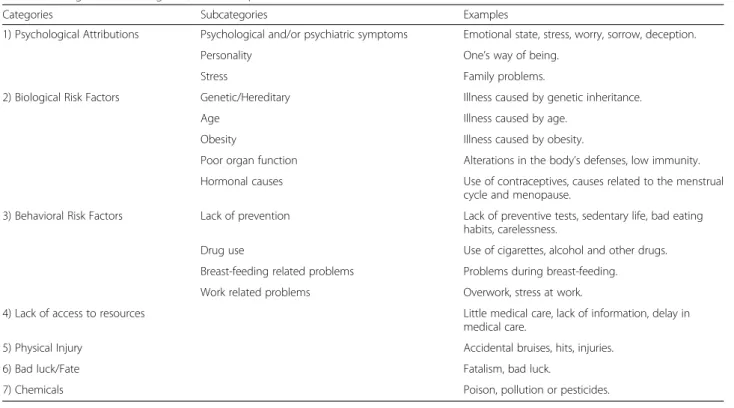
After exhaustive reading of the answers given by the participants, the answers were classified as: 1) Psycho-logical Attribution; 2) BioPsycho-logical Risk Factors; 3) Behav-ioral Risk Factors; 4) Bad luck/Fate; 5) Lack of resources; 6) Chemicals; and 7) physical injury. The first six categories were based on a previous study (Peuker, Armiliato, Vital and Castro, unpublished). As the six cat-egories were not sufficient for the analysis of the responses of women in this study, the inclusion of a seventh category was required,“Physical injury”(Table 1).
Step 2: Classification of answers by independent judges. In the second step, 16 subcategories were created. For the creation of the subcategories, there were three rounds of concordance analysis among three independ-ent judges. In the first two rounds, the subcategories that had the lower rates of agreement were altered in order to get a better match (Table 1).
In each classification round, three judges (Psycho-on-cology experts) were asked to rate the causes attributed to cancer by women independently in order to verify the validity of each category. Through a categorization form, each judge attributed a number for each subcategory for each of the answers given by participants. After the categorization of the answers by judges, the agreement was analyzed through the Kappa coefficient. In the third
and final round, a high level of agreement among the judges, regarding the proposed categorization, was ob-tained (Kappa coefficient 0,827) as shown in Table 1.
Results
Considering the sociodemographic characteristics, 64.3 % (F= 101) were married, 14 % (F= 22) separated, 11.5 % (F= 18) widowed, and 10.2 % (F= 16) single. As for the educational level, 1.9 % (F= 3) were illiterate, 33.1 % (F= 52) had incomplete primary education, 12.7 % (F= 20) complete elementary school, 7.6 % (F= 12) incomplete high school, 21.7 % (F= 34), complete high school, 5.7 % (F= 9) incomplete higher education 17.2 % (F= 27) univer-sity degrees. Furthermore, 68.2 % (F= 107) were not employed. Regarding the treatment, 70.1 % (F= 110) re-ceived radiotherapy, 65 % (F= 102) chemotherapy, 24.2 % (C = 38) hormones, and 84.1 % (F= 132) underwent sur-gery. Among them only 3.8 % (F= 6) had recurrence, and 22.3 % (F= 35) had metastasis.
Table 2 shows the ranking of the three most important causes of breast cancer in the IPQ-R from means of a check against the 18 items. Quantitative answers concerning the causal dimension showed that women attributed the illness mainly to psychological factors (symptoms, stress, and personality). The cause Stress or worry showed higher average (M = 3.98; SD = 1.12), followed by Emotional condition (M = 3.57; SD = 1.30) and Family problems or worries (M = 3.49; SD = 1.39).
Table 3 shows the Percentage and Frequency of Spontan-eous Answers According to Categories and Subcategories of Breast Cancer Causal Attribution. As for the causes attributed to breast cancer by participants in the first spon-taneous answer, here called Cause 1, the category that appeared more often was Psychological Attributions 47.8 % (F= 75), followed by Biological Risk Factors 21 % (F= 33), Behavioral Risk Factors 13.4 % (F= 21), Physical Injury 5.7 % (F= 9), Bad luck/Fate 3.2 % (F= 5), Chemical Agents 1. 9 % (F= 3), Lack of Resources 1.9 % (F= 3), and 5.1 % (F= 8) do not know. In Cause 2, the most frequently mentioned category was Psychological Attributions 36.9 % (F= 58), followed by Behavioral Risk Factor 14.6 % (F= 23), Biological Risk Factor 11.5 % (F= 18), Physical Injury 4.5 % (F= 7), Lack of Resources 3.2 % (F= 5), Bad luck/Fate 2.5 % (F= 4), Chemical Agents 0.6 % (F= 1), and 26.1 % (C = 41) do not know. In Cause 3, the most attributed category was Psychological Attribution 22.3 % (F= 35), Behavioral Risk 14.6 % (F= 23), Biological Risk Factor 8.3 % (F= 13), Lack of Resources 1.9 (F= 3), Bad Luck/Fate 0.6 % (F= 1), and 52.2 % (F= 82) do not know.
Discussion
cancer known and validated by the scientific community. In general, sick women tend to attribute the etiology of cancer to external, uncontrollable factors (Thomson et al., 2014; Peuker et al., 2015). In the perception of the
women studied, breast cancer was caused by
psychological factors. This reductionist and distorted perception of the cause of the illness can have negative consequences both individually and collectively.
At the individual level, causal attributions when pre-dominantly associated with uncontrollable factors, out of Table 1Categories, subcategories, and examples of causes attributed to breast cancer
Categories Subcategories Examples
1) Psychological Attributions Psychological and/or psychiatric symptoms Emotional state, stress, worry, sorrow, deception.
Personality One’s way of being.
Stress Family problems.
2) Biological Risk Factors Genetic/Hereditary Illness caused by genetic inheritance.
Age Illness caused by age.
Obesity Illness caused by obesity.
Poor organ function Alterations in the body’s defenses, low immunity.
Hormonal causes Use of contraceptives, causes related to the menstrual cycle and menopause.
3) Behavioral Risk Factors Lack of prevention Lack of preventive tests, sedentary life, bad eating habits, carelessness.
Drug use Use of cigarettes, alcohol and other drugs.
Breast-feeding related problems Problems during breast-feeding.
Work related problems Overwork, stress at work.
4) Lack of access to resources Little medical care, lack of information, delay in medical care.
5) Physical Injury Accidental bruises, hits, injuries.
6) Bad luck/Fate Fatalism, bad luck.
7) Chemicals Poison, pollution or pesticides.
Table 2Minimum, maximum, mean and standard deviation of the items of the causal dimension of the RIPQ (N= 157)
Cause Category Minimum Maximum Mean SD
Stress or worry Psychological Attribution 1 5 3.98 1.124
Emotional condition Psychological Attribution 1 5 3.57 1.307
Family problems or worries Psychological Attribution 1 5 3.49 1.394
Alterations in the body’s defenses Biological Risk Factor 1 5 3.48 1.289
Hereditary factors Biological Risk Factor 1 5 3.29 1.554
My personal behavior Behavioral Risk Factor 1 5 3.22 1.346
Fate or Bad luck Bad luck/Fate 1 5 3.01 1.439
My way of being (personality) Psychological Attribution 1 5 2.96 1.339
Overwork Work-related Cause 1 5 2.91 1.452
Negative mental attitude Psychological Attribution 1 5 2.78 1.347
Little medical care in the past Lack of Access to Resources 1 5 2.75 1.472
Eating habits Behavioral Risk Factor 1 5 2.71 1.374
Environmental Pollution Chemicals 1 5 2.61 1.314
Smoking Behavioral Risk Factor 1 5 2.46 1.483
Aging Biological Risk Factor 1 5 2.43 1.252
Overweight Biological Risk Factor 1 5 2.39 1.328
Microbe or virus Biological Risk Factor 1 5 2.24 1.094
one’s personal locus of control, such as psychological at-tributions, which might have a negative impact on women’s quality of life, undermining the psychosocial adjustment and increasing distress. Psychological attri-butions to breast cancer are understood as uncontrol-lable, since suffering situations (ex. betrayal, family quarrels) perceived as causing the illness, occurred in the past and can no longer be modified. As they do not depend on the volitional control of women affected by cancer, they might generate negative feelings (e.g., guilt, sadness, anger), damaging the emotional adjustment of these women and the effective coping with the illness.
Modifiable behavioral risk factors were seldom related to breast cancer in this sample. Less than half of the women felt that the cause of the illness could be linked to lifestyle habits. These results provide evidence that it is necessary for women to be aware of the need to adopt an active role in relation to their health condition. Ac-cordingly, the World Health Organization (WHO) sug-gests that over 30 % of cancer deaths could be prevented by modifying factors related to lifestyle (e.g., Adoption of a healthy diet, regular physical activity) (WHO, 2015).
It should be highlighted that in order to have effective changes in lifestyle, it is necessary that women realize
their health behaviors may be related to the develop-ment and/or early detection of breast cancer (balanced diet, exercise, annual medical checkup, for example). In this sense, at a broad level, distorted beliefs about cancer causes might impact negatively on the success of pre-ventive strategies and programs aimed at early detection (Thomson et al., 2014).
When people see the etiology of cancer as within their control, for example, related to behaviors associated with lifestyle, coping with the illness tends to be more effect-ive. By adopting this perspective, individuals become more likely to change behaviors that they realize that have contributed to their illness (Ferrucci et al. 2011). More accuracy regarding the causes of the illness is im-portant for the adoption of healthy behaviors that favor the prevention of breast cancer and other illnesses in general. For women already sick, a more realistic insight into the etiology of the illness can foster self-care behav-iors in both the treatment (improvement of symptoms, prevention of complications, and adjustments in lifestyle) and post-treatment follow-up (management of side effects treatment, and psychological fear of recurrence symp-toms) and thus promote better outcomes. The concept of self-care is broader than adherence to treatment, since it Table 3Percentage and Frequency of Spontaneous Answers according to categories and subcategories of Breast Cancer Causal Attribution (N= 157)
Categories Cause 1 Cause 2 Cause 3
% F % F % F
Psychological Attributions 47.8 75 36.9 58 22.3 35
Psychological and/or psychiatric 37.6 59 31.8 50 18.5 29
Stress 7.0 11 3.8 6 3.2 5
Personality 1.3 2 1.3 2 1.3 2
Biological Risk Factors 21.0 33 11.5 18 8.3 13
Genetic/Hereditary 19.1 30 5.1 8 2.5 4
Bad organ function 0.0 0 2.5 4 1.9 3
Hormonal Causes 4.5 7 3.2 5 1.3 2
Age 0.0 0 0.6 1 1.3 2
Obesity 0.0 0 0.6 1 1.3 2
Behavioral Risk Factors 13.4 21 14.6 23 14.6 23
Drug Usage 3.2 5 3.2 5 2.5 4
Lack of prevention 3.2 5 5.7 9 6.4 10
Breast-feeding problems 1.9 3 0.6 1 0.6 1
Labor-related causes 3.8 6 2.5 4 5.7 9
Physical Injury 5.7 9 4.5 7 0.0 0
Bad luck/Fate 3.2 5 2.5 4 0.6 1
Lack of Resources 1.9 3 3.2 5 1.9 3
Chemicals 1.9 3 0.6 1 0.0 0
Do not know 5.1 8 26.1 41 52.2 82
comprises the empowerment and the accountability of in-dividuals for their health (Castro & Moro, 2013).
The manner the illness is perceived is dynamic, which includes the dimension of causal attribution, focus of the present study. Since it is a cognitive representation, it can vary depending on people’s experiences and, there-fore, it is not a static construct. Thus, causal attribution of the illness can be modified in different ways, including social influences (e.g., media campaigns) and educa-tional, psychosocial, and self-management interventions. Health professionals can be trained to tell healthy women and patients about the prevention and treatment of the illness in an adequate way. Thus, educating women about the role of modifiable risk factors, the ones that might be controlled, may be necessary for the success of health promotion interventions (Ferrucci, et al., 2011; Shiloh et al. 2002). In this respect, the role of mental health professionals is important. Psychologists can help women understand the perceptions they have about breast cancer, and also assist other professionals in developing health interventions that consider the role of cognitive and emotional illness representations.
It is important that healthcare professionals are aware of and concerned about informing women with breast cancer about all aspects of the illness and its treatment, including causal attribution, demystifying potentially distorted beliefs about its causes. Providing high quality, patient-centered care requires sensitivity to breast cancer survivor’s beliefs about the causes of their cancer and awareness of how it can influence patient’s health be-haviors after diagnosis. If women with breast cancer attri-bute the illness to modifiable factors then they can change their lifestyle, improve their recovery and decrease the probability of cancer recurrence over time after diagnosis.
Conclusions
The findings of this study should be interpreted with cau-tion because the sample was composed primarily of women with cancer undergoing different treatments and low edu-cational level. For this last reason, probably they have little knowledge of illness. These sample characteristics can sig-nificantly influence the disease causal attributions. Because this study used a cross-sectional design, the possibility to determine causation is limited. Further studies should in-clude other variables to compare individuals from different groups as women with higher educational levels and con-sider disease characteristics (stage, type of treatment, etc.). Future research is necessary to replicate this study in other samples, particularly among women under different treat-ment conditions and stage of disease.
Competing interests
The contents of this manuscript have not been copyrighted or published previously and not now under consideration for publication elsewhere. There is not any competing interests (personal, political, religious, ideological,
academic, intelectual, commercial or any other) to declare in relation to this submitted manuscript. Finally, the authors are aware of the publication charges. We would like to thank Rejane Seibel, Daniela. Bianchini and Silvia Hass for their technical support at the health care sites.
Authors’contributions
The first author of this manuscript is ACP. MJA, LVS, EKC are others authors. All authors of this research paper have directly participated in the planning, execution, or analysis of this study. All authors of this paper have read and approved the final version submitted.
Received: 1 December 2015 Accepted: 2 March 2016
References
Castro KC, Moro L. Factores psicosociales relacionados con el autocuidado en la prevención, tratamiento y postratamiento del cáncer de mama.
Psicooncología. 2013;9(2–3):453–65. doi:10.5209/rev_PSIC.2013.v9.n2-3.40916. Dumalao-Canaria JA, Hutchinson AD, Prichard I, Wilson C. What causes breast
cancer? A systematic review of causal attributions among breast cancer survivors and how these compare to expert-endorsed risk factors. Cancer Causes Control. 2014;25(7):771–85. doi:10.1007/s10552-014-0377-3. Ferrucci LM, Cartmel B, Turkman YE, et al. Causal attribution among cancer
survivors of the ten most common cancers. Journal of psychosocial oncology. J Psychosoc Oncol. 2011;20(2):121–40. doi:10.1080/07347332.2010.548445. Figueiras MJ, Machado VA, Alves NC. Os modelos de senso comum das cefaléias
crônicas nos casais: relação com o ajustamento marital. Análise Psicológica. 2002;20(1):77–90. doi:10.14417/ap.285.
Hill J, Holcombe C, Clark L, Boothby MR, Hincks A, Fisher J, Tufail S, Salmon P. Predictors of onset of depression and anxiety in the year after diagnosis of breast cancer. Psychol Med. 2011;41(7):1429–36. doi:10.1017/S0033291710001868. IARC–International Agency For Research On Cancer. In, Jul 22, 2015, from
http://www.iarc.fr/
INCA - Instituto Nacional de Câncer José Alencar Gomes da Silva. In May 20, 2015, from http://www2.inca.gov.br/wps/wcm/connect/tiposdecancer/site/ home/mama. Accessed 23 Mar 2016.
Leventhal H, Meyer D, Nerenz D. The common sense representation of illness danger. In: Rachman S, editor. Medical psychology. New York: Pergamon Press; 1980. p. 7–30.
Leventhal H, Nerenz DL, Steele DJ. Illness representation and coping with health threats. In: Baum A, Taylor SE, Singer JE, editors. Handbook of Psychology and Health. New Jersey: Lawrence Erlbaum; 1984. p. 219–52.
Leventhal H, Brissette I, Leventhal EA. The common-sense model of selfregulation of health and illness. In: Cameron LD, Leventhal H, editors. The self-regulation of health and illness behaviour. London: Routledge; 2003. p. 42–65.
McKenna MC, Zevon MA, Corn B, Rounds J. Psychosocial factors and the development of breast cancer: a meta-analysis. Health Psychol. 1999;18(5):520–31. doi:10.1037/0278-6133.18.5.520.
McWhirter J, Todd L, Hoffman-Goetz L. Comparing written and oral measures of comprehension of cancer information by English-as-a-second-language Chinese immigrant women to Canada. J Cancer Educ. 2011;26(4):734–9. doi:10.1007/s13187-011-0219-x.
Niederdeppe J, Levy AG. Fatalistic beliefs about cancer prevention and three prevention behaviors. Cancer Epidemiol Biomarkers Prev. 2007;16(5):998–1003. doi:10.1158/1055-9965.EPI-06-0608.
Parkin DM, Boyd L, Walker LC. The fraction of cancer attributable to lifestyle and environmental factors in the UK in 2010. Br J Cancer. 2011;105:77–81. doi:10.1038/bjc.2011.489.
Peuker, Armiliato, Vital e Castro. (2015). Causal attribution to cervical cancer. Psicooncología. 12; 249-57, doi: 10.5209/rev_PSIC.2015.v12.n2-3.51007. Shiloh S, Rashuk-Rosenthal D, Benyamini Y. Illness causal attributions: an exploratory study of their structure and associations with other illness cognitions and perceptions of control. J Behav Med. 2002;25(4):373–94. doi:10.1023/A:1015818532390.
Thomson AK, Heyworth JS, Girschik J, Slevin T, Saunders C, Fritschi L. Beliefs and perceptions about the causes of breast cancer: a case-control study. BMC Res Notes. 2014;7(558):1–8. doi:10.1186/1756-0500-7-558.
Weiner B. An attributional theory of achievement motivation and emotion. Psychol Rev. 1985;92(4):548–73.