Outubro, 2015
Pedro Miguel da Fonseca Centieiro
M.Sc.
Enhancing Fan Experience During Live Sports
Broadcasts Through Second Screen Applications
Dissertação para obtenção do Grau de Doutor em InformáticaOrientador: Professora Doutora Teresa Isabel Lopes Romão Faculdade de Ciências e Tecnologia
Universidade Nova de Lisboa
ii
Enhancing Fan Experience During Live Sports Broadcasts Through Second Screen Applications
Copyright © Pedro Miguel da Fonseca Centieiro, Faculdade de Ciências e Tec-nologia, Universidade Nova de Lisboa.
iii
Acknowledgements
It is curious that the first words that you are reading were the last ones that I wrote. I think that this closes a cycle – or better, a journey – that started almost 4 years ago. Finding a theme for a PhD thesis is not an easy task, but for-tunately, I ended up studying a theme and a technology that I love. However, not everything was a walk in the park. This work involved countless hours and contributions from many individuals who deserve recognition. To those who have accompanied me in this journey, I would like to express my sincere grati-tude. First, none of this would have been possible without the unconditional support and encouragement of my family and colleagues. My parents, who al-ways gave me everything I needed. My better half for all the patience and un-derstanding across the years. My colleagues both former and current members of NOVA-LINCS, in particular Rui Madeira and Bruno Cardoso with whom I worked in close collaboration and attended different conferences; Professors Rui Prada and Nuno Correia for their invaluable feedback; my colleagues at Viva Superstars, mainly Mário Franco for his endless technology knowledge and Diogo Cordeiro for his help with eSports; Bárbara Teixeira for the graphic design created on different prototypes, and Carlos Oliveira for having the pa-tience to review this dissertation.
v
Resumo
Quando os fãs de desporto assistem a eventos desportivos ao vivo, é co-mum participarem em experiências sociais com amigos, familiares, e outros fãs que apoiam os mesmos atletas. Contudo, os fãs que assistem ao mesmo evento através de uma transmissão televisiva, acabam por não ter a mesma ligação emocional com os atletas e os milhares de fãs que estão presentes no local onde o evento se realiza. Tendo em conta este problema, nós procuramos criar apli-cações móveis que proporcionem experiências sociais enriquecedoras aos fãs remotos que assistem aos eventos desportivos através duma transmissão televi-siva. Devido ao crescente uso de dispositivos móveis enquanto se assiste a transmissões televisivas, estas aplicações procuram explorar o conceito de se-cond screen, o qual permite aos utilizadores interagir em tempo real com o con-teúdo que está a ser transmitido. Neste contexto, apresentamos um conjunto de protótipos que foram desenvolvidos para testar os nossos conceitos, realizar testes de utilizador, e analisar como estes se podem adaptar não só a vários desportos, mas também a diversos programas de TV e desportos electrónicos. Finalmente, apresentamos também o conjunto de dificuldades que enfrentámos e as diretrizes que seguimos durante as diferentes fases de desenvolvimento dos protótipos, o que pode representar uma ajuda considerável no desenvolvi-mento de futuras aplicações second screen para eventos ao vivo.
vii
Abstract
When sports fans attend live sports events, they usually engage in social experiences with friends, family members and other fans at the venue sharing the same affiliation. However, fans watching the same event through a live tel-evision broadcast end up not feeling so emotionally connected with the athletes and other fans as they would if they were watching it live, together with thou-sands of other fans. With this in mind, we seek to create mobile applications that deliver engaging social experiences involving remote fans watching live broadcasted sports events. Taking into account the growing use of mobile de-vices when watching TV broadcasts, these mobile applications explore the se-cond screen concept, which allows users to interact with content that comple-ments the TV broadcast. Within this context, we present a set of second screen application prototypes developed to test our concepts, the corresponding user studies and results, as well as suggestions on how to apply the prototypes’ con-cepts not only in different sports, but also during TV shows and electronic sports. Finally, we also present the challenges we faced and the guidelines we followed during the development and evaluation phases, which may give a considerable contribution to the development of future second screen applica-tions for live broadcasted events.
ix
Contents
1. INTRODUCTION ... 1
1.1. DESCRIPTION AND CONTEXT ... 2
1.2. RESEARCH GOAL AND QUESTIONS ... 5
1.3. CONTRIBUTIONS AND PUBLICATIONS ... 6
1.4. DOCUMENT ORGANISATION ... 9
2. RELATED RESEARCH ... 11
2.1. PSYCHOLOGY OF SPORTS FANS ... 11
2.2. REMOTE LIVE EXPERIENCES ... 18
2.3. SECOND SCREEN INTERACTION ... 22
3. BRIDGING THE EMOTIONAL GAP ... 31
3.1. WEAPPLAUD ... 34
3.1.1. Fans' Actions during Live Sports ... 35
3.1.2. Playing Games by Interpreting and Reproducing Rhythmical Patterns .... 37
3.1.3. The Prototype ... 39
3.1.4. Clap Detection ... 46
3.1.5. Implementation and Architecture ... 49
3.1.6. Evaluation ... 50
3.1.7. Conclusions ... 59
3.2. WEBET ... 60
3.2.1. Sports Betting ... 61
3.2.2. Interacting without Looking through Touchscreen Devices ... 63
3.2.3. The Prototype ... 65
3.2.4. Concept Stage ... 65
3.2.4.1. Design and Development ... 66
3.2.4.2. Evaluation ... 71
3.2.5. Interaction Stage ... 75
3.2.5.1. Design and Development ... 75
3.2.5.2. Evaluation ... 78
3.2.6. Real Setting Stage ... 83
3.2.6.1. Design and Development ... 83
3.2.6.2. Evaluation ... 92
x
3.3. WEFEEL ... 99
3.3.1. Social Engagement during Broadcasted Live Sports ... 100
3.3.2. Accessing Emotions through Computational Devices ... 102
3.3.3. The Prototype ... 103
3.3.4. Concept Stage ... 104
3.3.4.1. Design and Development ... 104
3.3.4.2. Evaluation ... 111
3.3.5. Potential and Users’ Preferences Stage ... 117
3.3.5.1. Design and Development ... 117
3.3.5.2. Evaluation ... 119
3.3.6. Conclusions ... 122
3.4. WESYNC ... 123
3.4.1. TV Broadcast Delays on Live Sports ... 124
3.4.2. Synchronising Second Screen Applications with TV Broadcasts ... 126
3.4.3. The Prototype ... 127
3.4.4. Concept Stage ... 128
3.4.4.1. Design and Development ... 129
3.4.4.2. Evaluation ... 135
3.4.5. Cheating-Free Competition Stage ... 143
3.4.5.1. Design and Development ... 144
3.4.5.2. Evaluation ... 148
3.4.6. Conclusions ... 155
4. ENHANCING FAN EXPERIENCE IN SPORTS, TV SHOWS AND ESPORTS ... 157
4.1. SPORTS ... 158
4.2. TVSHOWS ... 162
4.3. ESPORTS ... 164
5. DESIGNING SECOND SCREEN APPLICATIONS DURING LIVE BROADCASTS . 169 5.1. USER INTERACTION DESIGN ... 169
5.2. USER INTERFACE DESIGN ... 172
6. CONCLUSIONS AND FUTURE WORK ... 177
6.1. HOW TO IMPROVE THE REMOTE USER EXPERIENCE WHILE WATCHING A BROADCASTED LIVE SPORTS EVENT? ... 177
6.1.1. What factors of the event contribute more to the fan experience? ... 178
6.1.2. How to create satisfying social experiences? ... 179
6.1.3. How should the user experience be designed? ... 180
6.2. FUTURE WORK ... 181
xi
List of Figures
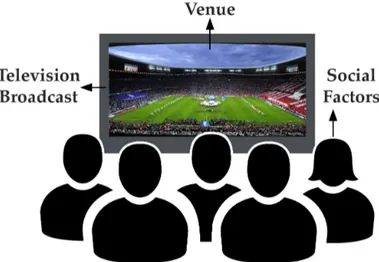
Figure 1.1: The three elements that play a part in the remote fan experience. ... 3
Figure 1.2: A summary of the conducted research process. ... 5
Figure 2.1: Model of Fan Satisfaction [10]. ... 12
Figure 2.2: Model for Measuring Sport Stadium Atmosphere [3]. ... 16
Figure 3.1: The conducted research process detailing the different stages. ... 33
Figure 3.2: Set of proof-of-concept prototypes. ... 34
Figure 3.3: Clapping action. ... 40
Figure 3.4: Game screen on the (a) main display and on the (b) mobile device. 41 Figure 3.5: Start screen on the (a) main display and on the (b) mobile device. .. 44
Figure 3.6: Final screen on the (a) main display and on the (b) mobile device. .. 44
Figure 3.7: Orientation of the device axes. ... 47
Figure 3.8: WeApplaud’s architecture. ... 50
Figure 3.9: Participants interacting with WeApplaud. ... 51
Figure 3.10: Summary of results from general feedback and usability. ... 55
Figure 3.11: Users playing WeApplaud during the demo day at ACE 2012. ... 58
Figure 3.12: Performing a swiping upward gesture (a) that displays the special bet interface (b). ... 67
Figure 3.13: The WeBet interface showing information about a match (a). Interaction with WeBet (b). ... 68
Figure 3.14: Participant interacting with WeBet during the first development stage. ... 71
Figure 3.15: Summary of results from general feedback, usability and entertainment issues. ... 74
Figure 3.16: Touching interaction method: touch a button on the bottom of the screen to place a bet (a) and the countdown screen after placing a bet (b). ... 76
Figure 3.17: Swiping interaction method: upward swiping gesture. The interface with the slide to bet area at the bottom of the screen (a). Performing a swiping gesture (b). ... 77
Figure 3.18: “Swiping and touching” interaction method: upward swiping gesture and posterior touch on the screen to place a bet. The interface with the slide to bet area at the bottom of the screen (a). The special bet interface (b). .... 77
xii
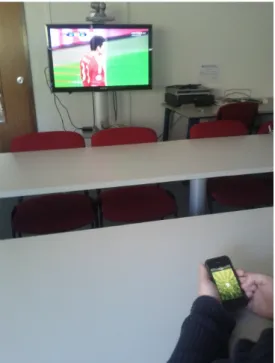
Figure 3.20: Box plots of the three interaction methods for statement 4. Mean and standard deviation added in grey. ... 81 Figure 3.21: Box plots of the three interaction methods for statement 5. Mean and standard deviation added in grey. ... 81 Figure 3.22: Box plots of the three interaction methods for the visual attention pattern. Mean and standard deviation added in grey. ... 82 Figure 3.23: A match event prompting users to answer what they think will happen during the coming penalty kick (a) and the corresponding outcome (b). ... 84 Figure 3.24: The eyes-free interaction mechanism on Viva Ronaldo: doing a swiping upward gesture (a) displays the special bet interface (b). ... 86 Figure 3.25: Interaction states overview. ... 87 Figure 3.26: Process to encapsulate the GITNS feature on any given screen. ... 88 Figure 3.27: Clickable area to place a bet. Users can easily touch it using their thumb, while holding the phone with one hand and without looking at the screen. ... 89 Figure 3.28: Match timeline showing the different outcomes according to the moment of the bet in relation with the timestamp of the goal. ... 90 Figure 3.29: Points rewarded when using the GITNS feature according to the number of seconds between a bet and the goal. ... 91 Figure 3.30: Summary of results from general feedback, usability and
entertainment issues. ... 95 Figure 3.31: Robert Plutchik’s Circumplex Model of Emotions (a) and the CAAT tool featuring reversed intensity ordering on the axes (b). ... 105 Figure 3.32: The minimized radial menu on the left centre of the screen (a) and the expanded radial menu presenting all the emotions also in Portuguese for user testing (b). ... 107 Figure 3.33: The six different pop-ups when sharing emotions that can appear on the broadcast screen. ... 108 Figure 3.34: A chart showing what the fans are feeling during a particular key moment. ... 109 Figure 3.35: Emotions being shared by friends on the right side of the screen, while a chart appears, on the left side of the screen, depicting the overall users’ emotions. ... 109 Figure 3.36: User choosing an emotion on a smartphone, while two different emotions from friends appear on the TV screen. ... 112 Figure 3.37: Timeline depicting the emotions shared. ... 114 Figure 3.38: Summary of results from general feedback, usability and
xiii
Figure 3.39. The two visualization methods: public (a) and private (b). ... 118
Figure 3.40: A key moment that prompts users to predict a corner kick (a) and the corresponding result (b). ... 129
Figure 3.41: Initial screen of SMUF (a). User setting a delay (b). ... 131
Figure 3.42: Iterative process of setting a delay. After setting a 3s delay (ds = 3, sv = 3) (a). Second try to set the right delay (ds = 3, sv = 4.5) (b). Third try to set the right delay (ds = 4.5, sv = 4) (c). Notification after the application is synchronised (d). ... 133
Figure 3.43: Average delays for each scenario including the overall scenario. The error bars indicate the maximum and minimum registered delays. ... 137
Figure 3.44: Average number of interactions per user for each scenario including the overall scenario. The error bars indicate the maximum and minimum measurements. ... 138
Figure 3.45: Average response time for all scenarios including the overall scenario. ... 139
Figure 3.46: Average final delays for each scenario including the overall scenario. The error bars indicate the maximum and minimum measurements. ... 140
Figure 3.47: Average delays for all scenarios including the overall scenario. .. 140
Figure 3.48: Summary of the questionnaire results regarding the user experience at the beginning (“a” statements) and end (“b” statements) of the different scenarios. Low delay in green, medium delay in yellow and high delay in red. ... 141
Figure 3.49: Summary of questionnaire results regarding the questions presented at the end of each test session. ... 142
Figure 3.50: Architecture with the algorithm’s main actions. ... 144
Figure 3.51: Summary flow of the cheating penalization module when a user is detected as a cheater. ... 148
Figure 3.52: Summary of the questionnaire results of Phase 1. ... 150
Figure 3.53: Participant playing WeSync during tests. ... 151
Figure 3.54: Summary of the questionnaire results of Phase 2. ... 154
xv
List of Tables
Table 2.1: Taxonomy of the different usages of the secondary screen in the
television environment [22]. ... 23
Table 2.2: Categorization of features of existing second screen applications as described in [94]. ... 26
Table 3.1: Factors that influence fans’ behaviours according to the analysis of Subchapter 2.1 – “Psychology of Sports Fans”. ... 32
Table 3.2: Typical fans’ actions during live sports events. ... 36
Table 3.3: Influential sports factors addressed in WeApplaud. ... 45
Table 3.4: Remote fans experience elements explored in WeApplaud. ... 46
Table 3.5: Clap detection success rates. ... 48
Table 3.6: Statements, regarding general feedback and usability issues, rated by the users. ... 53
Table 3.7: Most popular types of bets on football. ... 62
Table 3.8: Influential sports factors addressed in WeBet. ... 70
Table 3.9: Remote fans experience elements explored in WeBet. ... 70
Table 3.10: Statements, regarding general feedback, usability and entertainment issues, rated by the users. ... 72
Table 3.11: Statements rated by users regarding each interaction method. ... 79
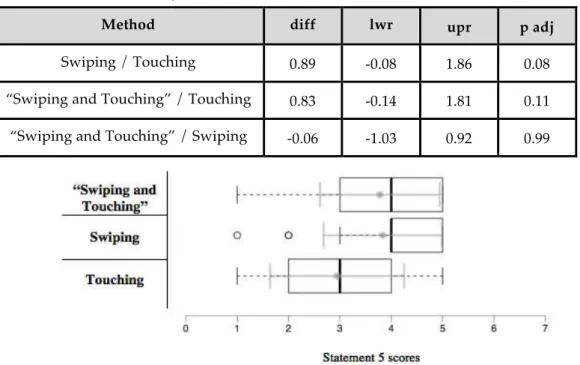
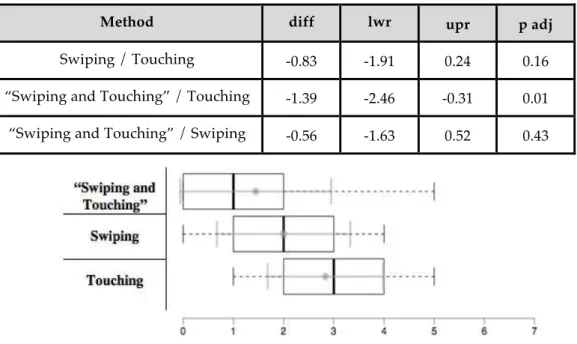
Table 3.12: Summary of the statements results. Higher scores are highlighted. 80 Table 3.13: Tukey Test Table for statement 4 between the three methods. ... 81
Table 3.14: Tukey Test Table for statement 5 between the three methods. ... 81
Table 3.15: Tukey Test Table for comparing the visual attention given to the mobile device between the three methods. ... 82
Table 3.16: Statements, regarding general feedback, usability and entertainment issues, rated by the users. ... 93
Table 3.17: Relation between Plutchick and WeFeel's model emotions. ... 106
Table 3.18: Influential sports factors addressed in WeFeel. ... 110
Table 3.19: Remote fans experience elements explored in WeFeel. ... 111
Table 3.20: Statements, regarding general feedback, usability and entertainment issues, rated by the users. ... 113
xvi
Table 3.22: Summary of results regarding the visualization methods. Higher
scores are highlighted. ... 121
Table 3.23: Interaction cues used to help users understand how to use SMUF. ... 134
Table 3.24: Statements, regarding general feedback about the activity and the SMUF’s interaction cues. ... 136
Table 3.25: Combinations of the two parameters options. ... 146
Table 3.26: Statements of the Phase 1’s questionnaire. ... 149
Table 3.27: Additional statements of the Phase 2’s questionnaire. ... 152
Table 4.1: How the different interaction concepts are applied in the football scenario, and how they can be generalized to different kinds of live events. .. 158
Table 4.2: Summary of the sports categories and their characteristics. ... 161
Table 4.3: Summary of the TV genres and their characteristics. ... 164
Table 4.4: Summary of the eSports genres and their characteristics. ... 167
1
Introduction
From so simple a beginning...
- Charles Darwin, The Origin of Species
Sports. This competitive physical activity has extended as far as the exist-ence of humanity, with evidexist-ence dating back from the Neolithic age of 7000 BC showing a wrestling match surrounded by crowds [1]. It is this natural human drive to compete that has always pushed the athletes forward. Rivalries have been born, records have been shattered, and history has been written, only be-cause athletes had a single goal in mind: to be the best of the best. Ali and Fra-zier, Prost and Senna, Armstrong and Ullrich, Bolt and Gay, Federer and Nadal, Ronaldo and Messi. These are some of the greatest rivalries that helped to cre-ate new standards in different sports for years to come.
Although not everyone practices sports regularly, watches live or broad-casted sports events frequently, or is aware of the latest sports achievements, the value of sports cannot be denied. Because sports often have a great impact on people’s lives. They affect people’s mood. They cause emotions. They create memories. Especially when people attend live sports events [2]. The stadium atmosphere involves sports fans in a unique experience, where the specific en-vironmental features of the venue and elicited affective responses of the specta-tors act together to create amazing vibes, strong emotions, goose bumps, and general euphoria [3]. Unfortunately, sports are sometimes haunted by “fans” that go too far in their “support”. Within football fandom, hooliganism is often associated with the clubs’ organised groups of fans called the “ultras”. These
2
groups may have a positive impact when supporting their clubs during match-es, but they can also have a strong negative impact by inciting members to vio-lence and brawling. This violent behaviour is often associated with keeping fans with families away from the venues, especially when there are important matches between rivals. Of course that it is not our goal to promote this kind of actions, but rather to promote positive feelings for fans watching a television broadcast of a sport event.
In fact, most fans do not have the chance to go to the venue due to factors like the ticket price, distance, the limited number of seats available or the above-mentioned violent behaviours. However, when those fans watch a sports event on TV they do not feel so emotionally connected with the athletes and the in-venue fans, as if they were watching it live where the event takes place. And since there are usually much more spectators watching a match through televi-sion than at the live venue (see [4], for example), we see this as a prominent ar-ea that should be taken into account by the entertainment computing communi-ty to create innovative and exciting experiences. To achieve this goal, first it is necessary to acknowledge what influences fans’ behaviours to watch and sup-port their favourite team and athletes. Only then, successful concepts can be materialized into computational applications that help to enhance the remote viewers’ experience during broadcasted live sports events, like the venue at-mosphere helps to improve the fans’ immersion and emotional levels during live sports events.
1.1.
Description and Context
3
there to watch football matches, while drinking a pint of beer with friends and other unknown fans. Finally, when a team achieves an important accomplish-ment, fans from all over a country set out to the main cities’ centres and em-blematic monuments, to celebrate with thousands of other fans that share the same affiliation.
Next, we investigated what kind of elements we could exploit while fans watch live broadcasted sports events, in order to enhance their user experience. To that end, we broke down the activity of watching a live broadcast sport event, which we refer to as the remote fan experience. The remote fan experi-ence is comprised of three elements: the venue where the event is taking place, the television broadcast that remote spectators are watching, and the social fac-tors related with the sports event (Figure 1.1). The venue is, of course, the basis of the whole experience: it is where the action happens and where fans go to support their team. Within this context, one can promote remote fans’ engage-ment in the in-venue fans’ activities and the sport action, so that the remote fans can feel closer to the venue atmosphere. It is also possible to expand the interac-tion with mobile devices, by adding visual and audible elements to the televi-sion. This results in an enhanced experience where the mobile device and the television are entwined. Finally, as we saw before, the social aspects are im-portant motivational factors to attend or watch a sport event. It is usual for fans to cheer, support, exchange opinions, and even brag about their teams with family members, friends or just simply unknown fans, during a sports event. Thus, it is crucial to make remote fans feel connected with others and provide them with an enhanced experience by creating the feeling that they are not alone watching the sport event.
4
While watching live broadcasted sports events, fans can be prompted to interact through different multimodal systems. Thus, to deploy applications that seek to explore multiple human senses, it is necessary to integrate compu-tational devices to the experience of watching television, in a seamless way. Such computational devices can range from traditional home computers (desk-tops and lap(desk-tops), to mobile computers (tablets and smartphones), and even to wearable computers (smartwatches and optical head-mounted displays). In our work, we decided to focus on mobile computers (especially smartphones) alt-hough other computational devices are equally valid to conduct research in this area. Our decision was tied to the rapid growth of the mobile phone market and its technologies. In most developed countries virtually everyone has a mobile phone, with the majority owning a smartphone [8]. Today, mobile phones are probably the most personal and most loved technology in the world, since they are always by our side when we need them, and they advise us and entertain us anywhere (where and when) we want it [9]. Therefore, our target audience is set on the fans that often use (or have intention to use) mobile applications while watching a broadcasted sports event and that, for whatever reasons, do not attend the venue where the event is taking place. When such audience in-teracts with mobile applications, they have access to a second screen besides the primary one (television). The use of a second screen while watching television has become quite popular, to the point of new applications being developed solely designed to allow an interaction with TV broadcasts. These applications have been dubbed second screen applications, since they explore a second screen concept, as viewers are experiencing a TV broadcast through two screens (this concept is also applicable to other computational devices such as comput-ers and smartwatches). Usually, the second screen applications aim to provide additional show-related information, access to social networks and interactive experiences synchronised with the program content, such as polls or quizzes. A survey conducted by Nielsen in the first quarter of 2013 [10], showed that near-ly half of smartphone (46%) and tablet owners (43%) use their devices as second screens while watching TV every day, which depicts how this interaction con-cept is becoming widely adopted by TV viewers.
fa-5
vourite athletes, or to discourage their opponents. Live betting is a popular theme on sports events, as fans are motivated to predict sports outcomes either due to its economic return or gamification feature. The social engagement refers to the interactions that fans have with each other and the strong emotional con-nections that they have with their teams. Finally, during our studies we became aware that television broadcasts delays can have a negative impact in the re-mote fan experience, as information about key moments can be known before-hand. Therefore, we also studied how viewers could synchronise at anytime a second screen application with any television broadcast, in order to provide an optimal user experience. Figure 1.2 summarizes the research process previously described. This process will be further detailed in Chapter 3.
Figure 1.2: A summary of the conducted research process.
1.2.
Research Goal and Questions
Our goal is to contribute to enhance the remote spectator experience dur-ing broadcasted live sports events through second screen applications. The idea is to encourage remote fans to participate in entertainment and social activities in order to enhance their experiences, all together with thousands of other fans supporting the same team and athletes. Thus, by exploring the use of technolo-gy to create new forms of social “liveness” [11], we hope to bridge the emotion-al gap between the sports stadium atmosphere and the remote users’ environ-ment.
From our research goal, one main research question and three sub-questions arise:
• How to improve the remote user experience while watching a broad-casted live sports event?
- What factors of the event contribute more to the fan experience? - How to create satisfying social experiences?
6
To answer the main research question, it was necessary to take three dif-ferent factors into account: first, the elements that can be explored during a sport event; second, the motives for watching a sport event with others, and third, the underlying - and sometimes invisible - design aspects, that allow for the creation of seamless second screen experiences. Such factors led to the for-mulation of the three sub-questions previously presented, to which we intend to have satisfying answers by the end of this document. With these questions in mind, we set out to develop and evaluate different mobile prototypes focused on football (soccer), although most concepts can be exploited in other sports or even other TV shows. We chose football because it is widely accepted as one of the world’s most popular sports [12], it moves an incredible number of fans all over the world, and generates strong emotions. Thus, we saw it as a natural fit to study and apply our concepts.
1.3.
Contributions and Publications
This work provides the following contributions:
• Enhancement of the fan experience during broadcasted live sports events through competitive and non-competitive activities, by focus-ing on different live sports themes: fans’ actions, live bettfocus-ing, social engagement, and broadcasts delays.
• Introduction of a set of concepts based on live sports themes that led to the development of four prototypes: applaud on key moments (WeApplaud), make live predictions (WeBet), share emotions and opinions with friends (WeFeel), and synchronise second screen appli-cations (WeSync).
• A discussion on how the different prototype concepts can be applied beyond football, not only to other sports, but also to TV shows, and even electronic sports (eSports) broadcasts.
• A set of guidelines useful for the design and development of future second screen applications that rely on live broadcasts.
Our work produced the following publications:
• Papers
Proceed-7
ings of the 9th International Conference on Advances in Computer Entertainment (ACE ’12). Springer-Verlag, 1-16.
ü Centieiro, P., Romão, T. and Dias, A. E. 2013. Enhancing Remote Live Sports Experiences through an Eyes-free Interaction. In Pro-ceedings of the 15th International Conference on Human-Computer Interaction with Mobile Devices and Services (MobileHCI ’13). ACM Press, 65-68.
ü Centieiro, P., Romão, T. and Dias, A. E. 2014. Bet without Looking: Studying Eyes-Free Interaction During Live Sports. In Proceedings of the 16th International Conference on Human-Computer Interac-tion (HCI InternaInterac-tional ’14). Springer-Verlag, 581-592.
ü Centieiro, P., Romão, T. and Dias, A. E. 2014. From the Lab to the World: Studying Real-time Second Screen Interaction with Live Sports. In Proceedings of the 11th International Conference on Ad-vances in Computer Entertainment (ACE ’14). Article 14.
ü Centieiro, P., Cardoso, B., Romão, T. and Dias, A. E. 2014. If You Can Feel It, You Can Share It! A System for Sharing Emotions Dur-ing Live Sports Broadcasts. In ProceedDur-ings of the 11th International Conference on Advances in Computer Entertainment (ACE ’14). Article 15.
ü Centieiro, P., Romão, T., Dias, A. E. and Madeira, R. N. 2015. Syn-chronising Live Second Screen Applications with TV Broadcasts through User Feedback. In Proceedings of the 15th International Conference on Human-Computer Interaction (INTERACT ’15). Springer-Verlag, 341-349.
ü Centieiro, P., Madeira, R. N., Romão, T., Dias, A. E. and Correia, N. 2015. In Sync with Fair Play! Delivering a Synchronized and Cheat-Preventing Second Screen Gaming Experience. In Proceedings of the 12th International Conference on Advances in Computer Enter-tainment (ACE ’15) (in press).
• Journal
ü Centieiro, P., Romão, T. and Dias, A. E. 2015. Engaging Remote Fans in Live Sports. Journal of Arts and Technology, 8, 4 (2015), 325-345.
8
ü Centieiro, P. 2013. Bringing the Sport Stadium Atmosphere to Re-mote Fans. In Proceedings of the 21st ACM International Confer-ence on Multimedia (ACM MM ’13). ACM Press, 1063-1066.
• Book Chapter
ü Centieiro, P., Romão, T. and Dias, A. E. 2015. Enhancing Remote Spectators' Experience During Live Sports Broadcasts with Second Screen Applications. In More Playful User Interfaces – Interfaces that Invite Social and Physical Interaction. Springer-Verlag, 231-261.
• Posters
ü Centieiro, P., Romão, T., Dias, A. E. and Madeira, R. N. 2015. A Synchronisation Mechanism based on User Feedback for Second Screen Applications. In Proceedings of the 12th International Con-ference on Mobile and Ubiquitous Systems: Computing, Network-ing and Services (Mobiquitous ’15) (in press).
ü Madeira, R. N., Centieiro, P. and Correia, N. 2015. Adaptation to TV Delays based on User Behaviour towards Cheating-free Second Screen Entertainment. In Proceedings of the 14th International Con-ference on Entertainment Computing (ICEC ’15). Springer-Verlag, 424-432.
ü Centieiro, P., Romão, T. and Dias, A. E. 2015. Emotion Sharing Dur-ing Live Sports Broadcasts: StudyDur-ing its Potential and the Users’ Preferences. In Proceedings of the 12th International Conference on Advances in Computer Entertainment (ACE ’15) (in press).
• Demos
ü Centieiro, P., Romão, T. and Dias, A. E. 2012. When Away Applaud Anyway. In Proceedings of the 9th International Conference on Advances in Computer Entertainment (ACE ’12). Springer-Verlag, 473-476.
9
application, viewers can interact live with the show, by visualizing extra con-tent on their mobile devices, answering polls and trivia questions, and much more. Both of these applications incorporate guidelines and results from our research work and are being used by hundreds of thousands of spectators.
1.4.
Document Organisation
11
Related Research
You can change your wife, your house, your car, but you can never change your team. Chairmen come and go, boards come and go, but the fans remain. They are the one true constant.
- Edward Thomson, former Chairman of Dundee United Football Club
This chapter presents the state of the art of the main areas covered by this work. Subchapter 2.1 mentions important studies regarding the motivations and behaviours of sports fans, Subchapter 2.2 explores the remote user interac-tion during live events by pointing out the most relevant works, and Subchap-ter 2.3 presents significant studies and applications developed within the se-cond screen research area.
2.1.
Psychology of Sports Fans
In the world of team-based sports, fans (or supporters) are key elements for the definition of the sport itself. Imagine if there were stadiums and venues without seats, or if the events would not be broadcasted through television or radio. Sports events would be less exciting and engaging, and teams would not feel the extra support coming from the crowd, resulting in lower team perfor-mances than usual. Also, and since fan involvement plays a big part in the eco-nomics of clubs (global sports industry is worth between €350 billion and €450
12
billion [13]), many club features, like merchandising or premium club television channels, would simply not exist.
Thus, it is not surprising that companies invest on sports that draw huge numbers of spectators (either in-venue or through television), since the specta-tors’ support of athletes and teams in the form of broadcast licensing fees and related merchandise has a high commercial value [14, 15]. Furthermore, sports arenas and stadiums are the number two most checked-in places in the US (on-ly after airports) [16], a clear sign that fans like not on(on-ly to attend sports, but al-so to show other people that they are supporting their team. This raises three simple but important questions: “How are fans connected with their favourite sports team?”, “What motivates them to watch sports events?” and “Why do they attend sports events?”. These questions are discussed next.
How are fans connected with their favourite sports team?
Back in 1976, Cialdini et al. [17] introduced the definition of BIRG: Basking In Reflecting Glory. BIRG refers to one’s desire to increase alliance with success-ful others, such as a team or a player. When a team is doing well, the fans feel happy and excited. On the day after a team's win, people feel better about themselves, they say things like “we won”, when they really feel part of the team. The closer people are identified with their favourite sports team, the more likely they are to bask in reflecting glory. Madrigal [18] studied fan satisfaction with sports events as a motive for attendance. He proposed a “model of fans’ satisfaction in which three cognitive antecedents are directly related to BIRG and fans’ enjoyment that, in turn, affect fan satisfaction” [18] (Figure 2.1).
13
The expectancy disconfirmation, team identification and the quality of the opponent are the three factors that influence BIRG and enjoyment. The expec-tancy disconfirmation refers to the fans’ feelings about the outcome of the sport event and whether it matches the expectations. Team identification represents fans’ emotional attachment to a team or player and it has a positive relationship with BIRG, in which fans who have a stronger team identification tend to BIRG more than others [19]. Finally, a victory over a difficult opponent makes fans feel an increased enjoyment, as well as they become more likely to feel and show their association with their team.
In contrast to BIRG, there is CORF: Cutting Off Reflected Failure. CORF happens when fans attempt to decrease their association with an unsuccessful team [20]. In this case, fans refer to their team as “they” instead of “we”, since they want to distance themselves from the team failures. This happens most frequently when there is not a strong relationship between the fan and the team, making a relationship that rises and falls according to the matches’ re-sults. On the other hand, fans with a strong bond with the team will still refer to them as “we”, and will continue to support their team, by wearing jerseys or scarfs and by attending the following matches. These two aspects of the psy-chology of sports fans shed some light on how fans connect with their team and how they behave according to the outcome of a sport event.
What motivates fans to watch sports events?
Social scientists have been studying the motivation of sports fans and spectators for many years. Whether fans go to sports events in stadiums, or whether they watch games on television or listen to them on the radio, individ-uals’ usually have a combination of motivations, not a single one. In his re-search, Wann [5] introduced the Sport Fan Motivation Scale (SFMS), an instru-ment designed to illustrate the degrees of fan intensity that helps sports deci-sion makers determine how to increase the fan involvement with the clubs. On further developments [6, 21], the SFMS revealed that fan motivation factors can be categorised into eight types:
- Eustress: defined as moderate or normal psychological stress inter-preted as being beneficial for the experiencer (e.g. engaging in a challenge, playing sports or watching a scary movie). Many sports fans feel they do not get enough stimulation or excitement from their own life, but find it through watching sports events [21]. - Self-esteem: it is related to how fans connect with their teams. The
14
on the fans self-esteem [21]. If the team has a good performance, fans feel better about themselves.
- Escape: fans who are dissatisfied or bored may temporarily forget about setbacks and distress through sports by using it as a diver-sion from work and the normal, unexciting activity of everyday life [22].
- Entertainment: some fans just find watching sports to be an enjoy-able pastime, like if they were watching a TV show, movie or play-ing a video game [21]. This may happen when our team or favour-ite players are not playing, but we still enjoy watching the game. - Economic/Betting: gambling is also an important motive for some
sports fans due to its economic return. As a site note, Trail and James [23] referred that this factor should be labelled betting or wa-gering, as the items evaluated in Wann’s study [21] asked about these terms and not about economic influence.
- Aesthetics: some fans are “attracted to the beauty and grace found in the athletic performance of some players” [24], which is enough to motivate them to become fans of a sport, a team or an athlete [21].
- Group Affiliation: “reflects fans’ desire to be with other people and involves a fans’ need for belongingness” [24]. Individuals with high group affiliation are willing to participate in a sport as a fan because it provides an opportunity to spend time with others (ex-cluding family members).
- Family: a similar motivation to group affiliation, the family factor involves one’s desire to spend time with his/her family, especially for those who are married with children [25].
dra-15
ma, vicarious achievement and community pride have an impact in the level of viewership of Japanese football fans.
In [7], the authors showed that sports fans reported the group affiliation factor as one of the top reasons for originally becoming a fan. Fans feel motivat-ed to continuously support the team when in the presence of others, but cease their support if they do not feel the support of other fans, or in other words, if they feel they are alone supporting their team. Wann et al. [30] showed that there is a strong relationship between social support and loneliness while watching sport matches. When watching sports events at the venue, fans felt more satisfaction for being with thousands of other fans, than when they watched the events alone at home. It was also identified a boost in social well-being when a fan encountered other fans with the same affiliation, distant to the locale where the team is located. That is why fans prefer to attend public spaces like a cafe to watch a sport event with friends, than to stay at home and watch it alone. In the same vein, the Director of Media Partnerships for Facebook, Nick Grudin, stated that sports can be fundamentally enhanced with social experi-ences [16], as fans are never fans alone.
Why do fans attend sports events?
According to Wochnowski [31], the definition of atmosphere in the context of sport setting is “the totality of emotionally appealing environmental stimuli in a defined place”. Thus, the atmosphere of a particular place can only be de-termined by integrating information about the environmental features of the place, with information about the affective responses of the people located in that place. This means that the sport stadium experience can be tentatively de-fined, as “the relationship between perceptions of the specific environmental features of a sport stadium and the elicited affective responses of the specta-tors” [3]. To be a unique theoretical construct, it must be further specified in terms of its temporal (period of time in which a sport event takes place) and spatial (area inside the sport stadium) limits, as well as its character. Therefore, to specify a conceptually complete measurement model for sport stadium at-mosphere, it is required “an exploration of the environmental stimuli in a sport stadium, as well as the typical affective states of the spectators” [3].
16
stimuli, has different environmental factors responsible for creating the unique atmosphere found in sport stadiums:
- Organiser: includes having an enthusiastic stadium announcer and playing the club’s anthem at games.
- Spectators: this kind of stimuli is associated with sports fans, such as certain chants, enthusiasm when the home team scores, choreo-graphic routines, the wearing of merchandise, and the exchange of chants between bleachers on opposite sides of the stadium (with fans of the same team or with the supporters of the opposing team). - Game Action: the action of the game and the teams’ performance provides suspense, thereby causing a response of arousal in the spectators. Further stimulation comes from players showing team spirit and a strong desire to win.
- Stadium Architecture: the direct proximity of the grandstands and bleachers to the field not only ensures that spectators have a good view of the game, but also makes them feel that they are an integral part of the action. Another important aspect of stadium design is the special acoustics, which make the sound in the stadium echo like in a covered hall.
Altogether, these factors result in the sport stadium atmosphere, which in turn result in amazing vibes, tremendous enthusiasm, strong emotions, goose bumps, a thrill in the air and general euphoria (according to the fans enquired in the studies, when asked what was so special about the sport stadium atmos-phere), as shown in Figure 2.2.
17
In a study conducted, by Stephanie Charleston [32], to explore the home stadium atmosphere in English professional football, participants ranked via a web survey the features of the stadium and aspects of match attendance that, according to them, most contribute for the atmosphere created during live matches. Participants could choose from cheering and singing, crowd size, his-tory with opponent, connect with supporters, stadium size, away fan location, proximity to the pitch, opponent standing, pubs in ground and memorabilia location. Results showed that noise (singing and cheering) and crowd size (full capacity crowd, as opposed to stadium size) were the most important to fans, followed by history with an opponent, and feeling connected to other support-ers. The higher noise level may represent increased feelings of belongingness amongst supporters, because they see themselves as part of one voice, the 12th player, which positively reinforces that aspect of their identity associated with the football club. The greater importance of the full capacity crowd/density suggested that empty seats may affect atmosphere more than the sheer number of supporters. For football supporters, attendance at a match with a sell-out crowd may add to the feeling that they belong to something others perceive to be quite special [33], thereby positively reinforcing their social identity. It seems that fans do not necessarily need a large stadium for the best atmosphere as in-dicated by the lower ranking of overall stadium size in the study, but do want a feeling of belonging or connectedness to be part of a community. This and other similar aspects have been the focus of some spectator crowd analysis studies, such as in [34, 35], where the authors concluded that the most important events of a match could be automatically detected by analysing the crowd’s motion on the stands.
In summary, and to answer the three questions previously presented: - Fans tend to connect with their favourite sports team in two ways:
when they feel satisfied with it, they Bask in Reflecting Glory, refer-ring to the team as “we”; however, if the team fails to match their expectations,theyCutOffReflectedFailure,referring to it as “they”. - Fans are motivated by a combination of factors, not just a single
one. Group affiliation (desire to be with others) is a top reason for fans to continuously support their team, being more satisfied when watching an event with others, than when watching it alone.
18
and connectedness to other fans most contribute for the sport sta-dium atmosphere.
As it will be presented in Chapter 3, we took into account some of these aspects in order to explore different concepts that allow remote viewers to ex-perience live sports events in interesting and innovative ways.
2.2.
Remote Live Experiences
Not so long ago, watching television was a defragmented social experi-ence. Viewers watched a TV broadcast from start to finish with no interruptions and, at the end of it, they phoned their friends and family members to discuss what they have just witnessed. Today, this rarely happens. As technology changes, so do viewers’ behaviours. Today, watching television has become a full social experience, to the point of the social TV market being worth $212.3 billion [36]. Since viewers use additional devices to communicate with others during a TV broadcast, some TV shows evolved into a bidirectional experience, allowing viewers to interact with them directly or through social networks such as Facebook or Twitter. In this sense, live video broadcasting through the Inter-net has become an area of intense interest. People from all over the world can broadcast themselves on daily activities, while viewers have the option to en-gage in polls and conversations not only with other unknown viewers, but also with the broadcaster, creating a participatory experience (see Periscope [37] or Twitch [38] for example). Moreover, through live video broadcasting, viewers can explore the world through someone else’s eyes in real time, which can help to create unique experiences. This feeling of being elsewhere is the focus of telepresence, “the human experience of being fully present at a live real-world location remote from one's own physical location” [39]. Next, we present sever-al examples on how participatory and telepresence activities can enhance the remote user experience in different kind of events.
Participating in Live Events
ex-19
perience for two reasons: they are drawn to the unique content of a particular broadcast, and they like to interact with others and participate in a broadcast-er’s community. In other words, people like to engage in social experiences. So-ciability, “the sheer pleasure of being together” [41], becomes as much essential to the broadcast, as the videogame action being streamed. As such, as commu-nities form around the broadcaster’s content, a sense of community is created. This social psychology concept is defined by McMillan [42] as a “feeling that members have of belonging, a feeling that members matter to one another and to the group, and a shared faith that members’ needs will be met through their commitment to be together”.
An example of a community in Twitch, is Twitch Plays Pokémon. What started as a social experiment back in February 2014, has now become a popular stream of the platform, taking the boundaries of participatory experiences even further. The idea is simple: a script parses the text from a chat room and uses it as input into an emulator running a copy of a Pokémon game to control the game’s character (initially the game was Pokémon Red). Viewers, also become players as they type in commands (e.g. “left”, “right”, “A”, “B”) and the one that has more votes after a short period of time (usually 20 seconds), is executed by the game. This experiment became immensely popular, reaching 55 million views with 1.16 million viewers participating, and a peak of 121.000 viewers simultaneously [43]. The first game was completed after more than 16 days of continuously gameplay. Commenting on the surprise success of this experi-ment, Twitch’s Vice President of marketing Matthew DiPietro stated “by merg-ing a video game, live video and a participatory experience, the broadcaster has created an entertainment hybrid custom made for the Twitch community” [44]. A study was conducted [45] to evaluate how the social dynamics developed within this novel gaming scenario, and the results are consistent with previous research [46, 47], demonstrating that in a social context with external and inter-nal obstacles, a group is able to unite to overcome them and achieve its goals. Finally, WeGame [48] is a similar system that supports co-located group play by allowing multiple players to jointly control a single character in different games.
20
presented a simple computational tool that enabled users to cheer their favour-ite ice hockey team. Users watched an ice hockey game through a websfavour-ite, and used the tool to select one of three cheering options: “Go!”, “Nice!”, and “De-fence!” (each with a different background colour: red, green and yellow, respec-tively). Then, every time someone chose an option, the corresponding word ap-peared on the 50-inch display screen at the rink side. For remote audiences to be able to perceive that their cheering option was shown to players and in-venue fans, the displayed word was also embedded in the streaming video. Another feature of the setup was the use of shock sensors to transmit the feedback of players hitting against the rink fence to remote users. When a shock was detect-ed by a sensor, the video was reversdetect-ed five times, to give a shocking feeling to remote audiences. Although the results of the user test were mixed, due to in-frastructure issues and inappropriate details of design, the concept of remote cheering and improvement of awareness between players and remote viewers was received with positive feedback.
21
Finally, besides remotely interacting through live video broadcasting web-sites, computational tools, motion sensing input devices, and communication platforms, mobile computing can also be explored to convey enhanced experi-ences for remote fans watching the same live event. We decided to conduct our research in this area, mainly due to two factors: first, fans are used to interact with mobile applications while watching TV broadcasts [10], and second, it is easier to materialize the developed prototypes in real applications, since the majority of fans have mobile phones. This topic is explored in more detail in Subchapter 2.3.
The Feeling of Being Elsewhere
22
indicated that PEBBLES had a very positive effect on both young and adult par-ticipants, which can serve as a motivation for future initiatives in this area. Re-garding home environments, HomeProxy [55] is a prototype that explores sup-porting video communication in the home among distributed family members through a physical proxy. HomeProxy combines a form factor designed for the home environment with a no-touch user experience and an interface that re-sponsively transitions between recorded and live video messages. Most users liked the video affordance, the easiness to access video messaging, and the home look and feel of HomeProxy (fabric enclosure, glowing lights, and sounds). Finally, Periscope [37] and Merkaat [56] are two examples of live video broadcasting applications that allow users to see the world from someone else’s eyes, in a way that is raw, unfiltered, and unfettered. Users can make their vid-eos public or private to certain users such as their friends or family members. While broadcasting, viewers can like the broadcast content (by sending “hearts”) or comment it through a text-based chat room. Both applications have reached mainstream status, and it is usual for some celebrities to also broadcast themselves in order to deliver personal messages to fans.
As we can see, sometimes a television set is not enough to experience an event. Sometimes it is necessary to take part in participatory experiences and feel like being somewhere, to satisfy our need of experiencing an event.
2.3.
Second Screen Interaction
sur-23
rounding the second screen interaction, also focused on electronic program-ming guides [58], commerce [59], and quiz games [60].
With the growth of the second screen concept popularity, in 2009 Cesar et al. [61] proposed a taxonomy for the different uses of the second screen in the TV environment. They classify use cases into three main categories: content control, content sharing and content enrichment. These cases focus on the pos-sibilities of interaction between viewers and the TV content: to control it, to share it or to enrich it. In content control, users are given the opportunity to de-cide which content is appropriate to display either on TV or on the second screen device. Common actions of this category include player control func-tionalities (e.g., play/pause), and the possibility of transferring a running ses-sion from one device to another (e.g., from the televises-sion to the second screen device). Content sharing empowers the users to share their opinions and com-ments with others. Viewers might want to share their opinions publicly on so-cial networks or privately, through chat-message services. Finally, content en-richment refers to the content manipulation that users can perform on either the TV or the second screen device. There are a number of sub-classes within this category such as fragmenting television content, generating new content, and enriching or annotating existing material. Table 2.1 presents a summary of these categories and their subclasses.
Table 2.1: Taxonomy of the different usages of the secondary screen in the television environment [61].
Category Definition Subclasses
Content Control To decide what and how to consume
television content
Select content
Browse content
Manage content
Select path
View extra material
Video controls
Session transfer
Content Enrichment To actively manipulate the television
content
Create content
Annotate content
Fragment content
24
Content Sharing To socially communicate with others Share personal content Share media fragments
Today, as the second screen concept matured and developers became aware of what people sought in second screen applications, other authors pro-posed a categorization of typical activities when watching TV [62]. They divide it in three categories: social sharing, gamification and extras, and expanded ex-perience. Next, we describe these categories, as we present several works in dif-ferent TV broadcasts genres.
Multiple Genres, Multiple Possibilities
Social sharing refers to the social interactions that we have with others, like when talking about a TV show with friends, or sharing broadcast-related content on social networks (human to human interaction). This is a topic of ma-jor interest within the second screen research area, which resulted in different studies. For instance, Geerts et al. [63] discussed the effect of TV genres on so-cial TV activities like chatting or clip sharing. A study conducted by Buchinger et al. [64] concluded that news, soap operas, quiz shows, and sports were the genres during which participants talk the most while watching, making them highly suitable for social media use. Furthermore, in [65] it is presented that viewers were mainly motivated to tweet during television series due to their desire of connecting with a community also watching the same show. In a sur-vey conducted by Nielsen [10], three in five of Twitter UK mobile users are on Twitter sending and reading tweets whilst watching television, as of November 2013. In fact, another example where we can see a shift in how television is con-sumed specially within the sport industry is the Super Bowl 2014 edition, which had 24.9 million related tweets (most of them done after exciting plays or touchdowns), edging out the 2013 edition by 800.000, and the 2012 edition by 11.2 million [66, 67]. This is a clear sign that spectators are starting to become more open to comment, interact, and cheer through electronic devices during live events, than they used to.
25
26
is not the same as being with others on the same physical space. This motivated us to combine the gamification and extras and social sharing categories, in or-der to create interactive second screen applications that motivate users to en-gage in social interactions.
Finally, expanded experience refers to the activities where the second screen application is the driver and the human is the consumer (machine to human interaction). These activities include content generated algorithmically without explicit user input, such as related news or facts about the content of the TV show. In this case, the existent initiatives focused on newscasts and TV shows. For example, FanFeeds [81] is a second screen application that provides in-sync additional content-related media. FanFeeds relies on one’s social circles to create contextual information for TV shows making the information feeds more personal and relevant to the primary content. Another example is the SentiTVchat [82], which allows users to chat on a mobile device about a TV show, analyse the chat-messages towards it, and plot the data on the TV screen to inform the viewer about the show popularity. In another study conducted [83], the authors used IntoNow [84] – a platform that enabled developers to identify TV shows through automatic content recognition – and the closed cap-tions of a live TV newscast, to find online articles that matched the news being broadcasted. When a match was found, the article was immediately presented to the user, in order to give additional information about a specific news piece. Table 2.2 summarizes the previously described categorization.
Table 2.2: Categorization of features of existing second screen applications as de-scribed in [62].
Category Interaction Examples of Common Features
Social Sharing Human-Human
Share and interact with social circles, comment on events in real-time, Twitter and Facebook integration, meme generation, and user-generated content.
Gamification and Extras Human-Machine
TV guide, remote, behind- the-scenes looks, deleted scenes, polls, trivia, badges, rewards, and editorially generated content.
Expanded Experience Machine-Human
27 Additional Devices, Additional Problems
28
means of peripheral stimuli, such as sound. We think that these findings may be in-line with what happens in sports: viewers perform parallel actions during uninteresting moments (e.g., after a foul), but once sportcasters talk more en-thusiastically, viewers are keen to shift their attention back to the broadcast. To conclude, the challenge here is to develop second screen applications that grab the viewers’ attention at the right time to provide interactive content, i.e. when it is safe to shift the attention from the TV, without the loss of important events. To solve this problem, we designed second screen applications that get users’ attention through audio or tactile cues (so users do not need to constantly look to the mobile device) during less relevant moments.
29
the TV playout difference between viewers. In the latter case, developers can use automatic content recognition (ACR), such as audio fingerprinting (see the third-party API Entourage [92] for instance), to identify a given TV show and synchronise the second screen application with it. However, if TV providers do not agree to synchronise their broadcasts between them, or if third-party APIs cannot identify the TV show being broadcasted, these solutions will not work. This issue motivated us to develop a simple and universal synchronisation mechanism that allows users with different TV delays to receive synchronised events on their second screen applications, without disrupting their user expe-rience (more details in Subchapter 3.4).
31
Bridging the Emotional Gap
What I love about the creative process, and this may sound naive, but it is this idea that one day there is no idea, and no solu-tion, but the next day there is an idea. I find that incredibly exciting and conceptually actually remarkable.
- Jonathan Ive, CDO of Apple Inc.
With the objective of investigating how to enhance the fan experience dur-ing broadcasted live sports events through competitive and non-competitive activities, we developed a set of proof-of-concept prototypes. These prototypes introduce new concepts of interaction during broadcasted live sports events, based on the findings from Subchapter 2.1 – “Psychology of Sports Fans”. Table 3.1 presents a summary of these results, by pointing out the factors that influ-ence fans’ behaviours. Each prototype addresses several of these factors and the different elements that encompass the remote fan experience (the venue, the television, and the social factors), as presented in Chapter 1.
32
Table 3.1: Factors that influence fans’ behaviours according to the analysis of Subchap-ter 2.1 – “Psychology of Sports Fans”.
Question Category Factors that Influence Fans’ Behaviours
How are fans connected with their favourite
sports team?
Connection
Bask in Reflecting Glory (BIRG)
Cut Off Reflected Failure (CORF)
Team Satisfaction Team Dissatisfaction
What motivates fans to
watch sports events? Motivation
Sport Fan Motivation Scale (SFMS)
Motivation Scale for Sport Consumption (MSSC) Aesthetics Escape Family Achievement/Self-esteem Social/Group Affiliation Eustress/Drama
Entertainment Knowledge
Economic/Betting Physical Attraction Physical Skills
Why do fans attend
sports events? Attendance
Stimuli
Organiser Spectators Game Action Stadium Architecture Enthusiastic Speaker Cheering and Singing Team
Performance Proximity to the Pitch Crowd Size Team Spirit
Connected-ness with Supporters History with Opponent Stadium Design
33
Figure 3.1: The conducted research process detailing the different stages.
The first prototype that we developed focused on the fans’ actions, as it was a topic that we kept coming back after several brainstorming sessions. The possibility for remote fans to perform supporting actions like if they were in the stadium (Subchapter 2.1 – “Why do fans attend sports events?”), was very ap-pealing to us, as we could connect the remote and in-venue audiences together. As such, we started by developing WeApplaud, a local multiplayer mobile rhythm game that prompts players to applaud their team (Subchapter 3.1). WeApplaud explores all the elements of the remote fan experience with special emphasis on the venue.
34
Due to the strong emotional connection that fans have with their teams (Subchapter 2.1 – “How are fans connected with their favourite sports team?”), we felt compelled – in a good way of course – to study how remote fans could share their emotions with their friends and the audience watching the same event. Thus, we idealized and developed WeFeel, a system that allows users to share emotions and opinions through the television screen (Subchapter 3.3). WeFeel relies on the television broadcast and social factors to deliver a seamless user experience and a sense of community.
Finally, during our studies, we became aware that broadcast delays can have a major influence in the remote viewer experience. A common scenario is when fans hear a neighbour shouting goal, before they watch it in their televi-sion. While we cannot do much to solve this problem, we can solve the one in a second screen application context, where synchronised events are presented earlier than they are supposed to. Therefore, we created WeSync, an application that allows users to synchronise second screen events with the TV broadcast (Subchapter 3.4). WeSync explores the television element, and uses a synchroni-sation mechanism to deliver an optimal experience. As a summary, Figure 3.2 presents the set of proof-of-concept prototypes previously mentioned.
Figure 3.2: Set of proof-of-concept prototypes.
![Table 2.1: Taxonomy of the different usages of the secondary screen in the television environment [61]](https://thumb-eu.123doks.com/thumbv2/123dok_br/16527460.736042/39.892.166.769.703.1108/table-taxonomy-different-usages-secondary-screen-television-environment.webp)