Morphophenological characterization of ornamental ginger
and selection for landscape use
(1)CARLOS EDUARDO FERREIRA DE CASTRO(2), ANA CECILIA RIBEIRO DE CASTRO(3)*,
CHARLESTON GONÇALVES(2), VIVIAN LOGES(4)
ABSTRACT
Many species of Zingiber have great ornamental potential, due to durability and exotic appearance of the inflorescences. Despite its large phenotypic variability, they are scarcely exploited or not yet exploited regarding the ornamental potential. To conserve potential ornamental genotypes, and subsidize breeding program, the Agronomic Institute (IAC) maintain a Germoplasm Collection of Ornamental Zingiberales with promising accessions, including Zingiber. The aim was the morphophenological characterization of ten Zingiber accessions and the indication for landscape purposes. A large variation was observed to the evaluated characters: Clump height (CH);Inflorescence visualization (IV); Clump area (CA); Clump density (CD); Leaf stem Firmness (LSF); Number of leaf stems per clump (NLSC); Number of leaves per stem (NLS); Leaf color (LCol); Evergreen tendency (ET); Flower stem growth (FSG); Flower stem length (FSLe); Flower stem diameter (FSD); Flower stem per clump (FSC); Color sensorial perception (CSP); Flower stem weight (FSW); Inflorescence length (IL); Inflorescence diameter (ID); Bracts aspects (BAs); and Flowering season (FSe). The accessions very suitable and with the best performance to use for landscape purpose were Z. spectabile, IAC Anchieta (Z. spectabile), Z. newmanii.
Keywords: Tropical flowers, landscaping, ornamental zingiberales, characterization
RESUMO
Caracterização morfofenológica de gengibre ornamental e seleção para uso paisagístico
Muitas espécies de Zingiber tem grande potencial ornamental, devido a durabilidade e aparência exótica de suas inflorescências. Apesar da larga variabilidade fenotípica, essas plantas são escassamente ou não exploradas apesar de todo apelo ornamental. Para conservar genótipos ornamentais e subsidiar o programa de melhoramento, o Instituto Agronômico (IAC) mantem uma coleção de germoplasma de Zingiberales ornamentais com genótipos promissores, incluindo os do gênero Zingiber. O objetivo foi a caracterização morfofenológica de dez acessos de Zingiber e a indicação de uso ornamental. Uma grande variação foi observada nas características avaliadas: Altura da Touceira (CH);Visualização da Inflorescência (IV); Área da touceira (CA); Densidade da Touceira (CD); Firmeza da haste foliar (LSF); Numero de hastes foliares por touceira (NLSC); Numero de folhas por haste (NLS); Cor da folha (LCol); Tendência de permanecer sempre verde (ET); Crescimento da haste floral (FSG); Comprimento da haste floral (FSLe); Diâmetro da haste floral (FSD); Haste florais por touceira (FSC); Percepção sensorial de cor (CSP); peso da haste floral (FSW); Comprimento da flor (IL); Diâmetro da flor (ID); Aspecto das brácteas (BAs); e época da floração (FSe). Os acessos mais adequados e com melhor desempenho para uso em paisagismo foram: Z. spectabile, IAC Anchieta (Z. spectabile), Z. newmanii. Palavras chave: FloresTropicais, paisagismo, zingiberales ornamentais, caracterização
DOI: http://dx.doi.org/10.14295/oh.v24i3.1208
(1) Received in 15/05/2018 and accepted in 21/08/2018
(2) Instituto Agronômico (IAC), Centro de Horticultura, Campinas-SP, Brazil.
(3) Embrapa Agroindústria Tropical (CNPAT), Fortaleza-CE, Brazil. *Corresponding author: [email protected] (4) Universidade Federal Rural de Pernambuco (UFPE), Recife-PE, Brazil.
Licensed by CC BY 4.0
1. INTRODUCTION
Zingiber is one of the most important genera of the ginger family (Zingiberaceae) but the real number of species is not known. Kishor and Leong-Skornicková (2013) described more than 250 species. Recently, Govaerts et al. (2015), after discarding synonyms, confirmed only 177 valid species. These plants are herbaceous and aromatic living originally in humid regions of the tropical to warm-temperate Asia. Thailand is the country with the richest
representation of the genus Zingiber, center of diversity
with 56 species, followed by China, with 42 species, of
which 36 are endemic (TRIBOUN et al., 2014).
The inflorescence usually arises from the base of the leaf stem, on a underground stem (SABU, 2003). Bracts often bright red, orange, or yellow, closely imbricate or with the apices free, forming small bags filled up with mucilage, comprising a single cincinnus. These exotic appearance of the inflorescences, flowering characterized by many
flower stems breaking the ground, the architecture and the
Some species are appreciated as ornamental plants due
to durability and the exoticism, as an example, Zingiber
spectabile (COELHO et al., 2017). Despite its large
phenotypic variability, few forms of Zingiber genera
are exploited commercially regarding the ornamental potential. Based on the genera amplitude, probably exists many others potential species, geographically restricted and poorly known.
The Germoplasm Collection of Ornamental Zingiberales of the Agronomic Institute (IAC), has promising genotypes,
including Zingiber. The objective of this work was the
morphophenological characterization of ten Zingiber accessions and the indication for landscape purposes.
2. MATERIAL AND METHODS
Evaluations were performed at Germoplasm Collection of Ornamental Zingiberales of the Agronomic Institute (IAC). Three Clumps aged 3 years, distributed randomly and maintained in the field at full sun condition of the following
accessions were evaluated during a year: Z. spectabile;
IAC Anchieta (Z. spectabile); IAC Angatu (Z. spectabile);
Z. zerumbet; IAC Almada (Z. spectabile x zerumbet); IAC
Suanno (Z. spectabile x zerumbet); Z. macradenium; Z.
newmanii; Z. ottensii; and Z. pachysiphon.
To perform the characterization, based on traits of clump, stems, leaves, inflorescences and flowering, were applied the following descriptors: Clump height (CH) - low (< 2.00 m), medium (≥ 2.00 and < 2.90), high (≥ 2.90
m); Inflorescence visualization (IV) - evident or hidden;
Clump area (CA): clump base diameter (m) and clump canopy diameter (m); Clump density (CD) – agglomerate, intermediate and sparse; Leaf stem firmness (LSF) - firm or overturn tendency; Number of leaf stems per clump (NLSC): low (< 20); intermediary (≥ 20 and < 40); high (≥ 40); Number of leaves per stem (NLS); Leaf color (LCol); Evergreen tendency (ET): yes or no; Flower stem growth (FSG): erect or decumbent; Flower stem length (FSLe) - distance between the base to apex (cm); Flower stem
diameter (FSD) (cm); Flower stem per clump (FSC) - low (< 15); medium (≥ 15 and < 30); high (≥ 30 and < 45); and very high (≥ 45); Color sensorial perception (CSP); Flower stem weight (FSW) (g); Inflorescence length (IL) (cm); Inflorescence diameter (ID) (cm); Bracts aspects (BAs): (appressed or free bracts and color); and Flowering season (FSe) – months of inflorescence occurrence.
A point scoring system was used to determine the accessions most suitable as ornamental plants base on: Inflorescence visualization (IV) (3 points - evident; 2 points - hidden); Clump density (CD) - (3 points - agglomerated; 2 points - intermediated; 1 point - sparse); Leaf stem firmness (LSF) - 3 points - firm; 0 points - overturn tendency; Evergreen tendency (ET) - 3 points - yes; 0 points - no; Flower stem per clump (FSC) - 3 points - very high and high; 2 points - medium; 1 point - low; Color sensorial perception (CSP) - 4 points to very intense color and contrast; 3 points to intense color and contrast; 2 points to intermediated color and contrast; 1 point to pale color with or without contrast; Flowering season (FS) - 3 points to more than 4 months; 2 points 4 to 3 months; 1 point - less than 3 months. Base on the total point score, the species were considered poorly suitable (less than 13 points), suitable (13 to 19 points) and very suitable (more than 19 points) to ornamental plants use.
3. RESULTS AND DISCUSSION
It was observed morphophenological variation between accessions with respect to general characteristics of clump, stems, leaves, inflorescences and flowering (Tables 1 to 5). About plant height, accessions ranged from 1.80 to
3.30 m and were classified as low (Z. zerumbet), medium
(IAC Anchieta, IAC Angatu, IAC Almada, IAC Suanno,
Z. newmanii, Z. ottensii and Z. pachysiphon) and high (Z. spectabile and Z. macradenium). All accessions showed
evident inflorescence visualization in the clump, except
Z. zerumbet whose inflorescence were hidden below the
foliage (Table 1).
Table 1. Clump characteristics of the Zingiber Accessions.
Accession Clump height (CH)
Inflorescence visualization (IV)
Clump area: base and canopy (CA)
Clump density
(CD) Photo
Z. spectabile
3.30 m
(high)
evident 1.20 and 4.10 m intermediate
IAC Anchieta
2.50 m
(medium)
IAC Angatu
2.70 m
(medium)
evident 1.70 and 5.10 m sparce
Z. zerumbet
1.80 m
(low)
hidden 1.15 and 3.50 m agglomerate
IAC Almada
2.50 m
(medium)
evident 0.75 and 3.10 m intermediate
IAC Suanno 2.75 m
(medium)
evident 1.20 and 3.60 m agglomerate
Z. macradenium
3.00 m
(high)
evident 0.73 and 2.90 m intermediate
Z. newmanii
2.60 m
(medium)
evident 1.11and 3.50 m intermediate
Z. ottensii
2.50 m
(medium)
evident 1.50 and 2.60 m sparce
Z. pachysiphon
2.20 m
(medium)
evident 0.73and 2.30 m sparce
Regarding the clumps area, there was a variation between 0.73 to 1.70 m at the base and the canopy ranging 2.30 to 5.10 m. It was observed that plants of the accession with large base also had high canopy (e.g. IAC Angatu), and plants with small base had low canopy (e.g.
Z. pachysiphon), but neither were the highest nor lowest plant height. Plants with most clustered growth (up to 3.50 m canopy projection) are interesting choices for
gardens with limited area, since requires smaller spacing. Base on clump density, accessions with agglomerated and intermediated characteristic could be indicated to hidden walls or fences better than accessions with sparse clumps (Table 1).
Only the accessions Z. zerumbet and Z. ottensii had
stems with overturn tendency. Other accessions keeps the stems firm and erect at the clump. The overturn tendency
is not directly related to the highest clumps. The number of stems per clump ranged from 16 to 58. The number of leaves was also quite variable, between 20 to 52 leaves per stem, but do not have a direct relation to the number
of stems per clump. The leaves color vary from green to
dark green. Z. zerumbet was the only accession that foliar
stems remains dry on the plant. The others accessions were evergreen during the year (Table 2).
Table 2. Leaf stem characteristics of the Zingiber accessions.
Accessions Leaf stem firmness (LSF)
Number of leaf stems per clump (NLSC)
Number of leaves per stem
(NLS)
Leaf color (LCol)
Evergreen tendency
(ET)
Z. spectabile firm 19 (low) 28 dark green yes
IAC Anchieta firm 50 (high) 47 green yes
IAC Angatu firm 33 (intermediary) 45 dark green yes
Z. zerumbet overturn tendency 52 (high) 31 dark green no
IAC Almada firm 26 (intermediary) 35 green yes
IAC Suanno firm 58 (high) 52 green yes
Z. macradenium firm 18 (low) 50 dark green yes
Z. newmanii firm 16 (low) 55 dark green yes
Z. ottensii overturn tendency 17 (low) 20 green yes
Z. pachysiphon firm 29 (intermediary) 28 green yes
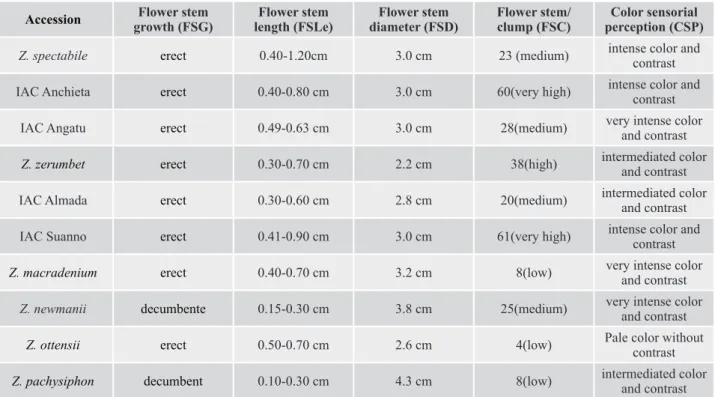
About the characterization of inflorescences was noted that all the flower stems were erect except by
Z. newmanii and Z. pachysiphon which growth were decumbent. In all the accessions were observed that the
length of the flower stems were quite variable in the same clump. The diameter of the flower stems ranged
from 2.20 (Z. zerumbet) to 4.30 cm (Z. pachysiphon)
(Table 3).
Table 3. Flower stem characteristics of the Zingiber accessions.
Accession Flower stem growth (FSG)
Flower stem length (FSLe)
Flower stem diameter (FSD)
Flower stem/ clump (FSC)
Color sensorial perception (CSP)
Z. spectabile erect 0.40-1.20cm 3.0 cm 23 (medium) intense color and
contrast
IAC Anchieta erect 0.40-0.80 cm 3.0 cm 60(very high) intense color and
contrast
IAC Angatu erect 0.49-0.63 cm 3.0 cm 28(medium) very intense color
and contrast
Z. zerumbet erect 0.30-0.70 cm 2.2 cm 38(high) intermediatedcolor
and contrast
IAC Almada erect 0.30-0.60 cm 2.8 cm 20(medium) intermediatedcolor
and contrast
IAC Suanno erect 0.41-0.90 cm 3.0 cm 61(very high) intense color and
contrast
Z. macradenium erect 0.40-0.70 cm 3.2 cm 8(low) very intense color
and contrast
Z. newmanii decumbente 0.15-0.30 cm 3.8 cm 25(medium) very intense color
and contrast
Z. ottensii erect 0.50-0.70 cm 2.6 cm 4(low) Pale color without
contrast
Z. pachysiphon decumbent 0.10-0.30 cm 4.3 cm 8(low) intermediatedcolor
and contrast
About the inflorescence number, the accession IAC Suanno and IAC Anchieta were the most productive, with
60 and 61 stems per clump. Z. zerumbet, with 38 flower stem
per clump, was classified as high production. Accessions
classified as medium produced among 15 to 30 stems (Z.
spectabile, IAC Angatu, IAC Almada, Z. newmanii) and some accessions produced up to 10 inflorescences per plant (Z. macradenium, Z. ottensii and Z. pachysiphon).
depending on the accession. It was observed that inflorescence weight is not only influenced by length and width, morphological aspects as having free bracts also seem to influence. The correlation between inflorescence length/width and flower stem weight could be noticed
in accessions with free bracts as Z. spectabile and Z.
macradenium.
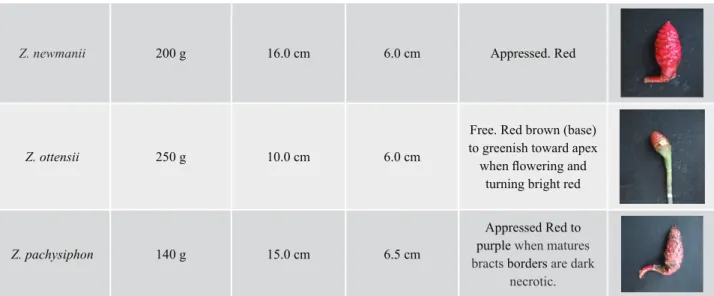
The color of the bracts is also very varied, depending on accession, ranging from green, yellow, orange to darker red on the lips. Most of the accessions have a gradual change color with the inflorescences aging, from the basis for the apex, adding exoticity (Table 4). Thus, the sensorial perception could range for very intense color and contrast to pale color without contrast (Table 3).
Table 4. Inflorescence characteristics of the Zingiber accessions.
Accession Flower stem weight (FSW)
Inflorescence length (IL)
Inflorescence
diameter (ID) Bracts aspects (BA) Photo
Z. spectabile 340 g 20.0 cm 9.0 cm Free. Orange-yellowish
IAC Anchieta 200 g 14.0 cm 6.5 cm Free. Yellow to orange
IAC Angatu 280 g 14.0 cm 8.0 cm
Free. Yellow to yellow
greenish, bracts borders (base) turning orange
Z. zerumbet 220 g 13.0 cm 5.5 cm Appressed. Green
turning red when mature
IAC Almada 140 g 15.0 cm 8.0 cm Appressed. Yellow to
orange
IAC Suanno 210 g 19.0 cm 7.0 cm
Free. Yellow to orange
in Apex, pale pink at
the inflorescence base,
borders red
Z. macradenium 430 g 21.0 cm 13.0 cm
Free. Pale green
Z. newmanii 200 g 16.0 cm 6.0 cm Appressed. Red
Z. ottensii 250 g 10.0 cm 6.0 cm
Free. Red brown (base)
to greenish toward apex
when flowering and
turning bright red
Z. pachysiphon 140 g 15.0 cm 6.5 cm
Appressed Red to
purple when matures
bracts borders are dark necrotic.
Table 4. cont.
The flowering season months observed was very early
(August to September) as observed in IAC Suanno and Z.
macradenium, mid (October to November) as observed Z. spectabile, IAC Anchieta, IAC Angatu, Z. zerumbet and Z. newmanii or late (December to January) as observed IAC
Almada, Z. ottensii . Z. pachysiphon was the only accession
that produce flowers from May to August.
4. CONCLUSIONS
The accessions morphophenologic characteristics were influenced by genetic variation and these traits are useful to indicate the type of use.
From the variability observed was possible to select potential accessions for landscaping.
The morphophenologic characterization and genotypic and phenotypic differences conserved in the collection is of great significance to agriculture, to provide important data for the commercial cultivation of potential species and to generate important information for breeding programs.
The accessions very suitable for use to landscape
purpose were Z. spectabile, IAC Anchieta (Z. spectabile)
and Z. newmanii and present easy inflorescence
visualization, leaf stem firmness and evergreen tendency, high number of flower stem per clump, very intense color and contrast sensorial perception.
ACKNOWLEDGMENTS
The authors would like to thank the Coordination of Superior Level Staff Improvement (CAPES) and National Council for Scientific and Technological Development (CNPq).
AUTHORS CONTRIBUTIONS
C.E.F.C. 0000-0002-1407-0611: Planting; Field analysis
and data collection; Descriptors and selection criteria elaboration; Manuscript critical review.
A.C.R.C. 0000-0001-6441-9888: Field analysis and data collection;
Descriptors and selection criteria elaboration; Manuscript
critical review and manuscript final version review. C.G.
0000-0001-5414-0306: Planting; Field analysis and data collection;
Descriptors and selection criteria elaboration; Manuscript
critical review. V.L. 0000-0001-9948-9501: Field analysis and data
collection; Descriptors and selection criteria elaboration; manuscript critical review.
REFERENCES
COELHO, V.A.T.; DIAS, G.M.G.; FERREIRA, M.M.; RODAS, C.L.; SILVA, M.L.S.; PASQUAL, M. Potássio e sódio na composição mineral e crescimento em plantas de
Zingiber spectabile. Revista Brasileira de Ciências Agrárias, v.12, p.35-40, 2017. DOI: 10.5039/agraria.v12i1a5417
GONÇALVES, C.; CASTRO, C.E.F; CASTRO, A.C.R;
LOGES, V. Zingiber zerumbet flower stem postharvest
characterization. Ornamental Horticulturae, v.23,
n.2, p.127-130, 2017. DOI: https://doi.org/10.14295/ oh.v23i2.956
GOVAERTS, R.; NEWMAN, M.; LOCK, J.M. World
Checklist of Zingiberaceae. Royal Botanic Gardens, Kew,
2015. Available in: http://apps.kew.org/wcsp/ Accessed on:
April 12th 2016.
KISHOR, R; LEONG-SKORNICKOVÁ, J. Zingiber
kangleipakense (Zingiberaceae): A new species from
Manipur, India. Gardens Bulletin Singapore, v.65,
n.1, p.39-46, 2013. DOI: http://dx.doi.org/10.11646/ phytotaxa.178.3.9
SABU, M. Revision of the genus Zingiber in South India.
Folia Malaysiana, v.4, n.1, p.25-52, 2003.
TRIBOUN, P.; LARSEN, K.; CHANTARANOTHAI, P.A.
Key to the genus Zingiber (Zingiberaceae) in Thailand
with descriptions of 10 new taxa. Thai Journal of Botany,