Pedro Jos´
e dos Santos Palhinhas Mota
Brownian Motion with Drift Threshold
Model
Dissertation presented to obtain the Degree of
Doc-tor in Mathematics, Speciality of Statistics, from the
New University of Lisbon, Faculty of Sciences and
Technology
LISBOA
Acknowledgements
I would like to express my sincere gratitude to:
• Professor Doctor Mathieu Kessler and Professor Doctor Manuel Esqu´ıvel, my supervisors for their help, guidance, encouragement and friendship that I have
always received from them.
• To my wife Inˆes for all the patience, love and support and to my two daughters Margarida and Mafalda.
• This work was supported in part by the European Community’s Human Po-tential Programme under contract HPRN-CT-2000-00100, DYNSTOCH and by
PRODEP III (medida 5 - Ac¸c˜ao 5.3), for which I am truly thankful.
Sum´
ario
Nesta tese propomo-nos a implementar procedimentos de estima¸c˜ao com vista a obter
estimadores dos limiares para modelos com limiares definidos a partir de equa¸c˜oes
di-ferenciais estoc´asticas. O primeiro procedimento a ser apresentado baseia-se na adequa¸c˜ao
do algoritmo EM (expectation-maximization ou esperan¸ca e maximiza¸c˜ao) `a estima¸c˜ao de
limiares no modelo com limiares construido a partir do processo Browniano com tendˆencia.
O segundo procedimento, repete uma das id´eias fundamentais na estima¸c˜ao de limiares
no contexto de s´eries temporais, estima¸c˜ao de minimos quadrados, ou seja o procedimento
que iremos adoptar ser´a o de estimar os limiares pelos valores que minimizam a soma do
quadrado dos erros. Iremos implementar este procedimento n˜ao s´o para modelos com
limi-ares baseados no processo Browniano com tendˆencia mas tamb´em para modelos gen´ericos
entre os quais se destacam os que s˜ao baseados nos processos de Ornstein-Uhlenbeck
e Browniano geom´etrico. Ambos os procedimentos s˜ao sujeitos a uma implementa¸c˜ao
pr´atica aplicada a dados simulados, sendo ainda o procedimento de estima¸c˜ao por
mini-mos quadrados aplicado a dados reais respeitantes a cota¸c˜oes di´arias de um conjunto de
fundos financeiros internacionais. O primeiro fundo ´e o fundo PF-European Sustainable
Equities-R da Pictet Funds e o segundo o Parvest Europe Dynamic Growth fund do BNP
Paribas. Os dados para ambos os fundos s˜ao os pre¸cos di´arios do ano 2004. O ´ultimo
fundo a ser considerado ´e o fundo Converging Europe Bond da Schroder e os dados s˜ao
os pre¸cos di´arios do ano 2005.
Summary
In this thesis we implement estimating procedures in order to estimate threshold
parameters for the continuous time threshold models driven by stochastic differential
equations. The first procedure is based on the EM (expectation-maximization) algorithm
applied to the threshold model built from the Brownian motion with drift process. The
second procedure mimics one of the fundamental ideas in the estimation of the thresholds
in time series context, that is, conditional least squares estimation. We implement this
procedure not only for the threshold model built from the Brownian motion with drift
process but also for more generic models as the ones built from the geometric Brownian
motion or the Ornstein-Uhlenbeck process. Both procedures are implemented for
simu-lated data and the least squares estimation procedure is also implemented for real data
of daily prices from a set of international funds. The first fund is the PF-European
Sus-tainable Equities-R fund from the Pictet Funds company and the second is the Parvest
Europe Dynamic Growth fund from the BNP Paribas company. The data for both funds
are daily prices from the year 2004. The last fund to be considered is the Converging
Europe Bond fund from the Schroder company and the data are daily prices from the
year 2005.
Symbols and Notation
• a∧b = min{a, b} • a∨b = max{a, b}
• ∆,∆n-discretization interval
• IA(x) =
1 if , x∈A
0 otherwise
• mod(a, b)-remainder of the integer division of a by b • τ1, . . . , τk, ...-threshold hitting times
• [x] = max{n∈N;n ≤x}
• X1, . . . , Xn observation of the process.
• BM D-Brownian motion with drift • CLS-conditional least squares • EM-expectation maximization • GBM-geometric Brownian motion
• M CEM-monte carlo expectation maximization • OLS-ordinary least squares
• OU-Ornstein Uhlenbeck
• SET AR-self exciting threshold autoregressive model • T AR-threshold autoregressive model
Contents
Acknowledgements iii
Sum´ario v
Summary vii
Symbols and Notation ix
List of Figures xiii
List of Tables xv
Preface xvii
Chapter 1. Overview on threshold model 1
1.1. Introduction 1
1.2. Overview on TAR models 2
1.3. Overview on diffusion threshold models 10
Chapter 2. MCEM-algorithm 13
2.1. Hitting times distribution 13
2.2. MCEM-algorithm in the threshold model 21
2.3. Simulation 28
Chapter 3. LSE for Brownian motion with drift threshold model 33
3.1. Discretely observed process with known regimes 34
3.2. Discretely observed process with unknown regimes 43
3.3. LSE for general diffusions discretely observed 48
Conclusion and future research 57
Resumo em Portuguˆes 59
RP-1. Resumo do Cap´ıtulo 1 60
RP-2. Resumo do Cap´ıtulo 2 61
RP-3. Resumo do Cap´ıtulo 3 69
xii CONTENTS
RP-4. Conclus˜ao 81
Appendix 1: Math. 4.1 instructions to generate a threshold trajectory 83
Appendix 2: Math. 4.1 instructions to compute the BMD MCEM estimators 85
Appendix 3: Math. 4.1 instructions to compute the BMD least squares estimators 91
Appendix 4: Math. 4.1 instructions to compute the GBM least squares estimators 93
Appendix 5: Math. 4.1 instructions to compute the OU least squares estimators 95
List of Figures
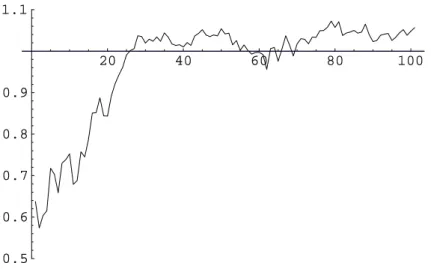
2.1 Estimated values for µ1 from MCEM 29
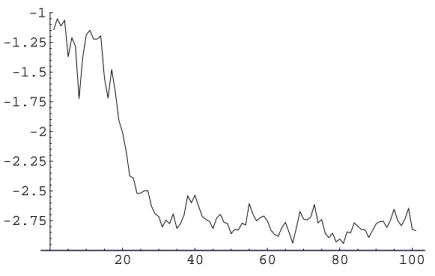
2.2 Estimated values for m from MCEM 30
2.3 Estimated values for M from MCEM 30
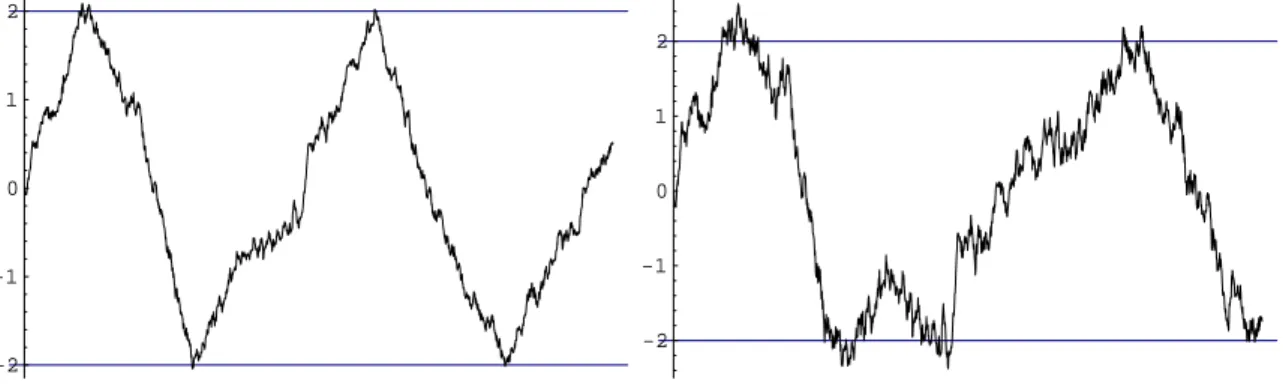
3.1 Two trajectories for the BMD threshold process 45
3.2 Trajectory for the BMD threshold process 47
3.3 Trajectory for the GBM threshold process 50
3.4 Trajectory for the OU threshold process 51
3.5 2004 daily prices from European Sustainable Equities-R fund 54
3.6 2004 daily prices from Parvest Europe Dynamic Growth fund 54
3.7 2005 daily prices from Converging Europe Bond fund 55
List of Tables
2.1 Mean and standard deviation for the estimates from MCEM 30
3.1 Estimates from BMD process with fixed ∆ in the [0,100⌉ observation interval 45
3.2 Estimates from BMD process with fixed ∆ in the [0,500⌉ observation interval 46
3.3 Estimates from BMD process with decreasing ∆ and fixed observation interval 46
3.4 Estimates from BMD process with decreasing ∆ and increasing observation
interval 47
3.5 Estimates from GBM process with decreasing ∆ and fixed observation interval 50
3.6 Estimates from GBM process with decreasing ∆ and increasing observation
interval 51
3.7 Estimates from O.U. process with decreasing ∆ and fixed observation interval 52
3.8 Estimates from OU process with decreasing ∆ and increasing observation interval 53
3.9 Threshold estimates from PF-European Sustainable Equities-R 54
3.10 Threshold estimates from Parvest Europe Dynamic Growth 55
3.11 Threshold estimates from Converging Europe Bond 55
Preface
The past decades have witnessed major developments in the field of statistical
infer-ence for diffusion processes and time series analysis. In the time series the assumptions
of linearity and stationarity have been abandoned and the study of nonlinear models
is increasing. One class of nonlinear models, called threshold models can be found in
[Tong, 1990], in this class the most popular is the threshold autoregressive model (T AR),
or T AR(m, p), where the process is divided into m regimes following in each regime an
AR model. Our goal is to extend the notion of threshold processes to continuous time
processes and obtain estimation methods for this kind of processes. A diffusion which
experiences a regime change upon crossing upper (M) and lower (m) levels will be our
generic model for the stochastic process. We want to study diffusions where changes in
the drift parameter have a consequence on the trend of the process, that is, we want to
consider diffusions with positive trend for some drift parameterµ1and with negative trend
for drift parameter µ2. For instance, the Brownian motion with drift is a diffusion of the
suggested type and the thresholds are introduced, in the model, in the following way. Let
us consider two thresholds, m and M, and suppose that we start with the process with
positive trend (driven byµ1) and the process continues in this first regime until it hits the
upper threshold M, at that time a change occurs and the process follows with negative
trend (driven byµ2) and continues in this second regime until it hits the lower threshold m, starting all over again in the first regime. We call the resulting process a continuous
time threshold model. Simple diffusion processes are often used for stochastic modelling
in many areas as physics, biology or economics. In many applications a continuous time
threshold model can be more useful than simple diffusion model, for instance in some
cool-ing (or heatcool-ing) system controlled by a thermostat we can observe this kind of behavior
in the temperature evolution see [Molina & et al., 2004], in a biological system where
the animal population increase until hits a threshold value that makes the population
dynamics to change (for instance the lack of food) and the population decreases until it
hits a lower threshold where the dynamics change (when the food is enough to support
a small population) and the population increases once again or in a financial context we
xviii PREFACE
can expect the price of some asset to have an increasing or decreasing dynamic between
two thresholds. All these models involve unknown parameters which need to be
esti-mated from observations of the processes. Different methods of estimation as maximum
likelihood, least squares or martingale estimating functions are well studied for diffusion
models. However, for thresholds diffusions models there are not (as to our knowledge)
CHAPTER 1
Overview on threshold model
1.1. Introduction
In the time series context the assumptions of linearity and stationarity have been
abandoned and the study of nonlinear models is increasing. One class of nonlinear models,
called threshold models can be found in [Tong, 1990], in this class the most popular is
the threshold autoregressive model (T AR), or T AR(m, p), where the process is divided
intomregimes following in each regime an ARmodel. This model can be represented by
the following equation:
(1.1) Yt=
m
X
i=1
(ai,0+ai,1Yt−1 +· · ·+ai,pYt−p+εi,t)I{ri−1≤Zt−1<ri},
where for each regimeithe nonlinear model is just ordinaryAR(p) process. The thresholds
are real numbers −∞ =r0 < r1 < . . . < rm−1 < rm = +∞ and Zt−1 =Z(Y1, ..., Yt−1) is
the threshold variable that specifies the change in regime.
We want to study diffusions where changes in the drift parameter have a consequence
on the trend of the process, that is, we want to consider diffusions with positive trend
for some drift parameterµ1 and with negative trend for drift parameter µ2. Considering
two thresholds, m and M, and suppose that we start with the process with positive
trend (driven byµ1) and the process continues in this first regime until it hits the upper
threshold M, at that time a change occurs and the process follows with negative trend
(driven by µ2) and continues in this second regime until it hits the lower threshold m,
starting all over again in the first regime. This model can be specified by the following
equation:
(1.2) dXt =a(µ(t), Xt)dt+b(σ, Xt)dBt,
with
µ(t) =X
k≥0
£
µ1I[τ2k,τ2k+1[(t) +µ2I[τ2k+1,τ2k+2[(t)
¤
,
where τ0 < τ1 < . . . < τj < . . . are the threshold hitting times, that is, τ2k+1 = inf{t > τ2k;Xt=M} and τ2k+2 = inf{t > τ2k+1;Xt =m} fork ≥0 and τ0 = 0.
2 1. OVERVIEW ON THRESHOLD MODEL
This thesis is mainly concerned with the estimation of the threshold parameters, m
and M, in the threshold diffusion process. The original contributions of this thesis are
contained in the next chapters. The thesis is organized as follows. The present chapter
continues with a review on the estimating procedures for the threshold models in the time
series context and in the diffusion context. Chapter 2 starts with an overview and some
results on hitting times for some diffusion processes and follows with the introduction of a
Monte Carlo Expectation Maximization type algorithm to estimate the parameters of the
Brownian motion with drift threshold model, from discrete observations of the process,
finishing with an implementation of the algorithm. In chapter 3, we start
implement-ing a conditional least squares estimation procedure for the Brownian motion with drift
threshold model, with decreasing step ∆n and knowing the regime for each observation,
after that we implement the procedure with unknown regimes. Finally, we generalize the
estimation procedure to more general threshold models as the ones built, for example,
from the Ornstein-Uhlenbeck and the geometric Brownian motion processes. For all the
estimating procedures presented, simulation studies are carried out and the results are
presented. In the end the procedure is also implemented with real data. Overall
con-clusions are presented in the end, along with some general comments on the estimation
methods and suggestions for possible extensions and future research.
1.2. Overview on TAR models
The objective of this overview is to look at some estimating procedures and relevant
questions in time-series threshold models. The threshold autoregressive model (1.1) can
be written as,
Yt=
a1,0+a1,1Yt−1+· · ·+a1,pYt−p+ε1,t, if Zt< r1 a2,0+a2,1Yt−1+· · ·+a2,pYt−p+ε2,t, if r1 ≤Zt< r2
· · ·
am,0+am,1Yt−1+· · ·+am,pYt−p+εm,t, if rm−1 ≤Zt
with p the order of the autoregression and m the number of regimes. One particular
well known case is the self-exciting threshold autoregressive model (SET AR), where the
threshold variable Zt is replaced by some lagged value of Yt that is Zt = Yt−d and d is
called the delay. For the threshold model, with Ai = (ai,0, ai,1, ..., ai,p), for i = 1, ..., m, r = (r1, ..., rm−1) and θ = (A1, ..., Am, r), the usual estimation procedure is conditional
1.2. OVERVIEW ON TAR MODELS 3
minimizes the conditional sum of squared errors,
LN(θ) = N
X
t=p
(Yt−Eθ[Yt|Ft−1])2,
with (Ft) the natural filtration and N the number of observations. The minimization is done in two steps.
(1) For fixed r, we can get by ordinary least squares (OLS) values for ˆAi,N(r), i =
1, ..., mand write
SN(r) = m
X
i=1
Si,N( ˆAi,N, r)
whereSi,N( ˆAi,N, r) =PNt=p
³
(Yt−Aˆi,N|Y)2I{ri−1≤Zt<ri}
´
,.|.stands for inner prod-uct andY = (1, Yt−1, ..., Yt−p).
(2) Then we choose ˆrN that minimizes SN(r), that is
(1.3) ˆrN = arg min
r SN(r)
and finally we put
ˆ
Ai,N = ˆAi,N(ˆrN), i= 1, ..., m.
Usually, it is assumed thatr∈R with R bounded set, and in the SET ARcase the delay parameterdis introduced and a double grid (overdand r) is introduced in (1.3). For the
case of SET AR model with m= 2,
(1.4) Yt =
a1,0+a1,1Yt−1 +· · ·+a1,pYt−p+ε1,t, if Yt−d ≤r a2,0+a2,1Yt−1 +· · ·+a2,pYt−p+ε2,t, if Yt−d > r
where εi,t =ciεt with εt i.i.d. zero mean and unity variance, using the same estimation
procedure (CLS), fixing r and d and performing a grid search Chan, in [Chan, 1993],
showed that when the autoregressive function is discontinuous, that is, when ∃W∗ =
(1, wp−1, wp−2, ..., w0), with wp−d = r, such that (A1−A2)|W∗ 6= 0, the CLS estimator
ˆ
θN of θ is consistent. Moreover, in the same paper, the author shows that ˆrN is N
consistent andN(ˆrN −r) converges in distribution toM−, where [M−, M+[ is the unique
random interval over which a compound Poisson process attains its global minimum.
Furthermore,N(ˆrN −r) is asymptotically independent of
√
N( ˆA1−A1,Aˆ2−A2) and the
latter is asymptotically normal with the same distribution as that for the case when r is
known. Still in the SET AR(2, p) case, when the autoregressive function is continuous,
4 1. OVERVIEW ON THRESHOLD MODEL
equivalent way, a1,i =a2,i for 1 ≤i 6=d≤ p and a1,0 +ra1,d =a2,0+ra2,d, that is, when
(1.4) can be written as
Yt =a0+ p
X
j=1,6=d
ajYt−j+
a1,d(Yt−d−r) +ε1,t if Yt−d ≤r a2,d(Yt−d−r) +ε2,t if Yt−d > r
where a0 = a1,0 +ra1,d and aj = a1,j = a2,j for j 6= d, Chan and Tsay, in the paper
[Chan & Tsay, 1998], show that theCLSestimator, ˆθN ofθ, is yet consistent. However,
ˆ
rN is now
√
N consistent and
√
N(ˆθN −θ) is asymptotically N(0, U−1V U),
where U =E[HtHtT] and V =E[e2tHtHtT]. With et(θ) = Yt−Eθ[Yt|Ft−1] and Ht(θ) =(−1,−Yt−1, ...,−Yt−d+1,−(Yt−d−r)−,−(Yt−d−r)+, ...,−Yt−p,
a1,dI{Yt−d≤r} +a2,dI{Yt−d>r})
T
the partial derivatives of et(θ) with respect to θ, where (y)− = min(y,0) and (y)+ =
max(y,0).
Hansen in a sequence of papers involving threshold models, studies several models. For
instance, in [Hansen, 2000] the author develops asymptotic theory for the distribution
of the regression estimates from the regression model, whenm = 2,
Yt=
AT
1Xt+εt, Zt≤r AT
2Xt+εt, Zt > r ,
with Xt = (1, X1,t, X2,t, ..., Xp,t), and when the regression errors form a martingale
dif-ference sequence. The estimation procedure is the same (CLS) and the fundamental
difference between the assumptions in [Hansen, 2000] and the other authors is that he
makes the assumption that
A2−A1 =cN−α,
that is, a decreasing threshold effect, with c6= 0 and 0< α <1/2. Getting,
N1−2α(ˆrN −r)→d ωT
where
ω= c
TV c
(cTDc)2f and T = arg maxs∈R
·
−12|s|+W(s)
¸
1.2. OVERVIEW ON TAR MODELS 5
With, D=D(r) when D(s) =E[XtXtT|Zt=s],V =V(r) when V(s) = E[XtXtTε2t|Zt= s],f =f(r) when f(z) is the density of Zt and
W(s) =
W1
−s, s <0
0, s = 0
W2
s, s >0 ,
whereW1
u and Wu2 are independent standard Brownian motion. The distribution forT is
known and given by,
P[T ≤x] = 1 +
r
x
2πexp
³
−x8´+3
2exp(x)φ
µ −3 √ x 3 ¶ − µ
x+ 5 2 ¶ φ µ − √ x 2 
whenx≥0 and φcumulative standard normal distribution function. For x <0, P[T ≤ x] = 1−P[T ≤ −x].
In [Hansen, 2000], the author also builds likelihood ratio tests to test the hypothesis
H0 :r =r0 under the assumption that εt are i.i.d. N(0, σ2). For the drift parameters in
the regression, he shows that, with ˆθ= ( ˆAT
1,AˆT2)T and θ = (AT1, AT2)T,
√
N(ˆθ−θ)→d N(0, Vθ),
whereVθ is the standard asymptotic covariance matrix as if r were fixed and known.
Earlier, in [Hansen, 1997] the author proved similar results about the asymptotic
distribution of the threshold and the likelihood ratio test for the T AR(2, p) model, he
also reviews the test for linearity suggested in [Hansen, 1996] to test the linear model
against the threshold model and the same kind of test is studied in [Hansen, 1999].
In the paper [Hansen & Seo, 2002] the authors provide an estimation procedure
for threshold co-integration in vector error-correction models with two regimes,
∆Yt =
AT
1Xt−1(β) +εt, wt−1(β)≤r AT
2Xt−1(β) +εt, wt−1(β)> r .
Where Yt is p-dimensional time series, I(1) (that is, each of the series is non-stationary
with unit root), which is co-integrated with cointegration vector β (so βTYt is stationary
orI(0)). Where wt(β) =βTYt,A is k×pmatrix and
Xt−1(β) = (1, wt−1(β),∆Yt−1, ...,∆Yt−l).
The errorsεt are assumed to form a martingale difference sequence with finite covariance
6 1. OVERVIEW ON THRESHOLD MODEL
authors implement maximum likelihood estimation (M LE) of the threshold model. The
Gaussian likelihood is
LN(A1, A2,Σ, β, r) =−N
2 log|Σ| − 1 2
N
X
t=1
εt(A1, A2,Σ, β, r)TΣ−1εt(A1, A2,Σ, β, r),
where
εt(A1, A2,Σ, β, r) = ∆Yt−AT1Xt−1(β)I{wt−1(β)≤r}−A T
2Xt−1(β)I{wt−1(β)>r}.
The M LE ( ˆA1,Aˆ2,Σˆ,β,ˆ rˆ) are the values that maximize LN(A1, A2,Σ, β, r), and the
proposed estimation procedure is the following:
(1) Form a grid forβ and r.
(2) For each value ofβ and r in the grid, calculate ˆA1(β, r), ˆA2(β, r) and ˆΣ(β, r) as
the constrained M LE for (A1, A2,Σ) (it coincides with OLS estimation).
(3) Find ( ˆβ,rˆ) as the values of (β, r) which yield the lowest value of
log|Σ(ˆ β, r)|
this is because the likelihood function is
LN(β, r) =LN( ˆA1(β, r),Aˆ2(β, r),Σ(ˆ β, r), β, r) = −N
2 log|Σ(ˆ β, r)| −
N p
2 .
(4) Finally, set
ˆ
Σ = ˆΣ( ˆβ,rˆ), Aˆ1 = ˆA1( ˆβ,rˆ) and ˆA2 = ˆA2( ˆβ,rˆ).
Another process is studied by Tsay, in [Tsay, 1998], where the author considers a
multivariate (open-loop) threshold regression model,
(1.5) yt=cj +
p
X
i=1
φjiyt−i+ q
X
i=1
βijxt−i+εjt, if rj−1 < zt−d ≤rj
withj = 1, ..., s,cj constant vectors,yand xare kand v dimensional, respectively. Given
observations {yt, xt, zt}, t = 1, ..., N the author provides a test to detect the threshold
nonlinearity of yt. Writing the linear model in a regression framework,
ytT =XtTφ+εTt, t =h+ 1, ..., N,
whereXt = (1, ytT−1, ..., ytT−p, xtT−1, ..., xTt−q)T,φis the parameter matrix andh= max(p, q, d).
The threshold variable takes values inS ={zh+1−d, ..., zn−d}, denotingz(i) the i-th
1.2. OVERVIEW ON TAR MODELS 7
based in the increasing order of the threshold variablezt−d is
(1.6) yt(i)+dT =Xt(i)+dT φ+εTt(i)+d, i= 1, ..., N −h.
To built the test the author uses predictive residuals. The idea is simply, ifytis linear then
the recursive LS estimator of (1.6) is consistent and the predictive residuals approach
white noise and are uncorrelated with the regressor Xt(i)+d. On the other hand, if yt
follows a threshold model, the predictive residuals will no longer be white noise because
the recursive LSE is biased and would be correlated with the regressor. The author
also generalizes in a similar way the results of [Chan, 1993] and [Hansen, 2000] about
the consistency of the CLS estimator of the parameters in model (1.5), and deduces the
asymptotic normal distribution for the slope parameters.
The estimation of threshold parameters and confidence intervals when the model
is SET AR(m, p) with discontinuous autoregressive function, is considered in the paper
[Kapetanios, 2003]. Using a different approach, the author proposes the use of
general-ized method of moments (GM M), specially in small samples. Using moment conditions
of the form
E[zj,t(r)εt] =E[ztI{rj−1≤Yt−d<rj}εt] = 0
wherezt are variables that provides extraneous information about the threshold
parame-ters. The author considers the loss function,
(1.7) Loss(Y;r) = ¯m(y;r)Tm¯(y;r)
where
¯
m(y, r)j =
1
N
X
i∈Γj(r)
zj,t(r)ˆεt(r),
r = (r1, ..., rm−1)T and Γj(r) denotes the set of observations for which the j-th moment
condition is specified to hold and ˆεt are the regression residuals. The author proves that
the estimator, ˆr, of the threshold parameter defined by the minimization of Loss(Y;r)
is consistent. The author also suggests the use of bootstrap (and sub-sampling) for
con-struction of standard errors and confidence intervals for the threshold parameter.
The model SET AR(2, p), is considered in [Gonzalo & Wolf, 2005] and the
pro-posed solution for inference about the threshold parameter is sub-sampling when the
estimation procedure for the model parameters is, once more, CLS. The basis of
8 1. OVERVIEW ON THRESHOLD MODEL
sampling distribution of ˆrN, properly normalized. With
JN(u) =P[Nβ(ˆrN −r)≤u]
for some positive β, the sub-sampling approximation to JN(u) is defined by
LN,b(u) =
1
N −b+ 1
NX−b+1
a=1
I{bβ(ˆr
b,a−ˆrN)≤u},
where the integer 1< b < N is the block size and ˆrb,a= ˆr(Ya, ..., Ya+b−1) is the estimator
of r computed in the sub-sample Ya, ..., Ya+b−1, that is, CLS estimation applied to the
sub-sample.
In the paper [Gonzalo & Pitarakis, 2002] the model of interest is the threshold
regression model, and the authors give conditions under which the threshold parameters
converge to the true value when the CLS procedure is used in the sequential estimation
of the parameters. Computer burden becomes substantial when m > 2 and to overcome
this problem the authors propose a sequential estimation procedure for the threshold
parameters. The authors consider at each step of the procedure a threshold regression
model with two regimes, and follow the CLS estimation with a slight difference. Instead
of estimating ˆrN as in (1.3), that is, ˆrN = arg minrSN(r) the authors define
(1.8) JN(r) =SN −SN(r)
whereSN is the sum of the square of the residuals when the model is supposed linear and
estimate ˆrN has
ˆ
rN = arg max
r JN(r).
The authors deduce the (non-stochastic) limit J∞(r) of JN(r) and give conditions for the
convergence
ˆ
rN p
→r(1)
where r(1) ∈ {r1, ..., rm−1} is the threshold parameter that dominates all the others in
terms of their contribution for the maximization of J∞(r). Writing ˆrN(1) for this first estimate, the sequential procedure continues, a second threshold estimate, ˆrN(2), is given by
ˆ
r(2)N = arg max
r JN(r|rˆ (1) N )
with
JN(r|rˆN(1)) =J1,N(r|rˆ(1)N )Inr<ˆr(1)
N
o+J2,N(r|rˆ(1)
1.2. OVERVIEW ON TAR MODELS 9
The objective functions J1,N and J2,N are of the same kind of (1.8) but are built when is
adjusted a threshold regression model with two regimes at each sub-sample, and where
the sub-samples are selected using the condition, on the threshold variable Z, Zt < ˆrN(1)
and Zt>ˆr(1)N , respectively. Then,
ˆ
r(2)N →p r(2)
and the procedure follows until all the thresholds are estimated. In this paper, the
au-thors also discuss the small sample behavior of the estimators, and provide an estimating
procedure for the number of regimes.
The Bayesian theory is also used for inference in T AR models as in the paper of
[Stramer & Lin, 2002]. The authors consider a SET AR(2, p1, p2), that is, they
con-sider a two regime SET AR model but where the autoregressive order is p1 in the first
regime andp2 in the second regime, that is,
Yt=
a1,0+a1,1Yt−1+· · ·+a1,pYt−p1 +c1εt, if Yt−d≤r a2,0+a2,1Yt−1+· · ·+a2,pYt−p2 +c2εt, if Yt−d> r
where εt is standard white noise. The authors consider the following prior distribution
for the parameters,
(i) Api are independentN(0, v−i 1Ii), i= 1,2 withIithe identity matrix andvi positive
scalar.
(ii) c2
i are independentIG(α, β) where IGdenotes the inverse gamma distribution.
(iii) r follows a U[a, b] (uniform distribution) where a and b are the 25% and 75%
empirical quantiles of the data.
(iv) d followsU(1, ..., D), a discrete uniform distribution for some positive integer D.
(v) pi are independent U(0, .., Ki) for some positive integer Ki, i= 1,2.
The authors then propose a reversible jump Markov-Chain-Monte-Carlo algorithm to
jump between models with differentp′s and for dealing with models with different values
of d.
Some authors use wavelets for inference in threshold models as the case in the
pa-pers [Li & Xie, 1999] and [Ip, Wong, Li & Xie, 1999]. In the first paper the authors
assume theSET AR(m, p) model,
Yt= m
X
i=1
10 1. OVERVIEW ON THRESHOLD MODEL
with −∞< a < r1 <· · ·< rm−1 < b <∞, and introduce the function,
T(y1, ..., yp) = m
X
i=1
(ai,0+ai,1y1+· · ·+ai,pyp)I{ri−1≤yd<ri}.
They built pempirical wavelet coefficients for the functionT(.) and use its properties for
the estimation of the delayd, the number of regimesm and the threshold coefficients. For
instance, checking the ones that have large absolute values the d parameter is estimated.
By further checking the empirical wavelets corresponding to the time delay across the fine
scale levels, the thresholds and their levels are identified. Finally the authors show the
consistency of the estimators.
In the second paper, [Ip, Wong, Li & Xie, 1999], the estimators are built in the
same way, but the process considered is the open-loop threshold autoregressive model
(T ARSO)
Yt = m
X
i=1
(ai,0+ai,1Yt−1+· · ·+ai,pYt−p+bi,0Xt+· · ·+bi,qXt−q+εi,t)I{ri−1≤Xt−d<ri}.
Then, they define the function T for this process as
T(z) =
m
X
i=1
(ai,0+ai,1y1+· · ·+ai,pyp+bi,0xt+bi,1xt−1+· · ·+bi,qxt−q)I{ri−1≤xd<ri}
with z = (y1, ..., yp, x1, ..., xq), and proceed as in the case of the SET AR model.
One fundamental question considered in several papers, [Caner & Hansen, 2001],
[Bec, Guay & Guerre, 2008], [Gonzalo & Montesinos, 2004], [Hansen, 1996],
[Hansen, 1999], [Hansen & Seo, 2002], [Tsay, 1998], [Wong & Li, 2000], is the
question of testing for linearity, that is, the question of testing the linear model against
some kind of threshold model.
1.3. Overview on diffusion threshold models
As to our knowledge the only paper where a threshold diffusion process is considered,
is in [Freidlin & Pfeiffer, 1998]. In this paper the authors consider Brownian motion
with a drift that changes from positive (b1) to negative (b0) and use it to build a threshold
model where the upper threshold (x1) is not known and the lower threshold is zero. The
regimes in the threshold model are driven by the positive and negative drifts, the process
is supposed to be continuously observed and the estimation procedure relies on maximum
1.3. OVERVIEW ON DIFFUSION THRESHOLD MODELS 11
defined as the continuous solution of the equation
dXt=bi(t)dt+σdBt, X0 =x <0,
where
i(t) =
1, τ2k ≤t < τ2k+1
0, τ2k+1 ≤t < τ2k+2
when τ2k+1 = min{t > τ2k : Xt = x1} and τ2k+2 = min{t > τ2k+1 : Xt = 0}. The
authors define a cycle for the level 0 < h < x1 as the time interval [τ2k∗ , τ2k+2∗ [ with τ∗
2k+1 = min{t > τ2k∗ :Xt =h}, τ2k+2∗ = min{t > τ2k+1∗ :Xt= 0}, that is, the time interval
between two successive intersections of the trajectory Xt with the level x = 0 separated
by crossing of the levelh and defineNT,h as the total number of cycles for the trajectory
of Xt in [0, T]. Next, for each cycle k they observe Xk = maxτ∗
2k<t<τ2∗k+2Xt and define,
withX(i)the ith-order statistic of theNT,h cycle maxima, the estimator ofx1 as the value X(l(NT ,h)) that satisfies,
X(l(NT ,h))(NT,h−l(NT,h)) = max
1≤i≤NT ,h
X(i)(NT,h−i).
CHAPTER 2
MCEM-algorithm
In this chapter we start with a first section dedicated to hitting times for some diffusion
processes and the chapter follows with a second section where we use the information on
hitting times to build an Expectation-Maximization type algorithm to estimate the model
parameters in the Brownian motion with drift threshold model.
2.1. Hitting times distribution
In this section we start with hitting times for the Brownian motion and the Brownian
motion with drift processes. The results being known will be stated and the proofs will
be written in order to allow the generalization for some other processes, namely the
geometric Brownian motion process. Given a stochastic process X with right-continuous
paths, which is adapted to a filtration (Ft)t≥0 and considering a subset Γ ∈ B(R) of the state space of the process, the hitting time (in Γ) is defined as,
TΓ(ω) = inf{t ≥0;Xt(ω)∈Γ}.
In the following the hitting times of interest will be in some predefined level or threshold.
2.1.1. Standard Brownian motion. Let B = (Bt)t≥0 be standard Brownian
mo-tion andTb = inf{t≥0 :Bt =b}, b∈Rthe first hitting time of the level b by the process B. We want to study the distribution ofTb.
Definition 2.1. Define the running maximum, or the maximum to the date, Mt, of
the Brownian motion by: ∀t >0, Mt = sup0≤s≤tBs
First we suppose b >0, from the following proposition is easy to deduce the density
function forTb.
Proposition 2.2 ([Hida, 1980] or [Revuz & York, 1991]). The following
equal-ities hold for b≥0 and t >0:
P[Tb ≤t] =P[Mt ≥b] = 2P[Bt ≥b]
14 2. MCEM-ALGORITHM
We obtain the distribution functionFTb,
FTb(t) = P[Tb ≤t] =P[Mt ≥b] = 2 √
2πt
Z +∞
b
e−y 2 2tdy=
= √2 2πt
Z +∞
b
√
t
e−x22√tdx.
doing the substitution x= √y
t. By differentiation the density of Tb is obtained,
fTb(t) = b √
2πt3e
−b22t, t≥0, b >0.
In the case b <0, we need the following definition.
Definition 2.3. Define the running minimum, or the minimum to the date, mt, of
the Brownian motion by: ∀t >0, mt= inf0≤s≤tBs.
Corollary 2.4. The following equalities hold for b≤0 and t >0:
P[Tb ≤t] =P[mt≤b] = 2P[Bt≥ −b].
Proof. If b <0 we have {Tb ≤t}={mt ≤b}, but
{mt ≤b}=
½
inf
0≤s≤tBs ≤b
¾
=
½
− sup
0≤s≤t
(−Bs)≤b
¾
=
½
sup
0≤s≤t
Bs ≥ −b
¾
,
because (−Bt)t≥0 is also a Brownian motion starting at the origin, and by proposition 2.2
we have
P[mt≤b] =P[Mt≥ −b] = 2P[Bt≥ −b].
¤
For b <0 we have{Tb ≤ t} ={mt ≤b}= 2P[Bt ≥ −b] then in this case the density
of Tb is given by
fTb(t) = −b √
2πt3e
−b2
2t, t≥0, b <0,
and so we can finally write the density forTb, b ∈R,
fTb(t) = |b| √
2πt3e
−b2
2t, t ≥0.
The moment generating function for Tb is known and can be written as
ϕTb(α) =
Z +∞
0
|b|e−αt
2πt3 e
−b2
2tdt =
Z +∞
0
|b|
2πt3e
−b2+2αt2
2t dt=e−|b|
√
2.1. HITTING TIMES DISTRIBUTION 15
2.1.2. Brownian motion with drift µ. In this section we want to study the
hit-ting times for the Brownian motion with drift process and we follow the construction in
[Karatzas & Shreve, 1991]. Let us consider the Ito process given by,
dB˜t=dBt−µdt, t≤T, B˜0 = 0
for T ∈[0,+∞[ andBt standard Brownian motion. We continue with, Tb = inf{t ≥ 0 : Bt=b}. Let,
Mt= exp
µZ t
0
µdBs−
1 2
Z t
0 µ2ds

=eµBt−12µ2t,
then by the Girsanov theorem ([Øksendal, 1998] or [Karatzas & Shreve, 1991]) we
define the measure Pµ in (Ω,F T) by,
dPµ=M
TdP= exp
µ
µBT −
1 2µ
2T

dP
and w.r.t. Pµ, the process ˜B
t, t≤T is a Brownian motion. Then we say that, under Pµ, Bt=µt+ ˜Bt is a Brownian motion with driftµ.
Remark 2.5. We have that,
(1) (Mt)0≤t≤T is a martingale w.r.t. (Ft)t≤T and P, ([Øksendal, 1998](Ex. 4.4)),
and so MTdP=MtdP inFt.
(2) Pµ[A] =E[I
AMt],∀A∈Ft because Pµ[A] =
R
ΩIAdP µ =R
ΩIAMtdP=E[IAMt].
With t fixed, on the set {Tb ≤ t} ∈ Ft∩FTb = Ft∧Tb we have Mt∧Tb =MTb and the Optional Sampling theorem ([Karatzas & Shreve, 1991] or [Revuz & York, 1991])
with the remark imply
Pµ[T
b ≤t] =E
£
I{Tb≤t}Mt
¤
=E£E[I{Tb≤t}Mt|Ft∧Tb]
¤
=E£I{Tb≤t}E[Mt|Ft∧Tb]
¤
=E£I{Tb≤t}Mt∧Tb
¤
=E£I{Tb≤t}MTb
¤
=E
·
I{Tb≤t}exp
µ
µBTb − 1 2µ 2T b ¶¸ =E ·
I{Tb≤t}exp
µ
µb−1
2µ 2T b ¶¸ = Z t 0
eµb−12µ2sP[Tb ∈ds]
=
Z t
0
eµb−12µ2s√|b|
2πs3e
−b2
2sds=
Z t
0
|b| √
2πs3e
−(b−2µss)2ds. (2.1)
SoTb has the density, under Pµ,
Pµ[T
b ∈dt] = | b| √
2πt3e
16 2. MCEM-ALGORITHM
Because, under Pµ, B
t =µt+ ˜Bt is a Brownian motion with drift µ, we can say that the
density of Tbµ is
fTbµ(t) = | b| √
2πt3e
−(b−2µtt)2, t >0,
with Tbµ= inf{t:µt+Wt =b} wereWt is the standard Brownian motion. We will write Btµ forµt+Bt and we get the moment generating function for Tbµ,
ϕTbµ(α) =E[e−αT
µ b] =
Z +∞
0
e−αtfTbµ(t)dt=eµb−|b|
√
µ2+2α
, α >0.
If we consider a Brownian motion with driftµ but starting ata instead of 0, represented
as Bt,aµ , and because Tb,aµ = inf{t : Bµt,a = b} = inf{t : Btµ = b−a} = Tbµ−a we get the density
fTb,aµ (t) =
|b−a| √
2πt3e
−(b−a2−tµt)2, t >0,
and the moment generating function,
ϕTb,aµ (α) = eµ(b−a)−|b−a|
√
µ2+2α
, α >0.
2.1.3. Brownian motion with drift µ and diffusion coefficient σ. Let us
con-sider the Brownian motion with drift µand diffusion coefficient σ,
Btµ,σ =µt+σBt
with Bt the standard Brownian motion. Starting with
Bµ/σt = µ
σt+Bt,
then we have
Btµ,σ =σB µ/σ t .
But
Tbµ,σ = inf{t:Btµ,σ =b}= inf
n
t :σBµ/σt =b
o
= inf
½
t :Btµ/σ = b σ
¾
=Tµ/σb σ
,
and because of what we have done in the last section, we obtain the density when B0µ,σ = a⇔B0µ/σ =a/σ
fTb,aµ,σ(t) = | b−a| √
2πσ2t3 e
−(b−2aσ−2µtt)2, t >0,
and, the moment generating function,
ϕTb,aµ,σ(α) =e
µ(b−a)−|b−a|√µ2+2ασ2
2.1. HITTING TIMES DISTRIBUTION 17
2.1.4. Transformation of the Brownian motion with drift. Let us consider the
Brownian motion with drift, Btµ,σ, we know the density for the first hitting time, Tb,aµ,σ. Define a new process by
Yt=g(Btµ,σ), Y0 =a,
for an invertible monotonous function g. Because
Tb,aY = inf{t≥0 :Yt=b}= inf{t≥0 :g(Btµ,σ) = b}
= inf©t≥0 :Btµ,σ =g−1(b)ª=Tgµ,σ−1(b),g−1(a),
we have the density for TY
b,a given by:
(2.2) fTY
b,a(t) =
|g−1(b)−g−1(a)|
√
2πσ2t3 e
−(g
−1(b)−g−1(a)−µt)2
2σ2t , t >0,
and the moment generating function
ϕTY
b,a(α) = e
µ(g−1(b)−g−1(a))−|g−1(b)−g−1(a)|√µ2+2ασ2
σ2 , α >0.
Remark 2.6. When we consider the process Yt = g(Btµ,σ) by the Ito’s formula, we
get
(2.3) dYt=
·
g′¡g−1(Yt)
¢
µ+σ
2
2 g
′′¡g−1(Y t)
¢¸
dt+σg′¡g−1(Yt)
¢
dBt,
and the results can be applied to the processes solution of this kind of s.d.e.
2.1.5. Geometric Brownian motion. If we consider the geometric Brownian
mo-tion, a positive process satisfying,
dXt=µXtdt+σXtdBt, X0 =a.
We know that the solution of the last s.d.e. is given by,
Xt=a e ³
µ−σ2
2 ´
t+σBt ,
we can then write
Xt=g
µ
Bµ−σ 2 2 ,σ t

with
g(z) = aez, g−1(x) = ln³x
a
´
.
Then we can write, using (2.2), the density for the first hitting time of the geometric
Brownian motion,
fTX b,a(t) =
|ln(b)−ln(a)| √
2πσ2t3 e
−
µ
ln(b)−ln(a)− µ
µ−σ22 
t
¶2
18 2. MCEM-ALGORITHM
and, the moment generating function,
ϕTX
b,a(α) = e
1 2 ·
ln(a)−ln(b)+2µ(ln(b)−ln(a))−|ln(b)−ln(a)|
√
8ασ2+(σ2−2µ)2
σ2
¸
, α >0.
2.1.6. Simple generalization. More generally, instead of starting with a Brownian
motion, we can think in the process solution of the SDE
dXt=α(t)dBt, X0 = 0,
that is,
Xt =
Z t
0
α(s)dBs,
where α(t) is a deterministic regular function. Our goal is to obtain the density for the
hitting times of such a process. We know that Xt is a time changed Brownian motion
Xt=BhXit with hXit=
Z t
0
α(s)2ds,
and we need a reflection principle for this kind of processes.
Proposition 2.7. Let Xt=
Rt
0 α(s)dBs, X0 = 0, α(s) continuous function and ∀t >
0, hXit≥t. With MtX = sup0≤s≤tXs and TbX = inf{t≥0;Xt =b} we have for b≥0
P[TbX ≤t] =P[MtX ≥b] = 2P[Xt≥b].
Proof. First observe that {TX
b ≤t}={MtX ≥b} because Bt has continuous
trajec-tories and α is continuous. On the other hand we have
P[MtX ≥b] =P[MtX ≥b, Xt ≥b] +P[MtX ≥b, Xt< b]
because {Xt≥b} ⊆ {MtX ≥b} we get
P[MtX ≥b, Xt ≥b] =P[Xt≥b].
Because XTX
b =b we can write
P[MtX ≥b, Xt< b] =P[TbX ≤t, Xt < b] =P[TbX ≤t, XTX
b +(t−TbX)−XTbX <0] and with s=t−TX
b
XTX
b +s−XTbX =BhXi(T X b +s)−
BhXiT X b
.
Taking into account that hXit is increasing and in {TbX ≤t}we have s >0, so
hXiTX
2.1. HITTING TIMES DISTRIBUTION 19
and with B Brownian motion and the hypotheses made we get
BhXi(T X b +s) −
BhXiT X b ⊥
FhXi T X b ⊇ F TX b . Then
XTX
b +s−XTbX ⊥ FTX
b
and
P[MtX ≥b, Xt< b] =P[TbX ≤t]P[XTX
b +s−XT X
b <0] = 1 2P[T
X b ≤t],
because XTX
b +s−XT X
b has Normal distribution with zero mean. Finally,
P[MX
t ≥b] = 2P[Xt ≥b].
¤
In the same way as earlier we can get the distribution for TX
b = inf{t ≥ 0 : Xt = b}, b≥0, once BhXit ∼N(0,hXit),
FTX
b (t) = P[M
X
t ≥b] = 2P[BhXit ≥b] = 2
p
2πhXit
Z +∞
b
e− y 2 2hXitdy =
= p 2
2πhXit
Z +∞
b
√
hXit
e−x22phXitdx,
doing the substitution
x= py
hXit .
By differentiation we obtain the density of TX b ,
fTX b (t) =
bhXi′t
p
2πhXi3 t
e− b 2
2hXit, t≥0, b >0.
Forb <0 we have the following analogous result.
Corollary 2.8. With the same assumptions of the last proposition, and mX t =
inf0≤s≤tXs and TbX = inf{t≥0;Xt =b} we have for b <0 P[TbX ≤t] =P[mtX ≤b] = 2P[Xt ≥ −b].
Proof. It is enough to see,
{TbX ≤t}={mXt ≤b}={ inf
0≤s≤tXs ≤b}={0sup≤s≤t(−Xs)≥ −b}
={sup
0≤s≤t
Bh−Xis ≥ −b}={sup
0≤s≤t
BhXis ≥ −b}={M
X
t ≥ −b}.
By proposition 2.7,
20 2. MCEM-ALGORITHM
¤
Becoming
(2.4) fTX
b (t) =
|b|hXi′
t
p
2πhXi3 t
e− b 2
2hXit, t≥0, b∈R.
Remark 2.9. If we consider α(t)≡1 thenXt=Bt, hXit=t and the last density is
just what we have computed in a previous section.
In order to generalize this result to a drifted process, let Yt be the solution of
dYt=−µα(t)dt+dBt, t ≤T, Y0 = 0
with α(t) as in proposition 2.7, Bt a Brownian motion. Then by Girsanov’s with
Mt = exp
µZ t
0
µα(s)dBs−
1 2
Z t
0
µ2α2(s)ds

, t ≤T
we define the measure Q in (Ω,FT) by,
dQ=MTdP,
with respect to which
Yt =−µ
Z t
0
α(s)ds+Bt
is a Brownian motion, for t≤T. Let
Xt=
Z t
0
α(s)dBs, X0 = 0, TbX = inf{t ≥0;Xt=b},
similarly to the case of the Brownian motion with drift, remark 2.5 and equation (2.1),
because Xt∈Ft, {TbX ≤t} ∈Ft and TbX ∈FTX b .
Q[TbX ≤t] =EP
"
I{TX
b ≤t}exp
Ã
µ
Z TX b
0
α(s)dBs−
1 2µ
2Z T
X b
0
α2(s)ds
!#
=EP
·
I{TX
b ≤t}exp
µ
µXTX b −
µ2
2 hXiTbX
¶¸
=
Z t
0 eµb−µ
2
2 hXisP[TX b ∈ds]
=
Z t
0 eµb−µ
2
2 hXis |b|hXi
′
s
p
2πhXi3 s
e− b 2 2hXisds =
Z t
0
|b|hXi′
s
p
2πhXi3 s
e−(b−2µhhXXiiss)2ds.
So the density w.r.t. Q of TX
b is given by,
fTX b (t) =
|b|hXi′
t
p
2πhXi3 t
e−(
b−µhXit)2
2hXit .
We can write,
Xt=
Z t
0
α(s)dBs =
Z t
0
α(s)dYs+µ
Z t
0
2.2. MCEM-ALGORITHM IN THE THRESHOLD MODEL 21
also w.r.t. Q, Yt is Brownian motion, and we can conclude that for the process solution
of the SDE
dXt=µα2(t)dt+α(t)dBt,
with Bt Brownian motion, we have
fTX b (t) =
|b|γ′(t)
p
2πγ3(t)e
−(b−2µγγ((tt)))2, γ(t) =
Z t
0
α2(s)ds.
Remark 2.10. Once more, writing α(t)≡1 then Xt is just a Brownian motion with
driftµ,γ(t) =t and
fTX b (t) =
|b| √
2πt3e
−(b−2µtt)2,
just as earlier for the Brownian motion with drift.
2.2. MCEM-algorithm in the threshold model
In this section we consider the Brownian motion with drift in order to built a threshold
model. Given two thresholds, m and M, and supposing that the change occurs only in
the drift coefficient we built a threshold model. Starting the process with a positive
trend (driven by µ1 >0), the process continues in this first regime until it hits the upper
threshold M, at that time a change occurs and the process follows with negative trend
(driven by µ2 < 0) and continues in this second regime until it hits the lower threshold m, starting all over again in the first regime. To estimate the thresholds m and M
and the drift parameters we use an Expectation-Maximization (EM) type algorithm for
incomplete data because we will work with observed data from the process but this data
do not include observations of the threshold hitting times.
Let us consider the following model:
dXt=µ(t)dt+σdBt, X0 =x0 ∈[m, M[,
where
µ(t) =X
k≥0
£
µ1I[τ2k,τ2k+1[(t) +µ2I[τ2k+1,τ2k+2[(t)
¤
, µ1 >0, µ2 <0
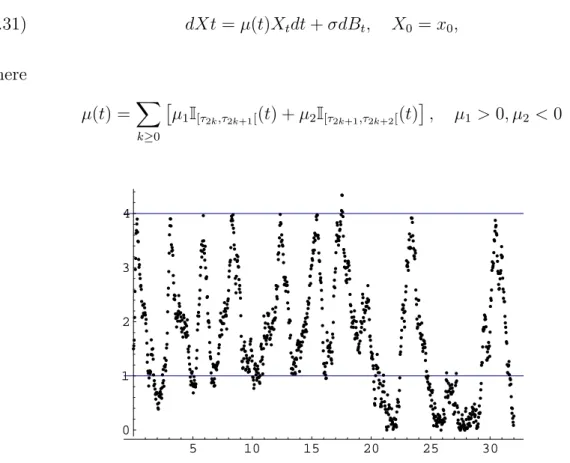
where 0 =τ0 < τ1 < . . . < τk < . . . are the threshold hitting times. That is, giving two
thresholds m and M, τ1 is the time needed for the Brownian motion with drift µ1 to go
fromx0 toM,τ2−τ1 is the time needed for the process with driftµ2 go fromM tomand,
more generally,τi−τi−1 is the time needed for the process to go from one threshold to the
other. We supposeσ is known and we want to estimate θ= (µ1, µ2, m, M). Suppose that
22 2. MCEM-ALGORITHM
with ∆ =tj−tj−1 andtj =j∆ forj = 1, ..., n. In both regimes the Brownian motion with
drift is used to build the threshold model as explained before, however the resulting process
is not a Brownian motion with drift in each of the regimes. Notice that, in the Brownian
motion with drift process we have Xj+1−Xj ∼ N(µ∆, σ2∆) but in the corresponding
threshold process this is not true, even if we know that is no change in regime between
the observation times. The transition densities are not known for the threshold process
and for that reason we use what we think that is a natural approximation, the transition
densities of the Brownian motion with drift process. In the next chapter we will return
again to the problem of the threshold process not being Brownian motion with drift in
each regime. If we consider Brownian motion with drift µ1 in the first regime of the
process and Brownian motion with drift µ2 in the second regime, then p1 and p2, the
transition densities in regime 1 and 2, are
p1(∆, xi, xi+1;µ1) =
1 √
2πσ2∆exp
µ
−(xi+1−xi−µ1∆)
2
2σ2∆

p2(∆, xi, xi+1;µ2) =
1 √
2πσ2∆exp
µ
−(xi+1−xi−µ2∆)
2
2σ2∆

.
The hitting times τ1, ..., τk are not observed and their number in the time interval [0, T] is
given by some random variableK. The densities for the difference between two consecutive
hitting times τ1, ..., τk are known (subsection 2.1.3), and given by:
fT1(τ1;µ1, M) =
M −x0
p
2πσ2τ3 1
exp
µ
−(M −x0−µ1τ1)
2
2σ2τ 1

,
for i= 2,4,6, ...,
fTi−Ti−1(τi−τi−1;θ) =
M−m
p
2πσ2(τ
i−τi−1)3
exp
µ
−(m−M −µ2(τi−τi−1))
2
2σ2(τ
i−τi−1)

,
and for i= 3,5,7, ...,
fTi−Ti−1(τi−τi−1;θ) =
M−m
p
2πσ2(τ
i−τi−1)3
exp
µ
−(M−m−µ1(τi−τi−1))
2
2σ2(τ
i−τi−1)

.
Because the hitting times process is Markov, we can write the joint density for k hitting
times as,
fT1,...,Tk(τ1, ..., τk;θ) =
M −x0
p
2πσ2τ3 1
exp
µ
−(M −x0−µ1τ1)
2
2σ2τ 1
¶Yk
i=2
M −m
p
2πσ2(τ
i−τi−1)3
×
[(k−1)/2]
Y
i=1
exp
µ
−(M −m−µ1(τ2i+1−τ2i))
2
2σ2(τ
2i+1−τ2i)
¶[k/2]
Y
i=1
exp
µ
−(m−M −µ2(τ2i−τ2i−1))
2
2σ2(τ
2i−τ2i−1)

2.2. MCEM-ALGORITHM IN THE THRESHOLD MODEL 23
where [v] = maxl∈N{l ≤v}. To get estimators for the drift and the threshold parameters we will use a Monte Carlo EM algorithm, because the hitting times are not observed and
we will use Monte Carlo simulation in the expectation step.
To implement the algorithm, we will augment the data X1, ..., Xn by considering the
hitting timesT1, ..., TK in order to write the complete likelihood function,
LKc (ω) = +∞
X
k=1
Lc(x1, ..., xn, τ1, ..., τk;θ)I{K=k}(ω)
with K the random variable that represents the number of hitting times in the interval
[0, T] (we don’t consider the term were K = 0 because in that case there is no change
in regime in [0, T]). Conditionally on the hitting times the process Xt is Markov and we
have
Lc(x1, ..., xn, τ1, ..., τk;θ) = fX1,...,Xn,T1,...,Tk(x1, ..., xn, τ1, ..., τk;θ) =fX1,...,,Xn|T1,...,Tk(x1, ..., xn|τ1, ..., τk)fT1,...,Tk(τ1, ..., τk;θ)
=
j1−1
Y
i=0
p1(∆, xi, xi+1)p1(τ1−tj1, xj1, M)p2(tj1+1−τ1, M, xj1+1) j2−1
Y
i=j1+1
p2(∆, xi, xi+1)
×p2(τ2−tj2, xj2, m)p1(tj2+1−τ2, m, xj2+1)· · ·p[1+mod(k+1,2)](τk−tjk, xjk, ⋆)
×p[1+mod(k,2)](tjk+1−τk, ⋆, xjk+1)
n−1
Y
i=jk+1
p[1+mod(k,2)](∆i, xi, xi+1)
× pM −x0
2πσ2τ3 1
exp
µ
−(M −x0−µτ1)
2
2σ2τ 1
¶Yk
i=2
M−m
p
2πσ2(τ
i −τi−1)3
×
[(k−1)/2]
Y
i=1
exp
µ
−(M −m−µ1(τ2i+1−τ2i))
2
2σ2(τ
2i+1−τ2i)
¶[k/2]
Y
i=1
exp
µ
−(m−M −µ2(τ2i−τ2i−1))
2
2σ2(τ
2i−τ2i−1)

,
where for alli= 1, ..., k, ji ∈ {1, ..., n−1} is, such thatτi ∈]tji, tji+1[ andj1 < j2 <· · ·< jk. With ⋆=m×mod(k+ 1,2) +M ×mod(k,2) and mod(a, b) is the remainder of the
integer division of a byb. Then we define the complete log-likelihood in a similar way,
log(LKc )(ω) =
+∞
X
k=1
24 2. MCEM-ALGORITHM
with
log(Lc(x1, ..., xn, τ1, ..., τk;θ)) =
=−
Ãj1−1 X
i=0
(xi+1−xi−µ1∆)2
2σ2∆ +
j2X−1 i=j1+1
(xi+1−xi−µ2∆)2
2σ2∆ +· · ·
+
n−1
X
i=jk−1
(xi+1−xi−µ[1+mod(k,2)]∆)2
2σ2∆ +
[(k+1)/2]
X
i=1
(M −xj2i−1 −µ1(τ2i−1−tj2i−1)) 2
2σ2(τ
2i−1−tj2i−1)
+
+
[(k+1)/2]
X
i=1
(xj2i−1+1−M −µ2(tj2i−1+1−τ2i−1))
2
2σ2(t
j2i−1+1−τ2i−1)
+
[k/2]
X
i=1
(m−xj2i −µ2(τ2i−tj2i))
2
2σ2(τ
2i −tj2i)
+
[k/2]
X
i=1
(xj2i+1−m−µ1(tj2i+1−τ2i))
2
2σ2(t
j2i+1−τ2i)
+ log
Ã
M −x0
p
2πσ2τ3 1
!
− (M −x0−µ1τ1)
2
2σ2τ 1 + k X i=2 log Ã
M −m
p
2πσ2(τ
i−τi−1)3
!
−
[(k−1)/2]
X
i=1
(M−m−µ1(τ2i+1−τ2i))2
2σ2(τ
2i+1−τ2i) − [k/2]
X
i=1
(m−M −µ2(τ2i−τ2i−1))2
2σ2(τ
2i−τ2i−1)
,
apart from a term not involving θ.
2.2.1. E-step. Using the EM algorithm we need in the p-iteration of the E-step to
compute the expectation of the log-likelihood of the augmented data given the observed
data and current value θp = (µ1,p, µ2,p, mp, Mp), that is
Q(θ, θp) =Eθp
£
log¡LKc (X1, ..., Xn, T1, ..., TK)
¢
|X1, ..., Xn
¤
.
We will approximate this expectation conditionally on the observed data through Monte
Carlo.
Concretely, we simulate replicates τl
1, ..., τkll, l = 1, ..., L, of T1, ..., TK and weight the replicates using importance sampling. Notice that, for each l ∈ {1, ..., L} we draw the sequence τl
1, ..., τkll from
fT1,...,Tkl(τ1, ..., τkl;θp) =fT1(τ1;µ1,p, Mp)fT2−T1(τ2−τ1;θp)fTkl−Tkl−1(τkl−τkl−1;θp)
in a sequential way. That is, we drawsl
1 fromfT1 taking τ1l =sl1 then drawsl2 fromfT2−T1
taking τl
2 = τ1l +sl2 and so on (while we are in the [0, T] interval). In this way we are
2.2. MCEM-ALGORITHM IN THE THRESHOLD MODEL 25
Finally, we can approximate the conditional expectation of the log-likelihood of the
augmented data writing,
(2.5) Eθp£log¡LKc ¢|X1, ..., Xn
¤
≈ L1
L
X
l=1
log¡Lkl
c (X1, ..., Xn, τ1l, ..., τkll)
¢
×wl,
where the weightwl is such that,
wl ∝fX1,...,Xn|T1,...,Tkl(x1, ..., xn|τ
l
1, ..., τkll)fT1,...,Tkl(τ
l
1, ..., τkll).
2.2.2. M-step. In the M-step of the algorithm we want to maximize Q(θ, θp) with
respect to θ. Because of what we have done so far, this is just get the value of θ that
maximizes,
QL(θ, θp) =
1
L L
X
l=1
log¡Lkl
c (X1, ..., Xn, τ1l, ..., τkll)
¢
×wl.
We start by differentiating QL(θ, θp) with respect to θ and solving,
dQL(θ, θp)
dθ = 0⇔
∂QL(θ,θp)
∂µ1 ∂QL(θ,θp)
∂µ2 ∂QL(θ,θp)
∂m ∂QL ∂M = 0 0 0 0
Forµ1,
∂QL(θ, θp) ∂µ1 = 1 L L X l=1 "
∂log¡Lkl
c (x1, ..., xn, τ1l, ..., τkll;θ)
¢
∂µ1
wl
#
Equating to zero we get,
(2.6) µ1
à L
X
l=1
£
a1,lwl
¤! − L X l=1 £
b1,lwl
¤
= 0,
with
a1,l = ∆
j1l +
[(klX−1)/2]
i=1
(j2i+1l −j2il −1) + (n−jkll−1)mod(kl+ 1,2)
+ 2τ1l
+ 2
[(klX−1)/2]
i=1
(τ2i+1l −τ2il ) +τkllmod(kl+ 1,2) + [kXl/2]
i=1
(tjl
2i+1−tj2li−1)−tjkll mod(kl,2), b1,l =xnmod(kl+ 1,2)−2x0+M(2[(kl+ 1)/2])−m(kl−1),
and using the fact that tj =j∆. For µ2 we get,
(2.7) µ2
à L
X
l=1
£
a2,lwl
¤! − L X l=1 £
b2,lwl
¤
26 2. MCEM-ALGORITHM
with
a2,l = ∆
[kXl/2]
i=1
(j2il −j2il−1−1) + (n−jkll−1)mod(kl,2)
+ 2
[kXl/2]
i=1
(τ2il −τ2il−1)
−τkllmod(kl,2) +tjl
1+1+
[(kl−1)/2]
X
i=1
(tjl
2i+1+1−tj2li)−tjkll mod(kl+ 1,2), b2,l =xnmod(kl,2) +m(2[kl/2])−M kl.
Form we get the equation,
m2
à L
X
l=1
h
(Uml p+Wl)wli
! +m à L X l=1 h
(−M(Uml p+ 2Wl)−Vmlp +µ1(kl−1)−µ2(2[kl/2]))wl
i! + Ã L X l=1 h
(M(Vmlp−µ1(kl−1) +µ2(2[kl/2]))−σ2(kl−1) +M2Wl)wl
i!
= 0.
(2.8)
With
Ul mp =
[kXl/2]
i=1
∆ (τl
2i−tjl
2i)(tj2li+1−τ
l 2i) Vmlp =
[kl/2]
X
i=1 xjl
2i(tj2li+1−τ
l
2i) +xjl
2i+1(τ
l 2i−tjl
2i) (τl
2i−tjl
2i)(tj2li+1−τ
l 2i) Wl =
kl
X
i=2
1
τl i −τil−1
.
Doing the same with respect to M we get,
M3
à L
X
l=1
·µ
−UMl p−W
l
−τ1l 1

wl
¸!
+M2
à L
X
l=1
h³
(x0+m)UMl p+V
l Mp
+µ1(2[(kl+ 1)/2])−µ2kl+
2x0+m τl
1
+ (x0+ 2m)Wl
¶ wl ¸¶ +M à L X l=1 ·µ
−x0mUMl p−(x0+m)(V
l
Mp+µ1(2[(kl+ 1)/2])−µ2kl) +σ
2k l−
x2
0+ 2mx0 τl
1
−(m2+ 2x0m)Wl
¢
wl¤¢+
à L
X
l=1
h³
x0m(VMlp+µ1(2[(kl+ 1)/2])−µ2kl
+x0
τl 1
+mWl)−σ2(m+ (kl−1)x0)

wl
¸
= 0,
2.2. MCEM-ALGORITHM IN THE THRESHOLD MODEL 27
with,
Ul Mp =
[(klX+1)/2]
i=1
∆ (τl
2i−1−tjl
2i−1)(tjl2i−1+1−τ l 2i−1)
;
VMlp =
[(kl+1)/2]
X
i=1 xjl
2i−1(tjl2i−1+1−τ l
2i−1) +xjl
2i−1+1(τ l
2i−1−tjl
2i−1)
(τl
2i−1−tjl
2i−1)(tj2li−1+1−τ l 2i−1)
.
Finally, we only need to solve the equations to getθp+1 and start the (p+ 1)-iteration of
the algorithm. If we consider the special case µ1 = −µ2 = µ, then the equations are as
following. Forµ
µ
à L
X
l=1
£¡
n∆ +τkll¢wl¤
!
−
L
X
l=1
[((2kl−2)(M −m) + 2(M −x0)
+(M−xn)mod(kl,2) + (xn−m)mod(kl+ 1,2))wl
¤
= 0,
(2.10)
form,
m2
à L
X
l=1
h
(Uml p+Wl)wli
! +m à L X l=1 h
(−M(Uml p+ 2Wl)−Vmlp +µ[2[kl/2] +kl−1])wl
i! + Ã L X l=1 h
(M(Vmlp−µ[2[kl/2] +kl−1])−σ2(kl−1) +M2Wl)wl
i!
= 0,
(2.11)
and for M we get,
M3
à L
X
l=1
·µ
−UMl p−W
l
−τ1l 1

wl
¸!
+M2
à L
X
l=1
h³
(x0+m)UMl p+V
l Mp
+µ(2[(kl+ 1)/2] +kl) +
2x0+m τl
1
+ (x0+ 2m)Wl
¶ wl ¸¶ +M à L X l=1 ·µ
−x0mUMl p−(x0+m)(V
l
Mp+µ(2[(kl+ 1)/2] +kl)) +σ
2k l−
x2
0+ 2mx0 τl
1
−(m2+ 2x0m)Wl
¢
wl¤¢+
à L
X
l=1
h³
x0m(VMlp +µ(2[(kl+ 1)/2] +kl)
+x0
τl 1
+mWl)−σ2(m+ (kl−1)x0)

wl
¸
= 0.
(2.12)
Remark 2.11. To start the algorithm we need initial values for µ1, µ2, m and M.
![Table 3.2. Estimates for 100 replicates for the threshold BMD process in [0, 500]](https://thumb-eu.123doks.com/thumbv2/123dok_br/16507650.734490/64.892.96.757.824.1057/table-estimates-replicates-threshold-bmd-process.webp)
![Figure 3.2. Threshold BMD process trajectory for ∆ = 1/32, observation in- in-terval [0, 32] and µ 0 = 1, m 0 = − 2, M 0 = 2, σ = .9](https://thumb-eu.123doks.com/thumbv2/123dok_br/16507650.734490/65.892.266.675.555.793/figure-threshold-bmd-process-trajectory-observation-terval-µ.webp)
![Figure 3.3. Trajectory for the Geometric Brownian motion threshold process with ∆ = 1/32, observation interval [0, 32] and µ 1 = 1 = − µ 2 , m 0 = 5, M 0 = 15, σ = .6](https://thumb-eu.123doks.com/thumbv2/123dok_br/16507650.734490/68.892.228.631.742.991/figure-trajectory-geometric-brownian-threshold-process-observation-interval.webp)