RESUMO.- [Efeito da modificação ambiental sobre a ocorrência de mastite e alterações hormonais de vacas Holandesas.] O trabalho teve como objetivo avaliar a efi -ciência do sistema de resfriamento adiabático evaporativo, acionado em diferentes horários, em instalação do tipo
fre-Effects of environmental modification on mastitis
occurrence and hormonal changes in Holstein cows
1Juliana R.P. Arcaro2, Soraia V. Matarazzo3*, Claudia R. Pozzi2, Irineu Arcaro Junior2, Luciandra M. de Toledo2, Elizabeth O. Costa4 and Mariana S. de Miranda2
ABSTRACT.- Arcaro J.R.P., Matarazzo S.V., Pozzi C.R., Arcaro Junior I., Toledo L.M., Costa E.O. & Miranda M.S. 2013. Effects of environmental modification on mastitis occurrence and hormonal changes in Holstein cows.Pesquisa Veterinária Brasileira 33(6):826-830. Departamento de Ciências Agrárias e Ambientais, Universidade Estadual de Santa Cruz, Ro-dovia Jorge Amado Km 16, Ilhéus, BA, 45662-900 Brazil. E-mail: [email protected]
The purpose of this research was to evaluate the effects of evaporative cooling in frees-tall on mastitis occurrence, milk production, and composition, as well as cortisol, T3 (triio-dothyronine), and T4 (thyroxin) levels in lactating dairy cows. Twenty-eight multiparous cows averaging 70 ± 10 day postpartum were used in four treatments from January to March 2003. The treatments were: Day (cooling from 7:00 a.m. to 7:00 p.m.); Night (cooling from 7:00 p.m. to 7:00 a.m.); 24-hour (cooling 24-hour); and Control (no cooling). Wired cup test was used for clinical mastitis diagnosis, and the California Mastitis Test (CMT) was used to identify subclinical mastitis. Blood and milk samples were taken weekly for micro-biological and hormonal analyses. The cortisol levels were higher than normal values in all treatment groups, suggesting stress conditions, but T3 and T4 levels remained normal in all groups. The occurrence of subclinical mastitis was lower in Day and Night groups than in Control and 24-hour groups. Regarding the microbiological analyses, in all groups the isolation of Corynebacterium sp. from milk samples increased while negative coagulase sta-phylococci (CNS) declined as etiological agents of subclinical mastitis. However, in Day and 24-hour groups, coagulase positive staphylococci (CPS) increased mainly Staphylococcus aureus (49.8% and 47.7% respectively). The Nightgroup showed a decrease in subclinical mastitis occurrences. Our data indicate that all animals subjected to treatments presented high levels of cortisol, indicating a stress condition. The Night treatment presented a reduc-tion in microbial isolareduc-tion, suggesting a reduced susceptibility to mastitis.
INDEX TERMS: Intramammary infection, mastitis, evaporative cooling,cortisol, thyroid hormones, dairy
1 Received on February 25, 2013.
Accepted for publication on April 25, 2013.
2 Centro APTA Bovinos de Leite, Instituto de Zootecnia (IZ), Rua Heitor
Penteado 56, Nova Odessa, SP 13460-000, Brazil.
3 Departamento de Ciências Agrárias e Ambientais, Universidade
Es-tadual de Santa Cruz (UESC), Rodovia Jorge Amado Km 16, Ilhéus, BA 45662-900, Brazil. *Corresponding author: [email protected]
4 Departamento de Medicina Veterinária Preventiva, Universidade de
São Paulo (USP), Av. Prof. Dr. Orlando Marques de Paiva 87, São Paulo, SP 05508-270, Brazil.
deter-minações hormonais de cortisol, tiroxina (T4) e triiodotiro-nina (T3). Para avaliação da ocorrência de mastite clínica e subclínica foram feitos exames semanais de TAMIS (cane-ca de fundo preto) e California Mastitis Test (CMT). Foram colhidas amostras de leite de todos os quartos para iden-tificação microbiológica dos agentes causais da mastite. O tratamento Dia diminuiu (P<0,05) a temperatura do frees-tall em 5,3°C às 12h e em 3,5°C às 14h em relação ao grupo Controle. A umidade relativa esteve elevada (P<0,05) às 7h no tratamento Noite e às 12h, 14h e 21h no tratamento Dia. Os maiores valores de ITU foram registrados no tratamento Noite às 12h, 14h e 21h. Não foram observadas diferenças entre os tratamentos (P>0,05) para a produção e composi-ção do leite. Nos animais do tratamento Os níveis de cortisol mostraram-se acima (P<0,05) dos níveis normais em todos os tratamentos. Já os teores de T3 e T4 estiveram dentro da faixa de normalidade. Na fase pré-experimental a maior fre-quência de isolamento bacteriano foi para Staphylococcus coagulase negativa. No tratamento noite e dia, houve uma diminuição na proporção de casos positivos de mastite sub-clínica da fase pré-experimental em relação à última sema-na da fase experimental. Na última semasema-na da fase experi-mental houve uma diminuição de Staphylococcus coagulase negativa e aumento da ocorrência de Corynebacterium sp.
TERMOS DE INDEXAÇÃO: Infecção intramamária, mastite, res-friamento evaporativo, hormônios tireoidianos, vacas leiteiras.
INTRODUCTION
Environmental conditions such as high temperature, humi-dity, and solar radiation compromise the ability of the lac-tating dairy cow to dissipate heat, resulting in heat stress. Also, climate variables are associated with increases in in-cidence of mastitis due to enhance animals’ susceptibility to infections (Hammami et al. 2013).
Cooling methods should be used to alleviate the thermal stress in these conditions (Renaudeau et al. 2010). Environ-mental modifications for dairy facilities are generally pro -vided by evaporative cooling such as misting or sprinklers associated to fans (Collier at al. 2006). Keister et al. (2002) verified a lower incidence of mastitis in Jersey cows housed in a freestall with a misting system compared to animals in a non-cooled freestall during the summer period in Arizona.
In general, plasma cortisol levels are increased in dairy cows during short periods of exposure to thermal stress. On the other hand, extended periods of exposure reduce these levels (Du Preez 2000). In addition, basal serum thyroxine (T4) and triiodothyronine (T3) concentrations decline un-der thermal stress. The modification of thyroid activity is accompanied by a decrease in metabolic rate, food inges-tion, growth, and milk production.
The purpose of this study was to evaluate the effects of a misting system in a freestall on mastitis occurrence, milk production, and composition, as well as cortisol, T3 and T4 levels in dairy cows.
MATERIALS AND METHODS
The study was conducted at the Centro APTA Bovinos de Leite do Instituto de Zootecnia, located in Nova Odessa, São Paulo, Brazil
at the coordinates 22°42’ S and 47°18’ W. The region has a subtro-pical climate with a hot and rainy summer. All procedures were approved by the Animal Care and Use Committee of the CAPTA Bovinos de Leite Nova Odessa, SP, Brazil.
The trial was carried out from January to March 2003. Twenty--eight multiparous cows averaging 70±10 days postpartum and 23±2.3 kg milk/day. The treatments were randomly assigned to the cows. The freestall were divided into four sections and then 1 of 4 treatments was installed: Day (cooling from 7:00 a.m. to 7:00 p.m.); Night (cooling from 7:00 p.m. to 7:00 a.m.); 24-hour (cooling 24-hour); and Control (no cooling). The treatments were activa-ted by an automatic controller. The misting system (0.3 L/h) was installed using PVC pipes with valves within a 2.8-m distance. The fans (2.5m/s) were placed about 2.5 m above the freestall bedding. The misting cycle included 5 min with 1 min of water spraying and 4 min turned off. Microclimate parameters’ dry bulb temperatu-re (DBT) and air temperatu-relative humidity (RH) inside the facility wetemperatu-re measured every 60 min over a period of 24 h using a data logger. The temperature and humidity index (THI) was calculated using the equation described previously by McDowell & Johnson (1971).
Weekly blood samples were collected from the coccygeal vein of the cows. The plasma was separated and stored at -80°C. The concentration of hormones was determined by a solid pha-se radioimmunoassay (RIA) using a commercial kit Coat-A-Count DPC® (DPC, Los Angeles, CA).
The animals were milked twice daily (7:00 a.m. and 7:00 p.m.). Milk samples from both milking were collected weekly to deter-mine fat, protein, lactose, total solids (Bentley2000® Instruments Inc.), and somatic cell counts (Somacount® 300).
Wired cup tests were used to diagnose clinical mastitis and California Mastitis Tests (CMT) were used to identify subclinical mastitis. Milk samples from all mammary glands were aseptically collected daily for six consecutive days in the pre-experimental phase and during the last week of the trial. The samples were cul-tivated in sheep blood agar, incubated under aerobic conditions at 37°C for 72 h with readings after 24, 48 and 72 h. The samples were also plated on MacConkey’s agar, where they were incuba-ted at 37°C for 48 h. The microbiological techniques used for the identification of bacteria complied with the guidelines described by Murray et al. (1999). Staphylococci sp. was identified based on colony morphology, mannitol salt agar, and tests of coagulase, urea, maltose, trehalose, xylose, lactose, sucrose, and raffinose. Corynebacterium sp. was identified based on catalase, urea, mal -tose, lac-tose, and sucrose tests (Costa et al. 1986). Streptococcus uberis, Streptococcus agalactiae, and Streptococcus dysgalactiae were identified based on catalase, esculin, and CAMP tests.
Milk yield, milk composition and, hormones were analyzed by repeated measures using PROC MIXED (SAS 2001) with a heteroge-neous compound symmetry covariance structure. Parity number was adopted as a covariate for the adjustment of milk production. For meteorological variables, days were used as the observation unit. The model contained treatments, time of day and treatment by time of day interaction. The data were subjected to an analysis of variance, using the PROC MIXED for repeated measures (SAS 2001) with a heterogeneous toeplitz covariance structure. Differ-ences were considered significant when P<0.05. The difference be -tween the incidence of mastitis in the mammary glands evaluated in the pre-experimental phase and in the last week was performed using the Instat Graphpad Sofware with chi-square test (χ²).
RESULTS
re-corded from 12:00 a.m. to 5:00 p.m. and were correlated with the lowest absolute values of relative air humidity (RH). Day treatment decreased the DBT by 5.3°C at midday and 3.5°C at 2:00 p.m. in relation to the Control group. The relative humidity was increased at 7:00 a.m. in Night treat-ment (96.5%) and at midday (70.0%), 2:00 a.m. (64.8%), and 9:00 p.m. (90.0%) in Day treatment. The highest values established for the THI were registered in the Night treat-ment at midday (79.3), at 2:00 p.m. (80.5), and at 5:00 p.m. (79.4). The 24-hour treatment presented the higher THI at 9:00 p.m (77.7).
Cortisol concentration of Control treatment (1.1µg/dL) was increased in relation to Night (0.6 µg/dL) and 24-hour (0.7µg/dL) treatment. No differences (P>0.05) were found in the levels of triiodothyronine and thyroxin among treat-ments. Mean values of treatments were 55.4 µg/mL and 2.9 ng/dL to T3 and T4 respectively (Table 2).
No differences in milk production and composition (P>0.05) were observed (Table 3). In the pre-experimental phase, 3.5% of the animals and 1.8 % of the quarters had clinical mastitis. In the last week of the experimental phase, the number of animals and quarters with clinical mastitis remained the same when compared with the pre-experi-mental phase. The frequency of subclinical mastitis in the pre-experimental phase in relation to the number of ani-mals and mammary quarters was 78.5 and 65.1% respecti-vely. There was a decrease in the percentage of animals and
mammary quarters affected with subclinical mastitis with 67.8 and 40.1% in the last week of the experimental phase (Table 4).
Table 1. Environmental conditions measured during the experimental period
DBT (°C)
Treatment 7:00 a.m. 12:00 a.m. 2:00 p.m. 5:00 p.m. 9:00 p.m.
Control 21.7 ±0.25a 29.4 ± 0.24b 31.4 ± 0.24b 29.6 ± 0.28a 24.5 ± 0.19b
Day 21.5 ± 0.25a 24.1 ±0.24a 27.9 ± 0.24a 30.9 ± 0.28b 24.3 ± 0.19b
Night 21.3 ± 0.25a 29.3 ± 0.24b 31.0 ± 0.24b 30.3± 0.28ab 24.6 ± 0.19b
24-hour 21.5 ± 0.25a 29.1± 0.24b 30.8 ± 0.24b 30.1 ± 0.19b 24.9 ± 0.19b RH (%)
Control 86.5±1.94a 47.5 ± 0.81a 43.1 ± 0.86a 47.5 ± 1.67a 70.0 ± 1.69a
Day 90.6±1.94a 70.0 ± 0.81b 64.8 ± 0.86b 52.0 ± 1.65b 90.0 ± 1.69b
Night 96.5±1.94b 64.6 ± 0.81c 56.1 ± 0.86c 58.0 ± 1.65c 83.5 ± 1.69c
24-hour 88.5±1.94a 59.3 ± 0.81d 51.2 ± 0.86d 53.7 ± 1.65b 75.0 ± 1.69d
THI*
Control 70.1± 0.26a 76.9 ± 0.26a 78.6 ± 0.26a 76.8 ± 0.26a 73.0 ± 0.26a
Day 69.9 ± 0.26a 72.2 ± 0.26b 79.2 ± 0.26b 78.4 ± 0.26b 74.1 ± 0.26b
Night 70.1 ± 0.26a 79.3 ± 0.26c 80.5 ± 0.26c 79.4 ± 0.26c 74.4 ± 0.26b
24-hour 70.0 ± 0.26a 77.5 ± 0.26d 77.3 ± 0.26d 79.4 ± 0.26c 77.7 ± 0.26d
a,b Means values in the same column with different letters differ by
Student´s Test(P<0.05).The data are expressed as mean ±SEM. * Tem-perature-humidity index (THI) was calculated as [DBT – 0,55x(1-RH)x (DBT-58)].
Table 2. Levels of the hormones cortisol, T3 and T4 in serum
plasma of dairy cows during the experimental period
Hormones Treatments
Control Day Night 24-hour
Cortisol (µg/dl) 1.1 ± 0.13a 0.8 ± 0.13ac 0.6 ± 0.13b 0.7 ± 0.13bc Thyroxin (T4), µg/ml 2.7 ± 0.14a 3.1 ± 0.14a 2.8 ± 0.14a 2.9 ± 0.14a
Triiodothyronine 50.2 ± 5.01a 57.6 ± 5.01a 59.4 ±5.0a 54.4 ± 5.01a
(T3), ng/dl
a,b Means values in the same row with different letters differ by Student´s
Test(P<0.05). The data are expressed as mean ±SEM.
Table 3. Milk production and composition of lactating cows during the experimental period
Milk Production Treatments
(kg/day) Control Day Night 24 hour Morning 9.4 ± 1.46a 10.1 ± 1.48a 9.9 ± 1.62a 9.3 ± 1.53a Evening 9.3 ± 1.65a 10.1 ± 1.48a 10.1 ± 1.55a 9.5 ± 1.68a Total 18.7 ± 3.10a 20.3 ± 2.93a 20.0 ± 3.16a 18.8 ± 3.27a Composition (%)
Fat 3.9 ± 0.13a 3.7 ± 0.13a 3.8 ± 0.13a 3.7 ± 0.13a Protein 3.0 ± 0.09a 3.1 ± 0.09a 3.3 ± 0.09a 3.1 ± 0.09a Lactose 4.3 ± 0.09a 4.6 ± 0.09a 4.6 ± 0.09a 4.6 ± 0.09a Total solids 12. ± 0.27a 12.5 ± 0.27a 12.8 ± 0.27a 12.5 ± 0.27a
a,b Means values in the same column with different letters differ by
Student´s Test(P<0.05). The data are expressed as mean ±SEM.
Table 4. Occurrence of clinical and subclinical mastitis (%) in the pre-experimental phase and in the last week of the
experimental phase
Cows Quarters
Pre-Exp. Phase* Last Week Pre-Exp. Phase Last Week Wired cup test 1 (3.5%) 1 (3.5%) 2 (1.8%) 2(1.8%) CMT** 22 (78.5%) 19 (67.0.%) 73 (65.1%) 45(40.1%)
TOTAL 28 28 112 112
* Pre-experimental phase = Pre-Exp Phase, ** California Mastitis Test.
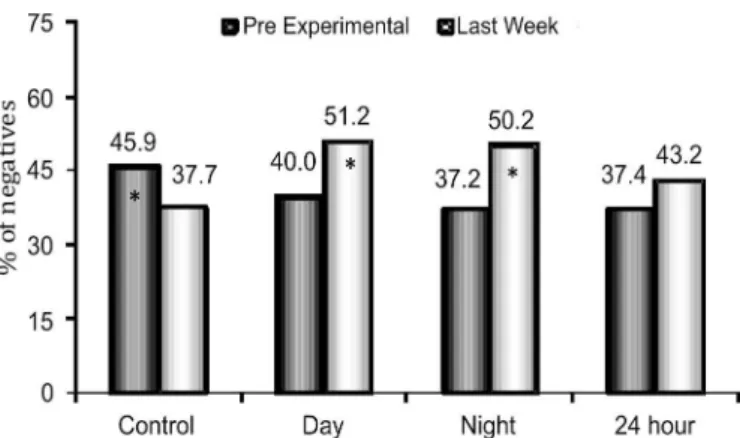
Fig.1. Percentage of mammary quarters negative for microbiologi-cal examination of dairy cows housed in freestall system with evaporative cooling systems.
The percentages of quarter milk samples without micro-bial isolates at the pre-experimental phase in the Control, Day, Night, and 24-hour treatments were 45.9%, 40.0%, 37.2%, and 37.4%, respectively (Fig.1). Control treatment showed a decrease (P < 0.05) in the negative microbial isolates in the last week of experimental phase (45.9 vs. 37.7%). On the other hand, Day (40 vs. 51.2%) and Night (37.2 vs. 50.2%) treatments presented an increase in the quarter without microbial isolates. No significant differen -ce (P>0.05) in the quarter without microbial isolates was observed in the 24-hour treatment (37.4% vs. 43.2%).
Staphylococcus sp. isolates in the last week of experimental phase. Coagulase-positive staphylococci (CPS), Staphylo-coccus aureus, and Corynebacterium spp. isolates were increase in the Day (36.2, 18.8, and 35.1%) and 24-hour treatments (45.3, 21.6, and 42.2%) in the last week of the experimental phase. There was no difference (P>0.05) for somatic cell counts between the pre-experimental and the last week of the experimental phase.
DISCUSSION
The effects of heat stress on dairy cows can be alleviated using a heat abatement system such as shades, fans, mis-ters, and sprinklers. In our trial, Day treatment was effi -cient to reduce the freestall temperature during the hottest hours (12:00 p.m. to 2:00 p.m.). The temperature was 5.3°C lower at midday and 3.5°C lower at 2:00 p.m. in relation to the Control group. These results are in agreement with Smith et al. (2006) who reported a decrease of 3.1°C in dry bulb temperature using evaporative cooling in the North Mississippi, an area characterized by high temperature and humidity.
The main objective of the misting system is to decrease the air temperature. However, the system efficiency is hi -ghly related with relative humidity (RH). High environmen-tal temperature and RH (higher than 70%) may limit the performance of the confined cows because of a reduction in heat dissipation. This restriction of thermal changes will provide an increase in body temperature due to the stora-ge of heat (Davis 2001). RH values higher than 70% were found in all treatments at 7:00 a.m. and at 9 p.m. in the Day, Night, and 24-hour treatments. The high RH observed in these situations is probably associated with the large vo-lume of steam (from breathing) and urine produced by the animals that cannot be removed from the building. Thus, the air changes should be improved to move the warm and humid air away from the facilities.
According to Hahn (1985), THI values of 70 or less are considered comfortable, 71–78 mild stress, 79–83 mode-rate, and values greater than 83 as severe stress with lac-tating cows being unable to maintain their thermoregula-tory mechanisms or normal body temperature. The highest values found for the THI in the Night treatment suggested that it is required to provide an effective cooling system
during the hottest hours of the day in order to help cows dissipate more heat into the environment.
Cortisol concentrations were high in all treatment groups. According to Smith (1993), the normal levels for bovine cortisol are around 0.35g/dL. There is evidence that cortisol, together with other hormones, influences the metabolism of the mammary gland. On the other hand, T3 and T4 levels were within the normal ranges, which in cows are 41-170 ng/dl for T3 and 3.6-8.9mg/ml for T4.These re-sults are similar to those observed by Avendaño-Reyes et al. (2010) who found lower concentrations of T3 and T4 in the months when the temperature and the air humidity were higher, although they remained within the normal range.
In the experimental phase, 3.5% of the animals pre-sented clinical mastitis being this percentage higher than the 3.0% that is accepted internationally (Reneau 1993). To know the clinical mastitis levels allows us to make infe-rences on subclinical mastitis rates. Pearson et al. (1971) verified a proportion of 1:14 between the cases of clinical mastitis for subclinical mastitis. In relation to mammary quarters, it was expected that this proportion would be higher due the cows present more than one quarter with mastitis. In our results, were found the proportion of 1:22 (animals) and 1:36 (mammary quarters) cases of clinical mastitis for subclinical mastitis. The increase of mammary quarters with negative CMT can be attributed to the spon-taneous cure that results from the efficiency between ud -der defense mechanisms and the inflammatory process.
The increase in the quarter without microbial isolates in Day (40 vs. 51.2%) and Night (37.2 vs. 50.2%) treat-ments can be attributed to animal resistance. Heat stress promotes acute and chronic changes in plasma cortisol le-vels, which when increased leads to the suppression of im-mune response and a decrease in the number of circulating leukocytes (Granner 1994). Cortisol levels were higher in the Control treatment, which can partly explain the great number of positive cases in the experimental phase.
The increase in the number of CPS isolates, especially Staphylococcus aureus, in the Day and 24-hour treatments could be due to the decrease in animal resistance. Accor-ding to Sutra (1990), some Staphylococcus aureus strains cause depression of the immune system and a
consequen-Table 5. Bacterial isolation (%) from milk quarters in the pre-experimental phase and in the last week of the experimental phase
Bacterial Isolation* Control Day Night 24 hour Pre-Exp Last Pre-Exp Last Pre-Exp Last Pre-Exp Last
Phase** Week Phase Week Phase Week Phase Week
Staphylococcus spp. 3.9a 5.5a 5.9a 0.0b 6.7a 0.0b 1.6a 2.0a Coagulase-positive staphylococci 17.8a 11.9a 18.8b 36.2a 10.1a 8.9a 19.6a 45.3b S. aureus 7.9a 6.4a 5.1b 18.0a 4.2a 4.4a 11.4a 21.6b Coagulase-negative staphylococci 52.4a 30.7a 56.4a 20.8a 64.4a 36.6a 59.0a 22.6a S. uberis 3.9a 8.2a 1.7a 4.2a 0.8a 8.8a 0.8a 3.0a S. agalactiae 0.0a 4.5a 0.0a 1.0a 0.8a 2.2a 0.0a 0.0a S. dysgalactiae 0.0a 5.5a 0.0a 1.0a 0.0a 1.1a 0.0a 0.0a Corynebacteriumspp. 21.7a 33.3a 17.0b 35.1a 16.1a 43.5a 18.0b 42.2a SCC (x1000/mL)*** 148.7a 454.5a 100.0a 62.3a 52.1a 57.3a 96.2a 209.4a *Bacterial isolation (n=672), ** Pre-experimental phase = Pre-Exp Phase, ***SCC= Somatic cell count
tly weak cellular response to infection in the mammary gland. Consistent with this, an increase in the number of Corynebacterium spp. isolates was observed in the quarter milk samples in all treatments.
The contagious mastitis occurs in different forms that depend on the microorganism involved, pathogenicity, and the ability to prevent tissue invasion. The host response is related to the resistance of the mammary gland (Blood & Radostits 1991). On the other hand, heat stress increases susceptibility to infection by decreasing animal resistance, or increasing exposure to pathogenic agents by promoting conditions that enhance their growth and proliferation in the environment (Whitaker et al. 2004).
CONCLUSIONS
Our data indicate that all the animals subjected to treat-ments presented high levels of cortisol, indicating a stress condition.
The Night treatment showed a reduction in microbial isolation, suggesting a reduced susceptibility to mastitis. In contrast, the animals subjected to the 24-hour treatment had the highest occurrence of Staphphylococcus aureus and therefore, the worst results.
Acknowledgment.- The study was supported by Fundação de Amparo a Pesquisa do Estado de São Paulo (FAPESP, Process nº 01/11093-2).
REFERENCES
Avendaño-Reyes L., Alvarez-Valenzuela A., Correa-Calderon A., Algándar--Sandoval E., Rodríguez-González R., Pérez-Velázquez U., Macías-Cruz R., Diaz-Molina P.H. & Robinson J.G. 2010. Comparison of three cooling management systems to reduce heat stress in lactating Holstein cows during hot and dry ambient conditions. Livest. Sci. 132:48-52.
Blood D.C. & Radostits O.M. 1991. Mastitis. Veterinary Medicine. Bailliére Tindall, London, p.501-559.
Collier R.J., Dahl G.E. & VanBaale M.J. 2006. Major advances associated with environmental effects on dairy cattle. J. Dairy Sci. 89:1244-1253. Costa E.O. da., Coutinho S.D.A., Castilho W., Teixeira C.M., Gambale W.,
Gan-dra C.R. de P. & Pires M. de F.C. 1986. Etiologia bacteriana da mastite bovina no Estado de São Paulo. Revta Microbiol. 17:107-112.
Davis M.S. & Mader T.L. 2001. Effects of water application to feedlot mound during the summer, p.165-172. In: Stowell R.P., Buckin R. & Botcher R.W. (Eds), Proceedings of the 6th International Symposium on Livestock
En-vironment, Louisville, Kentucky.
Du Preez J.H. 2000. Parameters for determination and evaluation of heat stress in dairy cattle in South Africa. Onderstepoort J. Vet. Res. 67:263-271.
Granner D.K. 1994. Hormônios do córtex adrenal, p.531-549. In: Granner
M.D., Murray R.K., Mayes P.A. & Rodwell V.W. (Eds), Harper’s Bioquímica. 7th ed. Atheneu, São Paulo.
Hahn G.L. 1985. Management and housing of farm animals in hot environ-ment, p.151-174. In: Yousef M.K. (Ed.), Stress Physiology in Livestock. Vol.2. CRC Press, Boca Raton, FL.
Hammami H., Bormann J., M’hamdi N., Montaldo H.H. & Gengler N. 2013. Evaluation of heat stress effects on production traits and somatic cell score of Holsteins in a temperate environment. J. Dairy Sci. 96:1844-1855.
Keister Z.O., Moss K.D., Zangh H.M., Teegerstrom T., Edling R.A., Collier R.J. & Ax R.L. 2002. Physiological responses in thermal stressed Jersey cows subjected to different management strategies. J. Dairy Sci. 85:3217-3224.
Laffranchi A., Muller E.E., Freitas J.C., Pretto-Giordano LG., Dias J.A. & Sal-vador R. 2001. A etiology of mammary infections in primiparous cows during the first four months of lactation. Ciência Rural. 31:1-10. McDowel R.E. & Johnson J.E. 1971. Research under field conditions,
p.306-361. In: National Academy of Sciences (Ed.), A Guide to Environmental Research on Animals. National Academy of Sciences, Washington, DC. Morais D.A.E., Maia A.S.C., Silva R.G., Vasconcelos A.M. & Lima P.O. &
Gui-lhermino M.M. 2008. Annual thyroid hormone variation and thermo regulators traits of milk cows in hot environment. Revta Bras. Zootec. 37:538-545.
Murray P.R., Baron E.J., Pfaller M.A., Tenover F.C. & Yolken R.H. 1999. Ma-nual of Clinical Microbiology. 7th ed. American Society for Microbiology,
Washington, DC. 1795p.
Ortiz X.A., Smith J.F., Bradford B.J., Harner J.P. & Oddy A. 2011. Effect of complementation of cattle cooling systems with feedline soakers on lac-tating dairy cows in a desert environment. J. Dairy Sci. 94:1026-1031. Pearson J.K.L., Greer D.O. & Spence B.K. 1971. The relationship between
bulk milk cell counts and cows and quarter mastitis incidence. Vet. Rec. 88:488-494.
Renaudeau D., Collin A., Yahav S., Basilio D.E.V., Gourdine J.L. & Collier R.J. 2010. Adaptation to tropical climate and research strategies to alleviate heat stress in livestock production. Adv. Anim. Biosci. 1:378-379. Reneau J.K. 1993. Clinical mastitis records in production medicine
pro-grams. Compend. Cont. Educ. Food Anim. Pract. 15:497-502.
SAS 2001. Statistical Analysis System. Users Guide, Statistics. SAS Institute, Cary, North Carolina.
Smith B.P. 1993. Tratado de Medicina Veterinária Interna de Grandes Ani-mais. Manole, São Paulo, p.1784.
Smith T.R., Chapa A., Willard S., Herndon Jr C., Williams R.J., Crouch J., Riley T. & Pogue D. 2006. Evaporative Tunnel Cooling of Dairy Cows in the Southeast. II. Impact on Lactation Performance. J. Dairy Sci. 89:3915-3923.
Sutra L. 1990. Phagocytosis of mastitis isolates of S.aureus and expression of type 5 capsular polysaccharidae are influenced by growth in the pre -sence of milk. J. Clin. Microbiol. 28:2253-2258.