AN E-LEARNING PIL
OF PORTUGUESE
UN
Maria da
(1 Centro (2)Unit for New
The Faculty of Arts of the Univers which aims to recycle teachers Actualização de Professores de course covers a diversity of subj literature, to a solid theoretical ba point of view, foreign language te model from the native speaker bu for different target groups: teach their professional activity; native Portuguese as a foreign languag the teaching of Portuguese as Portuguese teachers around the of Porto, the organizers of the co fits in the context of the mission institutional spirit of the Universi their agents and contribute for th excellence of their activities”[2]. January to 5th March), as a pilo already having some teaching e students, 9 successfully complet and one withdrew. For each lea materials, such as resources, a course the students were guide platform (forum, messages and a had to be performed by the trai integrated several elemen In this paper, we intend to prov objectives of University of Porto: New Technologies in Education courses using e-learning/b-learn with a diversity of contents, stra explore the results and what nee of the strengths and weaknesses
ILOT TRAINING COURSE FOR TEAC
SE AS A FOREIGN LANGUAGE AT T
NIVERSITY OF PORTO
da Graça Pinto
(1), Isabel Martins
(2) (1) Faculty of Arts, University of Porto tro de Linguística da Universidade do PortoPorto, Portugal
mgraca letras.up.pt
w Technologies in Education, University of Porto Porto, Portugal
imartins reit.up.pt
Abstract
ersity of Porto offers since 2006 a intensive summer c rs of Portuguese as a foreign language (CAPPLE – de Português Língua Estrangeira). As indicated by t
bjects - from culture, didactics, history, language, ling basis, necessary for foreign language teachers. Indee teaching is humanistic and educational in nature, no but on formal and academic registers [1].This course
chers of Portuguese as a foreign language who wish ive Portuguese speakers who want training in the age / second language; graduates who wish to direct t as a foreign language. Due to external demands, he country, and following the e-learning policies of the
course proposed a ICT edition of the above-mentioned ion of the University of Porto to "stimulate the cohes rsity of Porto, through the dynamics of the cooperatio
their projection to international and national level, pro . The 1st virtual edition of CAPPLE took place in 201 ilot training course involving 11 teachers and 15 stud experience in Portuguese as a foreign language. O leted the course (3 ECTS), 5 received a certificate of learning content module the teachers provided a set , activities and tasks to be performed by trainees. ded by the teachers / tutors through the tools availa d activities). All the content modules had at least one rainee, since this course ran under continuous asses ents that were rated on a qualitativ rovide a brief description of what is currently one o o: the pedagogical and technical support, provided by on (GATIUP), to teachers who want to deliver lifelo
rning strategies. An example of an innovative e-learn trategies and monitoring of trainees, will be present eeds to be improved in future editions based on the id es of this course.
CHERS
THE
r course (30h) – Curso de the title, the nguistics, and eed, from this not basing its e is designed ish to update e teaching of t their work to , even from the University ed course. It esion and the ation between promoting the 010 (from 4th tudents, most
1. Presentation of CAPPLE
Since 2006, The Faculty of Arts of the University of Porto, Portugal, has offered an intensive summer course in July, lasting one week, aimed at updating teachers of Portuguese as a foreign language (CAPPLE – Curso de Actualização de Professores de Português, Língua Estrangeira).
The main aims of the CAPPLE are:
1. to encourage participants to reflect upon different aspects of Portuguese language and culture, namely as far as the relationship between linguistic and sociocultural contents are concerned;
2. to acquaint participants with the Portuguese cultural and social reality from different points of view;
3. to encourage participants to see language as a means of social interaction, of structuring of thought, and of identity of the individuals in their interactions and relationships with the environment;
4. to familiarize participants with the techniques and procedures which are necessary for the development of teaching Portuguese both as a Foreign Language, and as a Second Language. According to the course plan, and in order to take into account the linguistic and cultural diversity inherent to a class of Portuguese as a foreign language, its programme includes several didactic proposals at the level of oral, written and mass media discourse, as well as from a lexico-phraseological perspective of Portuguese.
This version of CAPPLE requires the presence of participants in the classroom and lasts 30 hours. Assessment takes place after the course during an established period of time. There have been five editions of this course so far.
2. The first e-learning edition of CAPPLE
The first e-learning version of CAPLLE was run completely online and consisted of 90 hours, assessment being included. It lasted two months (from 4th January to 5th March 2010).
The programme of the e-learning version of the CAPPLE was similar to the programme of the traditional version. Eleven teachers lectured 15 modules of different but complementary contents. The modules were the following:
1. From the acquisition of a SL to the learning of a FL: two designations of the same reality?
2. Speech and body movement in face-to-face interaction 3. Topics of Portuguese literature
4. Ways of reading in Portuguese as a foreign language 5. Writing: a pedagogical-didactic approach
6. Questions of syntax
7. Tense and aspect semantics I and II 8. Topics of comparative syntax I and II
9. Articulatory training and teaching of Portuguese as a foreign language 10. Questions of semantics: a pedagogical-didactic approach
11. Lexicon: a pedagogical-didactic approach 12. Topics of Portuguese culture
13. Contemporary Portuguese society
For personal reasons of the teacher involved, the Didactics module (principles, actors and practices) was not included in this first e-learning edition of CAPPLE, though its importance in terms of connecting theory to practice and dealing directly with the teaching reality is undeniable.
3. Tutorial support
3.1 Instructions given to the tutors due to their lack of e-learning experience
This was in fact their first contact with an e-learning setting. The potential implications of their (natural) lack of experience cannot be overlooked.
It took considerable time to train the teachers to use the platform, to conceive new contents or to restructure/adapt old ones, and to make them sensitive to the tutorial process required by an e-learning course.
This preparation for e-learning was carried out by the unit of New Technologies in Education (Novas Tecnologias na Educação: NTE) of the University of Porto (UP), whose mission is to give technical and pedagogical support to teachers who use the Information and Communication Technologies (ICT) applied to teaching and learning.
Besides this task, this unit trains teachers who are interested in the conception and management of on-line curriculum units; gives support to the academic community of the University of Porto in terms of design and production of e-learning courses and of making them available online; develops multimedia educational contents; divulges past and present e-learning initiatives at the UP, namely by means of sessions presenting and divulging projects undertaken at the UP; offers permanent updating of skills in the domain of the ICT applied to teaching, that is to say through the attendance and participation in national and international projects/events in this area.
In the case of this e-learning version of CAPPLE, the NTE unit of the University of Porto helped teachers prepare their modules.
Teachers were not obliged to follow a rigid structure, but they were advised to include data which could facilitate the use of the module by the trainees such as guidelines (with information on goals, methodology, structure, and steps to follow in order to complete the planned work); a support text; tasks; a forum for discussion and doubts and other reference documents.
Different support material, resources, activities and tasks to be carried out by the trainees were available for each section of the programme.
With regard to autonomous work, the trainees could rely on the support of the teachers/tutors through the tools which were at their disposal on the platform (forum and messages).
The final result was very mixed, not only in terms of the degree of difficulty of the topics, but also in terms of the task proposals. Indeed, a certain décalage was verified between the foreseen duration of the accomplishment of the tasks and the effective time dedicated to their accomplishment.
4. Trainees
4.1 Trainees’ profiles
Fifteen trainees (14 females and 1 male), who were all teachers, enrolled in the e-learning course.
They were Portuguese and have a certain amount of experience with teaching Portuguese as a foreign language to students of different origins and ages, mainly in Portugal, but also abroad in the case of three of them. The trainee who withdrew (1 female) was the only one who was familiar with e-learning tools.
4.2 Method of assessment of the trainees
Each module presented at least one task to be carried out by the trainee, since continuous assessment was the mode of evaluation for the course.
The final mark of each trainee corresponded to the total marks obtained in the accomplished tasks in the different modules divided by the number of modules.
In order to get the necessary credits /ECTS, trainees had to carry out at least 75% of the proposed tasks.
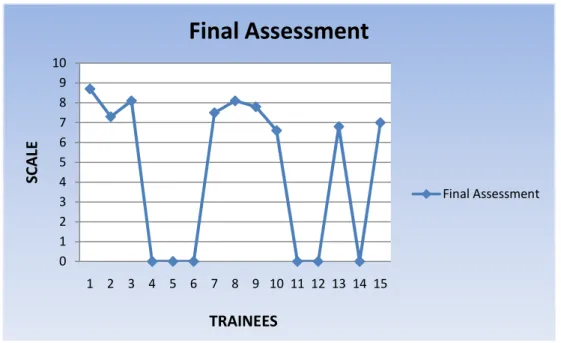
4.3 Final assessment of the trainees
Figure 1. Final assessment of the trainees
4.4 Assessment of the course by the trainees
The assessment of the course by the trainees obtained by means of an online questionnaire shows us positive and negative aspects of the course which have to be looked into and dealt with.
The questionnaire the trainees were asked to fill in (on a scale of 1-5) consisted of the followings items:
1. Ease of use of the e-learning platform 2. Interest of the topics dealt with in the modules 3. Acquisition of new knowledge
4. Appropriateness of the contents to the existing level of knowledge 5. Practical application of the acquired knowledge
6. Suitability of the methods used to the topics being taught 7. Duration of each module (amount of time for each programme) 8. Capacity to motivate and awaken interest through the topics taught 9. Clarity in the exposition and presentation of the topics
10. Sufficient and appropriate documentation
11. Capacity of tutors to answer the questions promptly 12. Time allowed to complete the on-line activities 13. A global assessment of the course
We only have answers from 13 of the 15 students enrolled.
The way the trainees answered the 13 questions may lead us to conclude that, although they might not have any experience with e-learning courses, they were nevertheless aware of what they are expected to do as teachers of Portuguese as a foreign language.
Their teaching experience led them, for example, to point out some methodological aspects which certainly have to do with the lack of experience of the teachers/tutors with the medium and also, certainly, with the absence of one of the modules which is more linked to practice in this particular domain: didactics.
It is possible that unfamiliarity with the medium is also responsible for the observations concerned with the time variable.
Although the topics dealt with in the different modules were considered interesting, and the global assessment of the course and the assessment of some particular aspects were positive, one point we should take into account is the suitability of the modules of this kind of course to reality, due to the fact that the area of this course is by nature practical.
0 1 2 3 4 5 6 7 8 9 10
1 2 3 4 5 6 7 8 9 10 11 12 13 14 15
S
C
A
L
E
TRAINEES
Final Assessment
Do the problems concerned with appropriateness at different levels have to do exclusively with lack of expertise of tutors as far as the medium is concerned?
Should we think of a blended course due to the fact that it is a language course?
Should other learning or e-learning tools, such as quizzes, assignments, discussion boards and chats be tried to avoid the gap between theory and practice?
Should the tutors be expected to be more virtually present by means of more and different tools which facilitate interaction?
Due to their lack of e-learning experience, were the teachers/tutors aware of how they were assessing the trainees, of the number of modules the trainees were attending and of the time the trainees had available to accomplish all the tasks?
4.5 Problems concerning the assessment method used
Many tasks to undertake;
Lack of time to undertake the tasks;
Difference of degree of difficulty required by the various modules; Lack of possibility of going deeper in each topic assessed by the trainee.
4.6 Suggestions proposed by the trainees
To have more time available to prepare and carry out the tasks;
To adjust the demands of the tasks to the time required to carry them out; To articulate the theoretical issues with the practice in a more visible way; To make some tasks clearer;
To establish interaction between tutor and trainee early on so that the trainee may quickly perceive some doubts s/he may have in the different modules;
To specify the methodologies and strategies to be used with students of Portuguese as a foreign language;
To respond to the trainees’ questions promptly; To produce tasks which require less time;
To provide more accurate instructions regarding the tasks;
To concentrate on communication with the trainees and on the uploading of the work on the platform;
To adjust the strategies and the supplied materials to the platform potential.
5. Future work
Some of the modules need to be structured to become more homogeneous and acquire the necessary equilibrium between the time required to accomplish the tasks and their degree of difficulty.
Teachers should give a more uniform structure to the organization of their contents. In fact, each module should have guidelines for use.
Contents should be more interactive. Multimedia techniques could be introduced in some topics in order to create spontaneous motivation in certain matters which may at first sight seem a bit “opaque”.
The method of assessment should also be restructured.
The participation of the trainees in the different modules by means of discussions, presentation of doubts, answers to questions put by the tutor and /or other trainees, and the requirement of only one final task seem to be more productive as far as the attendance of the course is concerned.
The selection of the work to be carried out should be made at the end of the presentation of the modules among the set of tasks proposed by the tutors.
5.1 Potential advantages of this method of assessment
Each trainee takes part in every module.
The tutor has less work at the end of the course because s/he only corrects one or two pieces of work depending on the number of enrolled participants and on the possible consideration of the total number of applications.
6. Final remarks
Finally, it seems relevant to ask if we have correctly understood the meaning of autonomy (see [3] for the concept of “autonomous learning”) which is linked to e-learning and if this kind of course is only intended to receive answers to questions or if it is possible to interact and contribute to personal communication which may lead the learning process further, i.e., beyond the mere accomplishment of tasks. It seems that we have a long way to go if we wish to have an e-learning course of Portuguese which will meet the needs of teachers of Portuguese as a foreign language all over the world and in Portugal, a country which is becoming more and more multilingual and multicultural and therefore in need of more good teachers of Portuguese as a foreign language. This kind of e-learning course and everything we may do to improve it may certainly contribute to the teaching quality the UP wishes to reach in order to be placed among the 100 best institutions of Higher Education in Europe in 2011, the year of its centenary. The challenges may be unlimited, but they will become realistic if each teacher does his/her best, namely in this case with the help of the New Technologies in Education (NTE) unit of the University of Porto.
References
[1] Kramsch, C. 2002. Beyond the second vs. foreign language dichotomy: The subjective dimensions of language learning. In: K. Spelman Miller; P. Thomson (Eds.). Unity and diversity in language use. New York: Continuum, 1-21.
[2] Marques dos Santos, J. C. 2006. Mission of the University of Porto, [online], webpage of University of Porto: http://sigarra.up.pt/up/web_base.gera_pagina?p_pagina=2443.