IN THE STATE OF MINAS GERAIS, BRAZIL: A MULTI-CASE STUDY Elisa Reis Guimarães1, Helga Cristina Carvalho de Andrade2, Álvaro dos Reis Cozadi3,
Luiz Marcelo Antonialli4, Antônio Carlos dos Santos5 (Received: January 31, 2017; accepted: July 26, 2017)
ABSTRACT:The specialty coffee market is still little known and underexplored in Brazil, motivating an analysis of the
competitive pressures and structure of the artisan coffee roaster segment in the state of Minas Gerais, in order to better understand it and encourage the adoption of specific policies for its expansion, besides comparing it to the commodity coffee roasting segment.A multi-case study was performed with three companies in this segment through in-depth interviews with their owners. There were significant changes in the competitive forces that shape the coffee industry, when comparing the specialty and commodity coffee segments, both in intensity and in motivations. Among the suggested policies to support the specialty coffee segment are its promotion and dissemination through “consumer education” and awareness raising on the differentiated properties of these products, besides providing subsidized courses and specializations for those who wish to be involved in this marketplace.
Index terms: Specialty coffees, strategy, coffee waves.
PRESSÕES COMPETITIVAS NO SEGMENTO MINEIRO DE TORREFADORAS ARTESANAIS: UM ESTUDO MULTI-CASOS
RESUMO: O mercado de cafés especiais ainda é pouco conhecido e explorado no país, motivando a realização de uma análise
das pressões competitivas e estrutura do segmento mineiro de torrefadoras artesanais, de forma a compreende-lo melhor e estimular a adoção de políticas específicas para sua expansão, bem como compará-lo ao segmento de torrefadoras de café commodity. Realizou-se um estudo multi-casos com três empresas deste segmento, por meio de entrevistas em profundidade com seus proprietários. Observaram-se importantes mudanças nas forças competitivas que moldam a indústria de café, quando comparados os segmentos de cafés especiais e commodity, tanto em sua intensidade quanto em suas motivações. Como políticas para apoio deste segmento, sugere-se a promoção e divulgação dos cafés especiais, “educando” o consumidor e conscientizando-o dos atributos de diferenciação destes produtos, bem como a disponibilização subsidiada de cursos e especializações para aqueles que desejem se inserir neste mercado.
Termos para indexação: Cafés especiais, estratégia, ondas do café. 1 INTRODUCTION
In order to explain the constant changes in the global coffee market, the concept of “waves” was created following three distinct movements that influence this market, each one with its own set of priorities, philosophies and contributions to the consumption experience (GUIMARÃES, 2016; GUIMARÃES; CASTRO JÚNIOR; ANDRADE, 2016). Such a concept is constantly evolving, but to the First Wave is attributed the significant increase of coffee consumption and important revolutions in the product’s processing and commercialization. The Second Wave would have arisen as a reaction to the low quality attributed to the coffees from the previous movement, being responsible for introducing the concepts of specialty coffees and
1,4,5Universidade Federal de Lavras/UFLA-Departamento de Administração e Economia/DAE - Cx.P. 3037 - 37.200-000 Lavras - MG - [email protected], [email protected], [email protected]
2Universidade Federal de Lavras/UFLA - Agência de Inovação do Café/InovaCafé - Cx. P. 3037 - 37200-000 - Lavras - MG [email protected]
3Universidade Federal de Lavras/UFLA - Departamento de Ciências da Computação -Cx.P. 3037 - 37200-000 - Lavras - MG [email protected]
producing origin, as well as for the popularization of espresso and the beverage consumption in coffee shops. In turn, the Third Wave, the most current movement, is understood as a revolution in the specialty coffee market, marked especially by the radical change of product’s perception (now considered as complex as wine) and by the adoption of several new differentiation factors (ANDRADE et al., 2015; BORRELLA; MATAIX; CARRASCO-GALLEGO, 2015; GUIMARÃES; CASTRO JÚNIOR; ANDRADE, 2016).
Regarding the Brazilian roasting and industrialization segment, it can be stated that, in the First Wave, only commodity beans were used, with a high percentage of robusta coffee (Coffea
canephora Pierre) in the blends and preference
Within this latter aspect, the studies of Michael Porter (1979), who revolutionized the field of strategy, created a methodology for the structural analysis of industries (“five forces framework”), recognized for its wide applicability, understanding simplicity and viewing easiness. According to Porter (2008), such methodology would also allow understanding the factors that influence the profitability of an industry (in this case, artisan coffee roasters) and adjusting the company’s positioning in a more profitable way. In this respect, Grundy (2006, p. 214) points out that the main contribution of this model “resided in distilling the complex micro-economic literature into five explanatory or causal variables to explain superior and inferior performance” from one industry in relation to the others.
These forces would be the threat of new entrants; rivalry among existing companies; bargaining power of suppliers; bargaining power of buyers; and threat of substitutes. Porter (1979, 2008) describes them as follows: a) threat of new entrants: entry of new competitors into a market, pressuring costs, prices and the investment needed for competition; b) rivalry among existing companies: occurring from different ways, such as the launching of new products or price discounts, being determined by intensity and bases of competition among the players; c) bargaining power of suppliers: powerful suppliers can retain a large part of the value they generate for themselves by charging high prices, limiting services or quality, besides transferring their own costs to industry; d) bargaining power of buyers: powerful buyers can limit the profitability of an industry, by forcing price reductions; e) threat of substitutes: those that can perform the same or similar function as the referred industry.
Each industry would be high or low affected by each of these forces (VARGAS et al., 2013). Furthermore, each one determines “prices, costs and investment requirements, which generate long-term profitability and therefore industry attractiveness” (GALBREATH; GALVIN, 2008, p. 109), thus affecting its performance. In Porter’s view (1980:29), “an effective competitive strategy then takes offensive or defensive action in order to determine a defendable position against the five competitive forces.” Therefore, it is understood that such forces are “profit extortionists,” and that such model does not consider the firm’s possible collaborative relationships with the industry’s structure determinants, potentially transforming them into “partnership forces” (DULCIC; GNJIDIC; ALFIREVIC, 2012).
In the Second Wave, producing origin concepts were introduced, still at a country level, besides roasting concepts, especially dark roasts. The preference for arabica coffee (Coffea arabica L.) beans in the blend composition increased and the discussion about specialty coffees and certifications began. Moreover, coffee capsules received a lot of attention. Finally, the Third Wave used only specialty arabica coffee beans, preferably from single origin (at the region or property level) and with lighter roasting, in order to emphasize the unique characteristics of the beans. The roasting takes place in an artisan way and the focus changed to the commercialization in smaller volumes of roasted coffee to be ground only at the consumption time (MANZO, 2014; GUIMARÃES, 2016; CASTRO JÚNIOR; ANDRADE, 2016)
This “wave” concept aids the understanding of the coffee market, as well as the appearance and enlargement of the niche of specialty coffees, whose number of consumers, professionals and companies related to its production, roasting and preparation (extraction) has grown significantly, although it is still little known and underexplored in the country, which motivated this study. The aim was to analyze the structure of the artisan coffee roasting segment in the state of Minas Gerais, Brazil, in order to understand it and encourage the adoption of policies for its expansion, besides comparing it to the roasting segment of commodity coffee.
Competitive pressures
The search for understanding the organizational performance determinants has resulted in two important aspects of strategic thinking: the resource-based view (RBV) and the structural characteristics of the industry (GALBREATH; GALVIN, 2008). In the first one, a firm’s performance is related to its specific resources, understood as “those (tangible and intangible) assets which are semipermanently linked to the firm” (WERNERFELT, 1984, p. 172). The second one, directly related to the structure-conduct-performance (SCP) model (GALBREATH; GALVIN, 2008), assigns this result to the industry structure, in which the conduct of companies is of little importance to their performance (KUPFER; HASENCLEVER, 2002). It is noticed, respectively, excessive focus on internal or external factors to the firm.
Despite its important contribution to the field of strategy, the five forces model has been widely criticized for being static (AFUAH; UTTERBACK, 1997; GRUNDY, 2006; DULCIC; GNJIDIC; ALFIREVIC, 2012), whereas the barriers to entry, substitutes and the number and nature of competitors are not changing together with the industry evolution (AFUAH; UTTERBACK, 1997; VARGAS et al., 2013). Other criticisms involve a) excessive focus on macro analysis at the industry level, in contrast to analyzing more specific segments at the micro level; b) the explanation of value chains without considering that buyers may need to be differentiated between channels, intermediate buyers and final consumers; c) the encouragement of the perception of an industry as a specific and limited entity, less appropriate currently, when its limits seem more fluid; d) the only implicit consideration that the forces are not autonomous and significantly interdependent with one another and with other environmental subsystems (GRUNDY, 2006); e) analytical power limited by the difficulty of measuring the global competitive condition and the degree of each force (LEE; KIM; PARK, 2012); f) and the model perception primarily as “a tool to assess the attractiveness levels of industries rather than gain strategic insight as to how a firm can compete more effectively within its industry” (DOBBS, 2014, p. 34).
In order to overcome some of these limitations, Grundy (2006) proposes some improvements to the five forces model, which will be incorporated in the present study: a) prioritize the five forces within the competitive force field; b) examine the sub-forces in action; c) examine the dynamics and impact of the industry mentality; d) segment markets to examine variations within the competitive landscape. In this way, it is also possible to analyze the evolution of the Brazilian coffee roasting segment in order to overcome the static characteristic of the model (AFUAH; UTTERBACK, 1997; GRUNDY, 2006; DULCIC; GNJIDIC; ALFIREVIC, 2012)
2 MATERIAL AND METHODS
This qualitative and descriptive research (GIL, 2002) based on the methodology proposed by Porter (1979, 2008) and adapted by Grundy (2006) aimed to analyze the competitive pressures and structural transformations of the artisan coffee roasting segment in the state of Minas Gerais,
Brazil (“third wave”), besides comparing it to the segment of conventional roasters, typical from the “first wave”, as portrayed by Faria et al. (2004), among other authors. The better understanding of these segments, especially the artisan coffee roasting one, stimulates and provides the adoption of specific policies for its expansion and consolidation.
Despite the traditional use of the five forces model as a way of measuring or explaining the performance of an industry, its application was chosen in order to demonstrate a new organization/ structure of the coffee roasting industry/segment, which can affect both the conduct of companies as their performance in this market.
A multi-case study was performed, as characterized by Yin (2015), with three artisan coffee roasters in the state of Minas Gerais, Brazil, selected by judgmental and non-probability sampling due to the restricted number of these companies and the difficulty in their identification. In order to obtain the necessary information, semi-structured in-depth interviews were performed by electronic means (Skype) and during the months of June and July 2016 with the owners of these companies that, for confidentiality reasons, are denominated Artisan coffee roaster 1 (ACR1), Artisan coffee roaster 2 (ACR2) and Artisan coffee roaster 3 (ACR3). The information was later interpreted through the qualitative content analysis (BARDIN, 2011).
3 RESULTS AND DISCUSSION
The three artisan coffee roasters studied in the present study are located in important coffee producing regions, being one in the “Cerrado Mineiro” and the others in the “Matas de Minas”, both located in the state of Minas Gerais, Brazil. All of them are family businesses, with a maximum of four years of operation and seven employees (Table 1).
The ACR1 actuated in the rental and technical assistance of espresso machines, marketing and distributing specialty coffee brands, providing inputs for coffee shops and conducting training and consulting in the segment. In 2012, it was acquired by the new owners, maintaining its original activities, including later a monthly coffee subscription and holding of events, beginning the roasting activity only in 2014. Its action was diversified from the demand for coffees by its school of baristas, since the used specialty coffees are above 85 points in the scale of the Specialty
Coffee Association of America (SCAA), still scarce in the Brazilian market at that time. Another objective was to increase the average ticket price, since the roasting activity would not be sufficient to maintain the company.
The ACR2 operates in the roasting activity (own or outsourced for producers) since 2013. It also operates in the commercialization of “white label”, rental and representation of espresso or vending machines (and supply of inputs) and holding events for companies and individual customers. The diversification and offer of complementary services are highlighted as important for gaining the preference of clients.
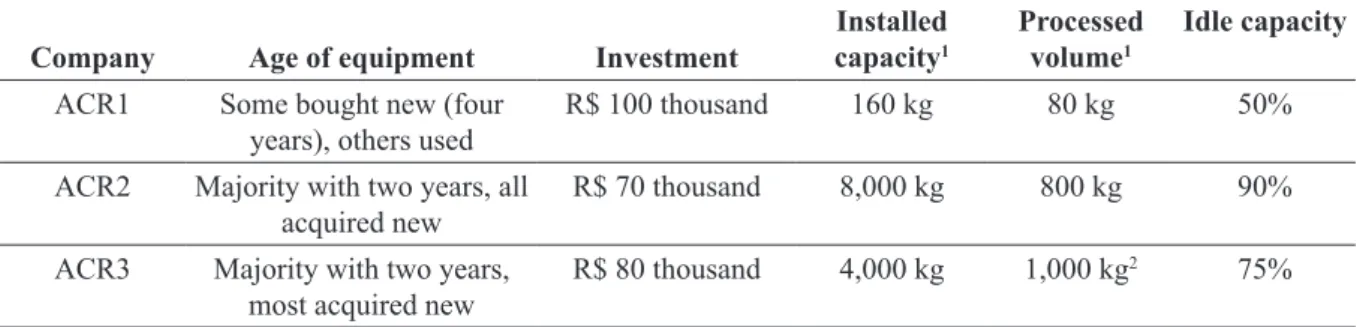
Besides the roasting (of superior and specialty coffee as well as “white label”), ACR3 operates in the segments of coffee brokerage, consulting, qualification and training, holding events (special coffee shop), rental and commodate of espresso machines.The roasting activity would not be sufficient to maintain the company, being the diversification and its complementary services essential for its survival. Investments, processed volume, age of equipment and installed and idle capacity are presented in Table 2.
The acquired equipment are considered as highly technological and its investment classified as high, especially by the small size of such companies, which corroborates the studies of Guimarães (2016) and Guimarães, Castro Júnior and Andrade (2016) about the characteristics of the Third Coffee Wave representatives.
A low percentage of installed capacity use is observed in these companies, being the highest utilization observed in ACR1. There were varied justifications for such fact. The ACR1 considers that there is a small consumer market, and there is difficulty in disposing of the product. The ACR2 emphasizes that the specialty coffee must be fresh, being not possible and/or recommended the roast of great volumes at a time. The ACR3 experiences a bottleneck in packaging, needing to hire staff and acquire one or two new sealing machines to utilize its full capacity.
Bargaining power of suppliers:
The ACR1 exclusively uses specialty coffees above 85 points, from micro lots of several regions, but predominantly from “Cerrado Mineiro” due to its location. It has 13 suppliers from different areas, such as coffee growers and suppliers of packaging machinery for rental to third parties.
TABLE 1 - Characterization of the studied artisan coffee roasters
Company Age Category Employees1 Region
ACR1 4 years2 Family business 07 Cerrado Mineiro
ACR2 3 years Family business 05 Matas de Minas
ACR3 2 years Family business 04 Matas de Minas
1 Including the owners
2Founded in 2005, but acquired by the current owners, interviewed herein, only in 2012.
Source: Own elaboration.
TABLE 2 - Information on the equipment used by the studied artisan coffee roasters.
Company Age of equipment Investment capacityInstalled 1 Processed volume1 Idle capacity
ACR1 Some bought new (four
years), others used R$ 100 thousand 160 kg 80 kg 50% ACR2 Majority with two years, all
acquired new R$ 70 thousand 8,000 kg 800 kg 90%
ACR3 Majority with two years,
most acquired new R$ 80 thousand 4,000 kg 1,000 kg
2 75%
1Monthly basis
2Considering the volume of specialty and superior coffees
There are a number of other possible suppliers, mostly small businesses and with low bargaining power. The negotiation among them is based on a price table (quotation), and there is no significant cost of exchange among suppliers.
The ACR2 also works exclusively with specialty coffees, counting on four categories of suppliers: general inputs, cups, packaging and coffee. There are other possible suppliers, but all with high prices, characteristic of the specialty coffee market, according to the interviewee. Currently, several suppliers determine a minimum volume of purchases, precluding the access of small companies, which cannot store such items. The solution would be preferably for imported products, which can still be bought in wide variety and low amount. The cost of exchange, in the case of general suppliers, would be high due to its small number.
The ACR3 works both with specialty coffees and superior ones - hard bean standard for exports. In the case of specialty coffees, the company works with an average of eight producers, but these are not “fixed”: whether they do not provide coffee in the necessary time, the owner searches for others, registering them and collecting information that will be provided in the packaging. For the supply of superior coffee, the company works with 10 producers in its region. Each coffee category demands a trading tactic: while each process of buying specialty coffee is unique due to quality variations, commodity coffee transactions are always based on market value. The criteria for acquiring this raw material are quality, price and ease of trading (standard maintenance and longer payment terms), respectively.
In this case, it is necessary to differentiate coffee suppliers from those packaging ones: there are several potential coffee suppliers in Brazil, but only two good national packaging companies. Nevertheless, there is a low exchange cost between the latter, being only necessary to be attentive in the maintenance of a standard. However, there is little bargaining power of the roaster in this purchase, being the price previously defined. In the coffee acquisition, the interviewee highlights the possibility that new suppliers could not reach a standard. This can also occur with award-winning coffees, being necessary to establish some rules with the producer in advance. Once they are high-quality specialty coffees, a higher price is paid, but negotiated.
Grundy (2006) recommends unraveling the bargaining power of suppliers in four respects: 1) exclusive knowledge; 2) size and number; 3) scarcity of resources; and 4) direct integration (ability to integrate the chain, increasing its competitive power). In the case of the artisan coffee roasteing segment, it can be said that the supply of specialty coffees is still scarce, while the knowledge necessary to produce them is significant. There are still few suppliers of this product, but their integration capacity is great, especially in relation to large producing properties. These aspects are not observed when dealing with packaging suppliers, in which the bargaining power is represented by the low number of suppliers.
Rivalry among existing companies
In the case of ACR1, the interviewee believes that it is “difficult to talk about competition”, since there are no other players in her service area with such a diversified action and/or geared towards “joining forces with other players in this sector”. The relationship among them is mostly friendly, many of them working together in some aspect, which can be observed in the interviewee’s speech:
“I have a commercial relationship with everyone, but we know many of them personally, preserving a good relationship. Most of them are inside my company, where I sell some product or render some service for them” (ACR1 interviewee).
However, she highlights difficulties related to the offer of compensation, financial or other, so that the customer use the coffees of a company. For her, the basis for competition in this market depends on the customer profile. For instance, she cites the case of coffee machines, whose clients range from restaurants to specialized coffee shops. Thus, she emphasizes that she must work with a differentiated price or give some equipment, but believes that the provision of services is the main factor for customer loyalty.
The ACR2 interviewee believes that the market comprises well all the players, because she does not believe that the client of specialty coffees will be loyal to a brand or company. This is because “no one will buy from you (company/
roaster) every day, he or she wants to taste, call friends, exchange experiences.” Thus, she believes
in the maintenance of partnerships for “customer exchanges”, one partner company indicating the coffees of the other. However, she points out that there are also those who “think they should run
At local level (acting city), the ACR2 has five competitors, but whether considering the non-special micro roasters, this number can reach 100. At regional and national level, she has not such information. Her main clients are in the states of São Paulo, Rio de Janeiro and the southern region of the country. This is because, in Minas Gerais, she perceives a “burnt and cheap” coffee culture. In this respect, she states that:
“[Consumers] do not drink bad wine, but specialty coffee is seen as expensive. Those who buy from me are relatives, because coffee has a surname and they want it by ‘luxury’, to give as a gift, or those who know coffee and want to gift it, but it represents 5% of sales, 95% I sell through the site or Facebook” (ACR2 interviewee).
For her, the relationship is good and respectful among some competitors, with information exchange, meetings at fairs and quality recognition with each other’s products. However, some players behave in a contrary way:
“There are others ... who say that only their [coffee] is good and those others are not as good. There are those who put their [coffee] in front of yours on the shelf. Those who do this are cheating, saying that their coffee is good and is 100% Arabica. It is not” (ACR2 interviewee).
For her, the main basis for competition in this market is the friendship with some merchant who makes her coffee available in the establishment. Otherwise, it only occurs whether requested by customers. Therefore, the strategy of displaying the product and requesting its availability on the shelf is used. Whether sold, the merchant pays for the product, otherwise, the roasting is obligated to collect such items from the shelves.
The ACR3 interviewee believes that competition in the specialty coffee market is lower than in the conventional one, although present and strong, creating barriers to entry into new coffee shops and stores. He points out that there is also competition with suppliers of traditional coffees, since in the case of specialty ones, there is no way to negotiate for price. He believes there are five local competitors for specialty and superior coffees, with good relationship among them, and up to 100 specialty brands at the regional level. At the national level, the interviewee stated that he could not measure such competition, but he highlighted the market growth and its intensification. He emphasizes that:
“Whether an end customer fails to consume traditional [coffee] to consume specialty one, even
if it is not mine, it is already good because the customer is coming to know the specialty ones. In the future, he will consume mine [specialty coffees], it is a ‘leap’” (ACR3 interviewee).
The ACR3 interviewee believes that the main basis for competition in the market is still the price. He also highlights quality in service and persistence to win new customers.
Grundy (2006) also proposes to evaluate the rivalry among existing companies as a function of their commitment to the market, their strategy and disposition and their similarities or differences. In the case of artisan coffee roasters, their typically friendly stance and mutual collaboration strategy reduces competition. However, their commitment to the market tends to be high. The small number of companies studied here precludes reliable statements on their similarities and differences, and the analysis of such aspects is a suggestion for future studies.
Threat of new entrants
The ACR1 demonstrates low concern about the threat of new entrants:
“We are very specialized, we follow the market evolution. It is possible to entry someone with more knowledge, I do not know. Because we always seek for training, we try to be updated. So I guess there is no danger, no. In fact, it is good, because it further develops the specialty coffee market” (ACR1 interviewee).
Regarding the main difficulties to start the business, she highlighted the low knowledge of consumers about specialty coffees and the restricted willingness to pay a higher price for these products. Therefore, she adopted actions aimed at consumer education, besides reducing the requirement of bean size in order to achieve a more competitive price.
Another barrier would be the lack of knowledge of this market by its professionals, overcame by their knowledge and previous experiences on specialty coffees. With the exception of non-formal regulations (care to obtain and maintain quality and hygiene), no further instructions for starting the enterprise were followed.
The interviewee does not report any retaliation from her competitors and is unaware of such actions. For her, the current market supply is not only sufficient to meet the demand, but that there is also “a little overplus”, since the consumer base willing to meet and acquire specialty coffees is still restricted. Once the initial investment has been paid, she considers that exit barriers are small due to the easiness of reselling the equipment.
The ACR2 interviewee is not worried about the threat of new entrants, considering her advantageous entry into the market by “educating
accommodated customers, accustomed to commodity coffee.” The main barriers to entry
would be marketing planning and coffee commercialization:
“It is not the first [sale], the first you can sell. But sell the second time to a customer... because he will find that the coffee is weak, spoiled. You have to sell a whole story, do tasting, give a good [coffee] and a bad one, it is a tough job. So I guess, the more people doing, the easier. Even though he [client] does not exclusively buy mine [coffee], but if he buys from the other, someday he will buy from me” (ACR2 interviewee).
Regarding the factors that encouraged and facilitated their entry into this market, the passion for coffee, the satisfaction in creating a quality product and the willingness to share this experience are highlighted. In relation to the regulations for starting the business, she was supported by SEBRAE.
Despite considering that there are no barriers to the entry of competitors, she emphasized the retaliation of companies to new entrants by the unfair competition and defamation:
“There is always the unfair competition; the one that, instead of adding, wants to ‘pull your rug’. Sometimes you put your product in a bakery, then comes a friend from the owner, and says that the coffee is bad. As the owner does not understand [about coffee quality], it remains one word against the other” (ACR2 interviewee).
For her, the current offer is enough to meet the demand in the market, but highlights the need for its expansion, which shows significant potential. Regarding the exit barriers, she cites financial and emotional costs:
“When I hear that someone is selling a roaster, I am sad unless it is to buy a bigger one. This is why I talk to producers in the region to be careful about investing, not because they are going to compete with me, but because it is a risk. I have done many courses, but I have to do many more. It is also hard to sell a roaster, a mill. They are expensive equipment” (ACR2 interviewee).
The ACR3 interviewee sees few companies willing to enter the specialty coffee market, both locally and regionally, being more frequent the entry into the conventional coffee market as indirect competitors. In the case of specialty coffee, there is a greater need for capital investment and improvement.
For him, the main barriers to entry are planning, market knowledge, ensuring that customers know and recognize the quality, as well as high initial investment for market opening and acquiring knowledge about specialty coffee roasting. He also highlights the importance of persistence in the conquest of consumer and his training about specialty coffees, “breaking the
stigma of low-quality coffees.”
The main incentives for the business opening were his prior knowledge, since he already acted as classifier and taster (Q-Grader) and his previous role in SEBRAE, where he developed projects with specialty coffee roasters. Regarding the regulations for starting the activities, he checked the regulations of the Ministry of Agriculture, Livestock and Food Supply (MAPA), attended events of the Brazilian Coffee Industry Association (ABIC) and contacted the local city hall, health surveillance and fire brigade.
Regarding the threat of new entrants, the competition for prices stimulated by conventional coffee roasters and its availability of capsule coffee machines are highlighted. However, in the specialty coffees, the investment in market opening and tasting is high, which shows all the work committed for obtaining the final product quality. The ability to meet the current demand would depend on the promotion of specialty coffees, since there would be significant room for growth in this market. However, an obstacle generated by the economic crisis is emphasized:
“Among all the products that consumers can think to improve when their income increase, coffee is the last. The customer improves the meat, dairy products, but coffee is the last one that it is thought to improve” (ACR3 interviewee).
He also believes that there are relevant exit costs due to high investment in machinery, not fully recovered after their sale. For him, only 50% of this amount would be recoverable, while investment in market opening and working capital would be wasted.
Grundy (2006) suggests the classification of the threat of new entrants into physical, informational, economic or psychological barriers to entry. In the case of artisan coffee roasters, economic barriers seem to be more relevant due to the high cost of equipment, whereas physical barriers seem to be medium, since access to consumers is not difficult, but to suppliers (low number of packaging suppliers and the specificity of the used coffee, with the
intention to use differentiated coffees also in relation to competitors). Informational barriers are considerably low due to the cooperative stance among competitors, as well as psychological barriers, since it is still an underexplored and considerably expanding market in the country. Bargaining power of buyers
The ACR1 has approximately 100 to 150 customers, among individuals and legal entities, being this latter predominant. The possibility of consumers pushing their prices are small, being possible to negotiate with coffee shops that buy in the ticket and in larger quantities.
In ACR2, legal entities (coffee shops, restaurants, among others) are also more significant. Few individual consumers buy through the website. Regarding the bargaining power of its customers, she emphasizes that she prefers to “give as a gift than lower the price”, since this would lead him to earn the respect of consumers. Furthermore, she emphasizes:
“I cannot want to exploit them, the aid must be mutual. There is no use in wanting to make a big sale and he [buyer] gets old coffee because I will be back to square one. Specialty coffee, if it is not fresh, then it is not good. When someone says they want to make a big purchase, I evaluate if it is for an event or something like this. If it is just to put on the shelf, I say that it is better not, that he or she should take less, that I’ll deliver more in the following week” (ACR2 interviewee).
The ACR3 has a portfolio of approximately 50 customers, including buyers of corporate and specialty coffees. For supermarkets, considered as the most powerful customers, both product categories are supplied. In this case, the entrepreneur opts for local supermarkets, since the larger ones charge key money and entry fee, precluding the negotiation. The entrepreneur often considers the attempt of price negotiation by customers, which often demand for cups, plates at the point of sale and machinery in commodate at no charge. This is then negotiated, but it is not uncommon to lose customers for companies that offer such benefits at reduced cost or for free.
The bargaining power of buyers is evaluated by Grundy (2006) according to the importance of the product/service in terms of added value; the discretion or emotion associated with them; and the urgency of consumption time. In the case of specialty coffees marketed by artisan coffee roasters, high added value and great emotion
associated with the product could be observed, as also observed by Guimarães (2016) and Guimarães, Castro Júnior and Andrade (2016). The urgency related to the consumption time is also high, since the maintenance term of the optimum state of the coffee after the roasting process is short.
Threat of substitutes
For ACR1, the substitutes to those products commercialized in her signature club are wines or craft beers. Regarding the espresso machines, they are usually only exchanged in case of substitution, for preparation of the same beverage or for another of instant coffee. It would be easy to find alternatives to these products, being the prices of their specialty coffees similar to wine and beers. However, such situation would not be applicable to espresso machines, with price well above these alternatives.
In the case of ACR2, other alternatives to coffee are provided to facilitate the purchase by its customers of several items from a single supplier. The interviewee points out that her main competitor is the “coffee from the countryside”:
“If it is said that it [coffee] is from the countryside of the Minas Gerais, then people think it is good, that beverage has quality. They have conviction and are offended if I say it is not.This coffee is priceless. It comes from your land, or from your friend’s land. It is there taking rain and sun, fermenting... but even so if it is the countryside coffee, it is good. Roasted until charred. So how do you compete with that? It is educating [the consumer]”(ACR2 interviewee).
Such alternatives are easily found by her competitors, with significantly price differences between specialty coffees and commodity ones, harming her business. However, she shows good expectations after the FIFA Soccer World Cup, which served to create awareness among national players for the low quality of coffee in the domestic market and the great national and international demand for high quality and sustainable coffees. Thus, she says to her micro roasting partners: “do
not give up, do not ‘prostitute’ by starting to make a traditional coffee, because that is regressing.”
For ACR3, the main substitutes for its products are tea, soda, juices, coffee-based beverages and chocolate, easily found in the market, since the points of sale usually “have
these products at the customer’s hand”. Regarding
the price difference, he considers as very large, especially in the case of espresso coffee, due to the low production cost of its substitutes and low consumption habits by young people.
Regarding the analysis of the threat of substitutes, Grundy (2006) proposes four criteria: the possibility of “do it yourself” by the consumers; the use of other technologies to achieve the same result; emotional issues related to product acquisition; and grouping or disaggregation, understood as “the customer’s ability to do something either as part of something else, or to take a packaged offering and to capture value by breaking up the value-added activity into its smaller components” (p. 222). In the case of artisan coffee roasters, there is the possibility of “do it yourself” by the consumers, whether they buy domestic and portable roasters, although the knowledge necessary to achieve a similar result is high. Thus, such possibility is greater in the case of forward integration by coffee growers or backward integration by specialized coffee shops. The use of other technologies is still restricted, while the very characteristic of the artisan coffee roaster business and the consumption philosophies of specialty coffees discourage grouping or disintegration activities. Finally, emotional issues are significant among specialty coffee consumers, minimizing the threat of substitutes.
In Table 3 the results are summarized and discussed.
General discussions
It could be suggested that this is a segment of medium/high attractiveness, since it has low threat of new entrants and low bargaining power of buyers, as well as low/medium rivalry among existing companies. The main adversities that may restrict its profitability are the high threat of substitutes, since they are widely available and significantly cheaper, and in the medium/ high bargaining power of suppliers, especially of packaging, since, according to the interviewees, there are only two good players in this market. In the case of the raw material, the bargaining power of coffee growers can be considered as medium, since they are still more vulnerable in this commercial relationship, but once they work with differentiated products (specialty coffees), they get some room for negotiations. In order to prioritize the five forces and facilitate their visualization, Grundy (2006) proposes to substitute Porter’s methodology by its classification into favorable, neutral or unfavorable by the alternative approach in vector model, considering the relative importance and weight of each one, represented by the length of lines. Its application to this study can be shown in Figure 1.
There are also important differences between the structure of the commodity and specialty coffee markets. In the first, the bargaining power of suppliers was low due to their high number and negotiation based on international market prices. These products were also highly standardized, which together with the ease of obtaining (high supply), reduced the cost of exchange among suppliers (FARIA et al., 2004). In the specialty coffee market, product differentiation and the reduced number of suppliers, even if still higher than artisan coffee roasters, and the exchange cost related to quality assurance of beans, have increased the bargaining power of coffee growers. However, the strongest players in this relationship became the packaging suppliers due to their limited numbers at the national level, which gives them the power to set minimum purchase volumes and determine prices. However, the cost of exchange among them is low due to the unique need to ensure the maintenance of a standard in these products.
Regarding the rivalry among existing companies, a reduced intensity was observed because such market is still small and its players consider that its growth will be beneficial for all, especially for not believing in “loyalty” of customers in the specialty coffee market, which is consistent with the studies of Guimarães, Castro Júnior and Andrade (2016). However, it is worth mentioning that the competition is more friendly among specialty coffee roasters, although there is intense and sometimes disloyal competition by the commodity coffee roasters, which compete with artisan ones, even if indirectly. In their study, Faria et al. (2004) also highlighted the predatory competition and low concern with quality and environmental issues by commodity coffee roasters, which was also confirmed by Guimarães (2016) when referring to “First Wave” companies. Thereby, the bases for competition in the market have had few changes, with the maintenance of the price factor and increase of the services rendered (quality and diversity), persistence to conquest customers and sponsorship. The issue of the absence of brand and coffee plantations was also mentioned by Faria et al. (2004), which demonstrates the continuity of such discomfort in the market, possibly caused by low investments in marketing and in the image change of the national coffee, especially in the quality of beans.
TABLE
3
Comparison between the interviewees’ perceptions in the present study
Category Specification ACR1 ACR2 ACR3 Bar gaining power of suppliers
No. of possible suppliers Bar
gaining power
Exchange cost
High Low Low Medium Low (cof
fee), high (others)
Low (cof
fee), high (others)
High (cof
fee), low (others)
Medium (cof
fee), high (others)
Low (others), medium (cof
fee)
Rivalry among existing companies Competition level No. of competitors Bases for competition Low Low Provision of service, price Medium Medium Sponsorship High High Price, quality of attendance, persistence
Threat of new entrants
Threat level Entry barriers Initial investment Retaliation Exit barriers Market size Low Culture, lack of knowledge R$ 30,000 No Low (equipment sales) Between fair and insufficient Low Mkt planning and commercialization R$ 80,000 Yes (high) High (financial and emotional) Fair Low Planning,
knowledge,
investment
and
quality assurance R$ 120,000 Yes (high) High (equipment sales and sunk costs) Fair
Bar
gaining power of
buyers
No. of potential customers Bar
gaining power
High Low High Low High Medium
Threat of substitutes Substitutes Ease of access to subs. Price dif
ferentials
Beers and fine wines High Low
Traditional cof fee High High Tea, soda, juice
s, soft drinks (cof
fee)
and
chocolate High High
Sour
ce:
The threat of new entrants remained low, but for different reasons. While Faria et al. (2004) attributed such fact to the great loyalty to brands, in the specialty coffee market this is considered as low due to the still limited size and great potential for expansion of this market, which would benefit everyone. In the case of specialty coffees, the main barriers would be the ingrained commodity coffee consumption culture, consumer resistance to paying more for specialty beans (especially for lack of knowledge about the product and not appreciation of new differentiation properties), the need for planning effective marketing and high investments in opening up the market and obtaining knowledge to start operations. The retaliation would be essentially linked to indirect competitors, represented by large commodity coffee roasters, while the main barriers to exit would be the emotional cost and unrecoverable costs related to the actions to open the market and sale of equipment.
A drastic change in the bargaining power of buyers was observed: while the low differentiation of the commodity coffees led to the intense price competition (FARIA et al., 2004; GUIMARÃES, 2016), in the specialty market this situation was reversed exactly by differentiation and value added to the product. In this case, individual buyers do not have any bargaining power, while business customers only achieve this by acquiring large volumes, which is uncommon in this market due to quality maintenance purposes. The specialty
FIGURE 1 - Vector representation of the five forces.
Source: own elaboration based on research data and the proposal of Grundy (2006).
coffees of artisan coffee roasters are sometimes still sold in supermarkets with high bargaining power, but there are other important marketing routes, such as coffee shops, hotels, bakeries and signature clubs for end consumers. In any case, unfair competition also occurs in the specialty market with regard to defamation of competing products or granting of benefits for the choice of coffee from a particular brand.
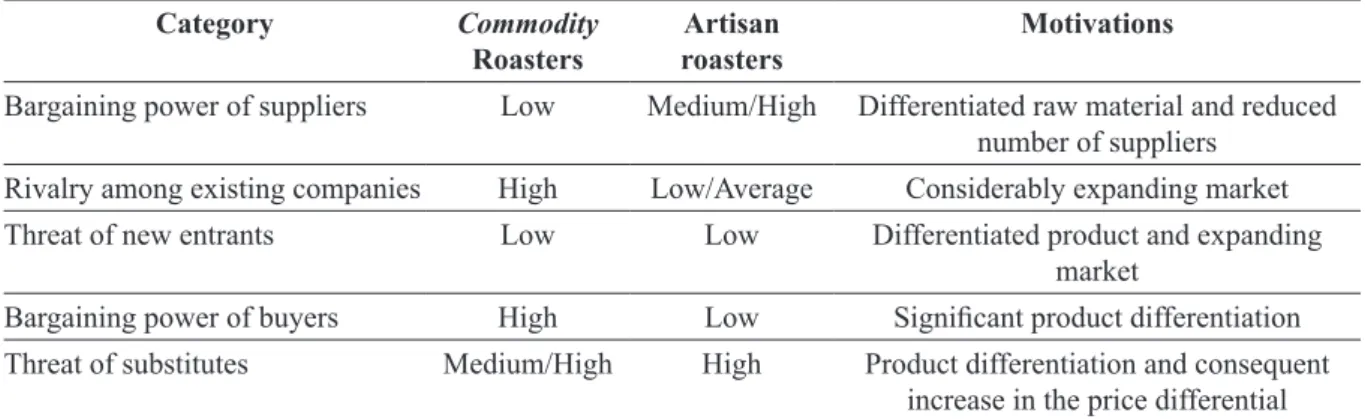
It is observed the maintenance of the significant threat of substitutes, due to their wide availability/ease of access. In the case of commodity coffees, the price difference between these products was low, being the threat represented by the low investment in coffee marketing, market stagnation and misconceptions related to the influence of beverage consumption on human health (FARIA et al., 2004). In the specialty coffee market, this situation is worsened by the large price differential between its specialty and conventional version, which is also significant in relation to other beverages, such as juices, coffee drinks, teas, soft drinks and chocolate. It is also observed the perception of fine wines and craft beers as direct competitors, especially by perception changes of the product (KLEIDAS; JOLLIFFE, 2010; GUIMARÃES, 2016; GUIMARÃES; ANDRADE, CASTRO JÚNIOR, 2016). The comparison between the results of Faria et al. (2004) and the present study can be observed in Table 4.
TABLE 4 - Comparison between the results achieved by Faria et al. (2004) and the present study
Category Commodity
Roasters roastersArtisan Motivations
Bargaining power of suppliers Low Medium/High Differentiated raw material and reduced number of suppliers
Rivalry among existing companies High Low/Average Considerably expanding market Threat of new entrants Low Low Differentiated product and expanding
market
Bargaining power of buyers High Low Significant product differentiation Threat of substitutes Medium/High High Product differentiation and consequent
increase in the price differential
1 Faria et al. (2004)
2 Data obtained in the present study
Source: Own elaboration.
Grundy (2006, p. 224) is favorable to the segmentation (prior to analysis of the five forces) of the industry under study, i.e. commodity versus artisan coffee roasters, since for him, “industry structures are like a landscape and highly variable in their attractiveness, meaning that the Porter’s model must be used in a more discriminating and localized way to describe them.” According to the author, this would become the five forces model more contextual and applicable at the company level. In order to avoid the static characteristic of the model, Grundy (2006) also proposes the comparison among these segments, listing the motivations for their transformations, information herein organized in Table 4. Evidently, it is not assumed that the segment of commodity roasters will evolve to the predominance of artisan coffee roasters, but only to illustrate how the changes of perception and philosophy of product/consumption are presented in this market.
4 CONCLUSIONS
It is concluded that the segment of artisan coffee roasters has medium/high attractiveness by the low threat of new entrants and reduced bargaining power of buyers, besides low/medium rivalry among existing companies. Thus, the limitations on its profitability are the high threat of substitutes and medium/high bargaining power of suppliers.
Wide and significant changes between the segments of commodity and specialty coffee roasting were observed both in the intensity of the studied forces and in their motivations. It is also worth mentioning the relevance attributed by the interviewees to consumer education actions,
corroborating the studies of Guimarães (2016) and Guimarães, Castro Júnior and Andrade (2016) on the specialty coffee market, belonging to the Third Coffee Wave movement.
Policies to support and foster the growth of specialty coffee are suggested in order to promote and disseminate this market, “educating” consumers and making them aware on the differentiated properties of these products, besides providing subsidized courses and specializations for those who wish to be involved in this marketplace. This may contribute to improve the national and international image of Brazilian coffee.
The limitations of the present study refer to the low number of studied roasters, essentially in the State of Minas Gerais, Brazil, and to the exclusivity of primary data, obtained through the perception of the interviewed owners. Therefore, it is suggested to increase the number of analyzed actors and their region of action, besides including secondary data that aid the analysis and corroborate the obtained information. Furthermore, it is suggested the study of differences of performance and profitability between the roasters of commodity and specialty coffees.
5 ACKNOWLEDGEMENTS
We would like to thank the Coordination for the Improvement of Higher Education Personnel (CAPES) for the financial support and to the Federal University of Lavras (UFLA), particularly the Department of Administration and Economics (DAE) and to the Coffee Innovation Agency (InovaCafé), for the technical and didactic support.
6 REFERENCES
AFUAH, A. N.; UTTERBACK, J. M. Responding to Structural Industry Changes: A Technological Evolution Perspective. Industrial and Corporate Change, Oxford, v. 6, n. 1, p. 183-202, jan. 1997. ANDRADE, H. C. C. et al. Atribuição de sentidos e agregação de valor: insumos para o turismo rural em regiões cafeicultoras. Revista Brasileira de Ecoturismo, São Paulo, v. 8, n. 2, p. 333-346, mai/ago 2015.
BARDIN, L. Análise de conteúdo. 4. ed. Lisboa: Edições 70, 2011, 288 p.
BORRELLA, I.; MATAIX, C.; CARRASCO GALLEGO, R. Smallholder farmers in the speciality coffee industry: opportunities, constraints and the businesses that are making it possible. IDS Bulletin, Brighton, v. 46, n. 3, p. 29-44, 2015.
DOBBS, M. E. Guidelines for applying Porter’s five forces framework: a set of industry analysis templates. Competitiveness Review, v. 24, n. 1, p. 32-45, jan. 2014.
DULCIC, Z.; GNJIDIC, V.; ALFIREVIC, N. From five competitive forces to five collaborative forces: revised view on industry structure-firm interrelationship. Procedia – Social and Behavioral Sciences, v. 58, p. 1077-1084, out. 2012.
FARIA, V. M. et al. Análise Competitiva das torrefadoras de café do sul e sudoeste de Minas Gerais. In: CONGRESSO BRASILEIRO DE ECONOMIA E SOCIOLOGIA RURAL, 42, 2004, Cuiabá. Anais... Brasília: SOBER, 2004, 1-20.
GALBREATH, J.; GALVIN, P. Firm factors, industry structure and performance variation: new empirical evidence to a classic debate. Journal of Business Research, v. 61, n. 2, p. 109-117, fev. 2008.
GIL, A. C. Como elaborar projetos de pesquisa. 4. ed. São Paulo: Editora Atlas S.A., 2002, 176 p.
GRUNDY, T. Rethinking and reinventing Michael Porter’s five forces model. Strategic Change, v. 15, n. 5, p. 213-229, ago. 2006.
GUIMARÃES, E. R. Terceira Onda do Café: Base Conceitual e Aplicações. 2016. 135p. Dissertação (Mestrado em Administração) - Universidade Federal de Lavras, Lavras, 2016.
GUIMARÃES, E. R.; CASTRO JÚNIOR, L. G.; ANDRADE, H. C. C. A Terceira Onda do Café em Minas Gerais. Organizações Rurais & Agroindustriais, Lavras, v. 18, n. 3, p. 214-227, jul./set. 2016.
KLEIDAS, M.; JOLLIFFE, L. Coffee attraction experiences: a narrative study. Tourism, London, v. 58, n. 1, p. 61-73, 2010.
KUPFER, D.; HASENCLEVER, L. Economia Industrial: Fundamentos Teóricos e Práticas no Brasil. Rio de Janeiro: Elsevier, 2002. 640 p.
LEE, H.; KIM, M.; PARK, Y. An analytic network process approach to operationalization of five forces model. Applied Mathematical Modelling, v. 36, n. 4, 1783-1795, abr. 2012.
MANZO, J. Machines, People, and Social Interaction in “Third-Wave” Coffeehouses. Journal of Arts and Humanities, Annapolis, v. 3, n. 8, p. 1-12, ago. 2014. PORTER, M. E. Competitive Strategy: Techniques for Analyzing Industries and Competitors. New York: The Free Press, 1980. 396 p.
PORTER, M. E. How Competitive Forces Shape Strategy. Harvard Business Review, Cambridge, v. 57, n. 2, p. 137–145, mar./abr. 1979.
PORTER, M. E. The five competitive forces that shape strategy. Harvard Business Review, Cambridge, v. 86, n. 1, p. 78-93, jan. 2008.
VARGAS et al. A cadeia de valores e as cinco forças competitivas como metodologia de planejamento estratégico. Revista Brasileira de Estratégia, Curitiba, v. 6, n. 1, p. 11-22, jan./abr. 2013.
WENERFELT, B. A Resource-Based View of the Firm. Strategic Management Journal, v. 5, n. 2, 171-180, abr./jun. 1984.
YIN, R. K. Estudo de caso: planejamento e métodos. 5. ed. Porto Alegre: Bookman Editora, 2015. 320 p.