http://www.uem.br/acta ISSN printed: 1806-2636 ISSN on-line: 1807-8672
Doi: 10.4025/actascianimsci.v38i3.30771
Effects of supplementing broiler diets with a combination of
fermented red ginseng marc powder and red-koji on thigh meat
quality of broiler chick during storage
Joong Gu Ji1 and In Hag Choi2*
1
Departamento de Cuidados de Saúde Oriental, Universidade Joongbu, 201, Daehak-ro, Chubu-myeon, Geumsan-gun, Chungcheongnam-do, South Korea. 2Departamento de Companhia Animal e Recursos de Ciência Animal, Universidade Joongbu, Geumsan-gun, Chungcheongnam-do, South Korea. *Author for correspondence. E-mail: [email protected]
ABSTRACT. We assessed the effects of supplementing broiler diets with a combination of fermented red ginseng marc powder and red-koji on thigh meat quality of broiler chick during storage. Broilers (n = 120) were randomly assigned to one of two groups: control or treatment with 1% fermented red ginseng marc combined with red-koji. There were four replicates per group, each comprising 15 birds (10 male and 5 female). Neither the dietary supplementation group nor the number of storage days had a significant (p > 0.05) effect on meat pH. However, TBARS, a measure of lipid oxidation, was significantly affected (p < 0.05) by both the number of storage days and the dietary supplementation, with reduced TBARS activity noted in the treatment group after 7 days of storage. There was no significant impact (p > 0.05) on the lightness (L*) of meat in group after 1 and 7 day of storage (included T1 group), or redness (a*) of meat in group at 1 through 7 days of storage, whereas the yellowness (b*) of meat in both groups increased significantly (p < 0.05) with an increase in storage duration. Our results suggest that supplementing broiler diets with fermented red ginseng marc combined red-koji powder does not affect meat color, even after storage. We conclude that dietary supplementation with 1% fermented red ginseng powder combined with red-koji can reduce lipid oxidation in broiler thigh meat after 7 days of storage.
Keywords: fermented red ginseng marc, red-koji, pH, TBARS, meat color, thigh meat.
Efeitos de dietas suplementadas para frangos de corte acrescentadas de pó de ginseng
vermelho fermentado e koji vermelho sobre a qualidade de carne da coxa durante
armazenamento
RESUMO. Avaliamos os efeitos de dietas de frango de corte suplementadas por pó de ginseng vermelho fermentado e koji vermelho sobre a qualidade de coxa de frango de corte durante armazenamento. Os frangos de corte (n = 120) foram distribuídos aleatoriamente em dois grupos, controle e tratamento com 1% ginseng vermelho fermentado acrescentado de koji vermelho, com quatro repetições por grupo, cada qual com 15 aves (10 machos e 5 fêmeas). Não houve efeitos significativos (p > 0.05) sobre pH da carne no grupo com suplementação nem no número de dias de armazenamento. TBARS, a medida de oxidação de lipídios, foi afetada significantemente (p < 0.05) pelo número de dias de armazenamento e pela suplementação, com decréscimo de TBARS no grupo tratamento após 7 dias de armazenamento. Não houve impacto significante (p > 0.05) sobre a brancura (L*) da carne após 1 e 7 dias de armazenamento (inclusive grupo T1), ou cor vermelha (a*) na carne no grupo entre 1 e 7 dias de armazenamento, enquanto a cor amarela (b*) da carne nos dois grupos aumentou significantemente (p < 0.05) com o aumento do período de armazenamento. Os resultados sugerem que as dietas suplementadas por ginseng vermelho fermentado e pó de koji vermelho não alteram a cor da carne após armazenamento. Podemos concluir que a suplementação dietária com 1% de ginseng vermelho fermentado e pó de koji vermelho pode reduzir a oxidação de lipídios na carne da coxa de frangos de corte após 7 dias de armazenamento.
Palavras-chave: ginseng vermelho fermentado, koji vermelho, pH, TBARS, cor da carne, carne da coxa.
Introduction
Red ginseng is fresh ginseng that is harvested after six years, then processed by steaming with water at 98–100°C followed by drying (Kim & In, 2010). Consequently, red ginseng undergoes certain
discarded as a waste product. Recently, the benefits of red ginseng marc have been studied. These benefits may be linked to the presence of bioactive components such as saponins, polysaccharides, and alkaloids, which are retained in red ginseng marc after extraction. A previous study found that supplementing the diet of laying hens with Korean ginseng root extract had no adverse effects on either egg quality, or productivity (Yildirim, Şekeroglu, Eleroglu, Şen, & Duman, 2013). Kim, Lee, and Choi (2014) explored the antioxidant effects of red ginseng marc, as a dietary supplement, on meat quality of broilers.
Red-koji (red yeast rice) has been used traditionally for centuries to improve digestion, revitalize the blood, or as a food preservative to help maintain the taste and color of meat and fish (Fujimoto et al., 2012). A fermented product of rice and red yeast (Monascus purpureus), red-koji has scarlet to purple red grains, which have a rice-grain structure (Erdogrul & Azirak, 2004). Several studies have demonstrated that the bioactive components present in red-koji include monacolin K,
γ-aminobutyric acid (Gaba), and dimerumic acid, which are thought to possess anti-hypercholesterolemic, anti-inflammatory, and antioxidant properties, and may help in the treatment of hypotension (Aniya et al., 2000; Su, Wang, Lin, & Pan, 2003).
To improve of meat quality as animal diets, other strategies have focused on using the combination of fermented red ginseng and red-koji prepared from
Monascus species. For example, the meat industry is
interested in the potential economic advantages of using a blend, rather than a single compound (Nanari, Hewavitharana, Becu, & Jong, 2004). Therefore, the impact of blends such as the combination of red ginseng marc powder and red-koji on meat quality still needs to be investigated before they can be successfully used in the poultry meat industry. This study aimed to determine the effects of supplementing broiler diets with a combination of fermented red ginseng marc powder and red-koji on thigh meat quality of broiler chick after storage.
Material and methods
Birds and diets
Fermented red ginseng marc and red-koji were prepared from Ginseng Organic Co. (Seoul, Korea). The rate at which fermented red ginseng marc and red-koji are mixed is 9:1 as a weight. The animal experimentation protocols were performed
according to the Guidelines for the Care and Use of the Dansan Farm (Yeongju, South Korea). 120 broiler chicks (80 male and 40 female, Arbor acres, 1 day old) were distributed into 2 groups with 4 replicates 15 birds (10 male and 5 female) each housed in 8 pens. Each pen was used as the experimental unit. Dietary groups consisted of a basal diet (control) and basal diet with 1% fermented red ginseng marc combined with red-koji (T1). The birds were fed the experimental diets for 4 weeks during the starter phase (1-21 days, 12.97 MJ kg-1 ME, 22 crude protein, 6 crude fat, 7 crude fiber, 10 crude ash, 0.9 Ca, and 1% P) and finisher phase (22-28 days, 12.97 MJ kg-1 ME, 19 crude protein, 6 crude fat, 7 crude fiber, 10 crude ash, 0.8 Ca, and 0.9% P). Birds were raised in an environmentally controlled room with ad libitum access to feed and water throughout the experimental period. Birds are also maintained under a light:dark schedule of 14:10. Pens (1.1 × 1.2 m) were equipped with one tube feeder and one hanging bell drinker. An approximately 6 cm layer of bedding materials in poultry litter included wood shavings and rice hulls. Ventilation was automatically regulated according to the birds' age and weight. The temperature was maintained at 35°C during the first 1 week and then decreased gradually to 24°C until 4 weeks. At the end of the experimental period, birds were fasted for 6 hours. Three birds chosen from each pen were moved to the slaughterhouse and sacrificed according to conventional slaughter procedures. After electrically stunning, birds were bled out–with a full ventral neck cut and exsanguinated. Thigh meat from all carcasses were then skinned and deboned for the determination of meat quality. All thigh meats were then packed in zip-sealable plastic bags and analyzed after 1, 3 and 7 day storage at 4°C.
Measurement of meat quality
pH
The pH of the thigh meat was measured by homogenizing a 10 g sample with 90 mL of distilled water for 1 min using a blender (HM-3000, Hyundai Electronic Industry Co., Incheon, South Korea). The pH was then determined using a digital pH meter (691 pH meter, Metrohm, Swiss) with a two-point method against standard buffers of pH 4.0 and pH 7.0.
TBARS
methods described by Sinnhuber and Yu (1977). A combination of 3 mL of 1% trichloroacetic acid solution, 0.3% NaOH solution, 17 mL of 0.25% trichloroacetic acid solution and 3.6 mM of HCl solution, was added to a 0.5 g sample of broiler breast meat. This mixture was heated in a 98°C water bath for 30 min and then cooled for 15 min in ice water. After being transferred to a glass test tube, 3 mL of chloroform was added to the mixture, which was then centrifuged at 3500 rpm for 30 min to separate the layers. Finally, the absorptivity of the supernatant was determined using an UV-Visible spectrophotometer (UV-24D, Shimadzu, Tokyo, Japan) at a wavelength of 532 nm. TBARS values were calculated as follows Equation 1:
TBARS (mg of malondialdehyde [MA] kg-1 of sample) = ([absorbance sample − absorbance blank]×46)/(meat sample weight [g] × 5)
(1)
Meat color
Color measurements of the thigh meat were recorded using a Minolta colorimeter (Minolta Co. CR 301, Japan), which was calibrated using a standard white plate (reference number 12633117, Y = 93.5, x = 0.3132 and y = 0.3198). The color values of lightness (L*), redness (a*) and yellowness (b*) were measured on the surface of the meat sample.
Statistical analysis
All measurements were performed in triplicate. We used the analysis of variance (ANOVA) option of the general linear models procedure in Statistical Analysis System (SAS, 2002). We then used paired t-tests (the difference between groups) and Duncan’s multiple range comparisons (the difference among storage day) to find significant differences (p < 0.05).
Results and discussion
pH and TBARS
The pH and TBARS values of the broiler meat on storage days 1, 3, and 7 are presented in Table 1. Overall, neither treatment group nor the storage duration had a significant (p > 0.05) effect on pH. Therefore, these results suggest dietary supplementation with the combination of fermented ginseng marc and red-koji had no impact on meat pH.
Table 1. Effect of dietary fermented red ginseng marc combined red-koji to poultry diets on pH and TBARS in broiler thigh meat during storage.
Item Storage day Groups
1
Significance Control T1
pH
1 6.32±0.13aA 6.31±0.22aA NS
3 6.45±0.18aA 6.29±0.16aA NS
7 6.45±0.24aA 6.38±0.16aA NS
Significance 2
NS NS
TBARS (mg MA 100 g-1)
1 0.16±0.10bB 0.31±0.05aB *
3 0.41±0.06aA 0.48±0.08aA NS
7 0.54±0.06aA 0.38±0.11bAB *
Significance * *
a, bMeans in the same row with different superscripts are significantly different (p < 0.05); A, BMeans in the same column with different superscripts are significantly different (p < 0.05); Mean values are expressed as means ± SEM; 1Control: no treatment; T1: 1% fermented red ginseng marc with red-koji; 2
NS: not significant.
Meat color
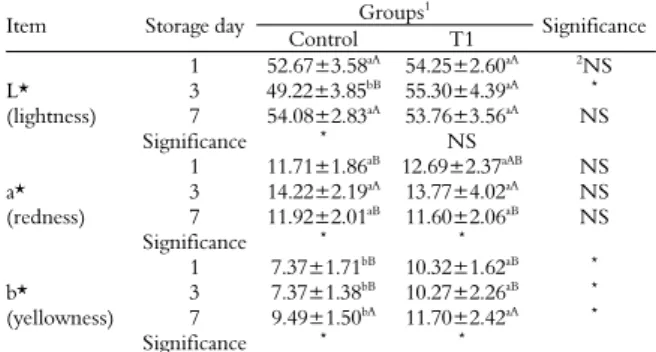
Table 2 summarizes the color of the thigh meat after days 1, 3, and 7 of storage. The L* and a* values of thigh meat samples differed between groups with or not 1% fermented red ginseng marc combined with red-koji or among storage days (p < 0.05). However, there was no significant impact (p > 0.05) on the L* of group after 1 and 7 day of storage (included T1 group), or a* of group at 1 through 7 days of storage. In addition, the b* value of the meat was influenced in both treatment groups and the storage duration (p < 0.05). In spite of statistically significance, our results suggest that supplementing broiler diets with a combination of 1% fermented red ginseng marc and red-koji powder did not have an effect on meat color after storage. This is similar to the results of Kim et al. (2014), which showed that supplementing broiler diets with red ginseng powder did not affect the color of thigh meat. Color is important to consider, because consumers associate it with the product's freshness and will choose poultry products that have an appetizing color or appearance. Other factors that affect meat color are pH and myoglobin concentration (Fletcher, 1999). Therefore, it is possible that the decrease in L* value observed or the increase in a* observed is related to the presence of antioxidant agents that could retard metmyoglobin formation in meat and decrease the activity of free radicals (Fernandez-Lopez, Zhi, Aleson-Carbonell, Perez-Alvarez, & Kuri, 2005). However, due to the lack of studies that evaluate the use of different types of red ginseng marc and red-koji in broiler diets, it is difficult to compare results across studies that assess the dietary inclusion of these supplements.
Table 2. Effect of dietary fermented red ginseng marc combined red-koji to poultry diets on color in broiler thigh meat during storage.
Item Storage day Groups
1
Significance Control T1
L* (lightness)
1 52.67±3.58aA
54.25±2.60aA 2
NS 3 49.22±3.85bB 55.30±4.39aA *
7 54.08±2.83aA 53.76±3.56aA NS
Significance *
NS
a* (redness)
1 11.71±1.86aB 12.69±2.37aAB NS
3 14.22±2.19aA
13.77±4.02aA
NS 7 11.92±2.01aB 11.60±2.06aB NS
Significance * *
b* (yellowness)
1 7.37±1.71bB
10.32±1.62aB *
3 7.37±1.38bB 10.27±2.26aB *
7 9.49±1.50bA
11.70±2.42aA *
Significance * *
a, bMeans in the same row with different superscripts are significantly different (p < 0.05); A, BMeans in the same column with different superscripts are significantly different (p < 0.05); Mean values are expressed as means ± SEM; 1Control: no treatment; T1: 1% fermented red ginseng marc with red-koji; 2NS: not significant.
Conclusion
Our research showed there was no impact of supplementing broiler diets with a combination of fermented red ginseng marc powder and red-koji on the pH or color of thigh meat after storage. However, after 7 days in storage, there was less TBARS activity (a measure of lipid oxidation) in the thigh meat of broilers fed the fermented red ginseng marc combined with red-koji when compared to those fed a standard diet.
Acknowledgements
The author would like to thank by the Small and Medium Business Administration funded by the Korean Government (grant n. C0150527) for their assistance.
References
Aniya, Y., Ohtani, II, Higa, T., Miyagi, C., Gibo, H., Shimabukuro, M., & Taira, J. (2000). Dimerumic acid as an antioxidant of the mold. Monascus anka. Free Radical Biology and Medicine, 286(6), 999-1004.
Arunachalam, C., & Narmadhapriya, D. (2011). Monascus fermented rice and its beneficial aspects: a new review.
Asian Journal of Pharmaceutical and Clinical Research, 4(1), 29-31.
Bak, M. J., Hong, S. G., Lee, J. W., & Jeong, W. S. (2012). Red ginseng marc oil inhibits iNOS and COX-2 via NFκB and p38 pathways in LPS-stimulated RAW 264.7 macrophages. Molecules, 17(12), 13769-13786. Erdogrul, O., & Azirak, S. (2004). Review of the studies
on the red yeast rice (Monasus purpureus). Turkish Electronic Journal of Biotechnology, 2(1), 37-49.
Fernandez-Lopez, J., Zhi, N., Aleson-Carbonell, L., Perez-Alvarez, J. A., & Kuri, V. (2005). Antioxidant and antibacterial activities of natural extracts: application in beef meatballs. Meat Science, 69(3), 371-380.
Fletcher, D. L. (1999). Poultry meat colour. In R. I. Richardson, & G. C. Mead. (Eds.). Poultry meat science
(p. 159-175). New York City, NY: CABI Publishing. Fujimoto, M., Tsuneyama, K., Chen, S. Y., Nishida, T.,
Chen, J. L., Chen, Y. C., & Shimada, Y. (2012). Study of the effects of Monacolin K and other constituents of red yeast rice on obesity, insulin-resistance, hyperlipidemia, and nonalcoholic steatohepatitis using a mouse model of metabolic syndrome. Evidence-Based Complementary and Alternative Medicine, 2012(12), 1-11. Kim, D. C., & In, M. J. (2010). Production of hydrolyzed
red ginseng residue and its application to lactic acid bacteria cultivation. Journal of Ginseng Research, 34(4), 321-326.
quality of broiler chicken. Journal of the Science of Food and Agriculture, 94(9), 1816-1821.
Man, R. Y., Lynn, E. G., & Cheung, F. (2002). Cholestin inhibits cholesterol synthesis and secretion in hepatic cells (HepG2). Molecular and Cellular Biochemistry, 233(1-2), 153-158.
Nanari, M. C., Hewavitharana, A. K., Becu, C., & Jong, S. (2004). Effect of dietary tocopherols and tocotrienols on the antioxidant status and lipid stability of chicken.
Meat Science, 68(2), 155-162.
Sinnhuber, R. O., & Yu, T. C. (1977). The 2-thiobarbituric acid reaction, an objective measure of the oxidative deterioration occurring in fats and oils.
Journal of Japan Oil Chemists' Society, 26(5), 259-267. Statistical Analysis System. (2002). SAS/STAT user’s guide:
version 8.2. Cary, NC: SAS Institute.
Su, Y. C., Wang, J. J., Lin, T. T., & Pan, T. M. (2003). Production of the secondary metabolites γ-aminobutyric acid and monacolin K by Monascus.
Journal of Industrial Microbiology and Biotechnology, 30(1), 40-46.
Yildirim, A., Şekeroglu, A., Eleroglu, H., Şen, M. I., & Duman, M. (2013). Effects of Korean (Panax ginseng C.A. Meyer) root extract on egg production performance and egg quality of laying hens. South African Journal of Animal Science, 43(2), 194-207. Zanardi, E., Dorigoni, V., Badiani, A., & Chizzolini, R.
(2002). Lipid and colour stability of Milano- type sausages: effect of packing conditions. Meat Science, 61(1), 7-14.
Received on January 28, 2016. Accepted on March 23, 2016.
License information: This is an open-access article distributed under the terms of the Creative Commons Attribution License, which permits unrestricted use, distribution, and reproduction in any medium, provided the original work is properly cited.