2017 | Lavras | Editora UFLA | www.editora.ufla.br | www.scielo.br/cagro http://dx.doi.org/10.1590/1413-70542017411024516
Preemergence herbicides on weed control in elephant grass pasture
Controle de plantas daninhas em pastagem de capim-elefante com herbicidas pré-emergentes
Alexandre Magno Brighenti1*, Leonardo Henrique Ferreira Calsavara2, Yago Vieira Guerra Varotto3
1Empresa Brasileira de Pesquisa Agropecuária/Embrapa, Embrapa Gado de Leite, Juiz de Fora, MG, Brasil 2Empresa de Assistência Técnica e Extensão Rural/Emater, Coronel Xavier Chaves, MG, Brasil
3Centro de Ensino Superior de Juiz de Fora/CES-JF, Juiz de Fora, MG, Brasil *Corresponding author: [email protected]
Received in July 17, 2016 and approved in September 28, 2016
ABSTRACT
Elephant grass (Pennisetum purpureum Schum.) is an important forage crop that has been proposed as a potential feedstock for bioenergy production. However, weed interference is a major factor limiting elephant grass production. Field experiments were conducted in 2014 and 2015 to evaluate preemergence herbicides for selective weed control in an elephant grass pasture. Herbicide treatments included atrazine + S-metolachlor, atrazine + simazine, ametryn, ethoxysulfuron, S-metolachlor, diuron + hexazinone, sulfentrazone, imazethapyr, and atrazine at label use rates. Weedy and weed-free treatments were included. Atrazine + S-metolachlor, atrazine + simazine, ametryn, ethoxysulfuron, S-metolachlor, sulfentrazone, and atrazine did not cause phytotoxicity on elephantgrass 35 days after treatment (DAT). However, diuron + hexazinone and imazethapyr were the most phytotoxic on elephantgrass, resulting in 81 and 70% phytotoxicity in 2014, and 7 and 6% phytotoxicity in 2015 respectively 35 DAT. All treatments provided effective weed control (>81%) with the exception of ethoxysulfuron (0 and 11% in 2014 and 2015, respectively), and atrazine (59% in 2014). These results show that atrazine + S-metolachlor, atrazine + simazine, ametryn, ethoxysulfuron, S-metolachlor, sulfentrazone, and atrazine were selectives when applied in preemergence in elephant grass pasture.
Index terms: Bioenergy; biofuel; napier grass; forage; Pennisetum purpureum.
RESUMO
O capim-elefante (Pennisetum purpureum Schum.) é uma planta forrageira importante que tem sido proposta como matéria-prima potencial para a produção de bioenergia. No entanto, a interferência das plantas daninhas é um fator limitante na produção do capim-elefante. Experimentos de campo foram realizados em 2014 e 2015 para avaliar herbicidas aplicados em condições de pré-emergência para o controle seletivo de plantas daninhas em pastagem de capim-elefante. Os tratamentos herbicidas incluíram atrazine + S-metolachlor, atrazine + simazine, ametryn, ethoxysulfuron, S-metolachlor, diuron + hexazinone, sulfentrazone, imazethapyr e atrazine em doses normalmente recomendadas no rótulo. Foram incluídas as testemunhas sem capina e capinadas. Atrazine + S-metolachlor, atrazine + simazine, ametryn, ethoxysulfuron, S-metolachlor, sulfentrazone e atrazine não causaram fitotoxicidade em capim-elefante aos 35 dias após os tratamentos (DAT). No entanto, diuron + hexazinone e imazethapyr foram os mais fitotóxicos ao capim-elefante, resultando em 81 e 70% de fitotoxicidade em 2014, e 7 e 6% em 2015, aos 35 DAT, respectivamente. Todos os tratamentos de controle de plantas daninhas foram eficazes (> 81%) com a exceção de ethoxysulfuron (0 e 11%, em 2014 e 2015, respectivamente) e atrazine (59%, em 2014). Estes resultados mostram que os herbicidas atrazine + S-metolachlor, atrazine + simazine, ametryn, ethoxysulfuron, S-metolachlor, sulfentrazone e atrazine foram seletivos quando aplicados em pré-emergência em pastagem de capim-elefante.
Termos para indexação: Bioenergia; biocombustível; capim napier; forragem; Pennisetum purpureum.
INTRODUCTION
Elephant grass (Pennisetum purpureum Schum.), a member of the Poaceae family, is a perennial, rhizomatous grass native to tropical Africa (Schmelzer, 1997). It was introduced as forage in many tropical and subtropical regions of the world because of its ability to produce high biomass yield under a wide range of climatic and edaphic conditions
(Aroeira et al., 2001) Elephantgrass is highly efficient in
fixing atmospheric CO2 and able to accumulate more than
60 Mg ha-1 of dry matter per year (Morais et al., 2009).
Although elephant grass is mainly used as an animal feed (Santos et al., 2013; Rusdy, 2016), the high biomass production, especially in tropical countries, makes it a potential feedstock for bioenergy production (Flores et
al., 2012; Ohimain; Kendabie; Nwachukwu, 2014; Sales
as charcoal (Strezov; Evans; Hayman, 2008), alcohol (Soares et al., 2011), methane, or even for direct burning (Samson et al., 2005; Lee et al., 2010). Elephant grass is
similar to crushed sugarcane in terms of fiber content (~ 65%), which is an important feature for the calorific value
of biomass (Morais et al., 2009).
Weed interference is a major factor limiting elephant grass cultivation. The crop is sensitive to weed interference after planting (3-6 w) (Silva et al., 2002) because of its slow early development. Grass weeds, such as Brachiaria spp., are especially difficult to control selectively in elephant grass because of the morphological similarities between the two species (Abreu et al., 2006).
Because elephant grass is not only considered a
crop, but also a weed species (Cutts et al., 2011; Odero;
Gilbert, 2012; Grey et al., 2015), there is limited research
on selective weed management in the crop. Currently, there
are no herbicides registered for selective weed control elephant grass pasture. The objective of this study was to evaluate preemergence herbicides for potential selective weed control in elephant grass pastures.
MATERIAL AND METHODS
Two field experiments were conducted in 2014 and 2015 at Brazilian Agricultural Research Corporation (Embrapa) experimental fields in Valença, Rio de Janeiro State, Brazil (22°22′06.30′′S, 43°42′00.62′′W) and Coronel Pacheco, Minas Gerais State, Brazil (21°32′31.83′′S, 43°15′10.07′′W), respectively.
The soils in Valença and Coronel Pacheco were Red-Yellow Argisol and Fluvic Cambisol, respectively. The soil chemical properties and texture are listed in Table 1.
Average monthly air temperatures (maximum and minimum) and rainfall during the experimental periods
are provided in Table 2.
The experimental design was a randomized
complete block with four replications. The treatments included preemergence application of atrazine + S-metolachlor at 1.48 + 1.16 kg ai ha-1, atrazine +
simazine at 1.5 + 1.5 kg ai ha-1, ametryn at 1.5 kg ai ha-1,
ethoxysulfuron at 0.15 kg ai ha-1, S-metolachlor at 1.92
kg ai ha-1, diuron + hexazinone at 1.17 + 0.33 kg ai ha -1sulfentrazone at 0.25 kg ai ha-1, imazethapyr at 0.1 kg ai
ha-1, and atrazine at 2.0 kg ai ha-1. Weedy and weed-free
(hand-weeded) treatments were included.
The experimental plots were plowed and a disc
harrows were used for smoothing out the surface of the
soil before planting the elephant grass on October 30, 2014 and November 12, 2015 in Valença and Coronel
Pacheco, respectively. Furrows 0.2 m deep with spacing of 1.0 m between rows were fertilized when planted using 200 kg ha-1 of MAP (mono-ammonium phosphate).
Stem cuttings of elephant grass cultivar BRS Capiaçu, 40 cm long with four buds per cutting were planted in the furrows and covered with approximately 15 cm of soil. Each plot was four furrows (rows) wide by 4 m in long. Plots were side-dressed with 40 kg of N ha-1 (urea)
30 days after planting.
Location pH
H20
P K Ca2+ Mg2+ V Sand Silt Clay
O.C dag kg-1
mg dm-3 cmolc dm-3 %
Valença 5.1 9.6 90 2.4 2.3 60 66 16 18 1.94
Coronel Pacheco 4.8 15.2 109 2.3 1.1 46 30 25 45 2.46
Table 1: Chemical analysis of the soil samples (0-20 cm depth) and soil texture properties.
Municipality Valença Coronel Pacheco
Month/Year Oct/14 Nov/14 Dec/14 Jan/15 Nov/15 Dec/15 Jan/16 Feb/16
Maximum T (°C) 30.6 29.5 32.3 34.0 24.9 25.4 24.6 25.5
Minimum T (°C) 17.0 19.1 20.3 20.4 23.7 24.0 23.4 24.0
Rainfall (mm) 77.4 254.4 134.2 136.6 204.4 194.6 505.4 154.6
Herbicide treatments were applied on November 4, 2014, in Valença before elephant grass and weed emergence and immediately after planting in Coronel Pacheco on November 12, 2015. The herbicides were applied using a CO2-pressurized backpack sprayer
(Herbicat Ltda, Catanduva, São Paulo State, Brazil) calibrated to deliver 140 L ha-1 of solution at 196 kPa. The
spray boom (2 m length) was comprised of four flat-fan
nozzles (Magno ADGA 11002) spaced 0.5 m apart. Sprayer boom height was adjusted to 0.5 m above the soil surface.
Temperatures were 27 to 30 °C and 29 to 32 °C, relative
humidity ranged from 68 to 75% and 78 to 82%, and wind speeds were between 0.8 and 1.6 m s-1 and 0.6 to 1.4 m s-1
in Valença and Coronel Pacheco, respectively during the
herbicide applications.
The phytotoxic effect of herbicide treatments on
the elephant grass and weed control were evaluated on a scale of 0 to 100% , with 0 being no injury or weed control and 100% being complete elephant grass death or complete weed control at 23 and 35 days after treatment (DAT)
Sociedade Brasileira da Ciência das Plantas Daninhas (SBCPD, 1995).
Prevalent weed species and their densities before
plowing the experimental area in Valença were alexandergrass
(Brachiaria decumbens L.) (4.0 plants m-2), guineagrass
(Panicum maximum Jacq.) (3.0 plants m-2), yellow nutsedge
(Cyperus esculentus L.) (2.0 plants m-2), and benghal
dayflower (Commelina benghalensis L.) (5.0 plants m-2). In
Coronel Pacheco, the most prevalent weed species and their densities before plowing the experimental area were benghal dayflower (Commelina benghalensis L.) (4.0 plants m-2),
redroot pigweed (Amaranthus retroflexus L.) (2.0 plants m-2),
common purslane (Portulaca oleracea L.) (1.2 plant m-2), and
morninglory (Ipomoea grandifolia (Dammer) O’Donnell) (2.6 plants m-2).
Weed densities (plants m-2) were measured at
35 DAT at both study locations. All weed species were
counted within a quadrat (1.0x1.0 m). Weeds were cut from the soil surface using the same quadrat to determine aboveground biomass at 35 DAT for both experiments and again at 50 DAT in experiment conducted in Valença.
Harvested weeds were weighed to determine fresh matter
weight. The weeds collected at 80 DAT in Valença and at 35 DAT in Coronel Pacheco were placed in kraft paper
bags and dried in a forced ventilation air oven at 65 0C
for 72 h, reaching a constant mass. The dry matter was weighted on a graduated scale.
For both experiments, elephant grass green color
indices were measured at 23 and 35 DAT by using a
SPAD-502 chlorophyll meter (Konica Minolta, Japan) and plant
height was measured at 35 DAT. Elephant grass yield was measured at 80 DAT in both locations. Plants were cut
within a quadrat (1.0x1.0 m) at the soil surface to quantify
aboveground biomass. Harvested plants were weighed,
placed in a forced-air ventilation oven at 65 °C for 72 h, and subsequently reweighed. The values of fresh and dry
matter weight of elephant grass were converted to kg ha-1.
The percentage of phytoxicity and weed control data were normalized by square root transformation of (x + 1) to perform analysis of variance tests. Data were
subjected to analysis of variance, and the mean values were
compared using the Scott–Knott test (P ≤ 0.05). Statistical analyses were performed using the SAEG software for
both experiments (Ribeiro Júnior, 2001).
RESULTS AND DISCUSSION
Experiment conducted in Valença-RJ
There was no phytotoxicity on elephant grass
at 23 and 35 DAT following treatments with atrazine + S-metolachlor, atrazine + simazine, ametryn, ethoxysulfuron, S-metolachlor, and atrazine (Table 3).
Similarly, there was no injury on elephant grass
cultivars Pioneiro and Cameron following preemergence
atrazine + S-metolachlor and S-metolachlor (Silva et al.,
2002). Both herbicides did not induce phytotoxic effects
on the tested cultivars.
Sulfentrazone caused slight chlorosis on elephant
grass leaves, resulting in 17% of phytotoxicity at 23 DAT. However, the phytotoxic effect of sulfentrazone was transient
and no visual symptoms of injury at 35 DAT. In contrast,
diuron + hexazinone and imazethapyr caused 81 and 70%
injure on elephant grass at 35 DAT, respectively. Young leaves showed faint yellowing at 23 days after application of
diuron + hexazinone. This symptom progressed to a stronger
yellowing and necrosis of leaf blade at 35 DAT. Imazethapyr injury symptoms in elephant grass include yellow of leaf blade and leaf tips may appear red or purple in colour.
Atrazine + S-metolachlor, atrazine + simazine, ametryn, S-metolachlor, diuron + hexazinone, and sulfentrazone provided 95% to 100% weed control at 35 DAT. Silva et al. (2002) reported 91% grass control and 80% broadleaf weed control with S-metolachlor at 2.3 kg ha-1 in an elephant grass pasture. Application of atrazine and
imazethapyr provided 59 and 81% weed control at 35 DAT,
respectively. However ethoxysulfuron did not provide any weed control. Atrazine, imazethapyr, and ethoxysulfuron
were not effective in controlling predominately grasses in
activity on grasses such as Brachiaria and are mainly used for broadleaf weed control (Rodrigues; Almeida, 2011).
For example, atrazine applied at 1.5 kg ha-1 did not have
any effect on palisade grass (Brachiaria brizantha (Hochst.
Ex A. Rich) Stapf.) intercropped with maize (Zea mays L.)
(Jakelaitis et al., 2005). In this study, palisade grass had
the highest biomass yield.
Weed density and fresh and dry matter weight were low for atrazine + S-metolachlor, atrazine + simazine, ametryn,
S-metolachlor, diuron + hexazinone, and sulfentrazone treatments (Table 4). This fact confirms the efficacy of these herbicides in controlling weeds presented in this experiment.
Although atrazine and ethoxysulfuron showed
selectivity on elephant grass species, they were not
efficient in controlling weed species. Also, imazethapyr
provided some level and weed control (81%) but also cause
phytotoxicity on elephant grass.
The treatments with atrazine + S-metolachlor, atrazine + simazine, ametryn, and S-metolachlor resulted
in SPAD indice values equal to the weed-free treatment
for both evaluations (Table 5).
Although, ethoxysulfuron and atrazine caused
no visual injury symptoms on elephant grass plants, SPAD indice values were lower compared to weed-free treatment at 35 DAT. This was probably attributed to weed interference as a result of poor weed control by
these treatments. Diuron + hexazinone, sulfentrazone, and
imazethapyr caused yellowing on elephant grass leaves resulting in lower SPAD indice values at 35 DAT.
All treatments caused reduction in elephant
grass plant height with the exception of atrazine +
S-metolachlor. The weedy plots had the highest value for plant height, probably due to competition for light, which led to plant etiolation. Atrazine + S-metolachlor, atrazine + simazine, ametryn, S-metolachlor, and sulfentrazone
provided significantly greater fresh and dry matter weight
of elephant grass (Table 5). Atrazine + Simazine and S-metolachlor had higher values of fresh and dry matter weight of elephant grass than the weed-free treatment. In many cases, hand hoeing does not completely eliminate all weeds mainly within crop rows. Maybe, these weeds that established within elephant grass rows reduced the fresh and dry matter weight of the elephant grass in weed-free plots.
Although atrazine and ethoxysulfuron did not
injure elephant grass, they did not provide weed control. This resulted in forage production losses manifested in the
low fresh and dry matter weights. Diuron + hexazinone
and imazethapyr also caused a reduction in fresh and dry
matter of elephant grass due to their phytotoxic effects.
Weed interference on elephant grass occurred when no control measure was undertaken, i.e. for the weedy
plots. The weedy plots produced 42% less elephant grass
dry matter compared to the weed-free plots.
Treatments Doses
(kg ha-1) Phytotoxicity (%) Control (%)
23 35 23 35
Atrazine + S-metolachlor 1.48 + 1.16 0.0 D1 0.0 C 95.0 A 98.2 A
Atrazine + Simazine 1.5 +1.5 0.0 D 0.0 C 92.0 A 95.0 B
Ametryn 1.5 0.0 D 0.0 C 98.2 A 99.5 A
Ethoxysulfuron 0.15 0.0 D 0.0 C 7.7 D 0.0 E
S-metolachlor 1.92 0.0 D 0.0 C 99.7 A 100.0 A
Diuron + hexazinone 1.17 + 0.33 71.0 A 80.5 A 99.2 A 99.5 A
Sulfentrazone 0.25 17.0 C 0.0 C 99.5 A 100.0 A
Imazethapyr 0.1 60.7 B 69.5 B 79.2 B 80.7 C
Atrazine 2.0 0.0 D 0.0 C 45.0 C 59.2 D
Weedy - 0.0 D 0.0 C 0.0 E 0.0 E
Weed-free - 0.0 D 0.0 C 100.0 A 100.0 A
Coefficient of Variation (%) 1.4 1.0 3.0 1.4
Table 3: Percentage of phytotoxicity and weed control at 23 and 35 days after application of treatments at Valença, Rio de Janeiro State, Brazil.
Experiment conducted in Coronel Pacheco-MG Phytotoxicity of atrazine + S-metolachlor, atrazine
+ simazine, ametryn, ethoxysulfuron, S-metolachlor,
sulfentrazone, and atrazine was low (2 to 14%) at 23 DAT
(Table 6).
By 35 DAT, there was no visual symptoms on elephant grass from these treatments. Diuron +
hexazinone and imazethapyr caused 29 and 7% injury at 23 DAT. Phytotoxicity symptoms on elephant grass
plants characterized by leaf chlorosis, tissue necrosis, and
reduced plant height. Injury from diuron + hexazinone Table 4: Density and fresh matter of weeds at 35 (FM35) and 50 (FM50) days after application of treatments (DAT) and dry matter of weeds at 80 DAT (DM80). Valença, Rio de Janeiro State, Brazil.
1 Mean values followed by different letters are significantly (P ≤ 0.05) different by Scott–Knott test.
Treatments (kg haDoses-1)
Density (plants m-2)
FM35 (g m-2)
FM50 (g m-2)
DM80 (g m-2)
Atrazine + S-metolachlor 1.48 + 1.16 1.0 C1 0.43 D 0.77 C 0.13 C
Atrazine + Simazine 1.5 +1.5 4.5 C 0.63 C 0.97 C 0.16 C
Ametryn 1.5 3.2 C 0.53 D 0.67 C 0.12 C
Ethoxysulfuron 0.15 9.0 B 3.81 A 2.32 A 0.44 A
S-metolachlor 1.92 4.0 C 0.29 D 0.32 C 0.06 C
Diuron + hexazinone 1.17 + 0.33 3.0 C 0.17 D 0.51 C 0.09 C
Sulfentrazone 0.25 2.2 C 0.35 D 0.33 C 0.06 C
Imazethapyr 0.1 3.7 C 0.79 C 1.27 B 0.22 B
Atrazine 2.0 3.2 C 1.20 C 1.51 B 0.28 B
Weedy - 17.5 A 2.24 B 1.25 B 0.25 B
Weed-free - 0.0 C 0.00 D 0.00 C 0.05 C
Coefficient of Variation (%) 59.3 36.4 45.5 40.4
Table 5: SPAD indices at 23 and 35 days after application of the treatments (DAT), plant height at 35 DAT and fresh (FM) and dry (DM) matter weight of elephant grass at 80 DAT. Valença, Rio de Janeiro State. Brazil.
1 Mean values followed by different letters are significantly (P ≤ 0.05) different by Scott–Knott test.
Treatments Doses
(kg ha-1) SPAD
Height (m)
FM (kg ha-1)
DM (kg ha-1)
23 35
Atrazine + S-metolachlor 1.48 + 1.16 60.8 A1 51.2 A 1.21 B 95,950 B 20,017 B
Atrazine + Simazine 1.5 +1.5 56.4 A 51.8 A 1.08 C 131,550 A 30,085 A
Ametryn 1.5 59.8 A 52.1 A 1.10 C 87,950 B 18,512 B
Ethoxysulfuron 0.15 43.4 B 49.6 B 1.01 D 30,250 E 6,234 C
S-metolachlor 1.92 56.0 A 52.2 A 1.04 C 120,050 A 24,743 A
Diuron + hexazinone 1.17 + 0.33 41.3 B 40.9 D 0.94 D 38,800 E 8,907 C
Sulfentrazone 0.25 43.1 B 49.3 B 0.97 D 102,375 B 18,566 B
Imazethapyr 0.1 57.4 A 40.9 D 1.01 D 70,375 C 13,240 C
Atrazine 2.0 59.0 A 46.0 C 1.00 D 57,200 D 11,793 C
Weedy - 56.8 A 33.8 E 1.40 A 51,950 D 10,386 C
Weed-free - 58.0 A 52.3 A 1.24 B 99,925 B 17,918 B
declined by 22% compared to a decline of 1% by imazehapyr at 35 DAT.
The phytotoxicity values were lower in the experiment conducted in Coronel Pacheco than in Valença. The soil of Coronel Pacheco had greater amount of clay and organic carbon when compared to the experiment conducted in Valença. Probably, great amount of
herbicide was adsorbed on clay and organic carbon in
Coronel Pacheco compared to Valença. Consequently,
less herbicides were in the soil solution and available for the elephant grass, resulting in lower percentage of
phytotoxicity.
Overall, all herbicide treatments provided
acceptable weed control (89 to 100%) at 35 DAT with
the exception of ethoxysulfuron which provided only 11% control. Although ethoxysulfuron showed selectivity
on elephant grass, it did not provide efficient weed control especially control of C. benghalensis which was
predominant at the experimental site. This weed species
is not effectively controlled by this herbicide (Rodrigues;
Almeida, 2011). Diuron + hexazinone, sulfentrazone, and
S-metolachlor were the most effective herbicides for weed control (provided 100% control at 35 DAT).
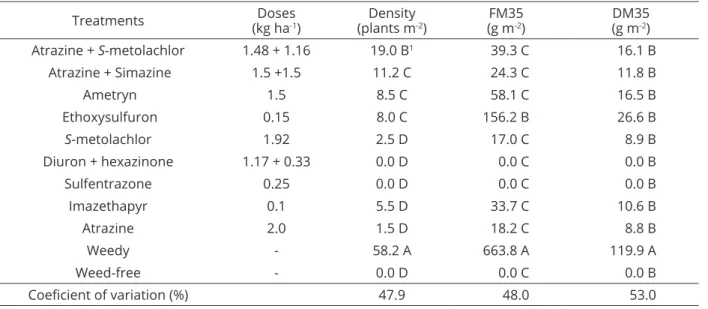
All treatments significantly reduced weed density,
fresh, and dry matter (Table 7).
The premix of atrazine + S-metolachlor applied on two elephant grass cultivars provided effective control of
broadleaf weeds such as Sida glaziovii, Sida urens, and Acanthospermum australe (Silva et al., 2002).
SPAD indices were similar for the weed-free control and atrazine + S-metolachlor, atrazine + simazine,
ametryn, ethoxysulfuron, S-metolachlor, sulfentrazone, and atrazine treatments at 35 DAT (Table 8).
Diuron + hexazinone and imazethapyr had mild chlorosis and had significantly lower SPAD indice values
compared to the rest of the treatments at 35 DAT Atrazine + S-metolachlor, ametryn, ethoxysulfuron, and atrazine did not cause reduction in plant height. The fresh and dry matter weights were not reduced in treatments containing atrazine + S-metolachlor, atrazine + simazine, ametryn, S-metolachlor, sulfentrazone, or
atrazine. Although ethoxysulfuron did not caused injury on elephant grass plants, it was not efficient in weed control,
thereby resulting in reduction in fresh matter and dry
matter weight of elephant grass. Diuron + hexazinone and
imazethapyr caused considerable reductions in the fresh and dry matter weights of the elephant grass in function
of their phytotoxicity.
Elephant grass biomass reduction as a result of weed interference was evident when the weed-free and weedy controls were compared. Forage biomass losses
were 44 and 41% for fresh and dry weight, respectively
when no weed control measures were undertaken (weedy control) compared to weed-free control.
Table 6: Percentage of phytotoxicity and weed control at 23 and 35 days after application of treatments. Coronel Pacheco, Minas Gerais State, Brazil.
1 Mean values followed by different letters are significantly (P ≤ 0.05) different by Scott–Knott test.
Treatments (kg haDoses-1) Phytotoxicity (%) Control (%)
23 35 23 35
Atrazine + S-metolachlor 1.48 + 1.16 0.0 F1 0.0 C 94.2 B 88.7 C
Atrazine + Simazine 1.5 +1.5 2.0 E 0.0 C 92.2 B 90.5 C
Ametryn 1.5 2.2 E 0.0 C 91.7 B 90.5 C
Ethoxysulfuron 0.15 3.5 D 0.0 C 20.7 C 10.5 D
S-metolachlor 1.92 2.5 E 0.0 C 99.5 A 99.5 A
Diuron + hexazinone 1.17 + 0.33 29.0 A 6.7 A 99.5 A 100.0 A
Sulfentrazone 0.25 14.0 B 0.0 C 99.0 A 100.0 A
Imazethapyr 0.1 6.5 C 5.5 B 90.0 B 90.5 C
Atrazine 2.0 2.7 E 0.0 C 91.0 B 97.0 B
Weedy - 0.0 F 0.0 C 0.0 D 0.0 E
Weed-free - 0.0 F 0.0 C 100.0 A 100.0 A
CONCLUSIONS
As an attempt to generate information useful for improving elephant grass utilization, this study reports on grass and broadleaf weed controls in this forages by using preemergence herbicides. Atrazine + S-metolachlor,
atrazine + simazine, ametryn, ethoxysulfuron,
S-metolachlor, sulfentrazone, and atrazine were selectives when applied in preemergence in elephant grass pasture.
The treatments with diuron + hexazinone and imazethapyr were the most phytotoxic herbicides for the elephant grass. Table 7: Density and fresh (FM35) and dry (DM35) matter of weeds at 35 days after application of treatments. Coronel Pacheco, Minas Gerais State, Brazil.
1 Mean values followed by different letters are significantly (P ≤ 0.05) different by Scott–Knott test.
Treatments Doses
(kg ha-1) (plants mDensity-2) (g mFM35-2) (g mDM35-2)
Atrazine + S-metolachlor 1.48 + 1.16 19.0 B1 39.3 C 16.1 B
Atrazine + Simazine 1.5 +1.5 11.2 C 24.3 C 11.8 B
Ametryn 1.5 8.5 C 58.1 C 16.5 B
Ethoxysulfuron 0.15 8.0 C 156.2 B 26.6 B
S-metolachlor 1.92 2.5 D 17.0 C 8.9 B
Diuron + hexazinone 1.17 + 0.33 0.0 D 0.0 C 0.0 B
Sulfentrazone 0.25 0.0 D 0.0 C 0.0 B
Imazethapyr 0.1 5.5 D 33.7 C 10.6 B
Atrazine 2.0 1.5 D 18.2 C 8.8 B
Weedy - 58.2 A 663.8 A 119.9 A
Weed-free - 0.0 D 0.0 C 0.0 B
Coeficient of variation (%) 47.9 48.0 53.0
Table 8: SPAD indices at 23 and 35 days after application of the treatments, plant height and fresh (FM) and dry (DM) matter weight of elephant grass. Coronel Pacheco, Minas Gerais State, Brazil.
1 Mean values followed by different letters are significantly (P ≤ 0.05) different by Scott–Knott test.
Treatments Doses
(kg ha-1) SPAD
Height (m)
FM (kg ha-1)
DM (kg ha-1)
23 35
Atrazine + S-metolachlor 1.48 + 1.16 51.9 A1 52.2 A 0.88 A 145,950 A 28,494 A
Atrazine + Simazine 1.5 +1.5 48.9 A 52.3 A 0.82 B 126,250 A 24,040 A
Ametryn 1.5 49.1 A 53.0 A 0.88 A 134,400 A 25,388 A
Ethoxysulfuron 0.15 51.3 A 51.3 A 0.88 A 113,050 B 22,017 B
S-metolachlor 1.92 41.6 B 51.3 A 0.83 B 138,600 A 26,346 A
Diuron + hexazinone 1.17 + 0.33 35.9 C 45.3 B 0.67 C 87,200 C 17,213 B
Sulfentrazone 0.25 35.0 C 51.7 A 0.83 B 148,900 A 30,717 A
Imazethapyr 0.1 31.9 C 40.2 C 0.56 D 103,300 B 20,649 B
Atrazine 2.0 50.7 A 51.9 A 0.91 A 139,750 A 28,783 A
Weedy - 52.6 A 45.6 B 0.70 C 72,275 C 15,645 B
Weed-free - 52.5 A 52.7 A 0.86 A 128,050 A 26,306 A
In both places, all treatments provided effective weed
control, except ethoxysulfuron and atrazine in Valença-RJ and ethoxysulfuron in Coronel Pacheco-MG.
ACKNOWLEDGEMENTS
The financial support from Fundação de Amparo a Pesquisa do Estado de Minas Gerais (FAPEMIG) and the Conselho Nacional de Desenvolvimento Científico e Tecnológico (CNPq) is highly appreciated.
REFERENCES
ABREU, J. G. et al. Glyphosate e nitrogênio no controle de
Brachiaria decumbens STAPF em capineiras estabelecidas. Ciência e Agrotecnologia. 30(5):977-987, 2006.
AROEIRA, L. J. M. et al. Daily intake of lactating crossbred cows grazing elephant grass rotationally. Pesquisa Agropecuária Brasileira. 36(6):911-917, 2001.
CUTTS, G. S. et al. Herbicide effect on napier grass (Pennisetum purpureum) control. Weed Science. 59:255-262, 2011.
FLORES, R. A. et al. Yield and quality of elephant grass biomass produced in the Cerrados region for bioenergy. Engenharia Agrícola. 32(5):831-839, 2012.
GREY, T. L. et al. Evaluation of control of napier grass (Pennisetum purpureum) with tillage and herbicides. Invasive Plant Science & Management. 8(4):393-400, 2015.
JAKELAITIS, A. et al. Efeitos de herbicidas no consórcio de milho com Brachiaria brizantha. Planta Daninha. 23(1):69-78, 2005.
LEE, M. K. et al. Pyrolysis of napier grass in an induction-heating reactor. Journal of Analytical and Applied Pyrolysis. 88(2):110-116, 2010.
MORAIS, R. F. et al. Elephant grass genotypes for bioenergy production by direct biomass combustion. Pesquisa Agropecuária Brasileira. 44(2):133-144, 2009.
ODERO, D. C.; GILBERT, R. A. Dose-response of newly establish (Pennisetum purpureum) to postemergence herbicides. Weed Technology. 26(4):691-698, 2012.
OHIMAIN, E. I.; KENDABIE, P.; NWACHUKWU, R. E. S. Bioenergy potentials of elephant grass, Pennisetum purpureum
Schumach. Annual Research & Review in Biology. 4(13):2215-2227, 2014.
RIBEIRO JÚNIOR, J. I. Análises estatísticas no SAEG. Editora UFV, Viçosa: 2001, 301p.
RODRIGUES, B. N.; ALMEIDA, F. S. Guia de Herbicidas. 6. ed. Londrina, PR: Grafmarke. 2011. 697p.
RUSDY, M. Elephant grass as forage for ruminant animals. Livestock Research for Rural Development. 28(4), 2016. Available in: <http://www.lrrd.org/lrrd28/4/rusd28049. html>. Access in: 03 Oct. 2016.
SALES, F. A. et al. Biomass of elephant grass and leucena for bioenergy production. Semina: Ciências Agrárias. 36(6):3567-3578, 2015.
SAMSON, R. et al. The potential of C4 perennial grasses for developing a global BIOHEAT industry. Critical Reviews in Plant Science. 24:461-495, 2005.
SANTOS, R. J. C. et al. Elephant grass clones for silage production. Scientia Agrícola. 70(1):6-11, 2013.
SOCIEDADE BRASILEIRA DA CIÊNCIA DAS PLANTAS DANINHAS
– SBCPD. Procedimentos para instalação e análise de experimentos com herbicidas. Sociedade Brasileira da Ciência das Plantas Daninhas. Londrina. 1995. 42p.
SCHMELZER, G. H. Review of Pennisetum section Brevivalvula
(Poaceae). Euphytica. 97(1):1-20, 1997.
SILVA, W. et al. Redução da interferência de Brachiaria decumbens na formação de pastagem de Pennisetum purpureum através de herbicidas. Planta Daninha. 20(2):273-281, 2002.
SOARES, I. B. et al. Ethanol production by enzymatic hydrolysis of elephant grass. Journal of Life Science. 5:157-161, 2011.