A
NALYZING PEER SELECTION POLICIES FOR
B
IT
T
ORRENT MULTIMEDIA ON
-
DEMAND
STREAMING SYSTEMS IN
I
NTERNET
Carlo Kleber da Silva Rodrigues
1,21
Electrical and Electronics Department, Armed Forces University
–ESPE, Sangolquí,
Ecuador
2
University Center of Brasília
–UniCEUB, Brasília, DF, Brazil
[email protected]A
BSTRACTThe adaptation of the BitTorrent protocol to multimedia on-demand streaming systems essentially lies on the modification of its two core algorithms, namely the piece and the peer selection policies, respectively. Nevertheless, it is true that most of the researches have been devoted to the piece selection while the peer selection has attracted less attention. Within this context, this article proposes three novel peer selection policies for the design of BitTorrent-like protocols targeted at this type of systems: Select Balanced Neighbour Policy (SBNP), Select Regular Neighbour Policy (SRNP), and Select Optimistic Neighbour Policy (SONP). These proposals are validated through a competitive analysis based on simulations which encompass a variety of multimedia scenarios, defined in function of important characterization parameters such as content type, content size, and client´s interactivity profile. Service time, number of clients served and efficiency retrieving coefficient are the performance metrics assessed in the analysis. The final results mainly show that the novel proposals constitute scalable solutions that may be considered for real project designs. Finally, the conclusion of this article is drawn with key challenges and future work in this research field.
K
EYWORDSBitTorrent, peer selection, multimedia, streaming, interactivity.
1.
I
NTRODUCTIONA number of researches in the field of content distribution have already proven that the BitTorrent protocol is a very efficient and scalable solution for content replication over Internet [1, 2]. Unlike early peer-to-peer (P2P) systems, such as Gnutella, Kazaa and eMule, in which peers sharing different files are organized together and exchange their desired files with each other, BitTorrent organizes peers sharing the same file into a P2P network and focuses on fast and efficient replication to distribute the file [1, 2, 3, 4].
Under the BitTorrent paradigm, peers are stimulated to cooperate with each other in the file (content) distribution through a bartering mechanism such as tit-for-tat, which enables peers with high uploading bandwidth to have corresponding high download bandwidth. Moreover, if a peer does not contribute at all to the ongoing file downloading, it itself will not be able to download the file. This bartering mechanism is simple, effective, and robust. In this way, BitTorrent prevents free riding effectively, which is very common in early P2P systems, and there is a load balance over the entire network [3, 4].
scales very well and has been widely used for various purposes, such as for distributing large software packages [3, 4, 5, 6, 7].
The piece selection and peer selection policies, respectively, are the basis of the BitTorrent protocol. The first policy is employed by a peer to decide which file pieces are going to be requested for download. This is because the files which are distributed using BitTorrent have to be first split into pieces and each piece is split into blocks. The second policy, by its turn, is employed by a peer to choose the peers that will receive the pieces it owns [8, 9].
The widespread popularity of BitTorrent has motivated a number of proposals to adapt it in order to meet the requirements of Internet on-demand streaming systems. These systems ideally let their clients select multimedia files, remotely stored in a server or group of servers, to be played at any instant of time with a satisfactory quality of service (QoS), mainly observed in terms of high playout continuity and low latency. The vast majority of these proposals focus on modifying both the original piece and peer selection policies, respectively, of BitTorrent. Nonetheless, it is true that more attention has often been given to the piece selection policy rather than to the peer selection policy [1, 5, 6].
Additionally, interactive scenarios have become tremendously popular on Internet. This means that, for most of the nowadays on-demand streaming applications, the client may behave as though he were at his home in front of a DVD-player, i.e., he is able to execute DVD-like actions during the multimedia file playback. This has become the reality due to the permanent and recent advances in the field of network technologies, especially those resulting in more bandwidth capacity, reliability, confidentiality, and scalability [1, 2, 5, 6].
The context discussed above gives the motivation for this article, whose main objective is to propose three novel peer selection policies for the design of BitTorrent-like protocols. These policies are denoted as Select Balanced Neighbour Policy (SBNP), Select Regular Neighbour Policy (SRNP), and Select Optimistic Neighbour Policy (SONP). They are destined for on-demand streaming systems, considering interactive access, and are validated through simulations on a variety of multimedia file replication scenarios. These scenarios are categorized in function of content type, content size, and client´s interactivity profile. Three important performance metrics are computed in the simulations: service time, number of clients served, and efficiency retrieving coefficient. The final results show that the novel policies constitute efficient scalable solutions which may be used for real project designs.
The remainder of this text is organized as follows. Section 2 briefly reviews several concepts related to the BitTorrent protocol and debates on the operation of its core algorithms: piece and peer selection policies, respectively. Besides, there is a general discussion of the reciprocity principle, which plays a very important role when adapting BitTorrent’s peer selection policy to on-demand streaming scenarios. Section 3 presents related work. The novel proposals come in Section 4. The performance evaluation lies in Section 5, including the simulation setup, the competitive metrics used in the simulations, and the overall results and the corresponding analysis. At last, conclusions and future work appear in Section 6.
2.
B
ASIS2.1. Concepts and general overview
This set of peers is denoted as a swarm and, hence, is associated to a session of content transfer. Swarms are independent. In particular, participating in a swarm does not bring any benefit for the participation in another swarm. Peers involved in a swarm cooperate among each other using the so-called swarming techniques [4, 8, 9].
As already mentioned, contents which are transferred using BitTorrent are split into pieces and each piece is split into blocks. Pieces are typically 256 kB in size, while blocks are typically 16 kB in size. Blocks are the transmission unit on the network, but the protocol only accounts for transferred pieces. In particular, partially received pieces cannot be served by a peer, only complete pieces can [4, 8, 9].
To request data, the peer identifies the piece it wants to download and then requests a number of blocks (typically five) of this piece. Whenever a block arrives, a new block request is sent in such a way that there are always several requests (typically five) pipelined at once. This surely helps to avoid a delay between pieces being sent. Peer A is interested in peer B when peer B has pieces that peer A does not have. Peer A is not interested in peer B when peer B only has a subset of the pieces of peer A. Peer A chokes peer B when peer A decides not to send data to peer B. Peer A unchokes peer B when peer A decides to send data to peer B [8, 9].
Each peer maintains a list of other peers it knows about. This list is the peer set. The notion of peer set is also known as neighbour set. This way, a swarm may be viewed as a collection of interconnected peer sets, each with typically a minimum of 20 and a maximum of 80 peers. Nevertheless, a peer should not exceed a threshold of 40 initiated connections among the possible maximum 80 at each time. As a consequence, the 40 remaining connections should be initiated by its neighbours. However, a peer can only send data to a subset of its peer set, denoted as active peer set. The active peer set has a typical size of four peers. This overall policy guarantees a good interconnection balance among the peer sets in the torrent [4, 8, 9].
A peer may be in two states: the leecher state, when it is downloading content but does not own all the pieces yet; and the seed state, when the peer owns all the pieces of the content. A peer is a leecher when it is in leecher state, and a seed when it is in seed state. Each peer knows the distribution of the pieces for each peer in its peer set. The consistency of this information is guaranteed by the exchange of messages among peers. A local peer is the peer that wants to download pieces, while remote peers are the peers that are in the peer set of the local peer. The exchange of pieces is governed by two core algorithms: the rarest first and the choke algorithms, respectively [4, 8, 9].
The choke algorithm is the peer selection policy used in BitTorrent. It determines the peers being part of the active peer set, i.e., which remote peers will be choked and unchoked. It is also called the tit-for-tat algorithm or tit-for-tat like algorithm. Only peers that are interested in the local peer and unchoked by the local peer are part of the active peer set. Its main goal is to guarantee a reasonable level of upload and download reciprocation. In general, peers prefer other peers that have recently provided data at the highest speeds. As a consequence, free riders, i.e., peers that never upload, are penalized [4, 8, 9]. A more detailed description of the peer selection policy is given in the next section.
The rarest first algorithm refers to the normal operation of the piece selection policy used in BitTorrent. It is also called the local rarest first algorithm. As already mentioned, each peer knows the distribution of the pieces for each peer in its peer set. More precisely, it maintains a list of the number of copies of each piece in its peer set. It uses this information to define a rarest pieces set. The rarest pieces are the pieces that have the least number of copies in the peer set. In the case the least replicated piece in the peer set has x copies, then all the pieces with x copies form the rarest pieces set [8, 9].
from its peer set [8, 9]. In general, right after being unchoked, the local peer requests the next piece to download at random in its rarest pieces set taking into account the available pieces on the remote peer that unchokes it. A more detailed description of the piece selection policy is presented in the next section.
2.2. Operation of the BitTorrent
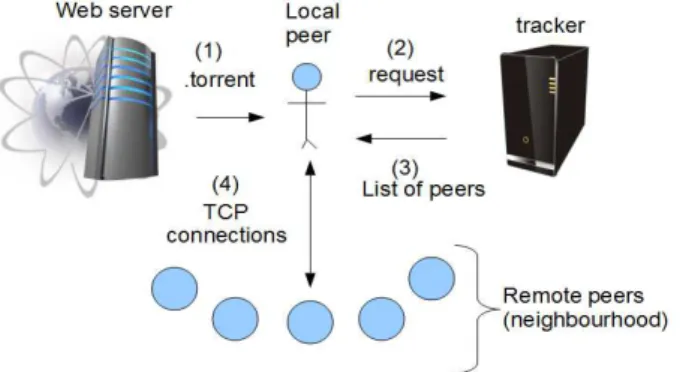
To participate in a swarm, a new peer, also denoted as a newcomer, first has to download the metadata file of extension .torrent from an ordinary web server. This peer is then able to contact the entity tracker, which provides it with a random list L of other peers (both seeds and leechers) that already belong to the swarm. This random list L typically consists of 50 peers chosen at random in the list of peers currently involved in the swarm. The tracker receives updates from peers periodically (typically at every 30 minutes), or when peers join or leave the swarm as well, indicating each time the amount of bytes it has uploaded and downloaded since it has joined the swarm [8, 9].
It is important to outline that in order to avoid congestion at the tracker, the request rate of an individual peer is limited. The default value in the original BitTorrent tracker implementation from Cohen [8] allows a single request every five minutes. However, in Internet, various tracker implementations exist and, hence, much shorter time intervals between requests (e.g., 10 seconds) are likely to be allowed [3, 4].
After receiving the list L, the new peer then attempts to establish bidirectional persistent connections (TCP connections) with the peers from it. Those connections resulting successful form the peer set or neighbour set. Once the connections are established, the peers exchange information among themselves. For example, they communicate the bitfield, i.e., a map of the data pieces they may share. This initial peer set is augmented by peers connecting directly to the new peer. Such peers are aware of the new peer by receiving its IP address from the tracker [9].
At this moment, the new peer gets to know the neighbours (i.e., remote peers) that are interested in it as well as the neighbours that it is interested in. To receive pieces, the new peer has first to be unchoked by neighbours it is interested in. Conversely, to send pieces, the new peer has first to unchoke neighbours that are interested in it. These two processes are ruled by the peer selection policy, explained in Section 2.2.1.
Finally, it is worth recalling that a peer should not exceed a threshold of 40 initiated connections (outgoing connections) among the possible maximum 80 connections at each time and, as a consequence, the 40 remaining connections should be initiated by its neighbours. Additionally, if the number of neighbours of a peer ever dips below 20, the peer contacts the tracker again to obtain a list of additional peers it could connect to [8, 9]. The sequence of events just described is succinctly depicted in Figure 1.
2.2.1. Peer selection policy
Figure 1. Sequence of events for a peer to join a torrent.
Algorithm 1: Peer Selection Policy of BitTorrent
Begin
Initialization
Step 1 The neighbours of a local peer are all choked and categorized in either interested or not interested remote peers;
Step 2 The local peer´s upload capacity is divided into four upload slots: three slots are denoted as regular unchoke slots, and one slot is denoted as optimistic unchoke slot;
Repeat
Step 3 Every δ seconds (this is denoted as the Regular unchoke interval)
Step 3.1 If the local peer is in leecher state: all interested remote peers are ordered according to their upload rate to the local peer, i.e., rate at which the remote peer has sent data to the local peer, and the three fastest peers are unchoked. In other words, the three regular unchoke slots are assigned, one for each of the three fastest peers [8, 9].
Step 3.2 Else if the local peer is in seed state: all interested remote peers are ordered according to the upload rate the local peer has to them and the three fastest peers are unchoked [8, 9]. Note that, under this state, peers with high download rates are favoured independently of their contribution to the torrent.
Step 4 Every 3δ seconds (this is denoted as the Optimistic unchoke interval)
Exactly one additional interested remote peer is unchoked at random. In other words, the optimistic unchoke slot is assigned. This optimistic unchoke has two purposes. It allows evaluating the upload capacity of new peers in the peer set, and it allows bootstrapping new peers that do not have any piece to share by giving them their first piece [8, 9].
Until the content download is complete
In addition to the description given in Algorithm 1, if the local peer is in leecher state and happens to go over τseconds (τ is typically set to 60) without getting a single piece from a given remote peer from whom it was formerly downloading, the local peer assumes it is snubbed by that remote peer and does not upload to it anymore (i.e., the remote peer is set choked), except under an optimistic unchoke. In case the local peer is snubbed by all its remote peers from whom it was formerly downloading, it may then optimistically unchoke more than one remote peer [8, 9]. This is an exception to the exactly one optimistic-unchoke rule, mentioned in Step 4 of Algorithm 1. This will hopefully cause download rates to recover much more quickly when they falter.
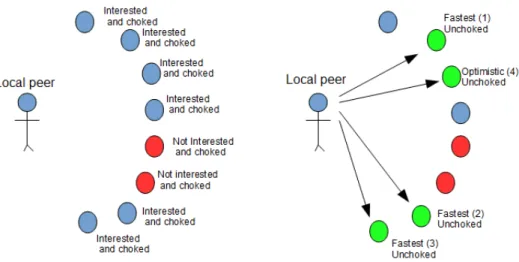
Also, note that each peer limits the number of concurrent uploads (regular unchokes) to a small number, typically three and, even though seeds have nothing to download, they also limit the number of concurrent upload to typically three as well. As for the optimistic unchoke, there is usually only a single current upload at once, except when the local peer is snubbed [8, 9]. This understanding is depicted in Figure 2.
Figure 2. Operation of the peer selection policy of BitTorrent.
2.2.2. Piece selection policy
Now the focus is on the piece selection policy of BitTorrent. To begin, it is important to stress the fact that to request data pieces, a local peer has first to be unchoked by a remote peer. More precisely, a local peer is unchoked by a remote peer and, only then, may request data pieces.
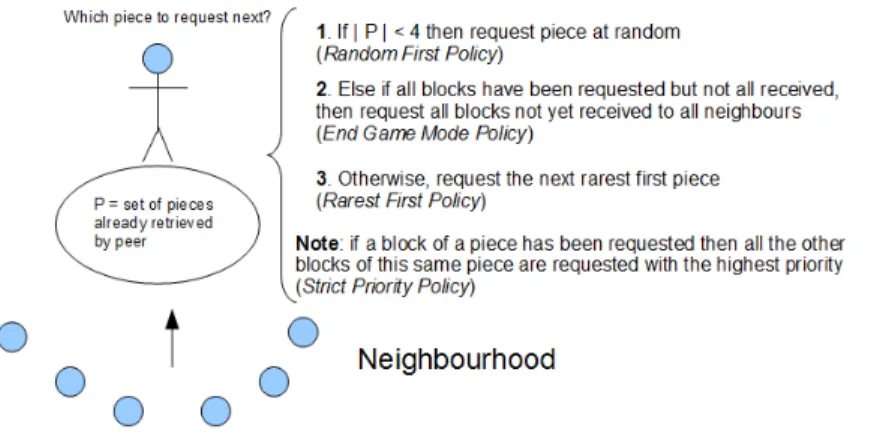
The piece selection policy of BitTorrent is explained in Algorithm 2 and, in fact, consists of a set of other specific policies, which map to three distinct stages: (i) initiating the download – the random first policy; (ii) normal operation – the rarest first policy; finally, (iii) pulling down the last remaining pieces – the end game mode policy.
Algorithm 2: Piece Selection Policy of BitTorrent
Begin
Repeat
Step 1 If the peer has downloaded strictly less than four pieces, then it chooses randomly the next piece to be requested. This is called the random first policy. Once it has downloaded at least four pieces, it switches to the rarest first policy.
This is because rare pieces are generally only present on a single peer, so they would be downloaded slower than pieces which are present on multiple peers for which it is possible to download blocks from different peers at a time (i.e., parallel download). Besides, a peer without a piece cannot reciprocate. It must wait for an optimistic unchoke. In fact, the first piece is most of the time received from peers that perform optimistic unchokes [8, 9].
Step 2 Else if all blocks have already been requested by the local peer but have not been received, then the peer requests all blocks not yet received to all peers in its peer set that have the corresponding blocks. This is called the end game mode policy.
Under this policy, each time a block is received, the peer cancels the request for the received block to all peers in its peer set that have the corresponding pending request [8]. This policy will only take place at the very end of the download and, therefore, the peer will not have to switch to any other policy. A peer never requests blocks of a same piece to more than one peer, unless it is under the end game mode policy.
Step 3 If neither Step 1 nor Step 2 takes place, then the peer selects the next piece to download at random in its rarest pieces taking into account the pieces available at the neighbour that unchokes it, i.e., it follows the behaviour of the rarest first policy. Note that, as a local peer is first unchoked by a remote peer and, only then, may request the piece, the rarest piece available on that remote peer might not be the globally rarest one.
Until the content download is complete.
End.
Also, if a peer ever happens to be choked during a piece download and this piece is not available on any other peer, the next time this peer is unchoked, a new piece will be then requested. As early as the partially downloaded piece is available again in the swarm, this peer will then request the remaining blocks with the highest priority.
As already mentioned, a local peer sends requests to remote peers that are unchoking it. So, if m remote peers unchoke the local peer, it then may potentially send requests to all these m remote peers (i.e., parallel download). Consider, for example, the extreme case in which the local peer is the only leecher and all remote peers are seeds. Thus, at most, the local peer downloads from as many remote peers as it has in its peer set.
Lastly, note that a peer may request blocks of different pieces to a single remote peer or to different remote peers. Consider the case of a single remote peer: recall that the idea is to always keep k block requests pipelined at once on the remote peer (k is typically set to five); now suppose that there are y blocks remaining to finish the download of the ongoing rarest piece and y < k. So there may still be (k – y) block requests for the next rarest piece in order to guarantee k block requests pipelined at once. Now consider the case of different remote peers: recall that the next piece to be selected by the local peer is the rarest piece available on the remote peer that has just unchoked it. Suppose that j remote peers have just unchoked the local peer and that these remote peers have different rarest pieces. It follows that the remote peer will request blocks of j different pieces at once.
To end this subsection, the general understanding of the piece selection policy is succinctly depicted in Figure 3.
Figure 3. General understanding of the piece selection strategy.
2.3. Reciprocity
Reciprocity mechanisms classify in two types: direct and indirect. In direct reciprocity, peers follow the principle of I scratch your back and you scratch mine. In indirect reciprocity, the return may come from a peer other than the recipient, i.e., a peer A provides content to a peer B at a rate equal to that at which content is being provided to it by a peer C, regardless of whether or not B and C are the same individual. In this case, peers follow the principle of give and you shall be given. Direct and indirect reciprocity are used in P2P systems [10].
Within this context, when a peer uses peer selection based on direct reciprocity, it will upload to other peers that have recently uploaded to it at the highest rates. On the other hand, when a peer uses peer selection based on indirect reciprocity, it will upload to other peers that have recently forwarded data to others at the highest rates [1, 10].
As already mentioned, the BitTorrent’ peer selection policy implements a direct reciprocity denoted as tit-for-tat strategy. So, peers prefer uploading to the peers that have recently contributed to them at the highest speeds. The emergent effect of this policy is that peers having higher uploads capacities also typically have higher download speeds and, hence, more incentives for cooperation. Although these are desirable properties for the scenario of traditional file transfer, this policy has may have two important drawbacks for on-demand streaming [1, 2, 6], as explained in the following.
Second, tit-for-tat was designed to maximize the download speed of peers. However, in on-demand streaming systems, peers gain little utility from having a download speed higher than the necessary to simply preserve stream continuity. The use of tit-for-tat, in an on-demand streaming system with heterogeneous peers (i.e., peers with distinct bandwidth capacity), may then lead to situations where, even if there is enough aggregate upload capacity to serve all system peers, not all peers experience a satisfactory QoS. This is because high-capacity peers may eventually receive download rates substantially higher than the file playback rate, while low-capacity peers may experience download rates that are too low to meet the on-demand streaming requirements.
3.
R
ELATED WORKIn what follows, there is a brief presentation of several important proposals of peer selection policies used by BitTorrent-like protocols. Because of being relatively recent and have already been proven to be efficient, these proposals surely represent some of the state-of-art schemes of the literature.
Legout et al. [9] possibly formally examines the first modification of the original BitTorrent protocol. This proposal considers changes exclusively when in seed state, as explained in the following. At most four remote peers can be unchoked and interested at the same time. Every 10 seconds, the unchoked and interested remote peers are ordered according to the time they were last unchoked, most recently unchoked peers first. The goal is to prioritize the remote peers which have been unchoked more recently. In case there is a tie, the remote peers are ordered according to the upload rate (i.e., from seed to remote peers), higher rates first. For two consecutive periods of 10 seconds, the 3 first peers are kept unchoked and an additional 4th peer that is choked and interested is selected at random and unchoked. For the third period of 10 seconds, the four first peers are kept unchoked. This proposal does not focus on the time constraints of on-demand streaming applications, but mainly on the replication efficiency.
Comparing to the original BitTorrent, Shah et al. [11] propose to use the optimistic unchoke slots more frequently. More precisely, they introduce a sliding window which contains the next w pieces to be consumed by a client. They use a policy in which at the beginning of every window playback, peers perform a new optimistic unchoke. This policy therefore gives more free tries to a larger number of peers in the swarm to download pieces which they can use to share later. As more peers become able to actively participate during each playback interval, the efficiency of the system hopefully improves and more peers will then improve the quality of their streaming. In other words, the idea is therefore to behave more altruistically. Problem is that frequent unchoke rounds may weaken incentives for cooperation; besides, a peer may compromise its own QoS by being too altruistic.
The proposal of Mol et al. [12] basically differs from the original BitTorrent with respect to the principle of reciprocity. For the three regular unchoke slots, each peer selects the nodes that have forwarded pieces received from it at the highest speeds. Thus, the principle of indirect reciprocity is clearly being applied. In order to discover the forwarding rate of a child node B, a peer A periodically asks its grandchildren about the pieces received from B. The child B is not asked directly as it could make false claims. The optimistic unchoke slots (one at a time) are assigned in a similar way as in BitTorrent, but the optimistic interval is of 2δ seconds (δ is typically set to 10). Exceptionally, if there is enough spare capacity, a peer is allowed to open a maximum of two additional regular unchoke slots.
D’Acunto et al. [2] propose three schemes mainly devoted to heterogeneous environments, i.e., peers may have different upload and/or download capacities among themselves. They are all based on the idea of adjusting the number of upload slots a peer opens, as it is explained next.
the peer’s upload capacity and the video playback rate. The core of the second scheme is to have peers dynamically adjusting the number of their optimistic slots to their current QoS. To measure the QoS, it is used the sequential progress, defined as the speed at which the index of the first missing piece grows. This measure is an indicator for the preservation of the continuity of the stream: a sequential progress faster than the video playback rate implies a continuous stream. This measure is agnostic with respect to the underlying piece selection policy, making a strategy based on it directly portable to other P2P video on-demand (VoD) protocols.
Finally, the third scheme of D’Acunto et al. [2] is based on the following observation. When a new peer joins the network, it needs to wait for a certain period of time to be optimistically unchoked by other peers. Once a node has obtained the first piece, it can forward it to other peers and get a chance of being selected by its parents in their regular unchoke slots. This time in which peers are waiting for the first piece is referred as bootstrap time. In a VoD system, where playback starts well before the file is completely downloaded, the bootstrap time can represent an important fraction of the startup delay, i.e., the waiting time before a client may start playing the file. Hence, the startup delay can be reduced by decreasing the bootstrap time. With this in mind, their third scheme then extends the second scheme, just explained, with a mechanism where nodes give priority to newcomers when performing optimistic unchoke. In this way, newcomers will not need to wait too long before being unchoked for the first time.
Rocha et al. [6] use the same number of regular and optimistic unchoke slots, respectively, as in BitTorrent. They though conjecture that, to efficiently select neighbours, the following values should be obtained: (1) how much the piece requests diverge from each other considering the arrival times; (2) how much of the retrieved file segments may be effectively shared; (3) how often each file position is requested. They then define three metrics: temporal dispersion, spatial dispersion and file position popularity p. Temporal dispersion is just another way to denote the block piece request rate and is be used to calculate the value (1). Spatial dispersion refers to the amount of content two consecutive distinct users’ requests have in common and is used to calculate the value (2). The popularity of a file position p is the number of times a position p is requested by the clients and is used to calculate the value (3). An algorithm for neighbour selection is then proposed considering these three metrics as main guidelines. The idea is to prioritize as neighbours those peers that result in neighbour sets with the lowest possible dispersion, given that they have likely retrieved most of the first file positions.
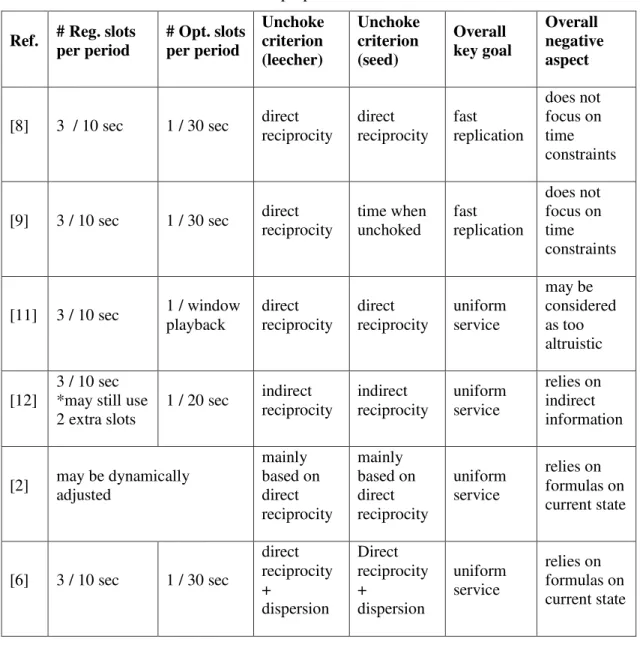
Lastly, to end this section, Table 1 brings a summary of the proposals briefly explained above as well as of the original BitTorrent. The goal is to outline the main points in common as well as the main differences among them. Within this context, it is worth noting that all these proposals, except that of D’Acunto et al. [2], employ a total of four upload slots. This mainly lies on the observation that increasing the number of peers served at the same time has the side effect of decreasing the service rate to each peer [13, 14].
4.
N
OVEL PROPOSALSThis section presents the three novel proposals, namely Select Balanced Neighbour Policy (SBNP), Select Optimistic Neighbour Policy (SONP), and Select Regular Neighbour Policy (SRNP). For ease of presentation and objectivity, only the steps that are modified with respect to Algorithm 1 (see Subsection 2.2.1) are outlined in the algorithms of the novel proposals, which appear in the following.
contain the data pieces that are the nearest ones to the current file playback point of the peer requesting data. When the remote peer requests a piece, it necessarily requests a piece that is within the slide window and, hence, very near to its current playback point. In this way, the on-demand time constraints are likely to be met.
Table 1. Main proposals in the literature.
Ref. # Reg. slots per period
# Opt. slots per period Unchoke criterion (leecher) Unchoke criterion (seed) Overall key goal Overall negative aspect
[8] 3 / 10 sec 1 / 30 sec direct reciprocity direct reciprocity fast replication does not focus on time constraints
[9] 3 / 10 sec 1 / 30 sec direct reciprocity time when unchoked fast replication does not focus on time constraints
[11] 3 / 10 sec 1 / window playback direct reciprocity direct reciprocity uniform service may be considered as too altruistic [12]
3 / 10 sec *may still use 2 extra slots
1 / 20 sec indirect reciprocity indirect reciprocity uniform service relies on indirect information
[2] may be dynamically adjusted mainly based on direct reciprocity mainly based on direct reciprocity uniform service relies on formulas on current state
[6] 3 / 10 sec 1 / 30 sec
direct reciprocity + dispersion Direct reciprocity + dispersion uniform service relies on formulas on current state
Algorithm 3: SBNP proposal
Step 2 The local peer´s upload capacity is divided into four upload slots. Two slots are denoted as regular unchoke slots, and two slots are denoted as optimistic unchoke slots;
The SONP proposal is presented in Algorithm 4. It aims to take into account the overall benefit of Shat et al. [11] and Mol et al. [12], respectively. That is, to provide more opportunities for newcomers. Nevertheless, it is more stable and conservative since the number of optimistic slots is fixed (i.e., there is no extra slot) and the time cycle for optimistic-slot assignment is set to 2δ seconds (δ is typically set to 10). This feature helps to avoid the problem of being too altruistic. Besides, this proposal solely considers direct reciprocity and, hence, does not rely on indirect information.
Algorithm 4: SONP proposal
Step 2 The local peer´s upload capacity is divided into four upload slots. One slot is denoted as regular unchoke slot, and three slots are denoted as optimistic unchoke slots;
Step 3.2 Else if the local peer is in seed state: all interested remote peers are ordered according to the time they were last unchoked, most recently unchoked peers first. The goal is to prioritize the remote peers which have been unchoked more recently. In case there is a tie, the remote peers are ordered according to the upload rate (from seed to remote peers), higher rates first.
Step 4 Every 2δ seconds, three additional interested remote peers are unchoked at random. In other words, three optimistic unchoke slots are assigned.
By its turn, the SRNP proposal comes in Algorithm 5. It mostly aims to simultaneously consider the general ideas of both D’Acunto et al. [2] and Rocha et al. [6], namely to capture the dynamics of the system in order to better select the peers to which send data. Nevertheless, it may be judged as more stable and conservative since it does not deploy formulas that may result intricate to be computed in an online manner. This feature hopefully guarantees a more efficient decision-making process for the peer selection policy.
Finally, to end this section, Table 2 makes a summary of the three novel proposals. The goal is to outline their main characteristics. Besides, it is also mentioned the key design thought of each proposal as well as the references on which each of them is based.
Algorithm 5: SRNP proposal
Step 2 The local peer´s upload capacity is divided into four upload slots. Three slots are denoted as regular unchoke slots, and one slot is denoted as optimistic unchoke slot;
Step 3.1 If the local peer is in leecher state: all interested remote peers are ordered according to their upload rate to the local peer, i.e., rate at which the remote peer has sent data to the local peer. They are then ordered again now according to the time they last received pieces, so that peers that have not recently received pieces will come first. Finally, the three first peers of the list are then unchoked. In other words, the three regular unchoke slots are assigned to the fastest peers that are more time without receiving a piece.
Table 2. Novel proposals.
Proposal # Reg. slots per period
# Opt. slots per period Unchoke Criterion (leecher) Unchoke Criterion (seed) Key thought Basis (references)
SBNP 2 / 10 sec 2 / 30 sec upload rate time being unchoked number of slots are equal
[8] and [9]
SONP 1 / 10 sec 3 / 20 sec upload rate time being unchoked prioritize optimistic slots
[11] and [12]
SRNP 3 / 10 sec 1 / 30 sec
upload rate + time receiving piece time being unchoked capture system dynamics
[2] and [6]
5.
P
ERFORMANCE EVALUATION5.1. Scenario characterization
A number of works in the literature are especially dedicated to the task of characterizing BitTorrent systems. To name a few, there are the works of [15-19]. In spite of being deeply intricate, this task is indeed invaluable. It mainly enables researchers to adequately choose system characterization parameters and set their numerical values to carry out simulation studies and experiments based on real-world scenarios.
For example, Souza e Silva et al. [15] developed a crawler to monitor one of the most popular Torrent Search Engines (Torlock.com) to determine the daily size of all swarms announced in the website (around 150,000 swarms) for ten consecutive days. Their final results indicate that most of the swarms are very small: about 73% of the total is formed by less than 10 peers, and 58% have less than five peers. This fact implies that, to analyze ordinary swarms, a size of less than 10 peers should be considered.
On the other hand, the large measurement carried out in the work of Hoßfeld et al. [7] indicates that there is a clear relationship between the content type and the swarm size, as exemplified in the following. For TV series, the average size is 15.53 peers per swarm and, for Movies and Music files, the averages are 25.46 and 9.76 peers, respectively, per swarm. These figures suggest that non-video contents tend to be less popular than video contents. So, in case there is more interest on the replication of video contents, large swarms should be then the focus.
Another important characterization parameter refers to the content size. For example, by means of measurement and analysis of real BitTorrent swarm systems, Wang et al. [19] have concluded that 90% of video contents are larger than 100 MB. Moreover, there are 5% of the video contents with size being larger than 10 GB, and the maximum video reaches nearly 20 GB. On the other hand, only 30% of the non-video contents are larger than 100 MB, and over 50% of non-video contents are less than 20 MB, whereas those small contents are very few in the existing video file swarms.
swarm scenarios. Second, to allow simulation studies focused on the objective of this work: to design peer selection policies for BitTorrent-like protocols devoted to on-demand streaming systems.
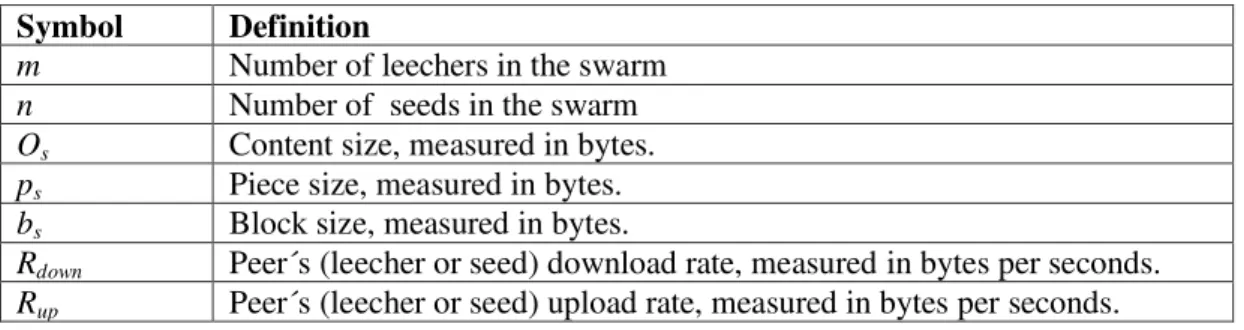
Table 3. Key characterization parameters.
Symbol Definition
m Number of leechers in the swarm n Number of seeds in the swarm Os Content size, measured in bytes. ps Piece size, measured in bytes. bs Block size, measured in bytes.
Rdown Peer´s (leecher or seed) download rate, measured in bytes per seconds. Rup Peer´s (leecher or seed) upload rate, measured in bytes per seconds.
5.2. Simulation setup and performance metrics
The three novel proposals are modeled on top of Tangram-II tool [20]. It is an environment for computer and communication system modeling and experimentation developed at Federal University of Rio de Janeiro (UFRJ), with participation of UCLA/USA, for research and educational purposes. It combines a sophisticated user interface based on an object-oriented paradigm and solution techniques for performance and availability analysis. The user specifies a model in terms of objects that interact via a message exchange mechanism. Once the model is compiled, it can be either solved analytically, if it is Markovian or belongs to a class of non-Markovian models, or solved via simulation. There are several solvers available to the user, both for steady state and transient analysis, respectively.
The modeling solely refers to the peer selection policy, i.e., it does not take into account the piece selection policy. Therefore, the results, analysis and conclusions are herein focused on system optimization provided exclusively by the peer selection policy. Additionally, the system to be evaluated in the simulations is considered to be in steady state, i.e., although peers might join and leave the system, the total number of peers remains constant. Lastly, the simulation results have 95% confidence intervals that are within 5% of the reported values.
The following performance metrics are used in the simulations: service time, number of clients served and efficiency retrieving coefficient (ERC). The first refers to the period of time the client has to stay in the system to receive the wanted data. The second refers to the total number of clients that are served during the entire simulation time. The third metric is calculated by means of Equation (1) and says how efficient a peer´s data retrieving process is compared to that employing an exclusive data-delivery channel. Recall that a swarm peer eventually needs to take turns with other system peers in order to download the wanted content, i.e., the content downloading process may be interrupted several times before it finally ends.
(1)
Lastly, to obtain the most possible accurate results for the performance metrics herein defined, the peer and piece selection policies, respectively, should be both modeled. This is because it is very likely to exist inter-influences between them, i.e., the piece selection influences the peer selection and vice-versa. Nevertheless, these possible inter-influences are mostly quantitative. This implies that they may modify the absolute values but not the qualitative and relative values. Hence, the results herein obtained are indeed sufficient and satisfactory for a truly impartial and competitive analysis. To model the piece selection policy is a complementary work deliberately left for the future.
5.3. Results and analysis
Results and analysis are separated into three subsections, as explained in the following. Subsection 5.3.1 is dedicated to an overall competitive analysis among the three proposed policies. To this end, different file replication scenarios, mainly defined in function of the parameters of Table 1, are examined. Subsection 5.3.2 is specifically devoted to evaluating the scalability, in terms of content size, of the most efficient proposal resulting from the analysis of Subsection 5.3.1. To this end, replication scenarios owning contents of different sizes are considered. Finally, Subsection 5.3.3 takes into account the client´s interactive behaviour and, again, solely the most efficient proposal coming out from Subsection 5.3.1. The goal is to quantify the influence of the interactive behaviour on the proposal´s performance.
5.3.1. Overall competitiveness
Table 4 presents typical values of the parameters defined in Table 3. They are based on works of the literature such as [3, 4, 7, 15-18]. As it can be seen, there are four scenarios, representing swarms, categorized in accordance with the content type: Music Files (MF); TV Series (TS); Movies (M); All Media (AM). The last one refers to swarms that are not restricted to any type of content.
Figures 4(a) and 4(b) bring the values of ERC and the total number of clients served, respectively, considering the three novel proposals deployed at the four distinct scenarios. Note that a similar number of clients served suffices to assure a truly fair ERC-based comparison among the proposals under a same scenario.
The results observed for the metric ERC clearly indicate that there is no noticeable difference in performance among the proposals. Given that four uploading slots are used in total, the rationale behind this fact is that neither the quantity of slots assigned (either regular or optimistic) for each peer swarm nor the time cycle assigned for slot re-evaluation are that significant to impact on the final performance.
In other words, considering four data slots for each swarm peer under typical scenarios of file replication, the corresponding slot categorization, either in regular or optimistic, does not really affect the proposal´s overall performance. Nevertheless, in case of choosing one of these proposals, the SBNP may be pointed out as the most adequate alternative, since it is the one that best preserves the natural equilibrium between direct and indirect reciprocities, thus equally sharing the peer´s upload bandwidth among faster and slower peers.
5.3.2. Scalability
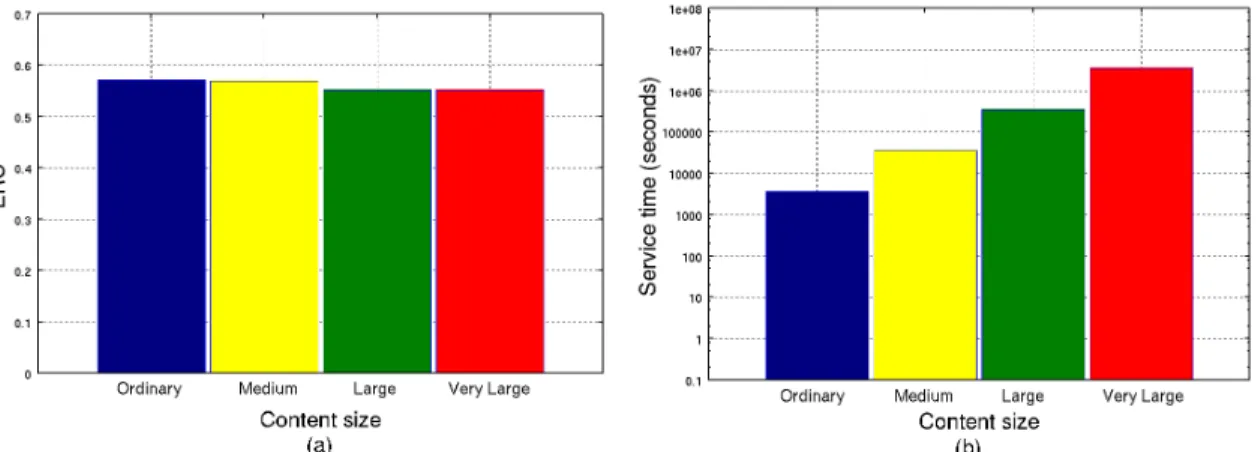
From Figure 5(a), the results of the metric ERC explicitly indicate that there is no noticeable difference in performance. This means that the SBNP proposal is indeed a very scalable solution for content replication, independently of the content size itself. This is a very important finding and may not be neglected at all when deciding about real solution implementations.
Table 4. Key characterization parameters for performance evaluation.
Parameters Replication scenarios
Music files (MF) TV series (TS) Movies (M) All media (AM)
m 10 15 25 7
n 1 1 1 1
Os 10.0 MB 100.0 MB 200.0 MB 20.0 MB
ps 256 B 256 B 256 B 256 B
bs 16 B 16 B 16 B 16 B
Rdown
104 B/sec 105 B/s 104 B/s 104 B/s Rup
Figure 4. (a) ERC in distinct scenarios; (b) Total number of peers served in distinct scenarios.
Nevertheless, it is worth stressing that a same value of ERC in distinct scenarios does not necessarily mean that the client´s service time is identical in all of the distinct scenarios. The service time is a function of the client´s download rate. Since, in the simulations, all scenarios are considered to have a same client´s download rate, the service time tends to be the shortest for the Ordinary scenario and the longest for the Very Large scenario. This fact may be observed in Figure 5(b). Clearly, the service time varies at about one-order magnitude from one scenario to another, considering an ascending-size order.
5.3.3. Interactivity
It has already been observed that the more interactive the client is, the less data he requests and, hence, less time he is likely to stay in the system [6, 21, 22]. Also, the more interactive the client is, the more playout interruptions he tends to suffer during his system sessions.
directly impact on the client´s slot occupancy, which computes how much of the slot itself, in time percentage, is effectively used for real data retrieving.
Figure 5. (a) ERC for distinct content sizes; (b) Services times for distinct content sizes.
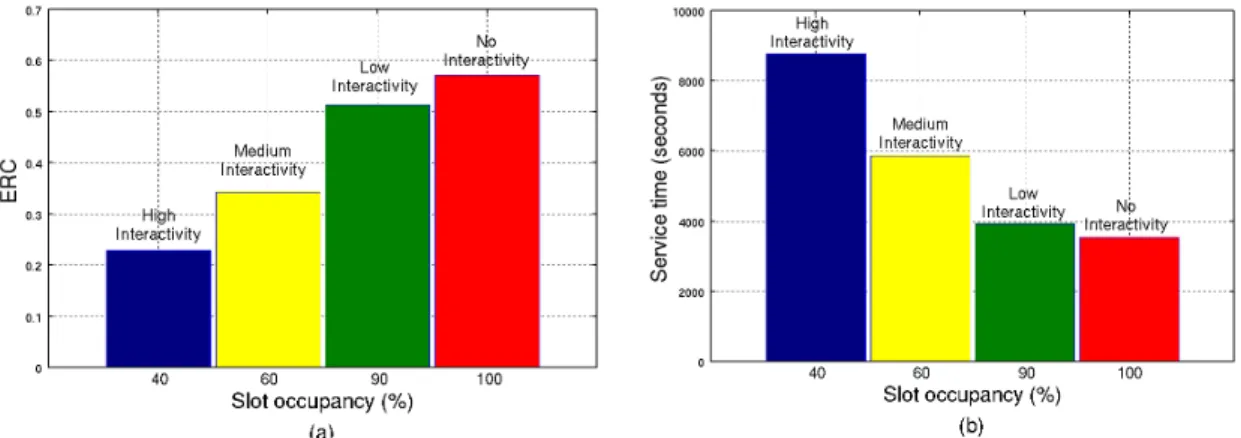
Considering the above, the following categorization for the client´s interactivity profile is admitted: High Interactivity (HI) – the slot occupancy is 40%; Medium Interactivity (MI) – the slot occupancy is 60%; Low Interactivity (LI) – the slot occupancy is 90%; No Interactivity (NI) – the slot occupancy is 100%. These numerical values are chosen to represent real-world swarms and are based on works of the literature such as [6, 21, 22].
Four scenarios, categorized in function of the client´s interactivity profile, are then examined in this section. Each scenario refers to one of the profiles. Besides, it is considered that the clients retrieve the entire file. The goal is to see how much the client´s interactivity may influence on the SBNP´s performance, identified as the best proposal in Subsection 5.3.1. The other parameters are the same of Table 4 and are set in accordance with the AM scenario.
From Figure 6(a), the final values of ERC indicate that the more interactive the client is, the less efficient the proposal becomes. By its turn, Figure 6(b) says that there are longer service times for the more interactive clients. The rationale behind these two general observations is that: the more interactive client needs more time slots than a less interactive client in order to retrieve the same quantity of data. Recall that all clients want to retrieve the same quantity of data.
It is worth mentioning that the final values of ERC present a sort of linear dependence on the slot occupancy. For instance, when the slot occupancy is reduced from 100% to 40%, there is a corresponding reduction of about 60% at the final value of ERC. In the case of the service time, there is an inverse dependence that follows a non-linear pattern.
Figure 6. (a) ERC for interactivity profiles; (b) Service time for interactivity profiles.
6.
C
ONCLUSIONS AND FUTURE WORKThis article introduced three novel peer selection policies for the design of BitTorrent-like protocols, namely Select Balanced Neighbour Policy (SBNP), Select Regular Neighbour Policy (SRNP), and Select Optimistic Neighbour Policy (SONP). They are especially devoted to Internet on-demand streaming systems, considering the client´s interactive behaviour, and were validated by means of simulations on a variety of file replication scenarios. Service time, number of clients served and efficiency retrieving coefficient (ERC) were the performance metrics used in the simulations.
In general, the novel proposals showed to be efficient solutions, independently of the size and type of content to be replicated. For instance, the ERC reached values up to 0.571, indicating a satisfactory data retrieving time, and the number of clients served reached up to 39414, mainly evidencing scalability and robustness. Besides, the following more specific results may be outlined: (i) given four data slots for each system peer and considering typical scenarios of file replication, the corresponding slot categorization, either in regular or optimistic, does not affect the proposals´ performance to a real significant extent; (ii) to preserve the natural equilibrium between direct reciprocity and indirect reciprocity, the SBNP proposal may be considered as the most adequate proposal. This is a very important finding and may not be neglected at all when deciding about a real solution implementation; lastly, (iii) under interactive scenarios, deploying local buffers on the client´s side may be an effective procedure to prevent any performance degradation.
Future work in this research field may specially include: (i) to implement the proposals herein presented together with proven-efficient piece selection policies of the literature, resulting in novel BitTorrent-like proposals for on-demand streaming systems. These proposals should be then compared with others of the literature; (ii) to quantify the data-retrieving efficiency that may be granted to BitTorrent-like protocols by the eventual deployment of local buffers on the client´s side, under interactive scenarios; (iii) to look into the peer request problem [23], the service request problem [23], and the traffic locality of P2P file swarming systems [19, 24] to see whether there is still space to optimize the BitTorrent’s peer and piece selection policies [25], respectively, targeting at on-demand streaming solutions; (iv) lastly, to examine the influences of the Network Address Translation (NAT) service [26] as well as of traffic hierarchical scheduling on the design of P2P on-demand streaming protocols [27].
A
CKNOWLEDGEMENTSin debt to Doctor Guilherme Dutra Gonzaga Jaime from the Nuclear Engineering Institute, Brazil, for patiently answering our questions about the simulation tool Tangram.
R
EFERENCES[1] D'Acunto, L., Chiluka, N., Vinkó, T. & Sips, H. (2013) “BitTorrent-like P2P approaches for VoD: A comparative study”,Computer Networks, Vol. 57, No. 5, pp 1253 – 1276.
[2] D’Acunto, L., Andrade, J. & Sips, H. (2010) “Peer selection strategies for improved QoS in heterogeneous BitTorrent-like VoD systems”, IEEE International Symposium on Multimedia, Taichung, Taiwan.
[3] Xia, R. L. & Muppala, J. K. (2010) “A survey of BitTorrent performance”, IEEE Communications surveys & tutorials, Vol. 12, No. 2, pp 140 – 158.
[4] Guo, L., Chen, S., Xiao, Z., Tan, E., Ding, X. & Zhang, X. (2007) “A performance study of BitTorrent-like peer-to-peer systems”, IEEE JSAC, Vol. 25, No. 1, pp 155 – 169.
[5] Hoffmann, L. J., Rodrigues, C.K.S. & Leão, R. M. M. (2011) “BitTorrent-like protocols for
interactive access to VoD systems”, European Journal of Scientific Research, Vol. 58, No. 4, pp 550 – 569.
[6] Rocha, M. V. M. & Rodrigues, C. K. S. (2013) “On Client’s interactive behaviour to design peer selection policies for BitTorrent-like protocols”, International Journal of Computer Networks & Communications(IJCNC), Vol. 5, No. 5, pp 141 – 159.
[7] Hoßfeld, T., Lehrieder, F., Hock, D., Oechsner, S., Despotovic, Z., Kellerer, W. & Michel, M.
(2011) “Characterization of BitTorrent swarms and their distribution in the Internet”, Computer Networks, Vol. 55, No. 5, pp 1197 – 1215.
[8] Cohen, B. (2003) “Incentives build robustness in BitTorrent”, First Workshop on Economics of Peer-to-Peer Systems, Berkeley, EUA.
[9] Legout, A., Urvoy-Keller, G. & Michiardi, P. (2006) “Rarest first and choke algorithms are
enough”, 6th ACM SIGCOM Conference on Internet Measurement, Rio de Janeiro, Brazil. [10] Menasché, D., Massoulié, L. & Towsley, D. (2010) “Reciprocity and barter in peer-to-peer
systems”, 29th Conference on Information communications, San Diego, CA, USA.
[11] Shah, P. & Pâris, J.-F. (2007) “Peer-to-Peer multimedia streaming using BitTorrent”, IEEE International Performance, Computing, and Communications Conference (IPCCC), New Orleans, EUA.
[12] Mol, J., Pouwelse, J., Meulpolder, M., Epema, D. & Sips, H. (2008) “Give-to-Get: Free-riding-resilient video-on-demand in P2P systems”, SPIE MMCN, San Jose, California, USA.
[13] Yang, X. & de Veciana, G. (2004) “Service capacity of peer-to-peer network”, 23rdAnnual Joint Conference of IEEE Computer and Communications Societies (INFOCOM 2004), Vol. 4, pp 2242 – 2252.
[14] Biersack, E., Rodriguez, P. & Felber, P. (2004) “Performance analysis of peer-to-peer networks
for file distribution”, Lectures Notes in Computer Science (LNCS), Vol. 3266, pp 1 – 10.
[15] de Souza e Silva, E., Leão, R., Menasché, D. & Rocha, A. (2013) “On the interplay between content popularity and performance in P2P systems”, Lecture Notes in Computer Science (LNCS), Vol. 8054, pp 3 – 21.
[16] Murai, F., Rocha, A., Figueiredo, D. & Souza e Silva, E. (2011) “Heterogeneous download times in a homogeneous BitTorrent swarm”, Computer Networks, Vol. 56, No. 7, pp 1983 – 2000.
[17] Ye, L., Zhang, H., Li, F. & Su, M. (2010) “A measurement study on Bittorrent system”, International Journal of Communications, Network and System Sciences, Vol. 3, pp 916 – 924.
[18] Varvello, M., Steiner, M. & Laevens, K. (2012) “Understanding BitTorrent: a reality check from
[19] Wang, H., Liu, J. & Xu, K. (2012) “Understand traffic locality of peer-to-peer video file
swarming”, Computer Communications, Vol. 35, No. 15, pp 1930 – 1937.
[20] De Souza e Silva, E., Figueiredo, D. & Leão, R. (2009) “The Tangram-II Integrated Modelling
Environment for Computer Systems and Networks”, ACM SIGMETRICS Performance Evaluation Review, Vol. 36, No. 4, pp 45 – 65.
[21] Costa, C., Cunha, I., Borges, A., Ramos, C., Rocha, M., Almeida, J., & Ribeiro-Neto, B. (2004)
“Analyzing Client Interactive Behavior on Streaming Media Servers”, 13th WWW Conference, New York, USA.
[22] Hoffmann, L. J., Rodrigues, C.K.S. & Leão, R. M. M. (2008) “On Scalable Interactive Video -On-Demand Services”, European Journal of Scientific Research, Vol. 21, No. 4, pp 662 – 686.
[23] Yang, Y., Chow, A., Golubchik, L. & Bragg, D. (2010) “Improving QoS in bittorrent-like VoD
systems”, Proceedings of the IEEE INFOCOM, San Diego, CA, USA.
[24] Le Blond, S., Legout, A. & Dabbous, W. (2011) “Pushing BitTorrent locality to the limit”, Computer Networks, Vol. 55, No. 3, pp 541 – 557.
[25] Atlidakis, V., Roussopoulos, M. & Delis, A. (2014) “EnhancedBit: Unleashing the potential of the unchoking policy in the BitTorrent protocol”, Journal of Parallel and Distributed Computing, Vol. 74, No. 1, pp 1959 – 1970.
[26] Masoud, M. Z. M (2013) “Analytical modelling of localized P2P streaming systems under NAT
consideration”, International Journal of Computer Networks & Communications (IJCNC), Vol. 5, No. 3, pp 73 – 89.
[27] Barhoun, R., Namir, A. & Barhoun, A. (2013) “Analysis of hierarchical scheduling for
heterogeneous traffic over network”, International Journal of Computer Networks & Communications (IJCNC), Vol. 5, No. 3, pp 103 – 116.
Author
Carlo Kleber da S. Rodrigues received the B.Sc. degree in Electrical Engineering from the Federal University of Paraiba in 1993, the M.Sc. degree in Systems and Computation from Military Institute of Engineering (IME) in 2000, and the D.Sc. degree in System Engineering and Computation from the Federal University of Rio de Janeiro (UFRJ) in 2006. Currently he is Military Assessor of the Brazilian Army in Ecuador, Professor at the Armed Forces University (ESPE) in Ecuador, and Professor at the University Center UniCEUB in Brazil. His research interests include the areas of computer networks, performance evaluation, and multimedia streaming.