Book of Abstracts of the
International Fire Safety Symposium 2015
Organizers:
cib - International Council for Research and Innovation in Building Construction UC - University of Coimbra Albrasci - Luso-Brazilian Association for Fire Safety
Authors:
João Paulo C. Rodrigues George V. Hadjisophocleous
Book ofAbstracts ofthe International Fire Safety Symposium 2015
held at the Department of Civil Engineering of the University of Coimbra, Portugal
20th-22ndApril2015
ISBN 978-989-98435-3-0
A Simposium organised by
albrasci
Luso-Brazilian Association
for Fire Safety
(http://www. albrasci. com)
Organizing Committee
João Paulo Correia Rodrigues, UC - University of Coimbra, Portugal (Chairman) Greg Baker, BRANZ, NewZealand (Co-chairman)
Cristina Calmeiro dos Santos, UC - University of Coimbra, Portugal C. J. Walsh, Sustainable Design International Itd., Ireland
Ehab Zalok, Carleton University, Canada
hlélder David da Silva Craveiro, UC - University of Coimbra, Portugal Hugo Caetano, UC - University of Coimbra, Portugal
Luís Miguel dos Santos Laím, UC - University of Coimbra, Portugal
/<^5\
-.1
International Council
for Research ana Innovation in
Building and Construction (www.cibworld.nl)
u University of Coimbra
(www. uc. pt)
Ali rights reserved. No part ofthe publication may be reproduced, stored in a retrieval system, or transmitted in any form or by any means, electronic, mechanical, photocopied, recording or otherwise, without prior permission ofthe Publisher.
Book ofAbstracts ofthe International Fire Safety Symposium 2015
held at the Department of Civil Engineering of the University of Coimbra, Portugal
20th-22ndApril2015
ISBN 978-989-98435-3-0
A Simposium organised by
albrasci
Luso-Brazilian Association
for Fire Safety
(http://www. albrasci. com)
Organizing Committee
João Paulo Correia Rodrigues, UC - University of Coimbra, Portugal (Chairman) Greg Baker, BRANZ, NewZealand (Co-chairman)
Cristina Calmeiro dos Santos, UC - University of Coimbra, Portugal C. J. Walsh, Sustainable Design International Itd., Ireland
Ehab Zalok, Carleton University, Canada
hlélder David da Silva Craveiro, UC - University of Coimbra, Portugal Hugo Caetano, UC - University of Coimbra, Portugal
Luís Miguel dos Santos Laím, UC - University of Coimbra, Portugal
/<^5\
-.1
International Council
for Research ana Innovation in
Building and Construction (www.cibworld.nl)
u University of Coimbra
(www. uc. pt)
Ali rights reserved. No part ofthe publication may be reproduced, stored in a retrieval system, or transmitted in any form or by any means, electronic, mechanical, photocopied, recording or otherwise, without prior permission ofthe Publisher.
Scientific Committee
George V. Hadjisophocleous, Carleton University, Canada (Chairman)
Ahmed Kashef, National Research Council, Canada
Ali Nadjai, University of Ulster, UK
Brian Meacham, WPI, USA
Charlie Fleishman, UniversityofCanterbury, NewZealand
Dhionis Dhima, CSTB, France
Ehab Zalok, Carleton University, Canada Euripidis Mistakidis, University ofVolos, Greece
Frantisek Wald, Technical University of Prague, Czech Republic
George Boustras, European University ofCyprus, Cyprus
Geraldine Charreau, INTI, Argentina
Gintaris Kaklauskas, Technical University ofVilnius, Lithuania
Gordon Andrews, University of Leeds, UK
Guillermo Rein, Imperial College, UK
Guo-Qiang Li, Tonngji University, China
Jean Marc Franssen, Liège University, Belgium
João Paulo Correia Rodrigues, Coimbra University, Portugal
José Torero, The University ofQueensland, Austrália
Juan de Dios Rivera , Pontifícia Universidad Católica de Chile Karen Boyce, University of Ulster, UK
Kathrin Grewolls, Ingenieurbüro Für Brandschutz Grewolls, Germany
Manfred Korzen, BAM, Germany
Manuel Romero, Universidad Politécnica de Valência, Spain
Maria Cruz Alonso - Instituto Eduardo Torroja, Spain
Paulo Vila Real, Aveiro University, Portugal
Pierre Pimienta, CSTB, France
Pietro Gambarova, Politécnico de Milano, Italy
Raffaele Landolfo, University of Naples, Italy
Ricardo Cruz Hernandez, Universidad de Santander, Colômbia Rita Fahy, National Fire Protection Association, USA
Rosaria Ono, São Paulo University (School ofArchitecture), Brazil
Simo Hostikka, VTT, Finland
Sunil K. Sharma, Fire Research, Central Building Research Institute, índia
Takashi Horiguchi, hlokkaido University, Japan
Tan Kang Hai, Nanyang Technological University, Singapore
UlfWickstrom, Lulea University ofTechnology, Sweden Ulrich Krause, University ofMagdeburg, Germany
Valdir Pignatta e Silva, São Paulo University (School of Engineering), Brazil
Venkatesh Kodur, Michigan State University, USA Wan-ki Chow, Hong Kong Technical University
PREFACE
On behalfofthe Organising and Scientific committees, as well as the CIB W-14 Commission on
Fire Safety it is our pleasure to welcome you to the International Fire Safety Symposium
-IFireSS 2015, which is organised by the CIB's Commission W14-Fire Safety, ALBRASCI and
University of Coimbra. The Symposium aims to contribute to the exchange of ideas and
knowledge in the área of Fire Safety and assist in planning future research activities in this área. CIB W14-Fire Safety is a Working Commission of CIB (International Council for Research and Innovation in Building & Construction) ana its main objectives are:
. To create an ongoing research and innovation focus for the development of a
comprehensive, coherent, rational and empirical basis for a safe and sustainable built
environment, which includes fire science and engineering practices and design methodologies;
. To promote the acceptance of Fire Science and Engineering Practices, Procedures andDesign Methodologies worldwide, and to encourage their use in Building and Fire Safety
Legislation, Codes, Regulations and Standards;. To provide technical input, from a Fire Science and Engineering Perspective, to other
relevant CIB Working Commissions and Task Groups;
. To facilitate the transfer of state-of-the-art Fire Science and Engineering Technology at
international levei;
. To encourage capacity building for Fire Science and Engineering worldwide.
The Luso-Brazilian Association for Fire Safety (ALBRASCI) was established recently by
Portuguese and Brazilian specialists in the área of Fire Safety to create a platform for the
development of Fire Safety in Portugal and Brazil.
The University of Coimbra (UC) is a reference in higher education and research in Portugal, due
to the quality of the courses taught and to the advances achieved in pure and applied research
in various áreas of knowledge. UC is also well-known around the World due to the research and training in Fire Safety with an MSc and PhD in the área.
The Symposium hás participants from researchers around the world and covers a wide variety
of research áreas including: Structural Fire Safety; Mechanical and Thermal Properties of
Materiais; Fire Chemistry, Physics and Combustion; Fire Reaction; Fire Safety in Vehicles and
Tunnels; Fire Risk Assessment; Smoke Control Systems; Firefighting and Evacuation; and Fire
Regulations, Standardization and Construction Trends.
João Paulo C Rodrigues
President ofthe Organizing Committee
George Hadjisophocleous
President of the Scientific Committee
CONTENTS
FIRE SAFETf OF STRUCTURES
LOCALIZED FIRE TESTS ON THE STEEL COLUMNS FOR DIFFERENT CROSS SECTION
AND CEILING CONDITIONS
Ali Nadjai, Sanghoon /-/an, Vassart Olivier and Obiala Renata
.3
NUMERICAL MODELS OF COLD FORMED STEEL COLUMNS MADE OF SQUARE TUBULAR SECTIONS SUBJECT TO FIRE
Waghner C. Rocha, Tiago A. Pires and José J. R. Silva
.7
SHEAR BUCKLING EVALUATION IN STEEL PLATE GIRDERS WITH NON-RIGID END POSTS SUBJECTED TO ELEVATED TEMPERATURES
André Reis, Nuno Lopes and Paulo Vila Real
11
PARTIALLY ENCASED SECTION: STRENGTH AND STIFFNESS UNDER FIRE CONDITIONS Paulo Piloto, David Almeida, A. B Ramos-Gavilán and Luís M. R. Mesquita
15
RECENTAPPLICATION OF EN1993-1-2 IN GERMANY
Martin Mensinger, Florian M. Block, Chrístian Maiershofer, Rudolf O. Reisch and Walter Borgogno
.
19
TEMPERATURES IN BLIND-BOLTS CONNECTIONS TO HOLLOW AND CONCRETE FILLED TUBULAR COLUMNS
Ana M. Páscoa/ and Manuel L. Romero
.23
EXPERIMENTAL INVESTIGATIONS ON THE THERMAL AND MECHANICAL BEHAVIOUR OF COMPOSITE COLUMNS WITH MASSIVE STEEL CORE IN FIRE
Peter Schaumann and Inka Kleiboemer
.27
FIRE BEHAVIOR OF COLD FORMED COLUMNS - EXPERIMENTAL TESTS
Waghner C. Rocha, José J. R. Silva, Tiago A. Pires and Leonardo M. Costa
.31
FIRE REACTION OF CONCRETE WITH AND WITHOUT PP FIBRES: EXPERIMENTAL
ANALYSIS AND NUMERICAL SIMULATION Paulo Piloto, Luís M. R. Mesquita and Carlos Balsa
.35
EXPERIMENTAL INVESTIGATION ON THE BEHAVIOUR OF COLD-FORMED STEEL
COLUMNS SUBJECTED TO FIRE
Hélder D. Craveiro, João P. Rodrigues and Luís Laim
.39
INCLINED COAL HANDLING BRIDGE AFTER FIRE
Kamila Horová, Petr Hejtmánek, Slavomír Entler and Frantisek Wald
.
43
IN-PLANE LOADED CONCRETE SLABS SUBJECTED TO FIRE: A NOVEL TEST SET-UP TO INVESTIGATE SPALLING
Francesco Lo Monte, Roberto Felicetti, Chiara Rossino, Alessandra Piovan and Gabriele Scaciga
.47
BEHAVIOR OF A STEELCONCRETE JOINT UNDER A ROBUSTNESS SCENARIO -INFLUENCE OF THE BEAM SPAN LENGTH AND THE BEAM AXIAL RESTRAINT
Cécile Haremza, Aldina Santiago and Luís Simões da Silva
.
51
BEHAVIOUR OF UNPROTECTED AND PROTECTED CELLULAR BEAMS HAVING
DIFFERENT OPENING SHAPES IN FIRE CONDITIONS
Ali Nadjai, Sanghoon Han, Faris Ali, Klelia Petrou, El Hadi and Ali Naili
.55
INFLUENCE OF HEAT AND MASS TRANSPORT ON MECHANICAL BEHAVIOUR OF TIMBER ELEMENTS IN FIRE
Robert Peôenko, Staffan Svensson and Tomaz Hozjan
.59
x
BOLTED TIMBER CONNECTIONS UNDER HIGH TEMPERATURES
Eduardo Schneid, Carolina da Rosa and Poliana Dias de Moraes
.
63
PARAMETRIC STUDY ON COLD-FORMED STEEL COLUMNS MADE WITH OPEN CROSS-SECTIONS SUBJECTED TO FIRE
Hélder D. Craveiro, João P. Rodrigues and Luís Laím
.67
ACCURACY OF AVAILABLE ANALYTICAL MODELS FOR FIRE DESIGN OF COLD-FORMED STEEL OPEN FLEXURAL MEMBERS
Lu/s Laím, João P. Rodrigues and Hélder D. Craveiro
.71
INFLUENCE OF INDUSTRIAL FAÇADES AND TRAPEZOIDAL SHEETING ON STEEL
MEMBERSWITH INTUMESCENT COATING Martin Mensinger and Peter Kraus
.
75
VERIFICATION OF WEB TAPERED BEAM-COLUMNS IN CASE OF FIRE USING THE GENERAL METHOD OF EUROCODE 3
Car/os Couto, Pedro Duarte, Paulo Vila Real and Nuno Lopes
.
79
A PARAMETRIC STUDY ON THE APPLICABILITY OF THE 500°C ISOTHERM METHOD FOR INVESTIGATING INTERACTION CURVES OF COLUMNS EXPOSED TO FIRE
Lijie Wang, Robby Caspeele and Luc Taerwe
.83
FIRE RESISTANCE OF WOODEN CELLULAR SLABS WITH RECTANGULAR PERFORATIONS
Jorge Meireles, Elza Fonseca, Paulo Piloto and Débora Ferreira
.
87
NUMERICAL EVALUATION OF THE BEHAVIOR OF PARTIALLY ENCASED COMPOSITE BEAMS IN FIRE
Fábio M. Rocha and Jorge M. Neto
.
91
FIRE BEHAVIOR OF COLD FORMED COLUMNS - EXPERIMENTAL TESTS
Waghner C. Rocha, José J. R. Silva, Tiago A. Pires and Leonardo M. Costa
.31
FIRE REACTION OF CONCRETE WITH AND WITHOUT PP FIBRES: EXPERIMENTAL
ANALYSIS AND NUMERICAL SIMULATION Paulo Piloto, Luís M. R. Mesquita and Carlos Balsa
.35
EXPERIMENTAL INVESTIGATION ON THE BEHAVIOUR OF COLD-FORMED STEEL
COLUMNS SUBJECTED TO FIRE
Hélder D. Craveiro, João P. Rodrigues and Luís Laim
.39
INCLINED COAL HANDLING BRIDGE AFTER FIRE
Kamila Horová, Petr Hejtmánek, Slavomír Entler and Frantisek Wald
.
43
IN-PLANE LOADED CONCRETE SLABS SUBJECTED TO FIRE: A NOVEL TEST SET-UP TO INVESTIGATE SPALLING
Francesco Lo Monte, Roberto Felicetti, Chiara Rossino, Alessandra Piovan and Gabriele Scaciga
.47
BEHAVIOR OF A STEELCONCRETE JOINT UNDER A ROBUSTNESS SCENARIO -INFLUENCE OF THE BEAM SPAN LENGTH AND THE BEAM AXIAL RESTRAINT
Cécile Haremza, Aldina Santiago and Luís Simões da Silva
.
51
BEHAVIOUR OF UNPROTECTED AND PROTECTED CELLULAR BEAMS HAVING
DIFFERENT OPENING SHAPES IN FIRE CONDITIONS
Ali Nadjai, Sanghoon Han, Faris Ali, Klelia Petrou, El Hadi and Ali Naili
.55
INFLUENCE OF HEAT AND MASS TRANSPORT ON MECHANICAL BEHAVIOUR OF TIMBER ELEMENTS IN FIRE
Robert Peôenko, Staffan Svensson and Tomaz Hozjan
.59
x
BOLTED TIMBER CONNECTIONS UNDER HIGH TEMPERATURES
Eduardo Schneid, Carolina da Rosa and Poliana Dias de Moraes
.
63
PARAMETRIC STUDY ON COLD-FORMED STEEL COLUMNS MADE WITH OPEN CROSS-SECTIONS SUBJECTED TO FIRE
Hélder D. Craveiro, João P. Rodrigues and Luís Laím
.67
ACCURACY OF AVAILABLE ANALYTICAL MODELS FOR FIRE DESIGN OF COLD-FORMED STEEL OPEN FLEXURAL MEMBERS
Lu/s Laím, João P. Rodrigues and Hélder D. Craveiro
.71
INFLUENCE OF INDUSTRIAL FAÇADES AND TRAPEZOIDAL SHEETING ON STEEL
MEMBERSWITH INTUMESCENT COATING Martin Mensinger and Peter Kraus
.
75
VERIFICATION OF WEB TAPERED BEAM-COLUMNS IN CASE OF FIRE USING THE GENERAL METHOD OF EUROCODE 3
Car/os Couto, Pedro Duarte, Paulo Vila Real and Nuno Lopes
.
79
A PARAMETRIC STUDY ON THE APPLICABILITY OF THE 500°C ISOTHERM METHOD FOR INVESTIGATING INTERACTION CURVES OF COLUMNS EXPOSED TO FIRE
Lijie Wang, Robby Caspeele and Luc Taerwe
.83
FIRE RESISTANCE OF WOODEN CELLULAR SLABS WITH RECTANGULAR PERFORATIONS
Jorge Meireles, Elza Fonseca, Paulo Piloto and Débora Ferreira
.
87
NUMERICAL EVALUATION OF THE BEHAVIOR OF PARTIALLY ENCASED COMPOSITE BEAMS IN FIRE
Fábio M. Rocha and Jorge M. Neto
.
91
ASSESSMENT OF THE SHEAR BEHAVIOUR OF T-SHAPED CONNECTORS AT ELEVATED TEMPERATURES
Luís Laím and João P. C. Rodrigues
.95
FIRE TESTS ON SLENDER CONCRETE FILLED TUBULAR COLUMNS SUBJECTED TO LARGE ECCENTRICITIES
Ana Espinós, Manuel L. Romero, Enrique Serra and Vicente Albero
.
99
THERMO-STRUCTURAL ANALYSES OF RC BEAMS IN FIRE
Gabríela B. M. L. Albuquerque, Valdir Pignatta Silva and João Paulo C. Rodrigues
.
103
PARAMETERS WITH INFLUENCE ON THE BEHAVIOR OF COMPOSITE TUBULAR
COLUMNS SUBJECTED TO FIRE
Tiago A. C. Pires, João P. C. Rodrigues and José J. R. Silva
.107
FIRE BEHAVIOUR OF TABIQUE WALLS
Alexandre Araújo, Elza Fonseca, Débora Ferreira, Paulo Piloto and Jorge Pinto
.109
MECHANICAL RESPONSE OF TWO-LAYERED CURVED REINFORCED CONCRETE BEAM EXPOSED TO NATURAL FIRE CONDITIONS
Dusan Ruzió, Miran Saje, Igor Planinc, Robert Pecenko and Tomai Hozjan
.113
ASSESSMENT OF THE INFLUENCE OF THE VENTILATION IN ADVANCED FIRE MODELS
lolanda Dei Frete, Nicola Bianco, Emidio Nigro and Giuseppe Rotondo
.117
MECHANICAL AND THERMAL PROPERTIES OF MATERIALS
STRESS REDISTRIBUTION ALONG POST-INSTALLED REBARS UNDER NON-UNIFORM TEMPERATURE LOADING
Nicolas Pinoteau, Sébastien Rémond, Pierre Pimienta and Thierry Guillet
23
XII
COMPRESSIVE STRENGTH OF FIBRE CONCRETES WITH ENHANCED FIRE BEHAVIOR Hugo Caetano, João P. C. Rodrigues and Armando M. Júnior
.
125
DETERMINATION OF WOOD THERMAL CONDUCTIVITY
Eduardo Schneid, Carolina da Rosa and Poliana D. Moraes
.127
ULTRASONOGRAPHY APPLIED TO DETERMINE THE CONCRETE RESISTANCE UNDER A FIRECONDITION
Armando LM. Júnior, Nádia S. Veiga, Carolina A. N. Alvim, André A. Garcia, Maria C. D. Relvas
and Rafaela Montefusco
.131
FIRE BEHAVIOUR OF LIGHTWEIGHT CONCRETE UNITS BASED ON CORN COB AGGREGATE
Nuno Alves, Paulo Piloto, Elza Fonseca, Luísa Barreira, Débora Ferreira and Jorge Pinto
.
133
THE RELATIONS BETWEEN THE ASSESSED DIAGNOSTIC PARAMETERS AND MECHANICAL PROPERTIES OF HEATED CONCRETES
Izabela Hager and Tomasz Tracz
.135
COMPRESSIVE BEHAVIOUR OF A TIRE RECYCLED STEEL AND TEXTILE FIBER
CONCRETE SUBJECTED TO FIRE
Cristina C. Santos and João P. Rodrigues
.137
EXPERIMENTAL RESEARCH ON THE RESIDUAL MECHANICAL PROPERTIES OF AN
ORDINARY CONCRETES AFTER FIRE Cristina C. Santos and João P. Rodrigues
.
141
EXPERIMENTAL ANALYSIS ON THE COMPRESSIVE STRENGTH AT HIGH TEMPERATURES OF A CONCRETE WITH PET CHIPS
Hugo Caetano, João P. Rodrigues and Pierre Pimienta
.
145
ASSESSMENT OF THE SHEAR BEHAVIOUR OF T-SHAPED CONNECTORS AT ELEVATED TEMPERATURES
Luís Laím and João P. C. Rodrigues
.95
FIRE TESTS ON SLENDER CONCRETE FILLED TUBULAR COLUMNS SUBJECTED TO LARGE ECCENTRICITIES
Ana Espinós, Manuel L. Romero, Enrique Serra and Vicente Albero
.
99
THERMO-STRUCTURAL ANALYSES OF RC BEAMS IN FIRE
Gabríela B. M. L. Albuquerque, Valdir Pignatta Silva and João Paulo C. Rodrigues
.
103
PARAMETERS WITH INFLUENCE ON THE BEHAVIOR OF COMPOSITE TUBULAR
COLUMNS SUBJECTED TO FIRE
Tiago A. C. Pires, João P. C. Rodrigues and José J. R. Silva
.107
FIRE BEHAVIOUR OF TABIQUE WALLS
Alexandre Araújo, Elza Fonseca, Débora Ferreira, Paulo Piloto and Jorge Pinto
.109
MECHANICAL RESPONSE OF TWO-LAYERED CURVED REINFORCED CONCRETE BEAM EXPOSED TO NATURAL FIRE CONDITIONS
Dusan Ruzió, Miran Saje, Igor Planinc, Robert Pecenko and Tomai Hozjan
.113
ASSESSMENT OF THE INFLUENCE OF THE VENTILATION IN ADVANCED FIRE MODELS
lolanda Dei Frete, Nicola Bianco, Emidio Nigro and Giuseppe Rotondo
.117
MECHANICAL AND THERMAL PROPERTIES OF MATERIALS
STRESS REDISTRIBUTION ALONG POST-INSTALLED REBARS UNDER NON-UNIFORM TEMPERATURE LOADING
Nicolas Pinoteau, Sébastien Rémond, Pierre Pimienta and Thierry Guillet
23
XII
COMPRESSIVE STRENGTH OF FIBRE CONCRETES WITH ENHANCED FIRE BEHAVIOR Hugo Caetano, João P. C. Rodrigues and Armando M. Júnior
.
125
DETERMINATION OF WOOD THERMAL CONDUCTIVITY
Eduardo Schneid, Carolina da Rosa and Poliana D. Moraes
.127
ULTRASONOGRAPHY APPLIED TO DETERMINE THE CONCRETE RESISTANCE UNDER A FIRECONDITION
Armando LM. Júnior, Nádia S. Veiga, Carolina A. N. Alvim, André A. Garcia, Maria C. D. Relvas
and Rafaela Montefusco
.131
FIRE BEHAVIOUR OF LIGHTWEIGHT CONCRETE UNITS BASED ON CORN COB AGGREGATE
Nuno Alves, Paulo Piloto, Elza Fonseca, Luísa Barreira, Débora Ferreira and Jorge Pinto
.
133
THE RELATIONS BETWEEN THE ASSESSED DIAGNOSTIC PARAMETERS AND MECHANICAL PROPERTIES OF HEATED CONCRETES
Izabela Hager and Tomasz Tracz
.135
COMPRESSIVE BEHAVIOUR OF A TIRE RECYCLED STEEL AND TEXTILE FIBER
CONCRETE SUBJECTED TO FIRE
Cristina C. Santos and João P. Rodrigues
.137
EXPERIMENTAL RESEARCH ON THE RESIDUAL MECHANICAL PROPERTIES OF AN
ORDINARY CONCRETES AFTER FIRE Cristina C. Santos and João P. Rodrigues
.
141
EXPERIMENTAL ANALYSIS ON THE COMPRESSIVE STRENGTH AT HIGH TEMPERATURES OF A CONCRETE WITH PET CHIPS
Hugo Caetano, João P. Rodrigues and Pierre Pimienta
.
145
FIRE CHEMISTRY, PHYSICS AND COMBUSTION
A DESIGN FIRE MODEL FOR THE FULL PROCESS OF FIRE
Xia Zhang, Xiao Li and George Hadjisophocleous
.149
TOXIC GÁS ANALYSIS FROM COMPARTMENT FIRES USING HEATED RAW GÁS
SAMPLING WITH HEATED FTIR 50+ SPECIES GÁS ANALYSIS
Abdulaziz A. Alarífi, Herodotos N. Phylaktou and Gordon E. Andrews
.
153
NUMERICAL SIMULATION OF VAPOUR CLOUD FIRES USING FLACS-FIRE
Deiveegan Muthusamy and Kees van Wingerden
.
157
IMPACT OF WOOD FIRE LOAD ON TOXIC EMISSIONS IN VENTILATION CONTROLLED
COMPARTMENT FIRES
Bintu G. Mustafa, Gordon E. Andrews, Herodotos N. Phylaktou, Ayesh AIShammri, Vishal Shah
and OmarA. O. Aljumaiah
.159
THE EFFECT OF USING LIDS IN DIFFERENTIAL SCANNING CALORIMETER
EXPERIMENTS FOR DETERMINING THE HEAT OF REACTION OF WOOD
Xiaoyun Wang, Charles Fleishmann and Michael Spearpoint
.
161
INVERSE MODEL FOR DETERMINING HEAT RELEASE RATES
Qianru Guo, Álvaro Salinas and Ann E. Jeffers
.165
TOXIC GASES FROM COMPARTMENT FIRES WITH HANGING COTTON TOWELS AND
LOW VENTILATIONGordon E. Andrews, Paul Yeomans and Herodotos N. Phylaktou and Ornar A. Aljumaiah
.
169
ANALYSIS OF A NEW PLATE THERMOMETER - THE COPPER DISC PLATE
THERMOMETER
Alexandra Bystrõm, OskarLind, Eríka Palmklint, Petter Jõnsson and UlfWickstrõm
71
XIV
FIRE REACTION
NUMERICAL INVESTIGATION ON THE EFFECT OF SIDEWALLS AND OPENING GEOMETRY ON WINDOW EJECTED FACADE FLAMES
M. Duny, D. Dhima, J. P. Garo, H. Y. Wang and B. Martinez-Ramirez
.177
BURNING OF POLYURETHANE FOAM CLOSE TO A WALL AND A CORNER DEPENDING ON SEPARATION DISTANCE
Junghoon Ji, Kazunori Harada, Yoshifumi Ohmiya, Masaki Noaki and Yichul Shin
.181
THE APPLICATION OF DIFFERENT COMPONENT SCHEMES TO PREDICT WOOD PYROLYSISAND FIRE BEHAVIOUR
Xiaoyun Wang, Charles Fleishmann and Michael Spearpoint
.185
BURNING OF POLYURETHANE FOAM BLOCK IN ISO ROOM COMPARTMENT
Kazunorí Harada, Ken Matsuyama, Kazuhiko Ido, Masaaki Noaki, Sungchan Lee and Jaeyoung Lee
.
189
NUMERICAL MODELING OF A VERTICAL WALL FIRE
M. Duny, D. Dhima, J. P. Garo, H. Y. Wang, and B. Martinez-Ramirez
.193
FIRE SPREAD RESULTED FROM BURNING A DOUBLE-SKIN FAÇADE DEMONSTRATION
RIG
Nadia C. L. Chow
.195
TESTS ON INTUMESCENT PAINTS FOR FIRE PROTECTION OF EXISTING STEEL STRUCTURES
António Bilotta, Donatella de Silva, Emidio Nigro and Luca Ponticelli
99
FIRE CHEMISTRY, PHYSICS AND COMBUSTION
A DESIGN FIRE MODEL FOR THE FULL PROCESS OF FIRE
Xia Zhang, Xiao Li and George Hadjisophocleous
.149
TOXIC GÁS ANALYSIS FROM COMPARTMENT FIRES USING HEATED RAW GÁS
SAMPLING WITH HEATED FTIR 50+ SPECIES GÁS ANALYSIS
Abdulaziz A. Alarífi, Herodotos N. Phylaktou and Gordon E. Andrews
.
153
NUMERICAL SIMULATION OF VAPOUR CLOUD FIRES USING FLACS-FIRE
Deiveegan Muthusamy and Kees van Wingerden
.
157
IMPACT OF WOOD FIRE LOAD ON TOXIC EMISSIONS IN VENTILATION CONTROLLED
COMPARTMENT FIRES
Bintu G. Mustafa, Gordon E. Andrews, Herodotos N. Phylaktou, Ayesh AIShammri, Vishal Shah
and OmarA. O. Aljumaiah
.159
THE EFFECT OF USING LIDS IN DIFFERENTIAL SCANNING CALORIMETER
EXPERIMENTS FOR DETERMINING THE HEAT OF REACTION OF WOOD
Xiaoyun Wang, Charles Fleishmann and Michael Spearpoint
.
161
INVERSE MODEL FOR DETERMINING HEAT RELEASE RATES
Qianru Guo, Álvaro Salinas and Ann E. Jeffers
.165
TOXIC GASES FROM COMPARTMENT FIRES WITH HANGING COTTON TOWELS AND
LOW VENTILATIONGordon E. Andrews, Paul Yeomans and Herodotos N. Phylaktou and Ornar A. Aljumaiah
.
169
ANALYSIS OF A NEW PLATE THERMOMETER - THE COPPER DISC PLATE
THERMOMETER
Alexandra Bystrõm, OskarLind, Eríka Palmklint, Petter Jõnsson and UlfWickstrõm
71
XIV
FIRE REACTION
NUMERICAL INVESTIGATION ON THE EFFECT OF SIDEWALLS AND OPENING GEOMETRY ON WINDOW EJECTED FACADE FLAMES
M. Duny, D. Dhima, J. P. Garo, H. Y. Wang and B. Martinez-Ramirez
.177
BURNING OF POLYURETHANE FOAM CLOSE TO A WALL AND A CORNER DEPENDING ON SEPARATION DISTANCE
Junghoon Ji, Kazunori Harada, Yoshifumi Ohmiya, Masaki Noaki and Yichul Shin
.181
THE APPLICATION OF DIFFERENT COMPONENT SCHEMES TO PREDICT WOOD PYROLYSISAND FIRE BEHAVIOUR
Xiaoyun Wang, Charles Fleishmann and Michael Spearpoint
.185
BURNING OF POLYURETHANE FOAM BLOCK IN ISO ROOM COMPARTMENT
Kazunorí Harada, Ken Matsuyama, Kazuhiko Ido, Masaaki Noaki, Sungchan Lee and Jaeyoung Lee
.
189
NUMERICAL MODELING OF A VERTICAL WALL FIRE
M. Duny, D. Dhima, J. P. Garo, H. Y. Wang, and B. Martinez-Ramirez
.193
FIRE SPREAD RESULTED FROM BURNING A DOUBLE-SKIN FAÇADE DEMONSTRATION
RIG
Nadia C. L. Chow
.195
TESTS ON INTUMESCENT PAINTS FOR FIRE PROTECTION OF EXISTING STEEL STRUCTURES
António Bilotta, Donatella de Silva, Emidio Nigro and Luca Ponticelli
99
SMOKE CONTROL
ROAD TUNNEL - FIRE AND EVACUATION SCENARIO CASE STUDY Dirceu Santos, João P. Rodrigues and Jorge Saraiva
SCALE MODEL EXPERIMENTS ON SMOKE MOVEMENT IN A TILTED TUNNEL S. /. Tsang, W. K. Chow and Gigi C. H. Lui
.
205
.207
FULL-SCALE TESTS AND CFD MODELLING TO INVESTIGATE THE EFFECT OF DIFFERENT MAKE-UP AIR VELOCITIES ON SMOKE LAYER HEIGHT IN ATRIUM FIRES Amir Rafinazarí and George Hadjisophocleous
.211
FULL-SIZE EXPERIMENTS OF AIR CURTAINS FOR SMOKE CONTROL IN CASE OF FIRE João Carlos Viegas and Hildebrando Cruz
.213
FIRERISKASSESSMENT
THE EFFECTS OF CONSTRUCTION TYPE AND ACTIVE FIRE PROTECTION OPTION ON THE OVERALL BUILDING FIRE RISK
Xiao Li, Xia Zhang and George Hadjisophocleous
.219
SENSITIVITYANALYSIS OF SIMULATION PARAMETERS FOR FIRE RISKASSESSMENT
Damien Lamalle, Pierre Carlotti, Richard Perkins and Pietro Salizzoni
.
223
FIRE RISK OF HORIZONTAL WOODEN STRUCTURES FULL SCALE VERIFICATION
Petr Hejtmánek, Luciano M. Bezerra and George C. B. Braga
.227
FIRE RISK ASSESSMENT OF INDUSTRIAL BUILDINGS - PARAMETERS THAT MAY HAVE INFLUENCE
Cecília Barra, João P. Rodrigues and Robert Fitzgerald
XVI
EVACUATION AND FIREFIGHTING
THE EFFECTIVENESS OF FIRE EXITS IN COMPLEX BUILDINGS - A WAYFINDING EXPERIMENT
Rosaria Ono, Katia B. R. Moreira, Tomaz P. Leivas and Gilberto L. Camanho
.235
METHODOLOGY TO VALIDATE THE -FASTER IS SLOWER' CONCEPT
César Martín-Gómez, Iker Zuriguel, Natalia Mambrilla, Angel Garcimartín and Martín Pastor
.237
PARAMETERS FOR BREATHING PROTECTION EQUIPMENT CONSUMPTION: CONTRIBUTION FROM AN EXPERIMENTAL PROTOCOL.
Cristiano Corrêa, Anderson S. Castro, Aline Falcão, George C. Braga, José J. R. Silva and Tiago A. C. Pires
.241
MULTICRITERIA EVALUATION OF EFFICIENCY IN THE URBAN FIREFIGHTING José P. Lopes, Car/os H. Antunes and João P. Rodrigues
.245
FIRE REGULATIONS, STANDARDIZATION AND CONSTRUCTION TRENDS
A FRAMEWORK FOR SYSTEMATIC DEVELOPMENT OF FIRE SCENARIOS AND
QUANTIFIED DESIGN BASIS FIRES
/an Jutras, Brian Meacham and Beth Tubbs
.251
EXPERIMENTAL PLAN FOR ASSESSING FIRE PERFORMANCE OF SELECT 'GREEN' BUILDING FEATURES AND TECHNOLOGIES
Drew Martin, Brian Meacham and Nicholas Dembsey
.255
RELIABILIT>'-BASED EQUIVALENT FIRE DURATION FOR CONCRETE ELEMENTS EXPOSED TO NATURAL FIRES
Ruben Van Coile, Robby Caspeele and Luc Taerwe
.259
SMOKE CONTROL
ROAD TUNNEL - FIRE AND EVACUATION SCENARIO CASE STUDY Dirceu Santos, João P. Rodrigues and Jorge Saraiva
SCALE MODEL EXPERIMENTS ON SMOKE MOVEMENT IN A TILTED TUNNEL S. /. Tsang, W. K. Chow and Gigi C. H. Lui
.
205
.207
FULL-SCALE TESTS AND CFD MODELLING TO INVESTIGATE THE EFFECT OF DIFFERENT MAKE-UP AIR VELOCITIES ON SMOKE LAYER HEIGHT IN ATRIUM FIRES Amir Rafinazarí and George Hadjisophocleous
.211
FULL-SIZE EXPERIMENTS OF AIR CURTAINS FOR SMOKE CONTROL IN CASE OF FIRE João Carlos Viegas and Hildebrando Cruz
.213
FIRERISKASSESSMENT
THE EFFECTS OF CONSTRUCTION TYPE AND ACTIVE FIRE PROTECTION OPTION ON THE OVERALL BUILDING FIRE RISK
Xiao Li, Xia Zhang and George Hadjisophocleous
.219
SENSITIVITYANALYSIS OF SIMULATION PARAMETERS FOR FIRE RISKASSESSMENT
Damien Lamalle, Pierre Carlotti, Richard Perkins and Pietro Salizzoni
.
223
FIRE RISK OF HORIZONTAL WOODEN STRUCTURES FULL SCALE VERIFICATION
Petr Hejtmánek, Luciano M. Bezerra and George C. B. Braga
.227
FIRE RISK ASSESSMENT OF INDUSTRIAL BUILDINGS - PARAMETERS THAT MAY HAVE INFLUENCE
Cecília Barra, João P. Rodrigues and Robert Fitzgerald
XVI
EVACUATION AND FIREFIGHTING
THE EFFECTIVENESS OF FIRE EXITS IN COMPLEX BUILDINGS - A WAYFINDING EXPERIMENT
Rosaria Ono, Katia B. R. Moreira, Tomaz P. Leivas and Gilberto L. Camanho
.235
METHODOLOGY TO VALIDATE THE -FASTER IS SLOWER' CONCEPT
César Martín-Gómez, Iker Zuriguel, Natalia Mambrilla, Angel Garcimartín and Martín Pastor
.237
PARAMETERS FOR BREATHING PROTECTION EQUIPMENT CONSUMPTION: CONTRIBUTION FROM AN EXPERIMENTAL PROTOCOL.
Cristiano Corrêa, Anderson S. Castro, Aline Falcão, George C. Braga, José J. R. Silva and Tiago A. C. Pires
.241
MULTICRITERIA EVALUATION OF EFFICIENCY IN THE URBAN FIREFIGHTING José P. Lopes, Car/os H. Antunes and João P. Rodrigues
.245
FIRE REGULATIONS, STANDARDIZATION AND CONSTRUCTION TRENDS
A FRAMEWORK FOR SYSTEMATIC DEVELOPMENT OF FIRE SCENARIOS AND
QUANTIFIED DESIGN BASIS FIRES
/an Jutras, Brian Meacham and Beth Tubbs
.251
EXPERIMENTAL PLAN FOR ASSESSING FIRE PERFORMANCE OF SELECT 'GREEN' BUILDING FEATURES AND TECHNOLOGIES
Drew Martin, Brian Meacham and Nicholas Dembsey
.255
RELIABILIT>'-BASED EQUIVALENT FIRE DURATION FOR CONCRETE ELEMENTS EXPOSED TO NATURAL FIRES
Ruben Van Coile, Robby Caspeele and Luc Taerwe
.259
IMPORTANCE OF ACCOUNTABILITY IN BUILDING CONTROL: A CASE STUDY. Amaya Osácar and Juan Echeverria
.261
RELIABILITY CENTERED MAINTENANCE APPROACH TO INSPECTION, TESTING, AND MAINTENANCE OF FIRE PROTECTION SYSTEMS AND EQUIPMENT
Lonny Simonian
.
265
COMMENTS TO EUROPEAN CODE PROVISIONS FOR CONCRETE MODULUS OF ELASTICITYAT ELEVATED TEMPERATURES
Izabela Hager and Katarzyna Krzemieh
.
267
Hot Disk AB develops and providosscientific instruments for measuring and
testing thermal conductivity, thermal
diffusivity and specific heat capacity. Solids ana liquids, including powders, pastes, foams and laminates can readily be
analysed. With any of the flexible and
robust Hot Disk systems, testing thermal
properties is accurate, fast and
non-destructive. Ali Hot Disk instruments utilize
the Transient Plane Source (TPS)
technique, described in ISO 22007-2, and
they ali test small samples from the single
millimetre scale and up.
The instruments are tailored to application specifications, temperature ranges etc.
Currently up to nine measurement modules are available, including: Isotropic Standard,
One-Dimensional, Anisotropic, Slab, Thin Film, Specific Heat Capacity, Structural Probe,
Low-Density/Highly-lnsulating and
Automatization modules.
In combination with the unique hlot Disk
sensors, the TPS instruments constitute
the most robust and flexible systems for analysing thermal properties currently
available on the market
IMPORTANCE OF ACCOUNTABILITY IN BUILDING CONTROL: A CASE STUDY. Amaya Osácar and Juan Echeverria
.261
RELIABILITY CENTERED MAINTENANCE APPROACH TO INSPECTION, TESTING, AND MAINTENANCE OF FIRE PROTECTION SYSTEMS AND EQUIPMENT
Lonny Simonian
.
265
COMMENTS TO EUROPEAN CODE PROVISIONS FOR CONCRETE MODULUS OF ELASTICITYAT ELEVATED TEMPERATURES
Izabela Hager and Katarzyna Krzemieh
.
267
Hot Disk AB develops and providosscientific instruments for measuring and
testing thermal conductivity, thermal
diffusivity and specific heat capacity. Solids ana liquids, including powders, pastes, foams and laminates can readily be
analysed. With any of the flexible and
robust Hot Disk systems, testing thermal
properties is accurate, fast and
non-destructive. Ali Hot Disk instruments utilize
the Transient Plane Source (TPS)
technique, described in ISO 22007-2, and
they ali test small samples from the single
millimetre scale and up.
The instruments are tailored to application specifications, temperature ranges etc.
Currently up to nine measurement modules are available, including: Isotropic Standard,
One-Dimensional, Anisotropic, Slab, Thin Film, Specific Heat Capacity, Structural Probe,
Low-Density/Highly-lnsulating and
Automatization modules.
In combination with the unique hlot Disk
sensors, the TPS instruments constitute
the most robust and flexible systems for analysing thermal properties currently
available on the market
Lijie Wang, Robby Caspeele andLuc Taerwe
simplified method for the cross-section 150mmx150mm become apparent at 60 minutes,
because the concrete área whose temperature is above 500°C also makes a contribution to the
load bearing capacity of the column. In the case of the 90 minutes fire duration, the 500°C
isotherm method is not appropriate for columns with small cross-sections since the
temperatures of the majority of the concrete are over 500°C. Hence, 500°C should not always
be chosen as the criticai temperature for the columns particularly in the case of small
cross-sections. Further, the criticai temperatures are tested and discussed for the concrete columns taking into account the effects of reinforcement ratios with respect to different fire durations of the ISO 834 fire.
4. CONCLUSIONS
The 500°C isotherm method is proven to be an effective method to predict fire resistance. However, for some cases like columns with small cross-sections (less than 200mmx200mm) or columns which exposure times to the standard fire of more than 90 minutes, higher criticai temperatures are recommended in the paper to provide references for the fire resistance design.
5. ACKNOWLEDGEMENTS
The authors would like to thank the China Scholarship Council (CSC) forthe financiai support. 6. REFERENCES
[1] Dotreppe J. C., Franssen J. M., Vanderzeypen Y. "Calculation method for design of reinforced concrete columns under fire conditions.", ACI Structural Journal, 1999, 96(1), 9-18.
[2] CEN. "EN 1992-1-2: Design of concrete structures - Part 1-2: General rules - Structural fire design.", European Committee for Standardization, Brussels, Belgium, 2004.
[3] Purkiss J. A. Tire Safety Engineering Design of Structures". Butterworth-Heinemann, Elsevier, Oxoford, UK, 2007.
[4] Tomasson B. "hligh Performance Concrete Design Guide Lines", Report 5008, Lund,
Sweden, 1998.
[5] Kodur V., Franssen J. M. "Structures in Fire. Proceedings of the Sixth International Conference". Lancaster, Pennsylvania, 2010.
[6] Kowalski R., Urbanski M. "Redistribution of bending moments in multi - span R/C beams and slabs subjected to fire", Technical Transactions, Civil Engneering Issue 1-B (6) 2013, 115-138.
86
IFireSS International Fire Safety Symposium
Coimbra, Portugal, 20th-22rd April 2015
FIRE RESISTANCE OF WOODEN CELLULAR SLABS WITH
RECTANGULAR PERFORATIONS
Jorge Meireles
Lab tech.
l PB- Bragança
Elza Fonseca Professor
IPB - Bragança
Paulo Piloto Professor
IPB - Bragança
Débora Ferreira Professor
IPB - Bragança
Keywords: Wooden slab, perforations, charring layer.
1. INTRODUCTION
This paper presents a numerical approach with finite element method in arder to predict both the behaviour and the performance of the wooden slabs with rectangular perforations under fire exposure. These typical constructions have good sound absorption, thermal insulation and relevant architectonic features, they are used in many civil engineering applications as: concert and conference halls, classrooms, nurseries, airports, hotéis, shopping, universities, and many other private and public buildings. These slabs are normally installed at lower levei in building constructions essentially due to an easy maintenance requisite. Depending on the installation requirement, the perforated wooden slabs could have an additional insulation material inside the cavities [1]. The proposed numerical model could be applied to different design constructive slab solutions. For this purpose a 3D numerical simulation was conducted with particular attention to the wood thermal properties variation with temperature [2]. The numerical results were compared with those obtained experimentally in laboratory, for two wooden slabs. The fire resistance (performance criteria related to the insulation (l) and integrity (E)) was evaluated, as
Autor correspondente - Departamento de Mecânica Aplicada da Escola Superior de Tecnologia e Gestão do Instituto Politécnico de Bragança. Campus de Santa Apolónia 5300-253 Bragança. PORTUGAL. Telef. :+351 273 303155. Fax;-351 273 313051. e-mail: efonseca@ipb. pt
Jorge Meireles, Elza Fonseca, Paulo Piloto and Débora Ferreira
well as the effect of rectangular perforations into the residual cross section of the slab. This
study was conducted in accordance with European Standard EN 1365-2 [3] and using a fire
resistance furnace which complies the requirements of EN 1363-1 [4] in the
experimentart
est.2. METHODOLOGY
Figure 1 shows the geometric model considered in this work and the mesh used in numerical
simulation. The model considers a wooden slab with three different cellular-zones"and'"w'it"h
different rectangular perforations in the bottom layer (slab 1 and slab 2).
Figure 1: Geometry ofwooden slabs and numerical model.
A.,3D fínlte. elenlent. (sdid7,o) with. 8 nodes was used for n°nlinear transient thermal analysis,
using^Ansys^oftware.
Each wooden slab was exposed to fire, at the bottom surface,"duj
rin1500S and 950s, respectively. At the exposed' surface and internai-cellula7'c7vÍties"'th^
^pa?me^!. !empe.raturc fo"°ws real exPerimental curves, based on data obtainedduring test
?.absjLmeans, of plate thermocouP'es. The convection coefficient was-taken~equ;al7o
'K [5] inside cavities and in the exposed surface. In the unexposed surfaceYhe"ambient
temperaturewaskept,
constant (200 C) and the value ofconvectioncoefficrentwas"considered
equal to 4W/m-K [4]. The surface emissivity is taken constant and equal to 1,0
forcei
surfaces and internai cavities [5].
3. CONCLUSIONS
During the fire exposure, the insulation (l) criterion was verified, in both wooden slabs, since the
temperature. on the unexPosed surface did n°t increase either: a) fhe average"
above^he
in!tLala
verage temPerature by more than 140 °C or b)temperaturea7any"loca'tion"l
.
morethanl8
0°c
above .
the initial avera9e temperature[3]. The integrity (E)
criterÍonwasalso
ven.
fíedduringexperimental tests using the cotton Pad i9nition test whereno'flamei
appea,:a"nce
occurrcd-durin9 thewooden slabs testing [31- The temperature evolution was compare7w
experimental (T_exp) results, in particular different nodal positions (T_num) during^OOs and
Jorge Meireles, Elza Fonseca, Paulo Piloto and Débora Ferreira
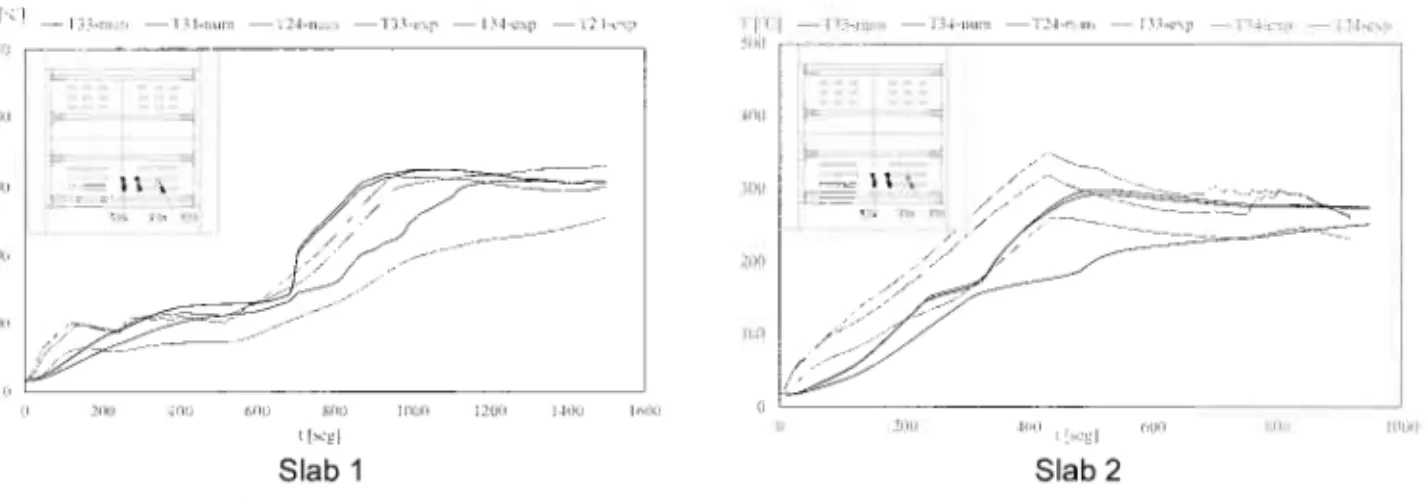
950s. Figure 2^presents the temperature evolution in locations near the rectangular perforations
for each slab. The numerical results are in good accordance with experimental results. Figure 3
shows the temperature field at the end of fire exposure for each slab, being the charred"layer
represented in grey colour. The criterion to determine the charred layer was applied to the last
time step and was compared with the experimental record obtained in each slab, allowing to
evaluate the residual cross section and the influence of different perforations on the"fire
performance ofwooden cellularslabs.
Slab 1
Slab 2
Figure 2: Temperature history in nodal positions compared with thermocouples.
The assessment of the charred layer allowed to verify that the cavity without perforations
presents the lowest values of charring rate, while the cavity with large perforations presents
highertemperatures values.t=1500s, Slab 1
t=950s, Slab 2
- t=1500s. Slab 1
Figure 3: Temperature ana charring rate results.
t=950s, Slab 2Table 1 presents a summary of the residual cross-sections and charring rates in different
cavities of the slabs according to the location identified in figure 4. At the end offire exposure,
cells without perforations dia not exceed 100°C at the ceiling levei, while cells with perforations
presented more than three times this value. Also, the charring rate value relationship between
the Perforated and non-perforated layers is almost double, which is justified by the temperatures
recorded within the cellular cavities of each slab. Results demonstrate the'importance of the
study in these type of structures ana the evaluation of the fire performance.
88
Jorge Meireles, Elza Fonseca, Paulo Piloto and Débora Ferreira
well as the effect of rectangular perforations into the residual cross section of the slab. This
study was conducted in accordance with European Standard EN 1365-2 [3] and using a fire
resistance furnace which complies the requirements of EN 1363-1 [4] in the
experimentart
est.2. METHODOLOGY
Figure 1 shows the geometric model considered in this work and the mesh used in numerical
simulation. The model considers a wooden slab with three different cellular-zones"and'"w'it"h
different rectangular perforations in the bottom layer (slab 1 and slab 2).
Figure 1: Geometry ofwooden slabs and numerical model.
A.,3D fínlte. elenlent. (sdid7,o) with. 8 nodes was used for n°nlinear transient thermal analysis,
using^Ansys^oftware.
Each wooden slab was exposed to fire, at the bottom surface,"duj
rin1500S and 950s, respectively. At the exposed' surface and internai-cellula7'c7vÍties"'th^
^pa?me^!. !empe.raturc fo"°ws real exPerimental curves, based on data obtainedduring test
?.absjLmeans, of plate thermocouP'es. The convection coefficient was-taken~equ;al7o
'K [5] inside cavities and in the exposed surface. In the unexposed surfaceYhe"ambient
temperaturewaskept,
constant (200 C) and the value ofconvectioncoefficrentwas"considered
equal to 4W/m-K [4]. The surface emissivity is taken constant and equal to 1,0
forcei
surfaces and internai cavities [5].
3. CONCLUSIONS
During the fire exposure, the insulation (l) criterion was verified, in both wooden slabs, since the
temperature. on the unexPosed surface did n°t increase either: a) fhe average"
above^he
in!tLala
verage temPerature by more than 140 °C or b)temperaturea7any"loca'tion"l
.
morethanl8
0°c
above .
the initial avera9e temperature[3]. The integrity (E)
criterÍonwasalso
ven.
fíedduringexperimental tests using the cotton Pad i9nition test whereno'flamei
appea,:a"nce
occurrcd-durin9 thewooden slabs testing [31- The temperature evolution was compare7w
experimental (T_exp) results, in particular different nodal positions (T_num) during^OOs and
Jorge Meireles, Elza Fonseca, Paulo Piloto and Débora Ferreira
950s. Figure 2^presents the temperature evolution in locations near the rectangular perforations
for each slab. The numerical results are in good accordance with experimental results. Figure 3
shows the temperature field at the end of fire exposure for each slab, being the charred"layer
represented in grey colour. The criterion to determine the charred layer was applied to the last
time step and was compared with the experimental record obtained in each slab, allowing to
evaluate the residual cross section and the influence of different perforations on the"fire
performance ofwooden cellularslabs.
Slab 1
Slab 2
Figure 2: Temperature history in nodal positions compared with thermocouples.
The assessment of the charred layer allowed to verify that the cavity without perforations
presents the lowest values of charring rate, while the cavity with large perforations presents
highertemperatures values.t=1500s, Slab 1
t=950s, Slab 2
- t=1500s. Slab 1
Figure 3: Temperature ana charring rate results.
t=950s, Slab 2Table 1 presents a summary of the residual cross-sections and charring rates in different
cavities of the slabs according to the location identified in figure 4. At the end offire exposure,
cells without perforations dia not exceed 100°C at the ceiling levei, while cells with perforations
presented more than three times this value. Also, the charring rate value relationship between
the Perforated and non-perforated layers is almost double, which is justified by the temperatures
recorded within the cellular cavities of each slab. Results demonstrate the'importance of the
study in these type of structures ana the evaluation of the fire performance.
88
Jorge Meireles, Elza Fonseca, Paulo Piloto and Débora Ferreira
cs, -~
Ct ^.cr> c=» .c=>
ca?^s ^3 *=i 'C3 C3 C=3
~F13]
C14] ca c=» caCisl 1=1 c=> afc, (l
C3 C3 CT>1
C1.C2.C3
c- te e. de t "g 'n ' j f
Ç4.C5
a p -ilc f^h = j ir
.Ct, C7. C8
a b ta «l ï, " ï. t
C»,C10.C11
h. :de '. ph* j k
CI2. C13
b .. ^fc Í ^h< ; ^
C1«,CI6,C1<
Figure 4: Cross-sections locations for charring rate measure. Table 1: Average measured charring rate.
Numerical charring rate
Experimental charring rate
Slab1
Slab2
C1, C2, C3, C9, C10, C11 - 1, 3mm/min 1, 2mm/min
iftssjir^jiíiiis s C4, C5, C12, C13 - 1,0mm/min M
a
C6, C7, C8, C14, C15, C16 - 1,4mm/min
Etíïa-C1, C2, C3, C9, C10, C11 -1, 3mm/min
S%Se}-íï
C4, C5, C12, C13- 0, 7mm/min
i^:i;;:;;:|i;tH!!if!ti
C6, C7, C8, C14, C15, C16- 1, 2mm/min
!T['F!, ;i-i!:'::y.ir-'i|j!!;|iU44.
4. ACKNOWLEDGMENTS
The authors gratefully acknowledge to Jular company, who provided technical and material
support for the wood slabs construction.
5. REFERENCES
[1] Fonseca E. M. M., Couto D., Piloto P.A. G. - Fire safety in perforated wooden slabs: a
numerícal approach, 5 Int. Conf. Safety and Security Eng., Vol. 134, 2013, p. 577-584.
[2] CEN, EN1995-1-2 - Eurocode 5: Design of timber structures - Part 1-2: Structural fire
design, Brussels, 2003.
[3] CEN, EN 1365-2 - Fire resistance teste for loadbearing elements. Part 2: Floors and roofs,
Brussels, 1999.
[4] CEN, EN1363-1 - Fire resistance teste - Part 1, General requirements, Brussels, 1999.
[5] CEN, EN1991-1-2 - Eurocode 1: Actions on Structures, Part 1-2: General actions - Actions
on Structures Exposed to Fire, Brussels, 2002.
90
IFireSS - International Fire Safety Symposium
Coimbra, Portugal, 20th-22nd April 2015
NUMERICAL EVALUATION OF THE BEHAVIOR OF PARTIALLY
ENCASED COMPOSITE BEAMS IN FIRE
Fábio Martin Rocha PhD Student
USP
Brasil
Jorge Munaiar Neto
Professor
USP
Brasil
Keywords: Composite Beams, Fire, Numerical Modelling, Partially Encased, Steel Beams.
1. INTRODUCTION
It is well known that the steel structures behaves badly when exposed to elevated temperatures.
This happens due to the steel elevated thermal conductivity ana the high slenderness of its
members, which favors the rise of temperature and accelerates the degradation of its
mechanical properties.
One solution to improve the behavior of the steel structures is fire is to use a concrete encasement as insulation, preventing the rise of the temperature in the steel members. The Eurocode 4 hás simplified methods to predict the fire resistance of partially encased steel
beams, but do not accounts for parameters such as the axial and rotational restraints. This
study consists in a series of numerical analysis of partially encased beams, similar to what is
presented in Figure 1, using a numeric model validated by experimental studies. It was
evaluated the influence of the beam span, section dimensions, degree of restraint, load factor