Editorial
Universidad
Cantabria
RESEARCH AND ADVANCED
TECHNOLOGY
RESEARCH AND ADVANCED
TECHNOLOGY
CONSEJO EDITORIAL Dña. Sonia Castanedo Bárcena
Presidenta. Secretaria General, Universidad de Cantabria D. Vitor Abrantes
Facultad de Ingeniería, Universidad de Oporto D. Ramón Agüero Calvo
ETS de Ingenieros Industriales y de Telecomunicaciones, Universidad de Cantabria D. Miguel Ángel Bringas Gutiérrez
Facultad de Ciencias Económicas y Empresariales, Universidad de Cantabria D. Diego Ferreño Blanco
ETS de Ingenieros de Caminos, Canales y Puertos, Universidad de Cantabria Dña. Aurora Garrido Martín
Facultad de Filosofía y Letras, Universidad de Cantabria D. José Manuel Goñi Pérez
Modern Languages Department, Aberystwyth University D. Carlos Marichal Salinas
Centro de Estudios Históricos COLMEX D. Salvador Moncada
Faculty of Biology, Medicine and Health, The University of Manchester D. Agustín Oterino Durán
Neurología (HUMV), investigador del IDIVAL D. Luis Quindós Poncela
Radiología y Medicina Física, Universidad de Cantabria D. Marcelo Norberto Rougier
Historia Económica y Social Argentina, UBA y CONICET (IIEP) Dña. Claudia Sagastizábal
IMPA (Instituto Nacional de Matemática Pura e Aplicada) Dña. Belmar Gándara Sancho
Editorial Universidad Cantabria
RESEARCH AND ADVANCED
TECHNOLOGY
IN FIRE SAFETY
Daniel Alvear
Research and advanced technology in fire safety [Recurso electrónico] / Daniel Alvear (ed.). – Santander : Editorial de la Uni -versidad de Cantabria, D.L. 2017.
419 p. : il. – (Difunde ; 237)
Otro título: FireSafety 2017
Comunicaciones presentadas en la International Conference on “Research and Advanced Technology in Fire Safety” FireSafety 2017, celebrada en la Universidad de Cantabria, Santander, los días 20 y 21 de octubre de 2017.
D.L. SA 739-2017. – ISBN 978-84-8102-832-4
1. Incendios-Prevención-Congresos. I. Alvear Portilla, Manuel Daniel, ed. lit. II. International Conference on Research and Ad -vanced Technology in Fire Safety (2017 : Santander)
614.841.3(063)
Esta edición es propiedad de Editorial de la Universidad de Cantabria; cualquier forma de reproducción, distribución, traducción, co -municación pública o transformación solo puede ser realizada con la autorización de sus titulares, salvo excepción prevista por la ley. Diríjase a CEDRO (Centro Español de Derechos Reprográficos, www.cedro.org) si necesita fotocopiar o escanear algún fragmento de esta obra.
© Daniel Alvear (ed.)
Compiled by: Mariano Lázaro, Orlando Abreu, Arturo Cuesta, David Lázaro, Alain Alonso, Adriana Balboa, Gemma Ortiz, Sonia Escalante, Pedro Lázaro
© Editorial de la Universidad de Cantabria Avda. Los Castros, 52. 39005 Santander Teléf. y Fax: 942 201 087
www.editorialuc.es
ISBN: 978-84-8102-832-4 (PDF) D. L.: SA 739-2017
i
Contents
Page
Contents...i
Preface ...iii
Método de cálculo para soportes de instalaciones frente a la acción del fuego en túneles ...1
Numerical Analyses of Pore Pressure Rise and Thermal Stress in Concrete Cylinders of Various Strengths during Fire Exposure ...21
An Experimental study on the Influence of compressive strength and water content of concrete on the occurrence of explosive spalling ...39
Performance in Fire of FRP-Reinforced Concrete Systems ...55
Modelling Human Behaviour in Escape and Evacuation Simulation ...69
Taking into account groups for evacuation analysis...85
Objective indices to evaluate Fire-fighter’s Cardiorespiratory State Based on Frequency Analysis of Heart Rate ...101
Framework for an integrated simulation system for Wildland-Urban Interface fire evacuation ...119
A Roadmap of WUI Fires Research Requirements: A Canadian Perspective ...135
Effect of air flow on the spread of forward and opposed smouldering combustion in biomass ...147
Emissions and Health Effects of Haze from Peat Fires ...159
Flame Spread Along Fences Near a Structure in a Wind Field ...173
A Study on Thermal Sensitivity of Sprinkler Heads for Residential Buildings ...189
An Analytical Hydraulic Model for Clean Agent Discharge ...201
Assessment of the predictive capabilities different modelling tools to forecast fire effects in residential compartments ...217
ii
Fire Performance of a Full-Scale Loaded Cold-Formed Steel Framed Assembly in a Large Scale Furnace
Test ...255
Balanced Summation model for the calculation of the buckling resistance of partially encased columns under fire: New improvements ...271
Performance Fire of Composite Columns Made from High and Normal Strength Concrete: influence of thermal and mechanical parameters ...289
The possible role of fire in the sinking of the Titanic - structural response of a steel bulkhead subjected to localised heating ...305
Prediction model for compartment effects on burning upholstered furniture ...315
Reaction-to-Fire Behaviour of Partial Quantities of Timber Surface Linings in Compartments ...331
Effects of boundary conditions variation on chemical reactions during STA measurements ...347
Revisión del modelado y simulación para la predicción de explosiones en incendios de espacios confinados ...359
On the operation of longitudinal ventilation systems in tunnels ...375
iii
P r e f a c e
These proceedings
include papers presented at the International Conference on “Research and
Advanced Technology in Fire Safety” FireSafety 2017 which took place at University of Cantabria,
Santander, Spain on October 20th-21st, 2017. During last decade, our research group organized
several on-day events and, in this sense, the success of this conference is a tribute for that continued
effort to exchange knowledge on this discipline.
We are very proud to have been able to attract experts from all parts of the world, which some of them
could also attend the Fall meeting of subcommittees 1, 3 and 4 of ISO TC92 Fire Safety hosted at
University of Cantabria. This congress represented such
an excellent “agora” for researchers and
engineers to present and discuss new and innovative approaches. In addition, this event was a unique
opportunity for Spanish-speaker scientific and technological community to receive them from top
references. The need for expertise in this field is also increasing in this geographical context and I feel
confident we were offering a leading forum for engineers, regulators and other stakeholders.
The papers selected by our Scientific Committee Board is a testament to the calibre of the research
that is on-going around the world. Unfortunately, we could not accept all the papers submitted for oral
sessions although we had a strong poster session to tackle interesting emerging research. Moreover,
two Invited Lectures abo
ut “PANIC IN FIRE EMERGENCIES: MYTH OR REALITY?” and
“TRAVELLING FIRES FOR STRUCTURAL DESIGN” were given by Prof. Dr. Daniel Nilsson,
Lund University (Sweden) and Prof. Dr. Guillermo Rein, Imperial College (UK) respectively.
iv
INTERNATIONAL CONFERENCE ONRESEARCH AND ADVANCED TECHNOLOGY IN FIRE SAFETY
(University of Maryland, USA), Dr. Guillermo Rein (Imperial College, UK), Dr. Weiguo Song
(University of Science and Technology, CHN), Dr. Stanislav I. Stoliarov (University of Maryland,
USA), Dr. Takeyoshi Tanaka (Kyoto University, JPN), Dr. José L. Torero (University of Maryland,
USA), Dr. Arnaud Trouve (University of Maryland, USA), Dr. Patrick Van Hees (Lund University,
SWE), Dr. Collen Wade (Branz, NZL), Dr. Koichi Yoshida (Yokohama National University, JPN),
whose scientist, contribution has allowed to reach an Advanced Research Workshop with the highest
quality.
We want to express our gratitude to the authors and speakers who have dedicated their time and effort
in presenting their experiences, methodologies and scientist - technical advances in the International
Conference.
Finally, I would like to thank our event partners and collaborators (Government of Cantabria, City of
Santander, University of Cantabria, Simulsoft- Mass Motion, Grupo KOMTES, NTCI, and NEFTAL)
for their cooperation and help.
Prof. Daniel Alvear
Congress Chairman
GIDAI
–
Fire Safety
–
Research and Technology
Universidad de Cantabria
405
Protected and Unprotected Cellular Wooden Slabs at
Elevated Temperatures
Gabriel N S Costa 1, Elza M. M. Fonseca 2, Laercio J. Junior 3
1 Master in Industrial Engineering, Polytechnic Institute of Bragança, 5300-253 Bragança, Portugal. 2 LAETA, INEGI, Polytechnic Institute of Bragança. 5300-253 Bragança, Portugal.
3 Universidade Federal Técnologica do Paraná – UTFPR, Brasil.
ABSTRACT
The aim of this work is to present a numerical approach, based on finite element method, to
predict the thermal assessment in protected and unprotected cellular wooden slabs, externally
exposed to fire, using the standard ISO 843 curve. All numerical calculations will be
performed to determine the wood residual cross-section and to determine the fire resistance
with the use of insulation materials. These type of elements have several applications in
building construction, as walls, ceilings and floors. All requirements according standards
(Eurocode 5) were conducted to determine the non-linear thermal properties of the wood
material and the proposed charring rate, to be compared analytically. In this study, it is
important to determine the type of insulation material (properties and geometries) for
guarantee a fire time resistance in cellular wooden slabs. All developed numerical study will
contribute to the knowledge in these elements, where the wood material represents a complex
behaviour in fire situations and the cavities inside the slabs represent a great problem for
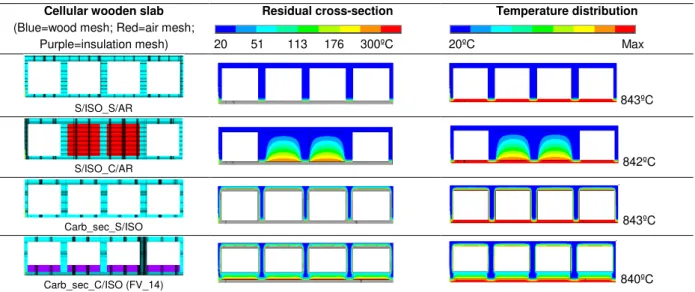
intensify the heat conduction, fig. 1. The numerical problem includes all boundary conditions,
including a new proposal for the use of the standard ISO 843 curve inside the slab cavity after
the char layer occurrence in the wood. The proposed methodology could be used to study
others cellular wooden slabs, to assess and contribute for a safe design.
Cellular wooden slab (Blue=wood mesh; Red=air mesh;
Purple=insulation mesh)
Residual cross-section
20 51 113 176 300ºC
Temperature distribution
20ºC Max
S/ISO_S/AR 843ºC
S/ISO_C/AR 842ºC
Carb_sec_S/ISO 843ºC
Carb_sec_C/ISO (FV_14) 840ºC
Fig. 1. Numerical cellular wood slabs, 1860s