UNIVERSIDADE DA BEIRA INTERIOR
Engenharia
Evaluation of Numerical Variable Density
Approach to Cryogenic Jets
Eduardo Luís Santos Farias Antunes
Dissertação para obtenção do Grau de Mestre em
Engenharia Aeronáutica
(2º ciclo de estudos)
Orientador: Professor Doutor Jorge Manuel Martins Barata
iii
Agradecimentos
Quero agradecer ao meu orientador, Professor Doutor Jorge Manuel Martins Barata, pelas excelentes aulas de Propulsão 1 onde aprendi muito e ganhei ainda maior paixão pela área, pela oportunidade que me deu de trabalhar com ele e pelo enorme conhecimento, ajuda e encorajamento que me prestou.
Quero agradecer ao Professor Doutor André Resende Rodrigues da Silva, pela ajuda e apoio que me prestou durante a execução desta tese principalmente na documentação e apoio bibliográfico.
Quero agradecer ao Engenheiro Fernando Manuel Silva Pereira Neves pela disponibilidade, apoio e encorajamento que me prestou principalmente durante a minha fase de
aprendizagem.
Quero agradecer a todos os meus amigos e colegas, pelo apoio moral, encorajamento e conhecimento que me prestaram durante todo o meu percurso académico.
Por último, mas não menos importante, quero agradecer a toda a minha família, em especial, aos meus pais e irmã por sempre me terem apoiado e acreditado em mim
incondicionalmente.
Eduardo Antunes Covilhã 2011
v
Resumo
O presente trabalho dedica-se ao estudo de jactos de azoto líquido criogênico em condições subcríticas perto do ponto crítico. A injecção de combustível é um dos maiores desafios actuais na engenharia de motores diesel, turbinas de gás e motores de foguete, com a complexidade extra de nestes últimos se combinar também a injecção de comburente. É amplamente conhecido que o aumento das pressões e temperaturas de operação aumenta a eficiências dos motores e reduz o consumo específico. Assim, existe a tendência de um aumento generalizado das pressões de operação em motores modernos. No entanto elevadas pressões de operação na câmara de combustão têm como consequência a exposição dos fluidos a condições que excedem os valores críticos. Vários autores concluíram que nestas condições os fluidos injectados sofrem variações nas suas propriedades que levam a que os modelos tradicionais de escoamentos com duas fases não consigam modelar correctamente o comportamento do jacto, assim são precisos novos modelos computacionais para estas condições específicas. Barata et al. [18] realizaram uma investigação numérica com o intuito de avaliar a aplicabilidade do modelo de gases de densidade variável em jactos líquidos em condições sub e supercríticas. Os resultados de Barata et al. [18] revelaram uma boa concordância com os dados experimentais, mas apenas foram consideradas razões de densidade intermédias de 0.05 a 0.14. O objectivo do presente trabalho é o de estender as investigações de Ref. 18 a razões de densidades mais baixas entre 0.025 e 0.045 que correspondem a casos de pressões subcríticas da câmara de injecção e determinar o limite de aplicabilidade do modelo de gases de densidade variável. Os resultados obtidos estão em concordância com os dados experimentais e numéricos obtidos por Chehroudi et al. apresentados em Ref. 18. Neste trabalho verificou-se também que o modelo computacional usado não oferece resultados validos para razões de densidade abaixo de 0.025 identificando-se assim o limite de aplicabilidade do modelo de gaidentificando-ses de densidade variável.
Palavras-chave
Injecção de combustível; ponto crítico; condições supercríticas; motores foguete; motores diesel; razão de densidades; jactos; densidade variável.
vii
Resumo alargado
A injecção de combustível apresenta-se como um dos maiores desafios actuais da engenharia em motores diesel, turbinas de gás e foguetes, sendo que neste ultimo caso se acrescenta ainda a complexidade extra da injecção combinada de oxidante. Estudos experimentais e numéricos efectuados para vários tipos de motores têm vindo a demonstrar que o aumento da pressão de funcionamento dos mesmos aumenta bastante a sua eficiência e reduz o consumo específico. Assim antevê-se que seja de todo o interesse a continuação do aumento das pressões de operação dos motores, o que, com o aparecimento de materiais inovadores mais resistentes, faz crescer ainda mais esta tendência.
No entanto, o aumento da pressão de funcionamento leva a que se atinjam e se ultrapassem os pontos críticos de pressão e temperatura dos líquidos e gases envolvidos. Como exemplos, a câmara de combustão do motor principal do Space Shuttle atinge uma pressão de 22.3 MPa enquanto no motor Vulcain, usado no Ariane 5, se registou um valor recorde de 28.2 MPa [1]. Em qualquer dos casos as pressões na câmara de combustão ultrapassam a pressão critica de Pcr = 5.043 MPa para o oxigénio liquido e Pcr = 1.28 MPa do
hidrogénio liquido. Também em motores diesel a câmara combustão pode em alguns casos atingir o dobro da pressão crítica. Para aplicações em motores foguete a temperatura inicial do oxigénio injectado está abaixo do valor crítico (Tcr = 154.58 K), mas assim que este entra
na câmara de combustão passa por uma transição na qual atinge temperaturas supercríticas. Nestas condições diz-se que o combustível (ou comburente líquido) está em condições supercríticas e o seu estado físico passa a ser denominado de estado fluido [1]. Á medida que o fluido alcança condições de pressão e temperatura que ultrapassam os valores críticos, o fluido passa por alterações significativas nas suas propriedades. A difusibilidade mássica efectiva, a tensão superficial e o calor latente do líquido desaparecem em condições supercríticas. Por outro lado, o calor específico a pressão constante, Cp, a compressibilidade
isentrópica, κs, e a condutividade térmica, λ, tornam-se infinitos [2]. Estas mudanças de
comportamento do fluido fazem com que os tradicionais modelos de escoamentos com duas fases não possam ser aplicados em injecções de combustível em condições supercríticas. Desta forma, nasce a necessidade de desenvolver novos modelos computacionais que possam ser correctamente aplicado à injecção de combustível em condições supercríticas.
Vários autores investigaram a injecção de combustível em condições supercríticas tanto experimentalmente como numericamente [3-22]. As primeiras investigações experimentais realizadas tinham como principal objectivo o estudo da estrutura visual do jacto, sem a obtenção de quaisquer resultados quantitativos [1, 6]. Estas investigações verificaram que a estrutura do jacto se alterava significativamente com o aumento da pressão. Primeiro a redução da tensão superficial leva à formação de ligamentos no jacto e de gotas de fluido que se separam da estrutura principal do jacto, um aumento maior da pressão da câmara de injecção para condições supercríticas conduz a uma estrutura do jacto semelhante àquela que
viii
seria visível numa injecção de um gás num ambiente também gasoso. Trabalhos experimentais mais recentes levaram a cabo estudos quantitativos nos quais foram obtidos resultados sobre o ângulo de abertura do jacto, densidade e temperatura [4, 7, 15, 16]. Estes resultados quantitativos experimentais permitem a comparação com os resultados obtidos em estudos numéricos e através da comparação é feita a validação destes mesmos modelos numéricos [17-22].
Barata et al. [18] realizou uma investigação inicial com o objectivo de avaliar as capacidades de um modelo computacional desenvolvido para escoamentos incompressíveis mas com densidade variável quando aplicado a condições supercríticas. Os resultados alcançados mostram ser concordantes com os dados experimentais, no entanto, nesta investigação apenas foram considerados razões de densidade intermédias de 0.05 a 0.14. O presente trabalho teve como principal objectivo estender a investigação da Ref. 18 a menores razões de densidade e definir qual o limite mínimo de razão de densidade para o qual se podia aplicar o modelo de escoamento incompressível mas com densidade variável. Para isso testaram-se diferentes razões de densidades abaixo de 0.05. Testaram se as razões de densidade ω = 0.010, 0.015, 0.020, 0.025, 0.035 e 0.045. Para estas razões de densidades obtiveram-se os campos escalares e da velocidade, gráficos da variação axial da densidade na linha central, do decaimento axial de velocidade na linha central e finalmente da metade da largura do meio da velocidade máxima (HWHMV) o qual permitiu determinar a tangente do ângulo de abertura do jacto.
A analise dos gráficos permitiu concluir que o modelo de gases de densidade variável resultados bastante concordantes com outros trabalhos para razões de densidades de 0.025 a 0.045. No entanto definiu-se que o modelo deixa de ser aplicável para razões de densidade inferiores a 0.025.
Um breve estudo, sobre a influência da velocidade de injecção sobre o comportamento obtido para o jacto no presente modelo, concluiu que a velocidade de injecção influência os resultados obtidos sobre o comportamento do jacto e desta forma deve ser um parâmetro a ter em conta.
ix
Abstract
The present work is devoted to study cryogenic nitrogen jets in high subcritical conditions. Fuel injection is one of the great challenges in engineering of diesel engines, gas turbines and rocket engines, combining in the last one also the injection of oxidizer. It is widely known that the increase of operation pressures and temperatures increases engine efficiency and reduces fuel specific consumption. Thus, it is a general trend in modern engines the operation in increasingly higher pressures. However at higher chamber pressures the injected fluids may experience ambient conditions exceeding the critical values. Several authors stated that at these conditions the injected fluids suffers a change of its properties, and the traditional two-phase flow models cannot correctly predict the jet behavior at these conditions, thus new computational models are needed for these specific conditions. Barata et al. [18] performed a numerical investigation aimed to evaluate the applicability of an incompressible but variable density model in liquid jets under sub-to-supercritical conditions. The results achieved agree well with the experimental data but they only considered intermediate density ratios from 0.05 to 0.14. The objective of the present work was to extend the investigation of Ref. 18 to lower density ratios from 0.025 to 0.045 which correspond to cases with subcritical chamber pressures. The obtained results agree well with the experimental and numerical data of Chehroudi et al. presented in Ref. 18. It was also found in this work that the computational model does not offers valid results for density ratios bellow 0.025, thus identifying the limit of applicability of model.
Keywords
Fuel injection; critical point; supercritical conditions; rocket engines; diesel engines; density ratio; jets; variable density.
xi
Index
Agradecimentos ... iii
Resumo ... v
Resumo alargado ... vii
Abstract ... ix
Index ... xi
Figures list ... xiii
Tables list ... xv
Nomenclature ... xvii
X/D
= axial distance normalized by injector diameter ... xvii
Acronyms List ... xix
Chapter 1 ... 1
Introduction ... 1
Chapter 2 ... 19
Mathematical Model ... 19
2.1 Governing Equations ... 19
2.2 Numerical Method ... 21
2.3 Boundary Conditions ... 21
Chapter 3 ... 23
Results and Discussion ... 23
Introduction ... 23
3.1 Study of the density ratio influence ... 24
3.1.1 Velocity and scalar fields for ω = 0.025, 0.035 and 0.045 ... 26
3.1.2 Axial variation of centerline density for ω = 0.025, 0.035 and 0.045
... 33
3.1.3 Centerline velocity decay for ω = 0.025, 0.035 and 0.045 ... 37
3.1.4 Half width of half maximum of the velocity for ω = 0.025, 0.035 and
0.045 ... 42
3.1.5 Centerline velocity and density decay rate at various
chamber-to-injectant density ratios ... 46
3.1.6 Tangent of the spreading angle at various chamber-to-injectant
density ratios ... 47
xii
3.2 Study of the injection velocity influence ... 50
3.2.1 Velocity and scalar fields for U
in= 5, 10 and 20 m.s
-1... 51
3.2.2 Axial variation of the centerline velocity for U
in= 3, 5, 10 and 20
m.s
-1... 55
3.2.3 Centerline velocity decay for U
in= 3, 5, 10 and 20 m.s
-1... 56
3.2.4 Half width of half maximum of the velocity for U
in= 3, 5, 10 and 20
m.s
-1... 58
Chapter 4 ... 61
Conclusion ... 61
References ... 63
Attachment 1...
Attachment 2...
Attachment 3...
xiii
Figures list
Figure 1– LN2 injection in GN2 at a) 4.0, b) 3.0 and c) 2.0 MPa [6]. ... 9
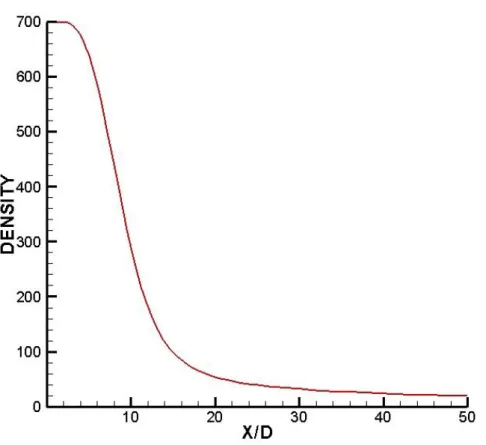
Figure 2 - Software magnified images of the jet at its outer boundary showing the transition to the gas-jet like appearance, starting at just below the critical pressure of the injected fluid. Images are at a fixed supercritical chamber temperature of 300 K [1]. ... 11 Figure 3 - Flow configuration ... 22 Figure 4 - Velocity and scalar fields of the jet with a density ratio of ω = 0.025 and a chamber pressure of Pr = 0.583, (a) Velocity vectors, (b) Mixture fraction contours, (c) Density contours. ... 26 Figure 5 - Velocity and scalar fields of the jet with a density ratio of ω = 0.035 and a chamber pressure of Pr = 0.642, (a) Velocity vectors, (b) Mixture fraction contours, (c) Density contours. ... 28 Figure 6 - Velocity and scalar fields of the jet with a density ratio of ω = 0.045 and a chamber pressure of Pr = 0.825, (a) Velocity vectors, (b) Mixture fraction contours, (c) Density contours. ... 30 Figure 7 - Axial variation of the centerline density with a density ratio of ω = 0.025 and a chamber pressure of Pr = 0.583. ... 33 Figure 8 - Axial variation of the centerline density with a density ratio of ω = 0.035 and a chamber pressure of Pr = 0.642. ... 34 Figure 9 - Axial variation of the centerline density with a density ratio of ω = 0.045 and a chamber pressure of Pr = 0.825. ... 35 Figure 10 - Axial variation of the centerline density in a logarithmic scale for the cases 1, 2 and 3. ... 36 Figure 11 - Centerline velocity decay for a density ratio of ω = 0.025 and a chamber pressure of Pr = 0.583. ... 37 Figure 12 Centerline velocity decay for a density ratio of ω = 0.035 and a chamber pressure of Pr = 0.642. ... 38 Figure 13 Centerline velocity decay for a density ratio of ω = 0.045 and a chamber pressure of Pr = 0.825. ... 39 Figure 14 - Centerline velocity decay for the cases 1, 2 and 3 of Table 1. ... 41 Figure 15 - Half width of half maximum of the velocity for a density ratio of ω = 0.025 and a chamber pressure of Pr = 0.583. ... 42 Figure 16 - Half width of half maximum of the velocity for a density ratio of ω = 0.035 and a chamber pressure of Pr = 0.642. ... 43 Figure 17 - Half width of half maximum of the velocity for a density ratio of ω = 0.045 and a chamber pressure of Pr = 0.825. ... 44 Figure 18 - Half width of half maximum of the velocity for the cases 1, 2 and 3 of Table 1. . 46
xiv
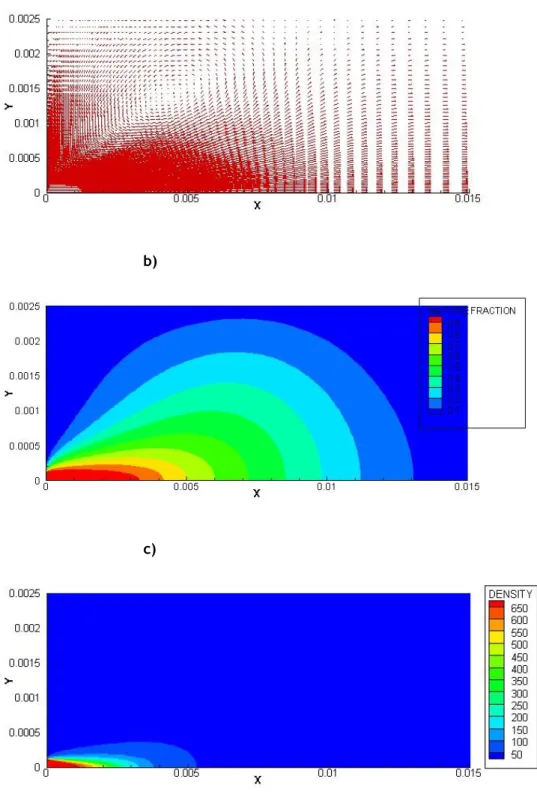
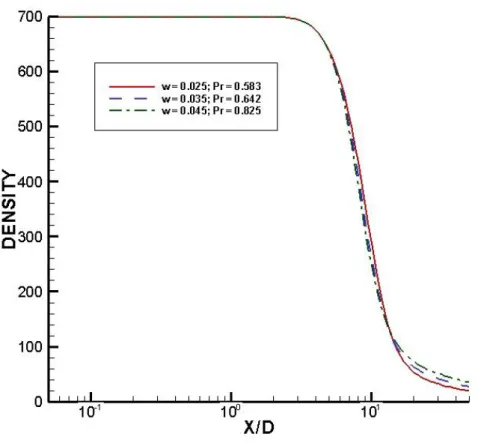
Figure 19 – Decay rate of the centerline velocity and density. ... 47 Figure 20 - Tangent of the spreading angle versus the chamber-to-injectant density ratio. .. 48 Figure 21 - Tangent of the spreading angle versus the chamber-to-injectant density ratio and representation if limit of applicability of the Variable Density approach. ... 49 Figure 22 - Velocity and scalar fields of the jet with a density ratio of ω = 0.025 and an injection velocity of Uin = 5 m.s-1, (a) Velocity vectors, (b) Mixture fraction contours, (c)
Density contours. ... 51 Figure 23 - Velocity and scalar fields of the jet with a density ratio of ω = 0.025 and an injection velocity of Uin = 10 m.s-1, (a) Velocity vectors, (b) Mixture fraction contours, (c)
Density contours. ... 52 Figure 24 - Velocity and scalar fields of the jet with a density ratio of ω = 0.025 and an injection velocity of Uin = 20 m.s-1, (a) Velocity vectors, (b) Mixture fraction contours, (c)
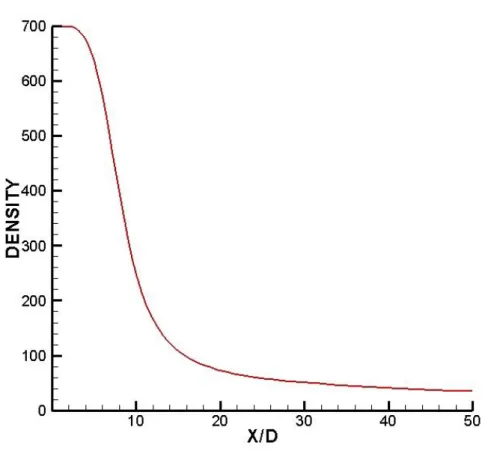
Density contours. ... 53 Figure 25 - Axial variation of the centerline density for the cases 4, 5, 6 and 7 of the Table 2. ... 55 Figure 26 - Centerline velocity decay for the cases 4, 5, 6 and 7 of the Table 2. ... 56 Figure 27 - Half width of half maximum of the velocity for the cases 4, 5, 6 and 7 of the Table 2. ... 58
xv
Tables list
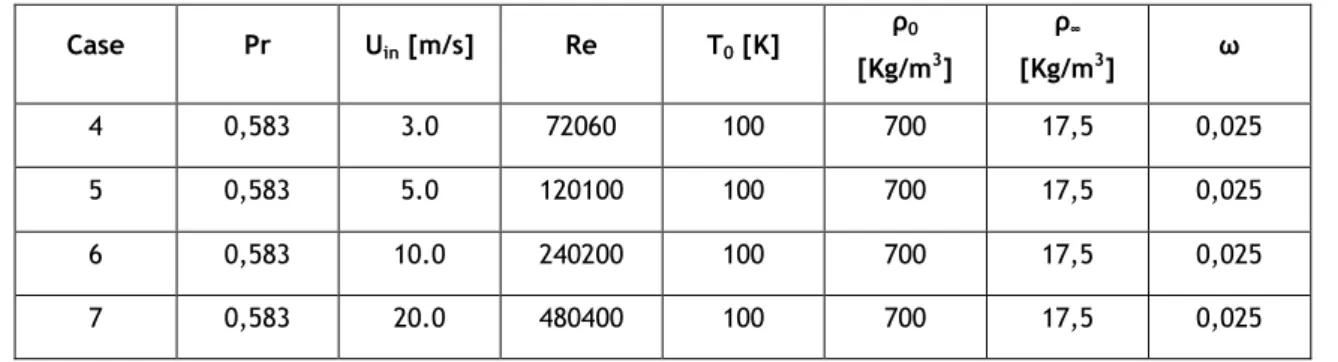
Table 1. Summary of test conditions ... 22 Table 2. Summary of test conditions for the injection velocity study ... 22
xvii
Nomenclature
B = transfer number
βv = evaporation rate
Cμ = coefficient in turbulence model
d0 = initial droplet diameter
d = droplet diameter
D = injector diameter [m], normalized droplet diameter (d(t) / d0)
ε = dissipation rate of turbulent energy
f = mixture fraction
F = mean mixture fraction
i = axial direction index
j = radial direction index
k = turbulent kinetic energy
ϕ = generalized variable
ω = chamber-to-injection fluid density ratio (ρ∞/ρ0)
Pcr = critical pressure [MPa]
P∞ = chamber ambient pressure [MPa]
Pr = reduced pressure (P∞/Pcr)
ρ = density [kg.m-3]
ρ0 = injected fluid density [kg.m-3]
ρ∞ = injection chamber’s fluid density [kg.m-3]
r = radial coordinate [m]
R/D = radial distance normalized by injector diameter
Rdiam = injector radius [m]
Re = Reynolds Number
Sϕ = source term
t = time [s]
T = temperature [K]
u = axial velocity [m.s-1]
U = mean axial velocity [m.s-1]
Uin = injection axial velocity [m.s-1]
v = radial velocity [m.s-1]
vt = turbulent kinematic viscosity
V = mean radial velocity [m.s-1]
X = axial coordinate [m]
xix
Acronyms List
NIST National Institute of Standards and Techonology SPT Standard conditions for temperature and pressure
1
Chapter 1
Introduction
Fuel injection presents itself as one of the great challenges in engineering of diesel engines, gas turbines and rocket engines, combining in the last one also the injection of oxidizer. It is widely known that the increase of operating pressure and temperatures in combustion chamber, or thrust chamber in rocket engines, leads to an increase of engine efficiency, reducing this way the fuel consumption.
Thereby is a general trend in new engine designs to operate in increasingly higher chamber pressures and temperatures. Also the appearance of new and more resistant materials is other reason that could make grow this tendency. As a result of these increasingly higher pressures, the injected fluids may experience ambient conditions exceeding the critical values. As an example of particular interest in rocket engines, the liquid-H2/liquid-O2 space shuttle main engine combustion chamber pressure is about 22.3
MPa, while the combustion chamber pressure for the Vulcain engine (used on the Ariane 5) with the same propellants can reach up to a record value of 28.2 MPa [1]. Both these pressure values are well above of the Hydrogen and Oxygen critical values, which for comparison are: H2 (32.94K; 1.28Mpa) and O2 (154.6K; 5.04Mpa). Also in diesel engines the combustion
chamber can in some cases achieve a pressure twice the critical value. At these conditions the liquid fuel is on supercritical conditions and its physical state is named generally as "fluid" [2].
Several studies about the behaviour of fluid injection have been conducted and verified that the behaviour of liquids in critical, transcritical and supercritical conditions is not the same that is verified in more generic subcritical case, which was exhaustively treated and reported in existing, extensive literature. In this manner it seems of great interest the experimental and computational treatment of the supercritical case with the objective of understand, simulate and predict, in the most correct manner, the behaviour of injected fuel in surrounding environments where the pressure and temperature conditions are greater than the critical values for the injected fuel.
The main objective of the present work is to evaluate the performance of conventional computational methods for the prediction of single phase jets in supercritical conditions and the hypotheses of treating them as variable density gaseous jets instead of droplet sprays valid for subcritical conditions. This work is mostly dedicated for application on the analysis of the fuel injection process in liquid rocket engines.
In order to analyse the injection process in critical, transcritical and supercritical conditions is important to understand physical properties linked to these states and so, in the
2
present revision will be given some emphasis to the understanding of behaviour of liquids and droplets evaporation prior to the treatment of the supercritical injection’s itself.
Supercritical conditions are defined as the ones which the values of pressure or temperature, or even the junction of both, are greater that the critical values for a liquid or gas.
The critical point is described as a thermodynamic singularity, in this conditions the fluids characteristics suffers a significant change. The effective mass diffusivity, the surface tension and the latent heat of the liquid all vanish in critical conditions. On the other hand, the heat capacity at constant pressure, Cp, the isentropic compressibility, κs, and the thermal
conductivity, λ , all become infinite [2]. The fact of the non existence of latent heat causes that, to vaporize the liquid no heat needs to be added, and thus, there isn’t vaporization heat. This conclusion was also defended by Yang [3]. Bellan [2] considers that it is incorrect to talk about vaporization with values of pressure and temperature above the critical ones, and suggests the term of "emission". She also considers in his work that what truly defines the supercritical state is the impossibility of a two-phase region. In these conditions there is no separation between the liquid and the gas, and the substance should be named as fluid, as also argued by Segal and Polikhov [4]. Oschwald M et al. [5] considers in their work that, in supercritical conditions, the addition of more heat does not conduct to a temperature augmentation, instead, all heat is converted in a rise of specific volume. An experimental work on injection of cryogenic fluids in hot fire conditions and could-flow conditions performed by Mayer et al. [6] concludes that increasing pressure at first reduces surface tension and a further increase in pressure through critical condition causes a complete vanish of the surface tension. Also the experimental work conducted by Chehroudi B et al. [7] reaches the conclusion that is evident the reduction of surface tension and enthalpy of vaporization as the critical pressure is achieved.
Another observation made by Bellan [2] is that the Navier–Stokes equations become increasingly invalid as the critical point is approached, and therefore any model of the critical/transcritical regime using the Navier–Stokes equations must be carefully scrutinized for inconsistencies.
In supercritical conditions, a clear bound between the injected liquid and the surrounding gas [4] vanishes, but the values of density to distinguish between injected liquid and the surrounding gas, it’s of maximum relevance for supercritical models [5].
3
In the study of liquid droplets under supercritical conditions it is important to understand individually the effects of supercritical conditions in fluid properties by facilitating the distinction between the effects caused by supercritical conditions, and those due to other causes not necessarily linked to the supercritical state.
One of the most commonly studied cases for supercritical condition is the one of evaporation and emission of single liquid droplets. This kind of studies has the objective of determinate the processes that a liquid droplet encounter when mixing with the ambient gas and also to determine the mixing rate. Knowing the evaporation/emission rate of a liquid droplet is a very important information because this allows to determinate the droplet lifetime, the travelled distance for example in a combustion chamber, the time of the combustion and also the ignition delay, and all of this information is of the most relevance in the project of combustion chambers for engines and their respective injection systems. Givler S.D. and Abraham J. [8] elaborated a revision about the several studies, conducted in the subjects of vaporization and droplets combustion under supercritical conditions, in which they describe the various conclusions achieved. One of the reached conclusions is that, despite its enormous importance for the modeling of combustion in sprays, until the paper’s date (1996) there was not any published study about the interaction effects of multiple droplets in supercritical regime combustion. The same thing is not valid for the study of single droplets. A comparison is made in this work between the subcritical and the supercritical case. One of the conclusions achieved is that the droplet mixture process goes through two different stages. One initial transient stage in which the fluid droplet undergoes a temperature increase resulting from the fact of being in a higher temperature environment. The second stage of the process is one where the droplet temperature is constant and uniform, having reached the thermal equilibrium. At this stage the droplet is in quasi-steady regime at a temperature slightly below the boiling point and all the heat transferred to the droplet will be associated with the evaporation of more fluid quantity from the droplet. These two stages described before are always seen in the subcritical case. It was also verified that in the subcritical case, especially under low pressure conditions, the transient stage has a significantly small duration when compared with the quasi-steady stage. At these conditions, by neglecting the transient stage, the droplet evaporation rate obeys to the square diameter evaporation law, often simply referred as “D2 Law”, and is correctly
described by the next expression:
(1)
Where d0 is the initial droplet diameter, t is the time and is the evaporation rate constant
4
With: ρ = density;
D = normalized droplet diameter (d(t) / d0);
B = transfer number.
During these quasi-steady conditions the droplet is referred as being in a “wet-bulb state”. The subcritical evaporation at low temperature is correctly described by the previous expression, as mentioned before. However, when ambient conditions approach critical values of pressure and temperature is observed that the transient stage suffers an increase in duration. In addition it is also observed that the evaporation begins to occur in this stage and not only in the quasi-steady stage. In the opposite to what happens in the quasi-steady stage, in the transient stage the droplet temperature is neither constant nor uniform and the D2 Law
can’t be applied. Therefore, this law doesn't describe the first stage of the evaporation process and can only be used to describe the second stage. This leads to values increasingly deviating from the experimental values when ambient conditions approach the critical conditions. As a consequence, many works described by Givler and Abraham [8] focused on the study of evaporation/emission to the transcritical and supercritical cases. In this kind of studies it becomes important to distinguish between those performed in normal gravity conditions and others performed in micro-gravity conditions. The gravity is an important factor for the evaporation/emission studies because it is responsible for the buoyancy and convective effects. These effects have great influence in droplets evaporation/emission rate leading to its rise, and it becomes more difficult to conclude which physical phenomena are effectively responsible to an evaporation/emission rate variation and the way how it happens. Thus, it’s interesting to conduct studies in microgravity conditions where the buoyancy and convective effects are minimized and it is easier to observe the direct changes in evaporation/emission rate caused by ambient pressure and temperature variations [2, 8]. With microgravity conditions Bellan [2] refers that higher pressures leads to a duration increase of the heating transient stage, which leads to a deviation from the D2 linear model.
In order to explain this deviation, several studies cited by Bellan [2] were performed with the objective of determining the droplet lifetime. These studies concluded that the temperature rise leads always to a decrease in the droplet lifetime. This is a logic and easy to understand conclusion, but the dependence of the droplet lifetime with pressure variations is not so easily understandable. It was found that the dependence relatively to the pressure varies
5
with the temperature. So, for a temperature above about 1.2 times the critical temperature ( ) the pressure rise leads to a monotonous decrease of the droplet lifetime. As for temperatures below about 0.8 times the critical pressure ( ) the droplet lifetime increases with the pressure increase. Some authors also suggest that there might be a temperature at which the droplets lifetime is independent of pressure (see Bellan [2]). However, it should be pointed out that the studies done in microgravity conditions must be carefully analyzed since, even with gravity values as low as 10-2 in parabolic flights and 10-3
for experiences performed in drop towers, the buoyancy and convective effects are still present. Givler and Abraham [8] refer in their work that the experimental observations under conditions of microgravity are inconclusive, but their work was performed 5 years earlier that the one made by Bellan [2].
Zhang et al. [9] made a computational work using a numerical model that include the high pressure transient effects, temperature and pressure dependent variable thermo-physical properties in the gas and the liquid phases and the solubility of inert species in the liquid phase, for a moving n-heptane droplet evaporation in a zero-gravity nitrogen environment. The unsteady equations of mass, species, momentum and energy conservation in axisymmetric spherical coordinates are solved using the finite-volume and SIMPLEC methods. The axisymmetric numerical model has been thoroughly validated against the extensive microgravity experimental data of Nomura et al. [10], in a work also referenced by Bellan [2] and Givler and Abraham [8].
In this work [10] it was noted that in high pressure environments the droplet is at a transient phase during all its lifetime, never reaching the quasi-steady phase of constant and uniform temperature. It was also verified that the increase of pressure is responsible for a decrease of droplet penetration distance and a rise in evaporation/emission rate.
As previously referred, studies of droplets evaporation/emission at normal gravity conditions have reported a problem of convection and buoyancy phenomena interference on the analysis of the direct effects of pressure and temperature on the evaporation/emission rate. However, smaller technical difficulties in the execution of these studies lead to more consistent results between different experiences. Studies reviewed by Bellan [2] indicate that for low pressure environments the emission rate obeys to the D2Law. However, as the
pressure increases, it becomes more difficult to fit the obtained experimental results in the D2Law. It is known that the convection effects increase with the pressure and it becomes
difficult to understand if the observed variation in emission rate comparatively to the D2Law
is due to the thermodynamic mechanisms, to the fluids mechanic (through convective effects) or to the combination of both.
Givler and Abraham [8] also refer that Tsue et al. [11] had conducted one of the most remarkable experimental investigations about droplets supercritical vaporization, by achieving in all ambient conditions quasi-steady droplets vaporization. In agreement with previous studies, they concluded that the vaporization rate increases with ambient pressure. It is however concluded that the vaporization rate achieves a maximum and then decreases
6
with further increases in ambient pressure. The experimental studies conducted with normal gravity by Givler and Abraham [8] agree that a higher ambient pressure corresponds to a vaporization rate increase. The final conclusions of the previous authors indicate that for subcritical and supercritical conditions with normalized pressure and temperature below to 2, both transient and quasi-steady phases exist, indicating that for some supercritical conditions the quasi-steady model may be acceptable. However, for supercritical conditions where normalized pressure and temperature are above 2 all the emission process is made at the transient phase and in this situation the quasi-steady model is not applicable. Finally, it is concluded that for supercritical pressure and temperature the droplet lifetime decreases when the temperature increases.
A numerical investigation of n-heptane droplet evaporation in nitrogen under transient and supercritical conditions, performed by Zhu and Aggarwal [13] reached similar conclusions. It was used a Lagrangian-Eulerian numerical method and were measured the density, latent heat, mole fraction, gas compressibility factor and the droplet lifetime. They concluded that droplet heat up time increases and becomes a more significant part of the droplet lifetime when the ambient pressure rises. As the droplet surface reaches a critical mixing point the latent heat of vaporization decreases and drops to zero. They also concluded that the droplet lifetime behavior it’s not linear, and at low and moderate ambient temperature the droplet lifetime increases with pressure. However, at higher pressures, for temperatures of 500 and 700K, the droplet lifetime decrease with pressure. With higher temperatures the droplet lifetime also decreases with pressure. Finally Zhu and Aggarwal [13] concluded that when the droplet surface approaches the critical mixing state, the difference between the gas and liquid phases disappears.
Fieberg et al. [12] conducted an experimental and numerical work about fuel droplet evaporation under high pressure and temperature. They studied temperatures between 300K and 500K and the pressures between 0.1MPa and 3.7MPa. For the experimental work the Phase Doppler Anemometry (PDA) technique was used and for the numerical work the FLUENT 6.0 CFD program. They measured the evaporation time, the surface temperature, the droplet diameter and the drag coefficient. It was also taken into account the effects of interaction between droplets in droplet chains. The conclusions reached in this work are that during the evaporation, the boundary layers increase because of the rapid diameter reduction and the exchange process between droplet surface and the adjacent gas phase slows down. Droplet deceleration in a droplet chain is much smaller compared to a single droplet, indicating that when injecting a group of droplets the penetration length should be much bigger than when injecting only one droplet. However, the burning rate of a single droplet is higher because of the existence of more available oxygen. For the experimental conditions the numerical results show that evaporation calculations in engine applications using quasi-steady modelling of the gas phase are valid even for supercritical conditions and produce acceptable errors compared to a fully transient calculation agreeing this way with the conclusions achieved by Givler and Abraham [8] that for some supercritical conditions the quasi-steady model is still
7
valid. Since the evaporation takes place in a spray plume, the surrounding gas is cooled below the critical temperature and only a small number of droplets evaporate under supercritical conditions. The effect on the whole spray is thus further reduced.
The study of sprays and jet injection into gaseous environments at high pressure is considered as one of the most interesting subjects because it is the scientific basis for understanding the fuel injection process in diesel engines, gas turbines and rocket engines. In this study it is given the jet denomination when the study of the disintegration of the fluid column injected is considered, the term spray is used when studying the path followed by the parcels of fluid (droplets) that have been separated from the injected fluid column [2]. In a spray there is always a separation process of the injected jet in several fluid parcels of different sizes which can occur in two different ways: by atomization or by disintegration. The former is a purely subcritical process, since it implies the existence of a superficial tension that must be broken. The last process only requires the existence of a boundary that hasn’t necessarily to be a tangible surface. Hence, it is also concluded that the existence of a spray implies necessarily the existence of a separation between two phases, because only this way makes sense to speak of a boundary. So, the injection of a gas into an also gaseous environment will never lead to the existence of a spray.
The liquid jet injection in a gaseous environment under subcritical conditions represents a case of study treated by several authors and for which an extensive literature exists. Under subcritical conditions the injected liquid always has surface tension, meaning that the liquid will separate by atomization. When it contacts with the gaseous environment with a relative speed, the liquid will suffer the action of friction forces in excess of their surface tension and the surface segregation of liquid/gas will break down, resulting in smaller droplets which remain cohesive by creating a new surface in the gas separation. Due to their smaller surface/volume ratio, the smaller droplets momentum decreases faster when compared with the bigger ones. This implies that large droplets travel a greater distance [14]. Adding to this the fact that the evaporation process takes more time for bigger droplets, as these have a bigger transient phase and also a greater volume to evaporate, the travelled distance difference between the large and the small droplets is further amplified.
Several research teams investigated the liquid jet injection at diverse conditions ranging from subcritical condition to supercritical. These investigations are both in experimental as in numerical environments. The objective of these investigations is to determinate the influence of pressure and temperature in the jet behaviour.
Mayer et al. [6] conducted an experimental study on the injection of cryogenic fluids in hot fire (with combustion) and cold-flow conditions. The experiments were performed both for single jets as for coaxial jets. In the latter case the application was the injection of fuel and oxidizer on rocket engines. The chamber pressure employed for this study range from 1 MPa to 10 MPa. For the hot fire conditions only coaxial jets of gaseous hydrogen and liquid oxygen (LOX) were used. At these conditions, when ignited, the flow shows no droplets which
8
is attributed to rapid vaporization and to the decrease of aerodynamic forces between the LOX and the H2 due to the reduction of density in the 3500K hot reaction zone. It was
expected that a decreased H2 injection temperature would lead to an increase of H2 density
that would intensify the mixing process. However, it was found that increasing chamber pressure has a greater effect in intensified the mixing process, due to an increase in H2
density, than a decrease in H2 injection temperature. On cold-flow conditions both coaxial
jets and singles jets were used. Liquid nitrogen was used instead of liquid oxygen, and the gaseous hydrogen was in some cases replaced by gaseous helium. The reason for these substitutions was to prevent combustion. The visualizations reveal that increasing the pressure reduces surface tension, which leads to an easier breakup of the jet and a formation of small droplets. It is also important to notice that the average diameter of formed droplets decreases as the ambient pressure rises, because the reduced surface tension is not strong enough to allow the existence of large droplets. A further pressure increase causes a complete vanish of the surface tension that leads to the disappearance of droplets formation. At Reynolds numbers exceeding 10,000 and for pressures higher than 70% of the critical pressure, the structure of the interface was dominated by turbulence at reduced surface tension, and did not depend on whether the pressure was supercritical or subcritical, when at a pressure of 6 MPa, fully under supercritical conditions, mixing is more like that between a dense and a light liquid in a turbulent shear layer and not more a liquid/gas mixing as in subcritical conditions. Finally, it was concluded that under certain conditions, often called transient conditions, the nature of the jet breakup process can be extremely sensitive to small perturbations in pressure, temperature, local mixture concentrations, and initial jet conditions, changing extremely fast from a liquid/gas behaviour to a gas/gas behaviour and vice versa. This study only reports qualitative results. Figure 1 shows the difference of the injection behaviour for supercritical, transcritical and subcritical conditions, evidencing the main conclusions reached in this work.
9 Figure 1– LN2 injection in GN2 at a) 4.0, b) 3.0 and c) 2.0 MPa [6].
Oschwald and Schik [15] made an experimental work injecting cryogenic nitrogen in a supercritical gaseous environment of nitrogen. Different pressures in the injection chamber of 4 MPa and 6 MPa were used. Both cases are supercritical, and correspond to normalized pressures of 1.17 and 1.76 respectively. The chamber temperature used was 298 K in all test cases and the injection temperature ranged from 100 K to 140 K. Different injection temperatures of 5 m/s and 20 m/s were used. Using spontaneous Raman Scattering the authors were able to determine density and temperature data, and determined the density spreading angle and the temperature spreading angle. It was concluded that a supercritical fluid behaves like a boiling liquid. Heat transfer to an evaporating liquid at its boiling point results in further evaporation, but not in an increase of its temperature. This shows that there is a rise of the specific heat. In fact it was observed that under supercritical pressure the specific heat has a peak when close to the critical temperature. The increase of the injection temperature causes a faster decrease in the jet density. However at higher supercritical pressures the injection temperature has a smaller effect on the jet behaviour, and the jet is more stable. With lower injection temperatures the increase of the chamber pressure leads to a faster temperature increase. As far as the spreading angle is concerned it was concluded that initially (when the injection temperature is higher) the nitrogen is close
10
to the critical temperature and the specific heat is very high, causing an initial smaller expansion and smaller spreading angle when compared with the cases with lower injection temperature. However, as the temperature rises, the case with a higher injection temperature departs from the critical temperature and the specific heat decreases leading to a higher expansion and higher spreading angle. In their work the authors also refer that in high pressure rocket engines the role of surface tension in the jet disintegration and mixing process is varying locally and equilibrium thermodynamics may be not adequate to describe the phenomena.
Chehroudi et al. [1, 7] also performed experimental studies of cryogenic jet injection under subcritical and supercritical pressures. In these studies quantitative results were obtained by measuring the jet growth rate/angle and the spreading rate of the mixing layer. They injected liquid N2, at a temperature between 99 K and 110 K, in gaseous N2 at an
ambient temperature of 300 K. The critical pressure of N2 is 3.39 MPa and the ambient
pressures used in the studies range from the reduced values of 0.91 to 2.71, the critical temperature of N2 is 126.2 K. Using photography techniques, shadowgraphy and Raman
scattering they were able to reach conclusions about supercritical injection, some of them agreeing with Mayer et al. [6]. Figure 2 reveals that when the chamber pressure is subcritical, the jet has a classic liquid-like appearance, but as the critical conditions are achieved the jet seems more like a gas/gas injection and the dark core of the jet appears to vanish and becomes less distinguishable from the ambient gas. These observations are validated by a quantitative agreement of the jet growth rate measurements with those predicted by the theoretical equations for incompressible variable-density gaseous jets, showing this way that besides having the appearance it has also the behaviour of a gaseous jet. Injection of liquid N2 in gaseous N2 at supercritical ambient temperature but at sub to supercritical pressure
shows two structural transitions. One is when the intact jet with irregularly looking surface waves transforms into a diverging jet with ligaments and many small droplets, indicative of the second wind-induced atomization regime. The other is when the latter structure changes, not into the full atomization, but into a (single phase) gas/gas jet appearance slightly below the critical pressure. As pressure is increased, the jet width increases and the structure of the shear region changes from being dominated by ligaments and droplets to being dominated by finger-like structures, the major structural and interfacial changes occurred at Pr = 1.03. Above this Pr, drops are no longer detected and regular finger-like entities are observed at the interface. They concluded that the change in the morphology of the mixing layer in supercritical conditions is evidently due to the combined effects of reductions in the surface tension and enthalpy of vaporization as the critical pressure is exceeded because of this transition. It was observed that at supercritical conditions the atomization regime is fully suppressed and they suggest that at these conditions cryogenic jet can indeed be treated like variable density gas jets as most of results obtained are similar to these ones. Finally, Chehroudi et al. [1] concluded that at critical and supercritical conditions, small changes in
11
temperature at fixed pressure cause wide variations of density, thermal conductivity and mass diffusivity. This conclusion is also shared by Mayer et al. [6].
Figure 2 - Software magnified images of the jet at its outer boundary showing the transition to the gas-jet like appearance, starting at just below the critical pressure of the injected fluid. Images are at a fixed supercritical chamber temperature of 300 K [1].
Mayer and Telaar [16] have made one experimental work investigating the injection of cryogenic nitrogen in a gaseous nitrogen environment and the nitrogen/helium coaxial injection. Unlike the previous work of Mayer et al. [6] which only obtained qualitative results, this work obtained also quantitative results by the evaluation of the jet spreading angle using the shadowgraphy technique. For this experiment the injected nitrogen was at a temperature of approximately 100 K and the ambient gaseous nitrogen at a temperature of 300 K. The chamber pressure used range from 1 MPa to 6 MPa, encompassing this way both subcritical and supercritical pressure conditions. These authors firstly studied the nitrogen properties around the critical point. They conclude that at the critical point the densities of the gas and the liquid phase become the same, also the fluid properties vary remarkably around the critical point, with the specific heat experiencing a peak near this point and the surface tension decreasing as the pressure and temperature rise approaching critical values, this conclusion was also achieved by Chehroudi et al. [7]. The surface tension totally disappears when both pressure and temperature are supercritical and there is no longer phase equilibrium. However it’s important to note that even above the critical pressure, surface tension is still present as long as the critical mixing temperature is not exceeded. The interpretation of the images obtain by the shadowgraphy technique in the cryogenic nitrogen injection led to the conclusion that at subcritical conditions the flow is controlled by aerodynamic and capillary forces, showing a wavy surface and droplet detachment. As the pressure rise in the subcritical range there are an increased number of droplets formed due to
12
the decreased surface tension. At supercritical conditions shear forces exceed the capillary forces, which eventually disappear, and the flow start to be dominated by shear forces and the jet expansion, in fact in the trans- and supercritical regime, the surface tension plays only an initial role when the fluid is still below the critical mixing temperature. Finally, it was concluded that cryogenic jets in the supercritical regime, well above the critical point, show a purely gas-like behaviour.
Another experimental work on subcritical and supercritical liquid/gas mixing was performed by Segal and Polikhov [4]. In their work they injected a liquid into a gaseous nitrogen environment with reduced temperatures ranging from 0.68 to 1.28 and reduced pressures ranging from 0.2 to 2.2, the injection speed ranged from 7 m/s to 25 m/s having the jet a Reynolds number between 11000 and 42000. The injected fluid chosen was FK-5-1-12 [CF3CF2C(O)CF(CF3)2] for its good thermal stability, good spectroscopic properties, and the
relatively low critical point, pc =18.4 atm, Tc=441 K. It was used the technique of planar laser
induced fluorescence (PLIF) to measure the density and the density gradients. By the analysis of the results it was concluded that surrounding gas inertia and surface tension forces dominate the mixing process in the subcritical case, pronounced ligament formation was observed at these conditions when the density gradient tends to be the highest. However, as transcritical conditions are achieved it is apparent a decrease importance of surface tension which manifests through the smoothening of the liquid-gas interface. Ligaments formation tends to significantly decrease. The ligament shape is similar to descriptions available in literature described before as finger-like structures or clusters. Packets of liquid continued to detach from the injected fluid and the density-gradient value decreased. With increased pressure and temperature above the critical conditions, the jet behaviour changed again: density-gradient values drastically decreased and approached values characteristic for a laminar jet at STP conditions, this type of a liquid/gas interface behaviour was described in previous computational results referred by authors but not seen in previous experiments. At supercritical conditions the mixing process is described as being controlled by vaporization rate of the injected fluid. The transitional mixing is defined as a domain when both subcritical and supercritical mixing types can be present, both droplet formation and irregularly shaped material broke from the injected fluid. This type of mixing is observed when only one thermodynamic variable exceeds its critical value or when either the pressure or the temperature was slightly below the critical value, thus supercritical mixing is possible even when only one thermodynamic variable exceeds its critical value.
It was observed in several experimental works that the processes which control the injection mechanism in the subcritical case are different from the ones that control it in the supercritical case. Thus it is important to find theories and computational models which can better predict the fluid behaviour under supercritical conditions. Several experimental works
13
suggested that under supercritical conditions the liquid jet has a gas-like behaviour, this way, using variable density gas models to study supercritical jets is one possible approach to this problem. The variable density effects in axisymmetric isothermal turbulent jets for sub-critical conditions were studied by Sanders et al. [17]. These authors used the standard "k-ε" model and the second order Reynolds stress model with first- and second-order turbulence models to obtain velocities, dissipation rate, spreading rate, turbulence kinetic energy, velocity decay on the centreline and unmixedness and then compare the results obtain for both model with the experimental results obtain by other authors. The governing equation are solved using an algorithm similar to the TEACH code. It was concluded that the influence of varying density is not considered to be dependent on the precise value of the spreading rate, thus there is no significant influence of density ratio on the spreading rates in both models, as also observed in some experimental works. The influence of including buoyancy in the calculations with a density ratio above 1 is to decrease the spreading rates. However, without buoyancy it was observed a slower velocity decay and faster mixture fraction decay in the far field region. Finally the authors concluded that the "k-ε" model cannot adequately simulate the buoyancy turbulence production and, although the differences are small, the Reynolds stress model showed better results than the "k-ε" model. This work had not the aim of study supercritical conditions, but only the effects of variable density in turbulent jets. A different hypothesis was formulated by Barata et al. [18]. Starting from the experimental evidence that supercritical jets behave as gaseous jets, they used the algorithm of Sanders et al. [17] to simulate sub- and supercritical conditions of a nitrogen jet injected in a nitrogen ambient. In their work they simulated the experimental conditions of Chehroudi
et al. [7] with a chamber temperature of 300 K and an injection temperature ranging from
100 K to 110 K. The chamber normalized pressure was ranging from 0.91 to 2.71, thus having both subcritical and supercritical pressure conditions, and the injection velocity was ranging from 1.71 m/s to 3.12 m/s. The results obtained in this work were the dense core length and thickness, velocity field and centreline velocity decay, scalar fields of density and mixture fraction, jet growth rate and the axial variation of centreline density. These results were then compared with theories and experimental work of other authors. It was observed that the length and thickness of the dense core decreases as the chamber pressure increases and approaches the values observed for a pure gaseous jet. Concerning the velocity decay along the centreline it increases when the normalized pressure increases. Despite the computational code was not written for the studied case, the numerical results of the spreading angle showed a good agreement with the experimental values obtained by Chehroudi et al. [7] and also with other theoretical works. However, when the density ratio decreases below the transition value, some small disagreements with experimental data are observed, since the jets approach the spray behaviour. This numerical work reached the conclusion that gaseous numerical models can indeed be used in the simulations of jets under supercritical conditions with a good degree of concordance.
14
Zong et al. [19] performed a numerical work investigating cryogenic nitrogen injection and mixing into supercritical gaseous nitrogen. The nitrogen injection simulation was conducted through a circular duct with an inner diameter of 0.254 mm. The injected cryogenic nitrogen was at a temperature of 120 K and gaseous nitrogen in the chamber was at a temperature of 300 K while the chamber pressure was ranging from 42 atm to 93 atm. The fluid was injected at 15 m/s, as reference the critical pressure and temperature of nitrogen are 34 atm and 126 K respectively so all the tested cases are at supercritical conditions. The model used in this work accommodates full conservation laws, real-fluid thermodynamics and transport phenomena over the entire range of fluid states of concern. For turbulent closure was used a large-eddy simulation technique. This work was very comprehensive in terms of obtained results being presented the density and density gradient, specific heat, temperature, vorticity fields, velocity, kinematic viscosity, thermal diffusivity and other variables. An important conclusion this work was that due to the continuous variation of fluid properties through the jet and surrounding ambient, conventional treatment of fluid jets at low pressures in which the liquid and gas phases are solved separately and then matched at the interfaces often leads to erroneous results. The problem becomes even more exacerbated when the fluid approaches its critical state, around which fluid properties exhibit anomalous sensitivities with respect to local temperature and pressure variations. Thus, a prerequisite of any realistic treatment of supercritical fluid behavior lies in the establishment of a unified property evaluation scheme valid over the entire thermodynamic regime. The authors also claim that in the vicinity of the critical point a scaled equation of state must be used. Concerning the numerical results obtained for the fluid properties it was observed a sharp decrease of the density near the critical point as the temperature increases, it was also observed that the temperature sensitivity of the specific heat depends strongly on pressure. It increases rapidly as the fluid state approaches the critical point, and theoretically becomes infinite exactly at the critical point, this observation was also made in some experimental studies described before [15, 16]. However, at very supercritical conditions (9.4 MPa) the fluid shows a change in its behavior, the specific heat displays a very small variation through the critical temperature and the density shows a smooth transition as the temperature increases. The results obtained for the jet injection behaviour show the appearance of large-scales instability waves near the injector in higher ambient pressures, also thread-like entities emerge from the jet surface at these pressures (9.4 MPa). It was also seen that high ambient pressures facilitate the entrainment of ambient gaseous nitrogen into the cold jet fluid which increases the mixing process. Other reason for the increase of the mixing process in high ambient pressure is the decreasing of the density stratification at these pressures, the density stratification is responsible for inhibit of the formation of instability waves which accelerate the mixing process.
Sierra-Palares et al. [20] made a numerical investigation with the propose of assess turbulence models and discern which is the most suitable to use when dealing with supercritical fluids. Unlike the majority of the studies of this subject this work had not as
15
motivation combustion chamber applications but the application in chemical reaction chambers. In this investigation a cryogenic nitrogen jet was injected into a pressurized reservoir of nitrogen at ambient temperature of approximately 300 K and at a pressure of 4 MPa was simulated. The cryogenic nitrogen was injected at a temperature ranging from 118 K to 140 K and with a velocity of 5 m/s, having this way a Reynolds number ranging from 115000 to 126000. The objective of this work was to find the best model to deal with supercritical fluids, and several different "k-ε" and "k-ω" turbulence models were used. In order to evaluate the performance of the various models used the dimensionless density and temperature profiles were compared between each other and with the experimental values. Also the residence time distribution results were compared between the models used and with other previous work. By the comparison of the overall results the authors claim that the "k-ε realizable" model is the one that shows the better results by having a deviation of approximately 16% from the experimental test cases while all the other models show are clearly less approximate with deviations above 20%. Nevertheless, the authors consider that the other "k-ε" models show also low deviations from the experimental results. The model could predict very well the residence time distribution even without any empirical information. However, the authors considered that because the actual turbulent models are not prepared to deal with the special characteristics of the supercritical turbulence, more improvements and adaptations are still needed in the model.
Another numerical work about jet injection was performed by Schimtt et al. [21]. These authors investigated the injection of a round nitrogen jet into a reservoir with supercritical pressure and also the injection of a coaxial hydrogen/oxygen jet with combustion. The objective of this numerical study was to build a real gas Large-Eddy Simulation solver that can compute large configurations with intricate geometries. Thus an unstructured explicit solver AVBP (which is a parallel CFD code that solves the three-dimensional compressible Navier-Stokes on unstructured and hybrid grids) was used to compute the compressible Navier–Navier-Stokes equations for a multispecies gas. The variables obtained in this work were the density and density field, the temperature and the OH mass fraction field, this last only for the investigation of the hydrogen/oxygen injection. In this work the authors describe the pseudo-boiling temperature as the temperature at which, for a given pressure, the heat capacity at constant pressure reaches its maximum. Two cases with different injections temperatures were tested for the investigation of the nitrogen injection: the first case at a temperature slightly below the pseudo-boiling temperature while the second case was at a temperature slightly higher than the pseudo-boiling temperature. The pseudo-boiling temperature for this investigation was 129.5 K at a reservoir pressure of 39.7 bar. The injection temperature was 126.9 K for the first case and 137 K for the second case. One of the first conclusions achieved in this study was that at the pseudo-boiling temperature the specific heat experience a peak, this conclusion is also shared with previous experimental and numerical studies [15, 16, 19]. It was observed that in the vicinity of the critical temperature there is a strong dependence of the injection temperature, small changes in temperature cause big behaviour variations
16
and this sensitivity to the temperature was also referred by other authors. The results for the flow visualisation showed that when the temperature is slightly below the pseudo-boiling temperature the jet shows ligament structures. However, for the second case of study, with the injection temperature only 10 K higher, the jet behaviour is completely different. The length of the dense core in the higher temperature case is smaller than in the case with lower injection temperature and jet growth angle is higher for the high injection temperature. Finally, it was concluded that the numerical results agree well with experimental data when the temperature is slightly below the pseudo-boiling temperature. Nevertheless, with a temperature slightly higher than pseudo-boiling temperature the numerical and experimental data show discrepancies.
Recently, Kim et al. [22] performed a numerical work about supercritical nitrogen injection. These researchers simulate the injection of liquid nitrogen with a temperature ranging from 128.7 K to 137.0 K in a chamber at a temperature of 278 K and a pressure ranging from 4.0 MPa to 5.98 MPa. The supercritical mixing processes were simulated by Large-Eddy Simulation based real-fluid models, the turbulence is generated by a "k-ε" turbulence model and were used modified CHEMKIN packages. For this work were adopted a modified "Soave Redlich Kwong" (SRK) equation of state and a "Peng–Robinson" (PR) equation of state, both these equation were compared between each other and also with a model using an ideal-gas equation of state having as reference the experimental data achieved in previous works. The Reynolds number for this work ranged from 160 000 to 200 000 and the injector diameter was 2.2 mm. Density, temperature, turbulent viscosity, turbulent kinetic energy, normalized axial velocity and specific heat were the obtain results used to establish the comparison between the models and the experimental result. By the analysis of the numerical results for the fluid properties, it was concluded that concerning the density the PR equation shows a better agreement with the NIST data in the higher pressure case, also in the cases with lower pressures and relatively low injection temperature the PR equation shows better agreement. The SRK equation shows a better agreement only in the case with lower pressure and relatively high injection temperature. Concerning the constant-pressure specific heat both equations of state agree well with NIST data for all temperature ranges except for a temperature of 129.5 K at near critical pressure. For the injection numerical results in the case with higher pressure the ideal-gas model erroneously underestimates the density level in the cold near-injector core region while the PR equation model slightly overestimate the density level in the same region, the SRK model is the more accurate, however for axial positions more downstream the PR equation starts to show a better agreement with the experimental data. In the case with lower chamber pressure and relatively lower temperature the PR equation has a better agreement with experimental data in both studied axial positions. For the case with relatively lower pressure but higher temperature the SRK equation shows a better agreement than PR equation. Finally, and agreeing with several other work it was conclude that near the critical pressure the fluid properties are very sensitive to small temperature variations it was also seen that when the pressure is equal to the critical
17
value, there is a temperature where the constant-pressure specific heat becomes infinite, this temperature is called the as the pseudo-boiling temperature. If the pressure is slightly different from the critical value the pseudo-boiling temperature does not correspond to an infinite value of the constant-pressure specific heat but only to a maximum. At supercritical conditions, at the pseudo-boiling temperature, heat transfer to the nitrogen does not increase its temperature but merely increases its specific volume. It was also concluded that an increase in the pseudo-boiling strength might result in an increase of the cold core length.
In the present investigation, the work of Barata et al. [18] is extended to lower density ratios, corresponding to subcritical pressures, and the limits of application of the variable density approach to supercritical jets is investigated.