ORIGIN
AL RESEAR
CH
1PhD in Neuroscience and substitute professor of the Department of Anatomy from the Federal University of Pernambuco (UFPE) – Recife (PE), Brazil.
2Professor of the Physiotherapy course of the Centro Universitário Maurício de Nassau (Uninassau) – Recife (PE), Brazil. 3PhD student in Neuroscience at the Federal University of Pernambuco (UFPE) – Recife (PE), Brazil.
4Professor of the Physiotherapy course of the Centro Universitário Joaquim Nabuco (Uninabuco) – Recife (PE), Brazil. 5Master’s student in Health at the University of Guarulhos (UNG) – Guarulhos (SP), Brazil.
6Professor of the Physiotherapy course of the Centro Universitário Maurício de Nassau (Uninassau) – Recife (PE), Brazil. 7Master’s degree in Neurosciences from the Federal University of Pernambuco (UFPE) – Recife (PE), Brazil.
8Professor of the Physiotherapy course of the Centro Universitário Maurício de Nassau (Uninassau) – Recife (PE), Brazil. 9PhD in Neurosciences and adjunct professor of the Department of Anatomy of Universidade Federal de Pernambuco (UFPE) – Recife (PE), Brazil.
10PhD in Neurology from the Universidade Federal de São Paulo (Unifesp) – São Paulo (SP), Brazil.
11Professor of the Graduate Program in Neuropsychiatry and Behavioral Sciences of Universidade Federal de Pernambuco (UFPE) – Recife (PE), Brazil.
65
Mental practice after physiotherapy
maintains functional mobility of people with
Parkinson’s disease
Prática mental após f isioterapia mantém mobilidade funcional de pessoas com doença
de Parkinson
Práctica mental tras la fisioterapia mantiene la movilidad funcional de pacientes con
enfermedad de Parkinson
Douglas Monteiro1,2, Liliane Pereira da Silva3,4, Priscila Oliveira de Sá5,6, Alisson Luiz Ribeiro de
Oliveira7,8, Maria das Graças Wanderley de Sales Coriolano9, Otávio Gomes Lins10,11
Corresponding address: Douglas Monteiro da Silva – Manoel Graciliano de Souza Street, 618, ap. 201b, Jardim Atlântico – Olinda (PE), Brazil – Zip Code: 53140-160 – Phone: (81) 99779-0429 – E-mail: [email protected] – Finance source: Nothing to declare – Conflict of interests: Nothing to declare – Presentation: Dec. 13th, 2016 – Accepted
for publication: Dec. 6th, 2017 – Approved by the Research Ethics Committee of the Universidade Federal de Pernambuco under protocol nº 45099915.6.0000.5208.
ABSTRACT | The objective of the study was to evaluate the use of mental practice after motor physiotherapy to maintain the effects obtained in functional mobility of people with Parkinson’s disease (PD). This randomized, controlled, single-blind trial included 14 subjects in stages 1 to 3 (Hoehn & Yahr), aged 45-72 years. After the initial evaluation with Timed Up & Go (TUG), Dynamic Gait Index (DGI) and Falls Efficacy Scale International Brazil (FES-I Brazil), the subjects performed 15 sessions of motor physical therapy. They were reevaluated and randomly divided into Control Group (CG) and Mental Practice Group (MPG). After the allocation, MPG underwent 10 sessions of mental practice associated with home exercise guidelines. CG was instructed to perform the home exercises only. The groups were then reevaluated. It was verified that MPG continued presenting a reduction in mean TUG time in the second reevaluation (p=0.05). In the second DGI reevaluation, MPG maintained the same mean score of the first reevaluation and CG presented a decrease in the mean. There were no significant differences in the intergroup comparison of FES-I Brazil
scores. Mental practice was able to maintain the gains in functional mobility of patients with PD obtained through physiotherapy.
Keywords | Parkinson’s Disease; Physical Therapy Modalities; Imagination; Locomotion.
RESUMO | O objetivo deste estudo foi avaliar a prática mental após a fisioterapia motora para manutenção dos efeitos obtidos na mobilidade funcional de pessoas com doença de Parkinson (DP). Este ensaio clínico randomizado controlado, com cegamento simples, incluiu 14 sujeitos com DP nos estágios de 1 a 3 (escala de Hoehn & Yahr), com idade entre 45 e 72 anos. Após a avaliação inicial com o Timed Up & Go (TUG), Dynamic Gait Index (DGI) e
os grupos foram novamente reavaliados. Verificou-se que o GPM continuou apresentando redução na média de tempo do TUG na segunda reavaliação (p=0,05). Na segunda reavaliação do DGI, o GPM manteve a mesma média de escore da primeira reavaliação e o GC apresentou declínio da média. Não foram verificadas diferenças significativas na comparação intergrupos dos escores na FES-I Brasil. A prática mental foi capaz de manter os ganhos obtidos pela fisioterapia na mobilidade funcional de pacientes com DP.
Descritores | Doença de Parkinson; Técnicas Fisioterápicas; Imaginação; Locomoção.
RESUMEN | El propósito de esta investigación es evaluar la práctica mental tras la fisioterapia motora en el mantenimiento de los resultados en la movilidad funcional de pacientes con enfermedad de Parkinson (DP). Este ensayo controlado aleatorizado, simple ciego, incluyó a 14 pacientes con DP entre los estadios 1 y 3 en la escala de Hoehn y Yahr, con edades entre 45 y 72 años. Después de la evaluación inicial empleando
el Timed Up & Go (TUG), el Dynamic Gait Index (DGI) y el Falls Efficacy Scale – International Brazil (FES-I Brasil), los pacientes recibieron 15 sesiones de fisioterapia motora. A continuación, se los evaluaron y los dividieron aleatoriamente en el Grupo Control (GC) y el Grupo Práctica Mental (GPM). Tras esta división, el GPM recibió 10 sesiones de práctica mental asociada con ejercicios en casa. Al GC se lo orientó a hacer ejercicios solamente en casa. Después los grupos pasaron por una nueva evaluación. Se comprobó que el GPM siguió con la disminución del promedio de tiempo del TUG en la segunda evaluación (p=0,05). En la segunda evaluación del DGI, hubo un mantenimiento del promedio de la puntuación de la primera reevaluación en el GPM, mientras que esta puntuación se redujo en el GC. No hubo diferencias significativas en la comparación intergrupal de las puntuaciones en el FES-I Brasil. La práctica mental comprobó su eficacia en mantener los resultados de la fisioterapia en la movilidad funcional de pacientes con DP.
Palabras clave | Enfermedad de Parkinson; Técnicas Fisioterápicas; Imaginación; Locomoción.
INTRODUCTION
Parkinson’s disease (PD) is the second most common neurodegenerative disease after Alzheimer’s disease and its incidence is significantly higher in men than in women, mainly in the 55-65 age group1,2.
The combination of motor limitations in PD can seriously compromise the ability to perform tasks such as walking, writing, turning and moving in bed3.
The progression of the disease is related to increasing deficits and ensuing deterioration of physical parameters, which may contribute to a sedentary lifestyle and reduced physical capacity, resulting in functional dependence of patients4.
Functional mobility is a person’s ability to move safely in a variety of environments in order to perform functional tasks. Mobility is an essential aspect of functional evaluation as it is closely related to the probability of falls, which generates a negative impact on functional capacity5,6.
Mobility deficits caused by motor changes in PD are difficult to treat with drugs or surgery,7 and
therefore patients face a persistent deterioration of functional mobility and daily life activities, often resulting in loss of functional independence and reduced quality of life8.
The benefits of an exercise program for people with PD are already recognized by the health community as clinically significant, and may even contribute to longevity after diagnosis9,10. However, some innovations
such as mental practice have been recently proposed and are considered to be promising approaches to rehabilitation in PD11.
Mental practice consists of a training method whereby a particular motor action is cognitively reproduced internally (mental simulation) and repeated extensively with the purpose of promoting the learning or enhancement of a motor skill without inducing any real movement12,13. Studies showed that it can be used
to try to mitigate deficits and facilitate and accelerate the process of functional recovery14,15.
There is little research on exercise programs capable of maintaining or improving agility in order to delay or reduce decline in functional mobility of patients diagnosed with PD. Silva et al. affirm in their systematic review16 that the few studies performed used mental
METHODOLOGY
Study design
This is a randomized, controlled, single-blind clinical trial whereby subjects with PD in stages 1 to 3 on the Hoehn and Yahr scale17 were submitted to
therapeutic intervention.
Study site and time period
The study was carried out between June 2015 and February 2016 at the Pro-Parkinson Program, Neurology Clinic of Hospital das Clínicas of the Federal University of Pernambuco (HC/UFPE) and the Physiotherapy Service of the same hospital. The Pro-Parkinson Program is multidisciplinary and cares for patients with PD who seek the hospital for routine medical follow-up.
Sample and eligibility
Convenience sampling was obtained considering the following inclusion criteria: patients aged 45-72; of both genders; in stages 1 to 3 of the Hoehn and Yahr scale17. For exclusion, the following criteria were
considered: presenting other neurological diseases; presenting decompensated systemic diseases; reduced cognitive level evaluated through Mini Mental State Examination (MMSE)18, adopting the following
cutoff scores according to schooling: 18 points for illiterate individuals; 21 points for individuals with 1 to 3 years of schooling; 24 points for individuals with 4 to 7 years of schooling; 26 points for individuals with more than 7 years of schooling; and patients unable to perform motor imagery during the administration of the kinesthetic and visual imagery questionnaire-20 (KVIQ-20) 19. This instrument determines how vividly the individual is able to visualize and feel the imagined movements.
Ethical aspects
All volunteers were duly informed about the research objectives and methodology and signed the Informed Consent Term (ICT). The study began following approval by the ethics committee of the Federal University of Pernambuco (UFPE).
Data collection procedures
A screening was initially performed whereby patients answered questions of two tests, Mini Mental State Examination (MMSE)18 and Kinesthetic and Visual
Imagery Questionnaire (KVIQ-20)19. On reaching
the minimum score required in MMSE and imagery capacity in KVIQ-20 patients continued answering the socio-demographic data sheet prepared by the authors to verify the eligibility criteria. After completing these steps patients were considered included, signed the ICT and scheduled a day for the clinical evaluation.
The following scales were used on the day scheduled for the clinical evaluation: Hoehn & Yahr original version (HY, off condition), Timed Up & Go (TUG) test, Dynamic Gait Index (DGI) scale e Falls Efficacy Scale International – Brazil (FES-I Brazil).
In stages 1, 2 and 3 of HY patients present mild to moderate disability, while those in stages 4 and 5 present more severe disabilities16.
TUG is a widely used test that aims to assess mobility. The cutoff points are: up to 10 seconds, normal for adults, indicating low fall risk; between 11 to 20 seconds, medium fall risk and partial independence; over 20 seconds, high fall risk and significant deficit of physical mobility20,21.
DGI was developed for functional evaluation of mobility, aiming to assess and document patients’ ability to modify their gait in response to changes in the demands of certain tasks. The higher the score, the greater the patient’s level of independence. Scores below 20 points are used as a cutoff point predicting serious fall risk and indicating functional disability22.
FES-I Brazil aims to assess fear of falling, that is, the subject’s confidence to perform 10 non-dangerous activities essential for independent living. FES-I scores range from 16 (no worry about falling) to 64 (great worry about falling)23.
Following the evaluation, all patients included were submitted to 15 sessions of a motor training protocol with visual and tactile cues, twice a week, lasting 40 minutes each. The protocol for motor physical therapy was based on the Guide to Physiotherapy Clinical Practice in patients with PD7.
Randomization and Group Composition
assigned to the Mental Practice Group (MPG) or Control Group (CG) by means of a random numerical sequence table generated by the site Randomization.com*. Following the allocation, MPG underwent 10 sessions of mental practice associated with home exercise guidelines from the PD Patient Handbook, while CG was instructed to carry out the handbook activities only, with reevaluation occurring after 10 sessions (approximately 5 weeks).
Interventions
The physiotherapy chapter of the PD Patient Handbook is divided into 4 parts: stretching, mobility, balance and strength, guidelines for everyday situations.
The home exercises were performed three times a week (every other day) for 12 weeks, in sessions lasting up to 50 minutes and during the on period of the medication (at least 1 hour after taking the medication). Patients received the material for free and were also able to access the blog Proparkinson**.
MPG patients started 10 sessions of mental practice, lasting 5 to 10 minutes, twice a week. These sessions were individual and took place in a quiet room. Patients remained in orthostatic position during mental practice and were asked to identify and sequence the joints or movements used to perform a single step and perform it. For purposes of standardization, the right lower limb was used in all sessions.
The protocol developed for MP was based on previous studies24,25 on task-oriented MP and consisted of three
phases, each one repeated ten times, with visual imagery and from a first-person perspective. In the first phase patients recited the kinematic components while performing the step, in the second phase patients recited the components while imagining the step and in the third stage patients only performed the motor imagery of the step.
After training patients were asked to classify their effort according to the Borg Scale (0 to 10)26. After the
10 MP sessions, MPG was reevaluated.
Statistical analysis
The results obtained were presented by mean (±) standard deviation and percentages. To verify
* Available from: www.randomization.com.
** Available from: https://proparkinson.wordpress.com/manual/.
the normality of the sample, the Shapiro-Wilk and Kolmogorov-Smirnov tests were performed. Once the normality of the continuous variable TUG performance time was verified, independent t-test was used for intergroup comparison and paired t-test was used for intragroup comparison. For the ordinal variables of the DGI and FES (non-normal variable) scores, intergroup comparisons were performed with the Mann-Whitney U test and intragroup comparisons were performed using the Wilcoxon test.
The statistical significance level considered was p ≤ 0.05 and data were analyzed using BioEstat 5.0 statistical software.
RESULTS
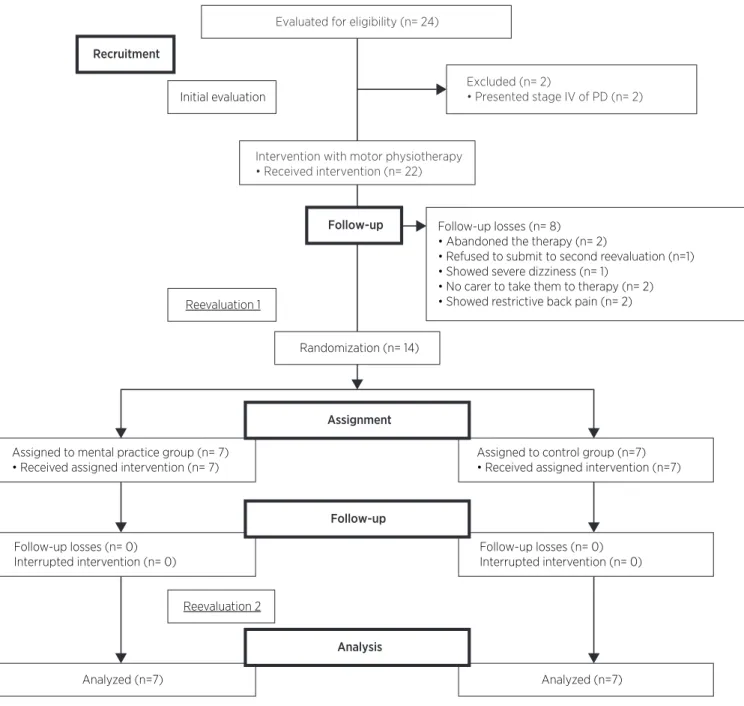
Twenty-four patients with idiopathic PD were recruited by convenience sampling, although 10 losses/ exclusions occurred (Figure 1).
The sample consisted of 14 patients of both genders, most of them male (86%). MPG and CG presented equivalent characteristics, with no significant differences regarding age, gender and stage and duration of the disease (Table 1).
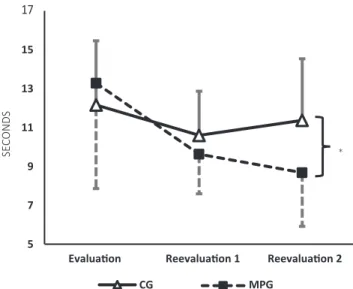
In the initial evaluation and first TUG reevaluation, no significant differences were verified between MPG and CG mean times. In the second reevaluation, a significant difference (p=0.05) was observed between the mean TUG times of MPG and GC (Figure 2).
The mean TUG times of both groups initially indicated average fall risk. In the second reevaluation, the mean TUG time of MPG showed low fall risk, while CG continued presenting average fall risk.
Evaluated for eligibility (n= 24)
Recruitment
Follow-up
Initial evaluation
Excluded (n= 2)
• Presented stage IV of PD (n= 2)
Randomization (n= 14) Reevaluation 1
Assigned to mental practice group (n= 7) • Received assigned intervention (n= 7)
Follow-up losses (n= 0) Interrupted intervention (n= 0)
Reevaluation 2
Analyzed (n=7) Analyzed (n=7)
Follow-up losses (n= 0) Interrupted intervention (n= 0) Assigned to control group (n=7) • Received assigned intervention (n=7) Follow-up losses (n= 8)
• Abandoned the therapy (n= 2)
• Refused to submit to second reevaluation (n=1) • Showed severe dizziness (n= 1)
• No carer to take them to therapy (n= 2) • Showed restrictive back pain (n= 2)
Intervention with motor physiotherapy • Received intervention (n= 22)
Assignment
Follow-up
Analysis
Figure 1. Sample composition chart flow
Table 1. Sample breakdown
MPG (n=7) CG (n=7) P (Mann-Whitney Test)
Age (years) 64 (7) 62 (12) 0.65
HY Stage 2 (1) 2 (0.5) 0.84
Period of PD 8 (4) 4 (2) 0.09
Gender (M/F) 7/0 5/2
-MPG: Mental Practice Group; CG: Control Group; N: number; M: Male; F: Female; HY: Hoehn and Yahr; PD: Parkinson’s disease; mean ± standard deviation. *Mann-Whitney Test, p≤ 0.05 significance level.
There were no significant differences between the mean scores of MPG and CG in any of the DGI evaluation/reevaluations. In the initial evaluation the mean score for both groups indicated severe fall
risk and functional disability. In reevaluation 1, both groups presented means that indicated a greater degree of independence, a result maintained by MPG in reevaluation 2, while CG reverted to a mean score indicating serious fall risk and functional disability.
5 7 9 11 13 15 17
Evaluation Reevaluation 1 Reevaluation 2
SECONDS
CG MPG
*
Figure 2. (intergroup analysis): mean TUG time and standard deviation of CG and MPG.
TUG: Time Up & Go; MPG: Mental Practice Group; CG: Control Group. T test, independent sample, p< 0.05 significance level.
Initial evaluation Reevaluation 1 Reevaluation 2
CG MPG
10 15 20 25
SCORE
Figure 3. mean DGI score and standard deviation of CG and MPG. Score: Dynamic Gait Index (DGI) values; CG: Control Group; MPG: Mental Practice Group. Mann-Whitney test, p< 0.05 significance level.
In the initial evaluation, 71% of patients in both groups showed severe fall risk and functional disability, according to the DGI score. In reevaluation 1 there was a reduction of this percentage to 29% in MPG and to 14% in CG. In reevaluation 2 it was verified that MPG maintained the 29% observed in reevaluation 1, while CG reverted to the initial percentage of 71% of patients with functional disability and severe fall risk.
In the FES-I evaluation, there were no significant differences between the groups in any of the evaluations/ reevaluations (Figure 4).
In the intragroup comparison of the FES-I results, a non-significant reduction in the mean scores of both
groups was observed in reevaluation 1. In reevaluation 2, a significant increase was observed in the mean scores of both groups in FES-I, MPG (p=0.04) and CG (p = 0.02). When comparing the mean scores in the initial FES-I evaluation and in reevaluation 2, a significant increase was observed only in CG (p=0.02).
Initial evaluation Reevaluation 1 Reevaluation 2
CG MPG
SCORE
0 5 10 15 20 25 30 35 40
Figure 4. mean FES-I score and standard deviation of CG and MPG.
CG: Control Group; MPG: Mental Practice Group; Score: Fall Efficacy Scale-International (FES-1) values.
Mann-Whitney test, p< 0.05 significance level.
DISCUSSION
It was observed in the present study that MP was capable of maintaining functional mobility in PD patients gained through motor physical therapy. There was no decline in functional mobility in MPG as that observed in CG in the comparisons between reevaluation 1 and reevaluation 2.
After the MP sessions MPG showed improved functional mobility and reduced fall risk evidenced by TUG, indicating that MP may not only preserve but also enhance the effects of physical practice.
MPG results in DGI showed maintenance of the positive effects of physical practice on fall risk and functional disability, since MPG presented a significant difference between the initial evaluation and reevaluation 2, maintained the low percentage of patients with functional disability/high fall risk and also showed a significant difference in the intergroup comparison in reevaluation 2.
monitoring (standard procedure of the service), in the second reevaluation CG presented decreased mobility, increased fall risk and increased fear of falling, indicated respectively by increase in mean TUG time, reduction in mean DGI score/increase in percentage of patients with functional disability, and increase in mean FES-I score, corroborating findings by Cavanaugh et al.10,
who monitored the activity of PD patients for one year and found a natural decline in the intensity of activity performed by PD patients in the mild to moderate stages.
Fear of falling measured through FES-I showed significant reduction after physical practice, demonstrating that improved mobility is not necessarily linked to reduced fear of falling. However, MPG showed no significant difference in the comparison between the initial evaluation and reevaluation 2, suggesting that there was no increase in fear of falling, while CG showed significant worsening.
Studies that use MP in motor rehabilitation of PD patients are still scarce in the literature26 and the results
of MP research are still controversial due to factors such as small samples, great heterogeneity among patients and diversity of intervention protocols27-30.
Some studies27,28 found that combining MP with
physical practice has significant benefits for mobility and gait, respectively, and disagree with Braun et al.29, who found no difference between rehabilitation
incorporated with practice and intervention with relaxation, and Santiago et al.30, who observed no
differences when they compared MP to physical practice in gait after a single session. It is important to emphasize that the few studies that used MP in the motor rehabilitation of subjects with PD did so by adding it to physical practice and mostly using different instruments, whereas the present study used MP after physical practice and in an isolated way.
The use of MP does not rule out the importance of physical therapy, since, as Allen et al31 concluded in the
study, reduction of muscle strength is associated with reduction of gait speed and a history of multiple falls in PD patients. In addition, studies32-35 have consistently
demonstrated that people with PD who take part in exercise programs have better motor function, cardiovascular fitness and quality of life than those who do not exercise. However, El-Wishy and Fayez28
emphasize that the MP technique is adequate for home exercises, which, in combination with regular
monitoring, might be an excellent way to preserve gains or prevent progressive decline in motor function.
MP attains conscious control of movement through cognitive strategies35. It has been demonstrated that
cognitive repetition of motor events activates neural structures similar to those involved during the active planning, control and execution of movement29. Pereira
et al.36 believe that increasing patients’ attention levels
to the task can shift automatic control (subcortical) of gait to control directed to the objective (cortical). Thus, the cortex can take on the main role, reducing the action of compromised neural circuits37,38. Increased cortical
activity may compensate for striatum dysfunction in patients with PD, which reinforces the use of MP as a cognitive strategy to preserve the mobility of patients with DP37.
In addition, Lord et al.39 affirm that maintaining
optimal levels of activity in healthy older adults is a challenge in itself and even more so in people with PD, which reinforces the need for strategies to minimize the consequences of inactivity. For, as stated by Ellis et al.40, lack of time to exercise and fear of falling seem
to be the main barriers perceived by patients with PD to engage in exercise programs.
The use of MP has some advantages since the method affords an opportunity for additional training without the need for a therapist or institutional environment and without additional cost or safety risk, besides providing patients with a self-management rehabilitation tool, since they can use it whenever they wish, including as a strategy to ideally prepare difficult actions such as walking26,27. It can therefore be considered a promising
form of therapy in PD.
CONCLUSION
This study showed that MP was capable of maintaining functional mobility in patients with PD gained through motor physical therapy. Its effects seem to be more effective than for a group engaged in non-monitored home exercises, which is often a common practice for patients with chronic diseases such as PD.
REFERENCES
1. Wirdefeldt K, Adami HO, Cole P, Trichopoulos D, Mandel J. Epidemiology and etiology of Parkinson’s disease: a review of the evidence. Eur J Epidemiol. 2011;26(Suppl 1):S1-58. doi: 10.1007/s10654-011-9581-6
2. Pringsheim T, Jette N, Frolkis A, Steeves TD. The prevalence of Parkinson’s disease: a systematic review and meta-analysis. Mov Disord. 2014;29(13):1583-90. doi:10.1002/mds.25945. 3. Van Nimwegen M, Speelman AD, Hofman-van Rossum EJM,
Overeem S, Deeg DJH, Borm GF, et al. Physical inactivity in Parkinson’s disease. J Neurol. 2011;258(12):2214-21. doi:10.1007/ s00415-011-6097-7
4. Lana, RC; Araujo, LN; Cardoso, F; Rodrigues-de-Paula, F. Main determinants of physical activity levels in individuals with Parkinson’s disease. Arq Neuropsiquiatr. 2016;74(2):112-6. doi: 10.1590/0004-282X20160009
5. King, LA; Horak, FB. Delaying mobility disability in people with Parkinson disease using a sensorimotor agility exercise program. Phys Ther. 2009;89(4):384-93. doi: 10.2522/ptj.20080214 6. Camara, FM; Gerez, AG; Miranda MLJ; Velardi, M. Capacidade
funcional do idoso: formas de avaliação e tendências. Acta Fisiátr. 2008;15(4):249-56.
7. Keus SH, Bloem BR, Hendriks EJ, Bredero-Cohen AB, Munneke M. Evidence-based analysis of physical therapy in Parkinson’s disease with recommendations for practice and research. Mov Disord. 2007;22(4):451-60. doi: 10.1002/mds.21244
8. Dibble LE, Cavanaugh JT, Earhart GM, Ellis TD, Ford MP; Foreman KB. Charting the progression of disability in Parkinson disease: study protocol for a prospective longitudinal cohort study. BMC Neurol. 2010;10:110. doi: 10.1186/1471-2377-10-110 9. Hely MA, Reid WG, Adena MA, Halliday GM, Morris JG. The Sydney
multicenter study of Parkinson’s disease: the inevitability of dementia at 20 years. Mov Disord. 2008;23(6):837-44. doi: 10.1002/mds.21956
10. Cavanaugh JT, Ellis TD, Earhart GM, Ford MP, Foreman KB, Dibble LE. Capturing ambulatory activity decline in Parkinson’s disease. J Neurol Phys Ther. 2012;36(2):51-7. doi: 10.1097/ NPT.0b013e318254ba7a
11. Abbruzzese G, Marchese R, Avanzino L, Pelosin E. Rehabilitation for Parkinson’s disease: current outlook and future challenges. Parkinsonism Relat Disord. 2016; 22(Suppl 1):S60-64. doi: 10.1016/j.parkreldis.2015.09.005
12. Pacheco M, Machado S, Lattari JE, Portella CE, Velasques B, Silva JG, et al. Efeitos da prática mental combinada à cinesioterapia em pacientes pós-acidente vascular encefálico: uma revisão sistemática. Rev Neurocienc. 2007;15(4):304-9.
13. Malouin F, Richards CL, Durand A, Doyon J. Clinical assessment of motor imagery after stroke. Neurorehabil Neural Repair. 2008;22(4):330-40. doi: 10.1177/1545968307313499
14. Nilsen DM, Gillen G, Gordon AM. Use of mental practice to improve upper-limb recovery after stroke: a systematic review. Am J Occup Ther. 2010;64(5):695-708. doi: 10.5014/ajot.2010.09034 15. Silva AT, Santos CF, Assis AA, Boas AV, Vilela RC, Costa
WCC. Análise dos efeitos da imagética motora associada a cinesioterapia no membro superior de pacientes hemiparéticos pós-acidente vascular encefálico. Rev Ter Man. 2011;9(45):526-33.
16. Silva DM, Coriolano MGWS, Macedo JGF, Silva LP, Lins OG. Protocolos de prática mental utilizados na reabilitação motora de sujeitos com doença de Prakinson: revisão sistemática da literatura. Acta Fisiátr. 2016;23(3):155-60. doi: 10.5935/0104-7795.20160030
17. Hoehn MM, Yahr MD. Parkinsonism: onset, progression, and mortality. 1967. Neurology. 2001;57(10 Suppl 3):S11-26. 18. Brucki SMD, Nitrini R, Caramelli P, Bertolucci PHF, Okamoto
YH. Sugestões para o uso do mini-exame do estado mental no Brasil. Arq Neuro-Psiquiatr. 2003;61(3B):777-81. doi: 10.1590/ S0004-282X2003000500014
19. Malouin F, Richards CL, Jackson PL, Lafleur MF, Durand A, Doyon J. The kinesthetic and Visual Imagery Questionnaire (KVIQ) for assessing motor imagery in persons with physical disabilities: a reliability and construct validity study. J Neurologic Phys Ther. 2007;31(1):20-9. doi: 10.1097/01.NPT.0000260567.24122.64 20. Rogers ME, Rogers NL, Takeshima N, Islam MM. Methods to
asses and improve the physical parameters associated with fall risk in older adults. Prevent Med. 2003;36(3):255-64. doi: 10.1016/S0091-7435(02)00028-2
21. Podsiadlo D, Richardson S. The timed “Up & Go”: a test of basic functional mobility for frail elderly persons. J Am Geriatr Soc. 1991;39(2):142-8. doi: 10.1111/j.1532-5415.1991.tb01616.x 22. Marchetti GF, Whitney SL. Construction and validation of the
4-item dynamic gait index. Phys Ther. 2006;86(12):1651-60. doi: 10.2522/ptj.20050402
23. Camargos FFO, Dias RC, Dias JMD, Freire MTF. Adaptação transcultural e avaliação das propriedades psicométricas da Falls Efficacy Scale – International em idosos brasileiros (FES-I Brasil). Rev Bras Fisioter. 2010;14(3):237-43. doi: 10.1590/ S1413-35552010000300010
24. Letswaart M, Johnston M, Dijkerman HC, Joice S, Scott CL, MacWalter RS, et al. Mental practice with motor imagery in stroke recovery: randomized controlled trial of efficacy. Brain. 2011;134(Pt 5):1373-86. doi: 10.1093/brain/awr077
25. Page SJ, Dunning K, Hermann V, Leonard A, Levine P. Longer versus shorter mental practice sessions for affected upper extremity movement after stroke: a randomized controlled trial. Clin Rehabil. 2011;25(7):627-37. doi: 10.1177/0269215510395793 26. Heremans E, Nieuwboer A, Feys P, Vercruysse S, Vandenberghe
W, Sharma N, et al. External cueing improves motor imagery quality in patients with Parkinson disease. Neurorehabil Neural Repair. 2012;26(1):27-35. doi: 10.1177/1545968311411055 27. Tamir R, Dickstein R, Huberman M. Integration of motor
imagery and physical practice in group treatment applied to subjects with Parkinson’s disease. Neurorehabil Neural Repair. 2007;21(1):68-75. doi: 10.1177/1545968306292608
28. El-Wishy AA, Fayez ES. Effect of locomotor imagery training added to physical therapy program on gait performance in Parkinson patients: a randomized controlled study. Egypt J Neurol Psychiat Neurosurg. 2013;50(1):31-7.
29. Braun SM, Wade DT, Beurskens AJHM. Use of movement imagery in neurorehabilitation: researching effects of a complex intervention. International J Rehabil Res. 2011;34(3):203-8. doi: 10.1097/MRR.0b013e328348b184
to physical practice on the gait of individuals with Parkinson’s disease: randomized clinical trial. NeuroRehabilitation. 2015;37(2):263-71. doi: 10.3233/NRE-151259
31. Allen, NE, Sherrington C, Canning CG, Fung VSC. Reduced muscle power is associated with slower walking velocity and falls in people with Parkinson’s disease. Parkinsonism Relat Disord. 2010;16(4):261-4. doi: 10.1016/j.parkreldis.2009.12.011 32. Kwakkel G, Goede CJT, van Wegen E. Impact of physical
therapy for Parkinson’s disease: a critical review of the literature. Parkinsonism Relat Disord. 2007;13(Suppl 3):S478-87. doi: 10.1016/S1353-8020(08)70053-1
33. Dibble LE, Addison O, Papa E. The effects of exercise on balance in persons with Parkinson’s disease: a systematic review across the disability spectrum. J Neurol Phys Ther. 2009;33(1):14-26. doi: 10.1097/NPT.0b013e3181990fcc
34. Goodwin VA, Richards SH, Taylor RS, Taylor AH, Campbell JL. The effectiveness of exercise interventions for people with Parkinson’s disease: a systematic review and meta-analysis. Mov Disord. 2008;23(5):631-40. doi: 10.1002/mds.21922 35. Keus SHJ, Hendriks HJM, Bloem BR, Bredero-Cohen
AB, De Goede CJT, Van Haaren M, et al. KNGF-richtlijn Parkinson. Ned Tijdschr Fysiother. 2004;114(3 Suppl):1-56.
36. Pereira VAI, Barbieri FA, Vitorio R, Simieli L, Lirani-Silva E, Orcioli-Silva D, et al. The motor deficits caused by Parkinson’s disease are not able to block adjustments for a safe strategy during obstacle crossing in individuals with moderate disease. Motriz: Rev Educ Fis. 2015;21(4):436-41. doi: 10.1590/ S1980-65742015000400014
37. Beeler JA, Petzinger G, Jakowec MW. The enemy within: propagation of aberrant corticostriatal learning to cortical function in Parkinson’s disease. Front Neurol. 2013;12(4):134-40. doi: 10.3389/fneur.2013.00134
38. Vitorio R, Lirani-Silva E, Pieruccini-Faria F, Moraes R, Gobbi LT, Almeida QJ. Visual cues and gait improvement in Parkinson’s disease: which piece of information is really important? Neuroscience. 2014;26(277):273-80. doi: 10.1016/j. neuroscience.2014.07.024
39. Lord S, Godfrey A, Galna B, Mhiripiri D, Burn D, Rochester L. Ambulatory activity in incident Parkinson’s: more than meets the eye? J Neurol; 2013;260(12):2964-72. doi: 10.1007/ s00415-013-7037-5