ISSN 2317-6431 https://doi.org/10.1590/2317-6431-2017-1965
Occurrence of hearing disorders in infants exposed to HIV
vertical transmission
Ocorrência de alterações auditivas em lactentes expostos à
transmissão vertical do HIV
Monalisa Alves Dantas Padilha1, Elaine Colombo Sousa Maruta2, Marisa Frasson de Azevedo3
ABSTRACT
Purpose: To verify the occurrence of peripheral and central auditory impairments in infants exposed to HIV vertical transmission. Methods: Retrospective analysis of 144 medical charts of infants who underwent audiological evaluation at birth, between 2010 and 2015, through transient evoked otoacoustic emissions and auditory brainstem response. The infants were divided into two groups: Study Group: composed of 72 infants with HIV positive mothers; and Control Group: with 72 infants without risk factors for hearing loss. For the study group, the results of the audiological monitoring at six months of age were also analyzed. Results: The groups did not differ
in age and sex. Results of otoacoustic emissions were normal in both groups, thus having normal cochlear function. In the study group, there was a tendency to present a higher occurrence of abnormalities in the auditory brainstem response results. The majority of infants did not show up for audiological monitoring, and among those who showed up, it was possible to identify audiological impairments. Conclusion: There was no cochlear function impairment in the study sample. There was a tendency towards central hearing impairments in the study group, with a predominance of lower brainstem impairment. There was a poor adherence to audiological
monitoring and poor agreement between the first and last evaluation.
Keywords: Audiology; Auditory brainstem response; Otoacoustic emissions, spontaneous; Vertical transmission of infectious disease; HIV
RESUMO
Objetivo: Verificar a ocorrência de alterações auditivas periféricas e centrais
em lactentes expostos à transmissão vertical do HIV. Métodos: Análise
retrospectiva de 144 prontuários de lactentes que passaram por avaliação
auditiva ao nascimento, entre janeiro de 2010 e dezembro de 2015, com
pesquisa das emissões otoacústicas evocadas por estímulo transiente e do potencial evocado auditivo de tronco encefálico. Os lactentes foram distribuídos
em dois grupos: grupo estudo (GE), composto por 72 lactentes com mães soropositivas para o HIV e grupo controle (GC), com 72 lactentes sem risco para perda auditiva. O GE teve, ainda, os resultados do monitoramento auditivo aos 6 meses de idade analisados. Resultados: Os grupos não se
diferenciaram em relação à idade e ao gênero. Os resultados das emissões otoacústicas foram normais em ambos os grupos, revelando função coclear normal. Houve tendência do grupo estudo de apresentar maior ocorrência de alterações centrais no potencial evocado auditivo de tronco encefálico.
A maioria dos lactentes não compareceu ao monitoramento auditivo e, entre
os presentes, houve identificação de alteração audiológica. Conclusão: Não
houve alteração de função coclear na população estudada. Houve tendência de mais alterações centrais no grupo estudo, com predomínio das alterações
de tronco baixo. Houve pouca adesão ao monitoramento auditivo e baixa
concordância entre a primeira e a última avaliação.
Palavras-chave: Audiologia; Potenciais evocados auditivos; Emissões otoacústicas espontâneas; Transmissão vertical de doença infecciosa; HIV
Study carried out at Programa de Residência Multiprofissional em Saúde da Criança e do Adolescente, Hospital São Paulo, Universidade Federal de São Paulo – UNIFESP – São Paulo (SP), Brasil.
1 Programa de Residência Multiprofissional em Saúde da Criança e do Adolescente, Hospital São Paulo, Universidade Federal de São Paulo – UNIFESP –
São Paulo (SP), Brasil.
2 Programa de Pós-graduação em Distúrbios da Comunicação Humana, Departamento de Fonoaudiologia, Universidade Federal de São Paulo –
UNIFESP – São Paulo (SP), Brasil.
3 Departamento de Fonoaudiologia, Hospital São Paulo, Universidade Federal de São Paulo – UNIFESP – São Paulo (SP), Brasil.
Conflict of interests: No.
Authors’ contribution: MADP participated on the study conception, data acquisition and analysis, and manuscript drafting; ECSM contributed to the data acqui-sition and analysis, and orientation on manuscript drafting; MFA participated on the critical revision and orientation of all steps of the study.
INTRODUCTION
The Human Immunodeficiency Virus (HIV) is a type of retrovirus that causes Acquired Immunodeficiency Syndrome (AIDS), which compromises progressively the immune system,
favoring the occurrence of many opportunistic infections(1,2).
HIV transmission occurs when there is direct contact with
HIV contaminated fluid. The increase in number of woman of
childbearing potential infected by HIV has determined the birth of virus exposed children, with vertical transmission (VT) being the main way of HIV infection in this population(3).
The virus can be vertically transmitted in three moments: gestational period, peripartum period, or postpartum period, through breastfeeding. About 20% to 25% of infections occurs during the intrauterine period, through many mechanisms, such as transplacental transfer of the virus into fetal circulation, or through maternal mononuclear cells HIV infected. It is estimated that 60% to 70% of transmissions occurs during labor or at birth, in which one of the reasons are ruptures in the protective barriers of the newborn’s skin(4).
Associations between HIV infection and hearing loss have been reported in the literature, and it has shown that during the disease’s initial phase, the chances of having hearing loss are lower. Over the years, this type of disorder has been observed more frequently in these patients. The symptoms can result from a combination of HIV infection and opportunistic infections
and/or possible ototoxic effects of certain medicines, including the use of highly active antiretroviral therapy - HAART (5).
This therapy has reduced largely morbidity and mortality
related to HIV infection. However, among the multiple effects,
there is an association of its use and sensorineural hearing loss(5).
Studies using auditory brainstem response (ABR) has shown electrophysiological impairments in the first stages
of the disease, even before clinical symptoms manifestation, suggesting a compromise of the synchrony when generating and transmitting neuroelectric impulses through the brainstem auditory pathway. Individuals exposed to antiretroviral treatment
also shows more ABR abnormalities, when compared to non-exposed individuals(6).
Taking into account the possibility of hearing disorders at birth, and mainly, possible late onset hearing loss, hearing protection organizations(7) indicate hearing monitoring, for at
least the first two years of life, even when passing the newborn
hearing screening.
The hypothesis is that infants exposed to HIV vertical transmission show higher occurrence of sensorineural hearing loss and central auditory impairments, when compared to infants without risk factors.
Therefore, this study aimed to verify the occurrence of peripheral and central auditory impairments in infants exposed to HIV vertical transmission.
METHODS
This study was conducted at the Research Center in Pediatric
Audiology of the Speech-Language Pathology and Audiology Department of Universidade Federal de Sao Paulo (UNIFESP).
This is a retrospective longitudinal study, with intergroup
comparisons, approved by the UNIFESP/HU/HSP Ethics
Committee, under the number 1137/2016.
The sample was composed by 144 infants of both sexes,
born from a full-term or preterm pregnancy, from January 2010 until December 2015, in a public hospital in Sao Paulo city,
distributed into two groups:
• STUDY GROUP (SG): consisting of 72 infants, which mothers had prenatal HIV positive diagnosis, without any other comorbidities. These infants underwent through antiretroviral therapy using Zidovudine (AZT), added or not to Nevirapine(8), upon medical recommendation;
• CONTROL GROUP (CG): consisting of 72 infants without any risk factors for hearing loss, according to
the Joint Committee on Infant Hearing(9), paired to the
SG according to gestational age and sex.
Patients with malformations and/or genetic syndromes were excluded from the sample.
Initially, patients underwent newborn hearing screening, which consisted of transient otoacoustic emissions (TOAEs)
and auditory brainstem response (ABR) using a click stimulus.
Infants that failed the newborn hearing screening underwent complementary diagnostic tests, which consisted of acoustic
immittance, frequency-specific ABR, and bone conduction ABR, when needed.
All patients were referred to auditory monitoring at 6 months of age. Tests included in this step were: TOAEs, acoustic immittance, auditory skills observation and visual reinforcement audiometry.
TOAEs were performed using AccuscreenPRO, from GNOtometrics. As stimulus, a non-linear click was used in a
60 Hz velocity, 70-84 dBpeSPL (45-60 dBHL), auto-calibrated,
according to each patient’s external auditory meatus, frequency bands between 1.4 KHZ and 4 KHz and a sample rate of 16 KHz. Newborns underwent testing in the period between 24 to 48 hours after birth, during natural sleep. When assessing the pass/fail criteria, the own equipment analysis was considered, with less than 20% of artefacts and stability of probe higher than 80%.
ABR was performed in newborns between the first
24 and 48 hours of life, during natural sleep. Click stimulus
ABR was acquired using the Smart-EP model, from Intelligent
Hearing Systems, with insert earphones ER 3A.
After cleaning the skin with NuPrepTM abrasive prepping gel, the disposable surface electrodes (Meditrace, from Kendal) were positioned on the forehead (Fpz) and on the right and left
mastoid bones (M2 and M1), according to the International 10-20 system electrode placement. Electrode impedance was
kept below 3 Kohms.
To record the click stimulus ABR, rarefaction stimulus polarity was used at 80 dBnHL, with duration of 100 µs, repetition rate of
27.7/s, presented by insert earphones. A 12 ms analysis window
was used, with 100 and 3000 Hz filters. It was presented, at
least, 2048 stimuli with replication. In both groups, absolute latencies and amplitudes of waves I, III and V were analyzed, as
well as interpeak I-III, III-V, and I-V latencies. Absolute wave and interpeak latencies were classified as normal or abnormal,
Central auditory impairment was considered as a delay in III and/or V absolute wave latencies, an increase in
interpeak I-III, III-V and I-V latencies, or an interaural difference
higher than 0.3 ms in wave V absolute latency and/or in the
interpeak I-V latency(10).
Lower brainstem impairments were characterized by normal wave I absolute latency and normal interpeak interval III-V,
but with a delay in wave III and V latencies and an increase in
interpeak intervals I-III and I-V. Upper brainstem impairments
were characterized by normal latencies in wave I and III and
normal interpeak interval I-III, but with a delay in wave V latency and increase in interpeak intervals III-V and I-V.
Additionally, patients could show impairment in both lower and upper brainstem(2).
Frequency-specific ABR, both air and bone conduction, was recorded using the Smart-EP model, from Intelligent Hearing
Systems, and insert earphones ER 3A, following the preparation
mentioned when recording click stimulus ABR.
To record the frequency-specific ABR, a tone burst stimulus
was used, a sinusoidal wave with short duration, that better
predicts the degree and audiometric configuration. Both bone conduction (BC) and air conduction (AC) were used to record
the responses in the frequency range from 500 to 4000 Hz. The threshold search through air conduction was performed
using at least 2000 stimuli. Initially, a 80 dBnHL stimulus was presented, and gradually reduced in 20 dB each time, until wave
V could no longer be seen. After that, stimulus was increased
in 10 dB each time until the lowest intensity that wave V could
be seen in lower amplitude, being that one considered the electrophysiological threshold(11).
When recording ABR through bone conduction, a bone
vibrator was placed on the mastoid bones and an alternating
wave was presented initially at 50 dBHL, decreasing gradually in 10 dB. As electrophysiological threshold, it was considered the lowest intensity where wave V was identified and replicated
by the examiner.
Acoustic immittance was assessed using the AZ7 Interacoustics tympanometer. When acquiring tympanometry curves, type A was considered as having a single peak with admittance between
-150 and +100 daPa; type B as no admittance peak seen; type C
as admittance peak being shifted to the negative pressures side; type As as showing an abnormally low compliance; and type Ad as having an abnormally high compliance(12).
In order to observe the auditory skills, a stimulus at around
50 and 70 dBSPL was presented during two seconds, produced by a non-calibrated sound (sleigh bells), in a distance of 20 cm
from the auricle, with an interstimulus interval of 30 seconds, in both sides, above and under the ear, according to the literature(13).
To the 6 to 9 months age range, correct lateral localization to the right or left and indirect top and bottom localization was considered as proper answers(13). Cochleopalpebral reflex was
assessed using a stimulus at 100 dB from an agogô, and also
if there was any behavioral signs that could suggest central auditory impairment, as described in the literature(13).
Visual reinforcement audiometry (VRA) was performed
using the PA-2 pediatric audiometer from Interacoustics,
which produces frequency modulated tones (warble), of
500, 1000, 2000 and 4000 Hz, at 80, 60, 40 and 20 dBHL.
The warble tones were presented in a 20 cm distance from the infant’s auricle, to the right and to the left, in the following order:
1000, 2000, 4000 and 500 Hz. A light stimulus as reinforcer was turned on when there was a sound localization answer of turning the head towards the sound. The lowest intensity where localization occurred for each sound frequency was considered as the minimum level for getting an answer. It was
classified as adequate the minimum level for getting an answer between 40 and 60 dBHL(2,13). The VRA results were assessed
together with the auditory skills results in order to integrate
the audiological profile of the children being monitored, in
accordance with the institute’s internal protocol.
The results were analyzed by a qualified professional, through the following tests: two proportions z-test, ANOVA, p-value, and Kappa’s coefficient. A significance level of 0.05
(5%) was used.
RESULTS
The sample was composed by 144 infants, distributed into two groups: the control group consisted of 72 infants, 35 females and 37 males. The study group consisted of 72 infants,
33 females and 39 males. There was no statistically significant difference in sex between the groups (p=0.738). Gestational age varied from 35 to 40 weeks, with no difference between the groups (p=0.0450). The post conceptual age varied between
35 and 41 weeks, with mean values of 38 in both groups, with
no statistical difference between the groups (p=1.00).
All the infants underwent newborn hearing screening at birth. Of all the 144 infants, only one child from the study group failed the screening with TOAEs, but, passed at the retest. Therefore, 100% of the sample presented otoacoustic emissions, thus having normal cochlear function.
Table 1 shows the results of ABR search for both groups.
There was no difference between the groups.
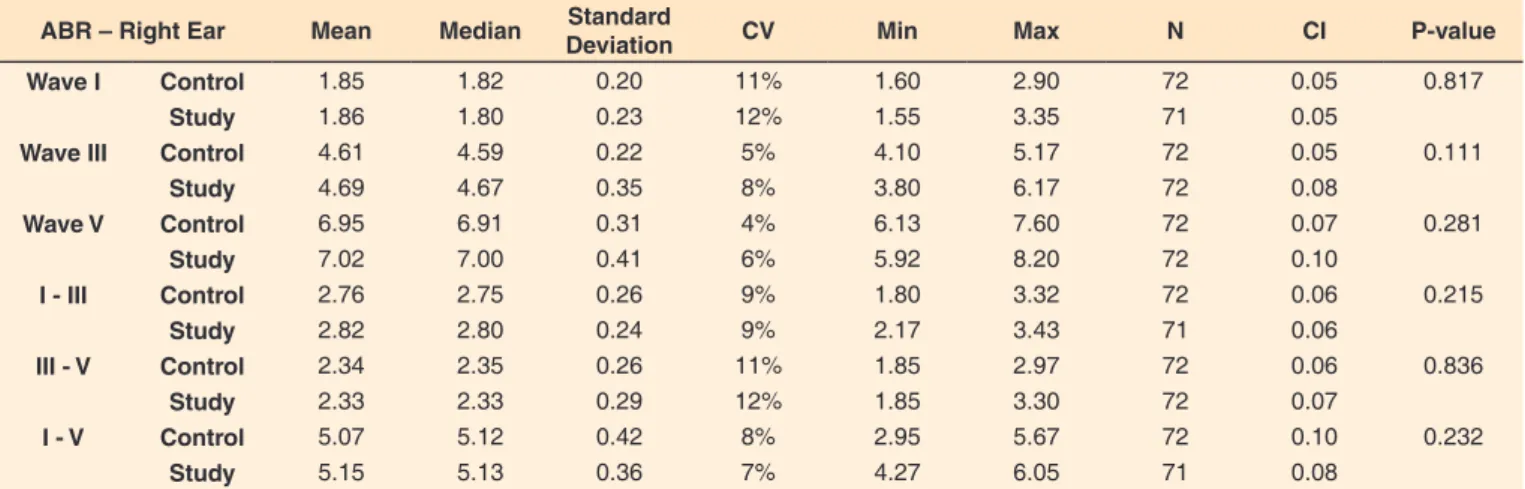
The mean absolute latency values of waves I, III and V and
interpeak I-III, III-V and I-V are shown in Table 2 (left ear) and Table 3 (right ear).
Statistical analysis, for both ears, showed similarity between
the study and control groups, having no significant difference.
Central auditory impairment was the most frequent type of hearing impairment in the groups, consisting predominantly of lower brainstem impairment. From all the patients with central auditory impairment, 16 showed a lower brainstem impairment,
3 upper brainstem impairment and only 1 showed a diffuse
hearing impairment. Auditory neuropathy spectrum disorder was not found in any of the children.
All the infants exposed to HIV vertical transmission
were referred to audiological monitoring, in which the first re-evaluation was at 6 months of age. However, there was poor adherence: only 22% (n=16) of the patients came again for the re-evaluation; 77,8% (n=56) did not show up, and this was statistical significant (p<0.001).
The results from the behavioral audiological evaluation,
conducted at 6 months of age, classified as normal, delay in
hearing development or central impairment, are described in Table 4.
According to the diagnosis, 87.5% of infants that showed
up for re-evaluation presented normal results, 6.3% delay in
Table 1. Results of auditory brainstem response of both groups
ABR Control Study P-value
N % N %
Normal 66 91.7% 58 80.6% 0.054
Central 6 8.3% 14 19.4%
Subtitle: ABR = Auditory Brainstem Response; N = number of subjects
Table 2. Mean values of auditory brainstem response absolute wave and interpeak latencies for the left ear of both study and control groups
ABR – Left Ear Mean Median Standard
Deviation CV Min Max N CI P-value Wave I Control 1.839 1.785 0.187 10% 1.630 2.730 72 0.043 0.370
Study 1.872 1.800 0.246 13% 1.570 3.200 72 0.057
Wave III Control 4.644 4.630 0.220 5% 4.170 5.200 72 0.051 0.130
Study 4.714 4.675 0.325 7% 4.030 6.220 72 0.075
Wave V Control 6.983 6.950 0.296 4% 6.300 7.670 72 0.068 0.416
Study 7.033 7.040 0.416 6% 6.100 8.070 72 0.096
I - III Control 2.805 2.810 0.239 9% 2.020 3.280 72 0.055 0.426
Study 2.838 2.820 0.257 9% 2.150 3.430 72 0.059
III - V Control 2.340 2.330 0.250 11% 1.920 3.000 72 0.058 0.723
Study 2.325 2.330 0.279 12% 1.630 3.170 72 0.064
I - V Control 5.146 5.140 0.307 6% 4.450 5.820 72 0.071 0.821
Study 5.133 5.100 0.393 8% 4.300 6.130 72 0.091
Subtitle: ABR = auditory brainstem response; CV = coefficient of variation; CI = confidence interval; Min = minimum value found in the sample; Max = maximum
value found in the sample; N = number of waves
Table 3. Mean values of auditory brainstem response absolute wave and interpeak latencies for the right ear of both study and control groups
ABR – Right Ear Mean Median Standard
Deviation CV Min Max N CI P-value Wave I Control 1.85 1.82 0.20 11% 1.60 2.90 72 0.05 0.817
Study 1.86 1.80 0.23 12% 1.55 3.35 71 0.05
Wave III Control 4.61 4.59 0.22 5% 4.10 5.17 72 0.05 0.111
Study 4.69 4.67 0.35 8% 3.80 6.17 72 0.08
Wave V Control 6.95 6.91 0.31 4% 6.13 7.60 72 0.07 0.281
Study 7.02 7.00 0.41 6% 5.92 8.20 72 0.10
I - III Control 2.76 2.75 0.26 9% 1.80 3.32 72 0.06 0.215
Study 2.82 2.80 0.24 9% 2.17 3.43 71 0.06
III - V Control 2.34 2.35 0.26 11% 1.85 2.97 72 0.06 0.836
Study 2.33 2.33 0.29 12% 1.85 3.30 72 0.07
I - V Control 5.07 5.12 0.42 8% 2.95 5.67 72 0.10 0.232
Study 5.15 5.13 0.36 7% 4.27 6.05 71 0.08
Subtitle: ABR = auditory brainstem response; CV = coefficient of variation; CI = confidence interval; Min = minimum value found; Max = maximum value found;
N = number of waves
Table 4. Distribution of results from the second evaluation of the study group
2nd evaluation results N % P-value
Normal 14 87.5% Ref.
Delayed 1 6.3% <0.001*
Central 1 6.3% <0.001*
*Statistically significant values (p≤0.05) – ANOVA test
Subtitle: N = number of subjects; Ref = reference
One of the infants was diagnosed with central hearing
impairment at the second evaluation, since at the first evaluation
the test showed a normal result. Four showed central auditory
impairment at birth, but the test result was normal at re-evaluation.
When assessing the concordance level of diagnosis at birth and at 6 months of age, the value for Kappa was 0.294, indicating a poor level of agreement, as showed in Table 5.
DISCUSSION
There was no difference in sex and gestational and post
conceptual age in the sample. Actually, this was expected since the groups were paired. However, it was important to guarantee the similarity between the groups.
a study done with 247 newborns, in which the study group consisted of 80 children that had a HIV seropositive mother, that also showed no association between HIV exposure, during pregnancy, and absence of otoacoustic emissions(14).
The absence of cochlear impairments in the first evaluation
does not exclude the chances of having a hearing impairment, especially when there is a HIV transmission and/or the child undergoes antiretroviral treatment. Studies with HIV sorepositive children and adults, in use of antiretroviral medication, showed evidences that 33% of this population presented some type of hearing impairment. There is no consensus in the literature if the hearing impairment was caused by the medication or by opportunistic diseases, due to low immunity. Furthermore, studies have demonstrated greater occurrence of hearing impairments in patients in advanced stages of the disease(6,15,16).
Regarding to the ABR results, there was no difference in
occurrence of impairments when comparing the groups, but the study group tended towards central hearing impairments. This result was also found in the literature. A study that
evaluated 69 children through ABR, with a study group of 36 HIV vertically infected children, also showed no difference
between the groups(17). Nevertheless, there were differences in
the type of impairment identified. In the same study, conductive
electrophysiological abnormalities only occurred in the study group, whereas in the present study only central hearing impairments were found in both groups.
In the study group, when analyzing ABR latencies, there
was an increase in wave I, III and V latencies for both ears,
but with no significant difference between the groups. A study
done with adults with HIV, using a click stimulus, showed a delay in waves I, III and V when compared to a healthy control group(18). Another study described the effects of HIV presence in
brain auditory evoked potentials, warning a higher probability of an increase in the waves latencies(19).
In the present study, no difference in latency between the
groups was observed. This could be attributed to the fact that the diagnosis was already established for the adults, whereas for the children the mother’s positive antibody only becomes
non-perceptible around 9 and 18 months of age, when the final diagnosis is established. In fact, a Brazilian study identified
greater occurrence of central hearing impairments (88%) in
children at the end of the first year of life, which they were
proven to be infected with HIV(20). Thus, the monitoring for less
than 12 months was considered a limitation of the present study, making it possible that some newborns could have presented a negative result (a seroreversion could have happened).
The results also pointed out a greater occurrence of lower brainstem hearing impairments. A similar result was found in the literature. A study with adults, using HAART, showed an
increase in interpeak I-III and I-V latencies, also characterized
as a lower brainstem impairment(6).
The poor adherence to the audiological monitoring (22%) in the population studied is worrisome, given the fact that
chances of delayed-onset hearing impairment have been proven
in the literature. The same was observed at the same institution that this study was conducted in a newborns toxoplasmosis monitoring(21). Therefore, this could be related to the profile of
the population assisted at the institution that mainly consists of people with low sociocultural level. Indeed, a study showed that the education level among people with HIV is lower than in the general population, and even lower for women compared to men, making this one of the likely reasons for not showing up for monitoring(22). Another associated factor can be the
normal result at the hearing screening at birth, which can have
influenced the family’s adherence and the level of concern. Hearing health institutions, such as the Joint Committee on
Infant Hearing(9), do not include HIV as a risk factor for hearing
impairment, thus not recommending hearing monitoring on this population. However, in the present study, a child diagnosed as normal at birth, later presented a central hearing impairment during monitoring, with language delay. This data shows the possibility of central hearing impairments in patients exposed to HIV vertical transmission, as well as for those indeed infected.
The behavioral evaluation is recommended to monitor newborns, and it allows to identify central impairment signs that leads to auditory processing and language impairments,
that requires speech-therapy. In the literature, central signs
are described as exacerbated answers to low intensity sounds,
absence of cochleopalpebral reflex and/or acoustic reflexes in
the presence of TOAEs, and inconsistency of answers to pure tones in visual reinforcement audiometry(13).
Since the behavioral evaluation is done in the audiological monitoring routine at the institution where the present study was conducted, there was an interest to verify if there was concordance between the diagnosis made through behavioral and electrophysiological evaluations. In this comparison, it was revealed a poor level of agreement between the results of both evaluations, which are considered complementary.
The poor level of agreement between the diagnosis made through the electrophysiological evaluation at birth and the behavioral at 6 months of age showed that they are independent of each other, highlighting the importance of monitoring these infants.
Due to poor adherence to audiological monitoring, the study
was limited, which might have interfered in the agreement level between the evaluations at birth and during monitoring, beyond the fact that it is not possible to know which children in fact have been infected.
CONCLUSION
The sample studied showed normal cochlear function. ABR results did not differ in absolute wave and interpeak latencies
between the groups. The study group showed a higher tendency
Table 5. Association between auditory brainstem response diagnosis at birth and behavioral evaluation at 6 months of age
Evaluation at 6 months
Kappa P-value
ABR Normal Abnormal Total
Normal 12 1 13 0.294 0.226
Abnormal 2 1 3
Total 14 2 16
towards central hearing impairments. There was poor adherence to audiological monitoring and poor agreement between the electrophysiological evaluation at birth and the behavioral evaluation at 6 months of age.
REFERENCES
1. Silva AC, Pinto FR, Matas CG. Potenciais evocados auditivos de longa latência em adultos com HIV/Aids. Pro Fono. 2007;19(4):352-6. http://
dx.doi.org/10.1590/S0104-56872007000400005. PMid:18200383.
2. Matas CG, Santos VAV Fa, Juan KR, Pinto FR, Gonçalves IC. Manifestações audiológicas em crianças e adultos com AIDS. Pro Fono. 2010;22(3):269-74.
http://dx.doi.org/10.1590/S0104-56872010000300019. PMid:21103717.
3. Vieira ACBC, Miranda AE, Vargas PRM, Maciel ELN. Prevalência de HIV em gestantes e transmissão vertical segundo perfil socioeconômico. Rev Saude Publica. 2011;45(4):644-51. http://dx.doi.org/10.1590/
S0034-89102011005000041. PMid:21739080.
4. Kakehasi FM, Ferreira FGF, Pinto JA, Carneiro SA. Vírus da imunodeficiência humana adquirida/HIV no período neonatal. Rev. Méd. Minas Gerais. 2014;24(2):241-7.
5. Vieira ABC, Mancini P, Gonçalves DU. Doenças infecciosas e perda auditiva. Rev. Méd. 2009;20(1):102-6.
6. Matas CG, Silva SM, Marcon BA, Gonçalves IC. Manifestações eletrofisiológicas em adultos com HIV/AIDS submetidos e não-submetidos à terapia anti-retroviral. Pro Fono. 2010;22(2):107-12. http://dx.doi.org/10.1590/S0104-56872010000200007. PMid:20640373.
7. Lewis DR, Marone SAM, Mendes BCA, Cruz OLM, Nóbrega M. Comitê multiprofissional em saúde auditiva: COMUSA. Rev Bras Otorrinolaringol. 2010;76(1):121-8.
8. Brasil. Ministério da Saúde. Departamento de Vigilância, Prevenção
e Controle das IST, do HIV/Aids e das Hepatites Virais. Protocolo
clínico e Diretrizes Terapêuticas para manejo da Infecção pelo HIV em Crianças e Adolescentes [Internet]. Brasília; 2014. Capítulo 2 [citado em 2017 Dez 13]. Disponível em: http://www.aids.gov.br/
pcdt/pediatrico/2
9. JCIH: Joint Committee on Infant Hearing. Year 2007 position statement:
principles and guidelines for early hearing detection and intervention
programs. Pediatrics. 2007;120(4):898-921. http://dx.doi.org/10.1542/
peds.2007-2333. PMid:17908777.
10. Rosa LAC, Suzuki MR, Angrisani RG, Azevedo MF. Potencial evocado auditivo de tronco encefálico: valores de referência em relação à idade. CoDAS. 2014;26(2):117-21.
http://dx.doi.org/10.1590/2317-1782/2014469IN. PMid:24918504.
11. Pinto FR, Matas CG. Comparação entre limiares de audibilidade e eletrofisiológico por estímulo tone burst. Rev Bras Otorrinolaringol. 2007;73(4):513-22. http://dx.doi.org/10.1016/S1808-8694(15)30103-8.
12. Jerger J. Clinical experience with impedance audiometry. Arch Otolaryngol. 1970;92(4):311-24. http://dx.doi.org/10.1001/ archotol.1970.04310040005002. PMid:5455571.
13. Azevedo MF. Avaliação audiológica no primeiro ano de vida. In: Lopes FO, organizador. Novo tratado de Fonoaudiologia. 3. ed. Barueri: Manole; 2013. p. 149-65.
14. Manfredi AKS, Zuanetti PA, Mishima F, Granzotti RBG. Triagem auditiva neonatal em recém-nascidos de mães soropositivas para o HIV. J Soc Bras Fonoaudiol. 2011;23(4):376-80. http://dx.doi.org/10.1590/
S2179-64912011000400014. PMid:22231060.
15. Chandrasekhar SS, Connelly PE, Brahmbhatt SS, Shah CS, Kloser PC, Baredes S. Otologic and audiologic evaluation of human immunodeficiency virus-infected patients. Am J Otolaryngol. 2000;21(1):1-9. http://
dx.doi.org/10.1016/S0196-0709(00)80117-9. PMid:10668670.
16. Buriti AKL, Oliveira SHS, Muniz LF, Soares MJGO. Avaliação da saúde auditiva em crianças com HIV/AIDS. Audiol Commun Res. 2014;19(2):105-11. http://dx.doi.org/10.1590/S2317-64312014000200002.
17. Mariz VF. Estudo eletrofisiológico da audição em crianças verticalmente infectadas pelo vírus da imunodeficiência humana em uso de terapia antirretroviral [tese]. Belo Horizonte: Universidade Federal de Minas Gerais, Faculdade de Medicina; 2009.
18. Castello E, Baroni N, Pallestrini E. Neurotological auditory brain
stem response findings in human immunodeficiency virus: positive
patients without neurologic manifestation. Ann Otol Rhinol Laryngol. 1998;107(12):1054-60. http://dx.doi.org/10.1177/000348949810701210.
PMid:9865637.
19. Bankaitis AE, Christensen LA, Murphy G, Morehouse CR. HIV/AIDS and auditory evoked potentials. Semin Hear. 1998;19(2):177-93. http://
dx.doi.org/10.1055/s-0028-1082967.
20. Matas CG, Iorio MC, Succi RC. Auditory disorders and acquisition of the ability to localize sound in children born to HIV-positive mothers. Braz J Infect Dis. 2008;12(1):10-4.
http://dx.doi.org/10.1590/S1413-86702008000100004. PMid:18553007.
21. Leite CA Fo, Lagreca LCC, Jesus NO, Corvaro CP, Ferrarini MAG, Monteiro AIMP, Azevedo MF. Alterações auditivas em crianças expostas à toxoplasmose durante a gestação. Rev CEFAC. 2017;19(3):330-9. http://dx.doi.org/10.1590/1982-0216201719313516.
22. Tomazelli J, Czeresnia D, Barcellos C. Distribuição dos casos de AIDS em mulheres no Rio de Janeiro, de 1982 a 1997: uma análise espacial. Cad Saude Publica. 2003;19(4):1049-61. http://dx.doi.org/10.1590/