Data mining to evaluate mortality after amputation surgery
Mineração de dados na avaliação de óbitos após cirurgia de amputação
Gabrielle dos Santos Leandro1,2, Sheila Cristina Parolim2, Claudia Maria Cabral Moro1, Deborah Ribeiro Carvalho1
Abstract
Background: The objective of amputation and disarticulation is to improve health. However, these treatments are associated with significant mortality rates that vary in relation to risk factors. Objective: To identify associations between determinants of postoperative mortality after amputation surgery. Methods: Case-control study (death vs. no death) considering data from 173 patients who underwent amputation surgery at a public hospital in Santa Catarina state, Brazil. These data were analyzed using a data mining approach to discover association rules and epidemiologic association metrics. Results: The main determinants were age > 60 years (odds ratio (OR) = 3.0), female sex (OR = 2.0), low education, hypertension (OR = 3.0), diabetes (OR = 1.6), and smoking (OR = 1.8). Among patients aged 60-69 years, 87.9% survived to discharge from hospital. The exceptions occurred when patients in this age range had peripheral vascular disease. The same was true when age was > 70 years, among whom diagnoses of embolism and thrombosis of arteries of the lower extremities were the exception factors (associated with death). The most common pathologies associated with death were vascular disease (47.0%) and diabetes (29.4%), heart disease (relative risk = 11.4), renal disease (OR = 10.4), and lung disease (OR = 5.2). Proximal surgeries were more strongly associated with death than distal ones. Among the deaths, 76.0% had been given spinal anesthesia and 24.0% general anesthesia. Conclusion: Data mining enabled identification of associations between death and a variety of different variables and diagnostic hypotheses; for example, age > 70 years and diagnosis of embolism and thrombosis of arteries of the lower extremities.
Keywords: amputation; mortality; data mining.
Resumo
Contexto: A amputação e a desarticulação objetivam melhorar a saúde de um indivíduo, mas esses tratamentos apresentam taxas significantes de mortalidade que variam de acordo com os fatores relacionados. Objetivo: Identificar as associações entre os determinantes da mortalidade pós-operatória da amputação. Métodos: Estudo do tipo caso-controle (óbito versus não óbito) em que foi adotada a descoberta de regras de associação (abordagem da mineração de dados) e métricas epidemiológicas sobre 173 registros de pacientes amputados em um hospital público de Santa Catarina em 2014. Resultados: Os principais determinantes foram: idade > 60 anos [odds ratio (OR) = 3,0], sexo feminino (OR = 2,0), baixa escolaridade, hipertensão (OR = 3,0), diabetes (OR = 1,6) e tabagismo (OR = 1,8). Dos pacientes com idade entre 60 a 69 anos (38%), 87,9% evoluíram para alta, estando o óbito associado a doença vascular periférica. Quando a idade foi > 70 anos, embolia e trombose de artérias dos membros inferiores foram o fator de exceção (óbito). As patologias com maior associação ao óbito foram doença vascular (47,0%), diabetes (29,4%), doença cardíaca (razão de risco = 11,4), doença renal (OR = 10,4) e doença pulmonar (OR = 5,2). As cirurgias proximais estiveram mais associadas ao óbito do que as distais. Entre os pacientes que foram a óbito, 76,0% foram submetidos a raquianestesia e 24,0% a anestesia geral. Conclusão: A mineração de dados permitiu identificar as associações vinculadas ao óbito entre as diferentes variáveis e diagnósticos, como por exemplo, entre idade > 70 anos e diagnóstico de embolia e trombose de artérias dos membros inferiores.
Palavras-chave: amputação; mortalidade; mineração de dados.
1 Pontifícia Universidade Católica do Paraná – PUCPR, Programa de Pós-Graduação em Tecnologia em Saúde – PPGTS, Curitiba, PR, Brasil. 2 Prefeitura Municipal de Joinville, Secretaria Municipal de Saúde, Joinville, SC, Brasil.
Financial support: This study received funding from Coordenação de Aperfeiçoamento de Pessoal de Nível Superior (CAPES) for masters scholarship. Conflicts of interest: No conflicts of interest declared concerning the publication of this article.
Submitted: August 07, 2017. Accepted: November 28, 2017.
INTRODUCTION
The objective of amputation and disarticulation is to improve the patient’s health.1 However, these
procedures are associated with elevated mortality rates: 15 to 30.0% after 1 month,2-4 greater than 50.0%
after 1 year,3 and as high as 77.0% after 5 years.4
The rates can be differentiated on the basis of site of surgery, varying from 21.0% for amputations at the transtibial level to 38.0% for amputation at the transfemoral level, at 1 year.5
Analysis of the mortality rates that follow a surgical procedure can improve understanding of the health status of a community and is important for assessment of the performance and organization of hospitals, use of resources, and working methodology.6 In this
case, it is important to identify relationships between amputation characteristics: cause, primary/recurrent, source of record of death, and other details. One way of identifying these relationships is by applying data mining (DM) techniques.7
The objective of this study was to identify associations between determinants of the postoperative mortality rate after amputation surgery, using DM techniques. The results of this study will improve understanding of the risk of postoperative death after amputation and help to identify its major determinants, providing a foundation for prophylactic planning and, consequently, for improvement of the services provided by the Brazilian National Health Service (SUS - Sistema Único de Saúde).
METHOD
A retrospective case-control (death vs. no death) study was conducted by reviewing the electronic healthcare records (EHR) of patients who had had amputations at a public hospital in Santa Catarina in 2014. The study was approved by the Research Ethics Committee, under protocol number 1.669.393.
A total of 173 EHR were analyzed, covering operations for amputation and/or disarticulation at the thigh, hallux, foot, and tarsal, legs and lower limbs, fingers toes, finger by finger, forearm, hand and wrist, and penis.
The variables collected were age, sex, marital status, race, educational level, profession, diagnostic hypothesis, diagnostic hypothesis group, diabetes, hypertension, smoking, alcohol use, exit (discharge, transfer, or death), rehospitalization, duration of surgery, type of surgery, and type of anesthesia.
The method used for identification of determinants comprised the three steps of the Knowledge Discovery in Databases process: pre-processing, data mining, and post-processing.7 The first step was to integrate
the social data with the EHR and calculate the postoperative mortality rate; the second step was to use the Apriori8 algorithm to discover the association
rules, and the third was to use the algorithm for discovery of exception rules9 to identify the exception
scenarios. An exception rule is intended to identify, among the rules discovered, those that are most likely to be of use to the specialist. An example rule pair is shown below:
A → C (i%, j%) Common sense rule (high coverage and high precision)
A,B → ¬ C (x%, y%) Exception rule (low coverage and high precision)7
The first is the general rule, followed by its respective exception rule.
The “¬” symbol signifies logical negation, which could represent a simple alteration to the variable’s possible value that is the consequence of the rule.7
These rules are generated with percentages, which are read in the following manner:
Rule: If (i%) occurs in A, of which (j%) also exhibit C.
Exception: If (x%) occurs in A associated with B, then (y%) occurs in C.
These rules are read in the following manner, for example, Rule 1 in Chart 1: “27% of the patients are aged from 40 to 59 years, of whom 93.5% survived to discharge”. Exception: “1.7% of the patients are aged from 40 to 59 years and have diagnostic hypothesis ICD E115 (“Type 2 diabetes mellitus with circulatory complications”)10; 66.7% of whom died”.
The epidemiological association metrics risk ratio (RR) and odds ratio (OR) were used to supplement the data analysis.
RESULTS
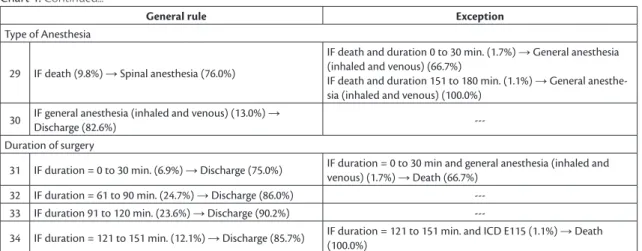
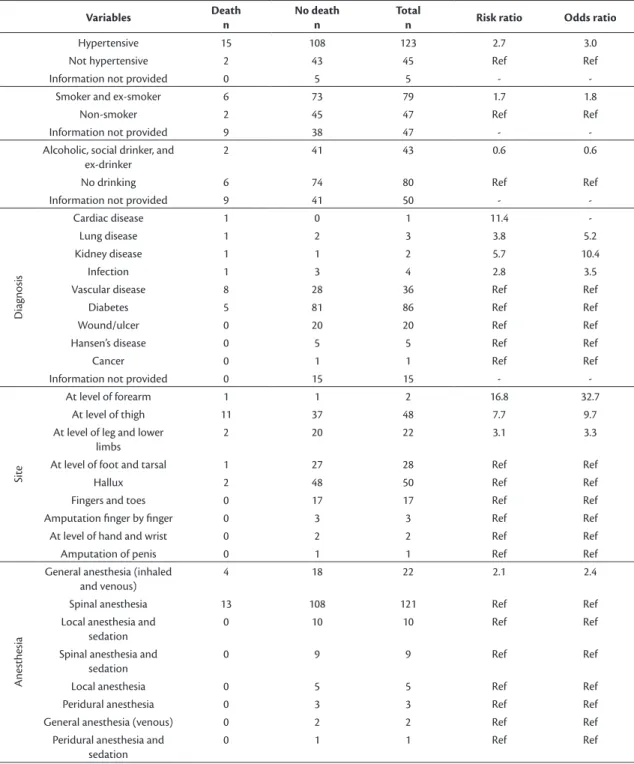
To aid in interpretation of the results, total numbers of deaths and amputations, RR and OR for determinants associated with death will be described in this section and also presented in Table 1. Similarly, the set of rules and exceptions derived using the DM techniques are also shown in Chart 1.
Chart 1. Rules and exceptions.
General rule Exception
Age
1 IF age is 40 to 59 years (27.0%) → Discharge (93.5%) IF age is 40 to 59 years and ICD E115 (1.7%) → ¬ Death (66.7%) 2 IF age is 60 to 69 years (38.0%) → Discharge (87.9%) IF age is 60 to 69 years and ICD I739 (1.7%) → ¬ Death (66.7%) 3 IF age is 70 years or more (35.0%) → Discharge (86.9%) IF age is 70 years or more and ICD I743 (1.1%) → ¬ Death (100.0%) Sex
4 IF sex is female (31.2%) → Discharge (85.2%) IF sex is female and ICD E115 (1.1%) → ¬ Death (100.0%) IF sex is female and ICD I739 (1.7%) → ¬ Death (66.7%) Marital status
5 IF widowed (19.0%) → Discharge (90.9%) IF widowed and retired (1.7%) → ¬ Death (66.7%) 6 IF married (63.0%) → Discharge (86.2%) IF married and ICD I743 (1.7%) → ¬ Death (66.7%)
Race
7 IF race is white (94.2%) → Discharge (88.3%) IF race is white and ICD I743 (1.7%) → ¬ Death (66.7%) IF race is white and ICD I739 (1.7%) → ¬ Death (66.7%) Educational level
8 IF literate (17.8%) → Discharge (93.5%)
---9 IF Primary Ed. completed (13.8%) → Discharge (87.5%)
---10 IF Primary Ed. not completed (32.2%) → Discharge (83.9%) IF Primary Ed. not completed and ICD I743 (1.1%) → ¬ Death (100.0%)
Hypertension
11 IF no hypertension (26.0%) → Discharge (93.3%)
---12 IF death (9.8%) → Hypertension (88%)
---13 IF death and hypertension (8.7%) → Diabetes (86.7%) ---Diabetes
14 IF no diabetes (24.0%) → Discharge (87.8%)
---15 IF death (9.8%) → Diabetes (82.0%)
---16 IF diabetes (72.0%) → Discharge (88.1%) IF diabetes and ICD I739 (1.1%) → Death (100.0%) Smoking
17 IF ex-smoker (24.0%) → Discharge (95.2%)
---18 IF smoker (21.0%) → Discharge (83.8%)
---19 IF non-smoker (27.0%) → Discharge (95.7%) ---Alcoholism
20 IF no alcoholism (46.0%) → Discharge (92.4%)
IF no alcoholism and retired (1.7%) → Death (66.7%) IF no alcoholism and ICD E115 (1.1%) → Death (100.0%) IF no alcoholism and ICD I739 (1.1%) → Death (100.0%) Rehospitalization
21 IF more than one amputation (33.9%) → Discharge (96.6%) ---22 IF death (9.8%) → one amputation (88.2%)
---23 IF death and one amputation (8.7%) → Spinal anesthesia
(80.0%)
---24 IF death and one amputation (8.7%) → Diabetes (80.0%)
---25 IF one amputation (65.5%) → Discharge (85.1%) IF one amputation and ICD E115 (2.9%) → Death (60.0%) Type of surgery
26 IF amp./disart. leg and lower limbs (13.0%) → Discharge
(90.9%)
---27 IF death (9.8%) → Amputation at thigh (64.0%) IF death and duration 0 to 30 min (1.7%) → Amp./disart. of hallux (66.7%)
28 IF amputation at thigh (28.0%) → Discharge (72.9%) IF amputation at thigh and ICD E115 (1.7%) → Death (100.0%) IF amputation at thigh and ICD I743 (1.1%) → Death (100.0%)
Chart 1. Continued...
General rule Exception
Type of Anesthesia
29 IF death (9.8%) → Spinal anesthesia (76.0%)
IF death and duration 0 to 30 min. (1.7%) → General anesthesia (inhaled and venous) (66.7%)
IF death and duration 151 to 180 min. (1.1%) → General anesthe-sia (inhaled and venous) (100.0%)
30 IF general anesthesia (inhaled and venous) (13.0%) →
Discharge (82.6%)
---Duration of surgery
31 IF duration = 0 to 30 min. (6.9%) → Discharge (75.0%) IF duration = 0 to 30 min and general anesthesia (inhaled and venous) (1.7%) → Death (66.7%)
32 IF duration = 61 to 90 min. (24.7%) → Discharge (86.0%) ---33 IF duration 91 to 120 min. (23.6%) → Discharge (90.2%)
---34 IF duration = 121 to 151 min. (12.1%) → Discharge (85.7%) IF duration = 121 to 151 min. and ICD E115 (1.1%) → Death (100.0%)
ICD E115 is type 2 diabetes mellitus with circulatory complications. ICD I739 is peripheral vascular disease, unspecified. ICD I743 is embolism and thrombosis of arteries of the lower extremities.
Table 1. Analysis of sociodemographic variables, morbidities, habits, diagnosis groups, surgery sites, and types of anesthesia.
Variables Death
n
No death n
Total
n Risk ratio Odds ratio
Total 17 156 173 -
-A
ge
40 to 59 years 2 45 47 Ref Ref
60 to 69 years 8 58 66 2.8 3.1
70 years or over 7 53 60 2.7 3.0
Sex FemaleMale 89 11046 11954 Ref2.0 Ref2.1
R
ace
White 17 146 163 -
-Brown 0 4 4 -
-Black 0 4 4 -
-Information not provided 0 2 2 -
-M
ari
tal
s
ta
tu
s MarriedSingle 131 967 1098 2.22.3 2.02.5
Widowed 3 30 33 Ref Ref
Divorced 0 21 21 Ref Ref
Others 0 1 1 Ref Ref
Information not provided 0 1 1 -
-Ed
uc
at
ion
al
le
ve
l
Did not complete primary education
8 48 56 2.6 3.0
Primary education completed
2 22 24 1.5 1.6
Illiterate 0 6 6 Ref Ref
Literate 2 29 31 Ref Ref
Did not complete secondary education
0 1 1 Ref Ref
Secondary education completed
1 15 16 Ref Ref
Higher education completed 0 1 1 Ref Ref
Information not provided 4 34 38 -
-Diabetic 14 111 125 1.5 1.6
Not diabetic 3 38 41 Ref Ref
Information not provided 0 7 7 -
Table 1. Continued...
Variables Death
n
No death n
Total
n Risk ratio Odds ratio
Hypertensive 15 108 123 2.7 3.0
Not hypertensive 2 43 45 Ref Ref
Information not provided 0 5 5 -
-Smoker and ex-smoker 6 73 79 1.7 1.8
Non-smoker 2 45 47 Ref Ref
Information not provided 9 38 47 -
-Alcoholic, social drinker, and ex-drinker
2 41 43 0.6 0.6
No drinking 6 74 80 Ref Ref
Information not provided 9 41 50 -
-D
ia
gn
os
is
Cardiac disease 1 0 1 11.4
-Lung disease 1 2 3 3.8 5.2
Kidney disease 1 1 2 5.7 10.4
Infection 1 3 4 2.8 3.5
Vascular disease 8 28 36 Ref Ref
Diabetes 5 81 86 Ref Ref
Wound/ulcer 0 20 20 Ref Ref
Hansen’s disease 0 5 5 Ref Ref
Cancer 0 1 1 Ref Ref
Information not provided 0 15 15 -
-Si
te
At level of forearm 1 1 2 16.8 32.7
At level of thigh 11 37 48 7.7 9.7
At level of leg and lower limbs
2 20 22 3.1 3.3
At level of foot and tarsal 1 27 28 Ref Ref
Hallux 2 48 50 Ref Ref
Fingers and toes 0 17 17 Ref Ref
Amputation finger by finger 0 3 3 Ref Ref
At level of hand and wrist 0 2 2 Ref Ref
Amputation of penis 0 1 1 Ref Ref
An
est
h
es
ia
General anesthesia (inhaled and venous)
4 18 22 2.1 2.4
Spinal anesthesia 13 108 121 Ref Ref
Local anesthesia and sedation
0 10 10 Ref Ref
Spinal anesthesia and sedation
0 9 9 Ref Ref
Local anesthesia 0 5 5 Ref Ref
Peridural anesthesia 0 3 3 Ref Ref
General anesthesia (venous) 0 2 2 Ref Ref
Peridural anesthesia and sedation
0 1 1 Ref Ref
n indicates the number of occurrences and Ref indicates that these variables were included in the reference group for calculation of the risk ratio and the odds ratio.
but among those with type 2 diabetes mellitus with circulatory complications (1.7% of the sample), 66.7% died (Rules 3, 2 and 1 from Chart 1).
A majority of the amputees were men (68.8%); but the risk and likelihood of death for women were twice those for men (RR = 2.0 and OR = 2.1). Of the female amputees, 85.2% survived to discharge, and all
of those with type 2 diabetes mellitus with circulatory complications (1.1%) died (Chart 1 – Rule 4).
disease (both present in 1.7% of the sample), 66.7% died (Chart 1 – Rule 7).
Married and single patients both had double the likelihood of death than divorced and widowed patients. Married patients accounted for 76.5% of deaths and 63.0% of all patients who had surgery. In the subset of married amputees, 86.2% survived to discharge; but among those with a diagnosis of embolism and thrombosis of arteries of the lower extremities (1.7%), 66.7% died (Chart 1 – Rule 6).
Low educational level was predominant among the amputees: just 1.0% had graduated from higher education and 67.0% had not attended secondary education. Among the 32.0% who had started but not completed primary education, 83.9% survived to discharge, and death was observed in all of those in whom this variable was combined with a diagnosis of embolism and thrombosis of arteries of the lower extremities (1.1%). Among literate amputees (17.8%), 93.5% survived to discharge; and among patients who had completed primary education (13.8%), the discharge rate was 87.5% (Chart 1 – Rules 10, 8 and 9). Information on profession was missing from 70.0% of records, making a detailed analysis impossible. Notwithstanding, the most common professions were: retired, homemaker, driver, construction worker, and salesperson.
Hypertension was present in 71.0% of the amputees and 88.0% of those who died. The likelihood of death was three times greater among hypertensive patients compared with those without hypertension. Of those without hypertension, 93.3% survived to discharge. Diabetes was present in 72.0% of the amputees and in 82.0% of the deaths. In the subset of amputees without diabetes (24%), 87.8% survived to discharge. In the subset of diabetics, 88.1% survived to discharge, but all diabetics with peripheral vascular disease (1.1%) died. Diabetes was present in 86.7% of the hypertensive patients who died (8.7%) (Chart 1 – Rules 11, 14, 16 and 13).
With regard to tobacco use, 45.0% of the amputees had used or still used tobacco, which was associated with 35.0% of the deaths. However, in 53.0% of deaths this information was not provided. Among amputees who stated they did not use tobacco (27.0%), 95.7% survived to discharge. Of the 24.0% ex-smokers, 95.2% survived to discharge; whereas 83.8% of the 21.0% of smokers survived to discharge (Chart 1 – Rules 19, 17 and 18). The order of risks, from higher to lowest, was as follows: smoker, ex-smoker, non-smoker.
With regard to alcoholism, 25.0% drank or had drunk alcohol, which was associated with 12.0% of deaths. However, in 53.0% of deaths this information
was not provided. Of the 46.0% who stated they did not drink alcohol, 92.4% survived to discharge. However, 66.7% of those who stated they did not drink alcohol and were retired (1.7%) died. All of the amputees who did not drink and had a diagnosis of type 2 diabetes mellitus and peripheral circulatory complications (1.1%) died, and so did all non-drinkers with a diagnosis of peripheral vascular disease (1.1%) (Chart 1 – Rule 20).
In the subset of patients who had more than one amputation (33.9%), 96.6% survived to discharge, and 88.2% of the patients who died had had just one amputation that year. In the subset of patients who had had just one amputation that year (65.5%), 85.1% survived to discharge. Among the 2.9% who had had one amputation and had type 2 diabetes mellitus with circulatory complications, 60.0% died (Chart 1 – Rules 21, 22 and 25).
The analysis of groups of pathologies in the diagnostic hypothesis showed that vascular diseases were the major cause of deaths (47.0%), followed by diabetes (29.4%). However, risk of death was 11.4 times greater in the presence of cardiovascular disease, five times greater with kidney disease (RR = 5.7 and OR = 10.4), three times greater with lung disease (RR = 3.8 and OR = 5.2), and double in the presence of infection (RR = 2.8 and OR = 3.5), when compared with the group of diagnostic hypotheses vascular disease, diabetes, Hansen’s disease, neoplasm, and wound/ulcer.
The most common surgeries were hallux (29.0%), thigh (28.0%), and foot and tarsal (16.0%). In the subset of patients who died, 64.0% underwent amputations at the level of the thigh, followed by 12.0% at the hallux and leg, and lower limbs respectively. The risk of death was 16 times higher for surgery at the level of the forearm (RR = 16.8 and OR = 32.7) and seven times higher at the level of the thigh (RR = 7.7 and OR = 9.7), in comparison to surgeries at the level of the foot, tarsal, hallux, fingers and toes, finger by finger, hand and wrist, and penis. Among thigh amputations, 72.9% of the patients survived to discharge, and death was associated with type 2 diabetes mellitus with circulatory complications (1.7%) and with embolism and thrombosis of arteries of the lower extremities (1.1%). After amputation of the leg and lower limb, 90.9% of patients survived to discharge (Chart 1 – Rules 28 and 26).
compared to all other patients, and general anesthesia was present in 24.0% of deaths. Among deaths after general anesthesia (66.7%), 1.7% had surgery lasting from 0 to 30 minutes. All patients with duration of surgery from 151 to 180 minutes (1.1%) and general anesthesia died. In the subset of amputee patients with general anesthesia, 82.6% survived to discharge (Chart 1 – Rules 29 and 30).
With regard to duration of surgery, in 75.0% of operations with duration from 0 to 30 min the patient survived to discharge; but when this duration of surgery was associated with general anesthesia (inhaled and venous), which was observed in 1.7% of the sample, 66.7% of the patients died. Amputations that resulted in discharge varied as follows: duration 61 to 90 min (86.0% discharge), duration 91 to 120 min (90.2% discharge), and duration 121 to 151 min (85.7% discharge). The greatest survival time was observed after operations with duration from 91 to 120 min, with lower survival associated with longer and shorter durations (Chart 1 – Rules 31, 32, 33 and 34).
DISCUSSION
The postoperative mortality rate in this study was low (9.8%) in comparison with other studies, which have reported rates of 19.0%.4 Some studies have
reported overall mortality rates at 30 days ranging from 4.0% to 22.0%.4,5,11 The differences in these
values can be explained by underlying differences in health services, surgical decisions, and the patients’ reasons for the amputation decision.4
Patients aged over the age of 60 years were three times more likely to die than younger patients, which is a characteristic that has been observed in other studies.2-5 Fortington et al. found that people over
the age of 85 years had a mean survival time of 8.8 months after an amputation, whereas in the subset of younger people, survival was greater than 20 months.4
Women had fewer amputations, but died twice as frequently as men. The same scenario was observed in a study by Rolim et al., in which 67.0% of amputations were in men and 33.0% in women, with 30-day mortality rates of 14.0% in men and 15.0% in women; 90-day mortality of 22.0% in men and 26.0% in women; 1-year mortality of 31.0% in men and 36.0% in women; and 5-year mortality of 58.0% in men and 61.0% in women, but this difference was not cited in their study.5
Fortington et al. reported that a majority of the amputees were men (60.0%) with a mean age of 72.1 years, while the women (40.0%) had a mean age of 77 years. In that study, 30-day mortality was 28.0% in men and 31.0% in women; 1-year mortality was 49.0% in men and 52.0% in women; and 5-year
mortality was 78.0% in men and 80.0% in women. This difference can be explained by the fact that the women had amputations at more advanced ages than the men, since age is an important risk factor.4
Mortality was predominantly observed in white patients. This can be explained by the fact that 89.7% of the population of the state of Santa Catarina are white; in addition to the fact that white is the predominant race seen at the study center, because of German immigration.12 In a study by Lavery et al.,
the predominant race was Hispanic (78.1%), survival rate was 78.0% 1 year after amputation and 48.0% at 5 years.13 A similar situation was found in studies with
black patients in the Caribbean and in Barbados, at 69.0% and 44.0%, respectively,14 but these rates are
lower than reported for indigenous North-Americans.15
The predominant marital status category was married (76.5%), but the chances of death were similar for married (OR = 2.0) and single patients (OR = 2.5), when compared with widowed and divorced amputees. This characteristic was linked to the profile of this population, since other studies have reported that a majority (58.0%) of amputation patients lived alone and just 42.0% lived with a partner.4 This information
is indicative of the different healthcare seeking behaviors in different types of marital status and shows that this attribute should be considered when planning treatment and rehabilitation.
The chance of death in hypertensive patients was three times greater than for those who did not have hypertension and the likelihood can increase when associated with diabetes. Studies report that patients with diabetes had greater numbers of minor amputations and twice as many amputations at the transtibial level than transfemoral amputations, in contrast with people who did not have diabetes.4
Risk related to tobacco use was observed in the following order, from high to low: smokers, ex-smokers, and non-smokers. This result agrees with a study that stated that 33.0% of patients who had smoked and 25.0% who had never smoked died within 30 days of amputation, that 50.0% of smokers and 46.0% of non-smokers died within 1 year, and that 78.0% of smokers and 77.0% of non-smokers had died within 5 years,4 confirming that tobacco use is a risk factor
for amputation patients. However, for this variable, for alcoholism, and for profession, there were high percentages of incomplete and missing data, making it difficult to conduct an effective analysis.
disease (peripheral arterial occlusive disease – 87.0%) followed by infection (7.0%), and that presence of ischemic heart disease and cerebrovascular disease had a significant impact as a predictive factor of lower survival.5
Another study showed that, 45.0% of amputees with cerebrovascular disease, 33.0% with kidney disease, 32.0% with cardiac disease, and 28.0% with chronic pulmonary disease died within 30 days of amputation. The probability of death within 30 days was two to three times greater in people who had cerebrovascular disease than in those who did not. Among people with kidney disease, there was a 3.53 times greater probability of death within 1 year and 5.35 times greater probability within 5 years than in the absence of this morbidity.4 Analysis of rehospitalization was
precluded by the temporal window chosen for data selection.
With regard to the level of amputation, the more invasive the amputation, the greater the risk of death. Another study reported survival rates at 30, 90, 365 days and 5 years for patients who underwent minor amputation of 95.0%, 91.0%, 79.0%, and 55.0%, respectively, whereas the figures for patients who underwent major amputations were 82.0%, 70.0%, 62.0%, and 35.0% respectively.4
The decision of which type of anesthesia to use for lower limb amputation surgery is a challenge, with preference usually given to local anesthesia and spinal anesthesia; although there is little evidence to support use of a specific type of anesthesia because of the profile of these patients,16,17 who are at elevated risk
of adverse events.17 In this study, spinal anesthesia
was used in 76.0% of amputations that resulted in death; however, even though general anesthesia (inhaled and venous) was only used in 24.0% of amputations that resulted in death, patients given general anesthesia were 2.4 times more likely to die than those who were not.
However, Chery et al.16 reported that local and/or
regional anesthesia for patients who underwent major amputation of an extremity were associated with a lower incidence of postoperative pulmonary complications and cardiac arrhythmias, which is probably because this is the type of anesthesia that is more favorable in this situation. Moreira et al.17 compared the
association between spinal anesthesia and general anesthesia in patients who underwent amputations of an extremity, concluding that mortality rates at 30 days and other morbidity rates were similar for both types of anesthesia and that type of anesthesia did not significantly affect morbidity or mortality.
CONCLUSIONS
Determinants associated with postoperative mortality after amputation were age over 60 years (OR = 3.0), female sex (OR = 2.0), white race, hypertension (OR = 3.0), diabetes (OR = 1.6), and smoking (OR = 1.8).
The pathologies that most resulted in death were vascular disease (47.0%) and diabetes (29.4%). Increased risk of death was observed in the presence of cardiovascular disease (RR = 11.4), kidney disease (OR = 10.4), lung disease (OR = 5.2), and infection (OR = 3.5). Proximal surgeries were more associated with death than distal surgeries. Anesthesia types most related with death were spinal anesthesia and general anesthesia (inhaled and venous).
Data mining made it possible to identify peculiarities of the associations between determinants of death after amputation surgery. For example, exceptions that link variables to different diagnostic hypotheses, increasing the likelihood of death.
REFERENCES
1. Brasil. Ministério da Saúde. Secretaria de Atenção à Saúde. Departamento de Ações Programáticas e Estratégicas. Diretrizes de atenção à pessoa amputada. 1. reimp. Brasília: Ministéio da Saúde; 2013. 36 p.
2. Jordan RW, Marks A, Higman D. The cost of major lower amputation: a 12-year experience. Prosthet Orthot Int. 2012;36(4):430-4. http:// dx.doi.org/10.1177/0309364612441489. PMid:22440579. 3. Kristensen MT, Holm G, Kirketerp-Moller K, Krasheninnikoff M,
Gebuhr P. Very low survival rates after non-traumatic lower limb amputation in a consecutive series: what to do? Interact Cardiovasc Thorac Surg. 2012;14(5):543-7. http://dx.doi.org/10.1093/icvts/ ivr075. PMid:22298857.
4. Fortington LV, Geertzen JHB, Van Netten JJ, Postema K, Rommers GM, Dijkstra PU. Short and long term mortality rates after a lower limb amputation. Eur J Vasc Endovasc Surg. 2013;46(1):124-31. http://dx.doi.org/10.1016/j.ejvs.2013.03.024. PMid:23628328. 5. Rolim D, Sampaio S, Gonçalves-Dias P, Almeida P, Almeida-Lopes
J, Teixeira JF. Mortalidade depois da amputação. Angiol Cir Vasc. 2015;11(3):166-70. http://dx.doi.org/10.1016/j.ancv.2015.06.001. 6. Associação Paulista de Medicina, Conselho Regional de Medicina do Estado de São Paulo. Programa de avaliação e controle da qualidade do atendimento médico-hospitalar. São Paulo: APM, CRM; 1992. (CQH Informativo; no. 3, ano I, julho).
7. Carvalho DR, Moser AD, Silva VA, Dallagassa MR. Mineração de dados aplicada à fisioterapia. Fisioter Mov. 2012;25(3):595-605. http://dx.doi.org/10.1590/S0103-51502012000300015. 8. Borgelt C. Apriori: association rule induction [online]. Apriori;
2004 [citado 2016 out 21]. http://www.borgelt.net/apriori.html 9. Hussain F, Liu H, Lu H. Exception rule mining with a relative
interestingness measure. Lecture Notes in Artificial Intelligence. 2000;1805:86-97.
11. Van Netten JJ, Fortington LV, Hinchliffe RJ, Hijmans JM. Early post-operative mortality after major lower limb amputation: a systematic review of population and regional based studies. Eur J Vasc Endovasc Surg. 2016;51(2):248-57. http://dx.doi.org/10.1016/j. ejvs.2015.10.001. PMid:26588994.
12. IBGE – Instituto Brasileiro de Geografia e Estatística. Notícias – Censo Demográfico 2000: Última etapa de divulgação do Censo 2000 traz os resultados definitivos, com informações sobre os 5.507 municípios brasileiros [online]. IBGE, 2016. [citado 2016 sep 12]. http://www.ibge.gov.br/home/presidencia/noticias/20122002censo. shtm
13. Lavery LA, Hunt NA, Ndip A, Lavery DC, Van Houtum W, Boulton AJ. Impact of Chronic Kidney Disease on Survival after Amputation in Individuals with diabetes. Diabetes Care. 2010;33(11):2365-9. http://dx.doi.org/10.2337/dc10-1213. PMid:20739688. 14. Hambleton IR, Jonnalagadda R, Davis CR, Fraser HS, Chaturvedi N,
Hennis AJ. All-cause mortality after diabetes-related amputation in Barbados: a prospective case control study. Diabetes Care. 2009;32(2):306-7. http://dx.doi.org/10.2337/dc08-1504. PMid:18984775. 15. Resnick HE, Carter EA, Lindsay R, et al. Relation of lower-extremity amputation to all-cause and cardiovascular disease mortality in American Indians: the Strong Heart Study. Diabetes Care. 2004;27(6):1286-93. http://dx.doi.org/10.2337/diacare.27.6.1286. PMid:15161777.
16. Chery J, Semaan E, Darji S, Briggs WT, Yarmush J, D’Ayala M. Impact of regional versus general anesthesia on the clinical outcomes of patients undergoing major lower extremity amputation. Ann Vasc Surg. 2014;28(5):1149-56. http://dx.doi.org/10.1016/j. avsg.2013.07.033. PMid:24342828.
17. Moreira CC, Farber A, Kalish JA, et al. The effect of anesthesia type on major lower extremity amputation in functionally impaired elderly patients. J Vasc Surg. 2016;63(3):696-701. http://dx.doi. org/10.1016/j.jvs.2015.09.050. PMid:26553953.
*
Correspondence
Gabrielle dos Santos Leandro Pontifícia Universidade Católica do Paraná – PUCPR Rua Imaculada Conceição, nº 1155, 2º Andar, Bloco 3 (Verde) CEP 80215-901 - Curitiba (PR), Brasil Tel.: + 55 (41) 3271-1657 E-mail: [email protected]
Author information
GSL - Graduate nurse from Universidade Estadual do Centro-Oeste (UNICENTRO) and Graduate in Systems Analysis and Development from Universidade do Estado de Santa Catarina (UDESC); Board-certified in Health Family by Pontifícia Universidade Católica do Paraná (PUCPR) and Universidade Federal de Santa Catarina (UFSC); Board-certified in Health Clinic Management by Instituto Sírio-Libanês de Ensino e Pesquisa; MSc student in Health Technology at PUCPR; Nurse (public health system), Joinville. SCP - Graduate nurse from Universidade Bandeirante de São Paulo (UNIBAN); Board-certified in Geriatric and Gerontological Nursing (UNIBAN); Board-certified in Stomal Therapy Nursing by Pontifícia Universidade Católica do Paraná (PUCPR); Clinical care nurse of the Surgery Center of the Hospital Regional Hans Dieter Schmidt; coordinator, Programa Curativos Especiais, Secretaria Municipal de Saúde de Joinville. CMCM - Graduate computer engineer from Pontifícia Universidade Católica do Paraná (PUCPR); MSc in Electrical Engineering from Universidade Estadual de Campinas (UNICAMP); PhD in Electrical Engineering from Universidade de São Paulo (USP); Full professor at PUCPR. DRC - Data processing graduate from Universidade Federal do Paraná (UFPR); MSc in Applied Computer Science from Pontifícia Universidade Católica do Paraná (PUCPR); PhD in Applied Computer Science from PUCPR and in High Performance Computing from Universidade Federal do Rio Janeiro (UFRJ); Professor of MSc in Health Technology (PUCPR); Collaborating professor of the MSc in Health Technology (UFPR).
Author contributions
Conception and design: GSL, DRC, CMCM, SCP Analysis and interpretation: GSL, DRC, CMCM, SCP Data collection: GSL, DRC, SCP Writing the article: GSL, DRC, SCP, CMCM Critical revision of the article: GSL, DRC, CMCM Final approval of the article*: GSL, DRC, CMCM, SCP Statistical analysis: GSL, DRC, CMCM, SCP Overall responsibility: GSL, DRC, CMCM, SCP