(Annals of the Brazilian Academy of Sciences)
Printed version ISSN 0001-3765 / Online version ISSN 1678-2690 www.scielo.br/aabc
Feeding and larval growth of an exotic freshwater prawn
Macrobrachium equidens
(Decapoda: Palaemonidae), from Northeastern Pará, Amazon Region
JEAN N. GOMES, FERNANDO A. ABRUNHOSA, ANNE K. COSTA and CRISTIANA R. MACIEL
Instituto de Estudos Costeiros/IECOS, Campus de Bragança, Faculdade de Biologia, UFPA, Alameda Leandro Ribeiro, s/n, Bairro de Aldeia, 68600-000 Bragança, PA, Brasil
Manuscript received on April 25, 2013; accepted for publication on November 26, 2013
ABSTRACT
In the present study, we carried out experiments on the diet of the freshwater prawn Macrobrachium
equidens. We tested which type of food and which density of food is suitable for larval development. For the experiment on the type of food, eight treatments were carried out: (I) starvation, (AL) microalgae, (RO) rotifers, (AN) Artemia, (RO + AN) rotifers + Artemia, (AL + RO) microalgae + rotifers, (AL + AN) microalgae + Artemia, (AL + RO + AN) microalgae + rotifers + Artemia. For the experiment on the density of food, we used the type of food, which had resulted in a high survival rate in the previous experiment. Three treatments were carried out: 4, 8 and 16 Artemia nauplii /mL. The rate of feeding during larval development was observed. The survival, weight and percentage of juveniles of each feeding experiment
were determined. We found that larvae are carnivores; however, they have requirements with respect to
the type of food, because larvae completed their cycle from the zoeal to the juvenile stage only when Artemia nauplii were available. We also verified that the larvae feed mainly during the day-time, and are opportunistic with respect to the density of food offered.
Key words: Palaemonidae, diet, food preference, live food.
Correspondence to: Cristiana Ramalho Maciel
E-mail: [email protected] INTRODUCTION
Recent studies have revealed several specimens
of
Macrobrachium
, which are morphologically
different from individuals of the same species
recorded for the region of Brazil. The analysis
of the mitochondrial cytochrome oxidase subunit
I gene (COI) has shown that their sequences
diverge 20% from those of
M. acanthurus
(a
native species) and from other sym patric, native
species. When the sequences of these individuals
were compared with sequences in the GenBank
database, we found that they were actually
Macrobrachium equidens
(Dana 1852), an exotic
species native to the Indo-Pacific region (Maciel
et al. 2011).
As
M. equidens
(Dana 1852) is considered an
exotic prawn species to the region of Brazil, studies
that aim to increase knowledge on this species,
including biology, interactions with other congeneric,
native species of the same genus, and the potential
risks of
M. equidens
colonizing the Amazon Region
are needed. So far, no one knows how or when this
alien species was introduced in Brazil.
1990); that adults and larvae can tolerate a wide
variations in salinity from freshwater to oceanic levels
(Denne 1968, Ngoc-ho 1976), and that
M. equidens
adapts well to degraded environments (Short 2004).
In order to become established in a new
environment, the new conditions need to be
com-patible with the reproduction and developmental
requirements of the exotic species. In this context,
reproduction is the most critical step, and in the case of
M. equidens
, larvae are dependent on brackish water
to complete their development (Ngoc-ho 1976). In
this phase, food is one of the most critical items to
the success of the larvae (Anger 2001). Therefore,
we need to know the proper foods and the proper
density of food for the development of
M. equidens
,
and how these factors correlate with variations in the
anatomical structures of the mouthparts and stomach
of the larvae. Furthermore, these data can provide
information about the success of reproduction and
development of this species in the region.
The ontogeny of decapod larvae is marked by
usual changes in dietary habits (Anger 2001). Chu and
Shing (1986) found that larvae of
Metapenaeus ensis
are omnivorous in the early larval stages, but later,
in the final stages, they become carnivores. Changes
in dietary habits among decapod crustacean larvae
happen at different stages of development (Anger
2001). In addition, enzyme production in decapod
crustaceans determines these dietary changes (Jones
et al. 1997). Another factor important to the eating
habits of decapod crustaceans is particle size, which
can influence food capture and reduce or impair
feeding (Anger 2001).
The density of food is also a factor that may
determine larval success. Larvae of most decapod
crustacean species progressively increase their live
food intake as they progress through development
(Anger 2001). However, a surplus of food can lead to
the deterioration of the conditions where the larvae
live, due to an increase in nitrogen compounds
(Abrunhosa and Kittaka 1997). By contrast, food
limitations can compromise nutritionally depleted
larvae, reducing the survival rate and increasing
cannibalism (Jones et al. 1997). The relationship
between increased larval consumption of
Artemia
in
response to an increase in the density of the latter had
been previously observed for larvae
of M. rosenbergii
(Barros and Valenti 2003), king crab -
Paralithodes
camtschaticus
(Epelbaum and Kovatcheva 2005)
and
M. amazonicum
(Maciel et al. 2012). Thus,
the success of feeding during larval development
depends on the efficient combination of food capture
by the larvae and the nutritional quality of the food
(Anger 2001). In general, the optimal density of food
varies from one species to another and in the same
species during different phases of the ontogeny.
Larvae of
M. equidens
have not been subjected
to feeding tests to determine their feeding habits.
Moreover, the ideal density of food that meets
the nutritional requirements of larvae and the
morphophysiological aspects of their digestive
tract are not known. The present study aims to test
different foods and identify their density during the
larval development of
M. equidens
.
MATERIALS AND METHODS
Ovigerous females of
M. equidens
were captured
with baited traps in the Caeté River, city of Bragança,
northeastern Pará, in the Amazon Region (00 58°
58'21" W and 46 ° 44'37" S). After being captured, the
animals were transported in constantly aerated water
from the place of collection to the laboratory. The
animals were then disinfected with formaldehyde
30 mg/L for 30 minutes. Ovigerous females were
stored in individual, six liter tanks with brackish
water at 16, with constant aeration until the larvae
hatched. The females were fed inert diet according
to Mallasen and Valenti (1998). Daily, the leftover
food and waste were removed by siphoning, with
exchange of 80% of the volume of water to avoid
the concentration of nitrogen compounds.
The density of rotifers was determined by
sampling 1 mL of the culture, which was cooled or
diluted in fresh water, to slow down the movement
of the organisms. After this procedure, rotifers were
counted with the aid of a stereomicroscope (40x
objective). For the food preference test, we adopted
a density of 40 rotifers/mL.
Artemia
nauplii were also used in the feeding
test. To determine the density of
Artemia
nauplii, a
1 mL sample was taken, diluted with 100 mL of fresh
water. From that, 10 sub-samples of 4 mL were
removed with a pipette with the tip cut off. All
subjects in each sub-sample were counted and an
arithmetic average was calculated. This number was
multiplied by the volume of fresh water (100 mL).
The resulting number was the density of
Artemia
present in 1 mL. To test for food preference, a
density of 12 AN / mL was adopted.
EXPERIMENT 2 – DENSITY OF THE FOOD SELECTED BY LARVAE
OF M. EQUIDENS
The type of food selected was defined in experiment
1, and the density was determined after observing
the amount of the
Artemia
nauplii. We adopted three
treatments with five replicates (total of 15 rearing
tanks), corresponding to the following food densities:
4 AN / mL, 8 AN / mL and 16 AN / mL. This
expe-riment was conducted in 2-liter tanks furnished with
biological filters in a closed dynamic system, with
a density of 50 larvae/L. At the end, survival, the
percentage of post-larvae, and the dry weight of the
post-larvae were evaluated.
The consumption of
Artemia
nauplii throughout
the day was assessed at 8:00 am, 12:00 pm and
8:00 pm. With the aid of a pipette with the tip cut off,
we withdrew, from each tank, five 4 mL samples. The
Artemia
nauplii present in each sample were counted
by visual observation, and the amount of nauplii per
1 ml was calculated. Subsequently, we calculated
the average of the five sub-units, and the result was
multiplied by the tank volume. The nocturnal food
intake was determined by subtracting the number
Parameters Values
Temperature 29.0 ± 1.0°C
Salinity 16.0 ± 0.5
pH 8.0 ± 0.3
Ammonia (NH4 +
), (NH3) < 0.1 mg/L
Nitrite (NO2) < 0.1 mg/L
Photoperiod 12:12h (light:dark cycle)
TABLE I
Parameters adopted for larval rearing.
EXPERIMENT 1 – FEEDING HABITS
The feeding trials were carried out in 200 mL, aerated
containers with 10 larvae/container. The water and
the food were changed daily (80%). There were eight
treatments (type diet), with ten replicates (total of
80 containers of culture). Treatments (diet offered):
(I) starvation, (AL) microalgae, (RO) rotifers, (AN)
Artemia,
(RO + AN) rotifers +
Artemia,
(AL + RO)
microalgae + rotifers, (AL + AN) microalgae +
Artemia
, (AL + RO + AN) microalgae + rotifers +
Artemia
. At the end of the experiments, survival and
the rate of metamorphosis in larvae and post-larval
stage index were evaluated.
Strains of
Chaetoceros gracilis
(Bacillario-phyceae) microalgae were reared by using agar gel
(fertilized with
Guillard
medium). After the colonies
were formed in the Petri dishes, the best set of colonies
was selected for the experiment. The exponential
growth of algae was conducted using the
Guillard
until obtaining the volume of 2,000 mL.
of nauplii offered, counted at 8:00 pm, from the
number of nauplii remaining the next morning, at
8:00 am, before food offer. The daytime intake was
calculated by subtracting the number of nauplii
counted at 8:00 am (after offering the food) from the
number counted at 8:00 pm Previous to offering the
food at 08:00 am and pm, we cleaned the tanks by
changing the 100 μm screen to a 500 μm, to collect
the remaining cysts and
Artemia
nauplii. During this
period, we also cleaned the bottom of the tank by
siphoning, to collect leftover food and larval excreta.
After these procedures, the 100 μm screens were
replaced, the temperature was taken, and the flow of
water for biological filters was checked.
We collected all organisms from the tanks 26
days after stocking. The numbers of larvae and
post-larvae were determined by counting them.
From these data and the values of each storage
tank, we determined the survival rate, the mortality
rate, and the survival curve, as follows:
S = N
T/ N
0m = - lnS/T
Nt = N0 . e-mt
(1)
(2)
(3)
in which:
S
= final survival rate, expressed as a
proportion,
N
T= number of larvae and PL harvest;
N
0= number of larvae stocked in the tank,
m
=
coefficient of mortality,
-ln
= natural logarithm,
T
= days of rearing;
Nt
= total number of larvae
estimated in the tank for each day;
e
= base of
natural logarithm;
t
= days of culture.
The survival curve was adapted from Krebs
(1999) and Winemiller and Dailey (2002) for a single
cohort. The equation assumes the mortality rate as
constant over time, and has been widely used in
biological studies to forecast fishing inventories. As
no phases of higher mortality were observed in the
hatchery tanks, this curve is acceptable to estimate
the amount of animals in the tank every day.
The number of animals contained in the tanks
every day was estimated by substituting the desired
day in the equation (3). Next, we divided the number
of nauplii consumed by the number of animals in
the tank on that day to estimate the consumption of
Artemia
nauplii/larva.
SURVIVAL, DRY WEIGHT OF POST-LARVAE
Each experiment (Experiments 1 and 2) was completed
when the treatment of at least one experimental
group reached 80% of metamorphosis (or higher) to
postlarvae. To obtain the dry weight of the postlarvae,
we placed the pre-weighed larvae in aluminum paper
containers. They were placed in Petri dishes and kept
in an oven at 60°C (± 5.0) for 48 hours. Then, the
cartridges were transferred to a desiccator and, after
two hours, weighed in with an accuracy of 10 µg.
LARVAL CONDITION INDEX (LCI) AND LARVAL STAGE INDEX (LSI) OF M. EQUIDENS LARVAE
Every 48 hours we verified the Larval Condition
index (
LCI
) (adapted from Tayamen and Brown
1999, for
M. rosenbergii
to
M. equidens
). The
following items were analyzed: bowel condition,
conditions of the hepatopancreas, state of the
chromatophores, body coloration, state of the
rostrum and setae, the proportion of muscle relative
to the intestine, abdominal muscle appearance,
melanization and the presence of infesting
organisms. Each item checked received a value
from 0 to 2, where: 0 = poor, 1 = good, 2 = excellent.
The larval condition index (
LCI
) was determined
according to the formula below:
LCI = Σ P /n
in which:
P
= total number of points assigned to each
larvae examined,
n
= number of larvae analyzed;
LCI
ranges varied from 0 to 2.
LSI = ( Σ ni Ei ) ⁄ n
in which:
ni
= number of larvae at stage
Ei
,
n
= number
of larvae analyzed;
E
= larval stage;
LSI
= ranges
varied from 1 to 10.
STATISTICAL ANALYSES
We used a randomized design for the experiments
on eating habits and the density of food offered. In
the statistical analysis of the results, we performed
tests of normality (Shapiro-Wilk) and
homosce-dasticity (Brown-Forsythe). As we did not observe
a significant deviation from normality and
homos-cedasticity, we applied the ANOVA
F
test. For the
analysis of the intake of
Artemia
we used three
treatments (4 AN / mL, 8 AN /mL and 16 AN /mL),
and the ANOVA was performed on sub-divided
portions. The consumption of nauplii was analyzed
using a split-plot ANOVA, with the feeding protocol
as the principal factor and larval age and feeding
time as sub-categories. We analyzed survival,
productivity and dry weight of the postlarvae.
The survival data were transformed by arcsine
√ x, but they were presented as a percentage to
facilitate understanding. It was considered that the
means differ significantly at
P
<0.05. Data were
analyzed using the SAS software package (version
8.0; SAS Institute).
RESULTS
FOOD MANAGEMENT TEST
The complete larval development happened only
in treatments where
Artemia
was offered as a food
item. Under the other experiments: starvation (I),
and microalgae (AL), all
M. equidens
larvae had
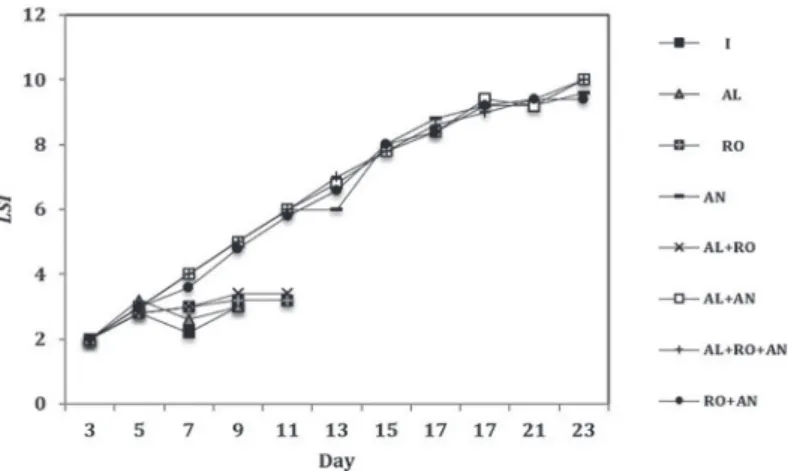
died by the day 11. The experiments in which
rotifers were offered as food (RO) and rotifers +
algae (AL + RO) ended around the day 13, after all
larvae were dead. The treatment with
Artemia
(AL
+ AN, AN and LA + RO + AN) had high survival in
which they were differed only to treatment
Artemia
+ rotifers (RO + AN) (
P
<0.001). Statistical
differences were observed with respect to other
treatments (Table II).
TREATAMENTS
AN AL+AN AL+RO+AN RO+AN
Postlarvae (%) 59 ± 1.72bc 82 ± 1.03a 60 ± 1.05b 44 ± 1.34c
Survival (%) 80 ± 1.33a 93 ± 0.82a 84 ± 1.42a 69 ± 2.46b Fresh weight (mg) 10.5 ± 0.2ab 13.1± 0.11a 12,2 ± 0.14a 9.2 ± 0.18b Dry weight (mg) 0.95 ± 0.31a 1.09 ± 0.19a 0.95 ± 0.13a 0.63 ± 0.23b
TABLE II
Metamorphosis of post-larvae, survival, and weight of post-larvae subjected to the treatments:
Artemia (AN) nauplii, Artemia complemented with microalgae (AL+AN), Artemia complemented
with microalgae and rotifers (AL+RO+AN), Artemia complemented with rotifers (RO+AN). n=
100 larvae per treatment (P< 0.05). Under the other experiments: starvation (I), and microalgae
(AL), rotifers (RO) and rotifers + algae (AL + RO) all M. equidens larvae had died.
The Larval Condition –
LCI
(close to 2) and the
Larval Stage –
LSI
indexes did not differ significantly
during the experiment in the treatments containing
Artemia
(Figure 1). The first post-larvae were
observed near the 22
ndday. The food management
test was concluded on the 27
thday.
In all treatments of the food management test
(Experiments 1) the dissolved oxygen values were
close to the saturation point. Ammonia and nitrite,
in all observations, were below 0.3 mg / L. The
hydrogen potential ranged from 8.0 ± 0.3.
FOOD DENSITY TEST
Intake of
Artemia
nauplii
treatments differed statistically, throughout the
days of the experiment, and between daytime and
night-time (Table III).
The larvae of
M. equidens
began to eat at
development stage II, which they generally reach on
the second day of life. In this phase, they consumed
more
Artemia
nauplii during the daytime and at the
concentration of 16 AN / mL (Figure 2).
Larvae of
M. equidens
ate
Artemia
nauplii
mostly during the day, and increased their intake
Factors and interactions F P
Treatment 1703.52 0.0001**
Replicate (Treatment) 3.01 0.0005**
Day 102.23 0.0001**
Day x Treatment 10.11 0.0001**
Replicate (Day x TR) 0.67 0.9997
Hour 17853.2 0.0001**
Hour x Treatment 1050.49 0.0001**
Day x hour 109.30 0.0001**
Day x Hour x Treatment 11.42 0.0001**
TABLE III
The consumption of Artemia nauplii was analyzed using a split-plot ANOVA, with the feeding protocol as the principal factor and larval age and
feeding time as sub-categories. We considered the
differences statistically significant when P < 0.05.
Figure 1 - Larval Stage (LSI) indexes subjected to the treatments: Artemia (AN) nauplii, Artemia complemented with microalgae (AL+AN), Artemia complemented with microalgae and rotifers (AL+RO+AN), Artemia complemented with rotifers (RO+AN). The complete larval development happened only in treatments where Artemia was offered as a food item, and the LSI did not differ
significantly during the experiment. Under the other experiments: starvation (I), and microalgae (AL), all M. equidens larvae had died by the 11th day. The experiments in which rotifers were offered as food (RO) and rotifers + algae (AL + RO) ended around day 13th, after all larvae were dead. n = 50 larvae per treatment.
during development and in response to increasing
density of food supply (Figure 2). On the fifth day
of culture, when most larvae were in Stage IV,
the daily intake of
Artemia
decreased. At night
there was no increase in the intake of
Artemia
,
independent of the density offered, except between
days 6 and 7 of culture. During this period, most
larvae were between stages IV and V.
The difference in the intake of
Artemia
was
significant between treatments (4 AN /mL, and 8
AN /mL and 16 AN /mL) and between daytime
and night-time (Table III). In the later stages of
development, a decrease in food intake in the
different treatments was not observed, regardless
of the density offered.
LARVAL CONDITION INDEX (LCI) AND LARVAL STAGE INDEX (LSI)
With respect to the Larval Condition Index
(LCI),
14 days, stage VI (Figure 3). Nevertheless, after
this period delay occurred in the LSI for larvae of
the treatment 4 AN/mL (
P
= 0.0049) only.
There were no significant differences in survival
rates, metamorphosis to postlarvae, productivity and
weight between the 8 AN and 16 AN treatments (Table
III). However, the results of the 4 AN / mL treatment
had lower values and were statistically different from
those of other treatments (
P
<0.0001) (Table IV).
Figure 2 - The consumption of Artemia nauplii, mean daytime and night-time ingestion by Macrobrachium equidens larvae during the study period in the following densities: a) 4 AN / mL, b) 8 AN/ mL and c)16 AN / mL.
Figure 3 - Larval Stage (LSI) indexes subjected to the treat-ments with food densities (Artemia nauplii - AN): 4 AN / mL, 8 AN / mL and 16 AN / mL. There were no statistical diffe-rences LSI within 14 days, thereafter, the 4 AN/ml treatment was statistically different (P = 0.0049) from the other
treatments (8 and 16 AN / mL).
4 AN 8 AN 16 AN
Survival (%) 56.8 ± 5.09b 78.4 ± 6.51a 73.8 ± 3.69a
Postlarvae (%) 62.4 ± 3.57b 83.6 ± 2.96a 74.8 ± 2.28a
Productivity (PL/L) 20.1 ± 2.86b 35.3 ± 5.17a 31.4 ± 3.03a
Fresh weight (mg) 6.58 ± 1.10b 9.97 ± 1.20a 10.38 ± 0.64a
Dry weight (mg) 0.39 ± 0.13b 0.93 ± 0.16a 0.98 ± 0.71a TABLE IV
Survival, postlarvae, productivity and weight of subjected to the treatments, food densities: 4 AN /mL, 8 AN / mL and 16 AN / mL. Different letters on the
same line indicate significantly different means (Tukey test, P< 0.05).
LARVAL REARING
Larval rearing took place in a rectangular, 2
liters tank with brackish water (16) in a closed
system dynamic, and a larval density of 50/liter
± 0.025 mg/L) and nitrite (0.1 ± 0.025 mg/L). The
complete development of
M. equidens
consisted
of 10 Zoea stages and one juvenile stage. Survival
was 84%. The first postlarvae were observed near
day 23 of the experiment and larval development
lasted 23-26 days, until the larvae reached the
juvenile stage.
DISCUSSION
Successfully rearing a crustacean species depends
on the quality of the water used and the availability
of appropriate food. To date, no experiments on the
feeding of
M. equidens
larvae had been performed,
which makes this study the first to ascertain the
food habits of this species, and how it relates to
food density.
Given that the water quality in all experiments
was deemed adequate, we can attribute the different
results we observed to the management of food.
Factors that may have interfered in the process
were the size and speed of the prey, as well as the
ease with which the larva captures, assimilates
and digests it. Moreover, larvae undergo changes
throughout their ontogenetic development, which
impacts their ability to find foods that meet all the
requirements of each larval stage (Liu et al. 2007).
M. equidens
larvae have carnivorous habits.
Furthermore, they have certain food requirements.
This idea was corroborated in our experiment by
the fact that only larvae, which were given
Artemia
nauplii, completed their full development to
post-larvae. Possibly,
M. equidens
larvae are able to
capture and digest
Artemia
during all phases of
their development, even though, at some point, the
relationship between the size of the prey and that of
the predator might be disadvantageous to the latter.
Barros and Valenti (2003) observed that larvae
of
M. rosenbergii
, in their early stages, consume
only the abdomen of
Artemia
, suggesting that the
prey is too large for the predator. Nevertheless,
M.
rosenbergii
larvae can be reared successfully on
Artemia
as their only food source (Lavens et al.
2000). According to Anger (2001), when a predator
is able to feed on large prey items, the energy gain is
higher, which may be beneficial to decapod larvae.
Feeding rotifers to
M. equidens
larvae
(
Brachionus plicatillis
) was not appropriate from
the early zoae stages. This may have been due to
the fact that
M. equidens
cannot efficiently capture
or digest and assimilate this food source. The main
evidence for this is a reduction in the larval condition
index from the fourth day of culture, which appeared
similar to the condition of larvae kept unfed or
larvae that were fed microalgae. Larvae on a rotifer
diet only reached the third larval stage, when they
probably were still using yolk reserves. Furthermore,
individuals fed rotifers +
Artemia
also had reduced
survival rate and weight, thus suggesting that the
simple presence of rotifers in the tank had some
kind of detrimental effect on
M. equidens
. A similar
situation was observed for larvae of
Scylla serrata
,
which was attributed to a possible visual confusion
of the larvae, resulting in the reduction in prey
capture (Ruscoe et al. 2004). In addition, rotifers do
not meet the nutritional needs of fish larvae (Atlantic
cod), and their presence increases the risk of bacterial
contamination, reducing water quality (Hamre et al.
2008). In this study,
M. equidens
was reared at low
densities, the density of food was controlled, and
water was exchanged daily, probably minimizing
the effects of water quality. Therefore, it is possible
that larvae of
M. equidens
in the experiments that
included rotifers were nutritionally compromised.
Our results revealed that
Chaetoceros gracilis
microalgae are not a food item in the diet of
M.
micronutrients (vitamins) (Lazo et al. 2000). Felix
and Surdharsan (2004) reported that the addition
of glycine betaine as attractants for
M. rosenbergii
juveniles improves the final weight and survival rates
of the latter. Harpaz (1997) reported that the presence
of betaine in a tank with juveniles results in 17%
growth. In addition, compared to other microalgae,
C. gracilis
stands out due to its high content of
chlorophyll
a
, proteins, soluble carbohydrates, and
total free amino acids (Moura-Júnior et al. 2006).
Another possible explanation is that these algae
not only nurture the
Artemia
nauplii, but that they
also contain nutrients that get transferred to the
M.
equidens
larvae through the food chain.
We observed that the
M. equidens
larvae
increase their intake of
Artemia
nauplii in
response to increasing density of supply, as well
as during ontogeny. Similar results were observed
for larvae of different species of crustaceans:
Paleamon serratus
(Yúfera and Rodríguez 1985a),
Palaemonetes varians
(Yúfera and Rodríguez
1985b),
Metapenaeus ensis
(Chu and Shing 1986),
Scylla serrata
(Zeng and Li 1992),
Ranina ranina
(Minagawa and Murano 1993),
Panopeus herbstii
(Welch and Epifanio 1995),
Zysmata wurdemani
(Zhang et al. 1998),
S. serrata
(Suprayudi et al.
2002),
M. rosenbergii
(Barros and Valenti 2003)
and
M. amazonicum
(Maciel et al. 2012). In most of
these studies, higher rates of survival were associated
with increased ingestion rates and a reduction in
the duration of the intermolt. For
M. equidens
, we
found that the low density of food could be limiting
for larval development, decreasing survival rate
and weight. Moreover, higher density (16 nauplii/
mL) of food was correlated with increased food
intake, but not with longer survival rates, LCI
,
LSI and weight of the post-larvae with respect to
an intermediate density (8 nauplii/mL). A similar
situation has been previously observed in larvae of
Lysmata wurdemanni
, wherein the increased intake
did not lead to increased survival and may even
have had a negative impact (Zhang et al 1998). It
is possible that the larvae of
M. equidens
have an
opportunistic behavior in response to density of
supply, and do not become satiated. The absence of
satiety had also been previously observed in larvae
of
Palaemon serratus
(Yúfera and Rodríguez
1985a) and
Palaemonetes varians
(Yúfera and
Rodríguez 1985b), corroborating our hypothesis.
When we analyzed food intake throughout the
day, we found that
M. equidens
larvae fed preferably
during daytime, and that night-time intake was
negligible. This behavior had been previously
reported for larvae of another crab species,
Ranina
ranina
(Minagawa and Murano 1993), confirming
our results. It is possible that vision has an important
role in prey capture. However, this hypothesis has
been questioned by several authors, who have
regarded capture success as depending on a chance
encounter between predator and prey (Moller 1978,
Anger 2001, Barros and Valenti 2003). Recently,
it was found that larvae of
M. rosenbergii
have
opposed eyes, which are adapted to an illuminated
environment, providing greater visual acuity than
the eyes of the adults of the species (Cavalari
2006). Moreover, positive phototropism has been
reported for decapod larvae (Lin 1997, Anger
2001), which swim about more intensely during
daylight, increasing the likelihood of finding prey.
The hypothesis we advance for
M. equidens
larvae
predicts that vision is critical for prey capture,
because in the absence of light (night), food intake
fell dramatically, even in the presence of high
densities of food, which increase the chance of a
predator and prey encounters. Another hypothesis
predicts that there is an endogenous trophic rhythm
associated with the feeding behavior and the cycle
of molt. Future studies should be conducted to test
these two hypotheses.
and VII, respectively, increasing the larval ability
to shift and to perceive the environment. Zhang et
al. (1998) reported that when larvae of
Lysmata
wurdemanni
reach stages IV to VII, their feeding
rate is less influenced by an increase in food density
than by their increased capacity to move and capture
prey. Further, the acceptance and ingestion of a diet
may be influenced by the maturity of the digestive
tract and by the physical and chemical properties
of the food itself, as well as by the larval ability to
perceive signals (Jones et al. 1997).
The present study strongly suggests that
larvae of
M. equidens
are essentially carnivores
because they reach the juvenile stage when fed
Artemia
nauplii only. We also verified that the
larvae feed mainly during the daytime, and they
are opportunist with respect to the density of food
offered. Such behavior may attribute to invasive
species an important role as a competitor or
predator of native species that utilize the estuarine
area to complete their reproductive cycle (Maciel et
al. 2011). Beyond this, the trophic diurnal rhythm
suggested for
M. equidens
is in accordance with
a more abundant prawn in the Amazon region,
M. amazonicum
, (Maciel et al. 2012). Recent
studies have demonstrated an expansion of the
M.
rosenbergii
in the Amazon coast and a real risk of
colonization in that region was presumed (Iketani
et al. 2011, Silva-Oliveira et al. 2011). For
M.
equidens
, the status of invasion in the Amazonian
area is still unknown therefore further studies are
necessary in order to clarify this issue.
RESUMO
No presente estudo foram realizados experimentos
sobre alimentação, com a espécie de camarão de água
doce Macrobrachium equidens. Foram, testados o tipo de alimento e a densidade de alimento adequada para o desenvolvimento das larvas. Para o experimento sobre o tipo de alimento, 8 tratamentos foram realizados: (I)
inanição, (AL) microalgas, (RO) rotíferos, (NA) náuplios
de Artemia, (RO + NA) rotíferos + Artemia, (AL + RO)
microalgas + rotíferos, (AL + NA) microalgas + Artemia, (AL + RO + NA) microalgas + rotíferos + Artemia. Para o experimento sobre a densidade de alimento, foi utilizado o tipo de alimento que resultou em uma elevada taxa de sobrevivência no experimento anterior. Três tratamentos foram realizados: 4, 8 e 16 náuplios de Artemia/mL.
A taxa de alimentação durante o desenvolvimento
das larvas foi observada. A sobrevivência, o peso e o
percentual de juvenis de cada experimento de alimentação foram determinados. Foi identificado que as larvas de
M. equidens são carnívoras, no entanto, houve uma seletividade do tipo de alimento, pois as larvas concluíram o seu ciclo de zoea para a fase de juvenil somente quando os náuplios de Artemia foram disponibilizados. Verificou-se também que as larvas Verificou-se alimentam preferencialmente
durante o período diurno, e são oportunistas em relação à
densidade do alimento ofertado.
Palavras-chave: Palaemonidae, dieta, preferência
ali-mentar, alimento vivo.
REFERENCES
ABRUNHOSA FA AND KITTAKA J. 1997. Functional morphology of mouthparts and foregut of the last Zoea, glaucothoe and
first juvenile of the king crabs Paralithodes camtschaticus,
P. brevipes and P. platypus. Fish Sci 63(6): 923-930. ANGER K. 2001. The biology of decapod crustacean larvae,
crustacean issues, vol. 14. Lisse, The Netherlands: A. A. Balkema Publishers.
BARROS HP AND VALENTI WC. 2003. Ingestion rates of Artemia nauplii for different larval stages of Macrobrachium rosenbergii. Aquaculture 217: 223-233.
CAVALARI VMH. 2006. Desenvolvimento ontogenético de estruturas sensoriais em Macrobrachium rosenbergii (De Man 1879) (Crustacea, Palaemonidae). Tese de Doutorado,
Universidade Estadual Paulista, 105 p.
CHU KH AND SHING CK. 1986. Feeding behavior of the shrimp, Metapenaeus ensis, on Artemia nauplii. Aquaculture 58: 175-184.
DENNE LB. 1968. Some aspects of osmotic and ionic regulation in the praws Macrobrachium australiense (Holthuis) and M. equidens (Dana). Comp Biochem Physiol 26: 17-30.
EPELBAUM AB AND KOVATCHEVA NP. 2005. Daily food intakes and optimal food concentrations for red king crab (Paralithodes camtschaticus) larvae fed Artemia nauplii under laboratory conditions. Aquac Nutr 11: 455-461. FELIX N AND SURDHARSAN M. 2004. Effect of glycine betaine,
HAMRE K, SRIVASTAVA A, RØNNESTAD I, MANGOR-JENSEN A AND STOSS J. 2008. Several micronutrients in the rotifer
Brachionus sp. may not fulfil the nutritional requirements of marine fish larvae. Aquac Nutr 14(1): 51-60.
HARPAZ S. 1997. Enhancement of growth in juvenile freshwater prawns, Macrobrachium rosenbergii, through the use of a chemoattractant. Aquaculture 156: 221-227.
IKETANI G, PIMENTEL L, SILVA-OLIVEIRA GC, MACIEL C, VALENTI W, SCHNEIDER H AND SAMPAIO I. 2011. The history of the introduction of the giant river prawn, Macrobrachium cf. rosenbergii (Decapoda, Palaemonidae), in Brazil: New insights from molecular data. Genet Mol Biol 34(1): 142-151.
JONES DA, YULE AB AND HOLLAND DL. 1997. Larval nutrition.
In: D’Abramo LR, Conklin DE and Akiama DM (Eds),
Crustacean Nutrition, 1st ed., Baton Rouge, LA: J World Aquac Soc, p. 353-387.
KREBS CJ. 1999. Ecological Methodology, 2nd ed., California, 620 p.
KRISHNA-MURTHY D AND RAJAGOPAL KV. 1990. Food and feeding habits of the freshwater prawn, Macrobrachium equidens (Dana). Indian J Anim Sci 60(1): 118-122. LAVENS P, THONGROD S AND SORGELOOS P. 2000. Larval
prawn feeds and dietary importance of Artemia. In: New
MB and Valenti WC (Eds), Freshwater Prawn Culture, 1st
ed., Oxford, p. 91-111.
LAZO JP, DINIS MT, HOLT GJ, FAULK C AND ARNOLD CR. 2000. Co-feeding microparticulate diets with algae: toward
eliminating the need of zooplankton at first feeding in
larval red drum Sciaenops ocellatus. Aquaculture 188: 339-351.
LIN XT. 1997. Influence of photoperiod on food consumption and development of Macrobrachium rosenbergii larvae. Oceanol Limnol Sin 29: 119-126.
LIU M, CAI Y AND TZENG C. 2007. Molecular Systematics of the Freshwater Prawn Genus. Zool Stud 46(3): 272-289. MACIEL C, QUADROS M, ABRUNHOSA F, BASTOS S, SCHNEIDER
H AND SAMPAIO I. 2011. Occurrence of the Indo-Pacific freshwater prawn Macrobrachium equidens Dana 1852 (Decapoda, Palaemonidae) on the coast of Brazilian Amazonia, with notes on its reproductive biology. An Acad Bras Cienc 83: 533-544.
MACIEL CR, NEW M AND VALENTI WC. 2012. The Predation of Artemia nauplii by the larvae of the Amazon river prawn Macrobrachium amazonicum (Heller, 1862) is affected by prey density, time of day, and ontogenetic development. J World Aquac Soc 43(5): 659-669.
MALLASEN M AND VALENTI WC. 1998. Comparasion of
artificial and natural new and reused, brackish water for
the larviculture of the Freshwater Prawn Macrobrachium rosenbergii in a recirculating system. J World Aquac Soc 29(3): 345-350.
MANZI JJ, MADDOX MB AND SANDIFER PA. 1977. Algal Supplement enhancement of Macrobrachium rosenbergii (De Man) Larviculture. Proc World Maric Soc 8: 207-223.
MINAGAWA M AND MURANO M. 1993. Larval feeding rhythms and food consumption by the red frog crab Ranina ranina (Decapoda, Raninidae) under laboratory conditions. Aquaculture 113: 251-260.
MOLLER TH. 1978. Feeding behaviour of larvae and postlarvae of Macrobrachium rosenbergii (De Man) (Crustacea,
Palaemonidae). J Exp Mar Biol Ecol 35: 251-258.
MOURA-JÚNIOR AM, NETO EB, KOENING ML AND LEÇA EE. 2006. Composição química de microalgas em cultivo semi-intensivo: Chaetoceros gracilis Schutt, Isochrysis
galbana (Parke) e Thalassiosira weissflogii (Grunow) G.
Fryxell and Hasle. Rev Ciên Agro 37(2): 142-148. NGOC-HO N. 1976. The larval development of the praws
Macrobrachium equidens and Macrobrachium sp. (Decapoda: Palaemonidae), reared in the laboratory. J Zool 178: 15-55.
RUSCOE IM, WILLIAMS GR AND SHELLEY CC. 2004. Limiting
the use of rotifers to the first Zoea I stage in mud crab
Scylla serrata (Forskal) larval rearing. Aquaculture 231: 517-527.
SHORT JW. 2004. A revision of Australian river prawns, Macrobrachium (Crustacea: Decapoda: Palaemonidae). Hydrobiologia 525: 1-100.
SILVA-OLIVEIRA GC, READY JS, IKETANI G, BASTOS S, GOMES G, SAMPAIO I AND MACIEL C. 2011. The invasive status of Macrobrachium rosenbergii (De Man, 1879) in Northern Brazil, with an estimation of areas at risk globally. Aquatic Invasions 6(3): 419-428.
SUPRAYUDI MA, TAKEUCHI T, HAMASAKI K AND HIROKAWA J. 2002. Effect of Artemia feeding schedule and density on the survival and development of larval mud crab Scylla serrata. Fish Sci 68: 1295-1303.
TAYAMEN M AND BROWN JH. 1999. A condition index for evaluating larval quality of Macrobrachium rosenbergii (de Man 1879). Aquac Res 30: 917-922.
WELCH JM AND EPIFANIO CE. 1995. Effects of variations in prey abundance on growth and development of Crab
larvae reared in the laboratory and in large field-deployed enclosures. Mar Ecol Prog Ser 116: 55-64.
WINEMILLER KO AND DAILEY WH. 2002. Life history stra-tegies, population dynamics, and consequences for supple-mental stocking of tarpon. Contrib Mar Sci 35: 81-94. YÚFERA M AND RODRÍGUEZ A. 1985a. Effect of prey density
on feeding rates during larval rearing of Palaemon serratus Pennant (Crustacea: Palaemonidae). Aquaculture 50: 31-38. YÚFERA M AND RODRÍGUEZ A. 1985b. Tasas de alimentación
y crecimiento de Palaemonetes varians (Crustacea: Palaemonidae) durante el desarrollo larvario. Invest Pesq 49: 597-606.
ZENG CS AND LI SJ. 1992. Experimental ecological study on the larvae of the mud Crab Scylla serrata (Forskal). I.
Effects of diets on survival and development of larvae.
Trans Chin Crust Soc 3: 85-93.