Correspondence: Erico Castro-Costa Av. Augusto de Lima, 1715 30190-002 Belo Horizonte, MG, Brasil E-mail: [email protected]
Received: Dec 18, 2017 Approved: Mar 18, 2018
How to cite: Castro-Costa E, Lima-Costa MF, Bof de Andrade F, Souza-Junior PRB, Ferri CP. Cognitive function among older adults: ELSI-Brazil results. Rev Saude Publica. 2018;52 Suppl 2:4s.
Copyright: This is an open-access article distributed under the terms of the Creative Commons Attribution License, which permits unrestricted use, distribution, and reproduction in any medium, provided that the original author and source are credited.
http://www.rsp.fsp.usp.br/
Cognitive function among older adults:
ELSI-Brazil results
Erico Castro-CostaI, Maria Fernanda Lima-CostaI,II, Fabíola Bof de AndradeI,II, Paulo Roberto Borges de Souza JuniorIII, Cleusa Pinheiro FerriIV
I Fundação Oswaldo Cruz. Instituto René Rachou. Núcleo de Estudos em Saúde Pública e Envelhecimento. Belo Horizonte, MG, Brasil
II Fundação Oswaldo Cruz. Instituto René Rachou. Programa de Pós-Graduação em Saúde Coletiva. Belo Horizonte, MG, Brasil
III Fundação Oswaldo Cruz. Instituto de Comunicação e Informação Científica e Tecnológica em Saúde. Rio de Janeiro, RJ, Brasil
IV Universidade Federal de São Paulo. Faculdade de Medicina. Departamento de Psicobiologia. São Paulo, SP, Brasil
ABSTRACT
OBJECTIVE: To investigate macroregional variations in cognitive function in a national sample representative of the Brazilian population aged 50 years and older.
METHODS: Data from the baseline of the Longitudinal Study of Brazilian Elderly (ELSI-Brazil), collected between 2015 and 2016, were used. Memory was measured by means of a 10-word list and executive function, by semantic verbal fluency, based on the naming of animals. Gender, age, education, and rural or urban residence were potentially confounding
RESULTS: Among the 9,412 ELSI-Brazil participants, 9,085 were included in the analysis; 53.9% were women and the average age was 63.0 (0.42) years. After adjusting for potential confounding variables, average scores for memory and verbal fluency were lower in the Northeast region and higher in the Midwest and Southeast, respectively. In the South region, higher scores were found for immediate and combined memory. In all regions, older participants and those with lower schooling had worse scores for memory and verbal fluency.
CONCLUSIONS: There are differences in cognitive function among older adults in the different macroregions, independent of age, gender, schooling, and rural or urban residence.
INTRODUCTION
Cognitive function is an important determinant of independence and better quality of life among older adults1. According to recent projections, the elderly population will triple in Brazil and will increase from 19.6 million in 2010 to 66.5 million in 20502, making it the sixth largest elderly population in the world3.
Aging is a complex phenomenon and its impact on health conditions and functionality
occurs heterogeneously among older adults. These differences are associated with genetic4,
environmental and social determinants5-8, and individual characteristics of the elderly9,10. Previous population-based studies with national samples from several countries have shown that socio-demographic factors11,12 and differences between rural and urban residence areas13,14 are related to alterations in cognitive function among older adults, showing important cultural and geographic variations11,12, 15,16.
Brazil is a country of continental proportions, has one of the highest levels of inequality17, occupies the 75th position in the Human Development Index (HDI)18 and presents differences for this index among its macroregions19. There has been an increasing number of studies on the cognitive function of Brazilian older adults20. However, it was observed that the majority (72%) was done in the Southeast and none of these studies had a design that allowed the comparison of cognitive function among Brazilian macroregions20.
The Brazilian Longitudinal Study of Aging (ELSI-Brazil) used a national sample representative of individuals aged 50 years or older and allows us to investigate the
cognitive function of older Brazilian adults. Thus, the objective of the present study was: 1) to investigate the cognitive function of older adults stratified by the Brazilian
macroregions; 2) to compare the association between sociodemographic factors and the place of residence with cognitive function and the variations between the macroregions; 3) to investigate whether the variations in the sociodemographic structure and the place
of residence observed are totally or partially responsible for the potential differences in
cognitive function among macroregions.
METHODS
Data Source
The ELSI-Brazil is a population-based cohort study, designed to represent the Brazilian
population aged 50 years or older, and with the objective of investigating the dynamics
of aging in the Brazilian population and its determinants. The baseline was established
between the years 2015/2016. More details can be found on the research’s homepagea and in another publication21.
ELSI-Brazil baseline data collection included: 1) a household interview; 2) an individual interview with the participant; 3) physical measurements; 4) laboratory tests; 3) storage of blood aliquots for future analysis.
Cognitive Function
The study adopts a conceptual framework common to other large-scale longitudinal studies
of aging in the world, such as the Health and Retirement Study21.
This specific concept of the cognitive function module in ELSI-Brazil allows direct comparison
of Brazilian results with results found in other countries, such as: China [the China Health and Retirement Longitudinal Study (https://g2aging.org/?section=study&studyid=4)], the United States [the US Health and Retirement Study (http://hrsonline. isr.umich.edu)], England [the English Longitudinal Study of Ageing (http://www.natcen.ac.uk/elsa)], Mexico [Mexican Health and AgingStudy(mhasweb.org/Resources.aspx)] etc.
In the present analysis, we selected two variables that represent three well-established domains of cognitive function: memory, language and executive function. Memory was evaluated through the word list learning test, in which 10 words were read to the
participants. Immediate memory was defined as the repetition of the words immediately after their reading. Late memory (delayed recall) was their repetition five minutes after presentation. The participant was kept busy filling out the questionnaire during the
interval between the two tasks. Combined memory was obtained by the sum of the scores for immediate and late memory. Language and executive function were measured by the
semantic verbal fluency test (animal category), in which participants were asked to say the
name of as many animals as they could in a one-minute period.
Other Variables
Also considered were the variables gender, age (50-59, 60-69, 70-79, 80 years or older), schooling (< 4, 4-7, 8-11, > 11) and place of residence (rural or urban).
Ethical Aspects
The ELSI-Brazil Project was approved by the Ethics Commission of Fiocruz, Minas Gerais
(CAAE 34649814.3.0000.5091). All participants signed separate informed consent forms for all research procedures.
Statistical Analyses
Statistical analyzes were conducted in the Stata 14.1 program. Due to the complex design
of the sample with stratification, all analyzes were done using weighting factors for each stratum, thus obtaining in the final results the contribution of each stratum according to its actual weight, and not through its participation in the sample. The use of Stata’s svy
command allowed the output of robust standardized error.
To compare the characteristics of the participants among the macroregions, the analysis
of variance (ANOVA) was weighted for continuous variables and the Pearson’s chi-squared
test was weighted for the categorical variables.
Multivariate linear regressions with a 95% confidence interval were performed to estimate the relationship between memory (immediate, late and combined) and verbal fluency with
gender, age, schooling and place of residence for each macroregion.
Finally, the average of the variables memory (immediate, late and combined) and verbal fluency was standardized separately and then simultaneously, by gender, age, schooling
and place of residence, using the direct method22 for each macroregion.
RESULTS
Of the 9,412 ELSI-Brazil baseline participants, 9,085 (96.5%) presented complete information
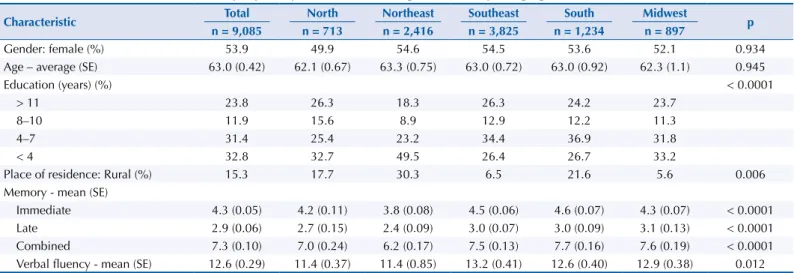
for all variables and were included in this analysis. The main characteristics of the participants by region are presented in Table 1. In the total sample, the average age was 63.0 years (SE = 0.42) and the majority were female (53.9%) and had less than 11 years of schooling (76.2%). Table 2 shows the average scores and multivariate analyzes of the association
between memory and verbal fluency scores stratified by macroregions. Residents in the
Southeast, South and Midwest regions had the best performances, both in the memory
and in the verbal fluency evaluation. Older adults in the Southern macroregion had the
best performance in the variables immediate memory and combined memory, while the
combined memory in the Northeast and Southeast, and in late memory in the Southeast.
In the Midwest, rural residents performed better in late and combined memory. Regarding
verbal fluency, participants from the rural area of the South and Midwest macroregion, and women from the North and Midwest, presented worse performance of this function.
Table 1. Characteristics of the 9,085 sample participants. Brazilian Longitudinal Study of Aging (ELSI-Brazil), 2015-2016.
Characteristic Total North Northeast Southeast South Midwest p n = 9,085 n = 713 n = 2,416 n = 3,825 n = 1,234 n = 897
Gender: female (%) 53.9 49.9 54.6 54.5 53.6 52.1 0.934
Age – average (SE) 63.0 (0.42) 62.1 (0.67) 63.3 (0.75) 63.0 (0.72) 63.0 (0.92) 62.3 (1.1) 0.945
Education (years) (%) < 0.0001
> 11 23.8 26.3 18.3 26.3 24.2 23.7
8–10 11.9 15.6 8.9 12.9 12.2 11.3
4–7 31.4 25.4 23.2 34.4 36.9 31.8
< 4 32.8 32.7 49.5 26.4 26.7 33.2
Place of residence: Rural (%) 15.3 17.7 30.3 6.5 21.6 5.6 0.006
Memory - mean (SE)
Immediate 4.3 (0.05) 4.2 (0.11) 3.8 (0.08) 4.5 (0.06) 4.6 (0.07) 4.3 (0.07) < 0.0001
Late 2.9 (0.06) 2.7 (0.15) 2.4 (0.09) 3.0 (0.07) 3.0 (0.09) 3.1 (0.13) < 0.0001
Combined 7.3 (0.10) 7.0 (0.24) 6.2 (0.17) 7.5 (0.13) 7.7 (0.16) 7.6 (0.19) < 0.0001
Verbal fluency - mean (SE) 12.6 (0.29) 11.4 (0.37) 11.4 (0.85) 13.2 (0.41) 12.6 (0.40) 12.9 (0.38) 0.012 All estimates were weighted by the sample parameters and sample weights of the subjects.
SE: standard error. For continuous and categorical variables, F tests were used, and the weighted chi-square, corrected for the study design, was used as a complex sample.
Table 2. Average scores and multivariate analyzes of the association between the cognitive function scores and the variables gender, age, schooling and place of residence of the 9,085 sample participants. Brazilian Longitudinal Study of Aging (ELSI-Brazil), 2015-2016.
Cognitive function North Northeast Southeast South Midwest Average 95%CI Average 95%CI Average 95%CI Average 95%CI Average 95%CI
Memory
Immediate 4.22 3.99–4.45 3.83 3.65–4.00 4.51 4.40–4.63 4.60 4.45–4.75 4.43 4.30–4.56
Late 2.76 2.45–3.07 2.42 2.23–2.60 3.05 2.90–3.20 3.09 2.92–3.27 3.15 2.89–3.41
Combined 6.99 6.53–7.46 6.26 5.92–6.60 7.58 7.32–7.83 7.70 7.39–8.01 7.60 7.22–7.99
Verbal fluency 11.52 10.78–12.27 11.41 9.73–13.09 13.24 12.42–14.06 12.64 11.84–13.44 13.01 12.25–13.77
β 95%CI β 95%CI β 95%CI β 95%CI β 95%CI
Immediate Memory
Gender (F versus M) 0.22 -0.15–0.59 0.01 -0.10–0.13 0.07 -0.07–0.21 0.04 -0.17–0.27 0.03 -0.13–0.19
Age (≥ 75 versus < 75) -1.95 -2.33– -1.57 -1.31 -1.45– -1.18 -1.20 -1.36– -1.03 -1.55 -1.90– -1.19 -1.49 -1.16– -1.36 Education (< 11 versus≥ 11) -0.96 -1.28– -0.64 -1.17 -1.36– -0.97 -1.02 -1.13– -0.91 -1.01 -1.19– -0.82 -1.07 -1.49– -0.66 Place of residence (rural
versus urban) -0.06 -0.30–0.16 -0.26 -0.39– -0.13 -0.51 -0.66– -0.36 -0.04 -0.32–0.24 0.01 -0.07–0.09 Late Memory
Gender (F versus M) 0.09 -0.17–0.35 0.07 -0.07–0.21 0.07 -0.08–0.23 0.26 0.06–0.46 0.00 -0.44–0.44
Age (≥ 75 versus < 75) -1.76 -2.23– -1.30 -1.13 -1.30– -0.96 -1.52 -1.70– -1.33 -1.54 -1.76– -1.32 -1.45 -1.70– -1.20 Education (< 11 versus≥ 11) -1.02 -1.27– -0.76 -1.22 -1.41– -1.03 -1.21 -1.35– -1.06 -1.11 -1.32– -0.89 -1.12 -1.57– -0.67 Place of residence
(rural versus urban) 0.13 -0.25–0.53 -0.24 -0.53–0.05 -0.54 -0.77– -0.30 -0.22 -0.45–0.02 0.39 0.25–0.52 Combined Memory
Gender (F versus M) 0.31 -0.28–0.90 0.08 -0.14–0.31 0.14 -0.12–0.42 0.31 -0.11–0.73 0.03 -0.55–0.61
Age (≥ 75 versus < 7 5) -3.72 -4.52– -2.92 -2.44 -2.70– -2.19 -2.72 -3.04– -2.40 -3.09 -3.66– -2.53 -2.94 -3.25– -2.62 Education (< 11 versus≥ 11) -1.99 -2.51– -1.46 -2.39 -2.73– -2.05 -2.23 -2.47– -1.99 -2.12 -2.46– -1.78 -2.20 -3.06– -1.34 Place of residence (rural
versus urban) 0.06 -0.50–0.63 -0.50 -0.86– -0.15 -1.05 -1.34– -0.76 -0.26 -0.74–0.22 0.40 0.22–0.58 Verbal Fluency
Gender (F versus M) -1.24 -2.04– -0.44 0.02 -2.07–2.13 -1.44 -3.34–0.45 -0.46 -0.96–0.03 -0.99 -1.72– -0.27 Age (≥ 75 versus < 75) -1.84 -2.66– -1.03 -2.33 -4.35– -0.31 3.74 -2.23–9.72 -2.04 -2.71– -1.38 -2.09 -2.76– -1.42 Education (< 11 versus≥ 11) -1.57 -2.44– -0.70 -1.75 -4.04–0.52 -2.71 -3.53– -1.88 -3.60 -4.24– -2.97 -2.45 -4.15– -0.75 Place of residence
(rural versus urban) -0.20 -1.18–0.77 -1.07 -3.53–1.39 0.90 -3.97–5.78 -0.73 -1.46– -0.01 -1.10 -1.84– -0.36 F: female; M: male
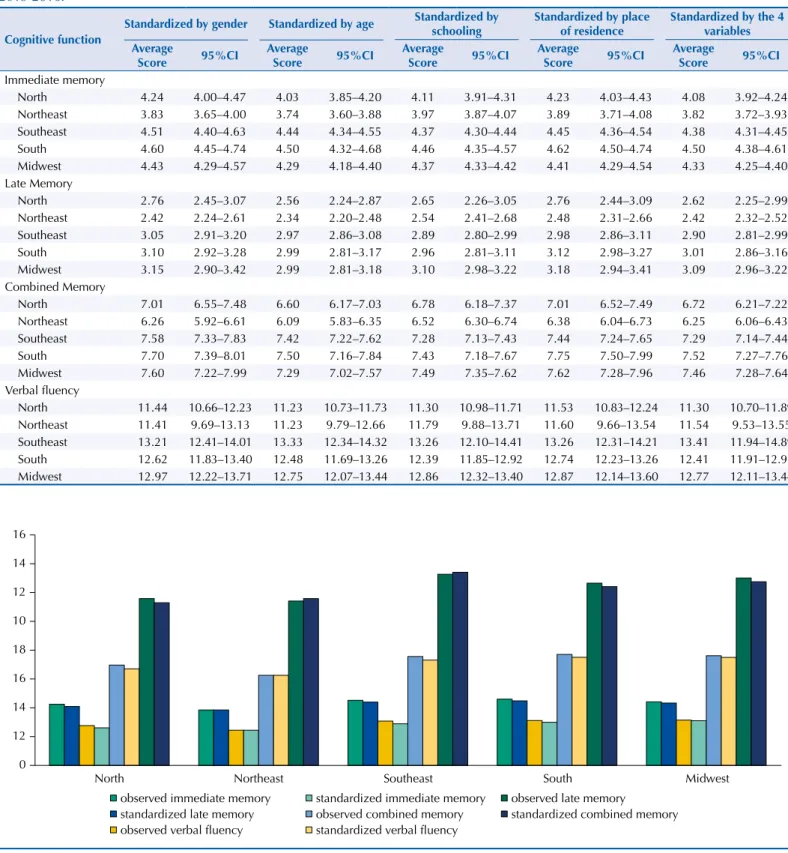
Standardized average memory (immediate, late and combined) and verbal fluency scores are arranged and compared between the macroregions in Table 3. The direct standardization of memory and verbal fluency averages by the individual effect of gender, age, schooling and place of residence and by the simultaneous effect of these four variables did not alter the pattern of difference between the regions.
The values of the averages observed and simultaneously standardized by the four variables are shown in the Figure.
Table 3. Standardized average scores of the cognitive function of the 9,085 sample participants. Brazilian Longitudinal Study of Aging (ELSI-Brazil), 2015-2016.
Cognitive function
Standardized by gender Standardized by age Standardized by schooling
Standardized by place of residence
Standardized by the 4 variables Average
Score 95%CI
Average
Score 95%CI
Average
Score 95%CI
Average
Score 95%CI
Average
Score 95%CI
Immediate memory
North 4.24 4.00–4.47 4.03 3.85–4.20 4.11 3.91–4.31 4.23 4.03–4.43 4.08 3.92–4.24
Northeast 3.83 3.65–4.00 3.74 3.60–3.88 3.97 3.87–4.07 3.89 3.71–4.08 3.82 3.72–3.93
Southeast 4.51 4.40–4.63 4.44 4.34–4.55 4.37 4.30–4.44 4.45 4.36–4.54 4.38 4.31–4.45
South 4.60 4.45–4.74 4.50 4.32–4.68 4.46 4.35–4.57 4.62 4.50–4.74 4.50 4.38–4.61
Midwest 4.43 4.29–4.57 4.29 4.18–4.40 4.37 4.33–4.42 4.41 4.29–4.54 4.33 4.25–4.40
Late Memory
North 2.76 2.45–3.07 2.56 2.24–2.87 2.65 2.26–3.05 2.76 2.44–3.09 2.62 2.25–2.99
Northeast 2.42 2.24–2.61 2.34 2.20–2.48 2.54 2.41–2.68 2.48 2.31–2.66 2.42 2.32–2.52
Southeast 3.05 2.91–3.20 2.97 2.86–3.08 2.89 2.80–2.99 2.98 2.86–3.11 2.90 2.81–2.99
South 3.10 2.92–3.28 2.99 2.81–3.17 2.96 2.81–3.11 3.12 2.98–3.27 3.01 2.86–3.16
Midwest 3.15 2.90–3.42 2.99 2.81–3.18 3.10 2.98–3.22 3.18 2.94–3.41 3.09 2.96–3.22
Combined Memory
North 7.01 6.55–7.48 6.60 6.17–7.03 6.78 6.18–7.37 7.01 6.52–7.49 6.72 6.21–7.22
Northeast 6.26 5.92–6.61 6.09 5.83–6.35 6.52 6.30–6.74 6.38 6.04–6.73 6.25 6.06–6.43
Southeast 7.58 7.33–7.83 7.42 7.22–7.62 7.28 7.13–7.43 7.44 7.24–7.65 7.29 7.14–7.44
South 7.70 7.39–8.01 7.50 7.16–7.84 7.43 7.18–7.67 7.75 7.50–7.99 7.52 7.27–7.76
Midwest 7.60 7.22–7.99 7.29 7.02–7.57 7.49 7.35–7.62 7.62 7.28–7.96 7.46 7.28–7.64
Verbal fluency
North 11.44 10.66–12.23 11.23 10.73–11.73 11.30 10.98–11.71 11.53 10.83–12.24 11.30 10.70–11.89
Northeast 11.41 9.69–13.13 11.23 9.79–12.66 11.79 9.88–13.71 11.60 9.66–13.54 11.54 9.53–13.55
Southeast 13.21 12.41–14.01 13.33 12.34–14.32 13.26 12.10–14.41 13.26 12.31–14.21 13.41 11.94–14.89
South 12.62 11.83–13.40 12.48 11.69–13.26 12.39 11.85–12.92 12.74 12.23–13.26 12.41 11.91–12.91
Midwest 12.97 12.22–13.71 12.75 12.07–13.44 12.86 12.32–13.40 12.87 12.14–13.60 12.77 12.11–13.44
16
14
12
10
18
16
14
12
0
North
observed immediate memory
Northeast Southeast South Midwest
standardized late memory observed verbal fluency
standardized immediate memory observed combined memory
observed late memory
standardized combined memory standardized verbal fluency
DISCUSSION
This is the first national study with a representative sample of the population aged 50 years or older that compared cognitive function in the five Brazilian macroregions, where the
same tests were applied in the same period. Residents of the Southeast, South and Midwest regions presented better cognitive function in all the applied tests. However, there were variations on the ranking, depending on the ability evaluated. In all regions, there was a
worsening of the three types of memory and verbal fluency correlated with the oldest age and
low level of schooling, except for the Southeast macroregion, where the worsening of verbal
fluency was not correlated with older age. Regarding the place of residence, we observed,
inconsistently, that residents of the rural area exhibited lower scores for tests that evaluate
memory and verbal fluency. However, residents of the rural area of the Midwest performed better in late memory than those in the urban area. The female gender presented the worst performance in verbal fluency tests in the North and Midwest macroregions. Finally, the standardized averages of the three types of memory and of verbal fluency by the effect of
gender, age, schooling and place of residence showed that these variables did not explain
all the differences found among the Brazilian macroregions.
This study has several advantages such as: 1) the use of a representative sample of Brazilian
adults aged 50 and older; 2) the direct evaluation of cognitive function through validated and applied tests in the same period, which allows comparisons between the Brazilian
macroregions and with other countries; 3) training and certification of the interviewers
according to the protocols developed for the study; 4) quality assurance and control of data collection by conducting previous pilot studies in order to identify and correct potential problems in procedures and interviews.
However, the study also has limitations that must be considered when interpreting the
results. The use of a weighted sample may underestimate the averages for cognitive function due to its design effect. However, the use of specific analyzes for weighting is
likely to overcome this limitation. Although all dimensions of cognitive function were
not evaluated in this study, scores of our measures (10-word list and verbal fluency test)
were normally distributed with no evidence of floor or ceiling effect23, commonly found
in low education populations.
The results of the present study are directly comparable with studies conducted in
high-income countries (Health Retirement Study [HRS], English Longitudinal Study of Ageing [ELSA], the Irish Longitudinal Study on Ageing [TILDA])11,12 and in middle income countries, such as (Mexican Health and Aging Study [MHAS] and the Chinese Health and Retirement Longitudinal Study [CHARLS])15,16, in which cognitive function was assessed using the same measure for memory (a list of 10 words, with the exception of the MHAS study, which used a
list of eight words) and verbal fluency (animal category semantic fluency test). ELSI-Brazil,
even with a younger sample due to the inclusion of middle-aged adults, presented lower averages for all abilities evaluated (immediate, late and combined memory) when compared to the three studies in high-income countries (HRS, ELSA, TILDA)11,12 which used a sample of
elderly individuals aged 60 years or older. Probably, this occurred due to the great difference
in schooling between these samples, since this factor plays an important role in cognitive function24. In ELSI-Brazil, 76.2% of the sample of Brazilians aged 50 and older have less than 12 years of schooling; in HRS, ELSA and TILDA, rates are 56%, 48% and 44% for those aged 65 years and older, and 39%, 28%, 28% for those aged 57-64 years, respectively11,12.
Compared with studies in middle- and low-income countries, where low schooling was similar between ELSI-Brazil, MHAS and CHARLS15,16. It was observed that in the Mexican study, in spite of presenting an older population (adults 60 years old or older), performance
in all three skills was better compared to our findings (immediate memory: 4.8 versus
4.3; late memory: 4.4 versus 2.9, and verbal fluency: 15.3 versus 12.6). This was because the
not present depressive symptoms16. In addition, the memory was tested by a list of eight
words, which probably influenced the results obtained with this version, overestimating
the performance of the participants16. Regarding the Chinese study15, combined memory performance was worse than in ELSI-Brazil (3.3 versus 7.3), probably because the majority of participants were from the rural area13,14.
Comparisons with other Brazilian studies are limited due to the differences between the age
groups and the outcomes studied. In a study with employees aged 35-74 at six universities
in the Northeast, Southeast and South macroregions, memory was evaluated by a list of 10 words applied at three different occasions (immediate, late, recognition), while semantic verbal fluency was evaluated by the animal category test25. The averages for late memory ranged from
four to eight in men and five to eight in women, while the average values for verbal fluency
ranged from 12 to 21 among men and 13 to 21 among women according to participants’ schooling25. Like the Longitudinal Study on Adult Health (ELSA-Brazil), the present study also demonstrated that older participants with low educational level had worse performance
in memory and verbal fluency. However, the scores were lower in all tests when compared to those found in ELSA-Brazil. This discrepancy probably occurred because ELSA-Brazil was
conducted exclusively in the urban area (six capitals), while ELSI-Brazil was conducted both with participants living in the urban area and with those living in rural areas.
Memory and Verbal Fluency assessments, in the present study, are part of the cognitive
assessment of the Consortium to Establish the Registry for Alzheimer’s Disease (CERAD)26, translated and validated to Brazilian Portuguese for carrying out in Brazilian elderly population27. Previous studies have shown that older people with lower levels of schooling and those coming from rural areas have worse cognitive performance11-16,27; data for the gender variable are inconsistent11,12,15,16,28. Our findings replicated the associations previously
demonstrated for memory and verbal fluency in other studies with population-based samples
11-16,26,27, with the exception of results for late and combined memory, which showed that
participants from rural areas in the Midwest had the best performance. This is likely to have
happened because the main activity in this macroregion is farming, which possibly favors better socioeconomic conditions, which in turn may have contributed to this performance.
Finally, the results of the present study showed that the performance of adults aged 50 years or
older on cognitive function tests is worse than that found in high-income countries (United States, England and Ireland) and inconsistent with that of middle-income countries (worse than that found in Mexico and better than that found in China). We observed that the association between sociodemographic, settlement factors and cognitive function had consistent variation patterns
in the Brazilian macroregions. However, as these factors do not fully explain the differences in
cognitive function in adults aged 50 years or older observed between regions, other contextual
and cultural factors not investigated here may play a relevant role in the differences found.
REFERENCES
1. Cigolle CT, Langa KM, Kabeto MU, Tian Z, Blaum CS. Geriatric conditions and
disability: the Health and Retirement Study. Ann Intern Med. 2007;147(3):156-64.
https://doi.org/10.7326/0003-4819-147-3-200708070-00004
2. Instituto Brasileiro de Geografia e Estatística, Coordenação de Geografia. Brasil: uma visão geográfica e ambiental no início do século XXI. Rio de Janeiro: IBGE; 2016.
3. World health Organization. World report on aging and health. Geneva: WHO; 2015 [cited 2017 Nov 25]. Availabe from: http://www.who.int/entity/ageing/publications/world-report-2015/en/
4. Steves CJ, Spector TD, Jackson SH. Aging, genes, environment and epigenetic: what twin studies
tell us now, and in the future. Age Aging. 2012;41(5):581-6. https://doi.org/10.1093/ageing/afs097
6. Wu L, Chen H, Hu Y, Xiang H, Yu X, Zhang T, et al. Prevalence and associated factors of elder
mistreatment in a rural community in People’s Republic of China: a cross-sectional study. PLoS
One. 2012;7(3):e33857. https://doi.org/101371/journal.pone.0033857
7. Shankar A, McMunn A, Banks J, Steptoe A. Loneliness, social isolation, and behavioral and biological
health indicators in older adults. Health Psychol. 2011;30(4):377-85. https://doi.org/101037/a0022826
8. Iliffe S, Kharicha K, Harari D, Swift C, Gillmann G, Stuck AE. Health risk appraisal in older people 2: the implications for clinicians and commissioners of social isolation risk in older
people. Br J Gen Pract. 2007;57(537):277-82.
9. World Health Organization. Closing the gap in a generation: health equity through action on social determinants of health: final report of the Commission on Social Determinants of Health. Geneva: WHO; 2008 [cited 2017 Nov 23]. Available from: http://whqlibdoc.who.int/ publications/2008/9789241563703_eng.pdf
10. Dannefer D. Cumulative advantage/disadvantage and the life course: cross-fertilizing
age and social science theory. J Gerontol B Psychol Sci Soc Sci. 2003;58(6):S327-37.
https://doi.org/10.1093/geronb/58.6.s327
11. Langa KM, Llewellyn DJ, Lang IA, Weir DR, Wallace RB, Kabeto MU, et al. Cognitive
health among older adults in the United States and in England. BMC Geriatr. 2009;9:23.
https://doi.org/10.1186/1471-2318-9-23
12. Savva GM, Maty SC, Setti A, Feeney J. Cognitive and physical health of the older populations of England, the United States, and Ireland: international comparability of the Irish Longitudinal
Study on Ageing. J Am Geriatr Soc. 2013;61 Suppl 2:s291-8. https://doi.org/10.111/jgs12196
13. Saenz JL, Downer B, Garcia MAG, Wong R. Cognition and context: rural-urban differences in
cognitive aging among older Mexican adults. J Aging Health. 2017 Apr 1::898264317703560.
https://doi.org/10.1177/0898264317703560
14. Cassarino M, O’Sullivan V, Kenny RA, Setti A. Environment and cognitive aging: a cross-sectional study of place residence and cognitive performance in the Irish Longitudinal Study on Aging.
Neuropsychology. 2016;30(5):543-57. https://doi.org/10.1037/neu0000253
15. Lei X, Smith JP, Sun X, Zhao Y. Gender differences in cognition in China and reasons for change over
time: evidence from CHARLS. J Econ Aging. 2014:4:46-55. https://doi.org/10.1016/j.jeoa.2013.11.001
16. Mejía-Arango S, Wong R, Michaels-Obregón A. Normative and standardized data for cognitive
measures in the Mexican Health and Aging Study. Salud Publica Mex. 2015;57 Suppl 1:S90-6.
17. World Bank. Gini Index (World Bank estimate) 2011-2015. Washington (DC); 2015. [cited 2017 Nov 23]. Available from: https://data.worldbank.org/indicator/SI.POV.GINI
18. United Nations Development Programme. Human Development Reports. New York: UNDP [cited 2017 Nov 23]. Available from: http://hdr.undp.org/en
19. Programa das Nações Unidas para o Desenvolvimento. Desenvolvimento humano nas macrorregiões brasileiras: 2016. Brasília (DF): PNUD, IPEA, FJP; 2016.
20. Martins NIM, Caldas PR, Cabral ED, Lins CCSA, Coriolano MGWS. Instrumentos de avaliação
cognitiva utilizados nos últimos 5 anos em idosos brasileiros. CiencSaude Coletiva. 2017 out [cited
2017 Nov 23]:0402. Available from: http://www.cienciaesaudecoletiva.com.br/artigos/instrumentos-de-avaliacao-cognitiva-utilizados-nos-ultimos-5-anos-em-idosos-brasileiros/16454?id=16454
21. Lima-Costa MF, Andrade FB, Souza Jr PRB, Neri AL, Duarte YAO, Castro-Costa E, de Oliveira C.
The Brazilian Longitudinal Study of Aging (ELSI-Brazil): objectives and design. Am J Epidemiol.
2018 Jan 31. https://doi.org/10.1093/aje/kwx387
22. National Institute on Aging; World Health Organization. Global Health and Aging. Bethesda (MD): National Institute of Health; 2011 [cited 2017 Nov 23]. (NIH publication, 11-773). Available from: http://www.who.int/ageing/publications/global_health.pdf
23. Batty GD, Deary IJ, Zaninotto P. Association of cognitive function with cause-specific mortality in middle and older age: follow-up of participants in the English Longitudinal Study of Ageing.
Am J Epidemiol. 2016;183(3):183-90. https://doi.org/10.1093/aje/kwv139
24. Park DC. The basic mechanism accounting for age-related decline in cognitive function. In: Park DC, Schwarz N, editors. Cognitive aging: a primer. New York: Psychology Press; 2000. p.3-21.
25. Passos VMA, Giatti L, Bensenor I, Tiemeier H, Ikram MA, Figueiredo RC, et al. Education plays a greater role than age in cognitive test performance among participants of the
Brazilian Longitudinal Study of Adult Health (ELSA-Brasil). BMCNeurol. 2015;15:191.
26. Morris JC, Heyman A, Mohs RC, Hughs JP, Van Belle G, Fillenbaum G, et al. The Consortium to Establish a Registry for Alzheimer’s Disease (CERAD). Part I. Clinical and neuropsychological assessment
of Alzheirmer’s disease. Neurology. 1989;39(9):1159-65. https://doi.org/10.1212/WNL.39.9.1159
27. Bertolucci PHF, Okamoto IH, Toniolo Neto J, Ramos LR, Brucki SMD. Desempenho da
população brasileira na bateria neuropsicológica do Consortium to Establish a Registry for
Alzheimer’s Disease (CERAD). Rev Psiq Clin (São Paulo). 1998;25(2):80-3.
28. Ferreira L, Ferreira Santos-Galduróz R, Ferri CP, Fernandes Galduróz JC. Rate of cognitive decline
in relation to sex after 60 years-of-age: a systematic review. GeriatrGerontol Int.
2014;14(1):23-31. https://doi.org/10.1111/ggi.12093
Funding: The ELSI-Brazil baseline study was supported by the Brazilian Ministry of Health (DECIT/SCTIE – Department of Science and Technology from the Secretariat of Science, Technology and Strategic Inputs (Grant 404965/2012-1); COSAPI/DAPES/SAS – Healthcare Coordination of Older Adults, Department of Strategic and Programmatic Actions from the Secretariat of Health Care) (Grants 20836, 22566, and 23700); and the Brazilian
Ministry of Science, Technology, Innovation and Communication.
Authors’ Contribution: Data analysis and interpretation: ECC, MFLC, FBA, PRBSJ, CPF. Manuscript writing: ECC, MFLC, FBA, PRBSJ, CPF. Manuscript critical review: ECC, MFLC, FBA, PRBSJ, CPF. All authors have approved the final version of the manuscript and assume public responsibility for its content.