ABSTRACT:Introduction: Multiple illness and injury classes can cause a functional disability of the elderly, or the right to seek help from another person. Caregiving can be generated without the caregiver functions, leading to burden. Objective: to describe the sociodemographic and care profile of caregivers of the elderly and to analyze the factors associated with excessive stress regarding care. Method: This is a cross-sectional study, part of the SABE (Health, well-being and aging) Study, carried out in the city of São Paulo in 2010, with 362 caregivers. The excessive stress associated with care was evaluated by the Zarit Scale, and the load was found to be less than 24 points and the presence of burden was considered, with scores ≥ 24 points. Hierarchical Logistic Regression was used to analyze the factors associated with the stress of family caregivers. Results: Most of the caregivers were family members (91.5%), being female (75.4%), mean age 53.9 years (SD ± 15.5), married (65.3%), lived in the same household with the elderly (68.2%). One-third of them presented burden, which was associated with age (OR = 1.04, p = 0.001), family dysfunction (OR = 5.60, p = 0.000), continuous care (OR = 78, p = 0.030). Conclusions: The data reveal the need to maintain their needs and support to caregivers, especially their relatives and their sources of life and their debts.
Keywords:Aged. Family. Caregivers.
Caregivers of elderly and excessive tension
associated to care: evidence of the Sabe Study
Cuidadores de idosos e tensão excessiva
associada ao cuidado: evidências do Estudo SABE
Daniella Pires NunesI , Tábatta Renata Pereira de BritoII ,
Yeda Aparecida de Oliveira DuarteIII, Maria Lúcia Lebrão (in memoriam)IV
IUniversidade Federal do Tocantins – Palmas (TO), Brazil. IIUniversidade Federal de Alfenas – Alfenas (MG), Brazil.
IIINursing School, Universidade de São Paulo – São Paulo (SP), Brazil. IVPubic Health College, Universidade de São Paulo – São Paulo (SP), Brazil.
Corresponding author: Daniella Pires Nunes. Universidade Federal do Tocantins, Complexo Laboratorial IV, Laboratório de Fundamentos de Enfermagem, sala 2, Avenida NS 15, Norte, 109, Plano Diretor Norte, CEP: 77001-090, Palmas, TO, Brasil. E-mail: [email protected]
Conflict of interests: nothing to declare – Financial support:Fundação de Amparo à Pesquisa do Estado de São Paulo (Fapesp).
INTRODUCTION
The increase in life expectancy has been accompanied by an increase in the prevalence of diseases and noncommunicable chronic diseases with a direct impact on social and health policies, since there is also a progressive increase in people with functional limitations due to such diseases with a constant need for care1. Caring for someone is complex because it involves a series of changes and adaptations both of the caregiver and of the one being taken care of. Studies on elderly caregivers identify their profile historically as familiar, female, spouse or daughter, aged between 50 and 55 years2-7.
The family caregiver, most of the time, has to take on such a function almost suddenly, and is generally not prepared, either psychologically or technically, for the performance of his new role. Very often, either by a family agreement or by exclusive lack of options, a family member is “elected” as an ideal, natural, necessary, desirable or possible caregiver, even if this person does not know, has not been consulted or is not that person’s choice.
This creates personal, family, and even professional conflicts if they perform other day-to-day job functions. Such circumstances can create a state of prolonged stress, leading the caregiver to ignore their own needs and neglect self-care, resulting in illness or even prema-ture death. On the other hand, evidence suggests that carers’ burden may ultimately lead to neglect of the person being taken care of8,9.
Therefore, it is necessary to be clear about the conditions triggering the burden of the caregivers in order to allow the adequate therapeutic planning that involves the elderly,
ReSUMO:Introdução:A presença de múltiplas doenças e agravos crônicos pode ocasionar a incapacidade funcional do idoso, o qual poderá requerer a necessidade de ajuda de outra pessoa. A prestação de cuidados diários e ininterruptos pode gerar no cuidador situações estressoras, levando-o a sobrecarga. Objetivo: Descrever o perfil sociodemográfico e assistencial dos cuidadores de idosos e analisar os fatores associados à tensão excessiva associada ao cuidado. Métodos: Trata-se de um estudo transversal, parte do Estudo Saúde, Bem-Estar e Envelhecimento (SABE), realizado no município de São Paulo, no ano de 2010, com 362 cuidadores. A tensão excessiva associada ao cuidado foi avaliada pela escala de Zarit, e considerou-se ausência de sobrecarga pontuação inferior a 24 pontos e presença de sobrecarga os escores ≥ 24 pontos. Utilizou-se regressão de logística hierárquica para analisar os fatores associados à tensão dos cuidadores familiares. Resultados: A maioria dos cuidadores era familiar (91,5%), do sexo feminino (75,4%), com média de idade de 53,9 anos (desvio padrão — DP ± 15,5), casado (65,3%), residente no mesmo domicílio do idoso (68,2%). Um terço deles apresentou sobrecarga de cuidado, que foi associado à idade (odds ratio — OR = 1,04; p = 0,001), ao relato de disfunção familiar (OR = 5,60; p = 0,000) e à prestação de cuidado contínuo (OR = 2,78; p = 0,030). Conclusão: Os dados revelam a necessidade de políticas públicas que incluam as necessidades e o suporte aos cuidadores, em especial, os familiares, a fim de melhorar sua qualidade de vida e a sua prestação de cuidados às pessoas idosas.
caregiver and family, thus enabling the prevention of health problems and the improvement in the quality of life of all involved.
Thus, the objectives of the present study were to describe the sociodemographic and care profile of caregivers of the elderly and to analyze the factors associated with excessive stress regarding care.
METHODS
A cross-sectional study using the database of the Health, Welfare and Aging Study (Estudo Saúde, Bem -estar e Envelhecimento – SABE), referring to cohorts A, B and C of the year 2010. The sample consisted of 362 caregivers, family members or not (domestic servant, paid caregiver or other non-family figures), living in the city of São Paulo (SP), who were char-acterized as to age, gender, schooling, marital status, family relationship with the elderly, frequency of care and residence or not with the person cared for.
The excessive stress associated with care was only verified among family caregivers (n = 331); hence the 31 non-family caregivers being excluded from the analysis of the fac-tors associated with this tension. For this evaluation, the Zarit Burden Interview (ZBI)10 scale was adapted and validated in Brazil11. This scale evaluates the informal caregiver’s burden in relation to different domains: health, social life, economic situation, mood and type of relationship with the elderly person. It is composed of 22 items, each 1 categorized from 0 (never) to 4 (always) points, making a total of 88 points that reflect the level of tension (burden) of the caregiver. The higher the score, the greater the identified burden. There is no established cut-off point for the Brazilian population that has been validated; therefore, tertiles have been used for classification.
Initially, the normal distribution of the burden variable, which was not detected (p = 0.000), was tested by the Kolmogorov-Smirnov test. Then, the burden among family caregivers was divided into tertiles:
• 1st tertile: < 12 points;
• 2nd tertile: between 12 and 23 points;
• 3rd tertile: ≥ 24 points.
Excessive stress associated with care (burden) was considered for the caregivers classi-fied in the third tertile. First and second tertiles were grouped because they did not present statistical differences, being classified as absence of excessive tension.
We investigated the association between excessive tension of the caregivers and the fol-lowing characteristics:
• health conditions of the elderly: difficulty in carrying out basic activities of daily living (ADL) (eating, bathing, dressing, walking a room, getting up and sitting in bed, going to the bathroom) and instrumental activities of daily living (IADL) (taking care of one’s own money, using means of transportation, buying food, placing a phone call and taking one’s own medication), depressive symptoms, cognitive decline, number of diseases, referred diseases (hypertension, diabetes, osteoporosis, chronic obstructive pulmonary disease, cardiovascular disease, stroke and osteoporosis) and number of medications (none, only one and more than one). The presence of depressive symptoms was evaluated by the brief geriatric depression scale, with cutoff values above five12. It was established as endowed with cognitive decline the elderly that presented values < 13 points in the mental state mini exam13;
• variables related to the care and relationship of the caregiver with the elderly: family functionality, time in the caregiver role (< 1 year, 1 to 5 years, ≥ 5 years), place of residence (same household, nearby household and distant household), impact of the activity on work/study, time spent on care (full-time, once a day, alternate days and whenever needed), and whether or not to receive help from another caregiver.
The family functionality was evaluated by family APGAR (adaptability, partnership, growth, affection and resolve), validated in Brazil by Duarte14. This is a screening test com-posed of the five predominant domains in family relationships — adaptation, companion-ship, development, affectivity and resolving ability —, that assess the degree of satisfaction of the family member in question and the behavior of their family towards each one of them, expressed in numerical form, ranging from 0 (never) to 4 (always). Scores from 0 to 8 classify the family as having high family dysfunction; 9 to 12, moderate family dysfunc-tion; and from 13 to 20, good family functionality14.
The analysis was performed in Stata version 11.0. Logistic regression was used to analyze the association of carers burden with explanatory variables. The magnitude of the associa-tion was estimated by the simple and adjusted odds ratio (OR), at a significance level of 5%. The hierarchical analysis was used, following a distal-proximal direction, starting with the sociodemographic characteristics of the caregiver (block 1), followed by variables related to the elderly’s health conditions (block 2) and then variables related to care and to the rela-tionship between the caregiver and the elderly (block 3) (Figure 1).
The variables that obtained p < 0.20 in the univariate analysis were included in their respective blocks for modeling. From this, they were being conjugated, constructing two more models (block 1 + 2 and block 1 + 2 + 3). A variable was maintained in the model of its respective block when it presented p ≤ 0.05 or when there were changes in adjusted OR greater than 10% in the variables of the previous block. The variables of the block already tested were kept and lost significance when a new variable of another block was included.
The waves from 2006 and 2010 were submitted and approved by the Research Ethics Committee (Comitê de Ética em Pesquisa – COEP) of the Public Health College of the University of São Paulo (opinions No. 83/06 and No. 2.044 / 10, respectively).
RESULTS
Of the 362 caregivers evaluated, 91.5% were family members and 8.5% were nonfamil-iar. Among non-family caregivers, the majority were female (92.2%), with a mean age of 50.7 years (SD ± 12.7) and married (44.4%). Among the family caregivers, 53.6% were sons/ daughters, 28.9%, spouses, 4.0%, siblings, 3.7%, grandchildren, 3.4%, sons-in-law or daugh-ters-in-law and 6.4%, other relatives. Regarding the time dedicated to care, 34.4% reported
Block 1: Sociodemographic characteristics: Gender, age, marital status, education, family
relation to the elderly
Block 2: Health condition of the elderly: Basic and instrumental activities of daily living (ADL and IADL), depression symptoms, cognitive
decline, number of diseases, referred diseases (hypertension, diabetes, osteoporosis, chronic obstructive pulmonary disease, cardiovascular
diseases, stroke and osteoporosis) and number
of medications
Block 3: Conditions related to care: Family function, time dedicated to care, place
of residence, impact of the activity on work activities/study, time in the function, aid for the
performance of the activity
Burden of family caregivers
Table 1. Distribution (%) of caregivers according to sociodemographic and care characteristics, and type of caregiver. Municipality of São Paulo, 2010 (n = 362).
Characteristics (n = 331)Family Non-family(n = 31) p-value
Gender
Male 24.6 2.8
0.043*
Female 75.4 92.2
Age (Mean ± SD) 53.9 ± 15.5 50.7 ± 12.7 0.280
Age in categoriess (years)
< 60 61.0 75.7
0.162
≥ 60 39.0 24.3
Marital status
Single 21.1 14.6
0.004*
Married 65.3 44.4
Separated 8.3 28.9
Widowed 5.3 12.1
Education
No 7.1 8.0
0.881
Yes 92.9 92.0
Geographical distance from the elderly
Same household 68.2 21.3
0.000*
Nearby household 27.4 46.2
Distant household 4.4 32.5
Frequency of help
Whenever necessary 41.9 53.1
0.574
Once a week/alternate days 2.0 1.3
Once a day 21.7 13.1
Full-time 34.4 32.5
How long has been taking care of the elderly (years)
Less than 1 year 11.3 34.1
0.014*
1 to 5 30.7 30.4
More than 5 58.0 35.5
Having assistance in providing care
Yes 36.1 51.1
0.248
No 63.9 48.9
Total 91.5 8.5
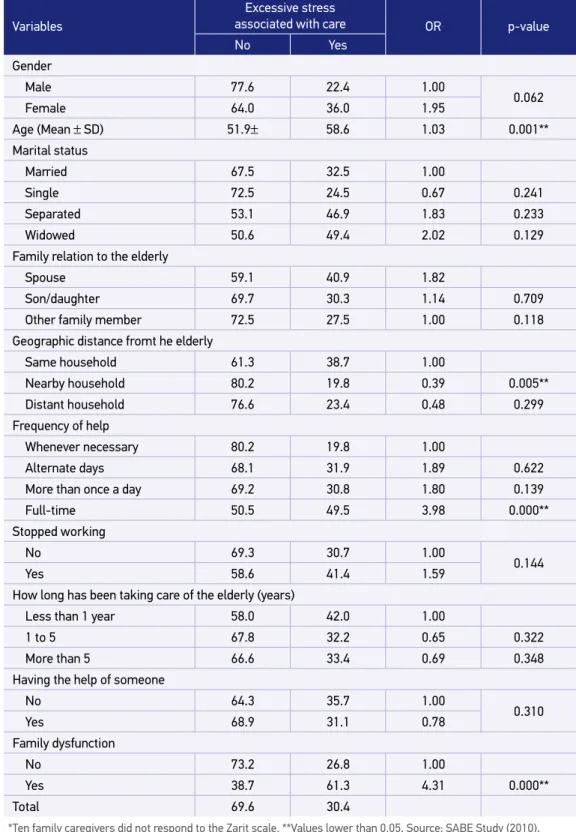
Table 2. Distribution (%) of family caregivers according to excessive stress associated with care and socio-demographic and care characteristics. Municipality of São Paulo, 2010 (n = 321*).
Variables
Excessive stress
associated with care OR p-value
No Yes
Gender
Male 77.6 22.4 1.00
0.062
Female 64.0 36.0 1.95
Age (Mean ± SD) 51.9± 58.6 1.03 0.001**
Marital status
Married 67.5 32.5 1.00
Single 72.5 24.5 0.67 0.241
Separated 53.1 46.9 1.83 0.233
Widowed 50.6 49.4 2.02 0.129
Family relation to the elderly
Spouse 59.1 40.9 1.82
Son/daughter 69.7 30.3 1.14 0.709
Other family member 72.5 27.5 1.00 0.118
Geographic distance fromt he elderly
Same household 61.3 38.7 1.00
Nearby household 80.2 19.8 0.39 0.005**
Distant household 76.6 23.4 0.48 0.299
Frequency of help
Whenever necessary 80.2 19.8 1.00
Alternate days 68.1 31.9 1.89 0.622
More than once a day 69.2 30.8 1.80 0.139
Full-time 50.5 49.5 3.98 0.000**
Stopped working
No 69.3 30.7 1.00
0.144
Yes 58.6 41.4 1.59
How long has been taking care of the elderly (years)
Less than 1 year 58.0 42.0 1.00
1 to 5 67.8 32.2 0.65 0.322
More than 5 66.6 33.4 0.69 0.348
Having the help of someone
No 64.3 35.7 1.00
0.310
Yes 68.9 31.1 0.78
Family dysfunction
No 73.2 26.8 1.00
Yes 38.7 61.3 4.31 0.000**
Total 69.6 30.4
care at all times and 41.9% when necessary. Some of them (19.7%) reported having left their work activities to take on the role of caregiver (Table 1).
Differences between family and non-family caregivers were observed in the marital state, in the place of residence and in the time of exercise in the caring role. It was noted that most family caregivers reported being married, living with the elderly and exercising the function for more than five years (Table 1).
In the assessment of excessive stress associated with care, 30.4% of the caregivers, that is, almost a third of them, presented scores higher than 24 points, thus creating a higher burden (Table 2).
In the univariate analysis, it was observed that the tension levels were associated with the increase of the age. Not living in the same household as the elderly is a pro-tective factor of the burden, when compared to those who lived in the same household. Referring to the exercise of the function as continuous is associated with greater burden in relation to those who assisted according to the need of the elderly, which, in a way, expresses the tension involved in the performance of the function, which is so intense that becomes immeasurable. The identification of the family as dysfunctional by the care-giver increased four times the chance of having tension associated with care (Table 2).
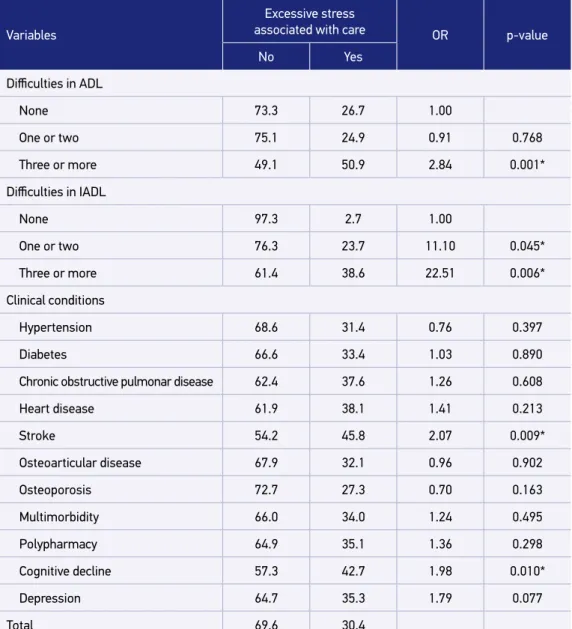
Caring for more dependent elderly significantly increases the chance for the burden of caregivers: 2.84 for ADL and 22.5 for IADL. The same can be observed among elderly with cognitive decline (OR = 1.98, p = 0.10) and encephalic vascular accident (OR = 2.07, p = 0.009) (Table 3).
In the multiple analysis, the characteristics associated with the excessive stress of fam-ily caregivers were age (OR = 1.04, p = 0.001), famfam-ily dysfunction (OR = 5.60, p = 0.000) and continuous care (OR = 2.78, p = 0.030), adjusted for the caregiver’s gender, difficulty in performing ADL, presence of cognitive decline and encephalic vascular accident in the elderly (Table 4).
DISCUSSION
In the most recent study, it can be observed that, even today, that there is a pre-dominance of married women with an average age of over 50 years among caregiv-ers of family and non-family elderly, corroborating other findings3,4,7,8,15-17. Historically, women have taken on the role of caring for their most needy family members, initially because such a role is seen as more feminine, then because they had not yet been in the labor Market18,19.
Table 3. Distribution (%) of the elderly according to health conditions and excessive stress associated with care. Municipality of São Paulo, 2010 (n = 321).
Variables
Excessive stress
associated with care OR p-value
No Yes
Difficulties in ADL
None 73.3 26.7 1.00
One or two 75.1 24.9 0.91 0.768
Three or more 49.1 50.9 2.84 0.001*
Difficulties in IADL
None 97.3 2.7 1.00
One or two 76.3 23.7 11.10 0.045*
Three or more 61.4 38.6 22.51 0.006*
Clinical conditions
Hypertension 68.6 31.4 0.76 0.397
Diabetes 66.6 33.4 1.03 0.890
Chronic obstructive pulmonar disease 62.4 37.6 1.26 0.608
Heart disease 61.9 38.1 1.41 0.213
Stroke 54.2 45.8 2.07 0.009*
Osteoarticular disease 67.9 32.1 0.96 0.902
Osteoporosis 72.7 27.3 0.70 0.163
Multimorbidity 66.0 34.0 1.24 0.495
Polypharmacy 64.9 35.1 1.36 0.298
Cognitive decline 57.3 42.7 1.98 0.010*
Depression 64.7 35.3 1.79 0.077
Total 69.6 30.4
ADL: basic activities of daily living; IADL: instrumental activities of daily living. *Values lower than 0.05. Source: SABE Study (2010).
Daughters take care of elderly parents even if there are male children in the family. These, sometimes, take care of material help or external tasks, such as transporting the elderly to other environments (consultations, examinations etc.)20.
This change is a challenge for health professionals, especially nurses, who should broaden their gaze to the “caretaker man” and review their associated stereotypes of caring as a fem-inine function. It is necessary and possible to encourage them to take on this family task, such as those who have decided to take care of their wives, bravely opposing social and cul-tural values and embarking on the task of caring, classified as eminently feminine24.
The presence of middle-aged caregivers is also a challenge, since their functional reserve may be compromised and may impact, at some point, the best performance of their functions, compromising the quality of care provided to more dependent elderly. In addition, they may neglect their own care, thus accumulating the risk of developing physical and emotional illnesses that may compromise their health and negatively reflect on caretaking5,8,21.
A study developed with 1,087 family caregivers (≥ 50 years old) revealed that they expressed a desire to receive information about how to keep their loved ones safe at home (43%) and how to manage their own stress levels (42%)25. Some studies17,26,27 pointed out that caregivers need professional support and a space to share their doubts and desires, rein-forcing the need to implement public policies aimed at the health care of the caregiver, as well as actions to instrumentalize families for the effective assistance to their more depen-dent elderly relatives.
Most caregivers (75%) lived with the elderly, which, on the one hand, may facilitate the performance of care activities and, on the other hand, contribute to the unfavorable eco-nomic conditions of families24. Many caregivers are unemployed and survive in a situation of living with the elderly, also living on the income of the latter while providing care1.
Families are still the primary caregivers of the elderly due to cultural issues and the shortage of long-term care services28. They are responsible for social, functional, economic,
Table 4. Factors regarding excessive stress associated with care in family caregivers of the elderly. Hierarchical multiple logistic regression models. Municipality of São Paulo, 2010 (n = 321).
Variables ORadjusted* 95%CI p-value
Age of the caregiver (continuous) 1.04 1.02 - 1.06 0001**
Family dysfunction
No 1.00
0.000**
Yes 5.60 2.33 - 13.45
Frequency of care
Whenever necessary 1.00
Alternate days 1.41 0.55 - 3.62 0.467
More than once a day 1.65 0.20 - 13.10 0.630
Full-time 2.78 1.11 - 7.00 0.030**
material and affective support. This assistance takes forms of help in household chores, cleanliness and other activities of daily living, company, affective support in normal and crisis times, transport and accompany to different places, medication care and help in case of illness29.
In 2015, in the United States, the Caregiving report was developed, showing that six out of ten caregivers of individuals (≥ 50 years old) assist them in at least one ADL, mainly trans-ferring them from bed to chair (45%), and collaborate (78%), on average, to carrying out four to seven IADL, such as commuting (78%), purchases (76%) or household chores (72%)25.
The functions attributed to the caregiver involve the performance of practical activities of daily living that aim to assist the physically or cognitively engaged elderly26. Such tasks are often developed without adequate guidance or support, as they involve changes in rou-tines and time spent in care, and can significantly affect their quality of life.
The act of caring can be an important stressor and, when associated with the chronic nature of the situation, may have a negative repercussion on the stress levels of caregiv-ers30. In the present study, it was noted that most of them were engaged all the time or at least once a day. Some authors have identified that caregivers spend a considerable amount of time and effort to take responsibility for caring and found that more than half of them spend an average of four to five hours/day care for the elderly31. The different conditions of care found, due to their not being the most adequate ones, can have as consequences the increase of the tension levels (burden).
Dominguez-Sosa et al.32 carried out a study with caregivers of beneficiaries of the Mexican Institute of Social Security and found a prevalence of burden (mild/intense) of 15%, half of what was observed in this study (30.4%). Such difference may be associated with the classification adopted.
Caregivers with higher levels of tension associated with care limit their social relation-ships, moving away from affective and professional relationrelation-ships, reducing their social net-work and opportunities for socializing and leisure7.
In view of the above, Pearlin et al.33 proposed a model to explain the process of caring for the well-being of family caregivers. This model comprises four explanatory domains:
1. background and context of stress, which include social and economic characteristics of the caregiver;
2. stressors, composed of primary ones, directly related to the provision of care, such as cognitive and behavioral status, problems and extent of dependence of the care recipient; and secondary ones, which arise from the primary and are of a more subjective nature, such as family conflict, and self-esteem;
3. stress mediators: coping and social support are the main ones that can explain the variability in the responses to stressors among caregivers;
4. results or manifestations of stress: physical and mental well-being of the caregiver.
The adoption of measures that aid family support could contribute to the elderly’s perma-nence in their home, thus avoiding institutionalization34.
The association of family dysfunction and excessive stress associated with care may be justified by the inability of family members to adapt to the needs and crises, not by mobi-lizing resources or even their participation in the care of the elderly24,35. Good family func-tionality, on the other hand, can ensure that the elderly, even if dependents, continue to live in community, along with their families.
The results found are challenging, as they question the organization of formal support services and the interaction between professionals, family caregivers and network inter-ventions. The impact of the caring task can be mitigated by sharing, not only within the existing social support network, but also through other support networks such as support or psychoeducational groups36.
CONCLUSION
It is concluded that caregivers are mostly family members, females, daughters, residents of the same household as the elderly and responsible for daily care. Some of them were burdened, which is associated with the frequency of care and the functional and cognitive conditions of the elderly.
Considering this, health professionals should guide caregivers with the demands of care due to the mental and functional condition of the elderly to reduce the burden and therefore the weight and stress, and increase the quality of life of caregivers and their sick relatives.
The findings point to the need for public policies that include the needs and support of caregivers, especially the relatives of the elderly, in order to improve the quality of life of family caregivers and the quality of care provided to the elderly.
1. Camarano AA. Os novos idosos brasileiros muito além dos 60? Rio de Janeiro: IPEA; 2004.
2. Pavarini SCI, Neri AL, Brígola AG, Ottaviani AC, Souza EM, Rossetti ES, et al. Elderly caregivers living in urban, rural and high social vulnerability contexts. Rev Esc Enferm USP 2017; 51: e03254. http://dx.doi. org/10.1590/S1980-220X2016040103254
3. Fuhrmann AC, Bierhals CCBK, Santos NO, Paskulin LMG. Associação entre a capacidade funcional de idosos dependentes e a sobrecarga do cuidador familiar. Rev Gaúcha Enferm 2015; 36(1): 14-20. http://dx.doi. org/10.1590/1983-1447.2015.01.49163
4. Gratão ACM, Talmelli LFS, Figueiredo LC, Rosset I, Freitas CP, Rodrigues RAP. Dependência funcional de idosos e a sobrecarga do cuidador. Rev Esc Enferm 2013; 47(1): 137-44. http://dx.doi.org/10.1590/ S0080-62342013000100017
5. Nardi EFR, Sawada NO, Santos JLF. Associação entre a incapacidade funcional do idoso e a sobrecarga do cuidador familiar. Rev Latino-Am Enferm 2013; 21(5): 1093-113.
6. Pedreira LC, Lopes RLM. Vivência do idoso dependente no domicílio: análise compreensiva a partir da historicidade heideggeriana. Rev Eletr Enf 2012; 14(2): 304-12. http://dx.doi.org/10.5216/ree.v14i2.10313
7. Amendola F, Oliveira MAC, Alvarenga MRM. Influence of social support on the quality of life of family caregivers while caring for people with dependence. Rev Esc Enferm USP [Internet]. 2011 [acesso em 22 jan. 2017]; 45(4): 884-9. Disponível em: http://www. scielo.br/pdf/reeusp/v45n4/en_v45n4a13.pdf
8. Pereira RA, Santos E, Fhon JRS, Marques S, Rodrigues RAP. Sobrecarga dos cuidadores de idosos com acidente vascular cerebral. Rev Esc Enferm USP 2013; 47(1): 185-92. http://dx.doi.org/10.1590/ S0080-62342013000100023
9. Morais HCC, Soares AMG, Oliveira ARS, Carvalho CML, Silva MJ, Araújo TL. Sobrecarga e modificações de vida na perspectiva dos cuidadores de pacientes com acidente vascular cerebral. Rev Latino-Am [Internet]. 2012 [acesso em 19 maio 2018]. Disponível em: http:// www.scielo.br/pdf/rlae/v20n5/pt_17.pdf
10. Zarit SH, Zarit JM. The Memory and Behaviour Problems Checklist 1987R and the Burden Interview (Technical report). Filadélfia: Pennsylvania State University; 1987.
11. Scazufca M. Versão brasileira da escala Burden Interview para avaliação de sobrecarga em cuidadores de indivíduos com doenças mentais. Rev Bras Psiquiatr 2002; 24(1): 12-7. http://dx.doi.org/10.1590/ S1516-44462002000100006
12. Almeida OP, Almeida SA. Confiabilidade da versão brasileira da Escala de Depressão Geriátrica (GDS) versão reduzida. Arq Neuropsiquiatr 1999; 57(1): 421-6. http://dx.doi.org/10.1590/S0004-282X1999000300013
13. Icaza MC, Albala C. Projeto SABE. Minimental State Examination (MMSE) del estudio de dementia en Chile: análisis estatístico. Genebra: OPAS; 1999.
14. Duarte YAO. Família: rede de suporte ou fator estressor: a ótica de idosos e cuidadores familiares [tese]. São Paulo: Escola de Enfermagem, Universidade São Paulo; 2001.
15. Ajay S, Kasthuri A, Kiran P, Malhotra R. Association of impairments of older persons with caregiver burden among family caregivers: Findings from rural South India. Arch Gerontol Geriatr 2017; 68: 143-8. http:// dx.doi.org/10.1016/j.archger.2016.10.003
16. Anjos KF, Boery RNDO, Santos VC, Boery EN, Rosa DOS. Características de idosos e de seus cuidadores familiares. Rev Enferm UFPE 2017; 11(3): 1146-5. https://doi. org/10.5205/1981-8963-v11i3a13489p1146-1155-2017
17. Miranda ACC, Sérgio SR, Fonseca GNS, Coelho SMC, Rodrigues JS, Cardoso CL, et al. Avaliação da presença de cuidador familiar de idosos com déficits cognitivo e funcional residentes em Belo Horizonte-MG. Rev Bras Geriatr Gerontol 2015; 18(1): 141-50. http:// dx.doi.org/10.1590/1809-9823.2015.13173
18. Guedes OS, Daros MA. O cuidado como atribuição feminina: contribuições para um debate ético. Serv Soc Rev. 2009; 12(1): 122-34. http://dx.doi. org/10.5433/1679-4842.2009v12n1p122
19. Moreira MD, Caldas CP. A importância do cuidador no contexto da saúde do idoso. Esc. Anna Nery 2007; 11(3): 520-5. http://dx.doi.org/10.1590/ S1414-81452007000300019
20. Neri AL, Sommerhalder C. As várias faces do cuidado e do bem-estar do cuidador. In: Neri AL (Ed.). Cuidar de idosos no contexto da família: questões psicológicas e sociais. 3ª ed. Campinas: Alínea; 2012.
21. Karsch UM. Idosos dependentes: famílias e cuidadores. Cad Saúde Pública 2003; 19(3): 861-6. http://dx.doi. org/10.1590/S0102-311X2003000300019
22. Gonçalves LHT, Alvarez AM, Sena ELS, Santana LWS, Vicente FR. Perfil da família cuidadora de idoso doente/ fragilizado do contexto sociocultural de Florianópolis, SC. Texto Contexto Enferm 2006; 15(4): 570-7. http:// dx.doi.org/10.1590/S0104-07072006000400004
23. Vilela ABA, Meira EC, Souza AS, Souza DM, Cardoso IS, Sena ELS, et al. Perfil do familiar cuidador de idoso doente e/ou fragilizado do contexto sociocultural de Jequié-BA. Rev Bras Geriatr Gerontol 2006; 9(1): 55-69.
24. Gonçalves LHT, Costa MAM, Martins MM, Nassar SM, Zunino R. A dinâmica da família de idosos mais idosos no contexto de Porto, Portugal. Rev Latino-Am Enferm [Internet] 2011 [acessado em 28 fev. 2018]; 19(3): [9 telas]. Disponível em: http://www.scielo. br/pdf/rlae/v19n3/pt_03.pdf
25. National Alliance for Caregiving, Public Policy Institute. Caregiving in the U.S. [Internet] 2015 [acessado em 22 jan. 2018]. Disponível em: http://ww1. prweb.com/prfiles/2015/06/03/12765231/2015_ CaregivingintheUS_Final%20Report_WEB.pdf
26. Diniz MAA, Figueiredo LC, Neri KH, Gaioli CCLO, Casemiro FG, Melo BRS, et al. Estudo comparativo entre cuidadores formais e informais de idosos. Ciênc Saúde Colet [Internet] 2016 [acessado em 11 dez. 2017]. Disponível em: http://www. cienciaesaudecoletiva.com.br/artigos/estudo- comparativo-entre-cuidadores-formais-e-informais-de-idosos/15954
27. Mafra SCT. A tarefa do cuidar e as expectativas sociais diante de um envelhecimento demográfico: a importância de ressignificar o papel da família. Rev Bras Geriatr Gerontol 2011; 14(2): 353-63. http:// dx.doi.org/10.1590/S1809-98232011000200015
29. Rodrigues SLA, Watanabe HAW, Derntl AM. A saúde de idosos que cuidam de idosos. Rev Esc Enferm USP 2006; 40(4): 493-500.
30. Carretero S, Garcés J, Ródenas F, Sanjosé V. The informal caregiver’s burden of dependent people: theory and empirical review. Arch Gerontol Geriatr 2009; 49(1): 74-9. https://doi.org/10.1016/j.archger.2008.05.004
31. Pinto-Afanador N, Barrera-Ortiz L, Sánchez-Herrera B. Reflexiones sobre el cuidado a partir del programa “cuidando a los cuidadores”. Rev Aquichan 2005; 5(4): 128-37.
32. Domínguez-Sosa G, Zavala-González MA, De la Cruz-Méndez DC, et al. Síndrome de sobrecarga en cuidadores primarios de adultos mayores de Cárdenas, Tabasco, México. Rev MED UIS [internet] 2010; 23(1): 28-37.
33. Pearlin LI, Mullan JT, Semple SJ, Skaff MM. Caregiving and the stress process: An overview of concepts and
their measures. Gerontologist 1990; 30(5): 583-94. http://dx.doi.org/10.1093/geront/30.5.583
34. McFall S, Miller BH. Caregiver burden and nursing home admission of frail elderly persons. J Gerontol 1992; 47(2): S73-9.
35. Roca-Roger M, Úbeda-Bonet I, Fuentelsaz-Gallego C, López-Pisa R, Pont-Ribas A, García-Viñets L, et al. Impacto del hecho de cuidar em la salud de lós cuidadores familiares. Atención Primaria 2000; 26(4): 217-23. http://dx.doi.org/10.1016/ S0212-6567(00)78650-1
36. Figueiredo D, Lima MP, Sousa L. Cuidadores familiares de idosos dependentes com e sem demência: Rede social, pessoal e satisfação com a vida. Psic Saúde Doenças 2012; 13(1): 117-29.
Received on: 07/27/2018 Accepted on: 08/28/2018