Raize: How an Innovative Business Model Led to a Successful IPO
Margarida Isabel Conceição Duarte
Case Study submitted as partial requirement for the conferral of Master’s in management
Supervisor:
Rui Ferreira, Prof. Auxiliary, ISCTE Business School, Department of Finance
Acknowledgements
While building a master thesis, we realize just how much power there is in knowledge, just how much we can grow just by reading, learning and observing. The demanding work that is involved in the construction of a thesis is no joke and it helps to understand a little better who we are and what we want.
I would like to dedicate this work to my parents and sister, who support me in every decision and are able to help me put everything into perspective. Thank you for always allowing me to follow my intuition and believing in me even when I couldn’t. To Gonçalo, the person that is always ready to hear me out, even if far away. A very special thanks to my dear friend Raquel, that dealt with my anxieties and insecurities and gave her unconditional support throughout the entire time.
A very special thanks to my supervisor, Professor Rui Ferreira, that believed in my potential even if I couldn’t see it myself. Your support was crucial for this work.
Abstract
For the past decade we have been watching a digital revolution taking place in our businesses. It seems everything is digital now, any activity that was previously costly or time consuming, is now efficient, on our pockets and usually for free.
The Portuguese entrepreneurial tissue is catching up to the trend and many new
start-ups are surging, being that there is a big emphasis on financial start-ups, commonly
known as FinTech’s.
I line with this, Raize’s growth is a phenomenon that you can’t help but observe.
It is a one of a kind growth in the Portuguese economy that sparked the attention of every
financial consumer. From a mere idea in 2012 to a growing start-up in 2013 culminating
with the launch of an IPO and what is the element that will shake up the capital market in
Portugal.
In this case, we will dissect the company’s business model and modus operandis
to understand what is the differentiation that makes this company be chosen over a
traditional and established traditional provider.
Keywords: Fintech, IPO, Digital Innovation, Business Model
G11 Portfolio Choice • Investment Decisions
Resumo
Na última década temos assistido a uma revolução digital que tem tomado conta das nossas empresas. Tudo aparenta ser digital agora, qualquer atividade que anteriormente seria dispendiosa ou consumidora de tempo, é agora eficiente, ao alcance do nosso bolso e normalmente sem custos associados.
O tecido empresarial português está a acompanhar estas tendências e muitas start-ups estão agora a surgir, havendo um grande ênfase em start-start-ups financeiras, conhecidas por Fintechs.
Em linha com este panorama, o crescimento da Raize é um fenómeno que não podemos deixar de observar. Representa um crescimento sem precedentena economia portuguesa que atraiu a atenção de todos os consumidores financeiros. De uma mera ideia em 2012 a uma start-up em crescimento e 2013 culminando no lançamento da IPO que se apresenta como o elemento para despertar o mercado de capitais nacional.
Neste Case Study, iremos dissecar o modelo de negócios e o modus operandis da empresa para compreender qual a diferenciação que a leva a ser escolhida ao invés de um provedor de serviços tradicional e já estabelecido no mercado.
Index
1. Case Study ... 1
1.1. The Issue ... 1
1.2. Raize ... 1
1.2.1. Mission and Vision ... 2
1.2.2. Company’s Evolution ... 2 1.2.3. Internal Diagnosis ... 4 1.2.3.1. Company’s Organization ... 4 1.2.3.2. Financial information ... 5 1.2.4. Business Model ... 5 1.2.5. Sustainability ... 8 1.2.6. Consumer relation ... 9
1.2.7. Sector Analysis in Portugal ... 10
1.2.8. The IPO ... 11
1.2.8.1. Financial and Legal Advisors ... 12
1.2.8.2. Raize’s Offer ... 12
1.2.8.3. Results of the IPO ... 13
1.3. Restatement of the Issue and Questions ... 14
2. Pedagogical Note... 15 2.1. Target ... 15 2.2. Educational Objectives ... 15 3.1. FinTech ... 16 3.1.1. Concept definition ... 16 3.1.2. Evolution ... 17 3.1.3. FinTech Revolution ... 18 3.2. Digital Innovation ... 20 3.2.1. Concept Definition ... 20 3.2.2. Cyber Security ... 20
3.2.3. Innovation of Business Models ... 21
3.2.4. PSD2 Directive ... 22
4. Methodology ... 23
4.1. Research Design ... 23
4.2. Research Design ... 23
4.4. Data Analysis ... 24
5. Case Solution Slides ... 25
6. Presentation of the set on analytical tools ... 26
7. Case study lecture plan ... 27
8. Lecture issues to be posed to the student ... 27
5. Resolution ... 28
5. Case Solution Slides ... 35
6. Management Conclusions ... 35
7. Bibliography ... 36
8. Attachments ... 41
8.1. Balance Sheet September 2016 ... 41
8.2. Balance Sheet March 2017 ... 42
8.3. Balance Sheet June 2017 ... 43
8.4. Balance Sheet September 2017 ... 44
8.5. Balance Sheet March 2018 ... 45
8.6. Balance Sheet June 2018 ... 46
8.7. Integral Interview with Tiago Correia ... 47
Index of Figures: Figure 1 Company's organogram, translated ……….…….…… 4
Figure 2 Raize's Capital distribution ……….……….…….……… 7
Index of Tables: Table 1 Comparison between Raize and Housers ………...………...… 11
1 1. Case Study
1.1. The Issue
Crowdfunding is not an innovative concept. Numerous papers and studies have been made on this topic and on the power held by the small investor to the success of companies in all kinds of areas.
However, the idea behind taking an already well known and establish business model and tweaking it to loans to small and medium enterprises can elevate the idea and form a new concept: crowdlending.
If the lending process is accessible to more people, is made easier and does not require massive amounts to begin, anybody can be an investor. The use of technology allows for a more cost-effective way to grow your savings while financing Portuguese companies and growing the national economy, all the while taking advantage of interest rates the traditional banking services are not able to offer.
This is the promise behind Raize, the company 100% Portuguese that launched an IPO and guarantees with this to gather more businesses, achieve partnerships with big companies and increase the number of small investors.
What we seek to analyze is if this move from the FinTech startup is going to be the best for the company given the competition.
1.2. Raize
Raize is a Portuguese FinTech Start-up founded in 2013 by José Maria Rego, Afonso Eça and António Marques. It rose from an initial investment of 1 million euros and in 2018 counts with a total of 10 employees. The company positions itself as the first platform of collective loans in Portugal. It has over 34 thousand of investors and is responsible for 16.5 million financing to small and medium enterprises.
It was in 2012 that the three founders of Raize started to come up with the concept they wanted to apply for the company. Given the fact that it is a technology-based enterprise, the implementation was the hardest part of the debut of this idea. The easiest part: the realization that there is a massive demand for this resource.
This business is presented as a simple and transparent process: on the one hand we have Portuguese innovative companies that need financing to grow and on the other hand we have investors hoping to achieve a more sustainable rentability. That way
2 investors can loan the money to one or more companies and achieve interest rates higher than they would on a traditional banking platform while growing the national economy.
1.2.1. Mission and Vision
The main mission of Raize: pave the way to an economy 99% different. Therefore, they aimed to launch a business model that allowed anyone to be able to invest in small national enterprises, and in that way stimulate the economy and growth
of the country.
The company identifies itself as an extensive service provider by allowing virtually anyone to invest. It is highly focused on customer satisfaction - companies can get financed faster, and investors can know who they are helping. It is a more transparent and direct way to connect both sides of the business which can convince even the more skeptical investor to help not only grow a business but also help grow the economy.
1.2.2. Company’s Evolution
2012: The start of the idea between the 3 founders.
Planification of the business in three steps:
• Study of the correct business model to implement the idea • Design of the platform
• Market Study
2013: Constitution of the “Raize Crowdfunding, Lda.” Society in November
2014: Development of the first version of the platform Raize.pt
2015: Start to officially raise clients to the platform
Finalist in the award “NOS Inovação 2015” – Honorable Mention
Winner of the “Startup of The Year” award in Economia Digital (ACEPI)
3 2016: Unveiling of the mobile app for iOS and Android
Reached 3.7 million of euros in financing small and medium enterprises since launch
2017: Addition of the third type of financing available through the platform: Invoice advance
Strategic partnership with “Banco BNI Europa” of 10 million euros
Reached 10.4 million of euros in financing small and medium enterprises
2018: Invited to be present in 2018 Web Summit held in Lisbon, Portugal
Certified by CMVM to exert the activity of intermediation of collective financing through loans in May 2018.
Financed over 16.5 million of euros and reached over 34 thousand investors.
Launch of an IPO for 15% of the company’s capital on 18 of June
4 1.2.3. Internal Diagnosis
1.2.3.1. Company’s Organization
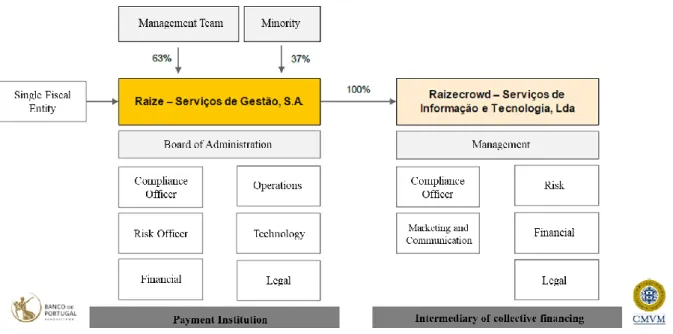
Raize Serviços de Gestão S.A. is a crowdlending platform and a payments institution authorized and supervised by Banco de Portugal. Raizecrowd is an intermediary of collective financing that is certified by CMVM. Raize owns 100% of Raizecrowd, and it is organized as per below:
Figure 1 Company's organogram, translated
The organogram pictured highlight the organization of both entities.
The distribution is divided by the three founders of the company (José Maria Rego, Afonso Fuzeta Eça and António Marques) with some activities being the subject of an external service provider, such as the financial, assured by Talis Qualis – Contabilidade, Ficalidade e Gestão, Unipessoal, Lda and Legal that is handled by law firm offices Úria Menendez, Proença de Carvalho Advogados, PLMJ Advogados and Pares Advogados. Management of both Raize and Raizecrowd are assured by the founders.
5 1.2.3.2. Financial information
In 2018 this platform found itself in the best shape of its life. It has been featured in pretty much every news outlet of the area as a success case. It is important to understand the evolution of the company and the business development.
Going back to 2015, it was the year that Raize began to build a consumer base. From the Balance Sheet dating to September of 2016 we are able to take that the equity concerning December 2015 was of 411.293€. The beginning of the activity was a relatively slow one, and the company registered a loss of 62.205 euros at the end of 2016.
Even though in the first trimester of 2017 registered a slight profit of 2.443 euros, and the breakeven point being reached in the second half of the same year, until the following year the company would have a loss in every balance sheet. It was in the first trimester of 2018 that the company had a profit of 22.001 euros, and at this time the founders were already pondering the company’s IPO launch. By the time of the launch of the IPO in June the company accounted with a profit of 21.399 euros. It was possible to witness a steady growth especially in the beginning of 2018 that is expected to continue this path.
1.2.4. Business Model
The platform is built under a crowdlending business model, also referred as peer-to-peer lending, which allows an investor to help finance companies without the latter having to resort to traditional banking, all the while offering the lenders very attractive interest rates, with a minimal risk.
Raize can offer this financial service through technology, internet and mobile app, which lowers the operational costs given the absence of physical agencies, reduced number of employees and increase speed and efficiency. All of this serve as optimal factors to increase the reach of the financial services even to those that are not financially savvy.
6 The offering of financial services to the companies occurs in three ways:
1. Treasury and investment financing: Consists on loans with monthly amortization between 6 and 60 months. Companies are required at least 2 years of ongoing activity and the interest rates are set according to risk (3% to 6%);
2. Invoice Advance: It allows companies to anticipate invoices with values above 2,500€ with clients. These need to refer to private entities and be regarding services already provided;
3. Start up financing: Loans directed at companies operating under a year that demonstrate good financial ability and growth prospects.
On the other hand, if you are an investor, you can make your money grow on the platform on three separate ways:
1. By activating the “Tracker”: the investor can control the amount per loan, the tracker will take on the platform as a whole and bid on several companies that reach the market;
2. Purchasing in the cession market from other investors;
3. Making offers in the primary market: investors can bid directly in the primary market according to the interest rate they are willing to offer.
Even though the company is trying to distance themselves from the traditional financing services, when selecting the business up to invest, Raize has very careful criteria in order to minimize the risk to the maximum and avoid payment delays or bankruptcy situations. Every business that wants to apply for financing must make sure that they are not in default to any banking institution, social security or tax authority. They also must make sure that they have a sustainable on-going activity and also have fiscal headquarters in Portugal.
7 In order to assure the best analysis possible, the company has built a selection process that is carried out in 48 hours and it accounts for 3 phases:
Phase 1: Document Validation and initial screening
In this stage the company will proceed with a thorough examination of the business’ financial documents as well as assuring the company hold no outstanding debt and that it assures the eligibility criteria previously mentioned.
Phase 2: Due Diligence
Complete audit of the company’s books and of the company’s organization. Extended analysis of the financial information, and the business partner’s suitability. At this stage, Raize holds an interview with the legal representative of the firm.
Phase 3: Final Approval, Pricing and Placement
Final verification of the information previously gathered, standardization of the main characteristics and understanding of the underlying risk. Definition of the loan amount, deadline and companies needs and presentation of the final proposal to the company applying. In case of acceptance, the company is placed in the platform.
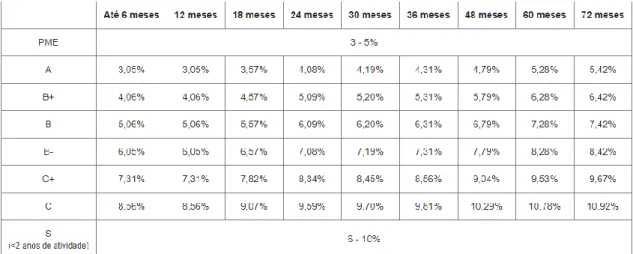
With the complete company diagnosis performed, the companies in the platform are placed within the risk bands:
Figure 2 Raize's Capital distribution
The lower risk companies and therefore the ones with a lower interest rates fall within the categories PME and A. On the risk band S the interest rates are higher
8 depending on the remaining analysis of the company and it is reserved for companies with less than two year of activity.
1.2.5. Sustainability
Raize’s business model is an innovative concept that attracted many users from the beginning. The question remains: How can the founders make this a sustainable business?
To begin this analysis, we can start by reverting to one of the premises of the start-up, the idea that anyone can be an investor. By allowing the investments through the platform to be done for values as low as 20€, it enables people that were not interested in investments before, given the taxes paid and high values requested, to become investors. This way the company is not just directing the financial services to the financial experts, it is facilitating the entrance of new small investors and creating consumers from a very little explored segment. It can be a way to delay or even avoid market saturation since the client base is broaden beyond the financial savvy.
Another business premise that can help with the success of the FinTech is the fact that if the platform grows, the national economy will grow as well. This is a lending platform directed to grow Portuguese small and medium enterprises, therefore the more companies are financed through Raize, the more they are able to contribute to the development of the economy and strengthen the Portuguese entrepreneurial fabric. In this way, a more favorable environment will exist for the creation of new businesses with new financing opportunities arising for the platform.
The favorable environment for entrepreneurs could, however, be a double edge sword for the FinTech. If on the one hand it can help attract companies towards the crowdlending company, it can also mean that new competing business can arise. The FinTech phenomenon is taking over the Portuguese Start-up base, and this spur is increasing the competition in the sector, which can downplay on the fact that Raize is currently the only 100% Portuguese crowdlending platform operating.
While attending the “The Future of Payments and FinTech” conference held on November 6th in Lisbon, Madalena Cascais Tomé, CEO of SIBS, one of the biggest FinTech’s operating in Portugal and considered a “FinTech grown-up”, referred the
9 current innovation factors for FinTech companies that could be of use for the study of the sustainability of the company. The increase of the investments in FinTech companies and higher awareness to this trend can increase the number of competing platforms acting in the market. Additionally, the evolution of the technology’s giants can lead to the disruption of other industries and originate that companies with an already big reputation in the market transition to the crowdlending sector.
Through the investor’s perspective, the fact that Raize was the first and only management entity for crowdfunding platforms registered and certified by CMVM can make this an appealing alternative to the traditional banking and financial services providers. The perceived security that comes with this certification elevates the platform since it offers a more competitive product with higher return without enhancing the perceived risk much higher than that of a traditional provider.
However, even though the company offers security to the users, this does not come without risks. As any other lending operation there is always the risk of default of the financed companies that have several small investors attached can compromise the return and cause shareholders to lose the investment in whole, while increasing distrust in the company and discouraging new users to join the platform.
1.2.6. Consumer relation
As specified in the company’s business model, an important consumer relation is necessary to guarantee a high investor retention. In an interview with one of the successful company’s financing it was possible to understand just that.
And I wonder is a Portuguese company that specializes in customized wedding and ceremony shoes. Tiago Correia, founder and CEO of the company, detailed the experience from the interaction. The financing with the platform occurred at the same time of the business creation, in 2013. After a Google search, Tiago came across Raize and contacted in order to proceed with the financing. 5 days later, the company was admitted into the platform asking for a loan of 5.000€ for treasury, which was obtained after just 15 days.
Following the investment, the company registered a growth every year of over 40%, in which the platform had a second role to play, since from the presence in the
10 platform alone the company was contacted by investors directly, after gaining awareness in the platform. One of the reason that helped make the decision for Raize and not traditional banking was also to understand if the investors validated the business proposition presented.
The good experience with the platform led the company to go back to be financed, and in 2018 it has obtained over 40.000 of funding from the platform.
1.2.7. Sector Analysis in Portugal
According to Forbes Portugal magazine (2018: 39) it is estimated that until 2020 the digitalization of the economy can contribute to an increase in the GDP of 1.8%, which would represent around 3.2 billion euros. Even though the FinTech start-up current overview in Portugal is already quite rich, Raize is acting as the only Portuguese crowdlending entity.
This phenomenon is a result of the increase of technology in the economy that drives costs down and efficiency up. It makes the sector a very attractive one, so Raize can face some heavy competition in the next years.
Additionally, the crowdlending represented 9 million euros of the loans to small and medium enterprises with a total finance of around 17 million euros in loans through lending platforms in 2017, according to the IPO’s informative document available by Euronext (2018).
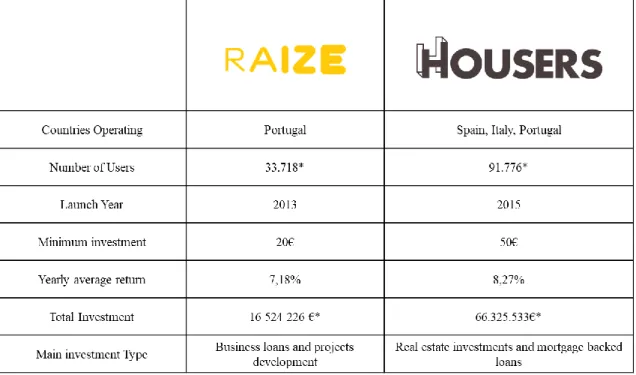
The biggest competitor now is Spanish real estate financing platform Housers, that serves as a lending service for the purchase of real estate in Lisboa and Porto while investing at very attractive interest rates, with minimum investments of 50€. It entered the Portuguese market in the end of the year 2017 and within 8 months it was able to attract over 1.5 million euros from investors.
11 Table 1 Comparison between Raize and Housers
*Data obtained from each of the companies’ websites; updated in 22nd of October 2018
Raize holds the advantage of being 100% Portuguese company but also the fact that it is certified by CMVM and Bank of Portugal, which makes the investor minimize the perceived risk and chose the one that not only offers more security in terms of regulation but also the feeling that they are developing and enriching the national economy.
Outside of the FinTech spectrum, Raize’s biggest competitor remains the traditional banking system. Banks are more and more incorporating these technological advances into their services, and by doing so it can attract investors and companies looking to be financed that are more old-fashioned and still perceive banks as a safety net. The advantage for Raize is that the lower costs from not holding physical infrastructures, from limiting bureaucracy and from eliminating the middleman, since it facilitates the direct contact between investors and companies, it can offer interest rates that the traditional banking is not able to match
1.2.8. The IPO
The Initial Public Offering IPO was a move that RAIZE had been planning since the end of 2017. The main goal of the company was to broaden their shareholder base, that at the time was only composed by the company’s founders (José Maria Rego, Afonso Fuzeta Eça and António Marques), and national investors SIMUM SGPS, PARTAC
12 SGPS, Parinama SGPS and investor Luís Delgado (previous owner of Time Out Magazine).
The Portuguese start-up’s expectation was, according to one of the founders, Afonso Fuzeta Eça, to raise awareness for the brand and by being present in the stock market also earn reputation. The founder also highlighted that this move of the company could be a stepping stone for new endeavors such as expanding the business internationally or even increase the services provided by the platform. This gave the market a better insight into the activity, allowing its participants to follow up the evolution of the business, while keeping in mind the importance for the founders to promote return for the already existing shareholders without compromising the company’s structure and integrity while legitimizing the development of the business model.
RAIZE’s IPO was the first Portuguese IPO since 2014, and the founder highlighted that it could open a precedent for many other companies to go public, since the Portuguese economy can only benefit from a “strong and dynamic capital market”. Ultimately the IPO would facilitate the admission of the shares in Euronext access, if proven successful.
1.2.8.1. Financial and Legal Advisors
In order to fulfill all of the legal and financial demands of actually making the company public, RAIZE decided to hire Investment Bank Haitong Bank (acting as Global Coordinator) and Law Firm Uría Menéndez. The due diligence was set to be done by the second trimester of 2018 and on the 29th of May the official documentation was delivered to Euronext Access for approval.
Since the total distribution of shares was below 5.000.000 euros (total proposal is 1.500.00 euros), the proposal for the IPO didn’t need to be regulated by CMVM and was presented directly to Euronext Access. This is a multilateral market that is managed by Euronext Lisbon that is not subjected to the same regulation than the regulated market, ideal for start-ups.
13 The IPO was launched on 18th of June of 2018 with 15% of the total capital, which corresponded to 750 thousand shares. The total capital of the company was represented by 5.000.000 shares with a nominal unitary value of 0,115€ (totaling 575.000 euros). The shares were made available for a fixed price of 2€, meaning the company would trade with a market capital of 10.000.000€.
By the end of the IPO on 12th of July, a subsequent offer would be launched on the same date as the admission (18th of July) with an additional 10% of the shares available for 6 months, a total of 500 thousand shares with prices that went from 2,20 to 4 euros. Therefore, the company made available a total of 25% of the capital. This would serve as a way to fix liquidity insufficiencies and diminish the risk of concentration in the stockholders by spreading the capital through a broader shareholder base.
1.2.8.3. Results of the IPO Preliminary Results
By 6th of June the shares of the company couldn’t be revoked anymore, and the results showed that the IPO was subscribed in 209%, which translated in the demand being 2.1 times the supply.
With 6 days still left to the end of the IPO, the company registered a steady growth. This served as an indicator of the good track the platform was in and a sign of a potentially successful IPO, since it was away from the risk of underpricing.
Final Results
The release of the conclusive results was officially launched by Euronext on the 13th of July. By July 12, date of the end of the IPO, it was subscribed completely in 369%, with demand being almost 4 times the supply, as stated in a statement released by the company. The high success of the operation lead to a need of a redistribution to make sure each investor had a minimum amount of 500 shares.
The IPO was in this way subscribed on a total amount of 5.538.660 euros, by 1.419 investors, with a total of 2.769.330 shares. The operation accounted also for a redistribution coefficient of 27%. The institutional investors that resulted from the IPO were SGF - Sociedade Gestora de Fundos de Pensões, investor Ilídio Pinho/IP-Holding and investor António Aguiar Moreira.
14 Life after the IPO
The IPO was a great launch for the company to go public and the premier in the Euronext Access stock market officially happened on the 18th of July. The negotiation will be held by phone, twice a day, under a double fixing negotiation with ISIN PTRIZ0AM0009.
The company’s social capital is now distributed as such:
The primary owners are founders Afonso Fuzeta and José Maria Rego with 30,09% each followed by Potus, Lda with 10%.
Another aspect of the IPO for the founders was to be able to achieve partnerships with big companies. 3 months after the IPO, Raize and Dif Broker closed on a partnership to support small and medium enterprises and in that way strengthen the capital market in Portugal. This also presents an amazing opportunity for Raize since these enterprises could find in the FinTech the financing opportunity they need. The expectation for both partners is to increase the number of Portuguese companies going public.
1.3. Restatement of the Issue and Questions
Considering the business presented above and the current endeavors of the company, there is a good opportunity to take a look at all that the company has accomplished, through the innovation present in the founder’s vision and the exponential growth it has experienced. On an academic context it could be interesting for the students to take on the information through the below questions:
15 1. Construct a market and business analysis through a SWOT and 5 Forces of Porter
Framework
2. Can the IPO launch and the fact that Raize is now a public company lead to a more sustainable growth?
3. Could the traditional banking’s integration of financial services threaten the success of the company?
4. Keeping in mind the presented case study, compare Raize’s track until now with the one of an established and successful fintech that has gone public and elaborate on how the company will be able to achieve sustainability in years to come.
2. Pedagogical Note 2.1. Target
This case study can be directed to two different audiences:
• The academic community, to study the evolution of a FinTech start-up as well as the effects of a public FinTech start-up on the national economy. Specifically, to the areas of finance, business strategy and brand identity.
• Entrepreneurs and FinTech companies, to understand what can be gained from going public as well as the process that the companies need to go through.
2.2. Educational Objectives
By the end of the case study the student is expected to:
• Perform a market analysis through and competitive analysis through the SWOT and 5 Forces of Porter framework;
• Understand how the fintech revolution has disrupted every business and learn how companies should adapt
• Recognize the basic functioning of an IPO and the process of going public • Identify a company’s competitive advantages and how to proceed to an
innovative business model
• Comprehend the alterations brought on by the PSD2 directive to payment services
16 3. Literature Review
3.1. FinTech
3.1.1. Concept definition
Even though this is a relatively new concept, the word FinTech is being heard more and more when discussing the evolution of financial services. They compose a substantial portion of the start-up spur in recent years. The meaning behind this word could be described as the “…marriage of “finance” and “information technology.” (Zavolokina, Dolata and Schwabe, 2016: 1). The rise of this ever-growing phenomenon comes from consumer’s search for a faster, easier and less bureaucratic access to financial services. This efficiency is achieved by converging the increase of the available technology and the growing demand for financial services (Kim, Park, Choi and Yeon, 2015: 137). The Oxford Dictionary defines FinTech as “Computer programs and other
technology used to support or enable banking and financial services”.
As Weichert (2017: 23) stated, these are important to “… better align payment
solutions with customer needs.”, and by doing so, the companies operating with financial
technology can not only bring the consumer closer to the service offered as they can also attract new investors driven by the conditions that normal financial service providers are not able to offer. There is also a high emphasis in customer appreciation, as one of the core objectives revolve in providing a consumer-oriented service which is facilitated by the use of technology that drives costs down and improves quality. (Vasiljeva and Lukanova, 2016: 26)
When using the word FinTech within an industry spectrum it can be referred as a
“phenomenon where a non-financial business uses innovative technology to provide services (…) without working with a financial company” (Kim, Park, Choi and Yeon,
2015: 137). It can also have an ambiguous meaning, as these can be financial services where technology is employed to provide innovative amenities or actual companies that employ these services, usually start-ups (Zavolokina, Dolata and Schwabe, 2016: 2).
Zavolokina, Dolata and Schwabe (2016) also believed that FinTech could be classified as an entrepreneurial phenomenon since it “is not triggered by exclusively one
and only driver of financial innovation, but rather is influenced by the combination of economic, technological and regulatory factors” (Zavolokina, Dolata and Schwabe,
17 These appear as a way to “reshape core elements in the banking landscape.” (Weichert, 2017: 23), while also providing technological advances that can help traditional banking be more accessible to all.
3.1.2. Evolution
Although when we hear the word FinTech we attribute this as a recent phenomenon, the introduction of technology into the financial and banking systems appeared way before the widespread definition we now know. If from the word technology we analyze the digital aspect, we can trace the introduction of the phenomenon as early as the late 60’s, with big financial players introducing IT departments to facilitate networking (Alt, Beck and Smits, 2018: 236).
Alt, Beck and Smits (2018) highlighted the importance of the appearance of SWITF in 1973 and TARGET in 1999 as a stepping stone for the digitalization of financial markets. Arner et al. (2016) was able to divide the FinTech evolution into three eras: FinTech 1.0 (1866–1967), FinTech 2.0 (1967–2008) and FinTech 3.0 (2008– present). The era we find ourselves now is the FinTech 3.0 and it was originated by the 2007/2009 crisis, that lead to a massive distrust in banks, which made consumers try to find alternatives.
From here on out, we are finding ourselves in a new era of financial and banking services, and FinTech’s will benefit from it in the end. Even though there are still many people that trust banks over highly technological service providers and banks still hold the power of being the only ones to “have access to real money” (Vasiljeva et al, 2016: 29), the technology that these market disruptors have at hand allows them to offer better and more efficient services while offering a lower price.
The future of banks and FinTech’s is going to rely on the traditional outlet’s attitude when faced with such strong competitors, they will either “choose the path of
rivalry and competition” (Vasiljeva et al, 2016: 26) or they will launch partnerships with
these companies by investing and learning to enhance their own services (Vasiljeva et al, 2016: 28).
Regarding the future of FinTech’s, Wichert (2014) identified 4 megatrends regarding the revolution within the payments services: End to End Commerce, Machine
18 Learning and Analytics, Mass Customization and Technological transformation regarding connectivity, efficiency and security (Weichert, 2017: 24). By highlighting these trends, we see that the driving force for FinTech’s going forwards rests on “customer-driven innovation” (Weichert, 2017: 23) and consumer centered decision making. (Chen et al., 2017). Consumer relations are going to rule businesses’ decision making in financial sectors and regulations are going to be put in place in order to increase transparency and reduce information asymmetry (Chen et al., 2017: 15). Regain the trust of the consumers will be a great tool for customer retention when traditional banking and financial providers begin to incorporate technological aspects into their services.
3.1.3. FinTech Revolution
Upon the presentation of the term and the evolution up until this point comes the question: where will this take us? The revolution brought by the increasing technology influence in all financial services makes us reflect on the actual benefits this transformation has brought into actual everyday consumers.
The 2007’s financial crisis and the imposed consequences regarding regulation led to the revolution that is FinTech’s (Alt, Beck and Smits, 2018: 236). Brett King provided a great introduction to this phenomenon in 2013 when he stated that “Banking
is no longer a place you go, but something you do”. Howar Siow as also stated that “Finance is a prime candidate for technological disruption over the next 5 to 15 years.”
(Baldwin, G., 2017: 17).
Even though some may anticipate the rise of FinTech’s as a natural evolution of the technological path, the reality is far more complex (Buchak et al., 2017: 237). We can say that it is instead a revolution brought up by the escalating needs of consumers being accompanied by a fast pace increase of the technology within the financial sector. The market is now populated by the so-called disruptors, that is, “fastmoving companies, often
start-ups, focused on a particular innovative technology or process in everything from mobile payments to insurance” (Pwc, 2016: 9).
The success of this companies can be attributed by the fact that since they are offering consumers more accessible and easy to use services, it could justify being at a higher price that the one offered by traditional providers (Buchak et al., 2017: 5). Instead,
19 they choose to offer a lower price, achieved by the minimal operating costs, making these companies extremely competitive.
The aftermath of the FinTech high results in two possible outcomes: start-ups focused on financial technology will eventually rule the market and achieve rapid growth or existing financial providers will have to adapt to the new reality, either by improving their own services or by sealing partnerships with new FinTech’s (Pwc, 2016: 11).
After analyzing the effects of FinTech’s throughout financial and banking sectors, we can now look at the bigger picture and understand the implication that the fast-moving technological advances triggered by the rise of FinTech’s will have on every other sector. Like a true revolution, it will affect every company operating now or new companies to come, since the lack of innovation could dictate the downfall of the business. Accenture Banking (2018) stated on their report that “In 2018, a failure to provide end-to-end digital
origination will start to move from the state of disappointment to more of an existential threat”.
3.1.4. FinTech IPO’s
IPO stands for an Initial Public Offering and it represents the debut of a company in the stock market. FinTech companies are increasingly taking advantage of their initial exponential growth to launch the company to the capital market, in order to achieve higher visibility and reputation, and assure profits for the company and shareholders.
There has been a spur of FinTech participation in the stock market, since 2008 (beginning of the third major era of FinTech) a total of 60 companies have gone public, and 30 of them filed for an IPO after 2016 (Mandal, 2018). The last two years have been favorable for FinTech growth and there are currently over 27 FinTech companies worth over a billion, the so-called FinTech unicorns (Williams-Grut, 2018).
From NASDAQ’s FinTech index, we can see that the biggest public FinTech’s are currently payment services provider PayPal and point of sales service provider Square with funding of 287M and 587.5M respectively. These are extremely successful cases of public ventures and they attract an increasing amount of interested start-ups.
The future of public FinTech’s could have endure a step back since a lot of unicorn and other successful platforms are planning an IPO for this year still, and it is still hard to
20 say which will be the reaction on behalf of the investors to a market flood of technology-based enterprises (Williams-Grut, 2018).
3.2. Digital Innovation
3.2.1. Concept Definition
We can’t talk about FinTech’s without addressing digital innovation. Fichman and Zheng (2014) defined digital innovation as a “product, process, or business model that is
perceived as new, requires some significant changes on the part of adopters, and is embodied in or enabled by IT”. The constant search for a faster, easier and more
cost-effective way to change processes provides the strength necessary for the digital innovation to be transversal to every business.
Svahn et al. (2017) also highlighted that “digital innovation is an organizational
capability, not merely a new technological platform or an innovation incubator”, which
goes to show how the innovation is not just a tool but need to be an intrinsic part of any business that wishes to compete in the current climate. Companies need to adjust their organization to fit the need of a strong IT department and do so while maintaining their essence and core businesses (Svahn et al., 2017: 16).
An accurate definition of digital transformation is “the profound and accelerating
transformation of business activities, processes, competencies, and models to fully leverage the changes and opportunities brought by digital technologies and their impact across society in a strategic and prioritized way.” (Demirkan, Spohrer and Welser, 2016:
14)
The disruption brought on by the massive introduction of technology in virtually all sectors paves the way to new opportunities. This will allow that “organizations
address market needs much more quickly than used to be possible, enabling higher levels of collaboration for sharing information much faster.” (Demirkan, Spohrer and Welser,
2016: 16).
3.2.2. Cyber Security
In the wake of a digital revolution that is taking every market segment by storm, it is important to understand that not everything is a bed of roses. As technology helps businesses achieving efficiency through sophisticated software, the ones attempting to
21 rupture it become more sophisticated as a result, which leads to a wrestle between companies and attackers (Kumar and Madhusudhan, 2018: 859) to see who will be one step ahead.
In PwC’s report (2016), they identified four concerns businesses should have regarding cyber security: Attack Service, Perimeter Security, Privacy concerns and Device management. Kumar and Madhusudhan (2018) highlighted that the origin of the attacks could be in search of monetary gain, in search of classified information or with the intent of stealing intellectual propriety.
Companies need to make sure that they keep an emphasis on cyber security and compliance mechanisms, since that is the best way to prevent attacks that could tarnish the business’s image and leave a great mark on consumer relations and retention.
“Cyberattacks constitute the biggest threat due to their increasing frequency, unpredictability, potential for systemic impact, and existing gaps in risk management.”
(LUKONGA, n.d.: 22), so companies need to make their platforms and databases as resilient as possible.
3.2.3. Innovation of Business Models
With the changes brought from the technological advances and revolution, business from every sector are going to have to adapt their practices. Innovation in technology needs to be accompanied by business model innovation, in which the company puts in place “new ways to create and deliver the existing product or service,
and new ways to capture value from it” (Yang et al., 2017: 1795). A broad definition of
business model as presented by Zott and Amit (2017) could be “a bundle of specific
activities – an activity system – conducted to satisfy the perceived needs of the market”.
Emphasis on consumer will be a very important aspect to incorporate in business decisions since they are “becoming more demanding and less loyal” (Pwc, 2016: 19). With the creation of more and more technological companies, the competition is going to get heavy and the market will be saturated of companies that offer very similar services. The ease with which consumers are going to be able to access the platform makes them subjectable to switch from one to the other if the service is more consumer-friendly.
22 In the banking and financial sector, the news spread quickly, and decision-makers were quick to adapt the businesses to the current climate. According to the PwC report (2016) in 2016, 61% of banks executives believe a customer-centric model is “very important” and 75% of banks are already directing their investments to this area. As more and more FinTech start-up arise in the financial sector, traditional outlets will need to be closer to consumers through technology in order to be able to retain more consumers. It is crucial for companies to maintain good customer relations in order to answer to the ever-growing user needs.
That being said, we can conclude that “A smartly designed new business model
can increase the total value created for all stakeholders, including customers, partners and suppliers.” (Zott and Amit, 2017: 20).
3.2.4. PSD2 Directive
Digital innovation affected not only business models and companies but forced regulators to adapt to the everchanging reality. It is about embracing the disruption brought on by new market players while assuring fair and equal legislation for all sides involved. The European Union found themselves forced to substitute their original Payment Services Directive (PSD) for a new and improved version on 2016, being the adoption of PSD2 officially integrated in every country by January of 2018 (SIBS, 2018).
That being said, the PSD2 is a directive from the European Union to facilitate the creation of an integrated European payments market. By the acceptance of the directive, countries are facilitating the digital payments within the European Union while being regulated and providing a higher security. Additionally, it will make payment services more efficient, fast and easy to use, which will foster financial inclusion. Not only consumers see advantages in this, the favorable environment for the creation of new digital businesses is going to increase the competition, which will force already existing companies to become more innovative and resilient (SIBS, 2018).
A small player will be able to find a good entry point since there is an incentive for Third Party Providers (TPP), that is, platforms regulated by national enterprises that will have access to the consumers information in banks, subject to the owner’s approval. The Third-Party Providers can be “Account Information Service Providers (‘AISPs’) and
23 that make available online the financial position for the consumer’s account, PISPs are entities that facilitate alternative payment methods.
In the everyday life, the directive will influence greatly the behavior of FinTech’s acting in the market and those planning to enter. It will create a more equal environment, one that is not overruled by technology and financial giants, since it proposes to offer a
“level playing field for payment services providers” (EY, 2017: 2). An increase in the
competition will be felt, however any new entrant must assure that they abide to the demanded compliance regulation and practices that help maintain security when performing any transactions. Also, consumers will benefit from the companies’ efforts to remain competitive such as a reduction of the services’ prices, and service customization (EY, 2017: 2).
4. Methodology
4.1. Research Design
In the context of digital innovation and market disruption, Raize represents the future of the entrepreneurial tissue in Portugal. It is important to take this case and analyze in three phases: How this company was; How this company is; How this company will be.
There is a great deal of information that can be extracted just by analyzing the company’s progress throughout the years and the business decision taken. Additionally, understanding why RAIZE’s consumer chose the company to lend their money or to place their investments can help understand market trends and preferences regarding the future of FinTech’s in the Portuguese market.
With this, the goal is to understand the success of the company and the aspect that made it what it is today, while keeping in consideration the consumer relation.
4.2. Research Design
Most of the data for this project will be secondary quantitative data, from company and industry reports that were collected from July to October and an additional primary qualitative data was obtained from an interview conducted to a success case of Raize’s platform.
24 4.3. Data Collection
Industry data collection for this project was conducted through the periods of July to September, time when the company was in the aftermath of the IPO. Follow-up investigation had to be conducted until the end of October to ensure that the information was updated to reflect the company’s evolution. Additionally, the testimony was provided at the end of October.
4.4. Data Analysis
From both the information obtained and the interview provided it was possible to infer that the company’s business model is in line with one that is adapted to the fintech revolution. The consumer relation
25 5. Case Solution Slides
26 6. Presentation of the set on analytical tools
In order to be able to solve the case study, it is important to collect from the presented information qualitative and quantitative data. To have a good insight on the company’s operations and results is fundamental to be able to fully develop the questions proposed ahead, in the most complete way possible.
Students should be able to infer from the information available the following: • Being able to fully understand Raize’s activity
• Analyze the evolution of the company throughout it many stages • Identify the company’s competitive advantages
• Scrutinize the Portuguese financial sector and the fintech presence in it • Comprehend company’s mission and vision and its relevance to the business
model used
• The core competencies of the business that will represent the strengths in the SWOT analysis
• The market trends will be fundamental to understand the threats and opportunities of the company
• From the literature review being able to infer some aspects that will help understand the sustainability of the company
27 7. Case study lecture plan
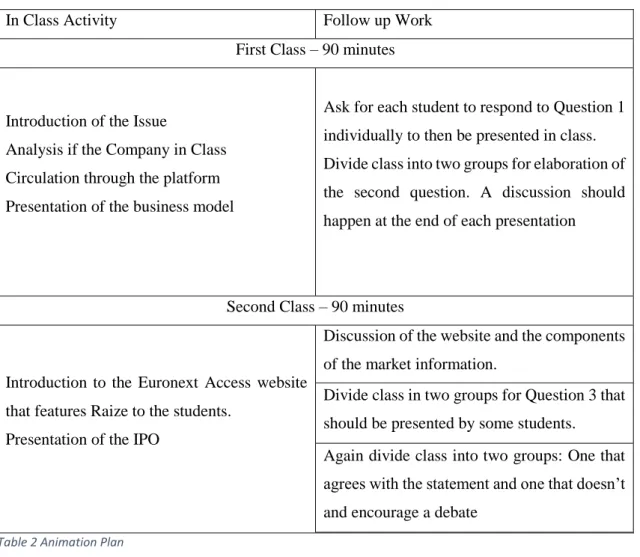
In Class Activity Follow up Work
First Class – 90 minutes
Introduction of the Issue
Analysis if the Company in Class Circulation through the platform Presentation of the business model
Ask for each student to respond to Question 1 individually to then be presented in class. Divide class into two groups for elaboration of the second question. A discussion should happen at the end of each presentation
Second Class – 90 minutes
Introduction to the Euronext Access website that features Raize to the students.
Presentation of the IPO
Discussion of the website and the components of the market information.
Divide class in two groups for Question 3 that should be presented by some students. Again divide class into two groups: One that agrees with the statement and one that doesn’t and encourage a debate
Table 2 Animation Plan
8. Lecture issues to be posed to the student
1. Construct a market and business analysis through a SWOT and 5 Forces of Porter Framework
2. Could the traditional banking’s integration of financial services threaten the success of the company?
3. Can the IPO launch and the fact that Raize is now a public company lead to a more sustainable growth?
4. In an interview with “Jornal Económico”, Albino Oliveira, analyst in Patris Investimentos stated: “The company has a small expression in the Lisbon Stock
Market, therefore I don’t have very high hopes. It may catch the attention of private investors, but it won’t be under the radar of the institutional investors”. Do you agree
28 with the statement made? Justify your answer taking into consideration the way the IPO and admission was handled, as well the company’s evolution so far.
5. Resolution
1. Construct a market and business analysis through a SWOT and 5 Forces of Porter Framework.
After analyzing the company as a whole and being able to see the big picture, it is possible for us to map out the positive and negative aspects internal to the company and the potential opportunities and threats the company can take advantage of
The best way to do so is by building a SWOT analysis, that will help understand the areas in which the company can grow, and what to change to guarantee sustainability.
Strengths
• Absence of operating costs: Given that this is a technology company, the absence of physical space, the reduced bureaucracy and the small number of employees the company currently has, there is little operating costs especially when compared to a traditional banking business;
• Competitive interest rates: Due to the aforementioned reduced costs, the higher efficiency enables the company to offer return much higher than traditional banking;
• Regulated by CMVM and Bank of Portugal: Raize is the first entity that manages crowdfunding platforms registered in Portugal. Both regulations decrease the investments’ perceived risk;
• High accessibility: The possibility to invest through Raize is literally on the palm of your hand, available through a mobile app;
• Bigger flexibility: The investor is not restricted when placing their investments, given that it works through a website and a mobile app, it is available 24/7. • Assured intellectual propriety: Raize is not only a registered brand in Portugal
as it also holds a patent in Spain. This means that any technological developments are assured by a contract.
29 Weaknesses
• Low Reputation in the market: Raize is still a relatively small player in the market, and therefore is still not a household name when addressing financial services. This is one of the weaknesses meant to be overturned by going public; • “Synthetic Identity Fraud”: Accenture (2018) highlighted in their report “Top
10 Trends to Watch in 2018” that the sophistication of the digital fraud would increase rapidly, with fake profiles being created to foster illegal activities in a way that the financial entities won’t even realize until it’s too late.
• Companies default: Even though this is a risk the company searched to mitigate through their comprehensive analysis of every company that wishes to apply for a loan, the risk of default is always present, and it could lead to great losses both on the investor and on the platform’s side.
• Low customer retention: As with FinTech’s, the accessibility that granted them an advantage over traditional business models could result in a downfall. That is, the easy to use platforms also make it easy to leave, which can mean that if a similar more competitive platform arises, Raize’s consumers could easily switch.
Opportunities
• Internationalization: Something the founders had shown great interest has been on taking the platform internationally. This could mean a broader users network and more business to the company;
• Growth of the Portuguese economy: The more the economy grows, the more Portuguese consumers will be able to set aside some savings and invest. This also creates a good environment for business creation, which can possibly mean an increase in the financing opportunities in the platform.
• Consumer relations: Raize’s business model revolves around consumer satisfaction and transparency, aligned with the platform’s accessibility, this could be a growing factor for the company;
30 • Favorable environment for FinTech creation: This can result in the appearance of multiple competitors for Raize with a similar business model that can adapt their business model by seeing the platform already in the market;
• Financial Crisis: This would lead to a reduced purchasing power on the consumer’s behalf, which would prioritize essential goods over investment opportunities. Additionally, it would be an unfavorable environment for the creation of new businesses and lead to a weak entrepreneurial fabric;
• Higher data protection regulation: Even though Raize is in line with the latest Data Protection Regulation (in effect since 25th of May of 2018), new and more strict laws can appear that can limit the platform’s normal functioning
In order to better clarify the influence of external elements in the company’s activity, it is possible to understand a lot from a company’s competitors and rivalry from the 5 Forces of Porter Analysis:
Intensity of competitive rivalry: High
At the moment, Raize is the only crowdlending platform acing in Portugal. It has a great advantage from the fact that it is a 100% Portuguese company acting in the market.
However, a similar platform is operating with great strides in the Portuguese lending scheme, Spanish P2P platform Housers. Housers can be a very strong competitor being that it offers higher return rates (average of 8.27% against Raize’s 7.18%), and it is acting in the market for longer. It is important to highlight that this is a market characterized by a fast growth and lower operating costs given the absence of physical infrastructures, lower processing demands, which is a signal of good profitability for its participants.
The product differentiation is also very high, since companies offer a similar service but operate in different ways. While Housers investments go to financing investment buildings, Raize’s are to help finance and boost Portuguese small and medium enterprises while helping the Portuguese economy to flourish.
Threat of new entrants - High
There is a very present threat of new market players that could potentially put in risk the company’s market position. The appearance of financial technology start-ups is
31 gaining force in the Portuguese panoram, and entrepreneurs are discovering this unexplored market segment.
Similar platforms can easily arise since there are really no barriers to entry, and the massification of technology made it possible that the entry investment can be supported without much strain on the entrepreneur’s behalf.
Bargaining power of suppliers - Medium
As we are dealing with a financial company that operates solely on technology, the suppliers we can identify are the companies that chose to be financed. These have a very high bargaining power since they are crucial to the continuing of the business.
They are not substitutable and a low amount of companies to invest in shies the investors away from the P2P platform, since they will not have the access to a desired diversified portfolio.
Individually the companies financed hold a very small power, however when considered aggregated they can seriously tarnish the fintech’s profit and the cost could be deadly to the company.
Bargaining power of buyers - High
Similar to the suppliers, the investors alone have little influence in the company’s books. However, if agglomerate it can result in a break of the fintech’s model given the way it is build.
As a Peer-to-Peer lending, if investors are not participating, Raize will have to support the loans made to the Portuguese start-up’s which can be a source of lower profitability as well as a destruction of the brand’s reputation as a lender.
Threat of Substitute Products - High
In the Portuguese market we can identify two very strong competitors: the aforementioned platform Housers and the traditional banking and financial outlets.
The perceived security and familiarization that the banks provide can be a challenge in the Portuguese market, that even though it is allowing the spur of technology driven companies, there is still a large part of the population that opts for the traditional. This is something that causes a difficulty for the company regarding consumer retention.
As for similar platforms, the one acting in the Portuguese market is real-estate crowdlending Housers and it can be a very interesting option for consumers.
32 2. Could the traditional banking’s integration of financial services threaten the
success of the company?
We can identify traditional banking as the number one competitor for the platform for companies that are seeking finance. The aspects that attract business looking to get financed are mostly the access to loan conditions they otherwise wouldn’t be able to reach in a normal loan. Also, new rules for Portuguese banks limit the amount that can be borrowed by consumers and are very often not able to finance immediately the full amount requested. The high interest practiced are also a reason why more and more businesses are shying away from recurring to a bank when searching for a loan.
Banks are on to this and can understand the changes that have come about when the digital revolution occurred. The subsequent spur of FinTech’s created an alternative market for all things financial. On the one hand we have an institution with a name and a good reputation offering a multitude of financial services to the public and on the other hand we have a handful of FinTech’s that specialize on each financial segment and deliver it in the most efficient way possible. While most of millennials appreciate having a smartphone full of apps at the reach of their pockets, each for a different function, a more conservative would prefer to go to a physical location and handle all in the same place, with the same provider that is already well-known and established in the field.
The introduction of technology on the banks’ side is something that we see already happening, with more and more facilitating the online access to the account, ability to perform some services that were only available if you got to the nearest ATM. The problem for banks and technology is the fact that these are very established and rigid institutions, for which the introduction of technology happens in just some specific services and in scattered parts of the business.
The current financial climate that is highly reliant on technology demands a full restructure of the businesses, since the focus and aim is now different. Consumers are more demanding and are more careful when making financial decisions, so the infrastructures should abide to these new types of customers by innovating the business model in the grand scale.
However, in Portugal we witness an ever-evolving star-up FinTech framework, the market is getting more and more competitive and these can hold a significant market share, but it is crucial to understand that even though banks are rivals, they actually play
33 a very important part in the development of these companies. Not only through the investment in many of the operating in the market, but also by being regulatory agents that end up legitimizing these companies that have low or even non-existing presence and reputation in the market. The PSD2 directive is going to be crucial for the inclusion of these financial services in banking, since it will allow TTP’s to interact directly with back and depositors.
For the company, the adaption of banks to the digital revolution will rely on the consumer retention that they will be able to achieve, since many FinTech’s currently act as just a complementary to the banking services provider, not a complete substitute. Therefore, it is important to maintain a good investor base and continue to practice competitive interest rates for the companies that wish to apply for a loan.
3. Can the IPO launch and the fact that Raize is now a public company lead to a more sustainable growth?
Raize has gone public on the 18th of July of this year, and the successful IPO caused a lot of attention to the company, being the first Portuguese IPO in 4 years.
The primary aspect of going public is the financial gain on behalf of the company. This was the initial reason the founders decided to launch the IPO and it is the biggest motivation to do so. These financial gains, that were achieved by the successful IPO, allow the company to access new investment opportunities in IT to improve the technology and assure the company’s competitive advantage. Also, the possibility to invest on the expansion of the business to more countries, which was an expressed wish on behalf of the founders, thus achieving a larger customer base. An important aspect for the company would also be to invest in the structure of the company itself, by shaping the platform from inside, it could create a stronger and more resilient business model.
Another important aspect is the increased visibility Raize is getting from the IPO. Being the first Portuguese company to go public since 2014, the buzz around the strategic decision got investors talking and thinking. The fact that the company is a start-up acting with an innovative business model came as a breath of fresh air, causing the IPO to be subscribed in over 300%. Jumping from the fintech start-up world into the stock market garnered bigger more mature investors, contrary to the typically younger shareholder base that characterizes fintech’s. It raised awareness for the brand for a new demographic.
34 Lastly, a company in the stock market has a bigger global reach, which could aid the company in their mission to launch internationally.
Regulation of public companies is much stricter than that of a normal business. The need to update constant reports and document the company’s evolution and business practices makes a very transparent and direct relation to both investors and actual consumers. The scrutiny under which the company is also means a higher compliance awareness and preparedness. A strong compliance division is going to be decisive if the company wishes to remain competitive. A failure to assure compliance regulation could potentially represent a massive lost for the company.
4. In an interview with “Jornal Económico”, Albino Oliveira, analyst in Patris Investimentos stated: “The company has a small expression in the Lisbon Stock
Market, therefore I don’t have very high hopes. It may catch the attention of private investors, but it won’t be under the radar of the institutional investors”. Do you agree
with the statement made? Justify your answer taking into consideration the way the IPO and admission was handled, as well the company’s evolution so far.
For the entirety of the IPO’s run, the company presented itself as a strong contender for a successful public traded company. Even before the end, the IPO was already subscribed in 200%. This materialized into an impressive debut on the stock market on July 18th with a 19% valorization in the first session. This was highly contrasted with the overall decline of the Portuguese economy in the beginning of September, where the company registered gains of 10%.
Currently, Raize is in the market with a slight decrease in the shares value that went from the initial 2.20€ to the current 1.95€. The buzz created around the first Portuguese fintech going public in 4 years caused for a great stir in the Lisbon stock market, with every investor keen on the development of the Portuguese capital market anticipating what would be the next move for the company.
The slowing down in Raize’s trading operations could be of a variety of factors. It could be said that the way the shares are being traded could hurt the results of the company. The fact that it is only by call and twice a day can cause a lot of offers not to be considered and hurting the company’s financial results.