GRADIENTS IN ABUNDANCE AND DIVERSITY OF
GROUND-DWELLING ARTHROPODS IN TEMPERATE
SILVOARABLE FIELDS
Pardon P1,2,3*, Reheul D2, Mertens J1,4, Reubens B3, De Frenne P1,2, De Smedt P1, Proesmans W1, Van Vooren L1,3,
Verheyen K1
(1) Department of Environment, Ghent University, 9090 Gontrode, Belgium (2) Department of Plants and Crops, Ghent University, 9000 Ghent, Belgium (3) Flanders Research Institute for Agriculture, Fisheries and Food (ILVO), 9820
Merelbeke, Belgium (4) Department of Applied Biosciences, Ghent University, 9000 Ghent, Belgium *Corresponding author: [email protected]
Abstract
Ground-dwelling arthropods play an important role in agricultural systems by providing multiple ecosystem services (ES), such as affecting nutrient and carbon cycling and providing biological pest control. However, potential patterns in presence of these arthropods in temperate agroforestry systems (AFS) have only been investigated to a limited extent. Therefore we have assessed the abundance and diversity of woodlice (Isopoda), millipedes (Diplopoda), rove beetles (Coleoptera: Staphylinidae) and carabids (Coleoptera: Carabidae) in function of distance to the tree row in temperate arable AFS. Abundance and diversity of woodlice and millipedes was significantly increased in the tree rows and in the arable zone near mature trees. These results indicate that the tree component of temperate AFS contributes to the preservation of arthropod biodiversity and the enhancement of associated ES, both in the tree rows and in the arable field zone.
Keywords: woodlice, millipedes, poplar, maize, winter cereals
Introduction
Ground-dwelling arthropods play an important role in agricultural systems by providing multiple ecosystem services (ES). Detritivorous species, for instance, affect nutrient and carbon cycling, and predatory species biological pest control. The presence of semi-natural landscape features, such as the tree component of agroforestry systems (AFS), may contribute to increasing functional agrobiodiversity and optimizing the delivery of abovementioned ES in agricultural landscapes. Alley cropping is a particular type of AFS whereby trees are organized in rows over the field. As a result, it can efficiently be combined with the use of modern farming techniques and machinery for the cultivation of agricultural crops in the intercropping zone between the tree alleys. Hence, this cropping system may be especially suited to increase the presence of semi-natural landscape features while maintaining agricultural production (Quinkenstein et al. 2009; Tsonkova et al. 2012). However, potential patterns in abundance and diversity in temperate alley cropping systems have scarcely been investigated for detritivorous soil-dwelling arthropods and only to a limited extent for predatory arthropods. Therefore we here assess the abundance and diversity of woodlice (Isopoda), millipedes (Diplopoda), rove beetles (Coleoptera: Staphylinidae) and carabids (Coleoptera: Carabidae) as function of distance to the tree row in temperate arable fields.
Materials and methods
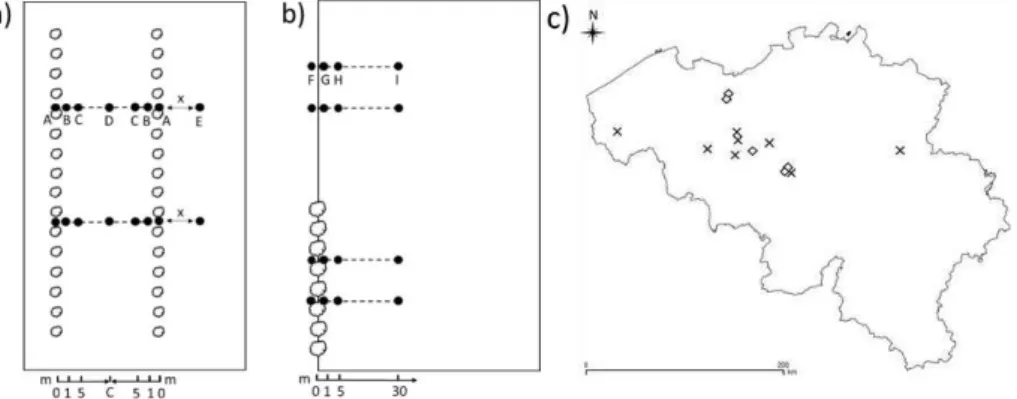
Two types of experimental fields were selected to investigate the abundance and diversity of beneficial arthropods on alley cropping fields of varying age (Figure 1). The resulting set comprised six young alley cropping fields. In addition, since older arable alley cropping systems in Flanders are scarce, a set of eight arable fields that are partly bordered by a tree row and
as a proxy (Table 1). On the young alley cropping fields, two transects were laid out between and perpendicular to the tree rows. Seven sampling points were fixed on a transect: two were m away from the field edge near both tree rows and o
approximately at 12 m from the field edge) (Figure 1a). Two control points were marked at a field, two transects were installed perpendicular to the tree row and to the treeless border (Figure 1b). The treeless parts of these fields hereby act as a reference situation. Four sampling m away from the field edge (Figure 1b). At each sampling point in both systems, a pitfall trap was installed during the last week of May 2015. The traps were in place during four weeks. For each individual trap the total number of woodlice, millipedes, carabid beetles and rove beetles caught was counted. The captured specimens of every taxon, except for rove beetles, were identified to species-level. This procedure was repeated in 2016 on a subset of the fields. Generalized mixed effects models with a Poisson error structure and Linear --Wiener diversity.
Figure 1: Experimental design. a) alley cropping fields, b) boundary planted fields. Black dots boundary planting).
Table 1: Characteristics of experimental fields. Year of plantation was estimated based on pers. -West, NS:
North-samples collected in 2016.
ALLEY CROPPING
Location Year of plantation Orientation Crop 2015 Crop 2016
Lochristi 1 2011 EW Forage maize Winter wheat
Lochristi 2 2011 EW Forage maize Forage maize
Lochristi 3 2012 EW Winter wheat Forage maize
Vollezele 2010 NS Winter barley NA
Haut-Ittre 1 2011 NS Winter wheat Winter wheat
Haut-Ittre 2 2011 NS Grain maize Winter wheat
BOUNDARY PLANTING
Results
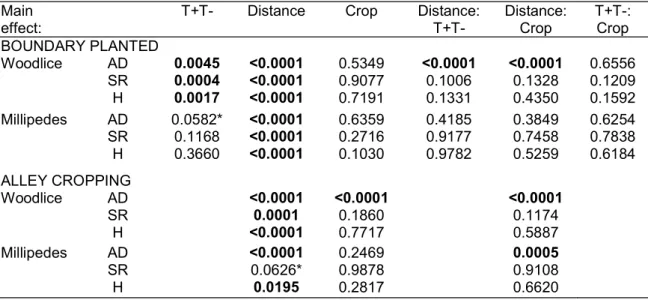
Activity-density, species richness and Shannon-Wiener diversity of woodlice and millipedes were significantly affected in both systems by distance to the tree rows/treeless field edges with decreasing values at further distances in the field (Figure 2, Table 2). In addition, for activity-density, species richness and Shannon-Wiener diversity of woodlice and for activity-density of millipedes, a significant effect of tree presence was found on the boundary planted fields with increased values in and nearby the tree rows when compared to the treeless field edges.
Figure 2: Activity-density, species richness and Shannon-Wiener diversity of woodlice and millipedes in alley cropping and boundary planted fields for each level of significant (interactions between) fixed effects.
Table 2: (Generalized) Linear Mixed Modelling results for detritivorous arthropods. Included their two-way interaction. Included fixed effects for the boundary planted field are
-- AD - SR
Shannon-Wiener diversity. Bold characters indicate a significant effect (P-value<0.05). (*) indicates 0.05 < P-value < 0.10.
Discussion
The increased detritivore abundance and diversity in the tree rows are assumed to result from the favorable habitat and refuge conditions (e.g. increased shade, soil and air humidity, food sources and nesting habitat) created by the relatively diverse and permanent presence of vegetation and litter, the absence of regular (soil) disturbances and the reduced use of crop protection agents. Strongly contrasting conditions occur in the arable field zone where the intensive agricultural management may cause profound adverse effects on the survival and reproduction of soil communities (Paoletti and Hassall 1999; Smith et al. 2008; Souty-Grosset et al. 2005) resulting in the observed decreases in activity-density and diversity.
Based on our results, tree row presence can increase abundance and diversity of detritivores in the arable zone, probably through colonization starting from these semi-natural refuges and through the mitigation of abovementioned adverse field conditions. Farmers may potentially benefit from the enhanced delivery of ES in silvoarable fields (e.g. enhanced decomposition and nutrient cycling), linked to the abovementioned increase in detritivorous arthropod abundance and diversity. However, to optimize this potential for ES delivery, adapted management may be advisable, e.g. by retaining dead plant material in the tree rows (such as pruning material), limiting the use of pesticides and herbicides (both in the tree component and in the arable zone), and striving for a diverse herbaceous composition in the tree rows.
Conclusion
Furthers analysis will focus on predatory arthropods (carabids & rove beetles), whereby a similar approach is used to study gradients in abundance, species richness and Shannon-Wiener diversity.
Main effect:
T+T- Distance Crop Distance: T+T- Distance: Crop T+T-: Crop BOUNDARY PLANTED Woodlice AD 0.0045 <0.0001 0.5349 <0.0001 <0.0001 0.6556 SR 0.0004 <0.0001 0.9077 0.1006 0.1328 0.1209 H 0.0017 <0.0001 0.7191 0.1331 0.4350 0.1592 Millipedes AD 0.0582* <0.0001 0.6359 0.4185 0.3849 0.6254 SR 0.1168 <0.0001 0.2716 0.9177 0.7458 0.7838 H 0.3660 <0.0001 0.1030 0.9782 0.5259 0.6184 ALLEY CROPPING Woodlice AD <0.0001 <0.0001 <0.0001 SR 0.0001 0.1860 0.1174 H <0.0001 0.7717 0.5887 Millipedes AD <0.0001 0.2469 0.0005 SR 0.0626* 0.9878 0.9108 H 0.0195 0.2817 0.6620
References
Paoletti MG, Hassall M (1999) Woodlice (Isopoda: Oniscidea): Their potential for assessing sustainability and use as bioindicators. Agric Ecosyst Environ 74: 157 165.
(2009) Ecological benefits of the alley cropping agroforestry system in sensitive regions of Europe. Environ. Sci Policy 12: 1112 1121. Smith J, Potts SG, Woodcock BA, Eggleton P (2008) Can arable field margins be managed to enhance their
biodiversity, conservation and functional value for soil macrofauna? J Appl Ecol 45: 269 278.
Souty-Grosset C, Badenhausser I, Reynolds JD, Morel A (2005) Investigations on the potential of woodlice as bioindicators of grassland habitat quality. Eur J Soil Biol 41: 109 116.
Tsonkova (2012) Ecological benefits provided by alley cropping systems for production of woody biomass in the temperate region: A review. Agrofor Syst 85: 133 152.