Department of Information Science and Technology
Information Security Frameworks Assisting GDPR
Compliance in Bank Industry
João Filipe Virtuoso Serrado
Dissertation submitted as partial fulfilment of the requirements for the degree of
Master in Computer Engineering
Supervisor:
Doctor Rúben Filipe de Sousa Pereira, Assistant Professor ISCTE-IUL
i
Acknowledges
I would like to thank my supervisor, Prof. Dr. Rúben Filipe de Sousa Pereira, for the amazing support during this research, the availability and incentives. Without his help, I believe I wouldn’t finished it.
Thanks to all the interviewees and the banks who collaborated in this investigation. Their help was very useful to evaluate this research and how useful it is.
Finally, I big thank you to my family and friends. A very special thank you to my parents and my brother.
iii
Resumo
Nos últimos anos com o consequente aumento do uso de Tecnologias de Informação (TI) pela população, assistimos a um aumento da recolha e tratamento dos dados por parte das organizações, destinando-se a diversos fins, como por exemplo, para a necessária prestação de serviços ou campanhas de marketing.
Como consequência do aumento de dados, têm existido diversas tentativas de roubo dos mesmos para se vender ou pedir resgates às organizações. Esta situação tem revelado que as organizações no que respeita à segurança e proteção de dados nem todas têm o mesmo grau de maturidade, sendo que um aspeto também determinante é a legislação existente não ser a mais adequada para o nível de utilização das TI nos dias de hoje.
Para colmatar estas falhas a União Europeia (UE) decidiu criar o Regulamento Geral de Proteção de Dados (RGPD), com entrada em vigor a 25 de maio de 2018, aplicável a todos as organizações que tratam dados pessoais de cidadãos residentes na União Europeia (EU). Com efeito as organizações conjugam todos os seus esforços para a implementação deste novo regulamento, de forma a que não sejam aplicadas multas por incumprimento ao mesmo.
À imagem do que foi descrito anteriormente e com base num conjunto de boas práticas e frameworks existentes sobre segurança da informação atualmente no mercado, esta tese propõe explorar como os frameworks de segurança da informação podem ajudar os bancos a cumprir com o RGPD, através do mapeamento dos requisitos do regulamento com as práticas dos frameworks. Numa segunda fase realizar-se-á entrevistas com responsáveis na matéria, num setor específico onde existe mais sensibilidade no que toca a estes temas, o setor da banca.
v
Abstract
In the last years, with the consequent increase use of Information Technology (IT) by the population, we watched an increase in the collection and processing of data by the organizations, for various purposes, such as for example the necessary provision of services or marketing campaigns.
As a result of the increase of data, there have been several attempts to steal the data to sell or request redemptions from organizations. This situation has shown that organizations as regards data protection and security do not all have the same degree of maturity, and a determining aspect is also that the existing legislation is not the most adequate for the level of IT use in the days of today.
To address these issues, the European Union (EU) decided to create the General Data Protection Regulation (GDPR), which entered into force on May 25, 2018, applicable to all organizations dealing with personal data of citizens residing in the European Union. In effect, the organizations combine all their efforts for the implementation of this new regulation, so that fines for non-compliance are not applied.
Based on the previous description and with base on a set of best practices and existing frameworks of information security existent currently in the market, this thesis aims to explore how can current IS frameworks help Banks comply with GDPR by mapping the requirements of the regulation with the practices of the frameworks. In a second phase, interviews will be conducted with professionals in the field, in a specific sector where there is more sensitivity for these topics, the bank industry.
vii
Index
Acknowledges ... i Resumo ... iii Index ... vii Table Index ... ix Figure Index ... xiList of Abbreviations ... xiii
Chapter 1 – Introduction ... 1
1.1. Problem and Motivation ... 2
1.2. Research Objectives ... 3
1.3. Methodology Approach ... 3
1.4. Structure of the Master Thesis ... 4
Chapter 2 – Theoretical Background ... 5
2.1. GDPR ... 5
2.2. IS Frameworks ... 6
Chapter 3 – Related Work ... 7
3.1. Similar Studies ... 7
3.2. Synthesis of the Related Work ... 9
Chapter 4 – Research Methodology ... 11
Chapter 5 – Design ... 13
5.1. Step 1 – Elicitation of the List of Concepts ... 14
5.2. Step 2 – Choice of IS Frameworks ... 14
5.3. Step 3 – Mapping Concepts with Framework Practices ... 14
5.4. Step 4 - Conducting Semi-structured Interviews ... 14
Chapter 6 – Development ... 17
6.1. Step 1 – Elicitation of the List of Concepts ... 17
6.2. Step 2 – Choice of IS Frameworks ... 18
6.3. Step 3 – Mapping Concepts with Framework Practices ... 19
Chapter 7 – Demonstration and Evaluation ... 21
Chapter 8 – Analysis and discussion of results ... 29
Chapter 9 – Conclusion ... 35
9.1. Research Limitations ... 36
9.2. Future Work ... 36
References... 37
Annex and Appendices ... 40
viii
Annex B – List of GDPR Concepts Mapped to Practices ... 53 Annex C – Interview Questionnaire ... 69 Annex D – Interviews Overview ... 83
ix
Table Index
Table 1 – Related Work ... 7
Table 2 – Chapters of GDPR ... 18
Table 3 – Example of extracted concepts from GDPR ... 18
Table 4 – Example of a concept with the practices ... 20
Table 5 – Selected banks overview ... 21
Table 6 – Interviewee specific questions ... 22
Table 7 – Concepts and practices question ... 23
Table 8 – Last notes ... 23
Table 9 – Interviewees comparation ... 25
Table 10 – Final set of questions ... 27
Table 11 – Score Matrix ... 29
Table 12 – Concepts with practices fully compliant ... 30
Table 13 – Concepts with practices not applicable ... 32
xi
Figure Index
Figure 1 – DRS Process Model ... 11
Figure 2 –Diagram of the Design ... 13
Figure 3 – Example of elicited concepts from article 5 ... 17
Figure 4 – Number of employees ... 26
Figure 5 – Frameworks followed/performed in the banks ... 26
xiii
List of Abbreviations
DP – Data Protection
DPA – Data Protection Authority DPR – Data Privacy
DS – Data Subject
EC - European Commission EU - European Union
FATCA – Foreign Account Tax Compliance Act GDPR – General Data Protection Regulation IoT – Internet of Things
IS – Information Security IT – Information Technology PD – Personal Data
PI – Personal Information
SCPD - Special Category Personal Data US – United States
1
Chapter 1 – Introduction
The rapid development of computers in the last 20 years, with the reduced prices for data storage, allows the processing of large amounts of personal data (PD), with the help of big data and data science, to use or exploit them late. Plus, with the large volume of PD collected, companies are facing serious vulnerabilities, like the misuse, that could result in privacy breaches (Agarwal, 2016).
The roles between governments, data subject (DS) rights, and data protections authorities (DPA) are different across the countries, due to significant levels of enforcement and legal competencies (Custers, Dechesne, Sears, Tani, & van der Hof, 2018). Therefore, The European Union (EU) published their own directive for data protection (DP), since the adoption in 1995, the Data Protection Directive 95/46/EC (Council, 1995) has been the central legislative for personal data privacy (DPR) instrument in the EU (Tikkinen-Piri, Rohunen, & Markkula, 2018). Considering this is not a regulation, all member states must translate it into local laws, which makes a non-uniformization of the laws across EU.
Since its inception, DP has, in turn, been driven by the development of information technology (IT) (Phillips, 2018), and in the last years with the increase use of IT by the citizens, in particularly the residents in EU, the Data Protection Directive 95/46/EC no longer meets the privacy requirements of the present-day digital environment. To solve this problem the European Commission (EC) has been developing, since 2009, the General Data Protection Regulation (GDPR), that has published a proposal for the DP reform in 2012 (Tikkinen-Piri et al., 2018).
In May 2018, the GDPR came into effect to replace the Data Protection Directive 95/46/EC, to meet current challenges related to personal DP and to harmonise DP across the EU (Tikkinen-Piri et al., 2018).
One major difference from the old directive is, that GDPR is a regulation and not a directive. This means that it will apply directly in all member states without them translating it into local laws. One of the main objectives of GDPR is to lead to consistency of DP in EU and this justifies the transition from a Directive to Regulation (Malatras et al., 2017).
As this regulation is currently available only in the textual format, it will require significant human and time effort to adhere to it. The regulation challenge the way that
2
companies process data, where our data is a product companies trade and sell (Krempel & Beyerer, 2018). Therefore, since every industry has their own specifications (for instance, financial services or healthcare), and since GDPR is not regulated by a specific sector, once again it requires significant time effort to understand the specific requirements of each industry.
1.1.Problem and Motivation
The transformation to digital society and digital economy is one of the consequences of ongoing process of digitalisation and globalisation. The creation of digital single market in EU has motivated that digital economy in EU has become increasingly reliant on the control and processing of personal data. This progression creates enormous opportunities for business, but in another way leaves open serious issues like the implementation of new technologies, and the increasing public awareness and concern for the importance of personal DP (Ri et al., 2018), and generate serious privacy, trust and security risks (Teixeira, 2018). To answer these challenges nowadays exists in the market a set of IS frameworks to improve the security and enhancing the following approaches (Srinivas, Kumar, & Kumar, 2019):
• Improve the efficiency and effectiveness of key processes; • Facilitate the systems integration and interoperability;
• Entitle various products or methods, which need to be compared significantly; • Provide a means for users to evaluate new products/services;
• Structure the method to deploy new technologies/business models; • Simplify complex environments.
The lack of trust can reduce the development, use and adoption of new technologies (Reding, 2010), and many new business opportunities may be missed if appropriate DP practices are not implemented (Ayala-rivera & Pasquale, 2018). So the GDPR came to bring and benefit companies by offering data protection practices across the EU member states and others that deal with personal data of EU citizens and by enabling more integrated EU DP policies (Tikkinen-Piri et al., 2018), moreover the adoption of the requirements in addition to ensuring compliance with the GDPR also brings competitive advantage to the companies.
3
The GDPR aims to meet the current challenges related to PD, consolidate online privacy rights and improvement Europe digital economy, and provide individuals with better capabilities for controlling and managing their PD (Mantelero, 2013), hence striving to reinforce the DS trust in PD collecting companies. Within the new DP framework, individual service users may also benefit from the free movement of data if it results in growing businesses with improved and personalised services (Ayala-rivera & Pasquale, 2018).
Nowadays, companies collect, process and interlink data in an expanded way (Reding, 2010). The appearance and mass usage of Internet of Things (IoT) and cloud computing that are available online to EU citizens, has increased the security risks related to personal information (PI) data breaches. In the past years there have been many security incidents lately and they serve to highlight the challenges that exist related to IS, DP and DPR of EU citizens.
1.2. Research Objectives
DP laws have been growing up since the 1960s, with the development of PD collection and processing technologies, but in the EU this law is not fragmented by specific sector, that means they must be generic for all sectors that deal with PD.
Subsequently the bank industry is one of the most regulated industries in the world, mainly because the giant reserves of rich data and its large scope for ambitious hackers, the DS expect their PD to be secure and protected by the most robust processes and technologies, which means that information security (IS) must be the number one priority throughout this industry to ensure that all transactional processes are efficient, reliable, secure and compliant (Sydekum & Networks, 2018).
Based on this information and since companies need to rearrange their own processes and technologies to be compliant with GDPR, especially a set of critical sectors, this investigation focus on bank industry.
Therefore, this research aims to explore how can current IS frameworks help Banks comply with GDPR.
1.3. Methodology Approach
The methodology used in this research is the Design Science Research (DSR). A literature review was performed to collect the information available in literature/papers.
4
Moreover, presential interviews with experts in the bank industry will be conducted to demonstrate and evaluate the proposed artefact.
1.4. Structure of the Master Thesis
This master thesis is composed in nine chapters, in the first chapter is the introduction and research objective. The second chapter is a theoretical background about GDPR and IS frameworks. The third chapter is about the related work. The fourth chapter is about the research methodology that is used in this research. The fifth and sixth chapter is the design and development. The seventh chapter is the demonstration and evaluation with the interviews that will be performed, proceeding by the eighth chapter analysis and discussion of results. For the last chapter is the conclusions to present the main findings of the research and the future work.
5
Chapter 2 – Theoretical Background
The definitions of the main concepts used in this research are summarized in this section. The sub-chapters detailed bellow are GDPR and IS Frameworks.
2.1. GDPR
The GDPR was designed to harmonize DP laws across Europe in order to give greater protection and capabilities to individuals for controlling their PD in the face of new technological developments. Plus, GDPR applies to all the organizations that handle PD about EU residents, regardless of their physical locations (Ayala-rivera & Pasquale, 2018).
GDPR comes with two new elements never seen before in DP. First, DP is mandatory, and fines are huge. Infringements are fined up to 20 million € or up to 4% of the total worldwide annual turnover of the preceding financial year, whichever is higher. The second part is called territorial scope. The regulation does not only apply to EU companies but to every company selling into the EU or marketing to EU citizens (Krempel & Beyerer, 2018), this means that applies to companies outside the EU, not just because they have a website accessible to a citizen in the EU, but because compliance is required when offering of goods or services to DS.
This regulation has four major focus points: accountability, transparency, protection and reliability. GDPR brings an onus to collect PD for specific purpose only, to uphold the trust of the person who gives their PD, to maintain and protect the information and to erase it when no longer required. PD and the special category personal data (SCPD) should be protected and EU is safeguarding the economic value of digitally kept information of citizens through GDPR. In the wrong hands an amalgamation of multiple data points from the same individual potentially leads to identity frauds (Philip, 2018).
Moreover, although some of the GDPR obligations were already specified in the Data Protection Directive 95/46/EC, these have mainly been perceived as “recommendations”. Therefore, most organizations have only started recently to implement measures to comply with the GDPR (Ayala-rivera & Pasquale, 2018).
So, the major challenge related to a solid implementation of the GDPR is the organizations lack awareness and understanding of the forthcoming changes and requirements that the GDPR enforces through its new rules. These requirements have
6
various practical implications for organisational design of systems, practices and processes, as well as personnel training (awareness) and assignment of new responsibilities in the organisations (accountability). In short, it brings out the need to review the current DPR practices, technological DP measures and IS measures, as well as possibly plan new ones to ensure compliance with the GDPR (Ayala-rivera & Pasquale, 2018). Additionally frequency in communication between IS and privacy teams is considered crucial for effective overall enterprise cybersecurity (Heimes, 2016).
2.2. IS Frameworks
The exploitation of IS in organisations needs a strategic alignment with the objectives to start the implementation, in consequence the transition from the alignment to the practical implementation needs a good framework to integrate/guide these strategic goals and identify the risks that organizations are exposed (Rijsenbrij, 2019), thus frameworks are created to lead to a uniformity that are simple to understand and manage by the organizations and with this fill the gaps, in most of the times derived by the lack of inexperience that exist in human resources and the need of obligations provided by the regulator, enhancing with this the risk of penalties and providing competition with other enterprises (Al-ahmad & Mohammad, 2012).
An additional guidance on IS frameworks is that organizations can develop codes of conduct or certifications of compliance, because the GDPR expressly provides that adherence to approved codes of conduct and certifications might demonstrate compliance (Heimes, 2016).
7
Chapter 3 – Related Work
This section aims to explore what the scientific community has been studying regarding the application of IS frameworks in the GDPR domain or GDPR implementation.
3.1. Similar Studies
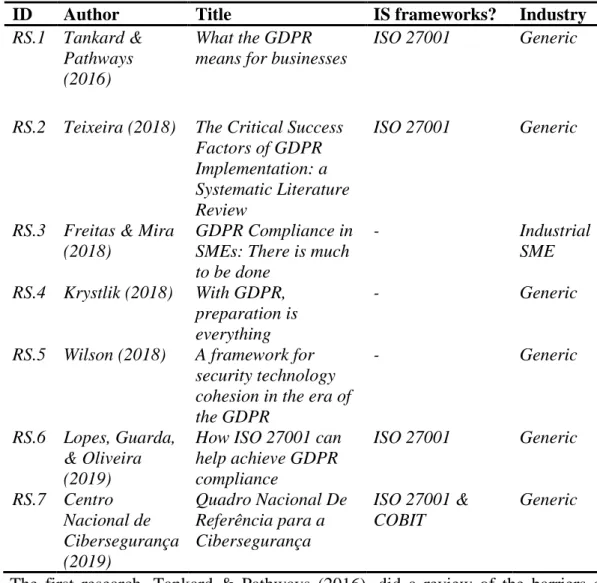
As can been seen in Table 1, seven relevant articles were found relating this research topics. From this universe, only two explore the implications during the implementation of GDPR and four explore the use of IS frameworks.
Table 1 – Related Work
ID Author Title IS frameworks? Industry
RS.1 Tankard & Pathways (2016)
What the GDPR means for businesses
ISO 27001 Generic
RS.2 Teixeira (2018) The Critical Success Factors of GDPR Implementation: a Systematic Literature Review
ISO 27001 Generic
RS.3 Freitas & Mira (2018)
GDPR Compliance in SMEs: There is much to be done - Industrial SME RS.4 Krystlik (2018) With GDPR, preparation is everything - Generic
RS.5 Wilson (2018) A framework for security technology cohesion in the era of the GDPR
- Generic
RS.6 Lopes, Guarda, & Oliveira (2019)
How ISO 27001 can help achieve GDPR compliance ISO 27001 Generic RS.7 Centro Nacional de Cibersegurança (2019) Quadro Nacional De Referência para a Cibersegurança ISO 27001 & COBIT Generic
The first research, Tankard & Pathways (2016), did a review of the barriers and consequences from not being in compliance and at the end they mention the importance of using ISO 27001. They insists that the implementation of ISO 27001 can force the appropriate measures and technological help that organizations need, as well, defining
8
responsibilities in the organizations about who can have access to the data and showing for the exterior that they have more credibility.
The second research, Teixeira (2018) performed a systematic literature review in order to identify the critical success factors that contribute for GDPR implementation. The main goal of this review is to find the barriers and enablers so that the organizations can prioritize their GDPR compliance program. The author refers the ISO 27001 as an internationally recognized IS framework and as it may help the organizations to ensure the appropriate level of desired security to safe their PI.
The third research, (Freitas & Mira, 2018) is related to the state of the art of GDPR implementation, in small and medium-sized Portuguese organizations and her level of knowledge in the subject. This exploratory study is performed by means of presential interviews with the senior official of each company. At the end of the study the authors highlighted the low maturity (10%) on GDPR knowledge among the interviewed organizations. Drawing special attention to the fact that organizations need to restructure their processes and technology procedures to adapt for GDPR compliance.
The fourth author, Krystlik (2018), talks about the principal barriers implementing GDPR, such as the Shadow IT, because many organizations create databases that have PD and with this exponential growth without a correct inventory of PD can be very frustrating in compliance achievement. The article mentions other problems like the cloud and how this can have consequences of having PD in other foreign country.
Wilson (2018) calls the attention for the fact that the organizations must know where the data is, the importance of the Data Protection Officer and their responsibilities in defining policies and procedures to be in place. Another important point is the communication between the Data Protection Officer and the IT team.
Lopes, Guarda, & Oliveira (2019), is an article started due to the difficulties that companies must implement GDPR. The authors study how the implementation of ISO 27001 might represent a facilitating factor to organizations, for an easier compliance with the regulation, from a top approach with the guidelines imposed by GDPR, mostly with the objectives of ISO 27001, and how can an independent certification could help proactively manage IS risks. This article is based on information published on websites about IS and governance.
Most recently, at the end of June 2019, was published in Portugal the “Quadro Nacional de Referência para a Cibersegurança” (QNRCS), from the Centro Nacional de
9
Cibersegurança, which is a generic framework for all types of organizations that aggregates all the best practices used by the principal IS frameworks. This work is not specific for GDPR because her own focus is cybersecurity, i.e. do not cover only DP/DPR. QNRSC has 5 main goals for security: identify; protect; detect; answer and recover.
3.2. Synthesis of the Related Work
Overall, the related articles mention the difficulties about implementing GDPR and the lack of awareness among companies. This happen because GDPR is a recent subject and concrete measures are not mentioned, appealing for implementing the requirements according to the level of risk that they have, for all the industries managing PD.
Plus, four studies argue that IS frameworks (ISO 27001 or COBIT) may help organizations achieving the level of compliance desired by GDPR, since the IS frameworks is not new and offers more concrete guidelines for implementing IS measures, reducing the risk of data breaches. However, none of these studies provide insights on how these IS Frameworks can do it.
As one can see in Table 1, there is no related work investigating how can IS frameworks help in GDPR compliance. Moreover, the few existent researches focus on the preparation without using IS frameworks and are generic to all industries.
To sum up, there is studies pointing IS Frameworks as useful to help companies comply with GDPR but no studies provide practical insights on how that can be done. This research intends to contribute with novel insights on how IS Frameworks can help companies. In this case it will be focused on Bank Industry.
11
Chapter 4 – Research Methodology
This research applies the DSR in order to design, build and evaluate how can current IS frameworks help Banks comply with GDPR.
Since this research purposes to expand the limits of human capacities and organizations, to create the artefacts invoking the Design Science Research Methodology (DSRM) is the right choice (Hevner, March, Park, & Ram, 2004). Plus, the DSR methodology consist in three more elements, the conceptual principles that help define the DSR, practical rules for DSR impersonation and procedures to perform and conduct the research (Peffers, Tuunanen, Rothenberger, & Chatterjee, 2007).
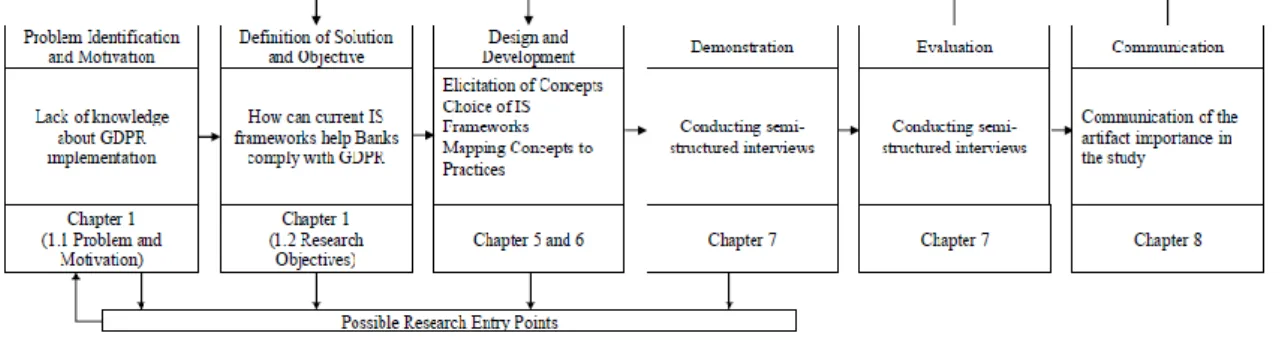
The DSR process applied in this research can be seen in more detail in Figure 1.
Figure 1 – DRS Process Model
The first two activities of this process have already been mentioned, in the respective chapters. The remaining DSR process is organized as follows.
In the design and development activity, is where all the design of the proposed artefact is done and the practical development of the same. Initially, the artefact is theoretically constructed, in other words, the IS frameworks model that will help in the implementation of GDPR in the bank industry is designed, through an instantiation of the artefact. Then, in the practical part, the development of the proposed artefact is made, based on the inputs of previous activities.
The demonstration and evaluation phase are where the validation of the artefact developed throughout this research will be performed. By conducting semi-structured interviews, a validation of the work developed is done, as well as the demonstration that it can be applied in the bank industry, by collecting the practices proposed in the research and already used by the interviewees. The interviewees are experienced professionals in the areas of DP or IS and all of them work in the bank industry.
12
Finally, in the communication, is presented a list of the main findings throughout this research and what are the key aspects that differentiate the banking industry from the requirements imposed by the GDPR.
13
Chapter 5 – Design
The focus of this research starts with the GDPR and the fact that is generic for all industries, IS Frameworks and the Bank industry. After the research work, it was not found in the scientific community, a set of IS frameworks to assist GDPR compliance in the Bank industry, because the GDPR requirements are generic for all industries. In attendance that the banks are changing their information systems, processes and methodologies to become GDPR compliant, there is a need in banks to more specific guidelines for implementing the GDPR.
Figure 2 synthesizes the Design of the proposed artefact. Four steps were performed sequentially. The final step was used to demonstrate and evaluate the proposed artefact.
R – Requirement (Requirements from the GDPR, i.e., the articles); C – Concept (Concepts that can be extracted from the requirements); IS - Information Security Frameworks (IS frameworks that exists in the market); P – Practices (Practices or controls from the IS Frameworks); I – Interview (Presential interviews to obtain qualitative data to the research)
Figure 2 –Diagram of the Design
In the following chapters will be explained the steps, that are related to the Objectives of this research.
14
5.1. Step 1 – Elicitation of the List of Concepts
The first part of the design consists in reading all the GDPR regulation (11 chapters and 99 articles) and from each of them extracting concepts that are related to the security of data, DP and rights of DS.
It must be noted that articles related to DPA obligations, such as for example investigations carried out to data breaches, penalties that could be applied to organizations, etc, were not considered.
5.2. Step 2 – Choice of IS Frameworks
Several IS frameworks exist, that despite not mandatory some could be certified to attest the compliance of the organizations with IS requirements. These frameworks offer a solid base to start implementing IS in the organizations, offering structures and practices not present in GDPR.
5.3. Step 3 – Mapping Concepts with Framework Practices
After complete Step 1 and Step 2 it was time to map the concepts with each IS framework. For each elicited concept, one or more practices from the frameworks were selected when met the requirement of the concept. The goal was for each concept, that GDPR do not give any specific instruction on how to implement them, find practices that give more precise instructions and can be applied to the bank industry in order to achieve the appropriate level of compliance.
5.4. Step 4 - Conducting Semi-structured Interviews
This step aimed to demonstrate and evaluate the applicability of the artefact with experts in the area, i.e. that have experience in the bank industry and in GDPR. Therefore, the qualitative method interview was chosen to assess if the proposed artefact is suitable to help Banks comply with GDPR.
The goal of interviews is to collect data that cannot be obtained using quantitative methods, interviewing people that gives insight into the subject studied and their opinion (Hove, 2005).
Several types of interviews exist like structured interviews, semi-structured interviews and non-structured interviews. In structured interviews, the interviewer has all the questions and only need the response, they are fairly straightforward, like an “if-then-else” (Seaman, 1999). The non-structured interview has the goal to obtain as much
15
information on the topic as possible without a defined set of questions but can have a large coast and not comparable results (Seaman, 1999). Last but not least, the semi-structured interview is a hybrid between the last two types of interviews, i.e. they start with a specific set of questions, but the interviewer can gather unexpected information to be used in the study, and is good to be used in exploratory studies (Seaman, 1999).
For this research, individual semi-structured will be used since this study has an exploratory strand. To obtain more information and validate the practices that are applied in the bank industry, the questions are open-ended, asking other information when necessary. Another additional point is that the interviews will be conducted individual and in presence.
17
Chapter 6 – Development
This research aims to explore how can current IS frameworks help banks comply with GDPR. To answer this, the next sub-chapters will provide the necessary knowledge and evidences about the artefact developed.
6.1. Step 1 – Elicitation of the List of Concepts
The first part of the artefact consists in extracting from the GDPR articles/requirements all the concepts that are related to the security of data, DP and rights of DS. For example in the below image (Figure 3), can be seen the following concepts: Lawfulness, Fairness and Transparency, Purpose Limitation, etc, that are present in the Table 3 and in Annex A with the full description of each concept.
Figure 3 – Example of elicited concepts from article 5
It should be noted that both the same concept can be elicited from more than one article and one article could have more than one concept, as can be seen in Annex A.
18
Table 2 – Chapters of GDPR Chapters with
Concepts
Principles;
Rights of the data subject; Controller and processor;
Transfers of personal data to third countries or international organisations;
Chapters without Concepts
General provisions;
Independent supervisory authorities; Cooperation and consistency; Remedies, liability and penalties;
Provisions relating to specific processing situations; Delegated acts and implementing acts;
Final provisions;
At the end of this step, 37 concepts (Annex A) were extracted from the 11 chapters (Table 2) and 99 articles that compose the GDPR. Some chapters were not considered since are not related to DPA obligations (for example, independent supervisory authorities or penalties that could be applied to the organizations and other subjects) and therefore are not directly related to the mandatory requirements of the organizations.
Table 3 – Example of extracted concepts from GDPR Concepts
Lawfulness, fairness and transparency Data Minimisation
Inaccurate Data Storage Limitation ….
6.2. Step 2 – Choice of IS Frameworks
From the list of IS frameworks existent in the market, the following four frameworks were chosen to ground the remaining steps of the research:
• ISO/IEC 27001:2013 (ISO/IEC, 2013) - Information technology - Security techniques - Information security management systems - Requirements
• ISO 27552 (ISO/IEC DIS 27552, 2019) - Security techniques - Extension to ISO/IEC 27001 and ISO/IEC 27002 for privacy information management -Requirements and guidelines
• NIST SP 800-53 rev.4 (NIST, 2015) - Security and Privacy Controls for Federal Information Systems and Organizations
19
• COBIT 2019 Framework (Cobit, 2019) - Governance and Management Objectives
The most know/used frameworks are ISO/IEC 27001:2013, that is the most used in the Europe by professionals, and NIST SP 800-53 that is more used in the US since it was created in the agency of the United States Department.
COBIT is the most used by IT professionals in IT Governance and addresses topics related to security of data. In 2019, a new version was released with updated practices regarding security aspects.
For last, ISO 27552 is a new framework, that is an extension of the ISO/IEC 27001:2013 and address the DPR and in especial the GDPR requirements. Since this is a new framework, it is only available right now in a draft.
In this research the practices are the controls from ISO 27001, NIST SP 800-53 and ISO 27552 or the activities from COBIT.
6.3. Step 3 – Mapping Concepts with Framework Practices
In this step, individually, for each of the identified concepts, was performed a research of the practices presented in every IS Framework, in order to check if the practice can fulfil the level of compliance.
The goal is from each of the concept, that do not give any specific instruction to implement them, find practices that give more precise instructions and can be applied to the bank industry to achieve the level of compliance. In case the practice fulfils the requirement of the concept, then it would add to the list (Annex B).
In Annex B can be seen the full list of the practices mapped to the each of the concepts. Some practices were used more than one time because they can be used to comply with more than one concept, and as we will see in the next section, some may not be the indicated for the concept or may not be applied in the bank industry.
Not all the concepts could be mapped with at least one practice from each framework, since there are some subjects that the frameworks do not cover at 100 percent, such as for example the concept “Lawfulness, fairness and transparency”, in the Table 4, that is not covered by the ISO/IEC 27001:2013.
20
Table 4 – Example of a concept with the practices Article Paragraph/
Line
Concept ISO 27552 ISO
27001:2013 COBIT 2019 NIST SP 800-53 v4 5 1-A Lawfulness, fairness and transparency 7.2.2 - Identify lawful basis 8.2.2 - Organization’s purposes - EDM05.02 - Direct stakeholder engagement, communication and reporting AP-2 - Purpose Specification
21
Chapter 7 – Demonstration and Evaluation
After the development of the artefact, it’s time to research possible contacts, who works in the bank industry and available for an interview, to do the demonstration and evaluation.
For the choice of interviewees, two methods where used: • Personal contact list;
• LinkedIn professional contact network.
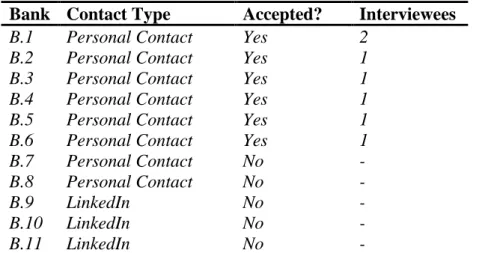
After the search, 11 possible banks were found, with at least one person to be interviewed. After the invitation was sent, six banks accept to participate in the study, and one of them with two people available for the interview. Table 5 shows the list of banks identified, how many accepted and the number of conducted interviews.
Table 5 – Selected banks overview
Bank Contact Type Accepted? Interviewees
B.1 Personal Contact Yes 2
B.2 Personal Contact Yes 1
B.3 Personal Contact Yes 1
B.4 Personal Contact Yes 1
B.5 Personal Contact Yes 1
B.6 Personal Contact Yes 1
B.7 Personal Contact No -
B.8 Personal Contact No -
B.9 LinkedIn No -
B.10 LinkedIn No -
B.11 LinkedIn No -
The interviews were conducted in person on the headquarters of six Portuguese banks, with a total of seven interviewees, from different departments, responsibilities and years of experience. All the selected interviewees have both knowledge in GDPR, DP and IS.
The goal of the interviews is to demonstrate and evaluate the developed artefact, to understand the following things:
• Is there any concept missing?
• The practice(s) are applicable to the related concept in the bank industry, and fulfil the concept?
22
To conduct this interview, a questionnaire was developed, as can be seen in Annex C, with the following structure. First, the header of the questionnaire is composed by generic questions (Table 6), to certify the experience of the interviewee in the bank industry and GDPR.
Table 6 – Interviewee specific questions
Additionally, directed to the bank exists a set of four specific questions related to the number of employees and frameworks that the bank follow/perform.
For each practice mapped to a concept, one question is made, to understand if the practice fulfils de concept, always in the bank industry. In each of these questions the interviewee must point out if the practice in the following concept is:
• Not Applicable (N/A) – If the practice is not applicable to the concept in the bank industry, or, if the practice is not applicable for this concept because it is not in the scope of them;
• Partially Compliant (PC) – In case of the selected practice do not meet all the requirement that the concept needs to meet, in the bank industry; • Fully Compliant (FC) – If the practices fulfil at 100% the requirements of
the concept in the bank industry.
Additionally, is proposed to be answered by the interviewee, if the practice is being implemented at their bank, in order to do the evaluation, with the following options:
23
• Implemented (I) – In the case of the bank already implemented them. Plus, the frameworks studied are not exposed to the interviewees until the end of the interview, due to possible influence on their own answers.
Table 7 lists an example of the first concept and their mapped practices with the possible questions to be answered by the interviewees. In addition to these questions and whenever as possible, additional information was gathered about the concepts and practices in the bank industry, as well as feedback about the implementation of the practices.
Table 7 – Concepts and practices question
At the end of the interview (Table 8), each interviewee was asked if with this concepts and practices, once again in the bank industry, they could be compliant with GDPR, if the implementation effort would be smaller and if the interview is useful.
Table 8 – Last notes
As mentioned earlier, the interviews were performed in six Portuguese banks, for a total of seven interviewees, from different departments, responsibilities and years of
24
experience. Once again, the selected interviewees participated in at least one GDPR project, and their professional experience is from IS or DP. Their current roles are the following:
• Chief Information Security Officer; • Data Protection Officer;
• IT Auditor;
• Responsible of Risk and Security of IS/IT; • Senior Manager of IS/IT.
In Table 9 it is possible to see an overview of interviewees, as well as their knowledge in GDPR and frameworks. Regarding the evaluation made by the interviewees about their knowledge of GDPR, it is normal to have dissonances between the experience (months) and the given evaluation, as it will depend on the feeling of each one and the degree of involvement of them in the projects, during this period of months.
The duration of the interviews in average was 1 hour and 30 minutes. The shortest took 1 hour and the longest took 2 hours and 30 minutes. The total of interviews duration was 12 hours.
25
Table 9 – Interviewees comparation Interview Years of Experience Role Years of experience in bank industry Months experience in GDPR Number of GDPR projects How much are familiar with GDPR (*) Frameworks in which they have experience
Interview duration
I.1 8 IT Auditor 8 12 1 Good ISO 27001; ISO
31000; ISO 22301; COBIT; NIST Cybersecurity Framework
1:30
I.2 13 IT Auditor 13 12 1 Good ISO 27001; NIST SP
800-53; COBIT; ITIL 1:00 I.3 15 Senior Manager of IS/IT
12 26 2 Very Good ISO 27001; ISO
31000; ISO 22301
1:30
I.4 14 DPO 12 10 1 Very Good ISO 27001; COBIT 1:30
I.5 25 CISO 19 30 2 Good ISO 27001; ISO
31000; ISO 38500; ISO 22301; COBIT; ISO 20000; ISO 9001; ISO 14000
2:00
I.6 26 DPO 26 30 1 Very Good ISO 27001; NIST SP
800-53; ISO 27005 2:00 I.7 33 Responsible of Risk and Security of IS/IT
30 30 1 Good ISO 27001; ISO
22301; COBIT
2:30
26
From the banks that participated in this study, half have more than 500 employees, as shown in Figure 4. Plus, all banks are present in Portugal and four of them have international presence.
Figure 4 – Number of employees
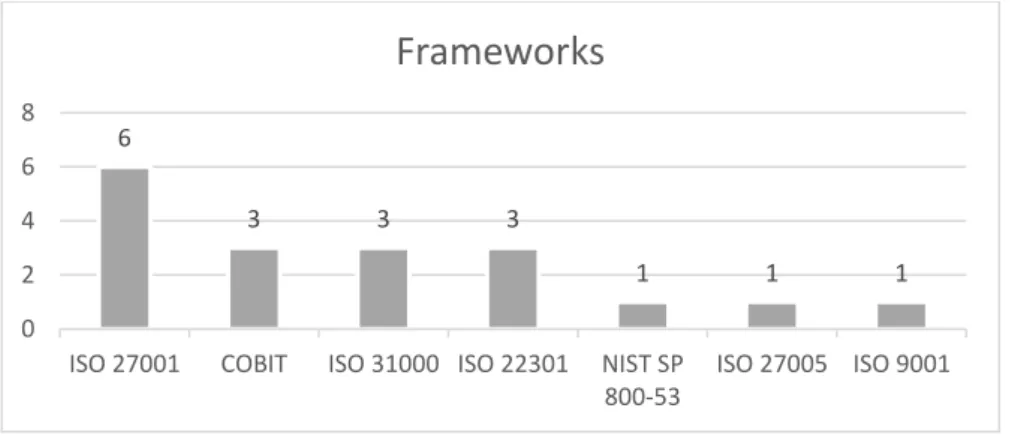
The interviewees said that all the banks follow/perform a framework or best practice. The most used framework among the interviewed banks is ISO 27001, with the justification that is the IS framework of reference in Europe. The second most used framework is COBIT, related to IT governance and IS, this framework is widely used by IT auditors as a reference for the processes to be audited in the bank industry.
Figure 5 shows the distribution of used frameworks in the banks. This list is not restricted only to IS frameworks.
Figure 5 – Frameworks followed/performed in the banks
As can be seen, most of the banks are of a considerable size, with a strong international presence, which requires compliance with more laws than those required in Portugal. Another important point, is that all the banks already follow one IS framework, as is the case of ISO 27001 which is present in all banks, although they don't implement everything. Additionally, there is a strong concern in this industry for compliance with this type of laws, in order to avoid reputational damage.
0 1 2 3 4
Number of employees
6 3 3 3 1 1 1 0 2 4 6 8ISO 27001 COBIT ISO 31000 ISO 22301 NIST SP 800-53
ISO 27005 ISO 9001
27
All the interviewees agreed that all the presented concepts are correct, and no further concepts were proposed as missing. Another additional point that all the interviewees agreed is that all concepts are required to be in place, but for this industry, some of them have some exceptions in their specifications, mainly due to other laws existent in this sector, that overlaps GDPR.
In a high-level evaluation, it can be stated that more than half of the banks interviewed already use most of the practices, and some may still be in implementation.
For the “Security of Personal Data” and “Security of Processing” concept, the opinion is that none of the existing practices is 100% compliant. However, the presented set of practices are the required to be compliant in the bank industry.
At the end of each interview a set of questions was performed to gather interviewees feedback on the research. This final set of questions is important for assessing the scope of this research and its usefulness.
As can be seen in Table 10, all the interviewees considered that they can be compliant with these practices. Regarding the effort required to implement GDPR, all interviewees said that the effort decrease, except for one interviewee, arguing that it will always depend on the approach of each bank, and if there is no IS framework already to be followed, the effort would be the same. For last, all the interviewees pointed this research as useful.
Table 10 – Final set of questions Can you be
compliant with these practices?
Would the effort of GDPR implementation decrease by implementing these practices?
This research is useful?
I.1 Yes Yes Yes
I.2 Yes Yes Yes
I.3 Yes Yes Yes
I.4 Yes No Yes
I.5 Yes Yes Yes
I.6 Yes Yes Yes
29
Chapter 8 – Analysis and discussion of results
Due to the existence of some questions in which there is a lot of divergence of answers by the interviewees, in this chapter a detailed analysis of the obtained results will be done. To better support this analysis, in Annex D can be seen the sum of the answers given by the interviewees in each question. In order to separate practices into three groups (Not Applicable, Partially Compliance and Fully Compliance), a formula was created to obtain a score per practice, with the following assumptions:
• Score of each practice = (Sum of answers with N/A * 0) + (Sum of answer with PC * 1) + (Sum of answers with FC * 2)
• N/A = 0 • PC = 1 • FC = 2
For example, in Figure 6, the practice “Identity lawful basis”, have 12 on score, based on this calculation (0*0) + (2*1) + (5*2) = 12
Figure 6 – Concept and Practices with score
To differentiate the practices that are fully compliant with the concept, partially compliant or not applicable, a range of values was created, as can be seen in Table 11, based on the score formula.
Table 11 – Score Matrix
Level of Compliance Score range Color
N/A – Not Applicable 0 – 7.99
PC – Partially Compliance 8 – 11.99 FC – Fully Compliance 12 - 14
After applying the previous formula in all practices, 13 out of 37 concepts have practices that are fully compliant. This means that 35% of the concepts have at least one practice that address the entire concept in the bank industry. Table 12 lists the concepts that have at least one practice that fulfil all the requirement, with the related practice(s).
30
Regarding the concept “Storage Limitation”, six of the interviewees agreed that is very difficult to implement due to the existence of old systems and many dependencies between them. Plus, this inhibits the banks to delete the information after the retention period, the solution is rebuilding the systems/applications, which are currently developed in technologies already obsolete.
Regarding data portability, the interviewees all agreed that it is urgent to create a form for data portability between banks, like what is already widely used in telecommunications companies. This point despite having the fully compliant practice, is crucial to create a form for the bank industry.
The transfer of data to third parties, the bank industry, must transfer PD to other countries, such as compliance with Foreign Account Tax Compliance Act (FATCA), which requires the sending of PD about the US citizens.
Table 12 – Concepts with practices fully compliant
Concept Practice
Lawfulness, fairness and transparency
Identify lawful basis
Storage Limitation Support data archiving and retention Data Retention and Disposal
Accountability Policies for information security
Information security roles and responsibilities Right of access by the data
subject
Individual Access
Right to rectification Access, correction and/or erasure
Evaluate and update or retire information Notification obligation
regarding rectification or erasure of personal data or restriction of processing
PII controllers' obligations and third parties
Right to data portability Providing copy of PII processed
Right to object Provide mechanism to object to PII processing Notification of a personal
data breach to the supervisory authority
Responsibilities and procedures
Data Protection Impact Assessment
Privacy impact assessment Designation of the data
protection officer
Acquire and maintain adequate and appropriate staffing
Governance and Privacy Program Tasks of the data protection
officer
Establish roles and responsibilities Governance and Privacy Program General principle for
transfers
31
On the Table 13 there are the concepts that have practices with less or equal seven in their score. The information gathered during the interviews was enough to justify this low score, and most of it is due to the specifications of the industry.
All practices that refer to automated decisions have a low score, because in the bank industry there are no automated decisions, they may have some automated decisions in processes, but their final output is made by humans. For example, it’s impossible to automatically decide if a mortgage loan can be decided based only in automated decision at this moment.
The concept “Information to be provided where personal data have not been obtained from the data subject”, unlike other industries that collect data and sell them, such as marketing companies, the bank industry when collect data they can only obtain them from Bank of Portugal or other regulators, for effects of money laundering and terrorist financing or other debtors blacklist. In this case the data subject cannot ask for rectification or erasure because there are other laws/regulations that overlap the GDPR. If this information is incorrect, the data subject must prove the home institution, responsible for the list that the data are incorrect, and never directly to the bank.
The practice “Review effectiveness of business process controls” is not necessary because it is redundant, as there are more complete practices outlined for the concept, since it is very abstract.
The practices of the concept “Communication of a personal data breach to the data subject” had a low score solely because they are not in the context of this concept. In reporting the incident to the DS it is not necessary to say what is being done to mitigate the problem, only to the regulator.
32
Table 13 – Concepts with practices not applicable
Concept Practice
Information to be provided where personal data are collected from the data subject
Automated decision making
Information to be provided where personal data have not been obtained from the data subject
Provide mechanism to modify or withdraw consent Provide mechanism to object to processing
Providing copy of PII processed Automated decision making
System of Records Notices and Privacy Act Statements
Right of access by the data subject
Automated decision making
Identify basis for international PII transfer
Direct stakeholder engagement, communication and reporting
Right to object Providing information to PII principals Automated individual
decision-making, including profiling
Establish data profiling methodologies, processes and tools
Data Mining Protection Regularly Testing, Assessing
and Evaluating
Review effectiveness of business process controls Communication of a personal
data breach to the data subject
Response to information security incidents Define classification schemes for incidents and service requests
As can be seen in Table 14, the average practices score per concept almost always indicates that they are in the partially compliance range, which is in line with what was said by the interviewees, that in most cases the practices complement each other to comply with the concept, in the bank industry.
The overall average of the concepts is 9.7, which is among the “partially compliance” range. There are 2 concepts that have a score below 8, because as explained earlier most of the practices do not apply in bank industry, although the concepts are necessary.
These results reinforce what was previously said by the interviewees, that the practices, with the exception of those removed (Table 13), will complement each other, thus obtaining a list of good practices, from IS frameworks, that help in GDPR implementation.
33
Table 14 – Practice score level per concept
Concept Practice score
level
Lawfulness, fairness and transparency 10.75
Data Minimisation 10
Innacurate Data 9,8
Storage Limitation 11
Security of Personal Data 9,46
Accountability 9,92
Transparent information, communication and modalities for the
exercise of the rights of the data subject 10,16
Information to be provided where personal data are collected from
the data subject 9,11
Information to be provided where personal data have not been
obtained from the data subject 7,22
Right of access by the data subject 9
Right to rectification 11,33
Right to erasure (‘right to be forgotten’) 8,75
Right to restriction of processing 10,4
Notification obligation regarding rectification or erasure of
personal data or restriction of processing 10,5
Right to data portability 10
Right to object 9,2
Automated individual decision-making, including profiling 7,75
Data Protection Policies 10
Codes of Conduct 10,2
Data Protection by Design 9,12
Data Protection by Default 9
Processor 9,6
Records of Processing Activities 9,69
Security of processing 9,7
Pseudonymisation 9,14
Encryption of Personal Data 9,42
Confidentiality, Integrity, Availability and Resilience 10,11
Restore the Availability 10,25
Regularly Testing, Assessing and Evaluating 8,71
Approved Certification 9
Notification of a personal data breach to the supervisory authority 10,71 Communication of a personal data breach to the data subject 8,85
Data Protection Impact Assessment 9,87
Designation of the data protection officer 11,5
Tasks of the data protection officer 11
Certification 8,5
35
Chapter 9 – Conclusion
This research aimed to explore how can current IS frameworks help Banks comply with GDPR. To answer this question, a research was carried out on mapping the concepts (requirements) with the practices of the IS frameworks. Then, semi-structured interviews were conducted with professionals working in the bank industry.
This research took contributions by exploring an area that was not explored previously, improving the body of knowledge about GDPR implementation with IS frameworks.
At the end, several conclusions could be withdrawn about the specificities of the bank industry, IS frameworks and the GDPR implementation. According to the evidence presented in previous chapters, one may argue that an IS framework is a good starting point to implement GDPR and getting more specific instructions, on how to implement controls to mitigate the IS and DP risk that the organizations are exposed.
In terms of particularities in the bank industry, the main findings are:
• When PD have not been obtained from the DS, the DS cannot deny the consent; • There are not automated decisions at the end of the process;
• Storage limitation is very difficult to implement, even though is mandatory and applicable in this industry;
• There is no template for data portability between banks;
• Other laws can overlap GDPR, like FATCA, money laundering and terrorist financing, etc;
• With the use of IS frameworks the banks can develop certifications of compliance, for example if they implement the entire controls of ISO 27001, because the GDPR expressly provides that adherence to approved certifications to demonstrate compliance.
In general, the interviewees are satisfied with the proposal due to the ability to improve the GDPR implementation and reduce the level of effort. Plus, with these practices they can have a more solid view of what to do, to comply with GDPR.
As can be seen, there is not a single IS framework that has practices for all concepts. This is due to several factors such as:
36
• Only ISO 27552 has been developed to comply with GDPR; • The NIST SP 800-53 is very technical and oriented to IS and DP; • ISO 27001 was last updated in 2013, when DP was not yet a hot topic;
• COBIT is very focused on governance and management of IT, although it was updated in 2019 and added new controls to IS.
However, the IS frameworks of this research complement each other and in answer to the objective of this research, it is possible for an IS framework assist in the implementation of GDPR, achieving the compliance and thereby decrease the level of effort required.
In conclusion, the research question, “How can current IS frameworks help Banks comply with GDPR” was answered positively and proves that IS frameworks can help Banks comply with GDPR, although not only with a single IS framework. Additionally, for this industry there are some limitations that should be considered.
9.1. Research Limitations
Throughout this research some limitations were identified. As the bank industry touches on critical data and the information shared abroad is greatly reduced, only 6 banks were able to participate in the study.
Another limitation found is that the study based its demonstration and evaluation on the knowledge of the interviewees and was not possible to create group meetings to do a brainstorming, since this point would have been more beneficial for the validation of some concepts and practices.
9.2. Future Work
The future work involves a second round of interviews to validate the results obtained in the previous chapter, ideally using Delphi techniques. Finally, with the final list of practices and concepts should be implemented in a bank with a low level of maturity, thus evaluating the usefulness of using the IS frameworks.
37
References
2019, C. (2019). Governance and Management. Governance and Management Objectives. https://doi.org/10.1201/b13869-7
Agarwal, S. (2016). Towards dealing with GDPR uncertainty. Retrieved from http://www.ifip-summerschool.org/wp-content/uploads/2016/08/IFIP-SC-2016_pre_paper_13.pdf
Al-ahmad, W., & Mohammad, B. (2012). CAN A SINGLE SECURITY FRAMEWORK ADDRESS INFORMATION SECURITY RISKS ADEQUATELY ?, 2(3), 222–230.
Ayala-rivera, V., & Pasquale, L. (2018). “ The Grace Period Has Ended ” : An
Approach to Operationalize GDPR Requirements. 2018 IEEE 26th International Requirements Engineering Conference (RE), 136–146.
https://doi.org/10.1109/RE.2018.00023
Council, O. F. T. H. E. (1995). DIRECTIVE 95/46/EC OF THE EUROPEAN PARLIAMENT AND OF THE COUNCIL of 24 October 1995, (L). Council, O. F. T. H. E. (2016). (Text with EEA relevance), 2014(April). Custers, B., Dechesne, F., Sears, A. M., Tani, T., & van der Hof, S. (2018). A
comparison of data protection legislation and policies across the EU. Computer Law and Security Review, 34(2), 234–243.
https://doi.org/10.1016/j.clsr.2017.09.001
Freitas, C., & Mira, M. (2018). GDPR Compliance in SMEs : There is much to be done, 3(4), 1–7.
Heimes, R. (2016). Global InfoSec and Breach Standards. IEEE Security and Privacy, 14(5), 68–72. https://doi.org/10.1109/MSP.2016.90
Hevner, A. R., March, S. T., Park, J., & Ram, S. (2004). Design science in information systems research. MIS Quarterly: Management Information Systems, 28(1), 75– 105. https://doi.org/10.2307/25148625
Hove, S. E. (2005). Experiences from Conducting Semi-Structured Interviews in Empirical Software Engineering Research, (Metrics).
38
27552 Security techniques — Extension to ISO / IEC 27001 and ISO / IEC 27002 for privacy information management — Requirements and guidelines, 2018. ISO/IEC, I. O. for S. E. C. (2013). Iso/Iec 27001: 2013. Information Technology
Standard. Retrieved from https://www.iso.org/obp/ui/#iso:std:iso-iec:27001:ed-2:v1:en
Krempel, E., & Beyerer, J. (2018). The EU General Data Protection Regulation and Its Effects on Designing Assistive Environments. Proceedings of the 11th PErvasive Technologies Related to Assistive Environments Conference, 327–330.
https://doi.org/10.1145/3197768.3201567
Krystlik, J. (2018). With GDPR , preparation is everything. Computer Fraud & Security Bulletin, 2017(6), 5–8. https://doi.org/10.1016/S1361-3723(17)30050-7
Lopes, I. M., Guarda, T., & Oliveira, P. (2019). How ISO 27001 Can Help Achieve GDPR Compliance, (June), 1–6. https://doi.org/10.23919/cisti.2019.8760937 Malatras, A., Sanchez, I., Beslay, L., Coisel, I., Vakalis, I., D’Acquisto, G., …
Zorkadis, V. (2017). Pan-European personal data breaches: Mapping of current practices and recommendations to facilitate cooperation among Data Protection Authorities. Computer Law and Security Review, 33(4), 458–469.
https://doi.org/10.1016/j.clsr.2017.03.013
NIST. (2015). NIST Special Publication 800-53 Security and Privacy Controls for Federal Information Systems and Organizations. Sp-800-53Ar4, 462.
https://doi.org/10.6028/NIST.SP.800-53Ar4
Peffers, K., Tuunanen, T., Rothenberger, M. A., & Chatterjee, S. (2007). <Design Science Research Methodology 2008.pdf>. Published in Journal of Management Information Systems, 24(3), 45–78. https://doi.org/10.2753/MIS0742-1222240302 Philip, R. K. (2018). General Data Protection Regulation (GDPR) and paediatric
medical practice in Ireland: a personal reflection. Irish Journal of Medical Science, (1), 1–4. https://doi.org/10.1007/s11845-018-1857-3
Phillips, M. (2018). International data-sharing norms: from the OECD to the General Data Protection Regulation (GDPR). Human Genetics, 137(8), 575–582.
https://doi.org/10.1007/s00439-018-1919-7
39
Ri, P., Dwd, H., Rq, D., Plohwd, G., Frp, J., Ri, S., … Ri, Q. L. (2018). $q ,psdfw ri *hqhudo ’dwd 3urwhfwlrq 5hjxodwlrq rq d 6pduw &lw\ &rqfhsw, 390–394. https://doi.org/10.23919/MIPRO.2018.8400074
Rijsenbrij, D. (2019). PrimaVera Working Paper Series PrimaVera Working Paper 2000-19 Redefining business – IT alignment.
Seaman, C. B. (1999). Qualitative Methods in Empirical Studies of Software Engineering, 25(4), 557–572.
Srinivas, J., Kumar, A., & Kumar, N. (2019). Government regulations in cyber security : Framework , standards and recommendations. Future Generation Computer Systems, 92, 178–188. https://doi.org/10.1016/j.future.2018.09.063 Sydekum, R., & Networks, F. (2018). Can consumers bank on financial services being
secure with GDPR ?, 11–13. https://doi.org/10.1016/S1361-3723(18)30054-X Tankard, C., & Pathways, D. (2016). What the GDPR means for. Network Security,
2016(6), 5–8. https://doi.org/10.1016/S1353-4858(16)30056-3
Teixeira, G. (2018). The Critical Success Factors of GDPR Implementation : a Systematic Literature Review.
Tikkinen-Piri, C., Rohunen, A., & Markkula, J. (2018). EU General Data Protection Regulation: Changes and implications for personal data collecting companies. Computer Law and Security Review, 34(1), 134–153.
https://doi.org/10.1016/j.clsr.2017.05.015
Wilson, S. (2018). A framework for security technology cohesion in the era of the GDPR. Computer Fraud & Security Bulletin, 2018(12), 8–11.