Aniki vol. 2, n.º 2 (2015): 400-406 | ISSN 2183-1750 doi:10.14591/aniki.v2n2.183 Enrico Camporesi
Paolo Gioli: Volti, at the Microscope Gallery (New York, April 10- May 18 2015).
One-person exhibitions seem to be the easiest way of displaying art. At first glance, nothing can look more intelligible than conversing with a single author who produced all the works in order to understand the specificity of a practice – or of a “stylistic uniformity”, to borrow Foucault’s expression (1977, 128). However, one should be aware that the way in which an exhibition is carried out entails a series of crucial questions that deserve to be acknowledged. Curating an exhibition is always a challenging process because of the combination of mundane, down to earth matters, alongside the framing needed to organize it. The case of Paolo Gioli’s exhibition “Volti” [“Faces”] is an interesting example given its starting point (Italian author Paolo Gioli), its location (the Microscope Gallery in Brooklyn, New York)2 and its targeted audience. In this text, I would like to take the reader on a journey through the exhibition-making process, discussing, among others, the difficulties that I have encountered. For obvious reasons – I was the guest curator of the show –, this will not be a critical review or a detached piece of writing, but rather a first person analytical attempt that will, I hope, go beyond the simple purposes of presenting a show. For this reason, I do not wish to dwell more than necessary on the (heterogeneous) nature of the work made by the artist in question. Instead, I would rather try to lay out some issues concerning the presentation of the artworks themselves. To put it shortly, this text is thought as a brief museological and museographical journey.
1 Université Sorbonne Nouvelle - Paris 3, LIRA Laboratoire International de
Recherches en Arts, 17 rue de la Sorbonne, 75005 Paris, France / Università di Bologna, Dipartimento delle Arti, Via Barberia 4, 40123 Bologna, Italy.
2 Founded in 2010, in the Bushwick area of Brooklyn, Microscope Gallery has been
conceived as a means to dissolve the boundary between the ‘white cube’ of the gallery and the ‘black box’ of the screening room. Microscope holds film and video screenings, exhibitions (around ten in the course of a year), and a variety of sound and performance events (virtually one event a week). See Camporesi 2014.
Figure 1: “Paolo Gioli: Volti” (Quando i volti si toccano, 2012;
Volti attraverso, 1987-2002) | Installation View © Paolo Gioli and Microscope Gallery Paolo Gioli (b. 1942) is the author of a conspicuous body of work that has been shown widely both in Italy and internationally. Trained as a painter at the fine arts academy in Venice, he turned to photography and film after a residency in New York in 1967. Since then, he’s shot thirty films and produced dozens of photographic series, touching upon a plethora of techniques, formats, and materials (pinhole photography, slit-scans, polaroids, cibachromes, found footage works, etc.). The first question that emerged while conceiving of a one-person show of Gioli’s work was a matter of simple choice. Given the wide technological implications of the artist’s work, which he considers as important and meaningful as the artworks themselves, one solution would have been to focus on a single technique and to show the variety of results of a given mechanical/chemical apparatus. Secondly, the artist’s long career, spanning different decades, put us before a timeframe problem. Should the recent productions be privileged? Paolo Gioli is, after all, a living and still active artist. But since this was his first solo show in the United States, a retrospective look seemed more appropriate, as the exhibition aimed to grasp and understand his broad activity.
As always, in terms of content, exhibitions prove to be a matter of tact, if not compromise – though certain bold statements can be allowed (and should be encouraged). Together with gallerists Elle Burchill and Andrea Monti, as well as researcher Eline Grignard, we decided to focus on a recurring motif rather than relying on the question of techniques or on a simple chronological organization. Looking at Gioli’s career, one realizes how his crucial concerns revolve around issues of portraiture (or self-portraiture), with special attention to the depiction of bodily movements and facial
expressions. Therefore, in order to allow the viewer to witness simultaneously the startling variety of practices and techniques mobilized by the artist, we focused on the human face (“volti”, the title of the exhibition, means “faces” in Italian). The choice of turning to a motif instead of drawing attention to the technical processes was a way of escaping the conventional understanding of Gioli’s work, the artist being often considered a “master” in the technical sense.3 By focusing on the images’ subject matter instead of concentrating on their production techniques, the works gathered would become mysterious apparitions and the inquiry into the tools of their fabrication would not devoid them of their intriguing quality, but rather deepen this feeling.
Figure 2: “Paolo Gioli: Volti” (Sconosciuti, 1994) | Installation View © Paolo Gioli and Microscope Gallery
We never tried to set up a retrospective of Gioli’s work - virtually an impossible task - because of the consistent amount of works, the availability of single pieces, and the restrictions linked to the gallery space.4 However, the exhibition would have to carry on the difficult task of displaying a coherent, but diverse, body of work according to a spiraling (and not a linear) timeline. It was important to show a selection from the 1994 series Sconosciuti [“Unknown People”], one of his most celebrated series of works. Gioli had found a series of 1950s glass photographic plates by an anonymous photographer. Observed from a certain angle, such plates would show painterly touches on their backs applied by an anonymous artisan in order to improve the flaws of the subject in the photo. In
3 The classic references in this sense are Toffetti 2011, and Valtorta 1995. A
technological approach to Gioli’s work can be found also in Rumble 2014, whereas a speculative and more nuanced perspective is evident in Bullot 2013.
4 Although Microscope moved ino a much bigger space in the fall 2014, walls could
not be built inside the room because they would not allow the screening/event configuration during the time of the exhibition.
Gioli’s treatment, however, such brushes become disfiguring scratches upon the faces that emerge from the past. With regards to the Sconosciuti series (and to all the other series displayed), we selected a restricted number of items and displayed them on a single wall, each series having been attributed a wall. The wide wall facing the Sconosciuti series was occupied by the Volti attraverso [“Faces Through”] series (1987-2002). Each of the subjects portrayed here was photographed with a “perverted” photo finish camera, in which the usual linear slit-scan was substituted with another image, related to the person’s identity (ideograms, fingerprints, pubic hair, and so on). Dismantling technical processes has been at the core of Gioli’s work, and the series provides an eloquent, iconographically charged example. We exhibited the vintage prints of the Sconosciuti and the Volti attraverso without frames, thus enabling the works to assume a quasi-narrative sequence while on display.
On the smaller wall we chose to hang three framed large format polaroids from the Luminescenti [“Luminescent”] series; made in 2007, it focuses on Roman sculptures from the Capitolini and the Vatican museums. Those images, whose colors and looks are at first inexplicable, were produced using handmade plates (approx. 25x35cm) made of the phosphorescent material used for road signs and airport runways and then printed in the dark room directly onto the “positive” (polaroid) surface. The transience of the figures depicted in the sculptures is evoked in the idea of the plate charged with light (also destined to fade away after being printed).
To respond to the “urge to secure phenomena” (Eisenstein 2014, 26) – as a character dear to Gioli, Sergei Eisenstein, once described photography - the exhibition needed to be punctuated by a selection of his moving images.
Figure 3:“Paolo Gioli: Volti” (Il volto inciso, 1984; Luminescenti, 2007) | Installation View © Paolo Gioli and Microscope Gallery
Once the theme of the exhibition had been defined, my choice immediately fell on a rather overlooked piece that Gioli produced for a display in Volterra in the mid-1980s. The work, entitled Il volto inciso (“The Graven Face”, 1984), draws its origin from a series of Etruscan sculptures, closely related to the place in which the original exhibition was set. Through a complex system of multiple projections (Super 8, 16mm, and slides), Gioli transferred the colors of his (living) models to the stone features of the Etruscan sculptures. Everything was re-photographed on video (VHS) and then transferred into a video file and displayed on a monitor for the purposes of our exhibition. After all, Gioli once said that sarcophagi curiously evoke the shape of a TV-set.
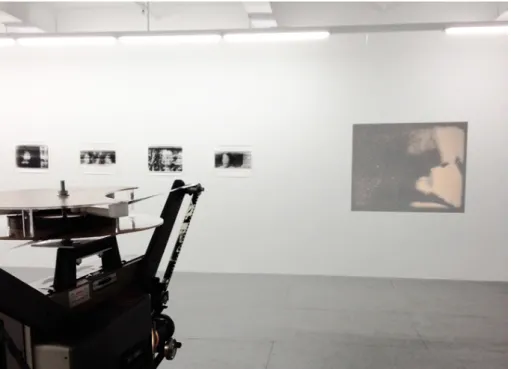
For the 16mm film Quando i volti si toccano (“When Faces Touch”) (2012), we operated another kind of displacement. This film is made by contact printing (hence the “double entendre” in the title). Working in the dark room, Gioli put the same photographic plates of the Sconosciuti onto unexposed 16mm film rolled on the surface of a tablet. The piece had been conceived, as all of Gioli’s filmic works, for the regular screening room. In order to build a dialogue with the works exposed, we decided instead to exhibit it on a looper (built by filmmaker and craftsman Kenny Curwood and installed by artist Sarah Halpern) and to project it onto a floating silver-painted screen (in order to achieve a more contrasted image in the immaculate white cube of the gallery). Such screen hanged from the ceiling with invisible threads. The angle of the projection interfered with the parallel organization of the works on the wall, as the video piece would. The choice of displaying the artwork in a way that had nothing to do with its original exhibition conditions was a strong statement of the exhibition; it also evinces a crucial turn in the way Gioli’s work is understood. His photographic practice tends too often to be considered separately from his filmic production; the display finally reunited them, ultimately respecting their material source.
Figure 4: Chrissie Iles visiting “Paolo Gioli: Volti” ( May 2015) | © Chrissie Iles The selection process, as well as the minute but essential displacements, had to fit the needs of a gallery like Microscope, which has taken on the difficult task of representing mainly time-based artists. Since it opened in 2010, Microscope has held exhibitions of both masters of experimental filmmaking (from Takahiko Iimura to Peggy Ahwesh) and emerging artists (Allison Sommers, Katherine Bauer, Matt Town, etc.). By bringing Paolo Gioli to a young, yet established gallery with this precise focus, the aim was to break the boundaries in the appreciation of his work (film versus photography) and, at the same time, to re-inscribe his work in the present (hence the refusal of a “restrospective” exhibition). The transition was not without difficulties, but had to be operated in order to open his work to the present critical discourses and to avoid the risk of an early “historical” framing. Whereas Gioli himself, resolutely bound to more classical exhibition settings, seemed skeptical about the curatorial operations we had carried out, shortly after the opening he found himself satisfied with a more canonical theatrical screening held at the gallery.
During the Q&A session after the screening of a film program that I organized (entitled “Face / Figure / Film” and spanning from 1972 to the 2000s), Gioli was facing a receptive audience, previously only partially aware of his achievements. Young artists from the New York scene, mostly living and working in Brooklyn, as well as legends like Jonas Mekas, or Lower East Side obscure masters such as Lary 7 and Bradley Eros, all gathered at Microscope, engaging in a discussion around techniques, materials, anecdotes from the history of photography, etc. The versatility of a venue like Microscope,
which allows the “white cube” to become a “black box” in a matter of hours, eloquently demonstrated that taking the chance of extrapolating Gioli from the quiet zone of historical understanding and bringing him into the spotlight again, was not only a curatorial gesture, but also the best homage to be paid to an artist of his stature.
BIBLIOGRAPHY
Bullot, Erik. 2013. “Pulsion, pulsations: notes sur le cinéma de Paolo Gioli”. Cahiers du Musée National d’Art Moderne 125: 44-63. Camporesi, Enrico. 2014. “Seen Through the Microscope. An
Interview with Elle Burchill and Andrea Monti”. La Furia Umana Paper 5: 324-332.
Eisenstein, Serguei. 2014. Notes pour une histoire générale du cinéma. Edited by Naum Kleiman, Antonio Somaini, and François Albera. Paris : AFRHC.
Foucault, Michel. 1977. “What Is an Author”. In Language, Counter-Memory, Practice. Selected Essays and Interviews, edited by Donald F. Bouchard, 113-138. Ithaca: Cornell University Press.
Rumble, Patrick. 2014. “Persistence of Vision: The Films of Paolo Gioli”. Artforum (52) 10: 342-351.
Toffetti, Sergio and Annamaria Licciardello, eds. 2011. Paolo Gioli. Un cinema dell’impronta / Imprint Cinema. Rome: Kiwido / Cineteca Nazionale.
Valtorta, Roberta, ed. 1995. Paolo Gioli. Fotografie, dipinti, grafica, film. Udine: Art&.