http://dx.doi.org/10.1590/1980-57642018dn13-010001
Cognitive reserve and dementia
A scientometric review
Maria Helena Pestana1, Margarida Sobral2
ABSTRACT. Research into cognitive reserve (CR) and dementia is advancing rapidly. This paper analyses the intellectual structure, emerging trends and relevant shifts in the development of available knowledge. Data collected from the Web-of-Science produced an expanded network of 564 articles and 12,504 citations in the 1998-2017 period. The co-citation network visualized was characterized by a scientometric review using CiteSpace. The results revealed that author Stern Y had the highest number of publications and citations. The network of journals, institutions and countries showed a central-peripheral structure with Neurology, Harvard University and the USA ranked first, respectively. While cognitive reserve remains the most prominent area of research in this field, studies related to functional ability, executive control, mortality data and reserve mechanisms have grown considerably. The identification of critical articles and the development of emerging trends highlights new insights in the area of research, better communicating key findings and facilitating the exploration of data.
Key words: cognitive reserve, dementia, intellectual structure, patterns, emerging trends, CiteSpace.
RESERVA COGNITIVA E DEMÊNCIA: UMA REVISÃO CIENTOMÉTRICA
Resumo. A pesquisa em reserva cognitiva e demência avança rapidamente. Este artigo analisa a estrutura intelectual, tendências emergentes e mudanças relevantes no desenvolvimento do conhecimento coletivo. Dados coletados do Web-of-Science, construíram uma rede expandida de 564 artigos e 12.504 citações, entre 1998-2017. A rede de cocitação visualizada foi caracterizada através de uma revisão cientométrica utilizando o CiteSpace. Os resultados revelam Stern Y com o maior número de publicações e citações. A rede de revistas científicas, instituições e países apresenta uma estrutura central-periférica, respetivamente com Neurologia, Universidade de Harvard e EUA em primeiro lugar. Enquanto a reserva cognitiva continua a ser a área de pesquisa mais proeminente neste campo, estudos relacionados à capacidade funcional, controle executivo, dados de mortalidade e mecanismos de reserva têm experimentado um crescimento considerável. A identificação de artigos críticos e o desenvolvimento de novas tendências emergentes destacam novos insights sobre a área de pesquisa, comunicando melhor as principais descobertas e facilitando a exploração de dados. Palavras-chave: reserva cognitiva, demência, estrutura intelectual, padrões, tendências emergentes, CiteSpace.
D
ue to the progressive ageing of thepop-ulation and life expectancy, increasing attention has been dedicated to the study of cognitive reserve (CR) and dementia. Demen-tia predominantly affects older people, and the risk of dementia rises with increasing age. Alzheimer’s disease (AD) is the most common form of dementia in the elderly.1 CR
is a hypothetical model which reflects cogni-tive aging and describes the capacity of the adult brain to tolerate the effects of this neu-rodegenerative process,2 while dementia is a
syndrome in which there is deterioration in memory, thinking, orientation, comprehen-sion, calculus, learning capacity, language, and judgement, thinking, behavior and the This study was conducted at the University Institute of Lisbon (ISCTE-IUL), Lisbon and Hospital Magalhães Lemos, Porto, Portugal.
1PhD, University Institute of Lisbon (ISCTE-IUL), Lisbon, Portugal. Research and Education Unit on Ageing (UNIFAI, ICBAS, UP). 2PhD, Psychogeriatrics Service,
Hospital Magalhães Lemos, Porto, Portugal. Research and Education Unit on Ageing (UNIFAI, ICBAS, UP). CINTESIS – Center for Health Technology and Services Research (FM, UP).
Margarida Sobral. Hospital de Magalhães Lemos – Rua do Professor Álvaro Rodrigues – 4149-003 Porto – Portugal. E-mail: margaridasobral@hmlemos.
min-saude.pt
Disclosure: The authors report no conflicts of interest.
ability to perform everyday activities. The CR hypoth-esis suggests that individual differences in the ability to cope with AD pathology2-5 are consistent with the
pre-diction that people with greater reserve can cope with advancing AD pathology longer before it is expressed clinically.2,5-7 CR is not fixed and continues to evolve
throughout the lifespan.6,7 CR is not measured directly8
and the variables that pertain to lifetime experience, such as education, occupation, and leisure activities, are the most commonly used proxies for CR.2,6,8-10 These
variables help the individual retain cognitive function in old age.11 Some studies have shown that the risk of
developing AD is reduced in individuals with higher levels of education,5,12-16 occupational attainment5,17-21
and participation in leisure activities.5,22-26 Other
stud-ies found no association between education and inci-dent dementia.15,27,28 Furthermore, no association was
found between occupational attainment and incident AD in several population-based longitudinal studies.29
CR interventions might be a key nonpharmacological approach to preventing this disease.6 Several studies on
CR and dementia have used different methodologies, leading to disparate results.
CR and dementia involve research in several fields and disciplines such as clinical neurology, neurosci-ences, geriatrics and gerontology. As research in these areas advances rapidly, it is critical to keep abreast of the respective intellectual structure, emerging trends and relevant shifts in the development of available knowl-edge. Studies on CR and dementia have been published in a large number of journals by authors from all over the world. However, there is a need to gather systematic data on this global scientific output. Therefore, innova-tive studies are required to make sense of the subse-quent ballooning number of publications in the area. In recent years, bibliometrics has been widely applied in various fields to identify the output of authors, insti-tutions and countries, as well as evaluate geographic distributions and international collaborations.30 In this
study, bibliometric analysis was used to evaluate the global scientific output on CR and dementia, and find an approach to quantitatively and qualitatively assess the current global research. Data were based on the science citation index expanded database from the Institute of Scientific Information Web of Science database, corre-sponding to 564 publications and 12,504 citations refer-ring to cognitive reserve and dementia in the 1998-2017 period. More specifically, this study aimed to analyze publications, journals, areas of research, the intellectual structure, keywords, research hotspots and emerging trends in CR and dementia.
METHOD
Network analysis and visualization
Bibliometric analysis is critical for conducting periodic reviews of existing research fields, identifying contri-butions to knowledge and for constructing substanti-ated arguments about the development of a field.31 The
present study focused on co-citation analyses to create network visualizations of the relationships between influential publications, highlighting disciplinary contri-butions in an interdisciplinary field.32 CiteSpace was
used to support network visualization from biblio-graphical sources and to quantify the science research using three types of metrics: (1) structural (between-ness centrality, modularity and silhouette), temporal (citation burst) and semantic (define cluster labels from phrases extracted from titles, abstracts and keywords or from index terms of citing articles). These metrics are useful for describing the intellectual structure of disci-plines and fields, detecting existing scientific schools and academic networks, and for identifying potential research fronts, as will be seen later in the paper.
Bibliographical records
The global scientific outputs were generated from the Web-of-Science (WoS) database and analysed using CiteSpace (http://cluster.cis.drexel.edu/~cchen/ citespace/) and VosViewer (http://www.vosviewer. com/). The dimensions used as a basis for selecting the articles on cognitive reserve and dementia were: keywords, journals and years of publication. Concerning keywords, given the focus on cognitive reserve and dementia, these two words were used. To provide more scientific and accurate information about our research, only those articles with the search terms in the title, abstract or keywords of the documents were extracted for further analysis33 from the WoS database. Regarding
time horizon, the analysis spans twenty years, from 1998 to 2017. Many previous articles have adopted a similar time horizon, e.g. Ye et al.34 Finally, concerning
the journals, the number of selected papers explicitly focused on cognitive reserve and dementia was taken into account. Only journals published in English were included in the sample. Using these three criteria (keywords, time horizon and journals), the total sample included 564 articles, representing 82.10% of all the documents, and 12,504 citations. Based on the assump-tion that the citing of an article makes it relevant to the topic,30 articles not cited by other studies and therefore
disconnected, were eliminated. According to Ohba et al.,35 findings on highly cited articles are useful to reveal
the recognition of scientific advancement and give a
historic perspective on scientific progress. Citation, as an association-of-ideas index, offers an approach to subject control of the literature of science.36 Some
papers are not relevant for a specific research stream, they are not cited by other studies and therefore remain “disconnected”. Exclusion of disconnected articles from the overall sample, gave a final sample of 528 connected articles. These articles were distributed across 256 jour-nals on the field of research, and 27 had no citations. The other 89.45% with at least one citation are distrib-uted into a network with reasonable quality (modularity 0.4295) and low density (0.0258), suggesting they are dominated by a small number of relevant journals. The top 10 journals in the WoS represent 37.25% of all CR and dementia journals and accounted for 23.94% of total publications. Neurology and Journal of Alzheimer Disease accounted for most of research, totaling 51 documents (7.98%), followed by Journal of the International
Neuro-psychological Society, Dementia and Geriatric Cognitive Disorders, International Journal of Geriatric Psychiatry, International Psychogeriatrics, American Journal of Geri-atric Psychiatry, Journal of the American GeriGeri-atric Society,
and Neurobiology of Aging.
The network has 2365 keywords, where 285 had the minimum number of five occurrences, and the top ones are shown by time in Figure 1. The more recent key words are marked in red, such as diagnostic guide-lines, human brain, lifelong bilingualism, life style, and prevention.
The structure of the network contains 1043 institu-tions and is dominated by a small number of them (very low density 0.00142). At the top, institutions with more than 20 documents include: Harvard University, with 23 documents and 1504 citations, followed by Colombia University, with 26 documents and 4003 citations, and finally UCLA, with 23 documents and 653 citations. All these Institutions are in the USA.
The sample of connected articles shows a pattern of increasing publications (Figure 3), with a relative growth rate of 0.28 per year. The number of research publications is doubling every 3.28 years, which is an indicator of relatively rapid growth in the amount of research work being done on CR and dementia over the last twenty years.
BIBLIOGRAPHICAL LANDSCAPE
Thematic clusters
Co-citation analysis is a useful empirical technique for describing the intellectual structure of disciplines.37
This technique uses pairs of documents which often appear together in reference lists and have something
in common.38 CiteSpace divides the co-citation network
into many clusters of co-cited references such that references are tightly connected within the same clus-ters, but loosely connected among different ones. This methodology focuses on references and, in this sense, explores the pillars of a specific research stream. Chen et al.39 recommended that the number of relevant
clus-ters in the network should have more than 10 members and a silhouette value >0.70, which is an indicator of its homogeneity or consistency, indicating good quality of the clustering configuration.
The network generated 60 clusters (#). The pattern of our network is dominated by small clusters (low density 0.0098), with clear boundaries (silhouette >0.70), such that nodes within the same group are connected tighter than nodes between different groups (high modularity 0.9549). Only seven clusters have at least 10 members and are highly homogeneous (Table 1). Each cluster is labelled by noun phrases from titles of citing articles of the cluster,40 through three different algorithms: term
frequency*inverse document frequency (Tf*idf), mutual information tests (MI), and log-likelihood ratio (LLR), where this last algorithm usually yields the best result in terms of uniqueness and coverage.41
The recentness of a cluster is indicated by the aver-age year of publication. For example, cluster #2 has an average year of 2011 and is the most recently formed cluster, while clusters #6 have an average year of 1993, representing the oldest clusters, as well as the least rep-resentative cluster with only twelve references.
The title of the top references that most cite the articles included in a cluster are marked in italics and
Figure 1. Network of keywords (1997-2018).
Source:
authors from
VosViewer
can shed some light on the research done in that cluster. The largest cluster (#0) has 26 members, and is labelled
cognitive reserve by LLR. The most active citer of #0
cov-ering 19% of their references, is Perneczky et al.,42 on
“Cognitive reserve and its relevance for the prevention and diagnosis of dementia”. According to these authors, progressive brain damage is undoubtedly the main cause of clinical symptoms of dementia in neurodegenerative disorders such as AD. However, the association between brain damage and cognitive symptoms is not linear. Cer-tain interindividual differences such as a good school education or a greater brain volume are associated with a higher resilience against brain damage, usually referred to as CR. In subjects suffering from progressive neurodegeneration, active mechanisms, mechanisms that are associated with the ability to maintain a certain level of cognitive performance in the face of progressive neurodegeneration for a longer period, help to compen-sate for brain damage. The article focusses on the posi-tive association between CR and the acposi-tive mechanisms that contribute to the adaptation of brain activity when task difficulty level is increased. Two articles account for 15% of cluster #0 references: Bartres-Faz and Are-naza-Urquijo,43 on “Structural and functional imaging
correlates of cognitive and brain reserve hypotheses in healthy and pathological aging”, focusses on brain plas-ticity and on a complex correspondence between active and passive components of reserve; and Whalley et al.,44
on “Cognitive reserve and the neurobiology of cognitive aging”, focuses on the association between CR and life-style choices (early and mild), early education, lifelong dietary habit, leisure pursuits and the retention of late life mental ability.
The second largest cluster (#1) has 19 members and is labelled functional ability by LLR. The most active cit-ers for this cluster are Roe et al.,45 making up 26% of
#1 references in “Alzheimer disease identification using amyloid imaging and reserve variables proof of concept”, focusing on the importance of the factors that influence AD pathology and dementia, to improve the predictive accuracy of amyloid imaging; and Geerlings et al.46
cov-ering 21% of #1 references in “Cognitive reserve and mortality in dementia: the role of cognition, functional
ability and depression”, focusing on the positive
associa-tion between higher CR and mortality rates when clini-cal symptoms are more severe.
The third largest cluster (#2) has 18 members, is the newest cluster, with an average publication year of 2011, and is labeled information by TF*IDf and executive control by LLR. The most active citers are Guzman-Velez and Tranel,47 in “Does bilingualism contribute to cognitive
reserve? Cognitive and neural perspectives” and Perani and Abutalebi,48 in “Bilingualism, dementia, cognitive
and neural reserve”, both accounting for 33% of #2 ref-erences. These articles focus on the relationship between CR and bilingualism information.
The 4th largest cluster (#3) has 17 members and is labeled mortality data by LLR. The most active citers are Katzman,49 in “Epidemiology of Alzheimer’s disease
and dementia: advances and challenges”, focusing on the age dependency of dementing disorders; and Qiu et al.,50 in “The influence of education on clinically
diag-nosed dementia incidence and mortality data from the kungsholmen project”, focusing on aging of the popu-lation and on the positive association between level of education and AD or dementia. No effect was found between education and mortality. Both citers made up 35% of the references included in #3.
The 5th largest cluster (#4) has 16 members and is labelled reserve mechanism by LLR. The most active citers for this cluster are Borroni et al.51 in “Reserve mechanisms
in neurodegenerative diseases: from bench to bedside
and back again”, focusing on novel therapeutic targets in neurodegenerative diseases; Daffner52 in “Promoting
successful cognitive aging: a comprehensive review”, exploring the positive association between CR and enhancing brain capacity; and Jones et al.,53 in “Aging,
brain disease, and reserve: implications for delirium”, centered on the prevention strategies for delirium and its role in aging and neuropsychiatric disease. All these citers together comprise 25% of #4 references.
Another major cluster corresponds to reversion, or
metabolism syndrome (cluster #5). The most active
cit-ers are Kawano et al.,54 covering 20% of # 5 references
in “Effects of educational background on verbal fluency task performance in older adults with Alzheimer’s dis-ease and mild cognitive impairment”, investigating the importance of subjects’ educational background to anal-yse the effect of fluency task on the risk for developing AD; and Bruandet et al.55 accounting for 13% of #5
refer-ences in “Cognitive decline and survival in Alzheimer’s disease according to education level”, addressing the rate of cognition declines and survival in AD.
Finally, cluster #6 labelled neuropsychological
assess-ment, or Edinburgh cohort, has an average publication
year of 1993. The most active citers are Basso and Bornnstein56 in “Estimated premorbid intelligence
mediates neurobehavioral change in individuals infected with HIV across 12 months”, focusing on the hypothesis that estimated premorbid intelligence mediates decline in neuropsychological function in patients with stable HIV status, and Pereda et al.57 in “Factors associated
with neuropsychological performance in HIV-seropositive subjects without aids”, on the effect of not being on zid-ovudine treatment, having lower reserve capacity and being of older age, to lower the threshold for neuropsy-chological abnormalities in cases of early HIV infection. All these citers cover 50% of #6 references.
The intellectual structure of CR and dementia
CiteSpace characterizes emerging trends and patterns of change in terms of visual attributes. Each node is depicted with a series of tree-rings across the time slices. The purple ring displays the structural properties of a node. The thickness of the purple ring displays the degree of betweenness centrality, which measures the transformative potential of a scientific study, essential for the development of a knowledge domain. The size of the node indicates the strength of citations the refer-ence received. The color of the citations rings indicates the time slices in which the citation burst occurs. Red colours indicate more recent slices while blue colours indicate the opposite.
Figure 2 shows a timeline visualization of the net-work with distinct clusters, where some landmark articles are identified by first author. Cluster #2 has the higher number of references with a burst of citations in 2017, showing the relevance of executive control research to the current study of CR and dementia. Nevertheless, Stern5 from cluster #0 has the highest burst of citations
in 2017 of all networks, showing its dominance for the current study of cognitive research.
The most cited papers have value in their revela-tion of advances in theory-building, and in providing a historical perspective on the progress made within a discipline.4 They are usually regarded as landmarks
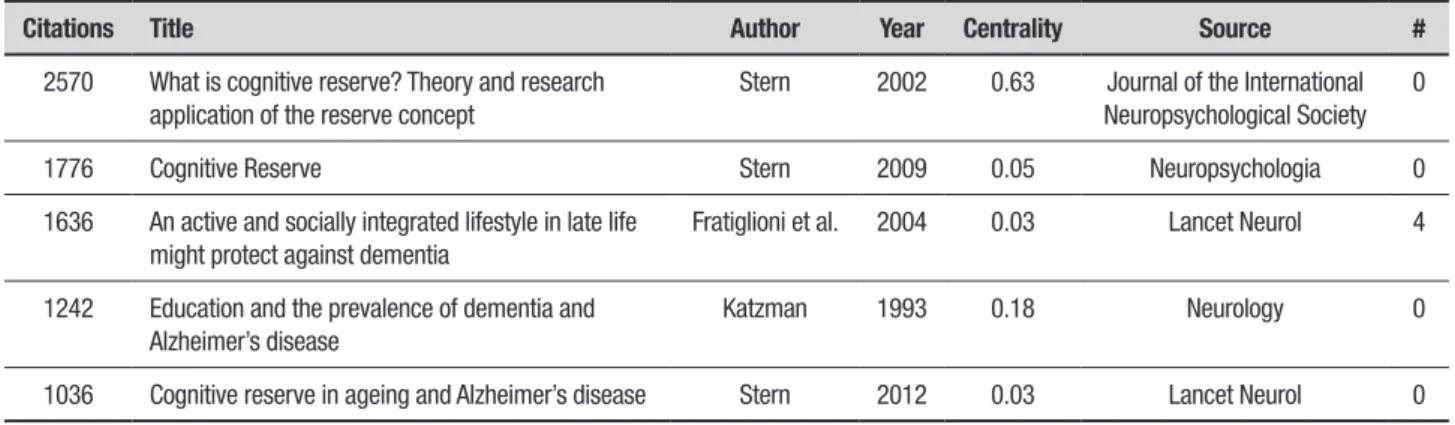
because of their ground-breaking contributions. The five top-cited articles are distributed between two areas of research (#0 and #4) between 1998-2017 (Table 2). At the top, are Stern5,58,59 and Katzman60 from
clus-ter #0, respectively with 2570, 1776, 1242, and 1036 citations; and Fratiglioni et al.,23 from cluster #4 with
1636 citations. Stern5,58,59 develops a coherent
theo-retical background of reserve and CR, and focuses on the relevance of lifelong experiences to increasing CR, including educational and occupational attainment, and leisure activities in later life. Katzman60 focused on the
effect of education on being diagnosed with dementia at an earlier point in time. Fratiglioni et al.23 focus on the
importance of an active and socially integrated lifestyle in late life to protect against dementia and AD.
The most cited and betweenness centrality papers play an important role in different fields of CR and dementia research. Betweenness centrality articles indicate their importance in bridging different stages of field development.61 Stern Y is an author highly cited
and belongs to three different clusters (#0, #1, #3), sug-gesting centrality in connecting these areas of research,
Table 1. Major clusters of co-citation references.
Cluster Size Silhouette Label (TF*IDF) Label (LLR) Label (MI) Avg. Year
0 26 0.642 underlying cognitive reserve cognitive reserve elderly adult 2004
1 19 0.739 mental status | preclinical alzheimers disease functional ability mrc cfa 1999
2 18 0.988 information | history executive control poststroke aphasia 2011
3 17 0.777 sex difference | clinical severity mortality data mrc cfa 2000
4 16 0.623 japanese population | identification reserve mechanism ethnic variation 2002
5 15 0.602 reversion national institute metabolic syndrome 1998
6 12 0.949 neuropsychological assessment Edinburgh cohort cognitive reserve 1993
Source: authors (2018) from CiteSpace.
and dementia. The top publications are marked with shading in Table 3, and include:
In 1999, Stern63 focuses on the effect of level of
edu-cation and occupational attainment on memory in AD patients.
In 2002, Wilson et al.64 focuses on the effect of
fre-quency of participation in cognitively stimulating activi-ties on the risk of AD.
In 2007, the three relevant articles are: Fratiglioni & Wang65 focuses on the effects of education, adult-life
occupational work complexity, mentally and social
inte-grated lifestyle in late life, as factors to affect the onset of clinical dementia and AD; Bialystok et al.62 focuses
on the effect of lifelong bilingualism on dementia in old age; and Valenzuela & Sachdev66 centers on LEQ as a tool
for estimating brain reserve in older individuals. In 2011, the three relevant articles are: Tucker & Stern6 focuses on the effect of executive functions task
on CR; on the association between CR and neural effi-ciency, capacity, and ability; and on the fact that CR is not fixed but continues to evolve during the lifespan; Gollan et al.67 focuses on the effects of bilingualism on
contributing to the transformative improvement in CR and dementia research. Stern58 has the highest level of
betweenness centrality (0.63). Another central article is Bialystok et al.,62 from cluster #2, connecting #2
(execu-tive control) with #0 (cogni(execu-tive reserve), currently highly cited, with a citation burst from 2013 to 2017 (Table 3). This article addressed the effect of lifelong bilingualism on dementia, which maintains cognitive functioning and delays the onset of symptoms of dementia in old age by about 4 years. Stern58 and Bialystok et al.,62 are also
articles that have contributed to a structural change in the network, in 2002 and 2007, respectively (Figure 3).
Most active clusters and references
A citation burst can be used to detect the most active articles and areas of research. A citation burst provides evidence that a publication is associated with a surge in citations, attracting an extraordinary degree of attention from the scientific community.61 All clusters from #0 to
#4 have bursts of citations, meaning they are represen-tative of the diversity of interests in the field of research. Citation bursts provide a useful means of tracking the development of research areas. Cognitive reserve (#0)
has the articles with strongest citation bursts, meaning that mainly after 2002, the beginning of the burst, the major efforts of the research field concentrated in this area of research. Other research interests, mainly after 1999, involve functional ability (#1) and mortality data (#3) then, after 2003, on reserve mechanisms (#4); and after 2013 in executive control (#2). Table 3 shows the most active areas of research and articles, displayed by burst strength per cluster.
Emerging trends in the network of CR and dementia
The intellectual structure of the knowledge of co-cited references can be measured by modularity.13 Newly
published articles may have little or no impact on the structure of the network, or may create a profound structural change, when deep changes occur in the modularity. Figure 3 shows the change in modularity during the 1998-2017 period. It is notable that modu-larity dipped mainly in 1999, 2002, 2007, and 2011. Therefore, we investigated potential emerging trends looking at publications with bursts of citations in these years, because we expected them to play an important role in changing the overall intellectual structure of CR
Table 2. Top-cited articles on Cognitive Reserve and Dementia.
Citations Title Author Year Centrality Source #
2570 What is cognitive reserve? Theory and research application of the reserve concept
Stern 2002 0.63 Journal of the International
Neuropsychological Society 0
1776 Cognitive Reserve Stern 2009 0.05 Neuropsychologia 0
1636 An active and socially integrated lifestyle in late life might protect against dementia
Fratiglioni et al. 2004 0.03 Lancet Neurol 4
1242 Education and the prevalence of dementia and Alzheimer’s disease
Katzman 1993 0.18 Neurology 0
1036 Cognitive reserve in ageing and Alzheimer’s disease Stern 2012 0.03 Lancet Neurol 0
Source: authors (2018) from CiteSpace.
Table 3. Structurally and temporally significant references.
Author references # Source Year Centrality Strength Begin End 1998 - 2017
Stern 0 Lancet Neurol 2012 0.03 242.959 2014 2017
Katzman 0 Neurology 1993 0.18 138.902 2002 2010
Tucker and Stern 0 Curr Alzheimer Res 2011 0.01 99.507 2014 2017
Roe et al. 0 Neurology 2007 0.01 75.746 2008 2012
Jones et al. 0 J Int Neuropsych Soc 2011 0.01 70.744 2015 2017
Stern 0 Neuropsychologia 2009 0.05 54.507 2012 2014
Valenzuela and Sachdev 0 Psychol Med 2006 0.08 54.275 2014 2015
Rentz et al. 0 Ann Neurol 2010 0.01 42.871 2011 2015
Scarmeas and Stern 0 Neurology 2001 0.06 40.768 2003 2007
Alexander et al. 1 Am J Psychiat 1997 0.01 89.673 1999 2010
Roe et al. 1 Arch Neurol-Chicago 2008 0.01 71.659 2010 2011
Stern et al. 1 Ann Neurol 1992 0.22 61.442 2003 2007
Katzman et al. 1 Ann Neurol 1988 0.13 42.944 2005 2013
Schweizer et al. 2 Cortex 2012 0.01 84.039 2014 2017
Bialystok et al. 2 Neuropsychologia 2007 0.22 78.819 2013 2017
Chertkow et al. 2 Alz Dis Assoc Dis 2010 0.11 76.964 2014 2017
Gollan et al. 2 Neuropsychologia 2011 0.05 69.731 2015 2017
Craik et al. 2 Neurology 2010 0.03 63.890 2014 2017
Stern et al. 3 Neurology 1999 0.24 103.659 2001 2009
Barulli and Stern 3 Trends Cogn Sci 2013 0.01 52.912 2015 2017
Satz 4 Neuropsychology 1993 0.02 100.073 2003 2011
Meng and D’Arcy 4 Plos one 2012 0.04 84.293 2014 2017
Wilson et al. 4 Jama-J Am Med Assoc 2002 0.01 78.773 2010 2013
Fratiglioni and Wang 4 J Alzheimers Dis 2007 0.03 56.810 2012 2013
Valenzuela and Sachdev 4 Psychol Med 2007 0.08 42.538 2013 2017
Source: authors (2018) from CiteSpace.
80 70 60 50 40 30 20 10 0 0.8 0.7 0.6 0.5 0.4 0.3 0.2 0.1 0 1997 1998 1999 2000 2001 2002 2003 2004 2005 2006 2007 2008 2009 2010 2011 2012 2013 2014 2015 2016 2017 New articles Modularity
Figure 3. Structural changes in the network measured (1998-2017)
CR and suggested an upper limit on the extent to which reserve can delay dementia; and Jones et al.68 focuses on
approaches for quantifying reserve using latent variable models, with an emphasis on their application in the analysis of data from observational studies.
CONCLUSION
This bibliometric study carried out during the 1998-2017 period has allowed a number of conclusions to be drawn in line with the objective established in the introductory section of this paper. The exploration of the literature on CR and dementia from WoS databases has outlined the evolutionary trajectory of the collective knowledge over the past twenty years and highlighted the areas of active pursuit and future research. Based on the network visualization and document co-citation analysis using CiteSpace and VosViewer, this study evaluated emerging trends and patterns of publications, citations, journals, institutions, and areas of research in the literature. The top clusters covered a range of inter-ests, reflecting the interdisciplinary nature of CR and dementia. They are foundational to the field of research. To the best of our knowledge, this study represents the first attempt to apply CiteSpace to explore and visu-alize CR and dementia knowledge. It is one of only a few investigations that have focused on co-citations as a marker of development of this domain from different perspectives. The findings of the present investigation demonstrate the potential of bibliometric visualization techniques for studying the scientific literature.
First, by visualizing the relational analysis of top authors and articles, the study provides insights into patterns of international research focus. The clustering technique used in this work identifies key articles that share similar topics. Articles that serve as an important bridge between two clusters are also detected in the net-work, namely Stern5,58,59 and Bialystok et al.62 Secondly,
the bibliometric visualization used in this paper pro-vides important temporal data by displaying nodes in different colours. A longitudinal view of cluster analysis and citation bursts of key articles adds a new dimension to the analysis and provides insights into the flow of major trends and collaborations. These temporal data allow researchers to identify research frontiers by high-lighting emergent hot topics, authors, and articles.41
Thirdly, co-citation analysis is a useful method of providing insights into a field based on a large sample of documents.41 Multiple metrics help elucidate and
explore relationships between articles and citations. Betweenness centrality can reflect the potential pivotal
point and new ideas in the CR and dementia field; while density, modularity, and burst strength provide a more objective metric analysis of the network.
Another contribution made by the research is the understanding it promotes regarding the way knowledge is structured in the field of CR and dementia. The study of clusters, previously described, showed that cluster #1, cluster #3, and cluster #4, due to bursts of citations, are the major current areas of research. Consequently, the maturity of research on this domain is evident by the fact that it has shifted from being focused mainly on CR to more specific aspects with a broader disciplinary base (functional ability, #1; mortality data, #3; reserve mechanisms and executive control, #4). Therefore, this field of study is becoming more multidisciplinary, increasingly being analyzed from the different angles provided by diverse scientific approaches, which comple-ment and enrich its content. In terms of authors’ affili-ations, among the top universities, the leader is located in the USA: Harvard University followed by Colombia University and UCLA. The network of journals shows a central-peripheral structure, where Neurology and Journal of Alzheimer Disease are ranked first, followed by Journal of International Neuropsychological Society. The investigation of the most cited articles has allowed the mapping of the intellectual structure of this field. Hence, the potential for development of the field of CR and dementia as a research focus is immense.
The study has some limitations. First, this work was restricted to English language journals. It is likely that some of the literature may have been published in other languages. Secondly, despite the relevance of the WoS databases to CR and dementia research, other impor-tant studies could have been included within other databases. Nevertheless, it is evident that bibliometric analysis has helped to characterize, both qualitatively and quantitatively, the CR and dementia research field in terms of its development, trends of investigation and collaboration networks. As a result, researchers have been equipped with new tools of exploration.
The results help further understanding on the intel-lectual structure of this field through an innovative methodology, using co-citation analyses to understand the development of CR and dementia from different per-spectives. The study findings demonstrate the potential of bibliometric visualization techniques to investigate the scientific literature.
Authors contributions. All authors contributed signifi-cantly to, and approved, the content of this manuscript.
REFERENCES
1. Berr C, Wancata J, Ritchie K. Prevalence of dementia in elderly in Europe. Eur Neuropsychopharmacol. 2005;15:463-71.
2. Stern Y. Cognitive Reserve: Implications for Assessment and Interven-tions. Folia Phoniatr Logop. 2013;65:49-54.
3. Siedlecki KL, Stern Y, Reuben A, Sacco RL, Elkind MSV, Wright CB. Construct validity of cognitive reserve in multiethnic cohort:the Northern Manhattan Study. J Int Neuropsychol Soc. 2009;15:558-69. 4. Stern Y. Elaborating a hypothetical concept:comments on the Special
Series on Cognitive Reserve. J Int Neuropsychol Soc. 2011;17(4):639-42. 5. Stern Y. Cognitive reserve in ageing and Alzheimer’s disease. Lancet
Neurol. 2012;11:1006-12.
6. Tucker AM, Stern Y. Cognitive reserve in aging. Curr Alzheimer Res. 2011;8(4):354-60.
7. Tucker AM, Stern Y. Cognitive reserve and the aging brain. In: AK Nair & MN Sabbagh (Eds.), Geriatric Neurology. Chichester: Wiley; 2014, pp. 118-125.
8. Sobral M, Pestana MH, Paúl C. Measures of cognitive reserve in Alzheimer’s disease. Trends Psychiatry Psychother. 2014;36(3):160-8. 9. Barulli D, Stern Y. Efficiency, capacity, compensation, maintenance,
plasticity: emerging concepts in cognitive reserve. Trends Cogn Sci. 2013;17(10):502-9.
10. Robertson IH. A right hemisphere role in cognitive reserve. Neurobiol Aging. 2014;35(6):1375-85.
11. Staff RR, Murray AD, Deary IJ, Whalley LJ. What provides cerebral reserve? Brain. 2004;127:1191-9.
12. Evans DA, Hebert LE, Beckett LA, Scherr PA, Albert MS, Chown MJ, et al. Education and other measures of socioeconomic status and risk of incident Alzheimer disease in a defined population of older persons. Arch Neurol.1997;54:1399-405.
13. Launer LJ, Andersen K, Dewey ME, Letenneur L, Ott A, Amaducci, LA, et al. Rates and risk factors for dementia and Alzheimer’s disease:results from EURODEM pooled analyses. Neurology. 1999;52:78-84. 14. Ravaglia G, Forti P, Maioli F, Martelli M, Servadei L, Brunetti N, et al.
Incidence and etiology of dementia in a large elderly Italian population. Neurology. 2005;64:1525-30.
15. van Oijen M, de Jong FJ, Hofman A, Koudstaal PJ, Breteler MM. Subjec-tive memory complaints, education, and risk of Alzheimer’s disease. Alzheimers Dement. 2007;3(2):92-97.
16. Rapp SR, Espeland MA, Manson JE, Resnick SM, Bryan NR, Smoller S, et al. Educational attainment, MRI changes, and cognitive function in older postmenopausal women from the Women’s Health Initiative Memory Study. Int J Psychiatr Med. 2013;46:121-43.
17. Stern Y, Gurland B, Tatemichi TK, Tang MX, Wilder D, Mayeux R. Influ-ence of education and occupation on the incidInflu-ence of Alzheimer’s disease. J Am Med Assoc. 1994;271:1004-10.
18. Schooler C, Mulatu MS, Oates G. The continuing effects of substantively complex work on the intellectual functioning of older workers. Psychol Aging. 1999;14:483-506.
19. Karp A. Psychosocial factors in relation to development of dementia in late-life:a life course approach within the Kungsholmen Project;S tockholm:Karolinska Institutet. 2015.
20. Daylee R. Greene. Relationship between occupational complexity and dementia risk in late life: a population study. AllnGraduate Theses and Dissertations. A dissertation submitted in partial fulfillment of the require-ments for the degree of Doctor of Philosophy; Utah State University 2013.
21. Moskowitz J, Miller S. Occupational complexity as a predictor of cogni-tive reserve. Journal for Undergraduate Research Opportunities. Natural Sciences. 2014:38-43.
22. Scarmeas N, Stern, Y. Cognitive reserve:implications for diagnosis and prevention of Alzheimer’s disease. Curr Neurol Neurosci Rep. 2004;4:374-80.
23. Fratiglioni L, Paillard-Borg S, Winblad B. An active and socially inte-grated lifestyle in late life might protect against dementia. Lancet Neurol. 2004;3:343-53.
24. Hughes TF, Chang CC, Vander Bilt J, Ganguli M. Engagement in reading and hobbies and risk of incident dementia:the MoVIES project. Am J Alzheimers Dis Other Dement. 2010;25(5):432-8.
25. Sobral M, Paúl C. Relationship of leisure activities and Alzheimer’s disease. Int J Adv Psychol. 2013;2(4):179-85.
26. Grande G, Vanacore N, Maggiore L, Cucumo V, Ghiretti R, Galimberti D, et al. Physical activity reduces the risk of dementia in mild cognitive impairment subjects:a cohort study. J Alzheimers Dis. 2014;39(4):833-9. 27. Graves AB, Larson EB, Edland SD, Bowen JD, McCormick WC, McCurry SM, Rice MM, Wenzlow A, Uomoto JM, et al. Prevalence of dementia and its subtypes in the Japanese American population of King County, Washington state:The Kame Project. Am J Epidemiol.1996;144:760-71. 28. Chandra V, Ganguli M, Pandav R, Johnston J, Belle S, DeKosky ST.
Prevalence of Alzheimer’s disease and other dementia in rural India:the Indo-US study. Neurology. 1998;51(4):1000-8.
29. Helmer C, Letenneur L, Rouch I, Richard-Harston S, Barberger-Gateau P, Fabrigoule C, et al. Occupation during life and risk of dementia in French elderly community residents. J Neurol Neurosurg Psychiatry. 2001;71(3):303-9.
30. Chen C, Hu Z, Liu S, Tseng H. Emerging trends in regenerative medicine:a scientometric analysis in CiteSpace. Expert Opin Biol Ther. 2012;12(5):593-608.
31. Denyer D, Tranfield D. Using qualitative research synthesis to build an actionable knowledge base. Manag Decision. 2006;44(2):213-27. 32. White H D, Griffith BC. Author co-citation: A literature measure of
intel-lectual structure. J Am Soc Inf Sci. 1981;32(3):163-71.
33. Fu HZ, Wang MH, Ho YS. The most frequently cited adsorption research articles in the Science Citation Index (Expanded). J Colloid Interface Sci. 2012;379(1):148-56.
34. Ye Q, Li T, Law R. A co-authorship network analysis of tourism and hospitality research collaboration. Journal of Hospitality & Tourism Research. 2013;37(1):51-76.
35. Ohba N, Nakao K, Isashiki Y, Ohba A. The 100 most frequently cited arti-cles in ophthalmology journals. Arch Ophthalmol. 2007;125(7):952-60. 36. Garfield E.Citation indexes to science:A new dimension in documenta-tion through the associadocumenta-tion of ideas. Science.1955;122(3159):108-11. 37. Benckendorff P, Zehrer A. A network analysis of tourism research. Ann
Tourism Res. 2013;43:121-49.
38. Xiao H, Smith S.L. Knowledge impact an appraisal of tourism scholar-ship. Ann Tourism Res. 2008;35(1):62-83.
39. Chen C, Dubin R, Kim MC. Emerging trends and new developments in regenerative medicine:A scientometric update (2000–2014). Exp Opin Biol Ther. 2014;14(9):1295-317.
40. Chen C, Ibekwe-SanJuan F, Hou J. The structure and dynamics of coci-tation clusters:A multiple-perspective cocicoci-tation analysis. J Am Soc Inf Sci Technol. 2010;61 (7):1386-409.
41. Chen C. Citespace II:Detecting and visualizing emerging trends and transient patterns in scientific literature. J Am Soc Inf Sci Technol. 2006;57(3):359-77.
42. Perneczky R, Alexopoulos P, Schmid G, Sorg C, Förstl H, Diehl-Schmid J, Kurz, A. Cognitive reserve and its relevance for the prevention and diagnosis of dementia. Nervenarzt. 2011;82(3):325-30:332-35. 43. Bartres-Faz D. Structural and functional imaging correlates of cognitive
and brain reserve hypotheses in healthy and pathological aging. Brain Topog. 2011;24(3-4):340-57.
44. Whalley LJ. Cognitive reserve and the neurobiology of cognitive aging. Aging Res Rev. 2004;3(4):369-82.
45. Roe CM. Alzheimer disease identification using amyloid imaging and reserve variables proof of concept. Neurology. 2010;75(1):42-8. 46. Geerlings MI, Deeg DJ, Penninx BW, Schmand B, Jonker C, Bouter LM,
et al. Cognitive reserve and mortality in dementia: the role of cognition, functional ability and depression. Psychol Med. 1999;29(5):1219-26. 47. Guzman-Velez E, Tranel D. Does bilingualism contribute to
cogni-tive reserve? Cognicogni-tive and neural perspeccogni-tives. Neuropsychology. 2015;29(1):139-50.
48. Perani D, Abutalebi J. Bilingualism, dementia, cognitive and neural reserve. Curr Opin Neurol. 2015;28(6):618-25.
49. Katzman R. Epidemiology of Alzheimer’s Disease and Dementia: Advances and Challenges. In: Alzheimer’s Disease. K Iqbal, SS Sisodia and B Winblad (editors); New York, USA: John Wiley & Sons, Ltda; 2002, pp.3-10.
50. Qiu C, Bäckman L, Winblad B, Agüero-Torres H, Fratiglioni L. The influence of education on clinically diagnosed dementia incidence and mortality data from the Kungsholmen Project. Arch Neurol. 2001;58(12):2034-9.
51. Borroni B, Premi E, Bozzali M, Padovani A. Reserve mechanisms in neurodegenerative diseases:from bench to bedside and back again. Curr Med Chem. 2012;19(36):6112-8.
52. Daffner KR. Promoting successful cognitive aging:a comprehensive review. J Alzheimers Dis. 2010;19(4):1101-22.
53. Jones RN, Fong TG, Metzger E, Tulebaev S, Yang FM, Alsop DC, et al. Aging, Brain Disease, and Reserve:Implications for Delirium. Am J Geriatr Psychiatry. 2010;18(2):117-27.
54. Kawano N, Umegaki H, Suzuki Y, Yamamoto S, Mogi N, Iguchi A. Effects of educational background on verbal fluency task performance in older adults with Alzheimer’s disease and mild cognitive impairment. Int Psychogeriatr. 2010;22(6):995-1002.
55. Bruandet A, Richard F, Bombois S, Maurage CA, Masse I, Amouyel P, Pasquier F. Cognitive Decline and Survival in Alzheimer’s Disease according to Education Level. Dement Geriatr Cogn Dis. 2008;25:74-80. 56. Basso MR, Bornstein RA. Estimated premorbid intelligence mediates neurobehavioral change in individuals infected with HIV across 12 months. J Clin Exp Neuropsychol. 2000;22(2):208-18.
57. Pereda M, Ayuso-Mateos JL, Gomez del Barrio A, Echevarria S, Farinas M, García Palomo D, et al. Factors associated with neuropsychological performance in HIV seropositive subjects without AIDS. Psychol Med. 2002;30(1):205-17.
58. Stern Y. What is cognitive reserve? Theory and research application of the reserve concept. J Int Neuropsychol Soc. 2002;8(3):448-60. 59. Stern Y. Cognitive Reserve. Neuropsychologia. 2009;47(10):2015-28.
60. Katzman R. Education and the prevalence of dementia and Alzheimer’s disease. Neurology. 1993;43(1):13-20.
61. Chen C. Searching for intellectual turning points: Progressive knowledge domain visualization. Proc Natl Acad Sci U S A. 2004;101(1):5303-10. 62. Bialystok E, Craik, Freedman M. Bilingualism as a protection
against the onset of symptoms of dementia. Neuropsychologia. 2007;28;45(2):459-64.
63. Stern Y, Albert S, Tang M-X, Tsai WY. Rate of memory decline in AD is related to education and occupation. Cognitive reserve? Neurology. 1999;53(9):1942.
64. Wilson RS, Mendes De Leon CF, Barnes LL, Schneider JA, Bienias JL, Evans DA, Bennett DA. Participation in cognitively stimulating activities and risk of incident Alzheimer disease. JAMA. 2002;287(6):742-8. 65. Fratiglioni L, Wang HX. Brain reserve hypothesis in dementia. J
Alzheimers Dis. 2007;12(1):11-22.
66. Valenzuela M, Sachdev P. Assessment of complex mental activity across the lifespan: development of the Lifetime of Experiences Questionnaire (LEQ). Psychol Med. 2007;37(7):1015-25.
67. Gollan TH, Salmon DP, Montoya RI, Galasko DR. Degree of Bilin-gualism Predicts Age of Diagnosis of Alzheimer’s Disease in Low-Education but not in Highly-Educated Hispanics. Neuropsychologia. 2011;49(14):3826-30.
68. Jones RN, Manly J, Glymour MM, Rentz DM, Jefferson AL, Stern Y. Conceptual and measurement challenges in research on cognitive reserve. J Int Neuropsychol Soc. 2011;17(4):593-601.