TEAM PRACTICES IN FALL PREVENTION IN INSTITUTIONALIZED
ELDERLY PEOPLE: SCALE DESIGN AND VALIDATION
Cristina Lavareda Baixinho1, Maria dos Anjos Dixe2
1 Ph.D. in Nursing. Escola Superior de Enfermagem de Lisboa. Lisboa, Portugal. E-mail: [email protected]
2 Ph.D. in Psychology. Escola Superior de Saúde do Instituto Politécnico de Leiria. Leiria, Portugal. E-mail: [email protected]
ABSTRACT
Objective: determine and elaborate the psychometric characteristics of nursing team practices and develop a behavior scale for fall risk management in institutionalized elderly people.
Method: the scale was designed based on a literature review and observation of the work of the teams in a long-term care institution for the elderly. The content of the scale was analyzed and the concordance index of the 14 initial items was checked by nine experts. The scale was applied to a sample of 152 caregivers from six long-term care institutions for the elderly. The research conformed to ethical principles.
The anonymity of the participants and the conidentiality of the data were ensured.
Results: after the determination of the psychometric characteristics, it was observed that the unidimensional scale had six items, with a Cronbach’s alpha of 0.918 and a score ranging from 6 to 30 points. Analysis of the results revealed that information about risk factors and
team discussions regarding preventive measures are not always present, allowing speciic team members to value different measures,
which impairs continuity of the care and individualization of the measures before the assessed risk.
Conclusion: the scale shows suitable psychometric features and can be used in investigation and clinical practice to assess the practices and behaviors of nursing teams in fall risk management in institutionalized elderly patients.
DESCRIPTORS: Falls. Elderly people. Caregivers. Risk management. Psychometry. Behavioral assessment scale.
PRÁTICAS DAS EQUIPAS NA PREVENÇÃO DE QUEDA NOS IDOSOS
INSTITUCIONALIZADOS: CONSTRUÇÃO E VALIDAÇÃO DE ESCALA
RESUMO
Objetivo: construir e determinar as características psicométricas da escala de práticas e comportamentos das equipes na gestão do risco de queda dos idosos institucionalizados.
Método: a escala foi desenhada com base na revisão da literatura e na observação do trabalho das equipes numa instituição de longa
permanência para idosos. Foi realizada a análise de conteúdo e a veriicação do índice de concordância dos 14 itens iniciais por nove juízes.
A escala foi aplicada a uma amostra de 152 cuidadores de seis instituições de longa permanência para idosos. A investigação respeitou os
princípios éticos. Garantiu-se o anonimato e a conidencialidade dos dados.
Resultados: após a determinação das caraterísticas psicométricas, veriicámos que a escala, unidimensional, icou constituída por seis
itens, com um Alfa de Cronbach de 0,918, pontua entre 6 e 30 pontos. A análise dos resultados permite constatar que a informação sobre os fatores de risco e a discussão em equipe sobre as medidas preventivas nem sempre são mantidas, possibilitando que elementos diferentes da equipe possam valorizar medidas diferentes, o que não garante a continuidade de cuidados e a individualização das medidas face ao risco avaliado.
Conclusão: a escala tem boas características psicométricas, podendo ser usada na investigação e na prática clínica para avaliar as práticas e os comportamentos das equipes na gestão do risco de queda em idosos institucionalizados.
PRÁCTICAS DE LOS EQUIPOS EN LA PREVENCIÓN DE CAÍDAS EN LOS
ADULTOS MAYORES INSTITUCIONALIZADOS: CONSTRUCCIÓN Y
VALIDACIÓN DE ESCALA
RESUMEN
Objetivo: construir y determinar las características psicométricas de la escala de prácticas y comportamientos de los equipos en la gestión del riesgo de caída de los ancianos institucionalizados.
Método: la escala fue diseñada con base en la revisión de la literatura y en la observación del trabajo de los equipos en una institución de
larga permanencia para adultos mayores. Se realizó el análisis de contenido y la veriicación del índice de concordancia de los 14 ítems
iniciales por nueve jueces. La escala fue aplicada a una muestra de 152 cuidadores de seis instituciones de larga permanencia para adultos
mayores. La investigación respetó los principios éticos. Se ha garantizado el anonimato y la conidencialidad de los datos.
Resultados: después de la determinación de las características psicométricas, veriicamos que la escala, unidimensional, quedó constituida
por seis ítems, con un Alfa de Cronbach de 0,918, puntualiza entre 6 y 30 puntos. El análisis de los resultados permite constatar que la información sobre los factores de riesgo y la discusión en equipo sobre las medidas preventivas no siempre se mantienen, posibilitando que elementos diferentes del equipo puedan valorar medidas diferentes, lo que no garantiza la continuidad de cuidados y la individualización de las medidas frente al riesgo evaluado.
Conclusión: la escala tiene buenas características psicométricas, pudiendo ser usada en la investigación y en la práctica clínica para evaluar las prácticas y los comportamientos de los equipos en la gestión del riesgo de caída en ancianos institucionalizados.
DESCRIPTORES: Caídas. Ancianos. Cuidadores. Gestión de riesgos. Psicometría. Escala de evaluación del comportamiento.
INTRODUCTION
Falls interfere with healthy and active aging, representing a serious public health issue.1-2 Fall
episodes are associated with high costs with regard to both individual quality of life and social welfare.3
With estimated incidence of 32.5% to 68% in long-term care (LTC) institutions, falls are an is-sue for institutionalized elderly people, who show
signiicantly higher incidence of the problem than
the elderly people living in communities.4-5 This
may be explained by higher levels of dependency and higher incidence of chronic conditions in the institutionalized population.3,6
The cumulative effect of fearing the falls them-selves, post-fall syndrome, and secondary injuries poses a potential risk of epidemy and increased health resource costs in a society with an exponen-tial increase of the elderly population. Falls, rather than being isolated events, also involve prevention of health issues in the elderly and observation of their behavior, socioeconomic conditions and en-vironment.7
Epidemiological studies on this subject focus on biophysiological risk factors and usually over-look environmental and behavioral aspects in the genesis of falls. Research stresses that the physical spaces and the presence of institution staff make facility environments different from homes, and may increase fall risk.6
A literature review shows that most guidelines value teamwork to solve this serious public health issue. However, little is known about individual
and collective work practices and how communica-tion, recording and surveillance of patients after fall episodes are carried out by caregivers. To help solve this problem, new interventions and new interven-tion designs are necessary, mainly those that take into account the relationship between residents and professionals8 and value characteristics other than
biological ones. This is a critical point, considering that elderly people present distinct features when compared to the general population: they have bio-logical, psychobio-logical, cultural, socioeconomic and epidemiological peculiarities that must be studied separately.2
In Portugal, information regarding individual and collective work practices and communication, recording and surveillance of patients after fall episodes is not available. A literature survey reveals that there is no scale to assess team practices and behaviors when it comes to managing fall risks. The design of such an instrument is pertinent, not just to evaluating fall risk management by teams, but also to using it to obtain new data about the prevalence of falls. This can help in data collection and control of fall episodes.
Given this scenario, the present study aimed to determine the psychometric characteristics of a scale to assess the practices and behaviors of nursing teams regarding fall risk management in institution-alized elderly people.
METHOD
caregivers and teams in LTC institutions in the area of fall risk management. To design a new scale, a
predeined protocol with the following steps was applied: deinition of the object of evaluation; data collection in databases; observation of the context; interviews with nurses, caregivers and residents; material selection for deinition of the items to be included in the tool; scale development; analysis of the agreement of the items; pretest; scale reformula
-tion; and application and validation.
A bibliographical survey allowed deinition of
the suitability of the items to the concept of fall risk management in LTC institutions. According to the World Health Organization, fall risk management
is deined as the process of planning, organizing,
leading and controlling the resources that allow
identiication, evaluation and management of all
risks that cause unintentional change in body posi-tion to a lower level. This promotes decision-making and establishment of priorities to ensure the safety of elderly people, based on evidence and different social responses to the elderly.
After the concept deinition, a database query allowed the identiication of a set of indicators that
are associated with teamwork, from risk evalua-tion to intervenevalua-tion and communicaevalua-tion about fall episodes. Nonetheless, information about teamwork and its contribution (or lack thereof) to fall preven-tion is present as recommendapreven-tions, and evidence of
its eficiency is low. For this reason, the researches
had to interview experts on falls and gather informa-tion from a populainforma-tion with characteristics similar to the ones in the sample of the study, by observing and interviewing professionals. One of the authors obtained permission to visit a LTC facility for one month, during which the functions developed by the institution staff were observed.
Item elaboration respected the criteria of clarity, accuracy, trust, consistency, suitability, semantics, reliability, usefulness, validity and con-sensus.9 At this stage, the semantic equivalency of a few terms was veriied by consulting Portuguese
dictionaries.
The analysis of the items was performed by
nine experts; four had published material on the topic and ive were specialized nurses who had more than ive years of experience in managing
equipment for elderly people. This criterion is based on the results of a study by Benner, who concluded
that nurses go through ive levels of experience: nov
-ice, advanced beginner, competent, proicient and expert. Experience in nursing leads to proiciency,
which can be understood as the association between theoretical and practical knowledge.10
Because studies conducted by clinical practice nurses were not found in this area, and considering the complexity of the phenomenon in question, the authors judged that their expertise was a crucial
cri-terion. Nurses with more than ive years of activity
have a theoretical background and experience that provides them with empirical, aesthetic, ethical, personal and intuitive knowledge that was valuable for the validation of the scale.10
The questionnaire was designed and sent out on Google Drive®. To standardize the analyses by the experts, the form included explanations of the
operational deinition of the tool, the proposed
items, and the indicators for their analysis: presenta-tion, clarity of the statements, readability, interpreta-tion and representativeness of the items. Regarding the latter, the answers were associated with a score
in a Likert scale from 1 to 4 (1=non-representative; 2=needs signiicant changes to become representa
-tive; 3=needs minor changes to become representa
-tive; 4=representative).9
The participants evaluated the irst version of the instrument; the form included a topic requiring
them to rate the items. They were also asked to give their opinion of the clarity of the items and the
dif-iculty of understanding and illing out the form.
These written impressions were used to improve the items by sharing the comments and inspecting the understandability of the material and the guidelines. The criterion for keeping an item in the scale was a minimum concordance of 80% of the ex-perts.9,11
Before the evaluation, the professionals were contacted by phone to ensure that they met the inclusion criteria, ask them to collaborate in the
research, and ask them to ill out the questionnaire.
This contact, which was made in order to obtain the professional’s authorization and to ask them to return the form, assumed an intention to join the
study; consequently, signature of the term of free
and informed consent was not requested.
To validate the content of the tool, the content validity index was applied to each of the items (CVII) and to the whole protocol (CVI). The inter-rater agreement (IRA) was employed to evaluate the reliability or agreement between the experts.
Once the irst version of the scale was ready,
carried out with 23 professionals from an LTC institution to verify understanding of the mate-rial and suitability of the questions and the Likert scale. This experiment also allowed a critical view of the content and format of the instrument with regard to clarity, understandability of the items,
and average time to ill in the form, which was
around 15 minutes.
The sample for evaluation of the psychometric characteristics of the scale consisted of 152
profes-sionals from six LTC facilities; they authorized the study and met the previously deined inclusion cri -teria: to be providing direct care to institutionalized old people and to freely agree to join the study. The professionals who had intermediate management positions or worked in home support were excluded from the sample.
The number of participants in this investiga-tion followed the guidelines required for valida-tion: ten people per item.9, 11 Some authors defend
different points, arguing that the reliability of an instrument relies on a minimum number of people,
or that ive participants are enough to evaluate
an indicator. However, the authors of the present study chose to get a sample ten times larger than the number of items to obtain a stable factorial solution.
The inal version of the tool was organized
in two parts: part 1, with demographic data
(age, gender), education, deined as frequency of
training (graduation from a degree program and continuing education) and professional
experi-ence, deined as years of professional activity in that speciic institution; and part 2, showing the
Scale of Practices and Behaviors of Teams for Fall Prevention (SPBTFP).
This tool seeks to determine the frequency with which healthcare professionals believe they
have developed speciic teamwork practices for
fall prevention, that is, it is a self-reported set of
measures. It uses a Likert scale whose ive possible answers were; “never,” “occasionally,” “some
-times,” “often,” and “always.” The irst page gave instructions for illing out the scale and using the Likert scale. The instrument was illed in by the
participants, without the presence of the researcher. Regarding the formal and ethical procedures, authorization to carry out the study was required by the boards of the institutions. The Ethics
Com-mittee of the Catholic University of Portugal issued a positive report (Ref. ICS/268/2012) related to the investigation. All the caregivers signed the free and informed consent form.
To guarantee the anonymity of the partici-pants, two boxes were placed at each of the six
in-stitutions; the consent document was to be placed
in one, and the protocol in the other. Data collection lasted 15 days because of shift schedules. When the
boxes were opened, anonymity and the conidential -ity were ensured by labeling the boxes with codes representing institutions.
Statistical treatment of the data was per-formed with SPSS version 19.0 software. The reliability of the scale was tested by internal con-sistency analysis and determination of Cronbach’s
alpha coeficient.9,11 Varimax orthogonal rotation
was used for factorial analysis of the principal components, with extraction of factors with proper values higher than 1. Cattell’s scree test plots were used to verify the number of factors to retain, and Kaiser-Meyer-Olkin (KMO) and Bartlett’s tests were run to measure the quality of the correlations between the variables and examine the validity of the factorial matrix.11
Given the characteristics of the variables in the scale and the non-normal distribution determined by application of the Kolmogorov-Smirnov test, the Mann-Whitney U test and Spearman’s rank correla-tion test were used equally.
In the statistical treatment, the missing answers were replaced by the mean value of the valid cases of the variable in the situations in which the non-answers corresponded to less than 10% of the total number of questions in the instrument.11
RESULTS
Content validation
The sample contained nine experts, of whom 66.6% were females, and was heterogeneous in
terms of specialty (ive nurses, one medical doctor,
one physical educator and two physical therapists) and post-graduate degrees.
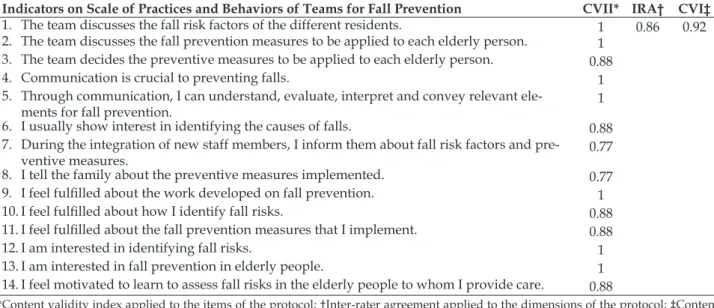
Table 1 – Agreement among the experts after the irst round of evaluation regarding the items of the
scale. Lisbon, Portugal, 2014. (n = 9)
Indicators on Scale of Practices and Behaviors of Teams for Fall Prevention CVII* IRA† CVI‡ 1. The team discusses the fall risk factors of the different residents.
2. The team discusses the fall prevention measures to be applied to each elderly person. 11
0.86 0.92
3. The team decides the preventive measures to be applied to each elderly person. 0.88
4. Communication is crucial to preventing falls. 1
5. Through communication, I can understand, evaluate, interpret and convey relevant
ele-ments for fall prevention. 1
6. I usually show interest in identifying the causes of falls. 0.88
7. During the integration of new staff members, I inform them about fall risk factors and
pre-ventive measures. 0.77
8. I tell the family about the preventive measures implemented. 0.77
9. I feel fulilled about the work developed on fall prevention. 1
10. I feel fulilled about how I identify fall risks. 0.88
11. I feel fulilled about the fall prevention measures that I implement. 0.88
12. I am interested in identifying fall risks. 1
13. I am interested in fall prevention in elderly people. 1
14. I feel motivated to learn to assess fall risks in the elderly people to whom I provide care. 0.88
*Content validity index applied to the items of the protocol; †Inter-rater agreement applied to the dimensions of the protocol; ‡Content
validity index of the protocol.
Items 7 and 8 did not achieve consensus higher
than 80%; the two experts that considered the items
non-representative suggested changes that were introduced in the protocol. As for item 7, one of the experts suggested that the item should be rewritten
as “New staff members are informed about fall risk factors and preventive measures during orientation.” Regarding item 8, the sentence was changed to “The
family is told about the implemented preventive
mea-sures”. The rephrased items were resent to the experts
and obtained CVII scores of 0.88 and 1, respectively. In semantic analysis, the 23 caregivers unani-mously considered the items clear.
Psychometric characteristics of the Scale of
Practices and Behaviors of Teams for Fall
Prevention
To evaluate the psychometry of the scale, 232 instruments were distributed in the six LTC
institu-tions; 152 forms were returned, corresponding to
65.52% of the total number. The sample consisted of women only, with an average age of 47.02±10.40 years. They had been working for 13.10±8.35 years, and 11.90±8.19 of them were dedicated to the institu-tion in quesinstitu-tion. Sixty-eight percent of the sample had
started their professional activities without a speciic
focus on work in LTC facilities, and 66.7% attended
continuous education courses; in 50.8% of the cases, the training was shorter than 150 hours; 38.1% of the
participants attended courses longer than 200 hours. The SPBTFP initially consisted of 14 items, which were reduced to 6, and presented a Cron-bach’s alpha of 0.918, as shown in Table 2.
Table 2 – Pearson’s coeficient and Cronbach’s alpha of the items with the total without the item in the
Scale of Practices and Behaviors of Teams for Fall Prevention. Lisbon, Portugal, 2014. (n = 152)
Content of the items Pearson’s coefi
-cient of the total without the item
Cronbach’s alpha without the item
1. The team discusses the fall risk factors for the different residents. 0.807 0.897 2. The team discusses the fall prevention measures to be applied to each
el-derly person. 0.799 0.898
3. The team decides the preventive measures to be applied to each elderly
person. 0.769 0.903
4. Communication is crucial to preventing falls. 0.734 0.907
5. Through communication, I can understand, evaluate, interpret and convey
relevant elements for fall prevention. 0.774 0.902
6. I usually show interest in identifying the causes of falls. 0.728 0.908
The total correlation varied from 0.728 and
0.807. Cronbach’s alpha without a speciic item
ranged from 0.898 and 0.908.
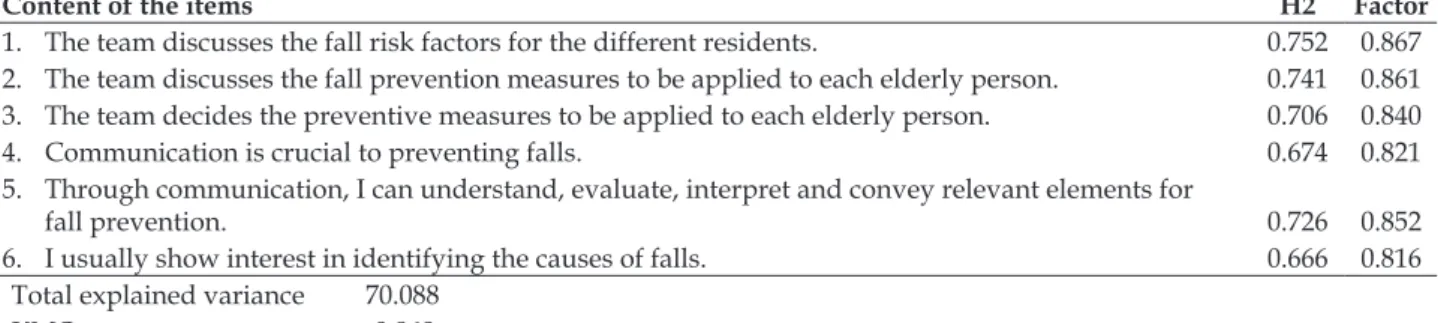
Regarding the validation of the protocol, it was observed that the factorial analysis with Varimax
rotation provided a KMO value of 0.869, and the Bartlett’s test of sphericity gave a value of 731,788 (p < 0.001). The six items are grouped in one factor that explains 70.088% of the total variance. Table 3 shows these results.
Table 3 – Analysis of principal components of the Scale of Practices and Behaviors of Teams for Fall Prevention. Lisbon, Portugal, 2014. (n = 152)
Content of the items H2 Factor
1. The team discusses the fall risk factors for the different residents. 0.752 0.867 2. The team discusses the fall prevention measures to be applied to each elderly person. 0.741 0.861 3. The team decides the preventive measures to be applied to each elderly person. 0.706 0.840
4. Communication is crucial to preventing falls. 0.674 0.821
5. Through communication, I can understand, evaluate, interpret and convey relevant elements for
fall prevention. 0.726 0.852
6. I usually show interest in identifying the causes of falls. 0.666 0.816
Total explained variance 70.088 KMO 0.869
Bartlett’s test of sphericity 731.789; p < 0.001
Practices and behaviors of teams for fall
prevention
According to the judgement of the profession-als, the item of the SPBTFP with the highest score
was “Communication is crucial to preventing falls”
(Ẋ=4.45±0.86); the items with the lowest scores were
“The team discusses the fall prevention measures to be applied to each elderly person” (Ẋ=3.91±1.03)
and “The team decides the preventive measures to be applied to each elderly person” (Ẋ=3.91±1.05). Table 4 exhibits the results of this analysis.
Table 4 – Sample characterization regarding team practices and behaviors for fall prevention according to the caregivers’ opinion. Lisbon, Portugal, 2014. (n=152)
Content of the items Mean SD
1. The team discusses the fall risk factors for the different residents. 3.98 1.05
2. The team discusses the fall prevention measures to be applied to each elderly person. 3.91 1.03 3. The team decides the preventive measures to be applied to each elderly person. 3.91 1.05
4. Communication is crucial to preventing falls. 4.45 0.86
5. Through communication, I can understand, evaluate, interpret and convey relevant elements for
fall prevention. 4.27 0.89
6. I usually show interest in identifying the causes of falls. 4.36 0.89
Total (6-30) 24.88 5.79
The analysis of the percentages for each an-swer to the indicators revealed that fall risk factors were always discussed by teams in 38.8% of the
situations; for preventive measures, the value was 31.6%; and for decision-making, the percentage was
33.6% of the professionals.
The Mann-Whitney U test showed that there
wa no statistically signiicant difference between the
SPBTFP and having had or not having had a training before and during the professional activity (p>0.05).
The Spearman’s correlation test revealed no
statistically signiicant differences between years
of professional activity, age and practices and be-haviors regarding falls in elderly people (p>0.05).
DISCUSSION
work routines may increase the risk of occurrence.6
In spite of efforts to characterize this phenomenon, it is recognized that the biomedical model, with the evaluation of biophysiological risk factors, has been predominant in the research on fall risks, and that there is a gap between evidence and translation of knowledge into clinical practice.12
This transfer process in LTC institutions is complex, not just because of its nature, but also because of the dimension of teams and diversity of practices. A literature review showed that little is known about teamwork in fall risk management and
how it can inluence the prevalence of falls.
It is important to emphasize that changes in organizations and the development of condi-tions that allow for support of the effective use of evidence-based interventions result in increased safety and quality of life of the institutionalized elderly people.12
The contribution of the present study to the state of the art in the area is the design, content validation, and application of a scale to assess practices and behaviors of teams regarding fall risk management in LTC facilities, in accordance with
guidelines for the use of speciic instruments to
evaluate practices and behaviors.9
Content validation was performed by a het-erogeneous examining board. This characteristic is advocated by some authors to guarantee the validity of the results, taking into account that multidiscipli-narity provides more valid predictive consensus.13
With an IRA=0.86 and a total CVI=0.92, the items achieved high consensus among the experts.
Analysis related to validation of the protocol uncovered psychometric properties, with a Cron-bach’s alpha=0.918, compatible with high internal consistency in the scale.9,11
The last six items proved discriminatory, causing the correlation item-total to vary from 0.728 and 0.807.9
In the application of the scale, the item with
the highest score was “Communication is crucial to preventing falls” (Ẋ=4.45±0.86). A study describing the introduction of a multi-intervention protocol, which implied a multiprofessional team, revealed that combined interventions for fall prevention that include training the team to improve interdisciplin-ary communication about the risk of falls in the residents were effective in decreasing the number of fall episodes.14
Professionals consider communication to be essential in preventing falls because it allows them
to understand, evaluate, interpret and convey rel-evant elements for fall prevention (Ẋ=4.270±0.895). This is why decisions about the preventive measures to adopt are always made by teams in 33.6% of the caregivers, who usually show interest in identifying the causes of falls (Ẋ=4.360±0.894). Communication, organizational policies and teamwork are crucial to decreasing the prevalence of fall episodes.15
A longitudinal, quasi-experimental study
whose objective was to evaluate the eficacy of a
curriculum of fall prevention based on TeamSTEPPS showed that combining team training with im-proved communication about fall risks was effective in reducing the prevalence of falls.16
The irst item of the last version of the pro -tocol addresses team discussions of fall risks for
different residents; the average for answers was
Ẋ=3.980±1.052, and identifying risk factors is crucial to implementing preventive measures and prevent-ing accidents. The evaluation of fall risk must be performed with every patient, and discriminating the different probabilities of suffering accidents is
the irst step in any prevention program.3
This information is corroborated by the results of another study, which concluded that one out of
ive elderly people just admitted to institutions fall in the irst days of stay. The authors attributed this
to the fact that the institution staff was more famil-iar with older residents15 and adjusted preventive
measures and surveillance to them, to the detriment of new patients.
The present study found that risk factors are discussed by teams in 38.8% of the situations, which means that they are not debated by the staff most of the time, pointing to an underestimation of fall risks.
The items of the scale with the lowest score
were “The team discusses the fall prevention measures to be applied to each elderly person”
(Ẋ=3.91±1.03) and “The team decides the preven
-tive measures to be applied to each elderly person”
(Ẋ=3.91±1.05). This data reveals sporadic practices regarding the implementation and maintenance of individualized preventive measures, which can im-pact fall risks. Interventions that combine multiple components and are developed by multidisciplinary teams can effectively decrease the number of fall episodes.16
This type of intervention, like all the others that refer to information, education and instruction of elderly people, is crucial to guaranteeing their safety during institutionalization. The results of
preventive measures and health promotion may
ensure that appropriate and speciic interventions
are implemented to reduce the incidence of falls.17
One study concluded that improvement of staff communication through sharing accurate informa-tion about the behavior and health condiinforma-tion of, and medicines being taken by, residents, along with other risk factors, may contribute to a decrease of 12% in fall episodes.18 The high prevalence of falls in LTC facilities justiies, as the health community advocates,
cooperation between multiprofessional health teams at all levels of care to identify residents who have a history of falls or are more likely to suffer accidents.19
Prevention of falls in LTC institutions poses many challenges and requires a combination of medical treatment, rehabilitation and changes in the environment. Preventive interventions can be introduced at the level of professionals’ or residents’ organizations.18 Future studies should associate fall
occurrences with the practices of teams.
It is assumed that it is essential to develop a culture of safety in LTC institutions that allows residents to maintain their autonomy, determination and independence during institutionalization. This philosophy should also encompass the excellence of the care given by nurses and other professionals
and eficient communication and teamwork.14,18 This
is why the design of programs that guarantee the safety of the elderly people is an ethical imperative in nursing caregiving and care management.
The engagement of residents in these pro-grams is paramount, in order to decrease the
preva-lence of falls; the level of safety of their practices
and behaviors must be taken into consideration.20
The limitations of the present study are related to the type of sample – intentional – which does not allow for extending the results to the rest of the pop-ulation, and to the fact that the measures are based on self-report, which may cause the answers to be
inluenced by what is considered socially expected.
CONCLUSION
The present study had as its objective the design, content validation and design validation of the Scale of Practices and Behaviors of Teams for Fall Prevention for institutionalized elderly people.
The original 14 items were evaluated by a
heterogeneous sample of nine experts; with an IRA
score of 0.86 and a total CVI score of 0.92, the items obtained high consensus among the judges. The heterogeneity of the examining board provided a more valid predictive consensus.
After validation of the protocol, the inal ver -sion presented six items, and a Cronbach alpha of
0.918; the item-total correlation varied from 0.728
to 0.807.
The scale has appropriate psychometric char-acteristics and can be used to determine the practices and behaviors of teams in fall risk management in institutionalized elderly people.
Future studies could associate fall prevalence with the practices and behaviors of teams, assessed through the scale, as well as the effectiveness of prevention programs addressing improvement in the practices and behaviors.
REFERENCES
1. Lee HC, Chang KC, Tsauo JY, Hung JW, Huang YC, Lin SI. Effects of a multifactorial fall prevention program on fall incidence and physical function in community-dwelling older adults with risk of falls. Arch Phys Med Rehabil [Internet]. 2013 [cited 2016
May 8]; 94(4):606-15. Available from: doi: 10.1016/j.
apmr.2012.11.037. Epub 2012 Dec 6.
2. Brito TA, Fernandes MH, Coqueiro RS, Jesus CS. Falls and functional capacity in the oldest old dwelling in the community. Texto Contexto Enferm [Internet].
2013 Jan-Mar [cited 2016 May 8]; 22(1):43-51. Available
from: http://www.scielo.br/pdf/tce/v22n1/pt_06. pdf
3. Baixinho CL, Dixe MA. Falls in institutions for older adults: characterization of fall occurrences and associated risk factors. Rev Eletr Enf [Internet]. 2015
Dec [cited 2016 Apr 27]; 17(4). Available from: http://
dx.doi.org/10.5216/ree.v17i4.31858.
4. Nitz J, Cyarto E, Andrews S, Fearn M, Su S, Haines T, et al. Outcomes from the implementation of a facility-specific evidence-based falls prevention intervention program in residential aged care. Geriatr
Nurs [Internet]. 2012 [cited 2016 May 8]; 33(1):41-50.
Available from: doi: 10.1016/j.gerinurse.2011.11.002. Epub 2011 Dec 30.
5. Burland B, Martens P, Brownell M, Doupe M, Fuchs D. The evaluation of a fall management program in
a nursing home population. Gerontologist [Internet].
2013 [cited 2016 May 8]; 53(5):828-38. Available from: doi: 10.1093/geront/gns197. Epub 2013 Jan 25. 6. Deandrea S, Bravi F, Turati F, Lucenteforte E, Vecchia
C, Negri E. Risk factors for falls in older people in nursing homes and hospitals. A systematic review and meta-analysis. Arch Gerontol Geriatr [Internet].
2013 [cited 2016 May 8]; 56(3):407-15. Available from:
doi: 10.1016/j.archger.2012.12.006. Epub 2013 Jan 5. 7. Kalula SZ, Scott V, Dowd A, Brodrick K. Falls and
J Saf Res [Internet]. 2011 [cited 2016 May 8];
42(6):461-72. Available from: doi: 10.1016/j.jsr.2010.12.003. Epub 2011 Nov 10.
8. Whitney J, Close JCT, Lord S, Jackson SHD.
Identiication of high risk fallers among older people
living in residential care facilities: a simple screen based on easily collectable measures. Arch Gerontol
Geriatr [Internet]. 2012 [cited 2016 May 8]; 55:690-5.
Available from: doi: 10.1016/j.archger.2012.05.010. Epub 2012 Jul 7.
9. Waltz C, Strickland O, Lenz E. Measurement. Nursing and health research. 4th. Ed. New York (US): Springer
Publishing Company; 2010.
10. Blum CA. Using the Benner Intuitive-humanistic Decision-making Model in action: a case study. Nurse Educ Pract [Internet]. 2010 [cited 2016 May
8]; 10(5):303-7. Available from: doi: 10.1016/j.
nepr.2010.01.009. Epub 2010 Mar 3.
11. Maroco J. Análise estatística com o SPSS Statistics.
Lisboa: Report Number; 2011.
12. Fixsen D, Scott V, Blasé K, Naoom S, Magar L. When evidence is not enough: the challenge of implementing fall prevention strategies. J Saf Res [Internet]. 2011
[cited 2016 May 8]; 42(6):419-22. Available from: doi:
10.1016/j.jsr.2011.10.002. Epub 2011 Oct 31.
13. Scarparo AF, Laus AM, Azevedo ALCS, Freitas MRI,
Gabriel CS, Chaves LDP. Relections on the use of
delphi technique in research in nursing. Rev Rene.
2012; 13(1):242-51.
14. Jackson KM. Improving nursing home falls management program by enhancing standard of care with collaborative care multi-interventional
protocol focused on fall prevention. J Nurs Educ
Practice [Internet]. 2016 [cited 2016 May 8];
6(6):84-96. Available from: https://doi.org/10.5430/jnep. v6n6p84.
15. Leland N, Gozalo P, Teno J, Mor V. Falls. Newly admitted nursing home residents: a national study.
JAGS [Internet]. 2012 [cited 2016 May 8]; 60(5):939-45.
Available from: doi: 10.1111/j.1532-5415.2012.03931.x. 16. Spiva L, Robertson B, Delk ML, et al. Effectiveness
of team training on fall prevention. J Nurs Care
Quality [Internet]. 2014 [cited 2016 May 8];
29(2):164-73. Available from: http://dx.doi.org/10.1097/ NCQ.0b013e3182a98247
17. Duffy A. The assessment and management of falls in residential care settings. BJN [Internet]. 2013 [cited
2016 May 8]; 22(5): 259-63. Available from: doi:
10.12968/bjon.2013.22.5.259.
18. Colon-Emeric CS, McConnel E, Pinheiro SO, et al. CONNECT for better fall prevention in nursing
homes: results from a pilot intervention study. J
Am Geriatr Soc [Internet]. 2013 [cited 2016 May 8];
61(12):2150-9. Available from: doi:10.1111/jgs.12550. 19. Nascimento JS, Tavares DMS. Prevalence and
factors associated with falls in the elderly. Texto Contexto Enferm [Internet]. 2016 [cited 2016 May
8]; 25(2):e0360015. Available from: http://dx.doi.
org/10.1590/0104-07072016000360015.
20. Baixinho CL, Dixe MA. Construction and validation of the Scale of Practices and Behaviors of Institutionalized Elderly to Prevent Falls. Universal J Public Health
[Internet]. 2016; 4(3):139-43. Available from: doi:
10.13189/ujph.2016.040303.
Correspondence: Cristina Lavareda Baixinho Escola Superior de Enfermagem de Lisboa Avenida Professor Egas Moniz
1600-190 Lisboa, Portugal E-mail: [email protected]