Involuntary commitment:
implication for psychiatric nursing practice
*INTERNAÇÃO INVOLUNTÁRIA: AS IMPLICAÇÕES PARA A CLÍNICA DA ENFERMAGEM PSIQUIÁTRICA
INTERNACIÓN INVOLUNTARIA: IMPLICACIONES PARA LA CLÍNICA DE ENFERMERÍA PSIQUIÁTRICA
* Extracted from the thesis “Enfermagem psiquiátrica e internação involuntária: a clínica do fato existente”, Anna Nery School of Nursing, Federal University of Rio de Janeiro, 2008 1 PhD in Nursing. Adjunct Professor of the Medical-Surgical Nursing Department of the Anna Nery School of Nursing of the Federal
University of Rio de Janeiro. Researcher of the Projects and Research in Mental Health Laboratory. Rio de Janeiro, RJ, Brazil. [email protected] 2 PhD in Nursing.
Full Professor of the Anna Nery School of Nursing of the Federal University of Rio de Janeiro. Coordinator of the Projects and Research in Mental Health
O
RIGINAL
A
R
TICLE
RESUMO
Quando nos deparamos com Internação Psi-quiátrica Involuntária (IPI), percebemos que as características dessa internação podem causar implicações para a relação enferma-gem/paciente. Relacionar os cuidados de enfermagem prestados ao paciente psiqui-átrico, considerando o tipo de internação; analisar a reação da equipe de enfermagem em relação ao paciente de Internação Psi-quiátrica Involuntária (IPI), e discutir as im-plicações da IPI para a clínica da enferma-gem psiquiátrica. Foi realizada uma Pesqui-sa de Campo com a equipe de enfermagem de uma instituição psiquiátrica do municí-pio do Rio de Janeiro. Após 50 horas de Ob-servação Participante e 9 horas de realiza-ção de Grupo Focal sinalizamos que há uma preocupação das equipes com a evolução clinica das pacientes. Não foi observada qual-quer manifestação da equipe de enferma-gem em relação ao paciente de IPI. Não há registro, nem qualquer ação que aponte haver um olhar específico sobre esse tipo de paciente. A enfermagem não consegue iden-tificar claramente esse paciente na enferma-ria, direcionando o cuidado pela demanda ou solicitação do paciente.
DESCRITORES
Enfermagem psiquiátrica Cuidados de enfermagem
Internação compulsória de doente mental Transtornos mentais
Lilian Hortale de Oliveira Moreira1, Cristina Maria Douat Loyola2
ABSTRACT
The characteristics of involuntary psychiat-ric commitment (IPI) may cause implica-tions on the nursing/patient relaimplica-tionship. The objectives of this study were to list the forms of nursing care delivered to psychi-atric patients, according to the type of com-mitment; analyze the reaction of the nurs-ing team towards the IPI patient, and dis-cuss on the implications that IPI have on the practice o psychiatric nursing. A field re-search was performed with the nursing team of a psychiatric institution in Rio de Janeiro. After 50 hours of participant ob-servation and 9 of focal group meetings, we found that the teams are concerned with the clinical evolution of the patients. No references of the nursing team to the IPI patient were observed. There are no records or actions of any kind that would suggest a specific look towards this type of patient. Nursing professionals are not able to clearly identify this type of patient, thus the care is provided as per the patient's needs or requests.
DESCRIPTORS
Psychiatric nursing Nursing care
Commitment of mentally ill Mental disorders
RESUMEN
Cuando nos encontramos con Internación Psiquiátrica Involuntaria (IPI), percibimos que las características de internación pue-den causar implicaciones en la relación en-fermería/paciente. Relacionar los cuidados de enfermería brindados al paciente psi-quiátrico, considerando el tipo de interna-ción; analizar la reacción del equipo de en-fermería en relación al paciente de IPI, y discutir las implicaciones de la IPI para la clínica de enfermería psiquiátrica. Investi-gación de Campo realizada con equipo de enfermería de institución psiquiátrica del Municipio de Río de Janeiro. Luego de 50 horas de Observación Participativa y 9 ho-ras de realización de Grupo Focal, determi-namos que hay preocupación del equipo con la evolución clínica del paciente. No se observaron manifestaciones del equipo en relación al paciente de IPI. No hay registro ni acción que determine una mirada espe-cífica sobre este tipo de pacientes. La en-fermería no consigue identificar claramen-te al pacienclaramen-te, orientando el cuidado según demanda o solicitud del paciente.
DESCRIPTORES
Enfermería psiquiatrica Atención de enfermería
INTRODUCTION
The central idea that has organized mental health over the past 200 years, was that the mental disorder sufferer is a dangerous individual and at the same time irresponsible, not answering for their acts, and should therefore be ex-cluded from living in society, for safety reasons, through hospitalization This need for safety in any society evokes a fear that the madness brings in itself, according to the so-called dangerousness of the mad. Here the fear that ac-companies the man throughout his whole existence is talked about(1). The same author describes the fear as a known
object, which has the specific aim of being able to cope. Fear is a habit present in a human group, fearing any threats (real or imaginary). It is appropriate to say, however, that it is not any fear that the mental disorder evokes. It is not an abstract fear, but one fear in particular: the fear of being physically assaulted. It is common sense, for any group (so-ciety, family, health professionals, including mental health technicians), that this individual is
unpredict-able, impulsive and aggressive. From the un-derstanding of this fear and to ensure safety, the Involuntary Psychiatric Hospitalization could be justified. This fear sustains society’s arguments about the dangerousness of the mental disorder sufferer and ensured the le-gitimacy of the social exclusion, through many involuntary hospitalizations, in the context of the safety of the patient, the family and the community. Stressing the concept of the dis-ease based on the concept of dangerousness, civil incapacity and liability, the hospice has created a culture of production of the stig-mas in the social imagery that are now much more difficult to modify than the asylum it-self. Therefore it is important to dismantle the mental asylums and the mentalities that cor-roborate our clinical view and compose our
clinic. With all the culture, other symbolic systems need to be determined, other truths that enable subjectivity, free-dom and dignity for all(2).
Psychiatry in Brazil is undergoing a process of change that has become more effective since 1987, from the Na-tional Anti-Asylum Movement, which had as its basis the denial of the hospitalization as a first treatment and pro-posed new forms of care for the individual suffering from a mental disorder. Since then, policy initiatives of elabora-tion and discussion of laws and government acelabora-tions have been created, searching for policies that guarantee digni-fied care and consolidate respect and citizenship. The Bra-zilian Psychiatric Reform (BPR) is constituted in a continu-ous struggle, and from this some Associations of Family Members, Users and Non-Governmental Organizations (NGOs) have also stemmed, organized in the struggle for the greater cause, which is efficient and dignified care to the mental disorder sufferer. Three National Conferences
sometimes timidly, the ideas have matured and the com-prehension of the benefits of these changes has been sought(3). After almost fifteen years and tireless discussions,
the Law 10.216 of 06/04/2001 was approved, which pro-vides protection and rights to people suffering from men-tal disorders and redirects the care model for menmen-tal health. This law is considered to be the Psychiatric Reform Law, noting that the original text, the Law 3.657/1989 Project, resulting in Law 10.216, was taken from what the author of the Project intended as the basis for the reform, which was the substitution of the asylums, and was also responsible for the strong opposition raised, initiated and orchestrated by the Brazilian Federation of Hospitals.
Law 10.216 has thus far graded much the dangerous-ness about the nonimputability of this individual, through two major referrals: the creation of programs for the inte-gration of these patients into the community, with treat-ment in non-hospital therapeutic provisions, such as Thera-peutic Residences, outpatient care, and the Psychosocial Care Centers (CAPS), as well as the Going Back Home Program, which under-took the management of the network; and with the careful regulation of the procedures for psychiatric hospitalization, through the creation of Regulation No. 2.391 of Decem-ber 26, 2002, which regulates the control of psychiatric hospitalizations, in accordance with the provisions of Law 10.216, and the involuntary hospitalization notification pro-cedures of the Public Ministry, by the health establishments, whether or not members of the Brazilian National Health System (SUS). Three decades ago there was already talk about the indignity of an involuntary commit-ment. Guided in their explanation by medi-cal, moral, historical and literary evidence, and stating that the confinement, i.e. the detention of people in mental institutions against their will, would be a form of impris-onment, with the practice of healthy men imprisoning their insane counterparts in psychiatric hospitals, and a crime against humanity. The Involuntary Hospitalization is a real-ity, and the psychiatric institutions adopt, as a treatment measure, the hospitalization of a mental disorder sufferer often using physical and mechanical restraint, as a way to contain the agitation and hostility of the patient(4).
Throughout history medicalization has not stopped, in reference to the patient whose clinical framework is attrib-uted to madness. The evidence in this process was the con-struction of the psychiatric asylum model. What is impor-tant is the medicine-hospitalization relationship, the de-velopment of a hospital technology, the unraveling of the power in the institution, and the maintenance of a social mandate from practices centered initially on asylum sup-port(5). Currently, from the psychosocial care work, where
there was a partial abandonment of treatment for the cure, The Involuntary
Hospitalization is a reality, and the psychiatric institutions adopt, as a treatment
measure, the hospitalization of a
mental disorder sufferer often using
physical and mechanical restraint, as a way to contain the
cion tend to be overcome by others that provide listening and the valorization of the subject-citizen who suffers men-tally(6). Madness is a human condition and constitutes us as
human beings as much as reason. For society to be civi-lized, it must accept both, however it has been accepting madness only to ensure the existence of a positive science capable of removing the madness of the social environ-ment(7). In this reason-madness interface, having as one of
the guides of analysis, the category fear and as fact the ex-istence of involuntary hospitalization, it is believed to be possible to discuss the quality/reality of the care provided to mental disorder patients by the nursing staff, faced with the involuntary hospitalization of patients in specialized psychiatric hospitals. The experiences of mental disorder patients during hospitalization are punctuated by several aspects that transpose an analysis based on what is pre-sented in the literature. As well as co-existing and sharing with these patients the experiences of the quotidian in a psychiatric institution and thus, sharing their perspectives and perceptions, is the ability, perhaps, to comprehend a little of their pain.
The ideal nursing care, within the psychiatric institu-tions, involves a greater proximity between the nurse and patient, encouraging the independence of the latter in re-lation to the caregiver, in a way that critical thinking is stimu-lated for their growth and maturation, improving their ac-tions and relaac-tionships with the environment through the way they self-care, think, act, choose, and finally, to be care that helps the patient find a sense of being(8). The
nurse-patient relationship involves a series of planned interac-tions with a goal to be achieved. It is a learning experience shared by the nurse and patient, in which both develop their interpersonal skills(9). In this process, the participants
are involved in the experience, although the degree and type of commitment can vary and each affects and is af-fected by the feelings, thoughts and behavior of the other. Psychiatric Nursing is a search process, which implies an interpersonal relationship of help. To achieve this proposal, there are some indispensable requirements, such as: the capacity to love (as opposed to indifference), solidarity, free-dom, interactive participation, technical and scientific preparation, and finally, critical awareness(10).
In psychiatric nursing, care only exists post-demand, and should be discrete and welcoming, allowing alternatives of expression of psychic production(11). It should be
empha-sized that two patients who supposedly present the same pathology, will not, necessarily, have the same clinical con-dition. In this respect, it is worth noting that the manner in which each person lives and interprets their story is always unique and untransferable. The nurse must be ready to care, an availability which implies a readiness to meet and to be by the patients’ side, to construct the possible routes, with them and not for them(12). To analyze the psychiatric
nurs-ing care in the context of hospitalization implies the respon-sibility to face the challenge of finding answers to a prac-tice of difficult theorization and systematization, related to
mainly because it is a practice with many dimensions. Ev-ery patient admitted to a hospitalization unit, independent of clinical status, expects to receive quality care from the nursing team who will assist them. However, when the spe-cific situation of involuntary psychiatric hospitalization is encountered, in which the patient makes it clear they do not want to be there and do not want to receive any care provided, the characteristics of this hospitalization cause implications for the nurse/patient relationship, in the con-text of the nursing care provided. The care is understood as necessary and essential to improve the quality of life of the patient. However, the treatment success is directly re-lated to how patients comprehend their illness and how they use this knowledge. There is the need of an adjust-ment to meet this demand, which at many moadjust-ments is in-efficient and deficient in assisting patients with a mental disorder and their family members(13).
OBJECTIVES
To relate the nursing care provided to psychiatric pa-tients, considering the type of hospitalization; to analyze the reaction of the nursing team regarding the IPH patient; and to discuss the implications of involuntary hospitaliza-tion for the clinical practice of psychiatric nursing.
METHOD
To delineate the method of this study a qualitative ap-proach was used, because the results were, thus, satisfac-torily presented for the interpretation, analysis and discus-sion of data(14-15). The Theoretical Framework was composed
of a multi-referential analysis of the mental health and psy-chiatric nursing specialists, from the information that emerged from the results. The Field Research technique(16)
was used for data collection, the subjects of this study were the duty nursing teams (nurses, technicians and auxiliaries) of the wards (male and female), and a university psychiat-ric institution, located in the municipality of Rio de Janeiro was the study scenario.
At first, 50 hours of participant observation(16) of the
quotidian of hospitalization were carried out, from the moment the patient was admitted. Later, the Focus Group technique(17) was used, with nine hours of discussion with
To conduct the Focus Groups, meetings were held with three subgroups of approximately six people each, with dis-cussions that aimed to reveal experiences, feelings and perceptions about the IPH, noting that the Participant Ob-servation was vital to establish the themes for the Focus Group discussions. The groups were formed by participants with common characteristics, in this case, the nursing team of the hospitalization unit of the institution studied, en-couraging them to talk to each other, exchange experiences and integrate their ideas, feelings, values ??and difficulties concerning the proposed theme. The Focus Groups were held on 28th September, 05th October and 30th November,
2007, and were attended by 20 members of the nursing staff, nine nurses and 11 nursing technicians. The observer was a professor of the Anna Nery School of Nursing, and member of the Laboratory of Projects and Research in Psy-chiatric Nursing and Mental Health and was responsible for the registration of the principle verbal and nonverbal impressions expressed by the groups.
The development of this study followed the provisions of Resolution No. 196/96 and was approved by the Research Ethics Committee of the Anna Nery School of Nursing / São Francisco de Assis Hospital School - EEAN/HESFA, under protocol No. 052/06. Data were analyzed using the prin-ciples of content analysis, through the focus of social re-search(14-16), based on a study of the more relevant
infor-mation originating from the Participant Observation, with
emphasis on the quotidian of the care provided, with the information entered in the Field Diary, and by a compari-son with the discourse of the team, during the Focus Groups. Content analysis, in qualitative research, responds to very particular questions and is concerned with a level of reality that cannot be quantified. That is, it works with the universe of meanings, motives, aspirations, beliefs, val-ues and attitudes, which corresponds to a deeper space of the relationships, processes and phenomena that cannot be reduced to the operationalization of variables(14-16), which
was considered to be relevant for the proposed study.
RESULTS
Data analysis was guided by what the nursing team un-derstood as Involuntary Psychiatric Hospitalization (IPH), based on the behavior exhibited by the patient during the hospitalization, because this event was not recognized as a fact that deserves a careful look and differentiated care. Thus, the data collected in both phases of the Field Re-search(16) are presented.
The invisible care of the nonexistent fact
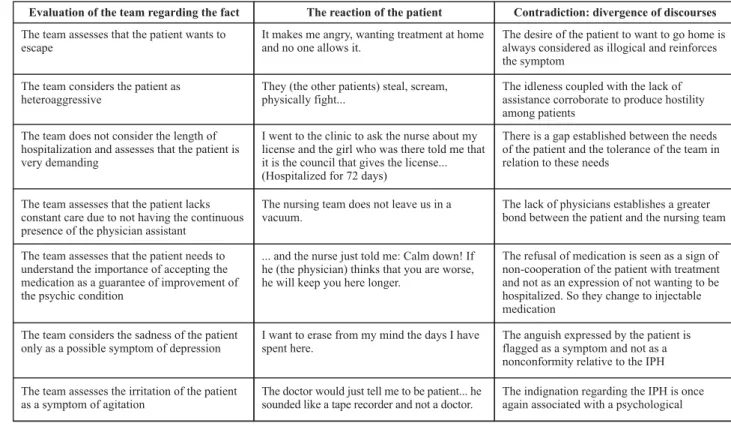
Based on the results of the two stages of data collec-tion it was possible to formulate a discussion on the impli-cations of the IPH in clinical psychiatric nursing, as is pos-sible to observe in the following:
Table 1 - Glossary of the nonexistent fact - Rio de Janeiro - August/2006 to July/2007
Evaluation of the team regarding the fact The reaction of the patient Contradiction: divergence of discourses
The team assesses that the patient wants to escape
It makes me angry, wanting treatment at home and no one allows it.
The desire of the patient to want to go home is always considered as illogical and reinforces the symptom
The team considers the patient as heteroaggressive
They (the other patients) steal, scream, physically fight...
The idleness coupled with the lack of assistance corroborate to produce hostility among patients
The team does not consider the length of hospitalization and assesses that the patient is very demanding
I went to the clinic to ask the nurse about my license and the girl who was there told me that it is the council that gives the license... (Hospitalized for 72 days)
There is a gap established between the needs of the patient and the tolerance of the team in relation to these needs
The team assesses that the patient lacks constant care due to not having the continuous presence of the physician assistant
The nursing team does not leave us in a vacuum.
The lack of physicians establishes a greater bond between the patient and the nursing team
The team assesses that the patient needs to understand the importance of accepting the medication as a guarantee of improvement of the psychic condition
... and the nurse just told me: Calm down! If he (the physician) thinks that you are worse, he will keep you here longer.
The refusal of medication is seen as a sign of non-cooperation of the patient with treatment and not as an expression of not wanting to be hospitalized. So they change to injectable medication
The team considers the sadness of the patient only as a possible symptom of depression
I want to erase from my mind the days I have spent here.
The anguish expressed by the patient is flagged as a symptom and not as a nonconformity relative to the IPH
The team assesses the irritation of the patient as a symptom of agitation
The doctor would just tell me to be patient... he sounded like a tape recorder and not a doctor.
The indignation regarding the IPH is once again associated with a psychological
...Continuation
Evaluation of the team regarding the fact The reaction of the patient Contradiction: divergence of discourses
The team considers some manifestations of the patient as hostile behavior
This made me angry. The impatience of the patient with little
compromise of the physician assistant is flagged as an expressions of hostility
The team generally do not have autonomy to allow access to the courtyard without the consent or prescription of the physician assistant
They (the physicians) do not seem to connect.
They just saybye-byefrom afar.
The daily absence of the physician assistant for an evaluation and possible access to the courtyard unfolds as a burden for the nursing team on duty
The team assesses the expression of despair of the patient as a suicide risk
I was betrayed by my family. Although the patient evidences the cause of
despair, once again this expression is determined as a symptom and a consequent need for vigilance, without a conversation with the patient about why they are suffering.
The team concurs with the prescription of mechanical restraint, considering the risk of that patient to the physical integrity of those close
... I do not care, I have been bound several times and did not die (...) I cannot stand it! The physicians stay a long time without appearing.
There is a constant exercise of the power of the professionals at any sign of lack of patient control over what they consider to be disrespect for their treatment.
A great sedation is justified by the team as being a condition of lethargy
It was much better until they clogged me up with medicine.
There is a frequent lack of care and the dose-effect relationship is not assessed in relation to what is considered necessary for the remission of the symptoms of a psychological condition.
Note: The figure presents the data collected during the Participant Observation and the Focus Groups, making a comparison between them.
DISCUSSION
At this stage of the study the outlining of a discussion was proposed, based on the information contained in the above figure and the analysis of it in the light of the mental health specialists, who were selected for the theoretical framework. It can be said that among the difficulties high-lighted by the team the clinical condition of the patient that presents resistance to the approach stands out, manifested through hostility, agitation, and verbal and/or physical ag-gression, in particular with regard to the nursing team, jus-tifying this difficulty by the fact that the team presents a greater contact with the patient throughout the length of the shift. Trying to overcome these difficulties, it is produc-tive for nurses to be prepared to be exposed to intense feel-ings and emotions inherent in the interpersonal relation-ship, in the nurse-patient context.
Even today, the team remains with the view that the pa-tient is considered severe, which according to the nursing team is the individual who has a risk of escape, suicide or hostile behavior and physical and/or verbal aggression to the ap-proach, and must be monitored constantly to avoid jeopar-dizing the integrity of the other patients and the nursing team, which continually highlights the weakness in their autonomy. The team points out that the patient who has arrived at the institution, misguided by the physician who attends and re-maining in the ward without having their questions answered, will not maintain a therapeutic relationship with nursing staff, that fulfill orders to medicate them without also giving the answers, because there is no multiprofessional interaction nor a discussion of each situation presented.
It seems that nursing still maintains the view of psy-chiatry committed to a reductionist vision of a mental dis-order, of the harshness of a dogmatic vision in relation to it. The effects of such practices have had important impli-cations in the quotidian of the nursing team, such as the issue of ward closures encountered in recent decades, and the role of the nurse as custodian. This is reflected in the care provided by the younger professionals who work in the institution. The opposition to the physicians is ex-pressed, in general, through complaints of uncaring atti-tudes regarding the importance of clinical intercurrences of the patients and in relation to the patients who are ex-periencing hospitalization against their will. There is dis-comfort, on behalf of the nursing team, that such intercur-rence are not evaluated with the necessary seriousness by the physician assistant, who spends little time with the patient and limits their attendance to brief visits in order to update or repeat the prescriptions.
Despite the criticism of the team in relation to their lack of constancy, or even the absence of the physician on the wards during the busiest shifts, the presence of the nurs-ing team with the patient, outside the moments of essen-tial nursing care, is also not evidenced. There are also other issues involving the detachment of the nurse in the care. One of the relevant aspects of this is the fact that the insti-tution where the professional works, often does not offer another possibility for treatment, in which there is provi-sion of shelter, food, medication and clothing, other than custody(18). It can be said, however, that a different trend is
prac-tice determines its role by seeking truly differentiated thera-peutic practices for the control exercised in the hospital sphere, where the idea of ??integrating the individual into the family and into the sociocultural environment is the focus of attention, thus making the new provisions in men-tal healthcare emphasize the dignity of the patient. It is in this sense that nursing is not held to a practice of monitor-ing and physical care to the mental disorder sufferer, but part of a multidisciplinary team therapeutic, which enables the subject to face their difficulties and feel able to live in the community.
The complex action of deconstructing concepts pro-posed by the Brazilian Psychiatric Reform does not occur solely in the community domain. Those most responsible for the mistaken opinion regarding the mental disorder may be the actual health professionals. Their work environment ultimately perpetuates particular perceptions and knowl-edge which produce the social exclusion of this patient. In this context, the model advocated by the Reform aims to look to the subject and their subjectivity, considering the quotidian life of this individual, their family, school, church, clubs and other aspects. Thus, the actions of the nurses will aim for care that contemplates the totality of the sub-jects: considering them people full of feelings and inserted in a social context, with these factors used in support of their treatment. The constant search for dialogue between the nursing team and patient serves to cultivate trust be-tween the parties, through the respect and empathy em-ployed in the care. Regardless of the clinical diagnosis, the patients feel weak in several aspects, therefore the kind of attention they receive in the hospital can contribute to an improvement in their condition, making them perceive that this communication can assist in their improvement.
It is important to highlight that, regardless of the type of institution, or clinical practice, the demands of the insti-tutions, with goals, rules and productivity to be achieved, culminate in the technicism process, currently experienced in the health area, and hinder the establishment of a thera-peutic relationship grounded in empathy, in listening and in respect for the individuality of the patient. This knowl-edge demonstrates the technical expertise of the nurses, however, the political capacity still needs to be found, such as in the area of participation, since nursing needs to seek greater participation in the psychiatric care transformations derived from the Brazilian Psychiatric Reform, with this cri-tique permitting a reflection regarding psychiatric nursing. How to exercise a capacity of criticism (and self-criticism) experiencing a daily fragility and a defense exercise in the practice of care for acute psychiatric patients resistant to hospitalization?
The generally situation is that the psychiatric hospital is a space where the hierarchy and the harshness of the relationships and discipline are independent of the type of psychiatry that is intended to be performed there. This en-vironment, most often prevents the adjustment of the pa-tient. There is space at this juncture for excessive caution,
intense elements of danger that exclude the subject from their characteristic place, for a common path of real or imaginary, danger and fear(18). The fear is related to the
understanding that the mental disorder sufferer may use aggression with everyone and at any time. This vision does not consider that any individual, even when considered normal, reacts aggressively when attacked or when under great tension.
Through fear, the professionals demonstrate an anxiety for their own physical integrity and thus adopt a strategy of punishment as a way of maintaining order in the institutional context. The nursing team is often immersed in a high level of stress and anxiety. It is complex to comprehend how such anxiety can be supported, which, in fact, it cannot be. Addi-tionally, the practice of this team provokes strong feelings and confusion in the nurses: compassion, love, aversion and resentment by the patients because they provoke such an intensity of feelings. The work involves engaging in tasks that are generally unpleasant and produce a mixture of disgust and fear(18). Through these feelings the professionals
dem-onstrate a concern with their own physical integrity and, therefore, often resort to authoritarian and punitive atti-tudes, such as sustaining the space in the hospital context. There is also a deployment of the relationship of these feel-ings, i.e. the relationship between punishment and aggres-sion, according to the perception of the patient or of the professional involved in the care. Thus, there is a coherence of this relationship that varies according to the occasion and psychic conditions of the subjects. They produce, in parallel, collective defense strategies in order to sustain the team, during experiences of anxiety, guilt, and uncertainty. This set of strategies are denominated as a social system of defense that develops over time as the product of an, often uncon-scious, secret or unspoken interaction and a secret agree-ment between members of a group(8).
Other issues exist in the care that are implicated in the detachment of the nurse. One of the relevant aspects is that the institution where the professional is inserted, of-ten does not offer another possibility for treatment, in which there is provision of shelter, food, medication and clothing, other than the custodial form(20). The quotidian
It is possible to affirm that there is a gap between the knowledge of the team regarding the asylum model in lation to the psychosocial model. While the first model re-duces the clinical care to a classification of madness as a disease that must be treated and controlled, the psychoso-cial model proposes the extension of the concept of mad-ness, understanding the person in their subjectivity, inserted in the social context and valued as a citizen with rights and duties in society(20-21). There is a real concern of the team
regarding the difficulty encountered in caring for the pa-tient resistant to the care, and the consequent lack of team knowledge in relation to the issues involved in the IPH, however, they do not discuss how this care should be con-ducted successfully. It is important to comprehend the pa-tient, since each subject responds in a unique way to the disease, therefore, awareness of what causes a person to seek treatment is needed. Only from this comprehension, is it possible that the team reflect and put into practice good nursing care(9).
CONCLUSION
The practice of psychiatric nursing is arduous, consid-ering the quotidian experience with a mental disorder. This harshness simultaneously provokes the mental and physi-cal suffering in the team. Psychiatric nursing care, particu-larly in a hospitalization unit, faced with the difficulties in-herent in the area, requires a high level of improvisation from these professionals, aggravated and revealed by the lack of adequate conditions in the quotidian work. In
con-trast, this aspect allows an exercise of creativity, reflected in the stimulation of the capacity of each one.
The study group, despite the fact of being without com-prehension about “what and how to perform”, care for the involuntarily hospitalized mental disorder patient, even through a practice of invisible care about a non-existent fact The fragility frequently mentioned by the nurses was the fact that this evaluated team did not have any autonomy for deci-sion-making, affirming that they do not have good conditions to perform skilled work having to be acting in accordance with the decisions of the physician professional, revealing the eter-nal victimization of the nursing team and the outsourcing of responsibility for the facts. However, although there was con-stant criticism of the nursing team in relation to the low fre-quency, or even the absence of the physician on the wards, the presence of nursing staff with the patient was also not observed, except in moments of essential care. In most cases, the nurses in particular, were observed to remain in the nurs-ing post dealnurs-ing with the paperwork or talknurs-ing to each other, avoiding working as a psychiatric nurse, with the time for lis-tening, the readiness to care or even being close to the pa-tient. However, this team, full of contradictions, made it evi-dent to the researcher that the nurses see the patient as the protagonist in their quotidian practice and do care for this mentally disordered person, although they do so, most often, instinctively. In conclusion, it was possible to affirm that nurs-ing still holds a superficial knowledge regardnurs-ing the constructs of the Brazilian Psychiatric Reform, the Reform Law and the implications of the IPH for clinical psychiatric nursing, which remains a non-existent fact, for which the care is still invisible.
REFERENCES
1. Delumeau J. O medo no ocidente: 1300-1800, uma cidade siti-ada. São Paulo: Companhia das Letras; 1989.
2. Silva Filho JF, Leibing AG. A psiquiatria, sua história e seu futu-ro no Brasil. In: Albuquerque P, Libério M. Práticas ampliadas em saúde mental: desafios e construções do cotidiano. Rio de Janeiro: IPUB/UFRJ; 1999. p. 13.
3. Brasil. Ministério da Saúde. Relatório Final da III Conferência Nacional de Saúde Mental. Brasília; 2001.
4. Szasz TS. Ideologia e doença mental: ensaios sobre a desuma-nização psiquiátrica do homem. Rio de Janeiro: Zahar; 1977.
5. Castel R. A ordem psiquiátrica: a idade de ouro do alienismo. Rio de Janeiro: Graal; 1978.
6. Oliveira AGB, Alessi NP. O trabalho de enfermagem em saúde mental: contradições e potencialidades atuais. Rev Lat Am Enferm. 2003;11(3):333-40.
7. Basaglia F. A psiquiatria alternativa. São Paulo: Brasil Debates; 1979.
8. Bressan VR, Scatena MCM. O cuidar do portador de transtorno mental crônico na perspectiva do enfermeiro: um enfoque fe-nomenológico. Rev Lat Am Enferm. 2002;10(5):682-9.
9. Cardoso TVM, Oliveira RMP, Loyola CMD. Entendendo a teoria de Peplau e a Reforma Psiquiátrica Brasileira. Esc Anna Nery Rev Enferm. 2006;10(4):718-24.
10. Miranda CML. Algumas questões sobre assistência de enfer-magem psiquiátrica de qualidade. Por uma assistência psi-quiátrica em transformação. Cadernos IPUB. 1999;(3):95-101
11. Miranda CM, Rocha RM, Sobral VRS. O ensino, a pesquisa e a assistência de enfermagem psiquiátrica. Rev Enferm UERJ. 1999;7(2):193-7.
13. Spadini LS, Mello e Souza MCB. A doença mental sob o olhar de pacientes e familiares. Rev Esc Enferm USP. 2006;40(1):123-7.
14. Minayo MCS. Pesquisa social: teoria, método e criatividade. Petrópolis: Vozes; 2002.
15. Becker HS. Métodos de pesquisa em ciências sociais. 4ª ed. São Paulo: Hucitec; 1999.
16. Cicourel A. Teoria e método em pesquisa de campo. In: Gui-marães AZ. Desvendando máscaras sociais. Rio de Janeiro: Francisco Alves; 1975. p. 85-124.
17. Debus M. Manual para excelência em la investigacion medi-ante Grupos Focales. Washington: Academy for Educational Development; 1997.
18. Loyola C, Figueiredo ACV. Cuidando de quem cuida: uma ex-periência de supervisão em enfermagem. Cadernos IPUB. 2000;6(19):37-53.
19. Costa-Rosa A. O modo psicossocial: um paradigma das práti-cas substitutivas ao modo asilar. In: Amarante P, organizador. Ensaios: subjetividade, saúde mental, sociedade. Rio Janei-ro: FIOCRUZ; 2000. p. 141-68.
20. Olschowsky A. O ensino de enfermagem psiquiátrica e saúde mental: análise da pós-graduação “Latu Sensu” [tese douto-rado]. Ribeirão Preto: Escola de Enfermagem de Ribeirão Pre-to, Universidade de São Paulo; 2001.