Assessment of the work conditions in
hospitals of Natal, Rio Grande do
Norte State, Brazil
*AVALIAÇÃO DAS CONDIÇÕES DE TRABALHO EM HOSPITAIS DE NATAL, RIO GRANDE DO NORTE, BRASIL
EVALUACIÓN DE LAS CONDICIONES DE TRABAJO EN HOSPITALES DE NATAL, RIO GRANDE DO NORTE, BRASIL
* Extracted from the thesis "As Repercussões dos Serviços Hospitalares em Diferentes Contextos: uma análise dos profissionais de saúde e usuários". Graduate Program in Health Sciences, Federal University of Rio Grande do Norte, 2006-2008. 1 Psychologist. Master's student in Graduate Program in Health
Sciences, Federal University of Rio Grande do Norte. Faculty at Vale do Acaraú State University. Natal, RN, Brazil. [email protected] 2 Psychologist. PhD.
in Development Psychology. Adjunct Professor at Psychology Department, Federal University of Rio Grande do Norte. Natal, RN, Brazil. [email protected]
3 Psychologist, PhD. in Clinical Psychology. Adjunct Professor at Psychology Department, Federal University of Rio Grande do Norte. Natal, RN, Brazil.
O
RIGINAL
A
R
TICLE
Joel Lima Júnior1, João Carlos Alchieri2, Eulália Maria Chaves Maia3
RESUMO
Buscou-se identificar como os profissionais de saúde avaliam as condições de trabalho em hospitais de diferentes naturezas, e ve-rificar como estas condições interferem na satisfação laboral. A amostra foi composta por 213 profissionais de diferentes catego-rias. A análise dos resultados evidenciou um perfil distinto entre os hospitais no tocan-te as condições de trabalho. De forma ge-ral, apontou as menores médias no hospi-tal estadual, enquanto as maiores foram observadas no hospital filantrópico; resul-tado que corrobora o atual cenário da saú-de pública do País. Ressalta-se ainda, uma associação significativa entre satisfação no trabalho e as variáveis renda familiar e hos-pital em que o profissional atua. Acredita-se que os conflitos nesAcredita-se cenário são inevi-táveis, frente à precária estrutura de algu-mas instituições públicas, contudo, são pre-visíveis e passíveis de solução se o hospital dispuser de um canal de expressão livre e acessível a todos os agentes.
DESCRITORES
Condições de trabalho. Satisfação no emprego. Recursos humanos em hospital. Saúde do trabalhador.
ABSTRACT
This study identified how health profession-als assess work conditions in different hos-pitals and verified how these conditions affect labor satisfaction. The sample was composed of 213 professionals from sev-eral healthcare fields. The analysis of the results indicated a distinct profile among the hospitals when it comes to work condi-tions. In a general perspective, the study observed low labor quality averages in State-run hospitals, while the highest ones were observed in the philanthropic hospi-tal. This result corroborates the current con-dition of Brazilian public health. It also sig-nificantly associates labor satisfaction with the variables of family income and work-place. Therefore, conflicts in this scenario are considered as inevitable due to the pre-carious structure of some public health in-stitutions; however, these problems can be foreseen and solved if hospitals create a free, accessible expression channel to all agents.
KEY WORDS
Working conditions. Job satisfaction. Personnel, hospital. Occupational health.
RESUMEN
Se buscó identificar como los profesionales de la salud evalúan las condiciones de tra-bajo en hospitales de diferentes naturalezas y verificar como estas condiciones interfie-ren en la satisfacción laboral. La muestra es-tuvo compuesta por 213 profesionales de diferentes categorías. El análisis de los resul-tados evidenció un perfil distinto entre los hospitales en lo que se refiere a las condi-ciones de trabajo. De forma general, apuntó los menores promedios en el hospital esta-tal, en cuanto las mayores fueron observa-das en el hospital filantrópico; resultado que corrobora el actual escenario de la salud pública del país. También, se resalta una aso-ciación significativa entre la satisfacción en el trabajo y las variables renta familiar y hos-pital en que el profesional actúa. Se piensa que los conflictos en ese escenario son in-evitables, frente a la precaria estructura de algunas instituciones públicas, sin embargo, son previsibles y pasibles de solución si el hospital dispusiese de un canal de expresión libre y accesible a todos los agentes.
DESCRIPTORES
INTRODUCTION
Nowadays, evaluative actions in health care are re-garded as permanently needed, since this is the only way to foresee new paths that should be taken. It must also encompass all individuals involved with the production, provision and consumption of services in this area(1). There-fore, it was possible to turn the spotlight towards the needs and interests of health professionals whose well-being has been long neglected.
Working conditions in the workplace have been consid-ered inadequate because of particularities in the working en-vironment, as well as because of the unsound activities that must be performed(2). The lack of qualified personnel, low salaries, insufficient workforce, higher exposure to health-threatening risks and a multitude of different working shifts generate difficulties for health system management, which has a negative effect on service quality, thus compromising the satisfaction of the professionals involved (3-4).
Satisfaction in the workplace is a theme of intricate com-plexity and difficult definition. After analyzing innumerous possible definitions and conceptions found within the cur-rent scientific literature, it was chosen to define it in this present study, as a result of the evaluation which the indi-vidual has about his or her job or about the personal fulfill-ment that is achieved through this activity, resulting in the person’s well-being(5). Such a personal and subjective state can vary from person to person, depends on the circum-stances involved, and changes through life. Furthermore, it is subject to internal and external forces to the workplace(6).
One study(7) has showed that some aspects of profes-sional identity are altered under different hospital environ-mental contexts, which will ultimately be reflected as pro-fessional conduct variations when dealing with the health system user. Therefore, the relationship that is established in the hospital scenario is circumscribed to an institution-alized context, since the latter composes the rules, norms and conventions which orient a great deal of supportive practices, determining limits and possibilities for health group actions.
For that reason, anyone who attempts to describe the hospital as an institution whose sole purpose is treating the body will make a huge mistake. Despite the emphasis
on curative processes, these institutions maintain their con-dition as a social product for intersubjective exchange(8).
Health institutions in Brazil work with high complexity levels, which generates even more demanding solutions for the health teams. Professionals also are at the risk of de-veloping physical and mental pathologies due to the poor working conditions. These two factors, in addition to the
labor satisfaction theme being useful to analyze the
per-formance and productivity at work and develop more ef-fective strategies for workforce health promotion, encour-aged the development of the present study, which could identify how health professionals evaluate working condi-tions in the hospitals they work and verify how these work-ing conditions interfere with their satisfaction.
METHOD
This is a descriptive study carried out in four hospitals in the city of Natal, capital of Rio Grande do Norte state, in the Northeast region of Brazil, between September 2006 and December 2007. The initial selection criterion for the hospitals was their institutional type: state, philanthropic, university and private. The other criterion was the accessi-bility for the research team.
The chosen hospitals were of small and large scale and, together, offer in the State of Rio Grande do Norte, ser-vices of low, medium and high complexity. It was observed that during the data collection period, the chosen private hospital was experiencing financial difficulties and the pe-diatrics and maternity wards, as well as a large number of beds from other wards had been deactivated.
A total 213 individuals were pooled together in this study, pertaining to the following professions: Nursing Aux-iliaries/Technicians (n=115), Nurses (n=31), Physicians (n=47); Social Workers and Psychologists were grouped under Others (n=20). Table 1 presents health professionals according to their professional category and type of hospi-tal. Choosing these professionals took in consideration the direct contact they have with hospital end-users, thus fa-voring the evaluation of the variables used in this study. The study sample was defined through stratified propor-tional method with a confidence interval of 95%. The sample loss was of 24 individuals.
Table 1 - Health care professionals according to professional category and type of hospital - Natal - 2007
Type of Hospital Professional Category
Nursing Auxiliaries/Technicians Nurses
Physicians Others
Total
State
65 18 29 13
125
Philanthropic
20 05 11 03
39
Private
23 05 02 02
32
University-Based
07 03 05 02
All professionals that participated in the survey were not identified in the questionnaires, which allowed them to be kept completely anonymous. This study was con-ducted in compliance with Resolution 196/1996 of the Na-tional Health Committee. Data collection started after au-thorization from the Research Ethics Committee at Federal University of Rio Grande do Norte (protocol 052/06). Par-ticipants were approached at their workplace. The respon-sible researcher and/or Psychology undergraduates in-formed them about the study and clarified any doubts they had. After providing written consent, the participants re-ceived the questionnaires.
Collection Instrument
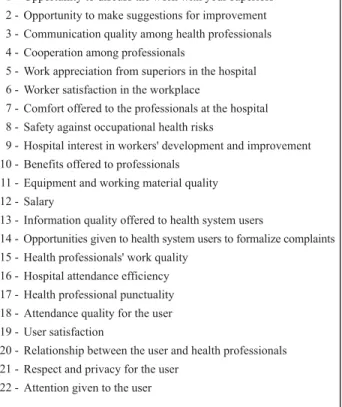
Data collection was performed using a semi-structured, self-administered questionnaire that had been previously tested in a pilot program. In the present study, only the two first parts of the questionnaire were used: Part 01 – Sociodemographic and Professional Background Character-istics; Part 02 – Made up of 22 items (Chart 1) referring to Health Service Quality Indexes(9). It must be noted that, for this study, only the Indexes from 1 to 12 were used, which directly evaluate health professionals’ working conditions.
Chart 1 - Health quality service indexes - Natal - 2007
Opportunity to discuss the work with your superiors Opportunity to make suggestions for improvement Communication quality among health professionals Cooperation among professionals
Work appreciation from superiors in the hospital Worker satisfaction in the workplace
Comfort offered to the professionals at the hospital Safety against occupational health risks
Hospital interest in workers' development and improvement Benefits offered to professionals
Equipment and working material quality Salary
Information quality offered to health system users
Opportunities given to health system users to formalize complaints Health professionals' work quality
Hospital attendance efficiency Health professional punctuality Attendance quality for the user User satisfaction
Relationship between the user and health professionals Respect and privacy for the user
Attention given to the user 1
2 -3 4 5 6 7 8 9 10 11 12 13 14 15 16 17 18 19 20 21 22
-Data from the second part of the questionnaire were organized as follows: in one column, health service quality indexes were presented and in the four next columns the
type of the investigated hospitals was presented (State, Philanthropic, Private and University). The participants were asked to score each index from zero to five (higher values indicated better evaluation of the indicator) only consider-ing the type of the institution where they worked.
Collection Procedures
The questionnaires were administered individually and/ or collectively. The participants were selected from the morning, afternoon and night shifts by convenience in the referred institutions. Data collection was also assisted by Psychology graduates from Federal University of Rio Grande do Norte properly trained by the researcher in charge.
It is imperative to note that data collection in the State hospital was hampered for approximately a month due to health professionals being on strike.
Data Analysis
The collected data was stored in a databank and ana-lyzed using Statistic 6.0. At first, analysis of variance was used to verify if there were any statistical differences between the hospitals in terms of scores attributed to worker satisfaction in the workplace. In order to verify the relationship between hospital type and worker satisfaction, Tukey Test was used. Multiple Linear Regression Analysis was used to identify which variable influenced the referred satisfaction. Finally, Chi-Square Test was performed to verify the possibility of association between the categorical variables.
RESULTS
The socioeconomic profile showed that most health care professionals were women (72.77%), with age between 31 and 40 years (36.15%), and most have secondary educa-tion (54.46%). Among these professionals, 54.46% are nurs-ing auxiliaries/technicians and have a total family income of 1 to 5 Brazilian minimum salaries, 52.11% work more than 40 hours a week and 32.86% have been in this area for 11 to 20 years.
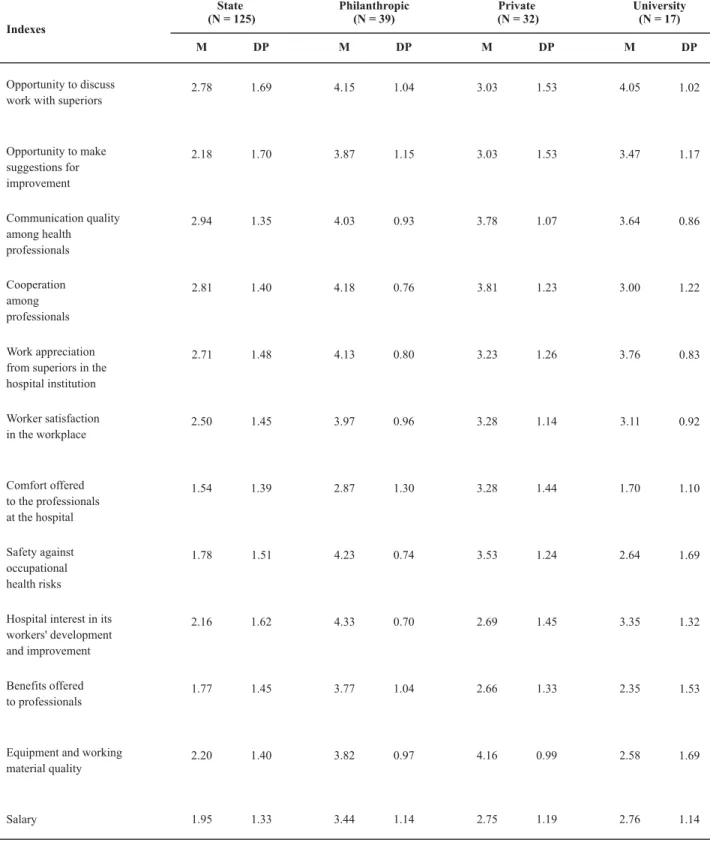
Table 2 - Mean Values (M) and Standard Deviation (SD) for the scores attributed by health care professionals considering the institution where they work - Natal - 2007
Indexes
State (N = 125)
Philanthropic (N = 39)
Private (N = 32)
University (N = 17)
M DP M DP M DP M DP
Opportunity to discuss work with superiors
2.78 1.69 4.15 1.04 3.03 1.53 4.05 1.02
Opportunity to make suggestions for improvement
2.18 1.70 3.87 1.15 3.03 1.53 3.47 1.17
Communication quality among health professionals
2.94 1.35 4.03 0.93 3.78 1.07 3.64 0.86
Cooperation among professionals
2.81 1.40 4.18 0.76 3.81 1.23 3.00 1.22
Work appreciation from superiors in the hospital institution
2.71 1.48 4.13 0.80 3.23 1.26 3.76 0.83
Worker satisfaction in the workplace
2.50 1.45 3.97 0.96 3.28 1.14 3.11 0.92
Comfort offered to the professionals at the hospital
1.54 1.39 2.87 1.30 3.28 1.44 1.70 1.10
Safety against occupational health risks
1.78 1.51 4.23 0.74 3.53 1.24 2.64 1.69
Hospital interest in its workers' development and improvement
2.16 1.62 4.33 0.70 2.69 1.45 3.35 1.32
Benefits offered to professionals
1.77 1.45 3.77 1.04 2.66 1.33 2.35 1.53
Equipment and working material quality
2.20 1.40 3.82 0.97 4.16 0.99 2.58 1.69
Salary 1.95 1.33 3.44 1.14 2.75 1.19 2.76 1.14
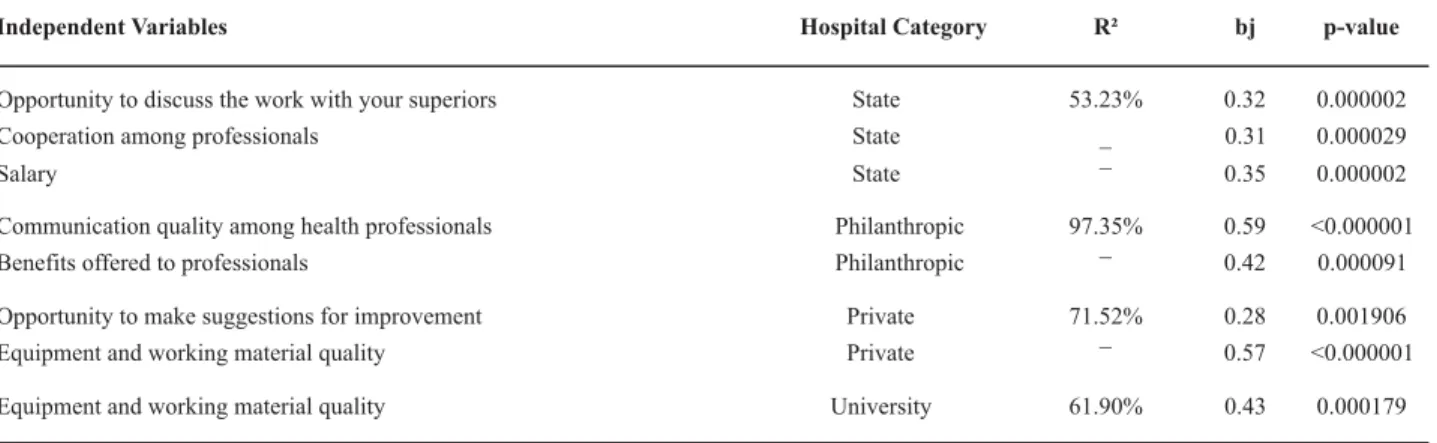
In the Multiple Linear Regression analysis, the item
Worker satisfaction in the workplace was considered as
a dependent variable. Table 3 shows the variables that
Table 3 - Variables that influenced the dependent variable Worker satisfaction in the workplace according to Stepwise Multiple Linear Regression, according to type of hospital - Natal - 2007
Independent Variables Hospital Category R² bj p-value
Opportunity to discuss the work with your superiors State 53.23% 0.32 0.000002
Cooperation among professionals State _ 0.31 0.000029
Salary State _ 0.35 0.000002
Communication quality among health professionals Philanthropic 97.35% 0.59 <0.000001
Benefits offered to professionals Philanthropic _ 0.42 0.000091
Opportunity to make suggestions for improvement Private 71.52% 0.28 0.001906
Equipment and working material quality Private _ 0.57 <0.000001
Equipment and working material quality University 61.90% 0.43 0.000179
Table 4 shows that only the variables Family Income (p=0.00676) and Type of Hospital (p=0.00000) are associ-ated with the dependent variable.
Table 4 - Chi-Square Test between the dependent variable Worker
satisfaction in the workplace and the categorical variables with a
significance level of 5% - Natal - 2007
Categorical Variables p-value
Gender 0.26563
Level of Education 0.05568
Profession 0.16895
Family Income 0.00676*
Type of Hospital 0.00000*
* Significative association with the dependent variable
DISCUSSION
According to the results, most participants were women and work as nursing auxiliaries/technicians, a situation that was also observed in a previous study(10). It has been ob-served that most health care professionals are women. Such professions include nursing, nutrition, psychology and so-cial work. One possible reason for this fact is the existence of stereotypes about these particular areas. Professions that deal with taking care, helping and comforting, imply, ac-cording to stereotypes, a condition of femininity. As for the medicine area, in 2004, 69.8% of Brazilian physicians were men. However specific medical areas where caring is more pronounced, such as pediatrics and gynecology, most prac-titioners were women(11).
The aforementioned data lead to another gender issue: the twofold work journey faced by women. In addition to being a health professional, many also play family roles as wives, mothers and/or housewives. These situations can overburden her work load, which can also significantly com-promise her professional performance, since this increase in activities, added to the overwhelming hospital routine,
could cause several mental and psychological pathologies, including stress, depression, burnout, and cumulative trauma disorders.
As for work conditions, the four investigated hospitals pre-sented distinct profiles. According to table 2, it could be noted that the highest scores were attributed to the philanthropic hospital, followed by the private and university hospitals. The lowest scores were associated to the state hospital, making it evident that such health institution faces innumerous deficien-cies, mainly concerning: comfort offered to health profession-als, safety against health risks, benefits offered to hospital pro-fessionals, equipment and material quality and salary.
Although hospital humanization is a broadly discussed topic, with several studies(9,12) addressing this issue with the purpose to contribute to improving the working conditions of hospital personnel, it is observed there is great disrespect with hospital professionals and poor work conditions at state hos-pitals. It should be emphasized that strikes and movements for better salaries and work infra-structure are frequent in these institutions, which causes further loss to service quality.
The present study results corroborate with our health care system’s current panorama in Brazil, which is suffering from a lack of resources, and this situation gets worse as the country’s problems increase(13). As resources run thinner and thinner, social differences arise and so does the need for care services, which will ultimately pose a serious challenge in terms of qual-ity health care, since the professionals in this area will find themselves surrounded by an environment that is diametri-cally opposed to what one may call an ideal scenario(14).
A completely different situation was observed in the philanthropic hospital. Such fact may be associated, mainly, to a quality program developed by the hospital trying not only to improve attendance quality for the patients, but also to implement a system for the workers and profession-als to speak their minds and be heard.
rea-sonably good when compared to those given to the public institution. It is believed that such result might have been influenced by the feeling of work instability and the fear of losing their position.
When it comes to the item Worker satisfaction in the
work-place (a dependent variable in the present study), a similar
situation is observed in relation to the given scores: the phil-anthropic hospital had the highest score, the private hospital came in second, followed by the university hospital, all the state hospital came in last. Apparently, most professionals who are unsatisfied with their work are currently in the state hos-pital. Once again, this gives evidence of the precarious condi-tions of many state hospitals in Brazil. When faced by strenu-ous financial conditions, it is observed in these institutions, mainly public hospitals, that workers are submitted to long and exhausting work shifts, high exposition to chemical and physical risk-factors, lack of proper professional knowledge, among many other stressful occupational agents inherent to the job. This eventually affects their satisfaction towards word and will later compromise service quality(15). A study performed in 2005(16) obtained a similar result, showing that profession-als from a public hospital presented a lower level of satisfac-tion compared to workers of a private hospital.
The variables that most significantly influenced the item
Worker satisfaction in the workplace were as follows: in the
public hospital, with 53.23% of variability: Opportunity to discuss the work with your superiors, Cooperation among professionals and Salaries; in the philanthropic hospital, with 97.35% of variability: Communication quality among health professionals, Benefits offered to professionals; in the pri-vate hospital, with 71.52% of variability: Opportunity to make suggestions for improvement, Equipment and working ma-terial quality; finally, in the university hospital, with 61.90% of variability: Equipment and working material quality.
Even though socioeconomic data had no significant ef-fect on the Multiple Linear Regression, when concerning the dependent variable, it was verified in the Chi-Square test (Table 4) that there was a significative association of this particular variable with Family Income and with the Type of Hospital. An opposite situation was found in a pre-vious study(12), which found a significant association among the variables Age, Level of Education and Employment Sta-tus (Public or Private), thus verifying an increase in satis-faction with age and a decrease with education.
The present study results show there are very distinct situations among different hospitals. Such situations range from material needs to human needs, which are here
repre-sented by the substandard communication quality within the institution. It is, therefore, concluded that the subjects of this quality-lacking environment behave themselves accord-ing to the particular environment that surrounds them. This shows the existence of an organizational culture which needs to be carefully considered for a proper understanding of the results, because, this situation, besides possessing a political aspect, as it expresses symbolic elements capable of assign-ing order and meanassign-ing, also acts as an element of communi-cation and consensus as well as concealing the relationships of domination within these institutions(17).
Another element to be considered is the fact that the present study gives evidence of the situation in hospitals located in Rio Grande do Norte, in the Northeast region of Brazil; a state permeated by innumerous social hardships(18) which have a significant effect on public health organiza-tion management.
FINAL CONSIDERATIONS
The present study has a few limitations. First, the de-scriptive analysis only permitted to study associations be-tween variables, with no possibility of establishing causal-ity. Another point to be noted is the reduced potential of generalization, because for such purpose a larger study group would be necessary. It must also be taken into ac-count that unique differences between individuals, as well as the particular organizational situation of each health in-stitution, although not evaluated in this study, are compo-nents that may affect the study.
Based on the data presented and discussed, as well as previous studies on the same topic, there is an urgent need for further studies, since precarious working conditions may lead to major work dissatisfaction, which, in turn, can cause intense somatic suffering and many other diseases triggered by mental distress.
Because of the growing level of complexity demanded by health services, it is clear that conflicts are inevitable, because, besides being subjected to low salaries, poor working condi-tions and excessive demand, this professional activity is, by itself, highly anxiogenic, due to the constant contact of these professionals with pain and suffering. This produces a signifi-cant level of psychic distress and consequent professional dis-satisfaction. However, these conflicts are predictable and solv-able when the hospital allows its workers to voice their con-cerns and preoccupations through an impartial and effective means that ought to be accessible to everyone.
REFERENCES
1. Dimenstein M, Santos YF. Compromisso com o SUS entre as profissões de saúde na rede básica de Natal. In: Borges LO, organizadora. Os profissionais de saúde e seu trabalho. São
3. Cordeiro H. Descentralização, universalidade e equidade nas reformas de saúde. Ciênc Saúde Coletiva. 2001;6(2):319-28. 4. Azambuja EP, Kerber NPC, Kirchhol AL. A saúde do trabalhador
na concepção de acadêmicos de enfermagem. Rev Esc Enferm USP. 2007;41(3):355-62.
5. Marqueze EC, Moreno CRC. Satisfação no trabalho: uma breve revisão. Rev Bras Saúde Ocup. 2005;30(112):69-79.
6. Martinez MC, Paraguay AIBB, Latorre RDO. Relação entre sa-tisfação com aspectos psicossociais e saúde dos trabalhado-res. Rev Saúde Pública. 2004;38(1):55-61.
7. Maldonado MT. Maternidade e paternidade: a assistência no consultório e no hospital. Petrópolis: Vozes; 1990. v. 1. 8. Campos RO. Reflexões sobre o conceito de humanização em
saúde. Saúde Debate. 2003;27 (64):123-30.
9. Brasil. Ministério da Saúde. Programa Nacional de Humaniza-ção da Assistência Hospitalar: projeto piloto. Brasília; 2001. 10. Moyle W, Skinner J, Rowe G, Gork C. Views of job satisfaction
and dissatisfaction in Australian long-term care. J Clin Nurs. 2003;12(2):168-76.
11. Carneiro MB, Gouveia VV, organizadores. O médico e seu tra-balho: aspectos metodológicos e resultados do Brasil. Brasília: Conselho Federal de Medicina; 2004.
12. Backes DS, Filho WDL, Lunardi VL. O processo de humaniza-ção do ambiente hospitalar centrado no trabalhador. Rev Esc Enferm USP. 2006;40(2):221-7.
13. Rebouças D, Legay LF, Abelha L. Satisfação com o trabalho e impacto causado nos profissionais de serviços de saúde men-tal. Rev Saúde Pública. 2007;41(2):244-50.
14. Borges LO, Tamayo A, Alves Filho A. Significado do trabalho entre os profissionais de saúde. In: Borges LO, organizadora. Os profissionais de saúde e seu trabalho. São Paulo: Casa do Psicólogo; 2005. p. 143-97.
15. Rosa C, Carlotto MS. Síndrome de Burnout e satisfação no trabalho em profissionais de uma instituição hospitalar. Rev SBPH. 2005;8(2):1-15.
16. Mrayyan MT. Nurse job satisfaction and retention: comparing public to private hospitals in Jordan. J Nurs Manag. 2005;13 (1):40-50.
17. Machado VB, Kurcgant P. O processo de formação de cultura organizacional em um hospital filantrópico. Rev Esc Enferm USP. 2004;38(3):208-7.
18. Rio Grande do Norte. Secretaria de Estado do Planejamento e das Finanças. Instituto do Desenvolvimento Econômico e do Meio Ambiente. Perfil do Estado do Rio Grande do Norte. Natal; 2002.
Acknowledgements